


|
Old Testament
New Testament
Gospels
Acts
Paul's Letters
General Letters
Revelation
Topical Studies
Beginning the Journey (for new Christians). en Español

|
Old Testament
New Testament
Gospels
Acts
Paul's Letters
General Letters
Revelation
Topical Studies

|
Home
Bible Studies
Articles
Books
Podcasts
Search
Menu
Donate
About Us
Contact Us
FAQ
Sitemap


5. Advice about Widows, Elders, and Slaves (1 Timothy 5:1-25; 6:1-2)
by Dr. Ralph F. WilsonAudio (24:59)|
Free
E-mail Bible Study
 The Discipleship Process
Home |
Bible Studies |
Articles |
Books |
Podcasts |
Search |
Menu |
Donate |
About Us |
FAQ |
Contact Us
The Discipleship Process
Home |
Bible Studies |
Articles |
Books |
Podcasts |
Search |
Menu |
Donate |
About Us |
FAQ |
Contact Us
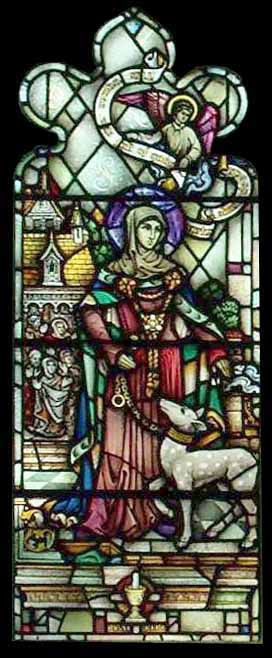
 Tabitha or Dorcas was a disciple in Joppa "who was always doing good and helping the poor" (Acts 9:36). She is the kind of widow Paul wants others to emulate. 'Tabitha' stained glass window, St. John's, Ainsdale, UK (1949). Larger image. |
Thus far Paul has shared with Timothy the dangers of the false teaching, pointed to areas that need correction, given guidelines for leader selection, and pointed to godliness as the goal. In this section he instructs Timothy in how to relate to various types of people in the church:
- Old men, young men,
- Old women, young women,
- Older widows, younger widows,
- Sound elders, sinning elders, and
- Slaves.
Though the culture may be thousands of years removed from our own, the principles endure.
5.1 Ministering to a Variety of Ages and Genders (1 Timothy 5:1-2)
"1 Do not rebuke an older man harshly, but exhort him as if he were your father. Treat younger men as brothers, 2 older women as mothers, and younger women as sisters, with absolute purity." (1 Timothy 5:1-2)
In his relative youth and inexperience, Timothy is likely to get this wrong. With false teachers who are elders, Timothy must learn how to nuance his speech. He must not remain silent, nor must he be too harsh. It would be inappropriate for a younger man to rebuke an older one. Here we find the first of three words for "rebuke" in the Pastoral Epistles,231 translated here "rebuke" (NIV, KJV), "speak harshly" (NRSV).232
Rather, Timothy is to treat him as he would his father, "to urge strongly, appeal to, urge, exhort, encourage," perhaps even "treat in an inviting or congenial manner."233 Younger men he can relate to more directly.
Some of the women in the church have been caught up in the false teaching. He must deal with the older women as he would his mother, with the younger women as his sisters. But Paul cautions Timothy to let his relationships with the younger women be "with absolute purity."234 Paul knows the temptations that pastors sometimes face, and cautions his protégé against them.
5.2 Dealing with Widows (1 Timothy 5:3-16)
Church Responsibility to Widows (1 Timothy 5:3-16)
Now Paul comes to a problem caused by the compassion and sense of family created by the Christian faith -- helping widows and orphans. How do you sort out who to help and who not to? Being "on the dole" can be a powerful incentive to indolence if not carefully thought through.
"3 Give proper recognition to those widows who are really in need. 4 But if a widow has children or grandchildren, these should learn first of all to put their religion into practice by caring for their own family and so repaying their parents and grandparents, for this is pleasing to God. 5 The widow who is really in need and left all alone puts her hope in God and continues night and day to pray and to ask God for help. 6 But the widow who lives for pleasure is dead even while she lives. 7 Give the people these instructions,235 too, so that no one may be open to blame. If anyone does not provide for his relatives, and especially for his immediate family, he has denied the faith and is worse than an unbeliever." (1 Timothy 5:3-8)
The first difficulty is for the church to show the right attitude. Rather than with resentment, godly widows should be accorded honor and high regard. The word for "honor" carries the idea of financial honor in 5:17 and may have that idea here as well.236 Paul distinguishes between three groups of widows:
- Godly widows who are older and have no family to support them: "really in need and left all alone" (5:5).
- Widows who have family who should be supporting them: "children or grandchildren" (5:4).
- Younger widows who should remarry rather than depend upon the church for support (5:6, 11-15).
Now Paul gives some practical guidelines to help Timothy (and the church, which is also reading this letter) to decide which widows they should be helping.
"9 No widow may be put on the list of widows unless she is over sixty, has been faithful to her husband, 10 and is well known for her good deeds, such as bringing up children, showing hospitality, washing the feet of the saints, helping those in trouble and devoting herself to all kinds of good deeds." (1 Timothy 5:9-10)
These older widows who have no other family to help them, are beyond marriageable age, and who have lived a life of faith and good works are suitable recipients of the church's support.
Problems with Younger Widows (1 Timothy 5:11-15)
You can tell by Paul's tone, however, that the church has been troubled by younger widows, some of whom are idle, gossipy, "living for pleasure," 237 sensual,238 and perhaps "on the make." As single women they may be viewed as a threat to the stability of the other families in the Christian community, for he comments: "the widow who lives for pleasure is dead even while she lives" (1 Timothy 5:6).
"11 As for younger widows, do not [put them on such a list.] For when their sensual desires overcome their dedication to Christ, they want to marry. 12 Thus they bring judgment on themselves, because they have broken239 their first pledge. 13 Besides, they get into the habit of being idle240 and going about from house to house. And not only do they become idlers, but also gossips241 and busybodies,242 saying things they ought not to. 14 So I counsel younger widows to marry, to have children, to manage their homes and to give the enemy no opportunity for slander.243 15 Some have in fact already turned away to follow Satan." (1 Timothy 5:11-15)
Perhaps Paul is thinking of women who have fallen prey to the false teachers, the women he describes in 2 Timothy as, "silly women, overwhelmed by their sins and swayed by all kinds of desires" (2 Timothy 3:6).
Since Paul uses terms such as "put on a list" (NIV, NRSV) or "taken into the number" (KJV), some have thought that there may be some kind of enrollment244 into an order of widows in the early church. Others see the idea of "pledge" (NIV, NRSV), "faith" (KJV) in verse 12 as the indication of this, since the word pistis ("faith") can carry the meaning, "a solemn promise to be faithful and loyal, assurance, oath, troth."245 However, an order of widows draws more on second century sources than anything we see in the apostolic church.
Paul had instructed the Corinthian church that remarriage was quite acceptable, but "only in the Lord" (1 Corinthians 7:39). Paul seems to have had experience in Ephesus with younger Christian widows who end up marrying unbelievers, rather than Christian husbands (which may have been in short supply), and then turn away from the faith. So he says here, "Some have in fact already turned away to follow Satan" (5:15). In this way they deny their "first pledge" (5:12), not to remain unmarried, but to be faithful disciples of Christ.
Responsibility to Help Widowed Family Members (1 Timothy 5:4, 8, 16)
Paul makes it absolutely clear that believers are expected to provide for aged family members.
"But if a widow has children or grandchildren, these should learn first of all to put their religion into practice246 by caring for their own family and so repaying their parents and grandparents, for this is pleasing to God." (1 Timothy 5:4)
"If anyone does not provide for his relatives, and especially for his immediate family, he has denied247 the faith and is worse than an unbeliever." (1 Timothy 5:8)
"If any woman who is a believer has widows in her family, she should help them and not let the church be burdened with them, so that the church can help those widows who are really in need." (1 Timothy 5:16)
Obviously, there is a problem with this in Ephesus, perhaps as a result of the false teachers. We' re not sure. So Paul speaks in the strongest possible terms. Since the fifth commandment is to "honor your father and your mother" (Exodus 20:12), to fail to do so is to deny the very faith you claim to believe. Even unbelievers care for their aged relatives, Paul argues. Not to take on this responsibility makes one worse than an "unbeliever" (NIV, NRSV) or "infidel" (KJV). Caring for one's parents and grandparents is God's way of "repaying" (NIV) or "requiting" (KJV)248 what they did for us.
Q1. (1 Timothy 5:1-16) What responsibilities do we have
to help aging family members? According to Paul, in what way is this our
Christian responsibility? In what way is this a "repayment" of a debt? To what
does Paul compare those who refuse this responsibility?
https://www.joyfulheart.com/forums/topic/848-q1-responsibilities/
5.3 Dealing with Elders (1 Timothy 5:17-23)
Honor and Compensation for Elders (1 Timothy 5:17-18)
Now Paul explains how to deal with the elders in the congregation. First, they should be shown honor.
"17 The elders who direct the affairs of the church well are worthy of double honor, especially those whose work is preaching and teaching. 18 For the Scripture says, ' Do not muzzle the ox while it is treading out the grain,' and ' The worker deserves his wages.' " (1 Timothy 5:17-18)
While deacons were managers of various elements of church business, the elders were in charge. "Direct the affairs of the church" (NIV), "rule well" (NRSV, KJV) is proistēmi, "to exercise a position of leadership, rule, direct, be at the head of."249 This is the same word used of managing a household (1 Timothy 3:4-5, 12).
Paul directs here that elders are deserving of financial remuneration for their work. That's the meaning of "worthy of double honor" (1 Timothy 5:17) -- (1) respect for their work as well as (2) the "honor conferred through compensation, honorarium."250 Elsewhere Paul explains that those who labor in the Lord's work are entitled to support, using examples from support of the Old Testament priesthood as well as the right of farmers to share in the crop they work on (1 Corinthians 9:5-14; Galatians 6:6). In verse 18 he cites Old Testament precedent as support:
- Compassion for work animals. "Do not muzzle an ox while it is treading out the grain." (Deuteronomy 25:4). Oxen would help thresh the grain after harvesting, but would be allowed to pause to eat some of it during their labor.
- Honest treatment of workers. "The worker deserves his wages" cites Jesus' teaching on preacher compensation in Luke 10:7 and rests on the ground of a number of commands in the Old Testament not to defraud workers, but to pay them promptly for their work (Leviticus 19:13; Deuteronomy 24:14-15; James 5:4).
Paul especially honors the elders who labor251 in teaching and preaching,252 over those whose main tasks are administrative. And they should be honored by compensation when they do their work well.
Q2. (1 Timothy 5:17-18) In what circumstances should
elders be compensated financially? What is the Scriptural support for such a
practice?
https://www.joyfulheart.com/forums/topic/849-q2-financial-compensation/
Discipline of Elders (1 Timothy 5:19-20)
False teachers, however, have not done their work well. So now Paul comes to the sensitive area of disciplining the elders who have been teaching false doctrine. It appears that Paul isn't recommending some kind of heresy trial. Rather, since the false teachers' lifestyles haven't been godly, Timothy is to discipline them based on their actions, which are much easier to prove and easier for the congregation to understand. Nevertheless, the false teachers are not to be rail-roaded out of the church. Justice is important to God and must be exercised in the assembled church, as well.
"19 Do not entertain an accusation against an elder unless it is brought by two or three witnesses. 20 Those who sin are to be rebuked publicly, so that the others may take warning." (1 Timothy 5:19-20)
Just as the judicial procedure of the Jewish synagogue and Sanhedrin required two or three witnesses (Deuteronomy 19:15), so the discipline of elders must be handled justly -- and publicly. Any accusation must be well supported or it should not even be considered.253 Fee observes, "This guideline protects an elder from capriciousness or maliciousness."254
But if the charges are proved, then elders should not be shielded by their office. They must be rebuked publicly. 255 The phrase "take warning" (NIV), "stand in fear" (NRSV), "fear" (KJV) means literally "fear."256 As long as the false teachers think they can get away with sinful living and still retain their leadership roles in the church, they' ll continue in what they've been doing. But if there's a "new sheriff in town" who actually holds leaders accountable -- one with apostolic authority -- then the church can finally right itself.
A Solemn Charge (1 Timothy 5:21)
Now Paul gives this in the form of an authoritative command with three holy parties as sanctions to the charge:
| "I charge257 you, | |
| in the sight of God | |
| and Christ Jesus | |
| and the elect angels | |
| to keep258 these instructions without partiality | |
| and to do nothing out of favoritism." (1 Timothy 5:21) | |
The word "partiality" (NIV), "prejudice" (NRSV), "preferring one before another" (KJV) is prokrima, "a judgment that involves taking a side beforehand, prejudgment, discrimination."259
"Favoritism" (NIV), "partiality" (KJV, NRSV) is prosklisis (from which we get our word "proclivity"), "a relatively strong preference for something, inclination."260
In other words, Paul is saying with all authority to Timothy -- and to us today -- don't pick and choose who should be disciplined and who shouldn't just because a false teaching elder might be rich or another very influential. Let the chips fall where they may.
The solemnity of verse 21 underscores the urgency of this matter of publicly rebuking the sinning elders at Ephesus.
We can't in the short scope of this lesson try to give a mini-primer on church discipline. Various denominations and traditions usually have set up judicial procedures to follow based on these verses. The problem is that church discipline is seldom invoked or exercised at all, even when sorely needed.
Of course, public church discipline doesn't need to be exercised with one, who when confronted, sincerely repents of his or her sins (Matthew 18:15-20), willing to take whatever consequences are appropriate. Whether or not that person can continue in office, however, may require a judicial hearing.
Q3. (1 Timothy 5:19-21) Why was it necessary to make
formal accusations and "try" the false teachers? Why were the temptations to
compromise and not go through with it so great? Why is it so difficult to exercise
church discipline today?
https://www.joyfulheart.com/forums/topic/850-q3-church-discipline/
Don't Be Hasty in Ordaining Replacements (1 Timothy 5:22, 24-25)
Paul has given Timothy a strong command to deal with the false teachers with all urgency. But now he offers a caution against selecting replacements too quickly.
"Do not be hasty in the laying on of hands, and do not share in the sins of others. Keep yourself pure." (1 Timothy 5:22)
The "laying on of hands" refers to ordination or setting into office.
"Then [Moses] laid his hands on [Joshua] and commissioned him." (Numbers 27:23)
Timothy himself had experienced this:
"Do not neglect your gift, which was given you through a prophetic message when the body of elders laid their hands on you." (1 Timothy 4:14)
The "body of elders" (NIV), "council of elders" (NRSV), "presbytery" (KJV), is presbyterion (from which we get our word "Presbyterian"). It refers to "an administrative group concerned with the interests of a specific community, council of elders," here, a council including all the elders, "presbytery."261 You can see other examples of the laying on of hands in Acts 6:6; 8:17; 13:3; 19:6; 2 Timothy 1:6.
Paul's point, however, is that quickly ordaining elders to replace the false teachers may be unwise. Elders, he had instructed Timothy, must not be new converts -- people about which little is known. Deacons "must first be tested; and then if there is nothing against them, let them serve as deacons." (1 Timothy 3:10)
By ordaining people whose lives we don't really know deeply we can share in their sins. The word translated "share" (NIV), "participate" (NRSV), "be partaker" (KJV) is koinōneō, "to share." In this context, to participate in the deeds of others means to be equally responsible for them."262 The laying on of hands at an ordination is not merely ceremonial. It involves us with that person at a much deeper level and makes us responsible in some measure for how they conduct themselves in ministry. It should not be entered into lightly on behalf of another.
The reason is that a person's sin may not be immediately apparent.
"The sins of some men are obvious,263 reaching the place of judgment ahead of them; the sins of others trail behind264 them." (1 Timothy 5:24)
The same can true with good deeds, Paul concludes. A person's goodness is not always immediately apparent -- but in the end usually come out.
"In the same way, good deeds are obvious, and even those that are not cannot be hidden."265 (1 Timothy 5:25)
Q4. (1 Timothy 5:22-25) Why does Paul say, "Don't be
hasty in the laying on of hands"? What are the dangers in doing so? How can
these dangers be lessened?
https://www.joyfulheart.com/forums/topic/851-q4-slow-to-ordain/
Use a Little Wine (1 Timothy 5:23)
In conjunction with his injunction to "keep yourself pure"
in verse 22, Paul didn't want
Timothy to be caught up with the false teachers' idea of abstaining from
certain foods in order to keep pure.266
"Stop drinking only water, and use a little wine because of your stomach and your frequent illnesses." (1 Timothy 5:23)
He is encouraging a medicinal use of wine, widespread among both Jews and Greeks. Unfortunately, alcoholics in our day can quote this verse at the drop of a hat to defend their excessive drinking. That is certainly not what Paul meant! The emphasis is on "a little," Greek oligos, "relatively small on a scale of extent, little, small, short.267
5.4 Dealing with Master -- Slave Relations (1 Timothy 6:1-2)
Paul concludes this section with a paragraph on slaves. He has advised Timothy on how to relate to old men and young men, old women and young women, older widows and younger widows, sound elders and sinning elders, and now slaves.
"1 All who are under the yoke of slavery should consider their masters worthy of full respect, so that God's name and our teaching may not be slandered. 2 Those who have believing masters are not to show less respect for them because they are brothers. Instead, they are to serve them even better, because those who benefit268 from their service are believers, and dear to them. These are the things you are to teach and urge on them." (1 Timothy 6:1-2a)
By this instruction does Paul endorse and defend slavery? No. All he does is provide guidance to the thousands of church members who are slaves. Of course, the seeds of freedom have been sown already in the Gospel:
"There is neither Jew nor Greek, slave nor free, male nor female, for you are all one in Christ Jesus." (Galatians 3:28)
The essential unity of all human beings in Christ is clear. And it was probably easier for those in Paul's time to recognize it, since their slaves were most likely Caucasians like themselves -- prisoners of war and their offspring -- not of another race that could be more easily painted as inferior by racists.
But just as women needed to maintain their roles in society for the sake of the church, so did slaves, "so that God's name and our teaching may not be slandered"269 (1 Timothy 6:1). It was difficult enough to proclaim the Gospel in terms this culture could understand -- Christians were called "atheists" during the cruel reign of Domitian because they refused to worship the Greek and Roman gods.270 If they also became known as the sect that encourages slaves to be rebellious, all the more reason to speak against and persecute the Christians.
Christian slaves are told to show respect271 toward their non-Christian masters, "so that God's name and our teaching may not be slandered" (6:1) -- that is, for the sake of the church. Christian masters were to be respected also, with the additional reason that they are brothers. You see a similar instruction in other epistles (Ephesians 3:22-25; Titus 2:9; 1 Peter 2:17-20).
Elsewhere, however, Paul encourages slaves to get their freedom, if that option becomes available (1 Corinthians 7:20-23), and encourages Philemon to free his now-Christian slave Onesimus (Philemon 10-16).
Q5. (1 Timothy 6:1-2) In what ways has the Gospel sown
the seeds that will eventually destroy slavery? Why does Paul seem to condone
slavery in this passage? What is Paul's motive?
https://www.joyfulheart.com/forums/topic/852-q5-slavery-and-gospel/
 Available in paperback, PDF, and Kindle formats. |
Timothy has been charged by Paul to stop the false teachers and to set the church in order. With these practical instructions, Timothy can begin to do so. And many of these instructions are still helpful to us today as we seek to grow healthy congregations for Jesus.
Prayer
Father, many who are studying with me are in churches with unsound leaders in places of authority. I pray that you would give them wisdom -- and, if you have placed them in positions of authority, I pray for wisdom to replace unhealthy leaders with those sound in the faith. Have mercy on us and on our churches, we pray. In Jesus' name. Amen.
Key Verses
"Do not rebuke an older man harshly, but exhort him as if he were your father. Treat younger men as brothers, older women as mothers, and younger women as sisters, with absolute purity." (1 Timothy 5:1-2, NIV)
"The elders who direct the affairs of the church well are worthy of double honor, especially those whose work is preaching and teaching. For the Scripture says, ' Do not muzzle the ox while it is treading out the grain,' and ' The worker deserves his wages.' " (1 Timothy 5:17-18, NIV)
"I charge you, in the sight of God and Christ Jesus and the elect angels, to keep these instructions without partiality, and to do nothing out of favoritism." (1 Timothy 5:21, NIV)
"Do not be hasty in the laying on of hands, and do not share in the sins of others. Keep yourself pure." (1 Timothy 5:22, NIV)
Endnotes
[231] The three words for "rebuke" in the Pastoral Epistles are (1) epiplēssō (1 Timothy 5:1-2), epitimaō (2 Timothy 4:2), and (3) elengchō (1 Timothy 5:20; 2 Timothy 4:2; Titus 1:9, 13; 2:9, 15).
[232] "Rebuke" (NIV, KJV), "speak harshly" (NRSV) is epiplēssō, originally in secular Greek, "strike at," then, "rebuke, reprove" (BDAG 377).
[233] "Exhort" (NIV), "intreat" (KJV), "speak to" (NRSV), "appeal" (NASB) is parakaleō, "to urge strongly, appeal to, urge, exhort, encourage," but it could also be used in the sense, "treat someone in an inviting or congenial manner," something like our "be open to the other, have an open door," "invite in, conciliate, be friendly to or speak to in a friendly manner." (BDAG 765, meanings 2 and 5).
[234] "Purity" is hagneia, "the quality of moral purity, purity; of a pure mind," specifically "chastity" (BDAG 12). We saw the word already in 1 Timothy 4:12.
[235] "Give instructions" (NIV), "give commands" (NRSV) "give in charge" (KJV) is parangellō, "to make an announcement about something that must be done, give orders, command, instruct, direct" (BDAG 760).
[236] "Give proper recognition" (NIV), "honor" (NRSV, KJV) is timaō, "to show high regard for, honor, revere for someone" (BDAG 1004, 2). But it also may carry the idea of "honor conferred through compensation, honorarium, compensation" as the root noun timē in 1 Timothy 5:17 (BDAG 1005, 3).
[237] "Living for pleasure" (NIV, NRSV), "liveth in pleasure" (KJV) is spatalaō, "to indulge oneself beyond the bounds of propriety, live luxuriously/voluptuously" (BDAG 936).
[238] "Sensual desires overcome" (NIV), "sensual desires alienate" (NRSV), "to wax wanton" (KJV) is katastrēniaō, "be governed by strong physical desire" (BDAG 528).
[239] "Broken" (NIV), "violated" (NRSV), "cast off" (KJV) is atheteō, "to reject something as invalid, declare invalid, nullify, ignore" (BDAG 24, 1).
[240] "Idle" is argos, "pertaining to being without anything to do, unemployed, idle" (BDAG 128, 1).
[241] "Gossips" (NIV), "tattlers" (KJV) is phlyaros, "gossipy" from phluō, "to babble" (BDAG 1060).
[242] "Busybodies" is periergos, "pertaining to paying attention to matters that do not concern one, of persons, meddlesome, officious, curious," substantive, "a busybody," from peri-, "around" + ergos, "work" (BDAG 800, 1).
[243] "Slander" (NIV), "revile" (NRSV), "speak reproachfully" (KJV) is loidoria, "speech that is highly insulting, abuse, reproach, reviling" (BDAG 602).
[244] The verb is katalegō, "to make a selection for membership in a group," here "be enrolled" (BDAG 520). In secular Greek this word had different meanings, but all had the idea of numerical calculation or details.
[245] Pistis, BDAG 818, 1b.
[246] "To put their religion into practice" (NIV), "religious duty" (NRSV), "shew piety" (KJV) is eusebeō, "be reverent, respectful, devout" in our lit. "to show uncommon reverence or respect, show profound respect for someone" (BDAG 413, b). See more on "godliness" in 1 Timothy 4:7-8 above (Lesson 4.2).
[247] "Denied" is arneomai, "to disclaim association with a person or event, deny, repudiate, disown," here "refuse, reject, decline" (BDAG 132, 3f). The word is used of Peter's denial of Jesus (Matthew 26:70, etc.).
[248] "Repaying" (NIV), "make some repayment" (NRSV), "requite" (KJV) is amoibē, "a return, recompense," from ameibō, "exchange" (BDAG 54).
[249] Proistēmi, BDAG 870, 1
[250] Timē, BDAG 1005, 3.
[251] "Work" (NIV), "labor" (NRSV, KJV) is kopiaō, "to exert oneself physically, mentally, or spiritually, work hard, toil, strive, struggle" (BDAG 558, 2).
[252] "Preaching" (NIV, NRSV), "the word" (KJV) is logos, "word," of utterance, chiefly oral (BDAG 598, 1aβ).
[253] "Entertain" (NIV), "accept" (NRSV), "receive" (KJV) is paradechomai, "to acknowledge something to be correct, accept" (BDAG 761, 1). "Accusation" is katēgoria, "accusation" (BDAG 533).
[254] Fee, p. 130.
[255] "Rebuke" is elenchō, "to express strong disapproval of someone's action, reprove, correct" (BDAG 315, 3). "Publicly" (NIV), "in the presence of all" (NRSV), "before all" is two words, pan, "all" and enōpion, "before," specifically, "pertaining to being present or in view, in the sight of, in the presence of, among" (BDAG 342, 2).
[256] Phobos, "the product of an intimidating/alarming force," the passive sense, "a fear, alarm, fright" (BDAG 1062, 2aα).
[257] "Charge" (NIV, KJV), "warn" (NRSV) is diamartyromai, "to exhort with authority in matters of extraordinary importance, frequently with reference to higher powers and/or suggestion of peril, solemnly urge, exhort, warn" (BDAG 233, 2).
[258] "Keep" (NIV, NRSV), "observe" (KJV) is phylassō, "guard," specifically, "to continue to keep a law or commandment from being broken," here, "observe, follow" (BDAG 1068, 5a).
[259] Prokrima, BDAG 871.
[260] Prosklisis, BDAG 881.
[261] Presbyterion, BDAG 861, b.
[262] Koinōneō, BDAG 552, 1bβ.
[263] "Obvious" (NIV), "conspicuous" (NRSV), "open" (5:24, KJV), "manifest beforehand" (5:25, KJV) is prodēlos, "pertaining to something that is quite obvious, clear, evident, known (to all)" (BDAG 867), in both verses 24 and 25.
[264] "Trail behind them" (NIV), "follow them there" (NRSV), "follow after" (KJV) is epakoloutheō, "to happen as result or appropriate event in connection with something, follow" (BDAG 358, 2).
[265] "Be hid(den)" is kryptō (from which we get our word "cryptography"), "withdraw from sight or knowledge, hide, keep secret" (BDAG 571,1 b).
[266] So Fee, p. 132.
[267] Oligos, BDAG 702, 2a.
[268] "Benefit" (NIV, NRSV), "partakers" (KJV) is antilambanō, "derive benefit from something, enjoy, benefit by" (BDAG 89, 4).
[269] "Slandered" (NIV), "blasphemed" (KJV, NRSV) is blasphēmeō, "slander, revile, defame, speak irreverently / impiously / disrespectfully of or about" (BDAG 178, bγ).
[270] Dio Cassius, Roman History 67.14.1-2.
[271] "Respect" (NIV), "honor" (NRSV, KJV) is timē, "the showing of honor, reverence, or respect as an action" (BDAG 1005, 2a).
Copyright © 2026, Ralph F. Wilson. <pastor joyfulheart.com> All rights reserved. A single copy of this article is free. Do not put this on a website. See legal, copyright, and reprint information.