


|
Old Testament
New Testament
Gospels
Acts
Paul's Letters
General Letters
Revelation
Topical Studies
Beginning the Journey (for new Christians). en Español

|
Old Testament
New Testament
Gospels
Acts
Paul's Letters
General Letters
Revelation
Topical Studies

|
Home
Bible Studies
Articles
Books
Podcasts
Search
Menu
Donate
About Us
Contact Us
FAQ
Sitemap


5. The Christian Hope of Resurrection at the Last Day
Free
E-mail Bible Study
 Experiencing the Psalms
Home | Bible Studies | Articles | Books | Podcasts | Search | Menu | Donate | About Us | FAQ | Contact Us
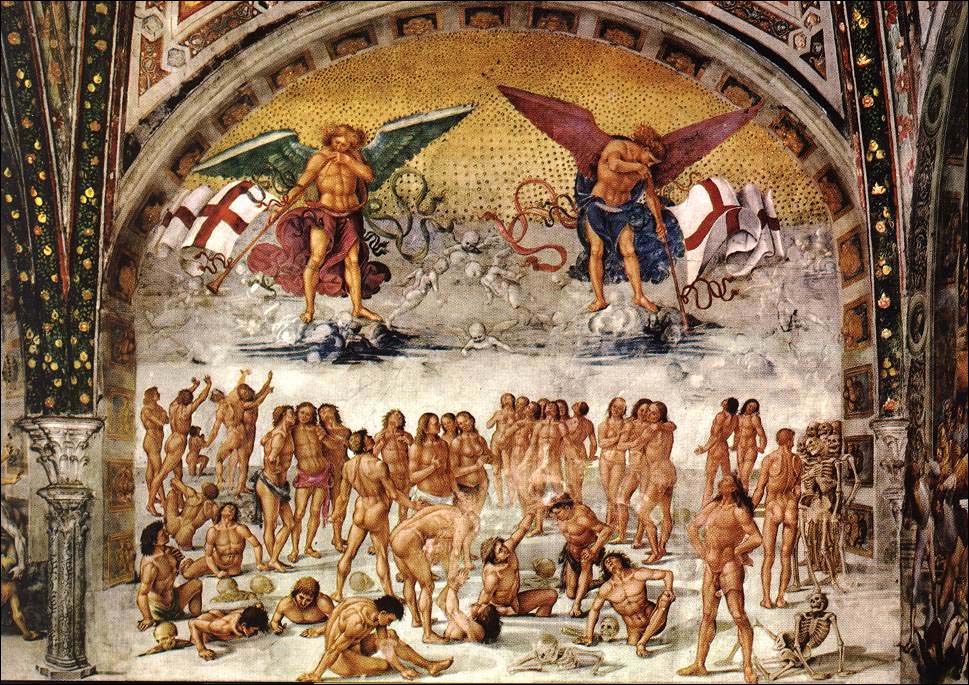 Luca Signorelli (c. 1450-1532), Angel Blowing Horn at the Resurrection on the Last Day, detail from "Resurrection of the Flesh" (1499-1502), Fresco, Chapel of San Brizio, Duomo, Orvieto, Italy. Larger image of full scene. |
|
As you prepare to study this lesson, read again 1 Corinthians 15 and 1 Thessalonians 4:13-18. |
Jesus was raised from the dead on the third day, breaking the hold that death had on mankind. He is the "firstborn from the dead" (Revelation 1:5; Colossians 1:18), "the firstfruits of those who have fallen asleep" (1 Corinthians 15:20). He is the first to be resurrected eternally, but not the last. Jesus clearly taught that on the Last Day, both the righteous and the unrighteous will be raised, the righteous to eternal life, and the unrighteous to eternal condemnation (John 5:28-29; Daniel 12:2-3; Acts 24:15).
Rapture vs. Resurrection
I've heard a lot of Christians talk about the "rapture" (a word that doesn't actually occur in the New Testament) but far fewer talk about the "resurrection" (which is mentioned many times). The word "rapture" comes from the Latin noun raptus, which means, "a carrying off," a concept referred to in 1 Thessalonians 4:17. Clearly the "rapture of the saints" and the "resurrection of the righteous" are one and the same event. Jesus himself talked about this great resurrection in terms of gathering. In a moment we'll look at several passages of scripture describing the order of Christ's return, but first observe the elements in the accounts:
- The appearance of Christ in the heavens,
- The angel's trumpet call summoning all God's people,
- Gathering of his people, dead and alive ("the quick
and the dead") (Matthew 13:24-30, 37-43, 47-50; 25:31-46; 2
Thessalonians 2:1)
- Resurrection of those who are dead and
- Changing into resurrection bodies of those alive at that time.
- Appearing before God's judgment (Revelation 20:11-13)
- Entering into glory
These things are mentioned in a number of places in the New Testament, but most completely in the following four passages:
"At that time the sign of the Son of Man will appear in the sky, and all the nations of the earth will mourn. They will see the Son of Man coming on the clouds of the sky, with power and great glory. And he will send his angels with a loud trumpet call, and they will gather (episunagō1) his elect from the four winds, from one end of the heavens to the other." (Matthew 24:30-31 || Mark 13:27)
"Listen, I tell you a mystery: We will not all sleep, but we will all be changed -- in a flash, in the twinkling of an eye, at the last trumpet. For the trumpet will sound, the dead will be raised imperishable (aphthartos2), and we will be changed (allassō3)" (1 Corinthians 15:51-52)
"For the Lord himself will come down from heaven, with a loud command, with the voice of the archangel and with the trumpet call of God, and the dead in Christ will rise first. After that, we who are still alive and are left will be caught up together (harpazō4) with them in the clouds to meet the Lord in the air. And so we will be with the Lord forever." (1 Thessalonians 4:16-17)
"Then I saw a great white throne and him who was seated on it. Earth and sky fled from his presence, and there was no place for them. And I saw the dead, great and small, standing before the throne, and books were opened. Another book was opened, which is the book of life. The dead were judged according to what they had done as recorded in the books. The sea gave up the dead that were in it, and death and Hades gave up the dead that were in them, and each person was judged according to what he had done." (Revelation 20:11-13; see also Romans 14:10; 2 Corinthians 5:10)
| Q1. What is the word used in the Bible
instead of "rapture"?
When will the resurrection take place in relation to Christ's
return? In relation to judgment? In relation to glory? (This
is NOT the place to debate various theories of the rapture
and the millennium.) https://www.joyfulheart.com/forums/index.php?showtopic=585
|
In Heaven Prior to the Resurrection
In 1 Thessalonians 4:17 above we see both the resurrection of the dead ("and the dead in Christ will rise first") and the rapture of those Christians still alive ("we who are still alive and are left will be caught up together with them"). Where have the dead been during this time? Verse 14 is rather clear: "We believe that God will bring with Jesus those who have fallen asleep in him." They have been in the presence of God from the instant of their death until the resurrection.
Occasionally you may hear the doctrine of "soul sleep," that Christians who die are asleep until the resurrection, when suddenly they awake -- unaware of the interval in time -- and are raised from the dead at the Last Day. "Sleep" is sometimes used as a euphemism for death in the New Testament. But soul sleep is not taught in the Bible. The scriptures are clear that at death, Christians are with Christ instantly. Consider Paul's words:
"I am torn between the two: I desire to depart and be with Christ, which is better by far; but it is more necessary for you that I remain in the body." (Philippians 1:23-24)
"We are confident, I say, and would prefer to be away from the body and at home5 with the Lord." (2 Corinthians 5:8).
So at the moment of death, we are ushered into the presence of God. The Book of Revelation twice mentions saints in heaven awaiting the resurrection.
"I saw under the altar the souls of those who had been slain because of the word of God and the testimony they had maintained. They called out in a loud voice, 'How long, Sovereign Lord, holy and true, until you judge the inhabitants of the earth and avenge our blood?' Then each of them was given a white robe, and they were told to wait a little longer, until the number of their fellow servants and brothers who were to be killed as they had been was completed." (Revelation 6:9-11)
The other mention is the 144,000, "wearing white robes and were holding palm branches in their hands" (7:9), worshiping the Lamb. "These are they who have come out of the great tribulation" (7:14). I think it's likely that these are two different pictures of the same group, though, of course, that's hotly debated.
The point is that there is a place for us with God, for Jesus told his disciples:
"In my Father's house are many rooms; if it were not so, I would have told you. I am going there to prepare a place for you. And if I go and prepare a place for you, I will come back and take you to be with me that you also may be where I am." (John 14:2-3)
| Q2. (Philippians 1:23-24; 2 Corinthians
5:8) According to these verses, where will Christians be
immediately after death? Where do we await the resurrection? https://www.joyfulheart.com/forums/index.php?showtopic=586
|
Redemption and Glorification
"Getting into heaven will satisfy me," you might be saying. "You can have this old body." That may be so, but God has a plan not only for your immortal soul, but also your body. We see several words that describe this in the New Testament:
Redemption of our bodies
. Paul writes, "We ourselves ... groan inwardly as we wait eagerly for our adoption as sons, the redemption of our bodies. For in this hope we were saved" (Romans 8:23-24a). Redemption (apolutrōsis) means literally, "the redeeming or setting free by paying the price." Christ's redemption is not only spiritual, but holistic, physical. In some sense the completion of the promises of God to us (such as "adoption as sons") await the resurrection at the Last Day.Glorification
. A number of passages associate being glorified with receiving the resurrection body: "It is sown in dishonor, it is raised in glory" (1 Corinthians 15:43; also Romans 8:17, 30; 2 Corinthians 3:18; 4:17; Philippians 3:21; Colossians 1:27; 3:4; 2 Thessalonians 2:14; 2 Timothy 2:10; Hebrews 2:10; ) This glory was also spoken concerning Jesus (Luke 24:26; John 7:39; 12:16, 23; 13:31; Acts 3:13; Colossians 3:4; 1 Timothy 3:16; Hebrews 2:9; 1 Peter 1:11, 21). There seems to be a special sense in which our final entering into Christ's glory will follow our resurrection.Corruptible vs. Incorruptible, Natural vs. Spiritual Bodies
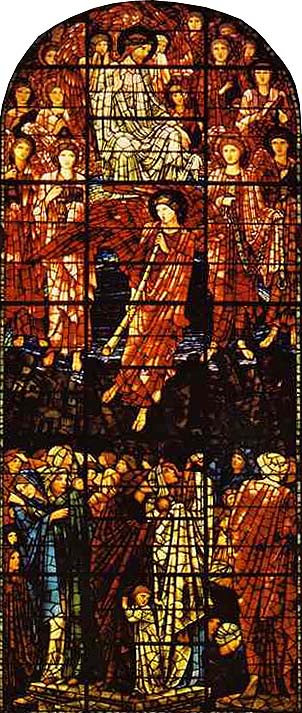 Edward Burne-Jones (Pre-Raphaelite English painter, 1833-1893), Last Judgement (1896). West Window, St. Philip's Cathedral, Birmingham, UK. Larger image. |
Probably the most important passage teaching about the resurrection is 1 Corinthians 15. Here Paul gives a number of contrasts between the characteristics of the natural body and those of the resurrection body.
"35 But someone may ask, 'How are the dead raised? With what kind of body will they come?' ... 42 So will it be with the resurrection of the dead. The body that is sown is perishable, it is raised imperishable; 43 it is sown in dishonor, it is raised in glory; it is sown in weakness, it is raised in power; 44 it is sown a natural body, it is raised a spiritual body." (1 Corinthians 15:35, 42-44)
We see several pairs of words in this passage:
Corruptible - Incorruptible
. Our physical bodies are "perishable, corruptible," phthora, "a breakdown of organic matter, dissolution, deterioration, corruption' in the world of nature. Then "the state of being perishable."6 But our bodies in the resurrection will be just the opposite -- imperishable, incorruptible (aphtharsia).7Dishonor - Glory
. Our physical bodies are characterized by "dishonor," atimia, "dishonor, ignominy, disgrace," used here of the unseemliness and offensiveness of a dead body."8 The contrast is a resurrection characterized by "glory", doxa, "the condition of being bright or shining, brightness, splendor, radiance."9Weakness - Power
. The physical body, especially one that is showing its age, is weak. The Greek noun is astheneia, which refers to both "sickness, disease" and physical "weakness -- incapacity or experience of limitation."10 By contrast the resurrection body is raised in "power," dunamis, "power, might, strength, force, capability."11Natural - Spiritual
. Paul describes the natural body with the adjective psuchikos, from psuchē, "soul, life," means here specifically, "pertaining to the life of the natural world and whatever belongs to it, in contrast to the realm of experience whose central characteristic is pneuma, "natural, unspiritual, worldly."12 Here it is translated "natural" (NIV, KJV) or "physical" (NRSV). The resurrection body is described as pneumatikos, "having to do with the (divine spirit)."13 This doesn't mean that people in the resurrection are spirits without a body. Jesus wasn't. But it means that the resurrection body has a spiritual dimension as Jesus' resurrection body did, able to operate in the spiritual realm as well as the physical.| Q3. What does the phrase "redemption of
our bodies"(Romans 8:23-24) tell us about our resurrection?
What words in 1 Corinthians 15:42-44 describe our
resurrection bodies? https://www.joyfulheart.com/forums/index.php?showtopic=587
|
What Is Our Resurrection Body Going to Be Like?
Just what is our resurrection body going to be like? Consider these passages:
"Dear friends, now we are children of God, and what we will be has not yet been made known. But we know that when he appears, we shall be like him, for we shall see him as he is." (1 John 3:2)
"[The Lord Jesus], who, by the power that enables him to bring everything under his control, will transform our lowly bodies so that they will be like his glorious body." (Philippians 3:21)
"And just as we have borne the likeness of the earthly man, so shall we bear the likeness of the man from heaven." (1 Corinthians 15:49)
Our resurrection bodies will be like Jesus' resurrection body. While we can't be certain of all that means for us, Jesus' body was described as "flesh and bones" (Luke 24:39c) -- though, of course, it is more than that (1 Corinthians 15:50)! Jesus' body could eat (Luke 24:42-43; Acts 1:4), be touched (Matthew 28:9; Luke 24:39b), could walk and talk (Luke 24:15), and be recognized by others -- when he wanted to be (Matthew 28:9; Luke 24:16, 31; John 20:14-16, 20; 21:4, 12). In these respects it was able to relate to the physical world like a normal physical body.
But it was not limited to the physical world. Jesus could enter locked doors (John 20:19, 26) disappear (Luke 24:31) and appear (Luke 24:36) at will. Our resurrection bodies will be incorruptible (1 Corinthians 15:42), glorified (1 Corinthians 15:43a), powerful (1 Corinthians 15:43b), and able to navigate in the spiritual realm (1 Corinthians 15:44).
Jesus' wounds were still visible in his renewed body (Luke 24:39-40; John 20:20, 25-27). Does that mean that our resurrection bodies will bear the scars, wounds, and sicknesses of our earthly struggle? No. Jesus' body seems to be a special case so his disciples would not mistake who he was. We expect that our bodies will be raised to an appearance that is in the full strength of health and beauty. Nevertheless, physical beauty will no longer have the sexual implications that it does now, since in the resurrection, marriage and sexuality no longer have meaning (Luke 20:34-36). These are spiritual bodies, no longer mortal. Jesus said: "They can no longer die, for they are like the angels" (Luke 20:36).
Why Will We Have Resurrection Bodies?
For some, who are quite happy with heaven -- thank you very much -- resurrection bodies may seem unnecessary. Why go to all this trouble? they ask. Surely, resurrection is the final victory over death. But we probably don't know the full answer. Nevertheless, I have often pondered these verses:
"That day will bring about the destruction of the heavens by fire, and the elements will melt in the heat. But in keeping with his promise we are looking forward to a new heaven and a new earth, the home of righteousness." (2 Peter 3:12-13)
"Then I saw a new heaven and a new earth, for the first heaven and the first earth had passed away... He who was seated on the throne said, 'I am making everything new!'" (Revelation 21:1, 5)
"You have made them to be a kingdom and priests to serve our God,
and they will reign on the earth." (Revelation 5:10)
What is life going to be like in the new heavens and new earth? We don't know. But we do know that in the resurrection we will have bodies that are capable of navigating on earth as well as heaven, and we may have some role in both places as we reign, that is administer the rule of the Kingdom of God, on earth. We'll see!
| Q4. What will our resurrection bodies be
like? Why do you think we will be given resurrection bodies?
What is the point? https://www.joyfulheart.com/forums/index.php?showtopic=588
|
Getting All the Right Molecules Restored
Clearly Jesus' resurrection body had a continuity with his physical body. After the resurrection he was recognized (when he wanted to be) and his wounds were visible as a sign that it indeed was he.
For us, frankly, by the time Jesus comes there may not be a lot left to resurrect. For this reason some Christians have resisted cremation so that at least some bones are left rather than ashes. To a whimsical mind, this presents all sorts of questions. What if someone is buried at sea and his molecules end up as part of the food chain in another human being? But this whole approach becomes silly. Wayne Grudem puts it this way:
"Whatever remains in the grave from our own physical bodies will be taken by God and transformed and used to make a new resurrection body. But the details of how that will happen remain unclear to us...."14
Death Is Not the Victor
The point is that physical death is not the victor. Paul writes, "The last enemy to be destroyed is death" (1 Corinthians 15:26). Resurrection of the body on the Last Day underscores the completeness with which God is restoring us to his original intent, our wasted world to the Garden of Eden and a New Heavens and a New Earth where righteousness dwell (2 Peter 3:13; Revelation 21:1, 5; Isaiah 65:17-19; 66:22).
I've conducted many funerals in my lifetime. Many times as I have stood in cemeteries surveying all the graves around me, I've thought: This will be a wonderful, wild place to be when Christ returns and raises the bodies lying here to resurrection life!
 Now all the lessons are available together in e-book and printed book formats. |
The resurrection is the sign of victory and glory. Death is not the end. Death does not have the last word. Your Christian loved ones are with Christ right now in spirit. But one day, at Christ's return, their bodies will rise, be reunited with their spirits, and live triumphant with Christ.
"Listen, I will tell you a mystery! We will not all die, but we will all be changed, in a moment, in the twinkling of an eye, at the last trumpet. For the trumpet will sound, and the dead will be raised imperishable, and we will be changed. For this perishable body must put on imperishability, and this mortal body must put on immortality... Thanks be to God, who gives us the victory through our Lord Jesus Christ!" (1 Corinthians 15:51-53, 57, NRSV)
Come soon, Lord Jesus!
| Q5. Why should Christians look forward to
the events surrounding our resurrection? Why do you think
Christians have largely lost this as their active expectation
and hope? What should be done to reclaim these truths? https://www.joyfulheart.com/forums/index.php?showtopic=589
|
Prayer
Father, thank you for the confidence we have of victory over death through our Lord Jesus Christ. Implant in us afresh a living faith in the resurrection of Jesus Christ our Lord and a living hope of our own resurrection on the Last Day. In Jesus' triumphant name, we pray. Amen.Key Verses
"Listen, I tell you a mystery: We will not all sleep, but we will all be changed -- in a flash, in the twinkling of an eye, at the last trumpet. For the trumpet will sound, the dead will be raised imperishable, and we will be changed." (1 Corinthians 15:51-52)"For the Lord himself will come down from heaven, with a loud command, with the voice of the archangel and with the trumpet call of God, and the dead in Christ will rise first. After that, we who are still alive and are left will be caught up together with them in the clouds to meet the Lord in the air. And so we will be with the Lord forever." (1 Thessalonians 4:16-17)
References
- Episunagō, "to bring together, gather (together)," BDAG 382. See also the noun in, "Concerning the coming of our Lord Jesus Christ and our being gathered (episunagōgē) to him..." (2 Thessalonians 2:1).
- Aphthartos, "pertaining to imperviousness to corruption and death, imperishable, incorruptible, immortal," the adjective of aphtharsia (1 Corinthians 15:42), see footnote 7 below.
- Allassō, "to make something other or different, change alter" (BDAG 45-46, 1).
- Harpazō, "to grab or seize suddenly so as to remove control, snatch/take away" (BDAG 134, 2.b.). The Latin Vulgate translation uses rapio, "seize, carry of by force," related to our English words "rapture" and "rape."
- Endēmeō, "to be in a familiar place, to be at home" (BDAG 332).
- Phthora, BDAG 1054-1055, 1.
- Aphtharsia, "the state of not being subject to decay/dissolution/interruption" (BDAG 155).
- Atimia, Thayer.
- Doxa, BDAG 256-258, 1.b.
- Astheneia, BDAG 142, 2.a.
- Dunamis, BDAG 262-263, 1.
- Psuchikos, BDAG 1100.
- Pneumatikos, BDAG 837, 2.
- Grudem, Systematic Theology, p. 833.
Copyright © 2026, Ralph F. Wilson. <pastor joyfulheart.com> All rights reserved. A single copy of this article is free. Do not put this on a website. See legal, copyright, and reprint information.
 To be notified about future articles, stories, and Bible studies, why don't you subscribe to our free newsletter, The Joyful Heart, by placing your e-mail address in the box below. We respect your