


|
Old Testament
New Testament
Gospels
Acts
Paul's Letters
General Letters
Revelation
Topical Studies
Beginning the Journey (for new Christians). en Español

|
Old Testament
New Testament
Gospels
Acts
Paul's Letters
General Letters
Revelation
Topical Studies

|
Home
Bible Studies
Articles
Books
Podcasts
Search
Menu
Donate
About Us
Contact Us
FAQ
Sitemap


4. Psalms: Offering High Praises to God
(Psalms
150, 95, and 98)
Free
E-mail Bible Study
 Experiencing the Psalms
Home | Bible Studies | Articles | Books | Podcasts | Search | Menu | Donate | About Us | FAQ | Contact Us
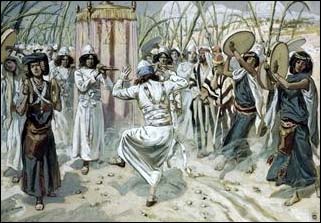 Several instruments and high praise is shown in James J. Tissot's painting, 'David Dancing before the Ark' (1896-1900), watercolor. |
What do Handel's "Hallelujah Chorus," Revelation, and the Psalms have in common? The word, "Hallelujah," that's what. The word rings throughout the Psalms in one mighty panoply of praise. Revelation reaches its climax with the triumphant cry:
"Hallelujah!
For our Lord God Almighty reigns." (Revelation 19:6)
But what does Hallelujah mean? It is a command, an imperative, made up of three parts:
| hālal | lu | Yah |
| Praise | you (plural) | short for Yahweh, "the LORD" |
The verb hālal means "praise." "This root connotes being sincerely and deeply thankful for and/or satisfied in lauding a superior quality(ies) or great, great act(s) of the object." It can mean, "to brag," and be used to praise a man or woman. But its primary use in the Old Testament is directed toward God.89
In this lesson we're going to begin to examine the psalms of high praise to God, psalms of joy and celebration. This belongs at the end of the Psalter as the high point of the Hallel psalms. These belong to genre of Hebrew poetry known as "hymns," though they aren't like the traditional hymns you'll find in your hymnal. They tend to be exuberant rather than staid, emotional rather than restrained.
Psalm 150 -- Let Everything that Has Breath Praise the Lord!
The Psalter concludes with this short psalm, beginning and ending with "Hallelujah," wrapping the psalm fore and aft with praise. Read it out loud right now in your favorite translation:
"1Praise the LORD.
Praise God in his sanctuary;
praise him in his mighty heavens.
2Praise him for his acts of power;
praise him for his surpassing greatness.
3Praise him with the sounding of the trumpet,
praise him with the harp and lyre,
4praise him with tambourine and dancing,
praise him with the strings and flute,
5praise him with the clash of cymbals,
praise him with resounding cymbals.
6Let everything that has breath praise the LORD.
Praise the LORD." (Psalm
150:1-6)
But the psalm doesn't just begin and end with praise. It has praise through and through, using the verb hālal a full thirteen times. There are many ways to look at this short psalm. One approach is to see it as answering various questions about praise:
- What? (verse 1a) -- praise
- Where? (verse 1b) -- in his holy place,90 heavens
- Why? (verse 2) -- for acts of power, for surpassing greatness
- How? (verse 3-5) -- with instruments and dance
- Who? (verse 6a) -- everyone that has breath
I doubt, however, that it is composed for us to analyze. Rather it is designed to catch us up in its all-out emotion of praise.
Instruments of Praise
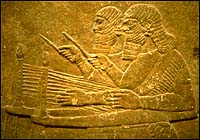 Captive musicians from the siege of Lachish sing praises to the conqueror. Detail of relief from SW Palace of Sennacherib at Nineveh, ca. 701 BC British Museum, London. Larger image. |
We can't be exhaustive about this psalm, of course. But let's describe the instruments, most of which have a modern-day equivalent.
"Trumpet" (shôpār) was originally the ram's horn.91 A metal trumpet (ḥaṣōṣerā) is also mentioned in the Old Testament. This trumpet was made of beaten silver (Numbers 10:2). Josephus describes it as "in length a little short of a cubit, it is a narrow tube, slightly thicker than a flute."92
"Harp" (NIV, NJB), "psaltery" (KJV), "lute" (NRSV), nēbel, is an instrument of 12 strings, plucked with the fingers.93 It was larger than the kinnôr or "lyre," with a deeper tone. This lyre had two arms with a box-shaped body (a Canaanite version). David played such an instrument and it was the main instrument in the second temple orchestra.94 Psalm 98 declares:
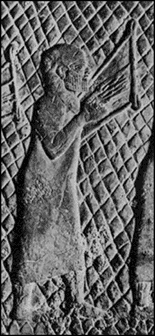 Detail of Jewish kinnor player is found in a bas-relief in the palace of Assurbanipal (705-681 BC) at Nineveh, portraying the fall of the Judean city of Lachish. |
"Make music to the LORD with the harp,
with the harp (kinnôr) and the sound of singing,
with trumpets (ḥaṣōṣerā) and the blast of
the ram's horn (shôpār) --
shout for joy before the LORD, the King."
(Psalm 98:5-6)
"Tambourine" (NIV, NRSV, NJB), "timbrel"(KJV), tōp, is a general term for tambourines and small drums (the most common instruments of percussion in ancient times).95 This was a hand drum, without the jingly metal plates we associate with a tambourine.
"Strings" (NIV, NRSV) or "stringed instruments" (KJV), mēn, is probably a collective term for stringed instruments.96
"Flute" (NIV), "organs" (KJV), pipes (NRSV, NJB), 'ûgāb, " is probably an end-blown, vertical flute, a reed-pipe."97
"Cymbals" (ṣelṣelîm) that have been found in various Near Eastern sites from the 14th to the 8th centuries BC are generally bronze round flat plates, 4 to 6 inches (10 to 15 cm.) in diameter, with central bowl-like depressions and fitted with iron finger rings. Verse 5 seems to describe two ways of playing the cymbals:
- Cymbals of pleasing sound. "Clash" (NIV), "clanging" (NRSV), "loud" (KJV).98
- Cymbals of alarm. "Resounding" (NIV), "loud clashing" (NRSV), "triumphant" (NJB), "high sounding" (KJV), terû'â, "alarm, signal, sound of the tempest."99
Everyone that Has Breath (150:6a)
The psalmist has encompassed all kinds of instrumentalists, all places, all reasons. Now he extends it the final step to "everyone who has breath." That's you and me. We are to praise Yahweh. We are! Praise ye the Lord!
Q1. (Psalm 150) What does this psalm teach us about praise? Where should praise occur? With what should praise be conducted? Who should praise? What does this psalm make you feel like after reading it out loud?
Psalm 95 -- Come, Let Us Worship and Bow Down
It's difficult to narrow down these high praise songs to just a few -- there are so many wonderful psalms of this type! Psalm 95 is both a call to praise and thanksgiving. It is also a exhortation to obedience and faith.
Structure of Psalm 95
Look briefly at the structure:
- A call to exuberant praise to the Lord (verses 1-2)
- The reason to praise, the Lord's greatness as Creator and King (verses 3-5).
- A call to bow down in humble worship before our God our Shepherd (verses 6-7c).
- A warning and exhortation to obey the Lord (verses 7d-11).
Names and Titles of God
There are six names or metaphors for God in this psalm:
- LORD, Yahweh (1a)
- Rock of our salvation (1b)
- Great God (3a)
- Great King above all gods (3b)
- Our Maker (6b)
- Our Shepherd (7, implied)
Expressions of Worship
"1Come, let us sing for joy to
the LORD;
let us shout aloud to the Rock of our salvation.
2Let us come before him with thanksgiving
and extol him with music and song." (95:1-2)
When I consider Psalm 95, I see several expressions of worship (in addition to hālal, "praise," which we examined above in Psalm 150). Since one of our purposes in the Psalms is to learn better to worship, let's examine the underlying Hebrew words:
- "Sing "(1a), rānan, means specifically, "cry out, shout for joy." The idea here is a shout of jubilation, a holy joy which is being celebrated by Israel's shouting. In Psalms the word appears in parallel poetry with nearly every term for joy, rejoicing, and praise, and a few times in parallel with "sing" (59:16; 98:4).100
- "Shout aloud" (1b, NIV) or "make a joyful noise" (KJV, NRSV), is rûa', "shout, raise a sound, cry out." The primary meaning is "to raise a noise" by shouting or with an instrument, especially a horn (Numbers 10:7; Joshua 6:5).101 The word is repeated as "extol" (2b, NIV) in verse 2b. Kidner explains it as, "the spontaneous shout that might greet a king or a moment of victory."102
- "Thanksgiving" (2a) is tôdâ, "confession, praise" of God's character and works. The verb is used to express one's public proclamation or declaration (confession) of God's attributes and his works. It is most often translated "to thank" in English, though the Old Testament does not have our concept of thanks. The expression of thanks to God is included in praise, it is a way of praising.103
In verse 6 we see a particular kind of worship -- kneeling, prostration, before the King.
"Come, let us bow down in worship,
let us kneel before the LORD our Maker."
(95:6)
In this one verse are three words which indicate prostrating oneself, kneeling. Prostration was quite common as an act of self-abasement or submission performed before relatives, strangers, superiors, and especially before royalty. The Muslims practice it today in prayer, in which the forehead must touch the ground.104
God our Shepherd (95:7)
The next verse is a beautiful image of a flock of sheep in deep grass.
"... For he is our God
and we are the people of his pasture,
the flock under his care." (95:7)
We worship, we bow down, because we recognize both God's ownership of us and his responsibility to care for us. As Jesus put it, he is not a hireling, but the owner of the sheep. Therefore, he is willing to lay down his life for the sheep -- and did! He is the Shepherd, we are the sheep, the flock. He cares for us.
Obedience Must Follow Worship (95:7d-11)
The final verses of Psalm 95 seem different from the rest of the Psalm. But they follow on the theme of worship. Worship, exhorts this prophetic voice, requires a tender heart of obedience toward God, not the stubbornness shown by the Israelites in the wilderness.
"7dToday, if you hear his voice,
8do not harden your hearts as you did at Meribah,
as you did that day at Massah in the desert,
9where your fathers tested and tried me,
though they had seen what I did.
10For forty years I was angry with that generation;
I said, 'They are a people whose hearts go astray,
and they have not known my ways.'
11So I declared on oath in my anger,
'They shall never enter my rest.'" (95:7d-11)
The psalmist recounts the sad story of Israel's 40-year sojourn in the wilderness. Under Moses they had been brought out of Egypt and seen the Egyptian army destroyed by God's mighty hand. But then the complaints began. No food. God provided manna. No water. God directed Moses to strike a rock and water gushed forth at Massah and Meribah (Exodus 17:7).
The crucial test, however, took place on the brink of entering the Promised Land (Numbers 13-14). Twelve spies had been sent north from the Israelite camp at Kadesh-barnea to spy out the land of Canaan prior to the conquest. When they returned, ten reported that they would not be able to defeat the walled cities and giants in the land. Only two -- Caleb and Joshua -- reported that through trust in God: "We should go up and take possession of the land, for we can certainly do it." (Numbers 13:30).
At that point the people of Israel rebelled. They were filled with fear from the negative report of the ten spies. There was talk of selecting another leader to take them back to Egypt. This wasn't just resistance against the authority of Moses, whom God had appointed, but unbelief of God himself. It was ugly! It constituted treason against both Moses and God.
God's response was anger at the unbelief of the entire generation. His oath in this passage begins "as surely as...." He responded:
"As surely as I live and as surely as the glory of the LORD fills the whole earth, not one of the men who saw my glory and the miraculous signs I performed in Egypt and in the desert but who disobeyed me and tested me ten times -- not one of them will ever see the land I promised on oath to their forefathers. No one who has treated me with contempt will ever see it." (Numbers 14:21-23)
None of the men and women 20 years old and older would enter the Promised Land and rest from their sojourn. They would die in the desert; only their children would enter the land. The writer of Hebrews discusses this passage extensively in Hebrews 3 and 4 as a warning against unbelief and apostasy.
Why did the psalmist insert this warning right after high praise and prostrate submission in Psalm 95? The topic of the psalm is worship. His point is that worship not only consists of praise, thanksgiving, and outward submission, but also submissive hearts before the Lord. This is not an outward worship, but inward. Too often our worship is empty words, rather than a submissive spirit full of faith in God and a readiness to obey him. The Apostle Paul reminds us:
"I appeal to you therefore, brothers and sisters, by the mercies of God, to present your bodies as a living sacrifice, holy and acceptable to God, which is your spiritual worship." (Romans 12:1)
The way we live our lives comprises our worship of God, not just what we say with our mouths on "worship days."
Q2. (Psalm 95) In Psalm 95 we are commanded to worship the Lord. What are the reasons why we should worship contained in this psalm? Why do you think the warning in verses 8-11 is included in this psalm? How does this fit with the earlier elements of the psalm?
Psalm 98 -- Sing to the Lord a New Song
Psalm 98 is typical of many of the praise psalms. The unidentified writer has no complaint to bring before the Lord. Rather he pens a love-song to God meant to be sung and accompanied by instruments, termed "a psalm" (mizmôr), from zāmar, "to sing, play an instrument."105
The structure of the psalm is fairly free flowing:
- Command: A call to sing a new song (98:1a)
- Reason: (1b-3) Because of the Lord's record of salvation, righteousness, and faithful love.
- Command: A call to shout to the Lord and make music (98:4-6)
- Command: A call to nature to join in the praise (98:7-9a)
- Reason: Because he is coming with righteous judgment (98:9b).
Sing a New Song (98:1-3)
"Sing to the LORD a new song...." (98:1a)
The psalm begins with a command to sing. Kidner comments, "The 'new song' is not simply a piece newly composed, though it naturally includes such, but a response that will match the freshness of His mercies, which are 'new every morning.'"106
Yahweh's Salvation for Israel (98:1b-3)
Now the psalmist gives the reasons that Yahweh is worthy of this song of praise. The words "salvation" (yeshû'â) and "save, deliver" (yāsha') occur three times in this section. In the New Testament, the idea of salvation focuses primarily on the forgiveness of sins, deliverance from its power, and the defeat of Satan. But in the Old Testament, salvation is usually in terms of how the Lord has delivered Israel from tangible enemies.107 As I read verses 1b-3 I think especially of God's deliverance of Israel from Egypt and carving out for them a new homeland in Canaan.
"1Sing to the LORD a new song,
for he has done marvelous things;
his right hand and his holy arm
have worked salvation for him.
2The LORD has made his salvation
known
and revealed his righteousness to the nations.
3He has remembered his love
and his faithfulness108
to the house of Israel;
all the ends of the earth have seen
the salvation of our God." (98:1b-3)
The imagery here is of Yahweh as a warrior who wields a sword with his right hand and "holy arm" on behalf of Israel. Yahweh the Warrior is a common image in the Psalms. Notice how through his salvation of Israel from captivity to their home in the Promised Land that God "made his salvation known" and revealed his righteousness to the unbelieving nations around. Because they told the story of what God had done, God's reputation for helping Israel was well known. People learn about God's salvation in our lives by what we share. Part of our praise towards God is furthering his reputation by our testimony of how he has saved and delivered us.
Instrumental Worship (98:4-6)
As we saw in Psalm 150, all the voices and instruments join in worship:
"4Shout for joy109
to the LORD, all the earth
burst into jubilant song110
with music;
5make music to the LORD with
the harp,
with the harp and the sound of singing,
6with trumpets and the blast of the ram's horn --
shout for joy before the LORD, the King."
(98:4-6)
All Nature Praises Yahweh (98:7-9a)
Now the psalmist commands all creation to praise the Lord:
"7Let the sea resound, and
everything in it,
the world, and all who live in it.
8Let the rivers clap their hands,
let the mountains sing together for joy;
9let them sing before the LORD...."
(98:7-9a)
The psalmist calls upon the sea and the earth and all their inhabitants to praise. Let the sea "roar." The word literally means "to thunder." If you've visited the coast, you know the roar of the breakers and the wind.111 The rivers are to "clap112 their hands," the mountains are to "sing."
I once met a Bible school graduate (who should have known better) who claimed that mountains must clap their hands. "If the Bible says they do, then they must do it!" he responded with some passion. This is not a question of inerrancy, but of the poetic use of language. The psalmist is obviously using figurative language. Hebrew poetry -- and the Book of Revelation, for that matter -- is full of figurative language. We must try to understand the words as the author intended them -- in this case figuratively.
When you read this section, you hear the exuberance of praise, the joy of praise, the fullness of praise that we are to bring to God.
The Reason for Praise: The Judge Is Coming with Righteousness (98:9b-d)
"... For he comes to judge the earth.
He will judge the world in righteousness.113
and the peoples with equity."114
(98:9b-d)
You might think that "Here comes the judge!" would be a fearful message, not one that would inspire praise. But if you've been living in a society where the poor are oppressed, where laws are not enforced equally and justly, where the wicked have free rein, you would look at the coming of righteousness and justice with excitement and anticipation.
Righteousness is coming -- at last! Hallelujah! For the righteous it is a joy, a hope, an expectation. For the wicked, however, the coming of the Righteous Judge is a fearsome message.
Praise the Lord!
Why? Because he has saved us marvelously!
Praise the Lord with music and instruments.
Let all creation praise the Lord with joy and exuberance!
Why? Because the righteous Judge is coming who will set all injustice
aright and bring our final salvation! Hallelujah!
Q3. (Psalm 98) What are the reasons given for praise in Psalm 98? Why do you think praise is so exuberant in this psalm? How exuberant is praise in your congregation, in your life? Why or why not is it exuberant?
Exercise. For one of the psalms in this lesson -- or another psalm with a similar theme -- do one of the suggested exercises to help you experience the Psalms in Appendix 1. These include such things as praying a psalm, meditating, reading to a shut-in, paraphrasing, writing your own psalm, singing, preparing a liturgy, and memorizing.
Prayer
 Available in paperback, PDF, Kindle formats. |
Father, what a privilege it is to praise you, to bring joyous happy praises to you with my whole heart. Through praising you, you've filled my life with joy. May my whole life -- not just my lips -- be a praise to your name. In Jesus' wonderful name, I pray. Amen.
Songs
- "Break into Songs of Joy" (in honor of the Lord Most High), words and music by Bill Batstone (© 1986, Maranatha! Music). Psalm 98.
- "Come Let Us Bow," words and music by Andy Park (© 1992, Mercy / Vineyard Publishing). Psalm 95.
- "Come, Let Us Worship," words and music by Chris Tomlin and Jesse Reeves (© 2002, worshiptogether.com songs / sixsteps Music). Psalm 95:6-7
- "Come, Let Us Worship and Bow Down," words and music by Dave Doherty (© 1980, Maranatha Praise, Inc.). Psalm 95:6-7.
- "Come Worship the Lord," words and music by John Michael Talbot (© 1980, Birdwing Music, BMG Songs, Inc.). Psalm 95.
- "Holy Moment," words and music by Matt Redman (© 2000, Thankyou Music). Psalm 95.
- "Praise Him, Praise Him," words: Fanny Crosby (1869), music: Chester G. Allen. Psalm 150.2.
- "Praise to the Lord, the Almighty, the King of Creation," words: Joachim Neander (1680), translated by Catherine Winkworth (1863); music: "Lobe den Herren" (1665), harmony by William S. Bennett (1864). Psalm 150:1-2.
- "Praise Ye the Lord" (Psalm 150), words and music by Reta Kelligan (© 1951, 1980, Reta Kelligan). Psalm 150.
- "Shout to the Lord," words and music by Darlene Zschench (© 1993, Hillsong Publishing). Psalm 95:1.
- "The Battle Song" (With the High Praises of God in our mouth), words and music by Jimmy Owens (© 1978, Lexicon Music, Inc.). Psalm 149:6.
- "We Bow Down," words and music by Twila Paris (© 1984, New Spring). Psalm 95:6
Endnotes
[89] In the cognate languages, hālal is related to the Akkadian root alālu, "to shout, brag, boast" and "to hail, acclaim, utter a cry, to generally express joy" (Leonard J. Coppes, hālal, TWOT #50)
[90] "Sanctuary" is the noun qōdesh, "apartness, holiness, sacredness, hallowed, holy," from the root qādash, "the state of that which belongs to the sacred, distinct from the common or profane" (Thomas E. McComiskey, qādash, TWOT #1990a).
[91] Hermann J. Austel, shāpar, TWOT #2449c. Daniel A. Foxvog and Ann D. Kilmer, "Music," ISBE 3:436-449, especially p. 439.
[92] Josephus, Antiquities 3.12.6 (§291).
[93] Louis Goldberg, nbl, TWOT 1284b. See also the Introduction to Psalms above. Josephus, Antiquities 7.12.3.
[94] Foxvog and Kilmer, pp. 440-442, John N. Oswalt, knr, TWOT #1004a
[95] Ronald F. Youngblood, tāpap, TWOT #2536a.
[96] Mēn, Holladay 200a; Foxvog and Kilmer, p. 445.
[97] 'ûgāb, Holladay 266; TWOT #1559c; Foxvog and Kilmer, pp. 443-444.
[98] Shema', "sounding cymbals. According to KB these are small tinkling cymbals as opposed to the loud, crashing cymbals" (Hermann J. Austel, shāma', TWOT #2412b).
[99] William White, rûa' ("shout, raise a sound, cry out"), TWOT #2135b; Foxvog and Kilmer, p. 444.
[100] William White, rānan, TWOT #2179.
[101] William White, rûa', TWOT #2135.
[102] Kidner, Psalms 73-150, pp. 352-353.
[103] Ralph H. Alexander, yādā, TWOT #847b
[104] "Bow down" (6a, NIV) or "worship" (KJV, NRSV) is now understood to be the Eshtaphal stem of ḥāwā. (Edwin Yamauchi, shāḥā, TWOT #2360). "The commonly occurring form hishtaḥăwâ, 'to prostrate oneself' or 'to worship,' which was analyzed as a Hithpael of shāḥā, is now regarded on the basis of Ugaritic evidence as an Eshtaphal stem (the only example) of ḥāwā (Edwin Yamauchi, TWOT #619). Holladay sees this as an histafal stem (pp. 97a, 365b). "Worship" (6a, NIV) or "bow down" (KJV, NRSV), kāra', "bow down, kneel, sink to one's knees, kneel in reverence, before God or a king" (R. Laird Harris, kāra', TWOT #1044). "Kneel" (6b), is bārak, usually translated "bless," but here and in two other places rendered "kneel" (John N. Oswalt, bārak, TWOT #285).
[105] Herbert Wolf, zāmar, TWOT #558c.
[106] Kidner, Psalms 73-150, p. 347
[107] John E. Hartley, yāsha', TWOT #929b.
[108] "Faithfulness" (NIV), "truth" is 'ĕmûnâ, "firmness, fidelity, steadiness" (Jack B. Scott, 'āman, TWOT #116e).
[109] "Shout for joy" (NIV), "make a joyful noise" (KJV) is rûa', "shout, raise a sound, cry out," which we saw above (William White, rûa', TWOT #2135).
[110] "Burst into jubilant song" (NIV), "break forth into joyous song" (KJV), "make a loud noise" (KJV) is pāṣaḥ, "cause to break or burst forth, break forth with" (BDB 822).
[111] William White, rā'am, TWOT #2189.
[112] Māḥā', "strike, clap." For more on clapping hands, see the Epilogue, footnote 1.
[113] "Righteousness" (ṣedeq) is conformance to an ethical or moral standard (Harold G. Stigers, ṣādēq, TWOT 1879a).
[114] "Equity" (mêshār) is "uprightness, straightness" from the verb yāshar, "be level, straight, (up)right, just" (Donald J. Wiseman, yāshar, TWOT #930e).
Copyright © 2026, Ralph F. Wilson. <pastor joyfulheart.com> All rights reserved. A single copy of this article is free. Do not put this on a website. See legal, copyright, and reprint information.
 To be notified about future articles, stories, and Bible studies, why don't you subscribe to our free newsletter, The Joyful Heart, by placing your e-mail address in the box below. We respect your