


|
Old Testament
New Testament
Gospels
Acts
Paul's Letters
General Letters
Revelation
Topical Studies
Beginning the Journey (for new Christians). en Español

|
Old Testament
New Testament
Gospels
Acts
Paul's Letters
General Letters
Revelation
Topical Studies

|
Home
Bible Studies
Articles
Books
Podcasts
Search
Menu
Donate
About Us
Contact Us
FAQ
Sitemap


Free
E-mail Bible Study
 Names and Titles of God
Home | Bible Studies | Articles | Books | Podcasts | Search | Menu | Donate | About Us | FAQ | Contact Us
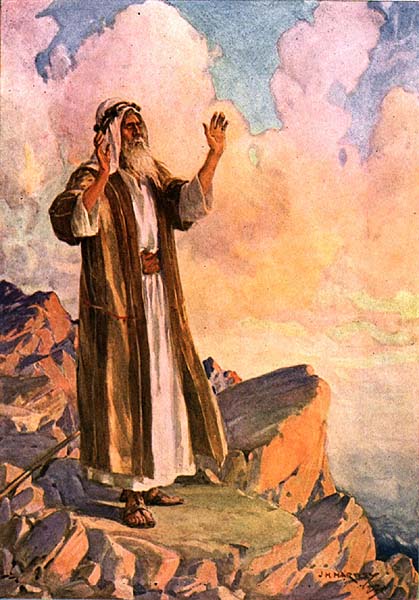 J. H. Hartley, "Moses Praying on Mt. Pisgah" (1922), in James Bailie and J H Hartley (illustrator), The Bible Story a connected narrative retold from Holy Scripture (A & C Black Ltd., London, 1923). Larger image. |
Moses is revered in both the Old and New Testaments as prophet, lawgiver, and deliverer of Israel -- and rightly so. When I try to assess his secret from a leadership viewpoint, I see two things in particular:
- He was chosen by God for this particular mission.
- Moses listened carefully and then obeyed what God told him to do.
On the first point, there isn't much we can do about God's calling. That is His business, and we have but to understand it, accept it, and obey.
It's on the second point, however, that I want to reflect.
Moses: Leadership by Listening and Obeying
Moses practiced leadership by listening and obeying. In this he was unique in the Old Testament. When Miriam and Aaron began to speak against Moses, the Lord said:
"When a prophet of the LORD is among you,
I reveal myself to him in visions,
I speak to him in dreams.
But this is not true of my servant Moses;
he is faithful in all my house.
With him I speak face to face,
clearly and not in riddles;
he sees the form of the LORD.
(Numbers 12:6-8)
At the conclusion of the Pentateuch we find similar words about Moses' uniqueness.
"Since then, no prophet has risen in Israel like Moses, whom the LORD knew face to face, who did all those miraculous signs and wonders the LORD sent him to do in Egypt -- to Pharaoh and to all his officials and to his whole land. For no one has ever shown the mighty power or performed the awesome deeds that Moses did in the sight of all Israel." (Deuteronomy 34:10-12)
The Prophet Who Was to Come (Deuteronomy 18:15, 18-19)
But is Moses' leadership style truly unique? God, speaking through Moses, pointed to a successor.
"15 The LORD your God will raise up for you a prophet like me from among your own brothers. You must listen to him.... I will raise up for them a prophet like you from among their brothers; I will put my words in his mouth, and he will tell them everything I command him. If anyone does not listen to my words that the prophet speaks in my name, I myself will call him to account." (Deuteronomy 18:15, 18-19)
Joshua was a great leader, but he wasn't the fulfillment of this prophecy, nor was any of the Old Testament prophets. The prophet God speaks of is Jesus himself,1 as Peter testified (Acts 3:22-23).
Jesus: Leadership by Listening and Obeying
When we look at Jesus' leadership style, we see the same underlying pattern that we saw in Moses -- though I don't want to oversimplify Jesus' leadership. We see a clear, unapologetic dependence upon the Father.
"I tell you the truth, the Son can do nothing by himself; he can do only what he sees his Father doing, because whatever the Father does the Son also does. For the Father loves the Son and shows him all he does...." (John 5:19-20a)
The source of Jesus' leadership was a close relationship with the Father nurtured by hours in prayer. Moses had his Tent of Meeting (Exodus 33:7-11); Jesus had the hills where he would lose himself to be with the Father.
"Very early in the morning, while it was still dark, Jesus got up, left the house and went off to a solitary place, where he prayed." (Mark 1:35 = Luke 4:42)
"And he withdrew himself into the wilderness, and prayed." (Luke 5:16)
"One of those days Jesus went out to a mountainside to pray, and spent the night praying to God." (Luke 6:12)
"Once when Jesus was praying in private and his disciples were with him, he asked them, 'Who do the crowds say I am?'" (Luke 9:18)
"About eight days after Jesus said this, he took Peter, John and James with him and went up onto a mountain to pray. As he was praying, the appearance of his face changed, and his clothes became as bright as a flash of lightning." (Luke 9:28-29)
"One day Jesus was praying in a certain place. When he finished, one of his disciples said to him, 'Lord, teach us to pray, just as John taught his disciples.'" (Luke 11:1)
"After he had dismissed them, he went up on a mountainside by himself to pray. When evening came, he was there alone." (Matthew 14:23 = Mark 6:46 = John 6:15)
"He withdrew about a stone's throw beyond them, knelt down and prayed." (Luke 22:41)
Can This Leadership Pattern Be Replicated?
Can Moses' and Jesus' pattern of listening and obeying be replicated today? Yes! Of course, Moses was unique among Old Testament prophets and Jesus was uniquely divine. But Jesus' ministry was clearly due to the power and anointing of the Holy Spirit upon him, not just his divinity, for he said to his disciples:
"I tell you the truth, anyone who has faith in me will do what I have been doing. He will do even greater things than these, because I am going to the Father." (John 14:12)
What does Jesus' going to the Father have to do with it? Because then the Spirit will come!
"I tell you the truth: It is for your good that I am going away. Unless I go away, the Counselor will not come to you; but if I go, I will send him to you." (John 16:7)
The same prophetic Spirit that was on Moses (Numbers 11:17, 25), was poured out at Pentecost upon the whole church. When the Holy Spirit comes to dwell within us as individuals and as congregations, then nothing is impossible to us. One of my favorite verses is found near the beginning of 1 Corinthians.
"The man without the Spirit does not accept the things that come from the Spirit of God, for they are foolishness to him, and he cannot understand them, because they are spiritually discerned. The spiritual man makes judgments about all things, but he himself is not subject to any man's judgment:
'For who has known the mind of the Lord that he may instruct him?'
But we have the mind of Christ." (1 Corinthians 2:14-16)
The same Holy Spirit that searches the deep things of God (1 Corinthians 2:10), also flows within us to reveal to us the thoughts of God (verse 11), if we will quiet our hearts and listen. This doesn't mean that God reveals everything to us. Nor does it mean that all of us have the same free-flow of communication that Moses experienced. I've found that you must learn to hear the Lord's voice; it is a privilege of all Christians. Of course, God bestows on some a special gift of prophecy that allows them to have a much greater flow of prophetic revelation for the benefit of the body, Christ's church.2
Jesus Modeled Spirit-led Leadership
I submit to you, my dear friends, that Jesus himself modeled for his disciples the same sort of leadership pattern that Moses followed more than 1,000 years previously: listen and then obey what God tells you to do.
 Available as an e-book and paperback |
No one said this leadership pattern is easy. It takes patience, a willingness to seek God, a desire for personal holiness, and a willingness to obey when God does speak. But the resulting power is much greater than any leadership model known to man. Nothing is impossible to the person who obeys what God tells him or her to do. As we conclude this study, I invite you to join me in a truly Spirit-led life.
Prayer
Thank you, Father, for the gift of your Holy Spirit. For too long we have taken your precious Gift for granted and ignored your voice. Teach each of us how to listen and obey. Raise up a generation of leaders who lead by the Spirit like Moses, who walk in Jesus' own steps. In His holy name, I pray. Amen.
References
1. See also Luke 24:44; John 1:45; 5:46; 26:22; 28:23.
2. 1 Corinthians 12:10, 28-29; chapter 14; Ephesians 4:11-12.
Copyright © 2026, Ralph F. Wilson. <pastor joyfulheart.com> All rights reserved. A single copy of this article is free. Do not put this on a website. See legal, copyright, and reprint information.
 To be notified about future articles, stories, and Bible studies, why don't you subscribe to our free newsletter, The Joyful Heart, by placing your e-mail address in the box below. We respect your