


|
Old Testament
New Testament
Gospels
Acts
Paul's Letters
General Letters
Revelation
Topical Studies
Beginning the Journey (for new Christians). en Español

|
Old Testament
New Testament
Gospels
Acts
Paul's Letters
General Letters
Revelation
Topical Studies

|
Home
Bible Studies
Articles
Books
Podcasts
Search
Menu
Donate
About Us
Contact Us
FAQ
Sitemap


Free
E-mail Bible Study
 Experiencing the Psalms
Home | Bible Studies | Articles | Books | Podcasts | Search | Menu | Donate | About Us | FAQ | Contact Us
|
|
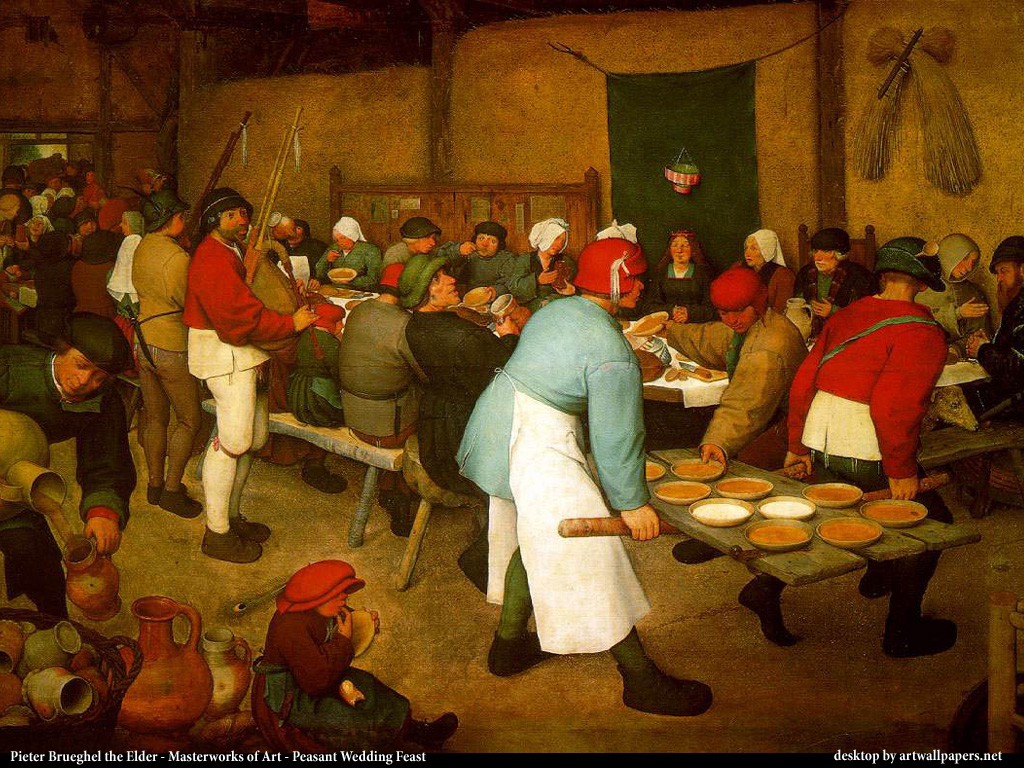
Our lesson at a wealthy Pharisee's home with a meal that introduces the Parable of the Great Banquet, and concludes with Jesus' uncompromising call to disciples who will follow him first and only.
Blessed Is He Who Banquets in the Kingdom (Luke 14:12-15)
Jesus has been invited for Sabbath dinner at the home of a leading Pharisee. The house is filled with the Pharisee's socially prominent guests, all experts in the Law. Jesus heals a man suffering from dropsy and then comments on the social-climbing proclivities of guests who take the best seats to advance their social status.
"Then Jesus said to his host, 'When you give a luncheon or dinner, do not invite your friends, your brothers or relatives, or your rich neighbors; if you do, they may invite you back and so you will be repaid. But when you give a banquet, invite the poor, the crippled, the lame, the blind, and you will be blessed. Although they cannot repay you, you will be repaid at the resurrection of the righteous.'" (Luke 14:12-14)
Invite those who can't repay you, Jesus says, for then you have an opportunity to receive a reward from God. Just inviting those of the same or higher social standing is its own reward. You have an opportunity to receive a blessing from God, he tells his host. Don't blow it.
This prompts one of the pious guests at the table to comment on the great banquet, voicing a common expectation of Judaism at the time concerning salvation in God's Kingdom, which we saw in Lesson 8.
"When one of those at the table with him heard this, he said to Jesus, 'Blessed is the man who will eat at the feast in the kingdom of God.'" (Luke 14:15)
Parable of the Great Banquet (Luke 14:16)
"Jesus replied: 'A certain man was preparing a great banquet and invited many guests.'" (Luke 14:16)
Two elements to note here: (1) This is to be a "great" banquet, and (2) many guests are invited. The host has planned a large feast with room for a great number of guests. This is no small, intimate gathering. (This parable is similar to the Parable of the Marriage Feast in Matthew 22:1-14, but has enough differences that it must have been told on a different occasion.1 )
Come, Everything is Ready (Luke 14:17)
"At the time of the banquet he sent his servant to tell those who had been invited, 'Come, for everything is now ready.'" (Luke 14:17)
While it may seem strange in light of invitation practices in the twenty-first century, in the first century world the invitation was two-fold: (1) the initial invitation some time ahead, and (2) the actual summons to the meal when it was ready. This fact is attested for both Jewish and Roman settings.2
The host has planned the feast based on the number of guests invited -- and those who had not previously indicated that they would not be present. Once the host has determined how many guests have accepted his invitation, then he is able to determine how many animals are to be killed and cooked. Bailey gives us an idea of the decisions involved. A chicken or two would suffice for 2 to 4 guests, a duck for 5 to 8, a kid for 10 to 15, a sheep for 15 to 35 people, or a calf for 35 to 75 people.3 In our passage, Jesus is referring to a large feast where the host had invited "many guests."
Not to come to a banquet where one had previously indicated acceptance, was a grave breach of social etiquette. It was an insult to the host. In a society where one's social standing was determined by peer approval -- who is invited to whose dinners -- this was an act of social insult as well. For a whole series of guests to reject the final summons appears to be a conspiracy to discredit the host. Joel Green says:
"In this instance, the socially elite of the host's community close ranks against him and shame him publicly. Whatever one makes of their excuses, their refusal to join the great dinner is a social strategy the effect of which is the host's defamation."4
Excuses, Excuses (Luke 14:18-20)
"But they all alike began to make
excuses. The first said, 'I have just bought a field, and I must go and see
it. Please excuse me.'
Another said, 'I have just bought five yoke of oxen, and I'm on my way to
try them out. Please excuse me.'
Still another said, 'I just got married, so I can't come.'" (Luke 14:18-20)
In the story Jesus tells, all the invitees now begin to make excuses. The Greek phrase used, apo mias pantes, means "from the first, all...." The rejection was unanimous. But the excuses are lame, and the three Jesus mentions are representative of the rest.
The first has just bought a field and must inspect it. But surely no one buys a field sight unseen. The second has just bought five pairs of oxen and must try them out. But no one buys five pairs of oxen without testing them first. These two excuses are flimsy on the surface. Both indicate men of wealth. Purchasing property is a wealthy man's luxury. Five yoke of oxen are for an estate; one or two pairs of oxen would be adequate for a small farm.5
The third excuse, that the guest has just been married, also is lame. When he accepted the invitation, he would have known of his wedding plans. That was the time to politely decline. But to back out at the last minute is an act of calculated rudeness.
|
|
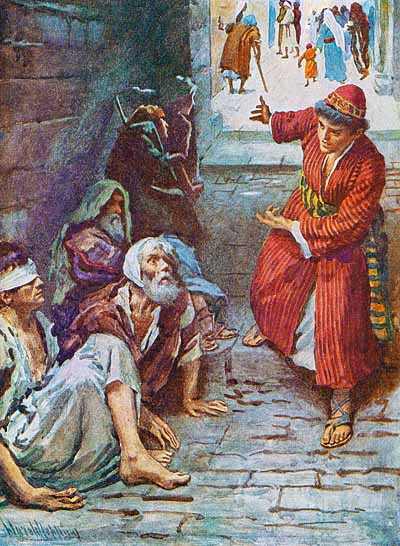
Bring in the Poor and Crippled from the Streets (Luke 14:21)
"The servant came back and reported this to his master. Then the owner of the house became angry and ordered his servant, 'Go out quickly into the streets and alleys of the town and bring in the poor, the crippled, the blind and the lame.'" (Luke 14:21)
You can't blame the host for being angry when he hears of this rude affront and unanimous rejection by his social peers. He is livid! So he tells his servant to do what would have been social suicide had he not been already rejected -- invite the lower classes. Now, however, it is an act that says, "I'll show them!" The host will not have an empty house at his feast. He will have guests!
The list of guests to be invited is identical to the list Jesus had suggested to his Pharisee host in verse 13 -- those who could not repay him by inviting him in return -- the poor, the crippled, the blind, and the lame.
Compel Them to Come from the Country Roads (Luke 14:22-23)
The servant knows his master and has anticipated his command.
"'Sir,'the servant said, 'what you ordered
has been done, but there is still room.'
Then the master told his servant, 'Go out to the roads and country lanes and
make them come in, so that my house will be full.'" (Luke 14:22-23)
The first sweep of the town included "broad, main streets or public squares" (platys) and "narrow streets, lanes, alleys" (rumē).6 The second sweep was outside the town in the rural areas, the "road, highway"(hodos)7 and "fences, hedges" (phragmos).8 Inside the town would be the poor, the beggars, the indigent. But outside the town would be the vagabonds and sojourners, those who were shunned and unwelcome in the towns.
Such people would have felt very uncomfortable at the feast of a rich man, socially very out of place. Additionally, it was a custom to politely refuse to come until pressed to -- kind of like politely refusing to take a second helping at a meal until the host says, "Oh, but you must!" and then passing your plate happily to receive more. The Greek word used is anankazō, "compel, force," of inner and outer compulsion, and then weakened, "strongly urge/invite, urge upon, press."9 The rich man hasn't sent out soldiers to sweep the area, round up everyone, and march them to his house. But he has instructed his servants not to take "No" for an answer. The servants have been told to encourage and strongly urge everyone they meet to accept this invitation.
The host's house must be full. He will not be made a fool of. He will have a full house!
None of Those Invited Will Taste the Banquet (Luke 14:24)
Jesus closes the parable in a curious way, almost as if he is voicing the words of the host himself.
"I tell you, not one of those men who were invited will get a taste of my banquet." (Luke 14:24)
It is a sentence that is filled with hurt and anger at rejection. It is a resolution not to give in to this social slight. As we read it, however, we almost hear the voice of the Father at the rejection by his rebellious people.
What Does the Parable Mean?
In interpreting the parable we need to be careful not to over-allegorize, that is, to find a correspondent meaning for every detail of the story. But this parable is an allegory, and has a similar message to the Parable of the Tenants (Luke 20:9-19) that we examined in Lesson 9.
The host is God the Father, inviting his people Israel to the messianic banquet in the Kingdom of God. The rich and socially elite who reject at the last minute the host's invitation are the Pharisees and Jewish religious establishment who begin to plot against Jesus and eventually render the ultimate insult of having Jesus executed as a common criminal. The poor and downtrodden are the common people, considered unclean by the Pharisees. Perhaps those inside the town are the Jews, while those in the outlying areas are the Gentiles. Beyond that level of allegory, however, I don't believe we should go.
What Does It Say to Disciples?
As I meditate on the Parable of the Great Banquet, I am impressed with a number of themes:
1. Rejection and Insult
We feel bad when we are rejected, but what about the Father? Think of his grief and broken heart. Think of his anger and mercy. I recall the verses at the beginning of John's Gospel that express this:
"He came to that which was his own, but his own did not receive him. Yet to all who received him, to those who believed in his name, he gave the right to become children of God -- children born not of natural descent, nor of human decision or a husband's will, but born of God." (John 1:11-13)
Jesus told us,
"If the world hates you, keep in mind that it hated me first. If you belonged to the world, it would love you as its own. As it is, you do not belong to the world, but I have chosen you out of the world. That is why the world hates you. Remember the words I spoke to you: 'No servant is greater than his master.' If they persecuted me, they will persecute you also. If they obeyed my teaching, they will obey yours also. They will treat you this way because of my name, for they do not know the One who sent me." (John 15:18-21)
This parable is a bittersweet reminder of rejection, but also of mercy.
2. Mercy and grace
The second theme I see is one of grace and mercy. Those who are not worthy to come to the host's table -- the poor, lame, crippled, blind -- are now invited. He's talking about you and me. We are unworthy to eat at our Host's table, but we have been invited and cleansed. How true it is:
"Blessed is the man who will eat at the feast in the kingdom of God." (Luke 14:15b)
As I read the servant's invitation, "Come, for everything is now ready," my mind begins singing an old gospel hymn:
"'All things are ready,' come to the
feast!
Come, for the table now is spread;
Ye famishing, ye weary,
Come and thou shalt be richly fed.
Hear the invitation, come, 'whosoever will.'
Praise God for full salvation for 'whosoever will.'"10
This is God's mercy, pure and simple.
3. Evangelism
A third, and closely related theme is evangelism. The poor, lame, crippled, and blind are now sought out. They are not just invited, but they are sought out and urged, compelled, to accept the invitation. The poor and oppressed among the Jewish people are in view, but also the Gentiles. We are the servants, and bring a marvelous message of invitation and acceptance and forgiveness. We must take our role seriously and urge the invitation wherever we are. This is not a take-it-or-leave-it task. It is a mission, the mission of the Host, and we must fulfill it.
4. Judgment
Those who reject the invitation, however -- for whatever reason -- will not taste the Master's banquet. They will not "eat at the feast in the kingdom of God" (Luke 14:15).
|
Q1. (Luke 14:15-24) In the Parable of the
Great Banquet, who do the original guests represent? Who do the
later invited guests represent? What does it mean to "compel them to
come in" (KJV)? How might this sense of urgency apply today?
|
5. Lame Excuses
I am sorry to say that in the lame excuses of the original guests, I hear some of my own shallow excuses for not doing God's will. We may be able to convince ourselves that what we are doing is noble, but I am afraid that too often our excuses are an insult to God. He is the Host and he is the Master of the house. It is God's mercy that we are not consumed!
6. God's Plan
The final theme that I see here is one of God's plan. The host has prepared food for a large number of guests, and he won't be satisfied until his house is completely full.
"The Lord is not slow in keeping his promise, as some understand slowness. He is patient with you, not wanting anyone to perish, but everyone to come to repentance." (2 Peter 3:9)
I get the feeling -- though this is not inherent in the parable before us -- that as soon as the last place is taken at the banquet, the door will be shut and the feast will begin. The Father is lingering, waiting for each and every seat to be taken, and the End will not come until that has occurred. We catch a hint of this in Second Peter:
"Since everything will be destroyed in this way, what kind of people ought you to be? You ought to live holy and godly lives as you look forward to the day of God and speed its coming." (2 Peter 3:11-12)
I believe we can "speed" the coming of the Day of the Lord by evangelism.
"And this gospel of the kingdom will be preached in the whole world as a testimony to all nations, and then the end will come" (Matthew 24:14).
As we do throughout the Bible, we see the themes of free will and predestination intertwined -- God's established purpose, our obedience to serve him, and the acceptance of the invitation by those to whom we speak. How it all fits together God only knows.
This parable is shocking socially. It is also sobering and urgent. May God use it to urge you to thankfulness and obedience too.
|
Q2. (Luke 14:15-24) In what way is the
Parable of the Great Banquet about grace? In what way is it about
judgment? In what way is it about evangelism? To what End Time event
does the great banquet point??
|
The Priority of Following Jesus (Luke 9:57-62)
Let's conclude our study of Jesus and the Kingdom by taking one final look at the nature of Jesus' call for discipleship.
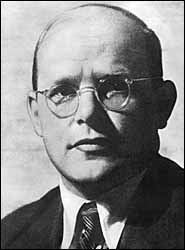
Dietrich Bonheoffer (1906-1945) wrote a brilliant but uncomfortable book, The Cost of Discipleship (1948). Bonheoffer was one of the few German clergymen to stand up against Hitler's godless rise to power -- and he paid for it with his life. But his book's title reminds us of the cost of following Jesus closely.
|
|
Luke 9:57-62 is all about following. The key word is a familiar one, Greek akaloutheō, "to follow someone as a disciple, be a disciple, follow."111 One question I'd like you to ponder as we study is this: Can a person be a Christian without being a follower of Jesus?
Discipleship's Sojourn (Luke 9:57-58)
"As they were walking along the road, a
man said to him, 'I will follow you wherever you go.'
Jesus replied, 'Foxes have holes and birds of the air have nests, but the
Son of Man has no place to lay his head.'"(Luke 9:57-58)
As Jesus walks, a whole company of people follow him, not only the Twelve. And from time to time various people come up alongside him and engage him in conversation as they walk. In our passage, a man, moved by Jesus' words and vision, says to him, "I will follow you wherever you go."
Jesus' reply, however, isn't encouraging, but rather off-putting: "Foxes have holes and birds of the air have nests, but the Son of Man has no place to lay his head." In other words, he is saying, I don't have any home. If you follow me, you will have no home to call your own either. Does that mean that disciples shouldn't look forward to home ownership?
That's what it may mean for some.
Jesus has left his family home in Nazareth to carry out his mission. He can't return to Nazareth where they seek to kill him (Luke 4:29). He has stayed with friends in Capernaum for awhile. But now he has "set his face towards Jerusalem" (Luke 9:51) and cannot turn back.
Jesus is a sojourner, a non-resident alien, one who stays for a time, and then travels elsewhere. In this he was like Abraham his forefather:
"By faith Abraham, when called to go to a place he would later receive as his inheritance, obeyed and went, even though he did not know where he was going. By faith he made his home in the promised land like a stranger in a foreign country; he lived in tents, as did Isaac and Jacob, who were heirs with him of the same promise. For he was looking forward to the city with foundations, whose architect and builder is God." (Hebrews 11:8-10)
We aren't to be other-worldly and detached from this life. Jesus wasn't. He lived in the here-and-now carrying out his Father's mission. But he was a sojourner. He had no home here to call his own. He was on a journey, and Golgotha lay squarely in his route. The road was painful, but had glory at its end.
"...Who for the joy set before him endured the cross, scorning its shame, and sat down at the right hand of the throne of God." (Hebrews 12:2)
He allowed nothing to distract him from this goal. This is Jesus' path. Can you follow him on it?
He isn't offering to follow you. You are offering to follow him and put up with the hardships and self-denial that come on his path. Are you really willing -- even though it means sacrificing some comforts?
"I will follow you wherever you go," said the man.
"Foxes have holes and birds of the air have nests," replied the Master, "but the Son of Man has no place to lay his head."
Are you able to follow a sojourner?
Discipleship's Immediacy (Luke 9:59-60)
"He said to another man, 'Follow me.'
But the man replied, 'Lord, first let me go and bury my father.'
Jesus said to him, 'Let the dead bury their own dead, but you go and
proclaim the kingdom of God.'" (Luke 9:59-60)
If the man's father has just died, what in the world is the man doing hanging around Jesus? He should be home making funeral arrangements! It's obvious that his father isn't dead -- yet. Not even seriously ill, or the man would be asking Jesus for healing.
What the man is saying is this: I have responsibilities to my father as long as he lives. I'm not free to follow you right now. But when my dad dies -- and he is getting on in years -- then I'll follow you right away. I just can't follow now.
Jesus' answer seems harsh. It seems to run counter to family responsibilities. It is strong: "Let the dead bury their own dead, but you go and proclaim the kingdom of God." Who are the "dead" who are going to conduct the funeral? Jesus is speaking figuratively here of the spiritually dead -- those who have put off following Jesus. The spiritually dead put family responsibilities before their responsibilities to Jesus. But the spiritually alive are to follow -- now!
Later, Jesus tells his disciples,
"If anyone comes to me and does not hate his father and mother, his wife and children, his brothers and sisters -- yes, even his own life -- he cannot be my disciple." (Luke 14:26)
Jesus is saying in the strongest possible terms that following him must come before every responsibility we have -- even those which we hold sacred.
For most of us, our call to follow Jesus does not mean we have to physically leave our loved ones. But we may need to leave them behind spiritually in order to follow Jesus. You can't say: When my husband gets saved and decides to follow Jesus, then I'll be the most faithful disciple you can find anywhere. I just don't want to get ahead of him spiritually. It doesn't work that way. You aren't to choose when you are to follow. Today is the day. Following Jesus is a now thing. It is immediate. No excuse you can offer is adequate to put on hold his compelling summons. "Let the dead bury their own dead," Jesus says, "but you go and proclaim the kingdom of God" (Luke 9:60).
In this case, Jesus is about to send seventy of his followers to go from village to village to carry the message of the Kingdom (Luke 10:1-24). Jesus needs this man ready and committed to be in a certain place at a certain time, even though Jesus hasn't announced the mission yet. But the man can't be counted on. His other commitments keep him from doing Jesus' immediate and glorious will for his life.
The message to you and me is just as strong: "Let the dead bury their own dead, but you go and proclaim the kingdom of God."
Discipleship's Single-mindedness (Luke 9:61)
"Still another said, 'I will follow you, Lord; but first let me go back and say good-bye to my family.'" (Luke 9:61)
If the first two people had met hard responses, the third seems harder yet. All the man wanted to do was go home and say good-bye. That's all. What's so wrong with that?
In light of the immediate mission ahead -- the sending out of the Seventy to the villages of Judea -- for the man to go home will mean that he will miss out, though his request seems reasonable enough.
It's like a man who has been drafted into the military in wartime. He says, "I'll report for duty in just a week, but first I need to go home and say good-bye to my girlfriend, my buddies, my mom and dad, my sisters and brothers, and have a final going away party, since I may be away a long time. Is he ready for the army? No way! He is looking to his own needs and desires, not the needs of the service.
Just last week I heard someone in her twenties say, "When I'm young I want to be free to enjoy myself. Later on, then maybe I'll settle down." This is common. I believe in Jesus, but I'm not ready to get too serious about it right now. When I get older, I will. What an insult to Jesus!
|
Q3. (Luke 9:57-61) Why was Jesus so harsh
with those who made excuses when called to follow him? Why is the
call so urgent? Why do our excuses seem so trivial when offered to
Jesus?
|
Crooked Furrows (Luke 9:62)
"No one who puts his hand to the plow and looks back is fit for service in the kingdom of God." (Luke 9:62)
Whether your plow is pulled by a mule or by a diesel tractor there is one no-no: You never try to plow while looking over your shoulder. If you do, your rows are crooked and your field is difficult to work. If you try to plow while looking back, you're not fit to be in the field. You'd be fired in a hurry by the farmer. Rather, plowmen fix their eyes on a point at the far end of the field and move steadily toward it, not veering to the right side or to the left.
To "put your hand to the plow," means to begin the task of plowing. The Greek verb tenses underline the point. Literally, "No man, having put (Aorist tense, past complete action) his hand to the plough, and looking back (Present tense, continuous action), is fit for the kingdom of God"(9:62, KJV). Jesus isn't saying you can't glance back. But he is saying you can't continue to look back once you've begun to plow. If you do, you're not "fit," Greek euthetos, "fit, suitable, usable, convenient for something."12
Teachings of Grace and Urgency
We've looked at two different teachings on the calling to be a disciple: The Parable of the Great Banquet and Jesus' teaching on the cost of discipleship.
In the Parable of the Great Banquet we see grace. It tells of the graciousness of a householder who invites undeserving people to his banquet, and is delighted to have them present. Unworthy or low in status, he invites them all, and they respond with appreciation at the honor. This is a parable of grace. Judgment follows only when grace is spurned. You have been honored with a personal invitation from the Master, and you have come in response.
Your invitation was urgent. Jesus won't take "No"for an answer. Nor is "later" or "too busy" acceptable. In the parable, a servant is sent to "compel them to come in" (Luke 14:23, KJV). And now you are the servant with the same message of discipleship, the same invitation to the feast.
|
Q4. What does the call to the Great Banquet sound like when we
extend the invitation to those around us? In what sense are we the
servants told to "compel them to come in"? In what sense are we
those who have been called to the feast in the Kingdom of God?
|
The Final Banquet in the Kingdom of God
The Kingdom of God is like this banquet, Jesus explains. The call to the Kingdom is serious and urgent and cannot be put off.
There will be a time, says Jesus -- and it is not so far away now! -- when the saints will gather, and you, too, have been invited to that feast.
"I say to you that many will come from the east and the west, and will take their places at the feast with Abraham, Isaac and Jacob in the kingdom of heaven." (Matthew 8:11)
Jesus ate bread and drank wine with his disciples at the Last Supper, and then said,
"I will not drink this fruit of the vine with you until I drink it anew with you in my Father's kingdom." (Matthew 26:29)
This is the feast to which you and I have been invited: the great Marriage Supper of the Lamb. "Blessed are those who are invited to the wedding supper of the Lamb," St. John records in Revelation 19:9.
 A book of the compiled lessons is available in both e-book and paperback formats. |
And until the final call comes to take our seats around the table, we are still inviters to yet others to come. For on that Day, at the final trumpet call, we'll be seated with the Kingdom greats around a table presided over by none other than the King of kings and the Lord of lords. And at that feast we will witness the consummation of the Kingdom of God!
"The Spirit and the bride say, 'Come!' And let him who hears say, 'Come!' Whoever is thirsty, let him come; and whoever wishes, let him take the free gift of the water of life." (Revelation 22:17)
Amen. Come, Lord Jesus!
Prayer
Father, in these parables I sense your seriousness, your hurt at those who reject your grace, and your urgency. Please help me to share your heart. Shake complacency out of me. Help me to be a worthy and obedient bearer of your invitation. In Jesus' name, I pray. Amen.
Key Verses
"Then the master told his servant, 'Go out to the roads and country lanes and make them come in, so that my house will be full.'" (Luke 14:23, NIV)
"No one who puts his hand to the plow and looks back is fit for service in the kingdom of God." (Luke 9:62, NIV)
References (Abbreviations)
1. Matthew 22:1-14 relates a similar parable, with several differences. The host is a king in Matthew, "a certain man" in Luke. The occasion is a wedding banquet for a son in Matthew, a "great banquet" in Luke. Those who make excuses and abuse the king's servants in Matthew are destroyed by the enraged king; in Luke they are promised that they will not taste of the banquet. Finally Matthew's account introduces a guest who isn't wearing wedding clothes. Surely Jesus repeated his parables dozens or hundreds of times in his itinerant teaching. This parable is also preserved in the Gospel of Thomas, in a form somewhat similar to Luke's account (Gospel of Thomas, 64).
2. Esther 6:14; La. R 4:2; Strack and Billerback I, 880f.; Philo, Opif 78; Terence, Heaut. 169f.; Apuleius Met. 3:12, cited by Marshall, Luke, pp. 587-588.
3. Kenneth E. Bailey, Through Peasant Eyes (Eerdmans, 1980), p. 94, cited by Green, Luke, p. 558, fn. 151.
4. Green, Luke, p. 559.
5. Jeremias, Parables.
6. Marshall, p. 590.
7. Hodos, BDAG 690-692.
8. Phragmos, BDAG 1064.
9. Anankazō, BDAG 60.
10. "All Things Are Ready," words by Charles H. Gabriel (1895), music by W.A. Ogden.
11. Akaloutheō, BDAG 36, 3.
12. Euthetos, BAGD 320.
Copyright © 2026, Ralph F. Wilson. <pastor joyfulheart.com> All rights reserved. A single copy of this article is free. Do not put this on a website. See legal, copyright, and reprint information.
 To be notified about future articles, stories, and Bible studies, why don't you subscribe to our free newsletter, The Joyful Heart, by placing your e-mail address in the box below. We respect your