


|
Old Testament
New Testament
Gospels
Acts
Paul's Letters
General Letters
Revelation
Topical Studies
Beginning the Journey (for new Christians). en Español

|
Old Testament
New Testament
Gospels
Acts
Paul's Letters
General Letters
Revelation
Topical Studies

|
Home
Bible Studies
Articles
Books
Podcasts
Search
Menu
Donate
About Us
Contact Us
FAQ
Sitemap


Free
E-mail Bible Study
 Experiencing the Psalms
Home | Bible Studies | Articles | Books | Podcasts | Search | Menu | Donate | About Us | FAQ | Contact Us
|
|
The Coming of the Son of Man and the Kingdom of Heaven
In Matthew chapters 24 and 25 Jesus focuses on the coming of the Son of Man and his Kingdom. He shares with his disciples:
- Signs of the End of the Age (24:1-31), which we examined in Lesson 4 in Luke's account
- Parable of the Fig Tree (24:32-33) putting forth its leaves
- No One Knows the Day or Hour (24:34-36)
- Days of Noah (24:37-41) and the need for watchfulness
- Parable of the Watchful Householder (24:42-44)
- Parable of the Faithful and Wise Servant (24:45-51)
- Parable of the Wise and Foolish Virgins (25:1-13)
- Parable of the Talents (25:14-30)
- Parable of the Sheep and the Goats (24:31-46)
Parable of the Talents (Matthew 25:14-30)
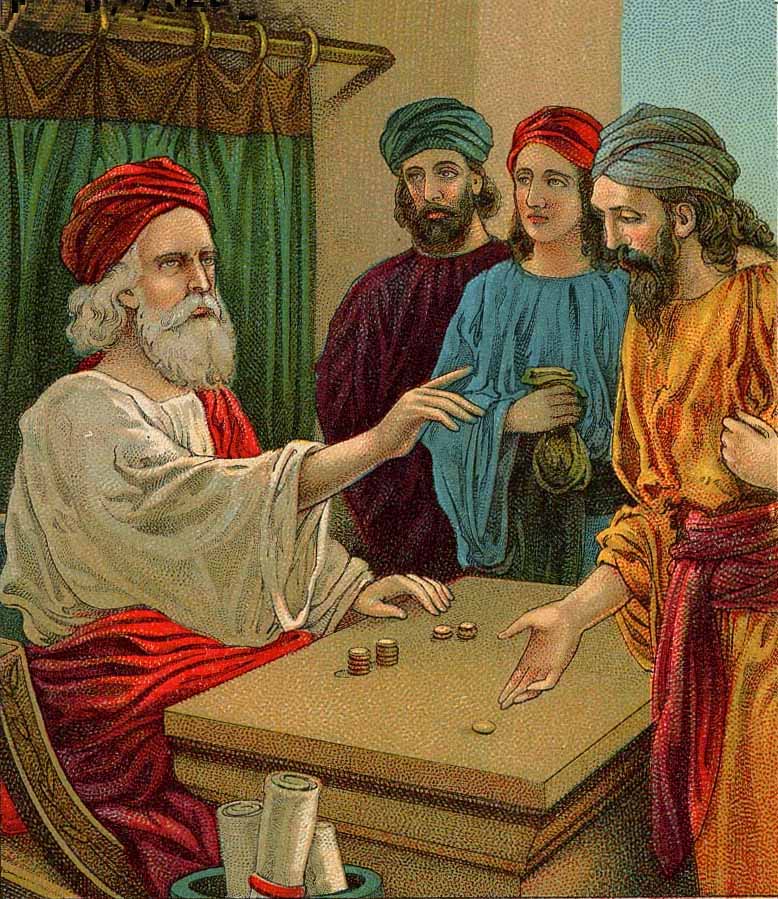
It is in this context of parables of the coming of the Son of Man and his Kingdom that we find the Parable of the Talents. It is about a man who went away, trusted his property to his servants, and upon his long-delayed return, settles accounts with these servants, rewarding the faithful and punishing the lazy. The obvious lesson is that when the Son of Man returns, he will settle accounts with us, his servants.
This parable is so famous and influential that our English word "talent," as "a special often creative or artistic aptitude, ability"1 flows directly from this very parable.
Our English word "talent" comes from the Greek word talenton, originally a measure of weight, then a unit of coinage, "talent.2 "In the Parable of the Unforgiving Servant (Lesson 7) we noted that one Tyrian talent would be worth about 6,000 denarii, with a denarius being the average daily pay for a laborer. Thus, if we calculated a laborer's pay today at a conservative $100 per day, one talent might be worth $600,000 or more in today's money.
It's important when reading the Parable of the Talents to realize that "talent"in this parable means money, not abilities (though that might be implied in an interpretation). To keep readers from taking the word metaphorically without thinking, some English translations translate talenton as "bags of gold"(NEB, TNIV).
The Parable of the Talents vs. the Parable of the Pounds or Minas
Jesus told two similar parables, but in different contexts. The more familiar to us is the Parable of the Talents (Matthew 25:14-30). It is quite similar to The Parable of the Pounds or Minas recorded in Luke (Luke 19:11-27). Both parables are in the context of a delay in Christ's return. And both involve giving servants money to invest in various enterprises, so the amount of money will be increased by the time the master returns. However, there are several differences:
|
|
Matthew: Talents |
Luke: Pounds |
|
Benefactor |
Wealthy man |
Nobleman who becomes a King |
|
Coinage |
Talent ($600,000) |
Mina3 ($7,800) |
|
Distribution |
More to some than others |
One to each servant |
|
Hatred of citizens |
- |
Mentioned |
These are similar but different parables. Jesus, who repeated his teachings constantly in town after town, obviously told this basic parable in two different ways, depending upon what he was seeking to emphasize. However, the primary point of each form of this parable is nearly the same.
The Kingdom of Heaven Will Be Like ...
Jesus begins this parable with the words:
"Again,4 it will be like a man going on a journey, who called his servants and entrusted his property to them." (Matthew 25:14)
"It" refers back to the beginning of the preceding parable, "At that time the kingdom of heaven will be like ten virgins..."(Matthew 25:1). The Parable of the Ten Virgins (Matthew 25:1-13) and the Parable of the Talents (Matthew 25:14-30) have two elements in common.
- Coming Kingdom. They both refer to what the Kingdom will be like when the Son of Man comes.
- Delay of Christ's Coming. They both have elements of delay: "The bridegroom was a long time in coming"(25:5) and "after a long time the master of those servants returned"(25:19).
But while the Parable of the Ten Virgins reminds us to be ready for an extended delay, the Parable of the Talents encourages us that the time waiting for the coming of the Kingdom should be used to make full use of the resources our Lord has given us.
A Man Going on a Journey (Matthew 25:14)
Jesus begins the parable by introducing "a man going on a journey." The verb is apodēmeō, "to travel away from one's domicile, go on a journey."5 The word suggests an extended absence.
Entrusting His Property to His Servants (Matthew 25:14b)
"Again, it will be like a man going on a journey, who called his servants and entrusted his property to them." (Matthew 25:14)
In ancient times, how does a businessman protect his capital when he must be gone for an extended period? He could bury his money, but he probably couldn't keep his household going at the same time. Perhaps he could deposit his money with a banker for passive growth of interest on the funds (verse 27). But for the best yield, he would find competent people who could invest his money wisely and then actively manage the investment, so that when he returns, the money has been at work and earned a handsome profit. Of course, there's some risk involved, but a businessman can minimize his risk in two ways:
- Divide the capital into several different investment pools.
- Give the most capital to the most competent managers and less to those who have yet to prove themselves.
That's exactly what our master does. In this case, he has his house slaves (doulos) to do the work for him. He gathers them into his office, explains exactly what he wants them to do, and then distributes his funds among them. Literally he "entrusted6 his property7 to them. "The Luke version of the parable employs the phrase, "put this money to work" (NIV) or "occupy" (KJV). The word is pragmateuomai, "do business, trade."8 The RSV translation, "trade with these," and the NRSV translation, "do business with these," render the idea well.
Each According to His Ability (Matthew 25:15)
Though in the Parable of the Pounds, each servant gets an equal amount, here in the Parable of the Talents, each servant gets an amount of capital commensurate with his potential -- "each according to his ability." "Ability"is dynamis, "power," in the sense of, "ability to carry out something, ability, capability."9 The most promising servant got the most, while the least promising servant got the least. If you figure a talent is about $600,000, then here's the distribution:
|
Servant 1 |
5 talents |
$3,000,000 |
|
Servant 2 |
2 talents |
$1,200,000 |
|
Servant 3 |
1 talent |
$600,000 |
Putting the Money to Work (Matthew 25:16-18)
Now the master leaves town and the servants get to work -- at least two of them.
"16 The man who had received the five talents went at once and put his money to work and gained five more. 17 So also, the one with the two talents gained two more. 18 But the man who had received the one talent went off, dug a hole in the ground and hid his master's money." (Matthew 25:16-18)
Notice that the first servant "went off at once" (NRSV, cf. NIV).10 He was eager and motivated. He "put his money to work" (NIV) or "traded" (NRSV, KJV) with it.11 And by the time the master returned, he had doubled his money12 to a cool $60,000. The second servant also doubled his money. But the servant with the single talent buried his in the ground. Burying something was considered a secure way of protecting one's treasure,13 but that only protected the capital; it did not increase it, as the master had intended.
Settling Accounts (Matthew 25:19-22)
Now, at length, the master returned.
"After a long time the master of those servants returned and settled accounts with them." (Matthew 25:19)
The time of reckoning had come. Each of the servants is brought into the office to give a report, to "settle accounts,"14 a phrase we saw in the Parable of the Unmerciful Servant (Matthew 18:23). The first two servants can hardly contain themselves as they report their successful investment experiences:
"20 The man who had received the five talents brought the other five. 'Master,' he said, 'you entrusted me with five talents. See, I have gained five more.'21 His master replied, 'Well done, good and faithful servant! You have been faithful with a few things; I will put you in charge of many things. Come and share your master's happiness!'
22 The man with the two talents also came. 'Master,' he said, 'you entrusted me with two talents; see, I have gained two more.'23 His master replied, 'Well done, good and faithful servant! You have been faithful with a few things; I will put you in charge of many things. Come and share your master's happiness!'" (Matthew 25:20-23)
"Well done" is Greek eu, an interjection that pertains to meeting a standard of performance, "well done! excellent!"15 The master also praises the character of these servants, calling each a "good and faithful servant.""Faithful" (NIV, KJV), "trustworthy" (NRSV) is the common Greek word pistos, "worthy of belief or trust, trustworthy, faithful, dependable."16
"You have been faithful with a few things," says the master. "I will put you in charge of many things. Come and share your master's happiness!" If one of the "few things" was responsibility to invest $30,000, the "many things" would have to mean greatly increased responsibility indeed -- and status! In the Parable of the Pounds, the servants' reward includes authority over several of the king's cities!17
More than that, the servant can bask in the master's "happiness." The word chara, "joy," used here can have the sense of something that causes joy, such as "a festive dinner or banquet."18 "Enter into" (NRSV, KJV), "share" indicates some kind of mutual celebration of joy.19
The Wicked Servant's Excuse (Matthew 19:24-25)
But the third servant is not nearly so eager to please.
"24 Then the man who had received the one talent came. 'Master,' he said, 'I knew that you are a hard man, harvesting where you have not sown and gathering where you have not scattered seed. 25 So I was afraid and went out and hid your talent in the ground. See, here is what belongs to you.'"(Matthew 19:24-25)
The unproductive servant is bold -- I'll give that to him. But he sounds almost like he is accusing his master of being an evil capitalist, "harvesting where you have not sown and gathering where you have not scattered seed." The servant claims to have acted out of fear (verse 25), since his master is a "hard" (NIV, KJV) or "harsh" (NRSV) man. The word is sklēros, "hard." Here it is used figuratively, "unyielding in behavior or attitude" in dealing with others "hard, strict, harsh, cruel, merciless."20
The servant sees this accusation as plenty of excuse for his actions. He will return to the master what is his, but he certainly won't help him increase it! There's a vein of bitterness apparent in the servant's answer, along with self-justification. If the servant had nothing to gain, he certainly wouldn't help his slave owner!
The Judgment on the Wicked Servant (Matthew 25:26-27)
The master hears him out, and then lambastes him:
26 His master replied, 'You wicked, lazy servant! So you knew that I harvest where I have not sown and gather where I have not scattered seed? 27 Well then, you should have put my money on deposit with the bankers, so that when I returned I would have received it back with interest.'"(Matthew 25:26-27)
The master calls the unproductive servant a "wicked," from ponēros, "morally or socially worthless, wicked, evil, bad, base, vicious, degenerate."21 In addition he is called "lazy" (NIV, NRSV), "slothful" (KJV). The word is oknēros, possessing oknos, that is, a state involving shrinking from something, "holding back, hesitation, reluctance." The adjective means, "idle, lazy, indolent."22
His motives were disobedient, self-righteous, and selfish. As a slave, he was morally and legally obligated to serve his master. Instead, he deliberately disobeyed and then excused himself by accusing his master.
The master faults the wicked servant for not even taking the simplest and most conservative steps to get some increase on the money by depositing23 it with the bankers.24 "Interest" (NIV) or "usury" (KJV) is Greek tokos, "interest on money loaned."25 While Jews were forbidden to receive interest on money loaned to the poor, some other kinds of business loans were legal for them.
The Faithful Will Receive More (Matthew 25:28-29)
The wicked servant has not been merely lazy, but has deliberately refused to do anything that will benefit his master. There is no second chance for deliberate rebelliousness.
"28 Take the talent from him and give it to the one who has the ten talents. 29 For everyone who has will be given more, and he will have an abundance. Whoever does not have, even what he has will be taken from him." (Matthew 25:28-29)
The master gives the unused talent to the servant who has five talents already, plus the five more he had earned. Someone might question his action on the basis of fairness -- or perhaps need. "He already has ten -- he doesn't need another." But the king is distributing his gifts on the basis of faithfulness and capability, not fairness or need. After a trial period, the king now expects of his servants a track record of faithfulness and productivity -- that they can use his gifts.
Punishment for His Enemies (Matthew 25:30)
But the wicked and lazy servant gets more than a tongue lashing and loss of the talent he had been given to invest. He is punished.
"And throw that worthless servant outside, into the darkness, where there will be weeping and gnashing of teeth." (Matthew 25:30)
This last verse seems to shift from a parable about a wealthy slave owner punishing a recalcitrant slave to another level entirely, to severe spiritual punishment. Elsewhere in Matthew, "weeping and gnashing of teeth"(8:12) is identified with outer darkness (8:12; 22:13) a fiery furnace (13:42, 50); and being cut in pieces (24:51), all terrible symbols of an even more terrible spiritual fate.
Interpreting the Parable of the Talents
I have deliberately resisted the temptation to jump too soon into this parable with interpretations and applications, so you'd have a chance to consider the entire parable before reflecting. But now is the time to apply this rather scary parable to ourselves. Let's ask some questions that guide us to applying this parable.
What do the "talents" represent?
A talent, we determined, is an amount of money, perhaps worth $600,000 or more in today's currency. Since the servants in our parable are slaves, they can't earn money, but they are given the master's money to invest until his return.
What does the money represent? I believe it represents the spiritual gifts, abilities, "talents," and knowledge that Jesus has passed on to his disciples -- to you and to me. Moreover, what we have to "invest" in Kingdom work includes our station in life, our wealth (if we have any), our houses, our cars, our job, our network of contacts and personal friends.
|
Q1. (Matthew 25:14-30) What do you think
the "talents" represent? If you were to take an inventory of your
"talents," what would they be? What spiritual gifts have you been
given? What abilities do you have? What Bible knowledge do you have?
Where has God placed you in your community? In society? In your
profession or industry? In what sense do these "belong" to God
rather than to you?
|
On what basis does God distribute the "talents"?
"To one he gave five talents of money, to another two talents, and to another one talent, each according to his ability." (Matthew 25:15)
It's pretty clear that the "talents of money" were given based on "ability." For that reason we can't make the simple equation between "talents" and "ability," as some naively do. Remember, "ability" (dynamis) here means "ability to carry out something, ability, capability."26 One's ability to carry out something is based on a number of things:
- Raw talent
- Drive
- Faithfulness
- Moral character
- Willingness to focus time to the task
When the master returned, those who had shown faithfulness and ability he rewarded with more responsibility. From the one who had some ability, but who lacked faithfulness, moral character, and will, he took away the single talent that he had been given.
|
Q2. (Matthew 25:15, 21, 23) What are the factors that make up a person's "ability to carry out something"? What percentage of this is raw talent, in your opinion? Why are some who succeed not necessarily the most talented? What factors are keeping you from carrying out what God has entrusted you to do? https://www.joyfulheart.com/forums/index.php?showtopic=1026
|
To whom do the "talents" and their increase belong?
It's easy for us to miss the fact that even the most successful servant was a slave. Even though he had earned a great deal of money for his master, he was not set free as a reward, but given greater responsibilities and higher status in the household. This is significant.
Often, when we become successful, we're tempted to imagine that we are "self-made" men or women and that the fruit of our success is ours to enjoy. This is wrong on three counts. First, no one ever succeeds by himself or herself. All of us are deeply indebted to those who have gone before. Second, it is God who has given us the resources that contribute to success. Third, we are stewards of what God has given. We do not suddenly become owners of God's resources when success comes. We are still stewards, servants, slaves of the Most High God. We must never take the glory to ourselves. All glory and credit goes to God who gave the "talents of money" for us to work with in the first place.
"Do you not know that your body is a temple of the Holy Spirit, who is in you, whom you have received from God? You are not your own; you were bought at a price. Therefore honor God with your body." (1 Corinthians 6:19-20)
|
Q3. When we are successful, to whom does
the fruit of our labors belong? In what sense are we independent
entrepreneurs? In what sense are we stewards of the gifts and
"talents" given us? How does the attitude of a self-made person
differ from the attitude of a steward?
|
How will God reward us for using our "talents"?
One of the haunting lessons of the Parable of the Talents is the attitude -- and fate -- of the servant who had been given one talent and buried it in the ground, ostensibly for safekeeping.
The real reason he buried the talent of money was that he both feared and resented his master. Thus, he acted selfishly, only doing what he thought might benefit him.
I wonder how many of us "bury our talent" and do not use it or develop it? You can be an extremely gifted violinist, but if you do not practice, you won't improve. If you don't play regularly, you'll get rusty. If you aren't in the habit of both practicing regularly and playing often for others, you will have wasted a tremendous natural ability.
God has given you gifts to further his Kingdom. They may include a lot of raw ability, or personal drive, or resources from a wealthy family, or a great job. Or perhaps the ability to help others through dedicated, faithful labor. Whatever it is God has given you, he will hold you accountable.
On Judgment Day, you will not be justified or condemned based on your works. Paul taught us:
"If any man builds on this foundation using gold, silver, costly stones, wood, hay or straw, his work will be shown for what it is, because the Day will bring it to light. It will be revealed with fire, and the fire will test the quality of each man's work. If what he has built survives, he will receive his reward. If it is burned up, he will suffer loss; he himself will be saved, but only as one escaping through the flames." (1 Corinthians 3:12-15)
We are justified by faith in the grace and mercy of God through Jesus Christ.
|
Q4. How do you think Jesus will hold you
personally accountable on Judgment Day for using your "talents"? If
you begin to be more faithful from now on, how do you think that may
affect his accounting on that Day?
|
Rewards for Faithful Service
The scripture is very clear:
"For we must all appear before the judgment seat of Christ, that each one may receive what is due him for the things done while in the body, whether good or bad."(2 Corinthians 5:10)
This judgment is about rewarding Christ's servants for their faithfulness and obedience while here on earth. There are many verses that indicate heavenly rewards for faithfulness.
"The Lord will reward everyone for whatever good he does...." (Ephesians 6:8)
"If anyone gives even a cup of cold water to one of these little ones because he is my disciple, I tell you the truth, he will certainly not lose his reward." (Matthew 10:42)
"Your Father, who sees what is done in secret, will reward you." (Matthew 6:4)
"For the Son of Man is going to come in his Father's glory with his angels, and then he will reward each person according to what he has done." (Matthew 16:27)
"You will be repaid at the resurrection of the righteous." (Luke 14:14b)
Parable of the Sheep and the Goats (Matthew 25:31-46)
In the Parable of the Sheep and the Goats we see the final judgment:
"Then the King will say to those on his right, 'Come, you who are blessed by my Father; take your inheritance, the kingdom prepared for you since the creation of the world." (Matthew 25:34)
The believers wonder what they had done to deserve this.
"'Lord, when did we see you hungry and feed you, or thirsty and give you something to drink? ... The King will reply, 'I tell you the truth, whatever you did for one of the least of these brothers of mine, you did for me.'" (Matthew 25:37, 40)
We don't do good deeds as "eye-service" to impress Jesus and earn "points" for heaven. We do them because "we are God's workmanship, created in Christ Jesus to do good works" (Ephesians 2:10). We do them because he has put his values in our hearts by his Holy Spirit, because we want to live as Jesus would, if he were in our place. Yet he sees each service and will reward it on that Day.
What Will the Rewards Be Like?
If you're like me, however, you have a hard time visualizing or even understanding the "rewards" that we may receive. I don't really serve Christ for the rewards, but out of love for him and a shared commitment to his mission. In addition to being in heaven, what more is there? What more do I need?
This may be a poor analogy, but it's the best I have for now. Many times I have gone to Chicago on business. Usually, I'll stay in a nice, but cheap hotel. It has everything I need -- and the price is right. Recently, however, I was asked to be a speaker at a conference held in the Chicago Hilton. One of the perks was a wonderful room in the hotel. Maybe that's what "heaven" is like. It was extremely comfortable! But I was lonely!
One evening, though, I was personally invited by the conference head to the penthouse suite for a party paid for by the conference organizers. The view over Chicago and Lake Michigan was utterly spectacular. But even better was the camaraderie of people at the party and their joy at being together. Many I had known for years. But others to whom I was introduced, I had only heard about. It was a heady occasion. A party, you know, is more than good food and drink. It is best enjoyed with people you care about and who care about you.
How will Jesus reward his servants for their faithfulness on that Day when he returns in his Kingdom? I don't know. Accommodations, I am sure, will be great for everyone in heaven. But will I be invited to spend "face time" with Father Abraham? Will I get to talk to St. Paul about his experiences? I can only speculate. I do know that his rewards will be wonderful. Most of all will I look forward with hope and expectation to Jesus words:
"Well done, good and faithful servant. Enter in to the joy of your Master."
I want to please him. With all my heart, I want to please him.
Ruling and Reigning with Christ
There are a number of passages that indicate that we will rule with Christ when the Kingdom comes. This accords with the greater responsibility given the faithful servants in the Parable of the Talents and the 10 cities given the faithful servant in the Parable of the Pounds or Minas.
Consider these verses, beginning with a prophecy in the Son of Man passage in Daniel that will be fulfilled when Christ returns in his Kingdom:
"But the saints of the Most High will receive the kingdom and will possess it forever-- yes, for ever and ever.... Then the sovereignty, power and greatness of the kingdoms under the whole heaven will be handed over to the saints, the people of the Most High. His kingdom will be an everlasting kingdom, and all rulers will worship and obey him." (Daniel 7:18, 27)
"At the renewal of all things, when the Son of Man sits on his glorious throne, you who have followed me will also sit on twelve thrones, judging the twelve tribes of Israel." (Matthew 19:28)
"I confer on you a kingdom, just as my Father conferred one on me, so that you may eat and drink at my table in my kingdom and sit on thrones, judging the twelve tribes of Israel." (Luke 22:28-30)
"Now if we are children, then we are heirs -- heirs of God and co-heirs with Christ, if indeed we share in his sufferings in order that we may also share in his glory." (Romans 8:17)
"Do you not know that the saints will judge the world? ... Do you not know that we will judge angels? ..." (1 Corinthians 6:2-3)
"If we endure, we will also reign with him." (2 Timothy 2:12a)
"He ... has made us to be a kingdom and priests to serve his God and Father" (Revelation 1:6)
"You have made them to be a kingdom and priests to serve our God, and they will reign on the earth." (Revelation 5:10)
"... They will be priests of God and of Christ and will reign with him for a thousand years." (Revelation 20:6)
You ask, I thought I was going to rest in heaven; do you mean I have to work there too? My response: You ask too many questions.
Dear friends, we don't understand how the rewards for faithfulness and service really work. But we do know that we are promised them -- on top of getting to heaven.
Can our "talents"be taken away?
There's a saying, "Use it or lose it." I think it applies to the Parable of the Talents. The servant who didn't use his "talent" for the master ended up losing it. It was taken away and given to a person who had demonstrated both ability and faithfulness. Ponder Jesus' teaching from this parable:
"Take the talent from him and give it to the one who has the ten talents. For everyone who has will be given more, and he will have an abundance. Whoever does not have, even what he has will be taken from him." (Matthew 25:28-29)
There is a truth that "God's gifts and his call are irrevocable" (Romans 11:29), though that verse is in the context of the election of Israel to be God's chosen people, not spiritual gifts. But there is also a truth that if we don't use God's gifts for their intended purpose, they can be taken away and given to someone who will use them.
I have a gift of evangelism, but I've learned that it can get rusty. If I don't continually stir up this gift, it can get rusty and non-functional. Paul had to exhort Timothy:
"I remind you to rekindle the gift of God that is within you through the laying on of my hands."(2 Timothy 1:6, NRSV)
How about you? Is there a gift you know you have from God, "talent on loan from God," that you've neglected? Now is the time to rekindle it!
If you're a person who is using God's "talents" faithfully, there is the prospect of receiving even more to use for God!
Why do the rich get richer? Why do successful people become more successful? Because they take full advantage of everything they receive -- and every little bit more makes them more successful. Losers, on the other hand, talk like victims, and either spend everything you give them or put it away fearfully for a rainy day. God expects you and me to have faith enough to succeed, and then succeed again and again for Jesus, even though we sometimes meet failures. Investing God's gifts takes faith as well as love for our Master.
Harsh Judgment
I wonder about the servant who buried his "talent of money."Why is he judged so harshly?
"As for this worthless slave, throw him into the outer darkness, where there will be weeping and gnashing of teeth." (Matthew 25:30)
I think he is judged not on the basis of his performance, but on the basis of his love. His dismal performance was a reflection of his lack of love for his master. Instead of love, there is resentment and fear. Rebellion is just under the surface.
Real disciples love their Master; they don't just give him lip service or eye-service. They serve him out of love.
 A book of the compiled lessons is available in both e-book and paperback formats. |
Dear friend, I don't want you to leave this parable afraid of being thrown into outer darkness where there is nothing but bitter regret. But to examine your heart. If you find yourself neglecting your "talents"because of a lack of love for Jesus, right now is the time to turn to him. Confess your lack of love. Confess your sins. Even this confession is an act of repentance. Then ask him for ways that you can begin to show your love for him in practical ways. He loves you. He'll show you how to begin again. There is a way forward for you that can end with the words, "Well done." And that road begins for you today. How about it?
In the final analysis, dear friends, the Kingdom is like a man going on a long journey, who entrusted his wealth to his servants to invest and increase for him. When he returned, he held them accountable, and rewarded them. This is a parable that looks to the future, to the coming of the Son of Man in his Kingdom. Let's be wise and act accordingly.
Prayer
Father, thank you for trusting me with gifts and abilities and opportunities that come directly from your hand. Forgive me for wasted time and opportunity. Help me to learn how I can be most productive for your Kingdom. I do love you Lord and want you to be able to count on me as a "good and faithful servant." In Jesus' name, I pray. Amen.
Key Verses
"To one he gave five talents of money, to another two talents, and to another one talent, each according to his ability." (Matthew 25:15, NIV)
"Well done, good and faithful servant! You have been faithful with a few things; I will put you in charge of many things. Come and share your master's happiness!" (Matthew 25:21, NIV)
"For everyone who has will be given more, and he will have an abundance. Whoever does not have, even what he has will be taken from him." (Matthew 25:29, NIV)
References (Abbreviations)
1. Merriam-Webster's 11th Collegiate Dictionary.
2. Talenton, BDAG 988.
3. In some translations the denomination of money is called "pounds" (RSV, KJV). The NIV however simply transliterates the term "mina," from Greek mna, "a Greek monetary unit equal to 100 drachmas" (BDAG 654), worth about 3 months wages (NIV footnote). If we calculate 3 months wages at $100 per day for a laborer and a 6-day week, one mina might be about $7,800 today.
4. Greek gar, "for" is probably used here as a "marker of clarification, "for, you see" (BDAG 189, 2), not repetition as is suggested by the NIV's "again."
5. Apodēmeō, BDAG 109, 1. Literally, the word means "be away from one's deme," that is from a district in a city-state.
6. "Entrusted" (NIV, NRSV), "delivered" (KJV) is paradidōmi, "to convey something in which one has a relatively strong personal interest, hand over, give (over), deliver, entrust" (BDAG 763, 1a).
7. "Property" (NIV, NRSV), "goods" (KJV) is a participle of hyparchō, "exist, be at one's disposal," here as a substantive, "what belongs to someone, someone's property, possessions, means" (BDAG 102, 1).
8. Pragmateuomai, BDAG 859.
9. Dynamis, BDAG 263, 2.
10. This idea of immediacy comes from the Aorist tense of the participle poreuomai, "go, proceed, travel."
11. Ergazomai, "work," here in the specific sense of a financial enterprise, "do business /trade with" (BDAG 389, 1).
12. "Gained" is kerdainō, "to acquire by effort or investment, to gain" (BDAG 542, 1a).
13. Jeremias (Parables, p. 61, fn. 51) notes that according to rabbinical law, anyone who buried a pledge or deposit immediately upon receipt of it, was free from liability if it went missing (b.B.M. 42a).
14. The verb "settle" is synairō, used here in a commercial sense as "settle accounts, cast up accounts" (BDAG 964.) The word "accounts" is the common noun logos, used in a special sense here as "computation, reckoning" (BDAG 603, 2b).
15. Eu, BDAG 402, 2.
16. Pistos, BDAG 820-821.
17. "Take charge of" (NIV) or "have authority over" (KJV) in Luke 19:17 centers on the Greek word exousia, "the right to control or command, authority, absolute power, warrant." (Exousia, BDAG 352-353, 3).
18. Chara, BDAG 107, 2c.
19. Eiserchomai, "to enter into an event or state, come into something = share in something, come to enjoy something" (BDAG 294, 2).
20. Sklēros, BDAG 930, 4a.
21. Ponēros, BDAG 851-852.
22. Oknēros, BDAG 702, 1.
23. Ballō, "throw," here, "to entrust money to a banker for interest, deposit money" (BDAG 163, 5).
24. Trapezitēs, money changer, banker" (BDAG 1013) from trapeza (from which we get "trapezoid"), "table," specifically the table on which the money changers display their coins, hence simply "bank" (BDAG 1013).
25. Tokos, BDAG 1010.
26. Dynamis, BDAG 263, 2.
Copyright © 2026, Ralph F. Wilson. <pastor joyfulheart.com> All rights reserved. A single copy of this article is free. Do not put this on a website. See legal, copyright, and reprint information.
 To be notified about future articles, stories, and Bible studies, why don't you subscribe to our free newsletter, The Joyful Heart, by placing your e-mail address in the box below. We respect your