


|
Old Testament
New Testament
Gospels
Acts
Paul's Letters
General Letters
Revelation
Topical Studies
Beginning the Journey (for new Christians). en Español

|
Old Testament
New Testament
Gospels
Acts
Paul's Letters
General Letters
Revelation
Topical Studies

|
Home
Bible Studies
Articles
Books
Podcasts
Search
Menu
Donate
About Us
Contact Us
FAQ
Sitemap


 The Discipleship Process
|
|
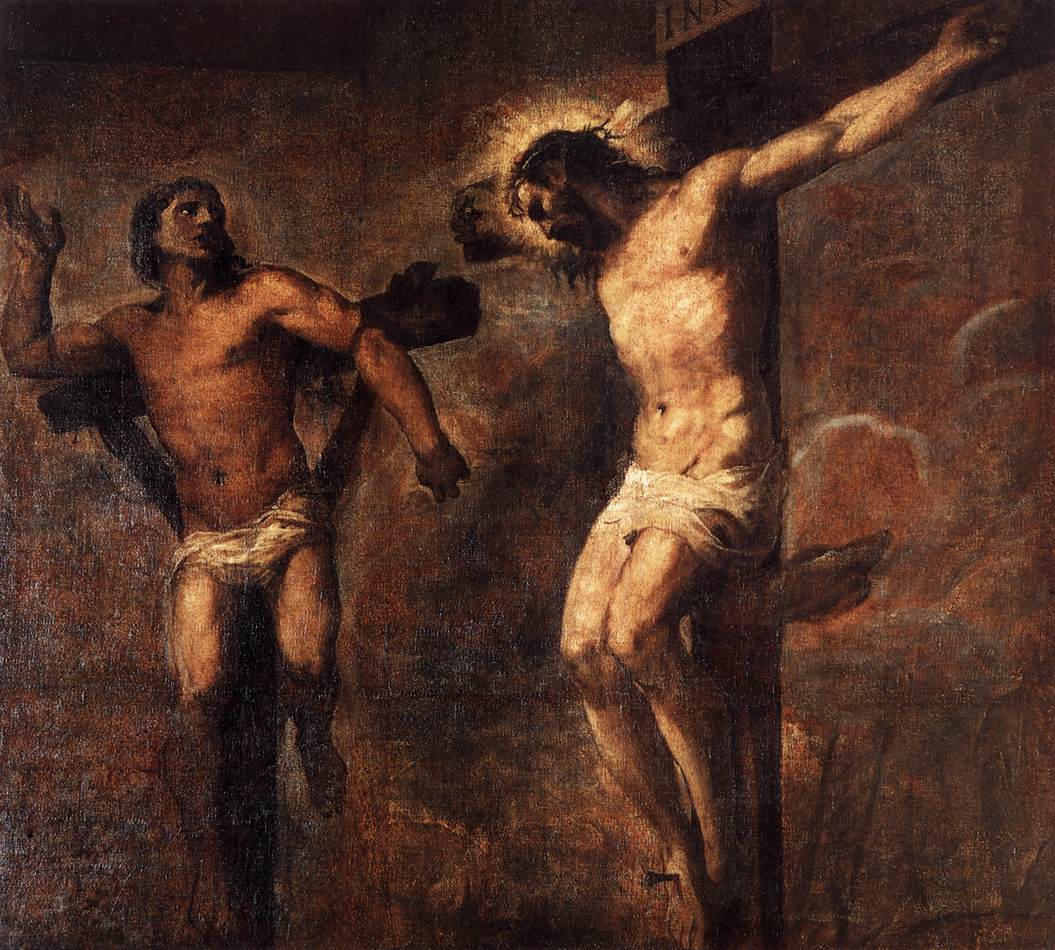
In this lesson we'll examine two passages that declare forgiveness to be the standard for the Kingdom of God.
Forgiving Seven Times (Matthew 18:21-22)
Living together with a dozen men day in and day out must have been frustrating sometimes. Each had his own idiosyncrasies and annoying quirks. With hot weather and long days tempers would flare. One day, Peter had had enough.
"21 Then Peter came to Jesus and asked, 'Lord, how many times shall I forgive my brother when he sins against me? Up to seven times?'22 Jesus answered, 'I tell you, not seven times, but seventy-seven times.'"(Matthew 18:21-22)
He had forgiven one of the other disciples again and again and was finished with forgiveness. But he had enough sense to ask Jesus. "Lord, isn't seven times enough forgiveness?" Peter, I am sure, felt he was being generous with allowing seven times for forgiveness. After all, Jesus had once taught his disciples:
"If [your brother] sins against you seven times in a day, and seven times comes back to you and says, 'I repent,' forgive him." (Luke 17:4)
Seven was a special sacred and symbolic number in Hebrew culture. The number is used in nearly 600 passages in the Bible. God rested on the seventh day. The Sabbath, of course, was the seventh day. The Hebrew verb shāba`, "to swear an oath" is etymologically related to the number seven (sheba`). On the Day of Atonement there was a seven-fold sprinkling of blood. Many other examples could be given.1
Jesus' answer to Peter in Matthew's account, requires more forgiveness yet -- either 77 times (NIV, NRSV) or 7 times 70 (KJV, NASB), depending on how you translate the Greek word hebdomēkontakis.2 But no matter how you translate it, Jesus indicates that forgiveness must go much farther than seven times.
Does Jesus mean that we must forgive 77 times and then stop? Or 490 times and then stop? No. He means that there is no end to forgiveness. Though Peter may have found this frustrating, I find it encouraging. If Jesus demands unlimited forgiveness of us humans, how much more can we expect unlimited forgiveness for ourselves before our loving heavenly Father!
|
Q1. (Matthew
18:21-22) Jesus says we must forgive 77 times or 490 times.
Should we take these numbers literally or figuratively? If
figurative, what are they figurative of? What does this
teach us about God's willingness to forgive us
repeatedly for the same sin?
|
The Kingdom of Heaven is Like ... (Matthew 18:23)
Now to underscore his teaching, Jesus indicates that repeated forgiveness is not just a guideline, but a foundational principle of the Kingdom. To teach this he employs a parable.
"Therefore, the kingdom of heaven is like a king who wanted to settle accounts with his servants." (Matthew 18:23)
The first character introduced in the parable is a king. He must be a king who controls vast lands, for, as we'll see in a moment, one of his servants owes him a huge sum. The king is powerful. He decides to "settle accounts" (NIV, NRSV), "take account" (KJV) with his servants, who are obviously provincial governors or other officials in his government. The verb "settle" is synairō, used here in a commercial sense as "settle accounts, cast up accounts."3 The word "accounts" is the common noun logos. We often see logos used in the sense of, "word, message." But here (and in Matthew 18:23) it is used in a special sense as "computation, reckoning."4 The idea conveyed by these two words is to conduct an audit of the transactions of a business partner and then either receive what is due or pay what is due, depending upon the results of the audit.
The Massive Debt (Matthew 18:24-27)
The results of an audit of one of the King's government administrator's accounts, however, was damning.
"As he began the settlement, a man who owed him ten thousand talents was brought to him." (Matthew 18:24)
The phrase "was brought" may indicate a certain unwillingness of the man to appear for the results of the audit. Not surprising, for this was a huge sum!
Josephus tells of an occasion when Ptolemy Ephinanes, King of Egypt (reigned 203-181 BC), asked principal men in his empire to bid for the position of tax farmer or tax collector for the provinces of Celesyria, Phoenicia, Judea, and Samaria. They bid 8,000 talents -- and were accused by Ptolemy of conspiring to bid too low. Whoever bid successfully for such a contract would be instantly liable to the king for a debt of 8,000 talents.5
A "talent" (talanton, the denomination of money referred to in the Parable of the Talents) was first a weight, then a unit of coinage. The value of a talent varied somewhat, but in general one Tyrian talent would be worth about 6,000 denarii,6 a denarius being the average amount that a laborer might earn for one day's work. If you calculate that a day laborer in our day might earn $100 or so, here's how you might calculate this administrator's debt:
10,000 talents = $60 billion
The debtor here was probably a provincial governor or perhaps a tax farmer, who had agreed to remit to the king a specific amount of taxes for a tax district. It was a staggering debt.
Foreclosure and Slavery (Matthew 18:25)
Alas, he couldn't pay, not even a portion.
"Since he was not able to pay, the master ordered that he and his wife and his children and all that he had be sold to repay the debt." (Matthew 18:25)
Perhaps he had collected the taxes, but then invested them in some scheme that had failed miserably -- or perhaps they had been stolen by bandits during transfer to the king, or even lost when a ship went down. We don't know.
In ancient times, there were two main remedies: either sale of the person's goods to pay the debt or debtor's prison. Debtor's prison was not a punishment so much as a means to induce the debtor's relatives and friends to pay his debt, so to bring about his release.
In light of the immense size of this administrator's debt, there is no way his family could be induced to pay a portion to get him out of debtor's prison. A laborer would have to work for 1,000 years to pay such a debt! Nor would the sale of his estate cover such a massive debt. So his property and lands were seized to be sold for what the king could get out of them and the administrator and his family were ordered sold into slavery -- a common fate for those who couldn't pay a debt.7
Mercy (Matthew 18:26-27)
The administrator's case is hopeless, so he does the only thing he can do. He begs.
"26 The servant fell on his knees8 before him. 'Be patient with me,'he begged, 'and I will pay back everything.'27 The servant's master took pity on him, canceled the debt and let him go." (Matthew 18:24-27)
The administrator doesn't ask for mercy. Rather he asks for time. He requests the king's patience and rashly promises to "pay back everything." The king knows that such a promise of repayment is both impossible and silly. He also knows that even if he gained a pittance9 from the sale of the administrator's estate and the value of his family as slaves, it wouldn't even make a dent in the massive debt owed.
And so "the servant's master took pity on him, cancelled the debt,10 and let him go"11 (verse 27). "Took pity"(NIV), "out of pity for him"(NRSV), "was moved with compassion" (KJV) is splanchnizomai, "have pity, feel sympathy, with or for someone," from splanchnon, "the viscera, inward parts, entrails," considered in ancient times as the center of the emotions.12 The king's compassion wiped out the entire obligation. The administrator was released free and clear.
The man could probably not believe his good fortune. One minute he was a slave with nothing, and the next he was at least a nobleman with his estate intact. Why? Because of the whim of a pragmatic king who knew he couldn't "squeeze blood out of turnip," as our saying goes.
The Tiny Debt (Matthew 18:28-30)
In a happy daze, the administrator leaves the palace. Now the plot thickens.
"28 But when that servant went out, he found one of his fellow servants who owed him a hundred denarii. He grabbed him and began to choke him. 'Pay back what you owe me!' he demanded.
29 His fellow servant fell to his knees and begged him, 'Be patient with me, and I will pay you back.' 30 But he refused. Instead, he went off and had the man thrown into prison until he could pay the debt." (Matthew 18:28-30)
The administrator sees one of his fellow government servants, one whom he has loaned 100 denarii, worth about 100 days work, perhaps $10,000 in our currency. It is a considerable sum, but not compared to the debt our administrator has just been forgiven, that is, $600 million.
|
|
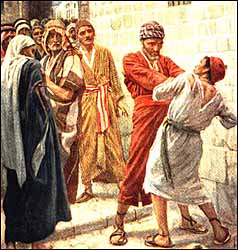
Yet the administrator grabs him violently and begins to choke him in his anger. He demands payment. When the fellow servant asks for patience and promises to pay it in full -- which was entirely possible with such a sum -- the administrator refuses and has him thrown into debtor's prison until the debt is paid in full.
His action might be understandable and even legal, but in light of the mercy he has just received, it is grossly inappropriate.
The King's Wrath (Matthew 18:31-34)
But others see this.
"31 When the other servants saw what had happened, they were greatly distressed13 and went and told their master everything that had happened.
32 Then the master called the servant in. 'You wicked servant,' he said, 'I canceled all that debt of yours because you begged me to. 33 Shouldn't you have had mercy14 on your fellow servant just as I had on you?'"(Matthew 18:31-33)
The king calls the administrator back to his throne room. He calls him a "wicked" servant. The word is ponēros, "pertaining to being morally or socially worthless, wicked, evil, bad, base, vicious, degenerate."15 The king is livid with anger. He had forgiven the man an astronomical sum. He knew he would never see that money again. But as an act of mercy he forgave the entire debt. Why couldn't the administrator have the common decency to do the same for a relatively small sum? To refuse to do so was an insult to the king's own mercy.
"In anger his master turned him over16 to the jailers to be tortured, until he should pay back all he owed." (Matthew 18:34)
This is more than debtor's prison. This is the kind of active torture17 reserved for the king's enemies. In Jesus' day people would have nodded sadly. Though torture was prohibited by Jewish law as inhumane, scourging was commonly used by the Romans to interrogate prisoners. Jeremias observes:
"Torture was regularly employed in the East against a disloyal governor, or one who was tardy in the delivery of the taxes, in order to discover where they had hidden the money, or to extort the amount from their relations or friends. The non-Jewish practice in legal proceedings ... is drawn upon to intensify the frightfulness of the punishment."18
Jesus intended this parable to stick in his disciples' memories.
|
Q2. (Matthew
18:23-35) In the Parable of the Unmerciful Servant, what is
the purpose of contrasting the huge debt with the small one?
If we were to put ourselves in the parable, which debt would
we owe? Which debt might be owed us? Why was the king
insulted by the unmerciful servant's action?
|
Jesus' Warning (Matthew 18:35)
But then Jesus says something unexpected and terrible.
"This is how my heavenly Father will treat each of you unless you forgive your brother from your heart." (Matthew 18:35)
Forgiveness "from your heart" is in contrast to forgiveness with one's lips only (Matthew 15:8, quoting Isaiah 29:13). The forgiveness must be genuine.
Jesus refers to God as "my heavenly Father" in an intimate and formal title. How could our heavenly Father punish unforgiving people? Is Jesus serious?
|
Q3. (Matthew
18:34-35) Why does Jesus frighten us with his statement:
"This is how my heavenly Father will treat each of you..."?
Is he serious? Is forgiveness (1) a learned grace, or (2) a
foundational principle of the Kingdom?
|
The Lord's Prayer (Matthew 6:12)
Jesus is quite serious about forgiveness! Consider the fifth petition of the Lord's Prayer, and Jesus' subsequent commentary on it:
"Forgive us our debts, as we also have forgiven our debtors." (Matthew 6:12)
"For if you forgive men when they sin against you, your heavenly Father will also forgive you. But if you do not forgive men their sins, your Father will not forgive your sins." (Matthew 6:14-15)
Three Greek words are used in relationship to sin in the Lord's Prayer in Matthew and Luke. Christians from different traditions use different words as they recite the Lord's Prayer.
"Debt" (Matthew 6:12), Greek opheilēma, 1. "debt = what is owed, one's due." 2. in a religious sense debt = sin (as Aramaic hobah in rabbinical literature).19
"Trespass" (Matthew 6:14-15, KJV), Greek paraptōma, "in imagery of one making a false step so as to lose footing: a violation of moral standards, offense, wrongdoing, sin."20 Paraptōma is a compound word from para- "beside or near"+ piptō "to fall." Thayer defines it as "a lapse or deviation from truth and uprightness; a sin, misdeed."21
"Sin" (Luke 11:4), Greek hamartia "sin. The action itself as well as its result, every departure from the way of righteousness…."22 Literally, "a failing to hit the mark."23
But this prayer, "Forgive us our debts, as we forgive our debtors," is a sort of trick prayer. It is a prayer Jesus uses to teach his disciples the elements of praying aright. The Greek word hōs, is a conjunction marking a point of comparison, meaning "as."24 Jesus teaches us to ask God to forgive us "as" we forgive others. In other words, if we forgive others only a little and hold grudges, we are asking God to forgive us only a little and bear a grudge against us. Wow! How many people pray the Lord's Prayer thoughtlessly, and each time they pray, they pray a curse of unforgiveness down upon themselves!
Jesus is making a point in this prayer, a point which he explains in more detail just after the prayer:
"For if you forgive men when they sin against you, your heavenly Father will also forgive you. But if you do not forgive men their sins, your Father will not forgive your sins." (Matthew 6:14-15)
How could it be plainer? Jesus had just told his disciples not to seek retribution.
"Love your enemies and pray for those who persecute you, that you may be sons of your Father in heaven" (Matthew 5:44-45).
Now he makes it clear that we must forgive, if we are to be considered sons of the Father. Otherwise he will not forgive us.
Quintessential Forgiveness
Perhaps the most powerful example of such forgiveness is that of Jesus himself. "He came to his own [people]," John records, "and his own [people] did not receive him" (John 1:12). His miracles and bread attracted the crowds, but when he had to say some hard things, they would leave as quickly as they had come (John 6:66). A number of times, when he said something they didn't consider Kosher, they tried to kill him, but he slipped away from their grasp (Luke 4:28-30; John 8:59; 10:31).
But the time finally came that God had planned (Galatians 4: 4-5). Jesus knew it was coming, and though it filled him with pain to think of it, he faced it openly. This time when his enemies sought to arrest him, he stood forth, said "I am the man," and allowed them to take him. He allowed a mock trial filled with patently false and unsupported charges. He could have called legions of angels to deliver him -- the armies of heaven were at his beck and call -- but he did not. Soldiers spat in his face and mocked him with a cruel crown of thorns and a purple robe, which they said made him look like a king. They scourged him nearly to death. Pilate washed his hands and ordered his crucifixion. And as they crucified him, he said,
"Father, forgive them, for they know not what they do." (Luke 23:34)
Love and Forgiveness
If we are to know and understand God, we must love. We must know and understand forgiveness. If we reject this part of God, we reject the kernel of who he is (1 John 4:16-21). So when Jesus puts it so bluntly -- you must forgive in order to be forgiven (Matthew 6:14-15) -- we dare not reject this truth.
Some ask: Isn't this a sort of "works righteousness"? If you are required to do something before you can be forgiven, then isn't this righteousness by works?
No. There's an old story of how to catch a monkey. You chain a cage to a post, and put an orange in the cage. Then when the monkey tries to grasp the orange, and can't pull it through the bars he is trapped. Can't he just release the orange and escape? Yes, but monkeys don't let go of the things that enslave them. They hold on tightly -- just like people. And so he is captured, just as surely as if he were in the cage itself.
To be free you must let go of unforgiveness. Is that meritorious so as to earn heaven? No, not any more than repentance from sin is meritorious. We don't earn heaven by repentance or by forgiving. But we must let go of our bondage to sin and hate if we want to receive something better.
|
Q4. (Matthew 6:12, 14-15) How could
praying the Lord's Prayer become a curse upon a person? Is
forgiving in order to be forgiven a kind of "righteousness
by works"? Why or why not?
|
The Struggle to Forgive
Forgiveness is sometimes terribly difficult. It's usually not so hard to forgive people we don't know. The people with whom we have a relationship of trust who turn on us, who betray our trust -- those people are the hardest to forgive. Husbands, wives, fathers, mothers, children, and boyfriends and girlfriends and our best friends. They can turn on us and wound us deeply. Sometimes we even doubt that, "It is better to have loved and lost, than never to have loved at all." Maybe we should withdraw and protect ourselves and never venture out again.
No. The path of health is forgiveness. The path of healing is forgiving.
Counterfeit Forgiveness
Sometimes we resist forgiveness because we mistake it for substitutes. In my article "Don't Pay the Price of Counterfeit Forgiveness,"25 I try to distinguish true forgiveness from its chameleons. True forgiveness does not minimize the sin or the hurt, nor excuse the sinner. True forgiveness chooses not to hold the sin against the sinner any longer. True forgiveness is pardon.
You may be freshly wounded and find your anger too massive to forgive. The injustice may be ongoing, the outrage constant. Perhaps you do not feel you are able to forgive right now. Then I ask you to pray this prayer: "Lord, I find it beyond my ability to forgive this person. I ask you to make me able to forgive in the future."Even that prayer may stretch your faith (or obedience) to pray, but pray it anyway. The God of Forgiveness answers prayers like that. He makes a way where there is no way. He takes us beyond ourselves.
In my experience as a pastor over the decades, I've found that forgiving is perhaps the most difficult thing Christians struggle with. And it is most rewarding as they are able to forgive and find the blessings of forgiving washing them and refreshing them.
Jesus' Hard "Family" Experience
I am reminded that Jesus had hard "family" experience with forgiveness. I am thinking of Jesus' Father-Son-Holy Spirit family. In the Old Testament we find the horrendous insults to God delivered by his people, by their thoughtlessness and carelessness, but also by their prostitution and unfaithfulness, their deliberate substitution of worship of Him with worship of idols, their murder of the prophets and apostles he sent to speak truth to them. The list goes on and on. One of the most poignant verses of the Bible appears in Isaiah:
"I revealed myself to those who did not ask for me; I was found by those who did not seek me. To a nation that did not call on my name, I said, 'Here am I, here am I.' All day long I have held out my hands to an obstinate people, Who walk in ways not good, pursuing their own imaginations -- A people who continually provoke me to my very face, offering sacrifices in gardens...."(Isaiah 65:1-3)
In spite of a history of insult and betrayal,
"For God so loved the world, that he sent his only begotten Son, that whosoever believeth in him should not perish, but have everlasting life." (John 3:16, KJV)
Jesus' demand for forgiveness must be viewed against the backdrop of God's persistent, steadfast love. Jesus demands forgiveness as a condition of entry into his kingdom, but he also modeled it and models it still today. If we can't forgive, we can't understand or know God, for that is what makes him tick.
Unforgiveness Is Not an Option.
I am convinced by Jesus' words that unforgiveness is not an option for us. We must forgive. We make all sorts of excuses for ourselves. We find doctrinal reasons to set aside the clear teachings of our Lord and not take them seriously. But his words remain. Unforgiveness is not an option for a follower of Jesus. We may struggle, we may not have the strength on our own and call out to Him for the will and the power to forgive, but we cannot hold onto our bitterness -- and continue to hold onto him.
Forgiveness and Non-Repentance
This is a tough one. Do we have to forgive someone who does not repent? We read:
"If your brother sins, rebuke him, and if he repents, forgive him." (Luke 17:4)
I think that forgiveness is something like a pardon. We have to accept it for it to be granted. In a technical sense, we can't really forgive someone who does not repent. But that doesn't let us off the hook. I think that God requires us to love our enemies, and this from our side of the relationship differs little from what forgiveness would require of us. In the Sermon on the Mount, Jesus is very clear:
"I tell you: Love your enemies and pray for those who persecute you, that you may be sons of your Father in heaven.... Be perfect, therefore, as your heavenly Father is perfect." (Matthew 5:43, 48)
 A book of the compiled lessons is available in both e-book and paperback formats. |
So technical forgiveness is not the issue, really. It is love from the heart, that is what God requires of us toward even our enemies. Forgiveness is what flows from that kind of heart when there is repentance. Love must always flow.
Not that any of this is easy. Often it is tremendously difficult. But discipleship is following and learning from Jesus. If we fail to learn this lesson of forgiveness and loving our enemies, we miss the essence of God himself.
Prayer
Father, this is a very sobering passage that brings us to the core of Kingdom values -- mercy and love. Teach me this in my heart of hearts, I pray. Free me from bitterness so I can forgive those who have hurt me, so I might be eligible for your Kingdom of mercy and forgiveness. In Jesus' name, I pray. Amen.
Key Verses
"Then Peter came to Jesus and asked, 'Lord, how many times shall I forgive my brother when he sins against me? Up to seven times?' Jesus answered, 'I tell you, not seven times, but seventy-seven times.'" (Matthew 18:21-22, NIV)
"Forgive us our debts, as we also have forgiven our debtors." (Matthew 6:12)
"For if you forgive men when they sin against you, your heavenly Father will also forgive you. But if you do not forgive men their sins, your Father will not forgive your sins." (Matthew 6:14-15, NIV)
References (Abbreviations)
1. Bruce C. Birch, "Number," ISBE 3:559.
2. "This word with the number seven 'may be short for "seventy times seven times," but is more likely "seventy-seven times"'" (Hebdomēkontakis, BDAG 269). "The decisive argument for 'seventy-seven' times is that the expression reproduces Genesis 4:24 (Septuagint), where it is the translation of a Hebrew expression that means 'seventy-seven times.'" (Morris, Matthew, p. 472, fn. 65).
3. Synairō, BDAG 964.
4. Logos, BDAG 603, 2b.
5. Josephus, Antiquities, 12.4.4.
6. "At 6,000 drachmas or denarii to the Tyrian talent, a day laborer would need to work 60,000,000 days to pay off the debt. Even assuming an extraordinary payback rate of 10 talents per year, the staggering amount would ensure imprisonment for at least 1,000 years" (Talanton, BDAG 988).
7. Jewish law prohibited sale of a man except for theft, and sale of the wife was forbidden, so this parable was cast in a non-Jewish context (Jeremias, Parables, p. 211, citing Sota 3.8; Tos Sota 2.9).
8. Proskyneō, "to express in attitude or gesture one's complete dependence on or submission to a high authority figure, (fall down and) worship, do obeisance to, prostrate oneself before, do reverence to, welcome respectfully." Frequently used to designate the custom of prostrating oneself before persons and kissing their feet or the hem of their garment, the ground, etc. The Persians did this in the presence of their deified king, and the Greeks before a divinity or something holy (BDAG 883, b). The KJV "worshipped" expresses a chiefly British, now archaic use of the term, to honor a human being. The word appears in the old form of the Anglican wedding ceremony, "With this Ring I thee wed, with my Body I thee worship, and with all my worldly Goods I thee endow; In the name of the Father, and of the Son, and of the Holy Ghost; Amen."
9. Jeremias (Parables, p. 211) notes that the average value of a slave was 500 to 2,000 denarii, citing b Qid 18a (Bar.); B.Q. 4.5.
10. "Cancelled the debt" (NIV), "forgave the debt" (NRSV, KJV) is two words, daneion, "loan" (BDAG 212) and aphiēmi, here, "to release from legal or moral obligation or consequence, cancel, remit, pardon" (BDAG 156, 2).
11. The word "let him go" (NIV), "released" (NRSV), "loosed" (KJV) is apolyō, a legal term meaning, "to grant acquittal, set free, release, pardon a prisoner" (BDAG 117, 1).
12. Splanchnizomai, BDAG 938; splanchnon, BDAG 938.
13. Lypeō, "become sad, sorrowful, distressed" (BDAG 604, 2a).
14. Eleeō, "to be greatly concerned about someone in need, have compassion/mercy/pity" (BDAG 315).
15. Ponēros, BDAG 853, 1aα.
16. Paradidōmi, "hand over, turn over, give up a person," as a technical term of police and courts, "hand over into [the] custody [of]" (BDAG 762, 1a).
17. "Jailers to be tortured" (NIV), "to be tortured" (NRSV), "tormenters" (KJV), is basanistēs, "guard in a prison, frequently under orders to torture prisoners, oppressive jailer," in our verse, "merciless jailer" (BDAG 168). The word is closely related to basanos, "severe pain occasioned by punitive torture, torture, torment" (BDAG 168).
18. Jeremias, Parables, pp. 212-213.
19. Opheilēma, BDAG 743.
20. Paraptōma, BDAG 770.
21. Paraptōma, Thayer 485.
22. Hamartia, BDAG 43-44.
23. Hamartia, Thayer 30.
24. Hōs, BDAG 1103-1106.
25. "Don't Pay the Price of Counterfeit Forgiveness," Moody Monthly, October 1985, pp. 106-108; https://www.joyfulheart.com/maturity/forgive.htm
Copyright © 2026, Ralph F. Wilson. <pastor joyfulheart.com> All rights reserved. A single copy of this article is free. Do not put this on a website. See legal, copyright, and reprint information.
 To be notified about future articles, stories, and Bible studies, why don't you subscribe to our free newsletter, The Joyful Heart, by placing your e-mail address in the box below. We respect your