


|
Old Testament
New Testament
Gospels
Acts
Paul's Letters
General Letters
Revelation
Topical Studies
Beginning the Journey (for new Christians). en Español

|
Old Testament
New Testament
Gospels
Acts
Paul's Letters
General Letters
Revelation
Topical Studies

|
Home
Bible Studies
Articles
Books
Podcasts
Search
Menu
Donate
About Us
Contact Us
FAQ
Sitemap

Free
E-mail Bible Study
 Names and Titles of God
Home | Bible Studies | Articles | Books | Podcasts | Search | Menu | Donate | About Us | FAQ | Contact Us
|
|
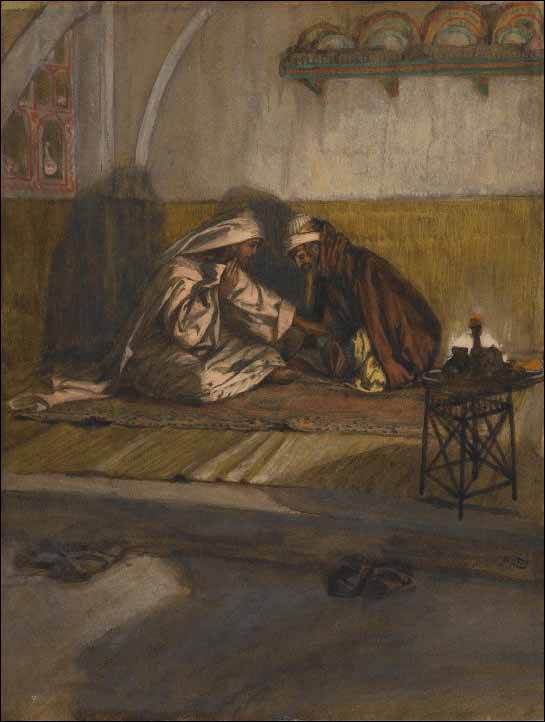
Jesus Knows the Heart (John 2:23-25)
"23 Now while he was in Jerusalem at the Passover Feast, many people saw the miraculous signs he was doing and believed in his name. 24 But Jesus would not entrust himself to them, for he knew all men. 25 He did not need man's testimony about man, for he knew what was in a man." (John 2:23-25)
Jesus was mobbed for his miraculous signs. And that is where our story begins.
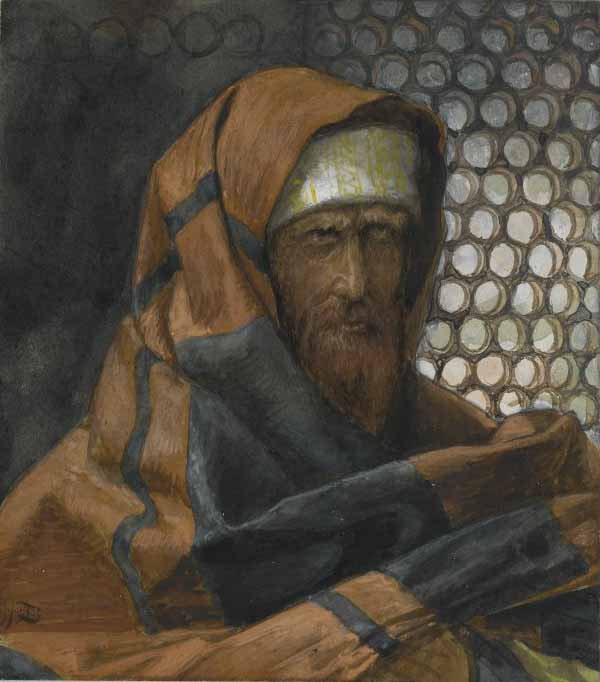
Nicodemus the Pharisee (John 3:1)
"Now there was a man of the Pharisees named Nicodemus, a member of the Jewish ruling council."(John 3:1)
"Nicodemus"is a Greek name (Nikodēmos, from nikos, "victorious"+ dēmos, "public, people") that means "conqueror of the people."The name was found among both Jews and Greeks. Perhaps he was a member of the Greek-speaking synagogue that met in Jerusalem (6:9; 9:29). We just don't know.1
However, we learn several things about Nicodemus here and in the two other passages where he is mentioned. First, he was a minor celebrity in his own right as one of the 70 Jewish rulers2 who served on the Jerusalem Sanhedrin, the body that made decisions for the country -- under Roman rule, of course.3
He was also a Pharisee, that is, a strict observer of the law (John 7:50-51). What's more, he was an expert in Jewish law, a scribe, since Jesus calls him "Israel's teacher"(John 3:10). He was probably wealthy, as well, both to be considered to be a member of the Sanhedrin and because he assisted Joseph of Arimathea in Jesus' burial, both physically and perhaps financially (John 19:39).
Nicodemus the Seeker (John 3:2)
But there was something different about Nicodemus from the other members of the Sanhedrin: he was spiritually hungry.
"He came to Jesus at night and said, 'Rabbi, we know you are a teacher who has come from God. For no one could perform the miraculous signs you are doing if God were not with him.'"(John 3:2)
Twice, the Gospel of John tells us that he came Jesus at night (3:2; 19:39). Why the nocturnal visit? There are several possibilities:
- Fear. We're told that fellow Sanhedrin member Joseph of Arimathea hadn't publicly himself identified with Jesus "because he feared the Jews"(John 19:38). Was Nicodemus afraid too? Perhaps, but he seemed bolder, since he stood up for Jesus in a meeting of the Sanhedrin (John 7:51).
- Caution. Probably caution fits Nicodemus. He doesn't want to be seen endorsing the teachings of this new Galilean teacher until he is sure. That's wise, it seems to me.
- Accessibility. Perhaps the best reason for seeking out Jesus at night is the ability to engage him in a longer conversation and ask earnest questions without interruption.4 Nighttime was probably a good choice for an earnest seeker.
Notice what this esteemed Bible scholar acknowledges when he meets Jesus.
Rabbi, which means in Hebrew, "great one."Nicodemus acknowledges the legitimacy of Jesus' teaching role, though Jesus hadn't been educated in the finest schools under the best rabbis, as had Paul, for example (Acts 22:3). (Jesus had, of course, impressed the temple teachers as a boy of twelve, Luke 2:46-47.) Nicodemus is impressed by him as a teacher, which is high praise coming from a well-known teacher like Nicodemus.
A teacher come from God. Unlike some of his fellow Pharisees who claimed that Jesus cast out demons by the devil himself (Mark 3:22), Nicodemus recognizes the divine origin of Jesus' miracles.
I used to think that Nicodemus was just being polite when he said: "Rabbi, we know you are a teacher who has come from God" (John 3:2a). But I was wrong. Nicodemus is just being honest. It is these miracles that make Nicodemus so curious.
"While [Jesus] was in Jerusalem at the Passover Feast, many people saw the miraculous signs he was doing and believed in his name." (John 2:23)
Nicodemus is one of these. He isn't a full believer yet, but the miracles cause him to recognize that God is behind Jesus' miracles. I know that the first time I saw a miracle first-hand, it changed my world-view. Unlike most of his fellow Pharisees, instead of rejecting Jesus' miracles or signs, he sees them as an indication of God's hand. Now he has come to learn more.
I've always thought that Jesus' reply to Nicodemus' statement seems rather abrupt and off-topic.
"In reply Jesus declared, 'I tell you the truth, no one can see the kingdom of God unless he is born again.'"(John 3:3)
After all, Nicodemus is talking about miracles and Jesus is discussing the Kingdom of God. Then I realized that Nicodemus' own presence that night with the miracle-worker is powerful testimony that he is seeking the Kingdom of God to which the miracles attested.5 Nicodemus is hungry to see and understand the Kingdom.
Discerning the Kingdom of God (John 3:3-5)
Now Jesus begins to teach about the spiritual nature of the Kingdom of God.
"In reply Jesus declared, 'I tell you the truth, no one can see6 the kingdom of God unless he is born again.'
4 'How can a man be born when he is old?' Nicodemus asked. 'Surely he cannot enter a second time into his mother's womb to be born!'
5 Jesus answered, 'I tell you the truth, no one can enter the kingdom of God unless he is born of water and the Spirit.'"(John 3:3-5)
|
|
Pause a moment. We're so eager to understand what it means to be "born again" that we miss what Jesus is saying about the Kingdom. Remember, the prevailing Jewish expectation was that the Messiah would come as a military leader to deliver them from Roman oppression, perhaps in the way that Judas Maccabeus and his family had led a rebellion that had delivered Israel from the control of the pagan Greek king Antiochus Epiphanes less than two centuries before.
Jesus tells us two things about the Kingdom:
- The Kingdom is spiritually discerned, that is, you can't see it or grasp it spiritually unless you are "born from above," unless God enables you to see it.
- The Kingdom is spiritually entered, that is, you can't enter into the Kingdom, which is a synonym for inheriting eternal life, unless you are changed spiritually.
Recall with me a couple of verses. Jesus has this dialog with Pontius Pilate:
"Pilate ... summoned Jesus and asked him, 'Are you the king of the Jews?'
... Jesus said, 'My kingdom is not of this world. If it were, my servants would fight to prevent my arrest by the Jews. But now my kingdom is from another place.'
'You are a king, then!' said Pilate.
Jesus answered, 'You are right in saying I am a king. In fact, for this reason I was born, and for this I came into the world, to testify to the truth....'" (John 18:33, 36-37)
And another teaching.
"No one knows the Son except the Father, and no one knows the Father except the Son and those to whom the Son chooses to reveal him." (Matthew 11:27)
"No one can come to me unless the Father who sent me draws him." (John 6:44)
The parables of the Kingdom are hidden from the unbelievers, too.
"The disciples came to him and asked, 'Why do you speak to the people in parables?'
He replied, 'The knowledge of the secrets of the kingdom of heaven has been given to you, but not to them. Whoever has will be given more, and he will have an abundance. Whoever does not have, even what he has will be taken from him.'"(Matthew 13:10-12)
The Kingdom of God is hidden from unbelievers.
"The god of this age has blinded the minds of unbelievers, so that they cannot see the light of the gospel of the glory of Christ, who is the image of God."(2 Corinthians 4:4)
Unbelievers can see that it might be present from the signs or miracles that result, and this may cause them, like Nicodemus, to search further. But unaided, they can't see or discern the Kingdom, much less enter it. It is God's prerogative to reveal.
At one level, this may not seem quite fair. After all, seeing spiritual things is a right, isn't it? No. We are blind, unless God graciously rescues us, saves us. There is a spiritual war going on. Salvation is costly. So costly that it can only be a gift.
Does this sound like the sovereignty of God and predestination? That is what it is. But as we'll see shortly, there is something that man can and must do to prepare himself to receive the gift.
|
Q1. (John 3:3, 5) What does Jesus
teach here about the nature of the Kingdom of God? Do you
think Nicodemus understands him? Why or why not?
|
Begotten or Born? (John 3:3-5)
Now let's explore this heavenly birth that Jesus teaches:
"In reply Jesus declared, 'I tell you the truth, no one can see the kingdom of God unless he is born again.'
4 'How can a man be born when he is old?' Nicodemus asked. 'Surely he cannot enter a second time into his mother's womb to be born!'
5 Jesus answered, 'I tell you the truth, no one can enter the kingdom of God unless he is born of water and the Spirit.'"(John 3:3-5)
First let's examine the word "born,"gennaō, "become the parent of, beget" by procreation; passive, "be fathered."7 The passive can mean either "born," as by a mother, or "begotten" as by a father.8 Nicodemus takes the word in its feminine sense of being in one's mother's womb. But elsewhere, the idea seems to be "beget" in the masculine sense:9
"Yet to all who received him, to those who believed in his name, he gave the right to become children of God -- children born not of natural descent, nor of human decision or a husband's will, but born of God." (John 1:12-13)
"No one who is born of God will continue to sin, because God's seed (sperma10 ) remains in him; he cannot go on sinning, because he has been born of God."(1 John 3:9)
"Everyone who believes that Jesus is the Christ is born of God, and everyone who loves the father loves his child as well."(1 John 5:1)
"For you have been born again, not of perishable seed (spora11 ), but of imperishable, through the living and enduring word of God."(1 Peter 1:23)
"Again"or "from Above"(John 3:3, 5, 7)
There's another issue to examine as we try to understand Jesus' teaching as accurately as possible. The adverb modifying "born/beget" in verses 3 and 5 is anōthen. The Greek word can have both the meaning "from above" (which is most common) as well as "again, anew" (less often)12
1. Argument for "from above"
Most modern commentators13 take the primary meaning here as "from above," since that is how the adverb is used three other times in this gospel (John 3:31; 19:11, 23). In addition, John's writings contain the idea of "born of God" (which is the same idea as "born from above") in several verses, as seen in the previous paragraph (1 John 3:9; 4:7; 5:1, 4; 5:18). A.T. Robertson observes that though Nicodemus took the word in the sense of "again," "the misapprehension of Nicodemus does not prove the meaning of Jesus."14 The translation "from above" is contained in the NRSV and NJB.
2. Argument for "again, anew"
However, I believe a strong case can be made for the translation "again, anew." First, the possibility of two meanings of the word is possible in Greek only, not in the Aramaic that Jesus would have spoken.15 Second, Nicodemus clearly took it in the sense of "again" when he pictured a person crawling back into his mother's womb "a second time"16 to be born. Third, Jesus seems to have taught something similar in Matthew:
"I tell you the truth, unless you change17 and become like little children, you will never enter the kingdom of heaven." (Matthew 18:3)
We also clearly see the idea of being "born anew" elsewhere in the New Testament:
"He saved us, not because of righteous things we had done, but because of his mercy. He saved us through the washing of rebirth (palingenesia18 ) and renewal (anakainōsis19 ) by the Holy Spirit."(Titus 3:5)
"In his great mercy he has given us
new birth (anagennaō20 )
into a living hope...."
(1 Peter 1:3)
"For you have been born again (anagennaō), not of perishable seed, but of imperishable, through the living and enduring word of God."(1 Peter 1:23)
For these reasons, I think that the translation "born anew" reflects Jesus' meaning here.21 Indeed, a number of commentators support this view,22 and both the NIV and NASB give "born anew"as their first reading. The best translation, however, is probably "born anew" rather than "born again," since Jesus intends this to be understood as not a repetition of a previous birth, but clearly a "new" kind of birth brought about by the Spirit.
Having said that, commentators agree that John deliberately used the ambiguous adverb anōthen so that both ideas of "anew" and "from above" would be considered, since the spiritual birth is both "anew" and "from above."
|
Q2. (John
3:3-5) What does "entering the Kingdom" have to do with
being "born anew"? Which do you think is the best
translation here: "born again," "born anew," or "born from
above"? Defend your reasoning.
|
Born of Water and Spirit (John 3:5-7)
Jesus has explained the concept of being "born anew." Nicodemus responds with a repetition of one's physical birth. It's not clear whether Nicodemus is making fun of the idea or just struggling to grasp it. But Jesus continues on instructing the earnest man.
"5 Jesus answered, 'I tell you the truth, no one can enter the kingdom of God unless he is born of water and the Spirit. 6 Flesh gives birth to flesh, but the Spirit gives birth to spirit. 7 You should not be surprised at my saying, "You must be born again."'"(John 3:5-7)
It's pretty clear that Jesus is differentiating this as a spiritual birth in distinction from a physical birth (as Nicodemus had understood it). What isn't so clear is what he means by "born of water and the Spirit."We understand the idea of being born of the Spirit (Matthew 1:20). But it's the reference to the water that is confusing to us.
Morris recites the various interpretations of water in the passage.
- Christian Baptism. John must have known that water would be associated by his readers with Christian baptism. Indeed, some have used this passage to teach a doctrine of baptismal regeneration, that a person cannot be saved without being baptized. However, Nicodemus could not have understood such a reference to a not-yet-existent sacrament. This explanation doesn't make sense to me.
- Procreation. Since Jesus contrasts physical birth with spiritual birth, some see the water as a reference to either semen or the bag of waters in the womb. Though such ideas may seem offensive to modern ears, there are many references in Rabbinic, Mandaean, and Hermetic sources that use terms like "water," "rain," "dew," and "drop" in the sense of male semen. Moreover, Hellenistic mystery religions made use of the terminology of rebirth.23 I see water as referring to procreation as a possibility.
- Repentance and Purification. Dipping in water naturally suggests washing and cleansing. If we look at the context of John's Gospel as far as chapter 3, the only water we've seen is the water of John's baptism and the water that Jesus turned to wine in Cana. Therefore, I think the most natural interpretation is to take "water and Spirit" to refer to the ministry of John the Baptist who preached "a baptism of repentance for the forgiveness of sins" (Mark 1:4). His baptism with water was also contrasted with the baptism of the Holy Spirit (Mark 1:8; John 1:33).
As we saw in Lesson 1, since John's baptism was probably viewed in the light of a baptism required of Jewish proselytes in the first century, it would take a real heart of humility for a Jew to submit to it, especially those who already considered themselves religiously pure, such as the Pharisees. Many of Nicodemus' colleagues bristled at the thought of them being baptized. Luke reports,
"The Pharisees and experts in the law rejected God's purpose for themselves, because they had not been baptized by John." (Luke 7:30)
We don't need to be cleansed like some new proselyte, they would assert proudly. We are Abraham's direct descendants! John the Baptist's rejoinder was sharp. He called them a brood of vipers:
"Produce fruit in keeping with repentance. And do not think you can say to yourselves, 'We have Abraham as our father.' I tell you that out of these stones God can raise up children for Abraham." (Matthew 3:8-9)
So, in this context, I believe Jesus is saying to Nicodemus: You must be born anew by your own repentance and humbling yourself before God and the Holy Spirit's divine regenerative work within you. You can't enter the Kingdom of God by your own effort. You must surrender yourself to God! Only God can bring about this new creation in you.
|
Q3. (John
3:5-7) What does it mean to be "born of water and the
Spirit"? What do you think "water" refers to? Why have you
come to this conclusion? How, then, would you paraphrase
"born of water and the Spirit" to best bring out the
meaning?
|
The Wind of the Spirit (John 3:8)
Jesus reinforces this by emphasizing that the Holy Spirit cannot be manipulated. He is out of man's control and entirely directed by God:
"The wind (pneuma) blows wherever it pleases. You hear its sound, but you cannot tell where it comes from or where it is going. So it is with everyone born of the Spirit (pneuma)."(John 3:8)
"Wind"is pneuma, the breath of God, the same word that is translated "Spirit" at the end of the verse. People who have been born of the Spirit, Jesus is saying, are motivated and moved by an unseen but powerful force beyond themselves. The life of the Spirit is a new level of spiritual existence, a different plane entirely. Only people who have been born of the Spirit can perceive and enter the Kingdom of God.
The Son of Man Must Be Lifted Up (John 3:14-15)
Now we'll skip down a few verses to a curious image:
"14 Just as Moses lifted up the snake in the desert, so the Son of Man must be lifted up, 15 that everyone who believes in him may have eternal life." (John 3:14-15)
Jesus is teaching Nicodemus about the relationship of faith and life. Jesus is referring to a incident that took place during the Israelite's sojourn in the desert after the exodus from Egypt. Many of them had been bitten by poisonous snakes, and Moses asked God what to do.
|
|
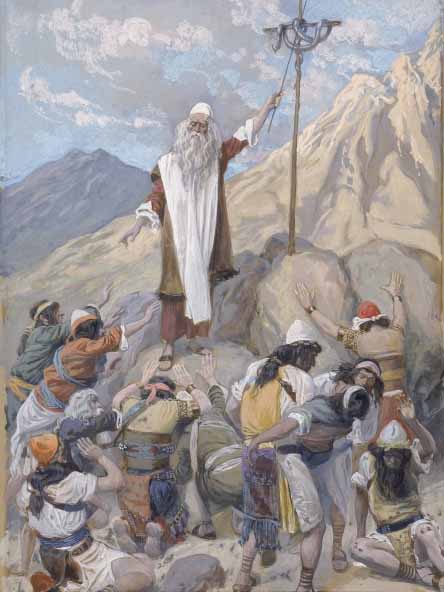
"The LORD said to Moses, 'Make a snake and put it up on a pole; anyone who is bitten can look at it and live.' So Moses made a bronze snake and put it up on a pole. Then when anyone was bitten by a snake and looked at the bronze snake, he lived." (Numbers 21:8-9)
A bronze snake was lifted up on a pole24 for people to look at in faith, and in looking they were healed.
Jesus is saying that in the same way that people looked with belief upon the bronze snake that was lifted up, so must they look with belief upon the Son of Man, who will be lifted up. Nicodemus can't know what this means fully, but in hindsight we see that Jesus was lifted up on the cross, raised from the dead, and finally ascended to glory.
For God So Loved the World that He Gave (John 3:16)
That is the context for the most famous verse in the Bible:
"For God so loved the world that he gave his one and only Son, that whoever believes in him shall not perish but have eternal life." (John 3:16)
Let's examine the verse phrase by phrase so we can understand it fully. The speaker25 attributes two actions to God: God loved and God gave. Both are in the Aorist indicative tense, which indicates a particular point in past time that God so loved and therefore gave (presumably, gave on the cross):
"Loved"is agapaō, the word used in the New Testament for the highest form of love, "to have a warm regard for and interest in another, cherish, have affection for, love."26 "Loved" is modified by the adverb "so," which indicates an intense degree of love.27
The object of love is "the world," the kosmos, a broad word that here refers to "humanity in general, the world."28 God doesn't limit his love only to the Jewish people or to believers, but to all of humanity.29 Thus he loved us while were still his enemies (Romans 5:8). In his first letter, John writes:
"He is the atoning sacrifice for our sins, and not only for ours but also for the sins of the whole world (kosmos)."(1 John 2:2)
"God was reconciling the world (kosmos) to himself in Christ, not counting men's sins against them."(2 Corinthians 5:19)
"We have put our hope in the living God, who is the Savior of all men, and especially of those who believe."(1 Timothy 4:10)
Gave is the common verb didōmi, "to give." It echoes the related verb paradidomai in Isaiah 53:12 (Septuagint), "He was given up for their sins." The word isn't "sent," but "gave," emphasizing the idea of sacrifice.30
Jesus, God's Unique Son (monogenēs)
Let's pause here to consider how the speaker describes Jesus as God's "one and only Son"(NIV), "only Son"(NRSV, NJB), "only begotten Son" (KJV, NASB). The word modifying Son is monogenēs, "pertaining to being the only one of its kind or class, unique (in kind) of something that is the only example of its category."31 This compound word is formed from monos, "sole, single"+ genos, "kind." Brown comments, "Although genos is distantly related to gennaō, 'to beget,' there is little Greek justification for the translation of monogenēs as 'only begotten.'"32 I agree.
This verse points clearly to Jesus as God's unique Son, one of a kind. We become sons and daughters of God by spiritual birth or adoption (depending on which analogy you choose). Praise God! What a privilege this is! However, though we resemble Jesus, he is unique in his relationship to God, since he is the Son from eternity, the Second Person of the Trinity.
Results and Purposes of God's Love (John 3:16)
We've been moving word by word through John 3:16. Now we're at the second half. Take another look:
"For God so loved the world that he gave his one and only Son, that whoever believes in him shall not perish but have eternal life." (John 3:16)
Notice the two "thats" in the verse:
- Result. The first "that"(hōste33 ) indicates result in verse 16a. God's intense love resulted in him giving/sacrificing his Son.
- Purpose. The second "that"(hina34 ) indicates purpose in verse 16b. God's love resulted in giving or sacrificing his Son for the purpose of (a) preventing us from perishing, but rather (b) having eternal life.
Not Perish (John 3:16b)
God's purpose is for us who believe to have eternal life. But to clarify this, we are given both the positive purpose (eternal life) and the flip side, the negative way of stating the same thing, to avoid perishing.
In our day, there's a lot of resistance to the idea of hell. Evangelical Christians seem to be moving toward the Jehovah's Witness position that hell is a sudden extinguishing of life into nothingness, not eternal punishment in the fires of hell. After all, how could a God of love allow people to suffer, even wicked people?
What does it mean to perish? The verb is apollymi, "to cause or experience destruction." In the middle voice as here, it means, "perish, be ruined." This encompasses dying by storm at sea, by the sword, killed by snakes, and especially of eternal death.35 This Greek word is often used of missing out on eternal life -- both in the Old Testament Greek Bible (the Septuagint)36 as well as in the New Testament.37, 38 New Testament scholar Albrecht Oepke concludes, "In view is not just physical destruction but a hopeless destiny of eternal death."39
Jesus' Teaching on Hell
Jesus uses two Greek words which have been translated "hell."
Hadēs, "(originally a proper noun, god of the underworld), then the nether world, Hades as place of the dead."40 Jesus taught that unbelievers would "go down to the depths" (Matthew 11:23; Luke 10:15), identified the "gates of Hades" (Matthew 16:18) as the enemy of the church, and the opposite of Abraham's bosom, a place where the rich man asks to have Lazarus "dip the tip of his finger in water and cool my tongue, because I am in agony in this fire" (Luke 16:23-24).
Gehenna, "Valley of the Sons of Hinnom, "a ravine south of Jerusalem. There, according to later Jewish popular belief, God's final judgment was to take place.41
In the gospels it is the place of punishment in the next life, "hell."42 Jesus speaks of the "fire of hell"(Matthew 5:22: 18:9), being "thrown into hell" (Matthew 5:29-30), the place "where the fire never goes out"(Mark 9:43, 45, 47), "condemned to hell" (Matthew 23:33).
Some of the most graphic images of hell are in the last book of the Bible, being "thrown into the lake of burning sulfur ... tormented day and night for ever and ever" (Revelation 20:10).
Finally, Jesus also talked about being "cast out into outer darkness" where "there shall be weeping and gnashing of teeth" (Matthew 8:12; cf. 13:42, 50; 22:13, 51; 25:30).
Of course, these descriptions are all symbolic rather than literal -- aren't they? And if they are symbolic, the reality must be terrible beyond anything we can imagine.
Why do we ruin the discussion of such a pretty verse as John 3:16 by talking about a literal hell? Because, if we don't understand what it means not to perish, we don't understand the greatness of the alternative -- everlasting life.
But Have Everlasting Life (John 3:16b)
"Eternal life" (NIV, NRSV, NASB), "everlasting life" (KJV) is made up of two words:
- Zōē (from which we get our words, "zoo" and zoology") means, "life," especially "transcendent life."43 In the New Testament, it is the word used for eternal life, rather than the other word for life, bios (from which we get our word "biology"). Bios refers particularly to life in its appearance and manifestations, distinguished from zōē, the condition of being alive."44
- Aiōnios, from the noun aiōn, "an extended period of time, age." Aiōnios means here, "pertaining to a period of unending duration, without end."45
"Eternal life"was used in the Judaism of Jesus' time as a synonym of entering or inheriting the Kingdom of God. You can see these terms used as synonyms in Jesus' encounter with the rich young ruler, who asks what he must do to "inherit eternal life" (Mark 10:17, cf. verse 30). When he is unwilling to obey the Master, Jesus says to his disciples, "How hard it is for the rich to enter the kingdom of God!" (verse 23).
Our passage in John 3 begins with Jesus' statement that a spiritual birth is necessary to "enter the kingdom of God" (John 3:5). Here faith is required to receive eternal life (John 3:16).
|
Q4. (John 3:16)
Why is this verse so famous? What does it teach us about
God? What does it teach us about salvation? Since "entering
eternal life" is a synonym for "entering the Kingdom of
God," what does this verse teach us about our destiny?
|
Not to Condemn, but to Save (John 3:17-19)
Our passage closes with two sayings, the first about condemnation and the second about light.
"17 For God did not send46 his Son into the world to condemn the world, but to save the world through him. 18 Whoever believes in him is not condemned, but whoever does not believe stands condemned already because he has not believed in the name of God's one and only Son." (John 3:17-19)
This passage helps fill out the meaning of verse 16:
- "to save the world" (verse 17) = "have eternal life" (verse 16)
- "to condemn the world" (verse 17) = "perish" (verse 16)
Note that "has not believed" is perfect tense, indicating a continuing disbelief. This is not a momentary lapse, but a determined unbelief.
Drawn to the Light of the Gospel (John 3:19-21)
John concludes this section with teaching about light and darkness:
"19 This is the verdict: Light has come into the world, but men loved darkness instead of light because their deeds were evil. 20 Everyone who does47 evil hates the light, and will not come into the light for fear that his deeds will be exposed.48 21 But whoever lives by the truth comes into the light, so that it may be seen plainly49 that what he has done has been done through God." (John 3:19-21)
Why do evil people prefer darkness rather than light? Why do they try to hide their sinful actions? Because if even non-believers actually see the degradation and corruption, they will likely condemn it. No wonder Jesus developed enemies, because he shed a strong light on hypocritical, unethical, and downright wicked practices, and because of this light, they could no longer hide. When we live good, honest, and righteous lives -- even when we don't loudly criticize others' lifestyles -- our lives cause a negative reaction in those who don't believe, since our righteousness casts a light on their unrighteousness. Jesus said, "No servant is greater than his master. If they persecuted me, they will persecute you also" (John 15:20).
Summing Up
This passage tells us some very basic things about the Kingdom of God.
-
It is a spiritual kingdom. The very finest religious person doesn't have a clue what the real Kingdom of God is about unless he has been born by the Spirit of God. Remember your parents saying, "When you're older you'll understand"? You couldn't understand then because you lacked the basic experience and understanding that was needed to decipher what you were seeing. The Kingdom is spiritually discerned.
-
Heart belief in Jesus is the key to this spiritual kingdom. Sometimes we confuse new birth with a radical conversion experience. Often conversion is sudden and radical, but sometimes it is gradual. Sometimes we confuse the new birth with saying the "sinner's prayer." That's the entry door for many, but many have prayed that prayer from unprepared hearts and come away with hearts still unlit by the Spirit. It comes back to our attitude towards Jesus. Do we "believe in him"?
-
All men and women are lost and need rescuing. This truth cuts very clearly across a culture that desperately resists absolute truth, absolute right and wrong, and vocally attacks any kind of judgment on its lifestyle. "Man is basically good, and just needs a little moral direction." No! To prove this, all you need to do is look at the environment, economic disparity, the apathetic consciences of the privileged, and the mess that many have made of their lives. Jesus teaches in this passage that man is basically blind, and lost, and perishing. The Kingdom is essentially God's rescue mission to a doomed planet.
"For God so loved the world that he gave his one and only Son, that whoever believes in him shall not perish but have eternal life." (John 3:16)
 A book of the compiled lessons is available in both e-book and paperback formats. |
Nicodemus came seeking truth from Jesus that night and got more than he bargained for. We have no record of a conversion that night. But on reckoning day, Nicodemus, with Joseph of Arimathea, buried the King as best they could. Out of the fog of Nicodemus' understanding, the shape of Jesus began to emerge and then sharpen in focus. One day, Nicodemus would come to believe in Jesus so much, that where a prudent leader would distance himself from an executed criminal, Nicodemus instead cradled Jesus in his arms, washed his body, and tenderly anointed and wrapped it for burial. Did he believe in the end? O yes, he believed. He could now see the Kingdom beyond the grave.
Prayer
Thank you, God, for your patience with us. So often we have been too busy to listen, too self-absorbed to recognize you. Thank you for coming to rescue us from our blindness. For taking us by the hand, and teaching us, and opening our eyes to your Kingdom, and flooding us with your Spirit. Thank you, King Jesus. Amen.
Key Verses
"I tell you the truth, no one can see the kingdom of God unless he is born again." (John 3:3, NIV)
"I tell you the truth, no one can enter the kingdom of God unless he is born of water and the Spirit. Flesh gives birth to flesh, but the Spirit gives birth to spirit. You should not be surprised at my saying, 'You must be born again.'" (John 3:5-7, NIV)
"For God so loved the world that he gave his one and only Son, that whoever believes in him shall not perish but have eternal life." (John 3:16, NIV)
References (Abbreviations)
1. TalBab Taanith 20a speaks of a wealthy and generous man in Jerusalem prior to 70 AD named Naqdimon ben Gurion (or Bunai), but he probably isn't the same person (Brown, John 1:130).
2. Nicodemus was an archōn, "one who has administrative authority, leader, official." Archōn, BDAG 140, 2a.
3. The Jewish Sanhedrin, the highest Jewish governing body in Palestine, was "made up of priests (Sadducees), scribes (Pharisees) and lay elders of the aristocracy. Its seventy members were presided over by the high priest" (Brown, John 1:30).
4. Beasley-Murray, John, p. 47.
5. Edersheim (Life and Times, 1:383) put it this way: "His errand was soon told: one sentence, that which admitted the Divine Teachership of Jesus, implied all the questions he could wish to ask. Nay, his very presence there spoke them."
6. "See" is eidōn, an obsolete form of the present tense, of horaō, "to catch sight of," here it is used figuratively in the sense of "to be mentally or spiritually perceptive, perceive" (BDAG 719, 4).
7. Gennaō, BDAG 194, 1a.
8. The same meanings are possible for the Hebrew root yld (Brown John,1:130).
9. "Despite the fact that the Spirit, mentioned in vs. 5 as the agent of this birth or begetting, is feminine in Hebrew (neuter in Greek), the primary meaning seems to be 'begotten.'" (Brown, John 1:130).
10. Sperma, "'seed,' male seed or semen" (BDAG 937, 1b).
11. Spora, "primarily ‘the activity of sowing' and figuratively 'procreation,' then by metonymy, 'that which is sown, seed'" (BDAG 939). We get our word "spore" from this word.
12. "In extension from a source that is above, from above" ... "at a subsequent point of time involving repetition, again, anew" (BDAG 92, 1 and 4).
13. Brown, John 1:130-131; C.K. Barrett, The Gospel According to St. John (Second Edition; Westminster Press, 1955, 1978), p. 206; Beasley-Murray, John, p. 45;
14. A.T. Robertson, Word Pictures, in loc.
15. Brown (John 1:130) observes, "Such a misunderstanding is possible only in Greek; we know of no Hebrew or Aramaic word of similar meaning which would have this spatial and temporal ambiguity."
16. Deuteros, "second" ... "for the second time" (BDAG 220, 2).
17. Strephō, "turn around," here figuratively, "to experience an inward change, turn, change" (BDAG 948, 5), "be converted" (KJV).
18. "Rebirth" (NIV, NRSV), "regeneration" (KJV) is palingenesia, from palin, "again, once more, anew" + genesis, "birth," meaning "experience of a complete change of life, rebirth" of a redeemed person (BDAG 752, 2).
19. Anakainōsis, "renewal" (BDAG 64) is found here and in Romans 12:2, "the renewal of your minds." It is a compound word from ana-, "repetition, renewal" (equivalent to denuo, 'anew, over again," Thayer p. 34) + kainos, "new, fresh."
20. Anagennaō, "beget again, cause to be born again" (BDAG 59).
21. Edersheim (Life and Times, 1:384) explains that the term "new-born" was used in rabbinical literature to refer to both Gentile proselytes, as well as "the bridegroom on his marriage, the Chief of the academy on his promotion, the king on his enthronement.... The expression, therefore, was not only common, but, so to speak, fluid...."
22. Morris (John, p. 213, fn. 13) cites Edwin A Abbott, Johannine Grammar (London, 1906); Strack and Billerback II, pp. 420f; and Brook Foss Westcott, The Gospel according to St. John (Grand Rapids, 1954) 1:136. Rudolf Bultmann (Das Evangelium des Johannes (Göttigen, 1956), p. 135) also favors this view (as cited by Beasley-Murray, John, p. 45).
23. H. Odeberg (The Fourth Gospel Interpreted in Its Relation to Contemporaneous Religious Currents in Palestine and the Hellenistic-Oriental World (Uppsala, 1929)) argues that the water stands for the celestial waters, viewed in mystical Judaism as corresponding to the semen of the fleshly being. Thus to be born of water and the Spirit means a rebirth by means of spiritual seed as in 1 John 3:9.
24. Nēs, "standard, ensign, signal, sign," then "standard," as pole. (BDB 652, 2). This "standard-bearing pole," is literally the word for "sign" both in the Masoretic text and in the Septuagint (Brown, John 1:133).
25. Some scholars see a change of speakers at verse 13 or verse 16 because the last "you" is in verse 12 and there is shift to the third person in verses 13 and following. But this is not unusual in John's Gospel and there is no indication that Jesus has stopped speaking. Brown rejects this theory of a change in speakers. He says: "All Jesus' words come to us through the channels of the evangelist's understanding and rethinking, but the Gospel presents Jesus as speaking and not the evangelist" (Brown, John 1:149).
26. Agapaō, BDAG 5, 1bα.
27. "So" is the adverb houtō," here a marker of a relative high degree, "so." Before a verb, it intensifies the verb, "so intensely," here and in 1 John 4:11, "Dear friends, since God so loved us, we also ought to love one another" (BDAG 742, 3).
28. Kosmos, BDAG 562, 6b.
29. I know that 5-point Calvinism limits Christ's atonement to the elect only, but John 3:16 doesn't support such an interpretation.
30. Vincent, Word Studies, in loc.
31. Monogenēs, BDAG 658, 2.
32. Brown, John 1:13. He says, "Monogenēs describes a quality of Jesus, his uniqueness, not what is called in Trinitarian theology his 'procession.'"
33. "That" is hōste, which introduces a dependent clause of the actual result, "so that" (BDAG 110, 2aα). "The result clause is in the indicative.... The classical use of this construction is for the purpose of stressing the reality of the result: 'that he actually gave the only Son'" (Brown, John 1:134).
34. Hina is a marker to denote purpose, aim, or goal, "in order that, that," in the final sense (BDAG 475, 1).
35. Apollymi, BDAG 110, 1bα.
36. Psalms 9:5-6; 37:20; 68:2; 73:27; 83:17; Isaiah 41:11.
37. John 3:16; 10:28; 17:12; Romans 2:12; 1 Corinthians 1:18; 8:11; 15:18; 2 Corinthians 2:15; 4:3; 2 Thessalonians 2:10.
38. Apollymi is often translated "lost" in the New Testament. This word is at the core of Jesus' teaching on his mission to "the lost sheep of the house of Israel" (Matthew 10:6; 15:24), as well as Jesus' Parables of the Lost Sheep (Matthew 18:10-14; Luke 15:3-7), the Lost Coin (Luke 15:8-10, the Lost Son (Luke 15:11-32).
39. Albrecht Oepke, apollumi, ktl., TDNT 1:394-397.
40. Hadēs, BDAG 19.
41. Here children had been burned to death as
sacrifices to the false god Molech (2 Chronicles 28:3). "The fire" was
identified early with the Valley of Hinnom. It was also a place where
the prophets Jeremiah pronounced terrible curses of God's judgment and
slaughter of the wicked (Jeremiah 7:31-32; 19:1-6). Isaiah saw the
judgment of the wicked in terms of burning: "And they will go out and
look upon the dead bodies of those who rebelled against me; their worm
will not die, nor will their fire be quenched, and they will be
loathsome to all mankind" (Isaiah 66:24). By the second century B.C.,
the Valley of Hinnom had come to be equated with the hell of the last
judgment (Joachim Jeremias, gehenna, TDNT 1:657-658).
There is some evidence that the Valley of Hinnom was the refuse dump of
Jerusalem. The Prophet Jeremiah identifies the location of the Valley of
Hinnom as "near the entrance of the Potsherd Gate" (Jeremiah 19:2), that
is, the place where broken pots were discarded. New Testament scholar
Joachim Jeremias observes, "It was still in modern times the place for
rubbish, carrion, and all kinds of refuse" (Jerusalem, p. 17).
Jeremias also cites an ancient Jewish document that identifies the Dung
Gate as leading to the Valley of Hinnom (Jerusalem, p. 310). It
is logical, then, that it was a place where garbage burned continually.
Both David John Wieand ("Hinnom, Valley of," ISBE 2:717, citing
Lightfoot) and Leon Morris (Matthew (Eerdmans, 1992), p. 115) see
this as a possibility.
42. Gehenna, BDAG 190-191.
43. Zōē, BDAG 430, 2bβ.
44. Bios, BDAG 176.
45. Aiōnios, BDAG 33, 3.
46. "Sent" (apostellō) is parallel to "gave" in verse 16. Both are in the Aorist tense. Apostellō means, "to dispatch someone for the achievement of some objective, send away/out" (BDAG 120, 1b).
47. Prassō, "do, accomplish" (BDAG 860, 1a). It carries the idea of "to practice" in the present tense.
48. Elenchō, "to scrutinize or examine carefully, bring to light, expose, set forth" (BDAG 315, 1).
49. Phaneroō, "reveal, expose publicly," here, "become public knowledge, be disclosed, become known" (BDAG 1048, 2aβ).
Copyright © 2026, Ralph F. Wilson. <pastor joyfulheart.com> All rights reserved. A single copy of this article is free. Do not put this on a website. See legal, copyright, and reprint information.
 To be notified about future articles, stories, and Bible studies, why don't you subscribe to our free newsletter, The Joyful Heart, by placing your e-mail address in the box below. We respect your