


|
Old Testament
New Testament
Gospels
Acts
Paul's Letters
General Letters
Revelation
Topical Studies
Beginning the Journey (for new Christians). en Español

|
Old Testament
New Testament
Gospels
Acts
Paul's Letters
General Letters
Revelation
Topical Studies

|
Home
Bible Studies
Articles
Books
Podcasts
Search
Menu
Donate
About Us
Contact Us
FAQ
Sitemap


Free
E-mail Bible Study
 Names and Titles of God
Home | Bible Studies | Articles | Books | Podcasts | Search | Menu | Donate | About Us | FAQ | Contact Us
|
|
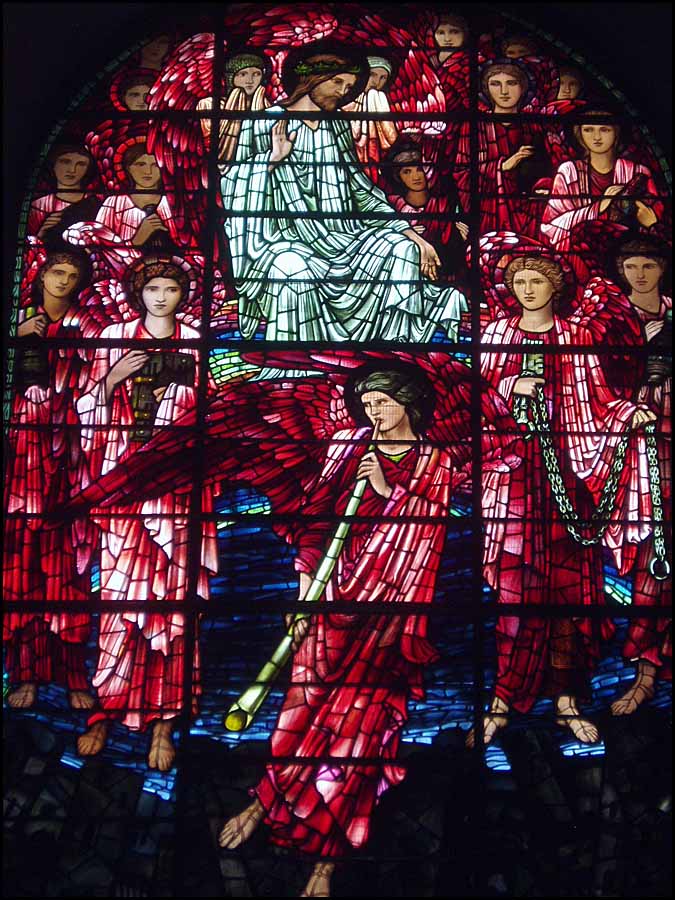
When Will the Kingdom Come? (Luke 17:20a)
Jesus begins his teaching with a question from the Pharisees.
"Once, having been asked by the Pharisees when the kingdom of God would come...."(Luke 17:20a)
Why would the Pharisees ask this? What did they believe about the Kingdom? We have no documents from Jesus' day that tell us what the Pharisees believed about the end times. We know, however, that a Pharisee named Sadoq was involved in the founding of the Zealot party, apparently from an older wing of the Pharisees.1 Judas the Galilean, a leader of the Zealots was considered by some the messianic heir-apparent. The Pharisees seem to be involved in the ferment of messianic expectancy that made the first century a volatile place for Roman rulers to keep under control. The Pharisees are quizzing Jesus, trying to find out his own expectation, perhaps prodding him to see if he'll claim to be the messiah. They ask "when"the Kingdom of God will come.
The Kingdom Is Not a Visible One (Luke 17:20b-21a)
Like many of Jesus' responses to the Pharisees'trick questions, Jesus doesn't answer them directly. Basically, he says that they are asking the wrong question because they don't understand the nature of the Kingdom.
"Jesus replied, 'The kingdom of God does not come with your careful observation, nor will people say, "Here it is,"or "There it is".....'"(Luke 17:20-21a)
The word translated "careful observation"(NIV), "things that can be observed"(NRSV), "with observation"(KJV) is paratēresis, "the act of watching or keeping an eye on something closely, observation."In other words, "God's Reign is not coming in such a way that its rise can be observed."2
No doubt the Pharisees are looking for a political kingdom that will overthrow the Romans and bring back the glory days of the Davidic kingdom. Jesus says that you won't be able to see it arise in that way.
The Kingdom of God is within You (Luke 17:21b)
This would be a good time to read again the Introduction to these lessons where I survey the six interpretations of the nature of the Kingdom of God as well as comments on the interpretation of Jesus' startling statement to the Pharisees in this passage:
"... because the kingdom of God is within you."(Luke 17:21b)
The adverb translated "within"is entos, "inside, within, within the limits of"or "among you, in your midst."3
This is a difficult verse, since Jesus' primary audience here is made up of Pharisees, not true disciples. Different meanings have been suggested.4 Here are the two most common ones:
1. The Kingdom is essentially God's Reign in the individual soul
One popular interpretation is that the Kingdom comes personally in the individual human heart. This interpretation appeals to people in this psychological and individualistic age. Though the adverb entos can fit this meaning, this interpretation falters at two points:
- This teaching is not found elsewhere in the Gospels; it is different from Jesus' other teachings on the nature of the Kingdom.
- We have no indication that the Pharisees were the sort of people that Jesus would say this about. Elsewhere in the Gospels, they are characterized as legalistic and outward in their observance of the Law, rather than concerned with the inward, subjective holiness that Jesus stressed.5
2. The Kingdom is "in your midst"in the Person of Jesus
The kingdom is "among you,"that is, it is present in the Person and ministry of Jesus.6 I think the second interpretation is closer to what Jesus meant -- that the Kingdom was present among them in Jesus himself. That the Kingdom had already begun as Jesus teaches, gathers disciples, and exercises God's authority here on earth. Of course, the Kingdom is present within us by Jesus' Spirit -- that is true, and the Epistles develop the idea of the indwelling Spirit. But since Jesus doesn't teach this anywhere else in the Gospels, I think he intended this saying to be understood in the sense of the Kingdom being "among"or "in the midst"of the Pharisees in his own Person.
Another saying that teaches the immediacy of the Kingdom of God in the Person and ministry of Jesus is found in both Matthew and Luke:7
"If I drive out demons by the Spirit of God, then the kingdom of God has come upon you."(Matthew 12:28)
"If I drive out demons by the finger of God, then the kingdom of God has come to you."(Luke 11:20)
The Kingdom of God, Jesus is saying, is not only a future reality. The Kingdom is present now in his very Person and will be fully revealed in the future. We see this tension throughout the Bible -- "now"and "not yet."
|
Q1. (Luke 17:21) In
what sense was the Kingdom of God present in the Person and
ministry of Jesus? In what sense is the Kingdom of God present
today?
|
False Christs Will Come (Luke 17:22-23)
Now Jesus seems to turn from the Pharisees to explain the coming of the Kingdom to his own disciples:
"22 Then he said to his disciples, 'The time is coming when you will long to see one of the days of the Son of Man, but you will not see it. 23 Men will tell you, "There he is!"or "Here he is!"Do not go running off after them.'"(Luke 17:22-23)
The first question is, what does Jesus mean by "one of the days of the Son of Man"? Does he predict that his disciples will look back longingly to their days together walking the roads of Galilee? Or is he speaking of the day of his return in glory? Or something else?8
The answer is clarified in Luke 17:24 where Jesus says, "For the Son of Man in his day will be like the lightning...."Jesus seems to be saying in verse 22a then, that his disciples will long for his future coming in glory. The Day of the Son of Man is identical to the Day of the Lord.
Then Jesus says in verse 22b, "... but you will not see it."The disciples long to see Jesus' return but will not -- not yet. I don't think Jesus is telling the disciples they won't see his return at all. He has already told them to be ready because they don't know the day and hour (Luke 12:39-40). Rather this phrase goes with the next. In their eagerness to see the coming of the Son of Man they aren't to go running off to verify one report or another. That's not the way to see the Son of Man, Jesus tells us.
Matthew's parallel to this passage specifies that people will be lured by false christs and false prophets doing great signs and miracles (Matthew 24:24). We aren't to run after this person or that who is acclaimed as the messiah -- even if he can do miracles. We had a few of those in the twentieth century -- Father Divine (1876-1965), Sun Myung Moon (1920- ), David Koresh (1959-1993), and others. Historically, it seems that every generation has had its claimants to being the messiah.
The Son of Man Will Come Like Lightning (Luke 17:24)
Why couldn't one of these people be the messiah? Because, when Jesus returns, everyone will see him.
"For the Son of Man in his day will be like the lightning, which flashes and lights up the sky from one end to the other."(Luke 17:24)
The word translated lightning is Greek astrapē, "lightning"and the word translated "flashes"is the verbal form of this root, astraptō, "to flash, gleam."9 The third word translated "lights up"(NIV, NRSV) or "shineth"(KJV) is Greek lampō, "to emit rays of light, shine, flash, gleam."10
Lightning can be seen at great distance and lights up a huge area. Since it often starts thousands of feet above the earth, the normal horizon caused by the earth's curvature doesn't limit its view nearly as much as if it took place at ground level. Jesus says it "lights up the sky from one end to the other"(17:24b). In the Book of Revelation, we read:
"Look, he is coming with the clouds,
and every eye will see him,
even those who pierced him;
and all the peoples of the earth will mourn because of him."(Revelation
1:7)
When Jesus comes he won't appear to just a few or in secret. He will be visible to all -- believer and unbeliever alike. Don't go running off when you hear reports of a messiah-sighting, Jesus instructs us.
|
Q2. (Luke 17:22-24)
What do Jesus' words about lightning teach us about the nature
of the coming of his Kingdom?
|
Suffering and Rejection Come First (Luke 17:25)
"But first he must suffer many things and be rejected by this generation."(Luke 17:25)
The word translated "suffer"is Greek paschō, "suffer, endure, undergo."11 The word translated "be rejected"is Greek apodokimazō, "reject (after scrutiny), declare useless, to regard as unworthy/unfit and therefore to be rejected."12
My mind immediately recalls a passage from Isaiah 53 that speaks about the Suffering Servant, who turns out to be none other than the Redeemer, the Messiah.
"He was despised and rejected by men,
a man of sorrows, and familiar with suffering.
Like one from whom men hide their faces
he was despised, and we esteemed him not."(Isaiah 53:3)
Though the Old Testament Septuagint uses Greek words different from Luke's Gospel, the idea is very similar.
On that Day
Jesus talks again and again of a particular time, as "day,""days,"and "night."
"... the days of the Son of Man...."(Luke 17:22)
"The Son of Man in his day will be like the lightning...."(Luke 17:24)
"... so also will it be in the days of the Son of Man."(Luke 17:26)
"It will be just like this on the day the Son of Man is revealed."(Luke 17:30)
"On that day no one who is on the roof of his house...."(Luke 17:31)
"on that night two people will be in one bed...."(Luke 17:34)
The day that the Son of Man is revealed seems to be the same day on which destruction comes, the day when one is taken and another left. A lot seems to be happening in a very short scope of time.
One obvious key word in our passage is "day"and "days,"hēmera. In Greek the word has the same kind of flexibility that our English word "day"has. It can mean (1) the period between sunrise and sunset, (2) civil or legal day, including the night, (3) a day appointed for very special purposes, and (4) an extended period of time.13 Here it refers to the special appointed day of God's final judgment and the coming of the Son of Man.
We see the concept of the Day of Judgment many times in the Old and New Testaments. It is often called "the day of the Lord"and is consistently referred to as a day of vengeance, of wrath, and of punishment.14
As in the Days of Noah and Lot (Luke 17:26-30)
Jesus relates two incidents well-known to his hearers: the great flood in Noah's time (Genesis 6-7) and the destruction of Sodom and Gomorrah (Genesis 19).
"Just as it was in the days of Noah,
so also will it be in the days of the Son of Man. People were eating,
drinking, marrying and being given in marriage up to the day Noah
entered the ark. Then the flood came and destroyed them all.
It was the same in the days of Lot. People were eating and drinking,
buying and selling, planting and building. But the day Lot left Sodom,
fire and sulfur rained down from heaven and destroyed them all. It will
be just like this on the day the Son of Man is revealed."(Luke
17:26-30)
These two events have two elements in common:
- People are going about their normal lives as if nothing is going to happen.
- On a particular day destruction from God occurs suddenly and without further warning.
Remember Lot's Wife (Luke 17:31-33)
Now Jesus warns his disciples that when this Day suddenly appears they aren't to rush off or turn away to get something.
"On that day no one who is on the roof of his house, with his goods inside, should go down to get them. Likewise, no one in the field should go back for anything. Remember Lot's wife! Whoever tries to keep his life will lose it, and whoever loses his life will preserve it."(Luke 17:31-33)
Those who are concerned about material things will be destroyed. Only those who look forward to the Lord's coming will be saved. Though told to run for her life without looking back, Lot's wife paused and looked back longingly at Sodom -- and became a pillar of salt (Genesis 19:17, 23-26).
It was probably something like what happened in Pompeii in AD 79. First, a volcanic gas settled over the city, asphyxiating many while they slept. Then the city was covered with heavy deposits of volcanic ash and the chemical action of the ash hardened the bodies of the dead, causing the surrounding ash to retain a perfect cast of the bodies.15 Perhaps Lot's wife's body became caked with the chemical salts raining down from the cataclysm. We're not sure.
How tragic! She was so close to deliverance and salvation, but her longing for her home was too much. Jesus warns us not to worry about our "things"on that Day, else they become a snare to us and cause us to miss out on the deliverance he offers.
|
Q3. (Luke 17:24-32)
What indications does Jesus give in this passage that he will
suddenly come in his Kingdom without further warning? What are
the implications of this for our attitude? For our lives?
|
One Will Be Taken, the Other Left (Luke 17:34-36)
Now comes an awesome and cryptic passage:
"I tell you, on that night two people will be in one bed; one will be taken and the other left. Two women will be grinding grain together; one will be taken and the other left."(Luke 17:34-35)
Now the Day shifts to night. There is a division, even between individuals who are in close physical proximity -- two people in a bed, two women grinding grain together with hand mill, no doubt chatting as women do while doing their routine chores. Without warning, one is taken and the other left.
|
|
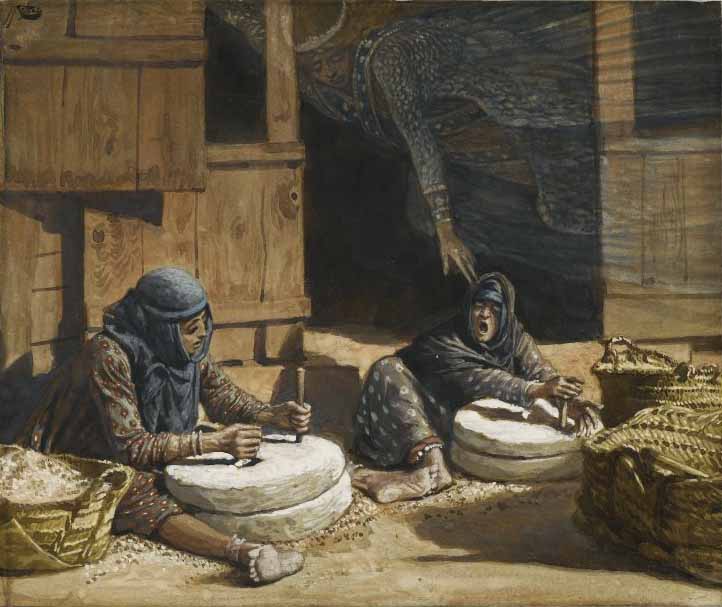
The word "taken"is Greek paralambanō, which means, "to take into close association, take (to oneself), take with/along,"usually in a positive sense.16 The word "left,"Greek aphiēmi, on the other hand, means, "to move away, with implication of causing a separation, leave, depart from."17
Taken where? Left to what purpose? The context in Luke is pretty vague. When we look at the parallel in Matthew 24 we get a hint of what Jesus might have meant.
"As it was in the days of Noah, so it will be at the coming of the Son of Man. For in the days before the flood, people were eating and drinking, marrying and giving in marriage, up to the day Noah entered the ark; and they knew nothing about what would happen until the flood came and took them all away. That is how it will be at the coming of the Son of Man. Two men will be in the field; one will be taken and the other left. Two women will be grinding with a hand mill; one will be taken and the other left."(Matthew 24:37-41)
In Matthew, Jesus has just talked about Noah entering the ark. We know that he took his family and a pair of every animal with him. Those who are taken along with him are saved from the catastrophe, but those who are left are destroyed by the impending judgment.
The Rapture of the Church
"I tell you, on that night two people will be in one bed; one will be taken and the other left. Two women will be grinding grain together; one will be taken and the other left."(Luke 17:34-35)18
Neither in Matthew nor in Luke are we told that this "taking"is the Rapture, that is, the gathering of all God's people to him at Christ's coming,19 both the living and the dead.20 In fact, Luke doesn't refer explicitly to the Rapture at all, except perhaps in this verse. But it seems to fit with what we're told elsewhere about the Rapture or great gathering of God's people:
"And he will send his angels with a loud trumpet call, and they will gather his elect from the four winds, from one end of the heavens to the other."(Matthew 24:31)
"And he will send his angels and gather his elect from the four winds, from the ends of the earth to the ends of the heavens."(Mark 13:27)
"Listen, I tell you a mystery: We will not all sleep, but we will all be changed -- in a flash, in the twinkling of an eye, at the last trumpet. For the trumpet will sound, the dead will be raised imperishable, and we will be changed."(1 Corinthians 15:51-52)
"After that, we who are still alive and
are left will be caught up together with them in the clouds to
meet the Lord in the air. And so we will be with the Lord forever."
(1 Thessalonians 4:17)
"Concerning the coming of our Lord Jesus Christ and our being gathered to him, we ask you, brothers...."(2 Thessalonians 2:1)
Though we can't be sure that Jesus is speaking of the Rapture in Luke 17:34-35, it seems that one group is taken away to be saved, and others are left to experience terrible destruction and punishment. There won't be time to get right with God. This separation will take place instantly, without warning. We must be ready now for the coming of the Son of Man.
|
Note: This is not the place to argue for or against a so-called "secret rapture"of the saints that is not mentioned in this passage. Please be gentle and loving with each other. Q4. (Luke 17:33-36)
What does our passage teach about the separation and judgment
that will occur when the Kingdom comes? How should this affect
our lives? Our testimony? Our love for our neighbors?
|
There the Vultures Will Gather (Luke 17:37)
The final passage is framed by another question from Jesus' disciples:
"Where, Lord?"they asked.
He replied, "Where there is a dead body, there the vultures will
gather."(Luke 17:37)
This passage is difficult for us to understand -- particularly for the city-folks among us. Jesus doesn't answer the disciples directly with a location, but tells a mini-parable of the vultures. The KJV rendering seems somehow grander than the NIV:
"Wheresoever the body is, thither will the eagles be gathered together"(Luke 17:37).
Eagles are more glorious than vultures. After all the Bald Eagle is the national symbol of the United States of America. But when you research it, you find that the "eagle"here probably refers to the vulture.
Eight species of eagles and four species of vultures appear in Palestine, most probably described by the same Hebrew word neser or Greek word aetos. In the Near East, both eagles and vultures ate carrion and hunted prey and were considered unclean (Leviticus 11:13; Deuteronomy 14:12).21 In this parable Jesus is referring to the common pattern of vultures circling high above a carcass.
Where I live in the dry foothills of California's Sierra Nevada, the sight of circling vultures or buzzards is exceedingly common, as it must have been above the hills and deserts of Palestine. These birds are huge, with a six-foot wingspan, and are majestic in their effortless soaring flight. First, one vulture will spot a dead or dying animal. Soon, from far off, others will see the lone vulture circling and join it in its vigil. When the animal is dead, the vultures descend for a meal.
In Jesus' parable, he is referring to the gathering and circling of vultures where a carcass is found, marking its location and making it obvious from miles around. The carcass doesn't somehow represent Jesus' body -- that is pushing the parable beyond its intent. The point is that high circling of the vultures makes the location obvious from afar. In Matthew's parallel, this verse is immediately preceded by a verse on the visibility of lightning from the west to the east at the coming of the Son of Man (Matthew 24:27-28). I believe that in his parable of the vultures, Jesus is saying that there is no need to pinpoint a location now; when Jesus comes it will be obvious to all. As Green puts it, "Just as the presence of carrion is indicated by circling vultures, so will his presence at the end be clearly evident."22
The Coming of the Kingdom
This passage teaches us several important things about the whens and wheres of the Kingdom.
- Present. The Kingdom is both present and future. Where Jesus is present, there is his Kingdom. "Where two or three are gathered in my name, there am I in the midst of them"(Matthew 18:20).
- Future. The Kingdom is not yet. While it is present in the person of the King, its coming is also future, when the King will come with judgment and complete rule. We pray in the Lord's Prayer, "Thy kingdom come, thy will be done, on earth as it is in heaven."As Son of Man, Jesus is "coming with the clouds of heaven,"and when he comes "his dominion is an everlasting dominion that will not pass away, and his kingdom is one that will never be destroyed"(Daniel 7:13-14).
- Sudden. Jesus' Second Coming and the coming of the Kingdom will not be progressive and gradual, but instant, quick, apocalyptic. It will be like lightning in its instantaneous and pervasive light. And in its unexpectedness, it will be like the Flood or the judgment on Sodom. There won't be time to gather your possessions or come in from the field.
- Judgment. Judgment will suddenly separate people from one another, husband and wife in bed together, as well as two women grinding grain. The judgment is both positive and negative. For those who trust in Christ, they will be gathered to Christ. For those who do not, they will remain to experience the terrible judgment that is coming.
In other gospels we get the same picture, suddenness, unexpectedness: like a thief in the night he will come and it will be too late then to make any preparations.
"So you also must be ready, because the Son of Man will come at an hour when you do not expect him"(Matthew 24:44).
Are you ready for his swift coming? Are you ready for final judgment? Near the end of his life, the Apostle Peter wrote,
"First of all, you must understand that in the last days scoffers will come, scoffing and following their own evil desires. They will say, 'Where is this "coming" he promised? Ever since our fathers died, everything goes on as it has since the beginning of creation....'
But do not forget this one thing, dear friends: With the Lord a day is like a thousand years, and a thousand years are like a day. The Lord is not slow in keeping his promise, as some understand slowness. He is patient with you, not wanting anyone to perish, but everyone to come to repentance.
But the day of the Lord will come like a thief. The heavens will disappear with a roar; the elements will be destroyed by fire, and the earth and everything in it will be laid bare.
Since everything will be destroyed in this way, what kind of people ought you to be? You ought to live holy and godly lives as you look forward to the Day of God and speed its coming. That Day will bring about the destruction of the heavens by fire, and the elements will melt in the heat. But in keeping with his promise we are looking forward to a new heaven and a new earth, the home of righteousness."(2 Peter 3:3-4, 8-13)
 A book of the compiled lessons is available in both e-book and paperback formats. |
The Kingdom is now in the Person and presence of the Messiah in our midst. But it is also coming in completeness and fullness and quickness in the future, when Christ's reign will be complete. Then, finally,
"At the name of Jesus every knee should bow, in heaven and on earth and under the earth, and every tongue confess that Jesus Christ is Lord, to the glory of God the Father."(Philippians 2:10-11)
Come soon in your Kingdom, Lord Jesus!
Prayer
Lord Jesus, when we ponder your teaching about the awesome and sudden coming of your Kingdom, it frightens us. We are not worthy of your glory or of your Kingdom. We are pitiful in our own righteousness. But we know that you have loved us, forgiven us, cleansed us, and declared us righteous. Help us to stand in you if the Day of the Kingdom comes suddenly in our lifetimes. If not, O Lord, have mercy on our children. In your holy name and in your grace, we pray. Amen.
Key Verses
"The kingdom of God does not come with your careful observation, nor will people say, 'Here it is,'or 'There it is,'because the kingdom of God is within you."(Luke 17:20b-21, NIV)
"For the Son of Man in his day will be like the lightning, which flashes and lights up the sky from one end to the other."(Luke 17:24, NIV)
"I tell you, on that night two people will be in one bed; one will be taken and the other left. Two women will be grinding grain together; one will be taken and the other left."(Luke 17:34-35, NIV)
References (Abbreviations)
1. Rudolf Meyer, pharisaios, TDNT 9:27. He cites Josephus, Antiquities 18, 4ff.
2. Paratēresis, BDAG 771-772.
3. Entos, BDAG 340.
4. Some scholars have suggested the meaning to be that the kingdom is "within your reach," that is, attainable if you go the right way about it. Marshall (Luke, p. 655) notes that this view was supported by a study by C.H. Roberts of the usage in the papyri, meaning, "in the hands of, in the control of, within the power of," hence meaning here "within your reach" or "within your grasp." But another interpretation of the papyri usage is possible. H. Riesenfeld and A. Wikgren suggest that the meaning in the papyri is rather, "in the house of," that is, "in your domain, among you." Marshal sees this as making good sense, so "Jesus is speaking of the presence of the kingdom of God among men, possibly as something within their grasp if they will only take hold of it."
5. See NIV, KJV, Green, Luke, p. 630, fn. 54; Ladd, Theology of the NT, p. 121; Barclay, Luke, p. 220, sees both interpretation #1 and #2 as possible.
6. So Moffatt; RSV; Henry Alford, Greek NT, 1:609, "(already) among you"; Morris, Luke, p. 359; Green, Luke, p. 630; BDAG 340-41 sees this as patterned after Isaiah 45:14, with entos in the sense of "'among you, in your midst,'either now or suddenly in the near future."
7. See the Introduction for an exegesis of these verses.
8. Marshall (Luke, p. 658) gives six possible interpretations, but sees the future day that the Son of Man comes as "the least unsatisfactory."
9. Astrapē, BDAG 146. A closely-related word astron means "star, constellation" which has found its way into the English language with such words as "astronomy."
10. Lampō, BDAG 585-586.
11. Paschō, BDAG 785-786.
12. Apodokimazō, BDAG 110.
13. Hēmera, BDAG 436-438.
14. Malachi 4:5; 1 Corinthians 5:5; 2 Corinthians 1:14; 1 Thessalonians 5:2; 2 Peter 3:10; Revelation 16:14; Isaiah 2:12; 13:6, 9; 34:8; Jeremiah 46:10; Lamentations 2:22; Ezekiel 30:3; Joel 2:1; Amos 5:18; Obadiah 1:15; Zephaniah 1:8, 18; 2:2-3; Zechariah 14:1.
15. Victor P. Hamilton, The Book of Genesis, Chapters 18-50 (New International Commentary on the Old Testament; Eerdmans, 1995), p. 48, fn. 16. D.J. Wiseman, "Lot," ISBE 3:171-172.
16. Paralambanō, BDAG 767-768.
17. Aphiēmi, BDAG 156, 3.
18. The KJV and a few ancient manuscripts contain verse 36: "Two men will be in the field; one will be taken and the other left." Metzger (Textual Commentary, p. 168) sees strong manuscript support for the shorter text: p75 Aleph A B L W Δ Θ Ψ and others. The United Bible Societies Editorial Committee gave the shorter reading a {B} degree of certainty, "some degree of doubt." Modern translations omit the verse which was likely assimilated by copyists from Matthew 24:40.
19. Dispensationalists teach that the "secret rapture" of the church will take place when Christ appears secretly, but that the judgment will come when Christ comes publically. I don't see this distinction taught anywhere in Scripture. This doctrine was developed by J.N. Darby in the mid-nineteenth century, popularized by study notes in the Scofield Reference Bible, Hal Lindsey's book The Late Great Planet Earth (1970), and the best-selling Left Behind fiction series by Tim LaHay and Jerry B. Jenkins.
20. The English word "rapture" refers to the gathering together and catching away of God's people in the air when Christ returns. (It comes from a Latin word raptus, "snatching away," from which we also derive our word "rape.") It is referred to in 1 Thessalonians 4:13-18; 1 Corinthians 15:51-52; Matthew 13:31; Mark 13:27; 2 Thessalonians 2:1; and elsewhere.
21. Harold van Broekhoven, Jr., "Eagle," ISBE 2:1-2. R.K. Harrison, "Vulture," ISBE 4:999.
22. Green, Luke, p. 636.
Copyright © 2026, Ralph F. Wilson. <pastor joyfulheart.com> All rights reserved. A single copy of this article is free. Do not put this on a website. See legal, copyright, and reprint information.
 To be notified about future articles, stories, and Bible studies, why don't you subscribe to our free newsletter, The Joyful Heart, by placing your e-mail address in the box below. We respect your