|
Old Testament
New Testament
Gospels
Acts
Paul's Letters
General Letters
Revelation
Topical Studies
Beginning the Journey (for new Christians). en Español

|
Old Testament
New Testament
Gospels
Acts
Paul's Letters
General Letters
Revelation
Topical Studies

|
Home
Bible Studies
Articles
Books
Podcasts
Search
Menu
Donate
About Us
Contact Us
FAQ
Sitemap


Free
E-mail Bible Study
 Experiencing the Psalms
Home | Bible Studies | Articles | Books | Podcasts | Search | Menu | Donate | About Us | FAQ | Contact Us
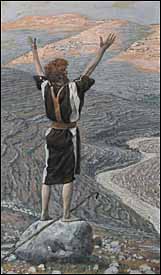 James J. Tissot, "The Voice in the Desert" (1886-1896), watercolor, Brooklyn Museum, New York. Larger image. |
He dresses strangely, has few manners that ingratiate himself to those who come to hear him. Rather, his message is blunt and uncompromising. But contained in this message is the first key to understanding the Kingdom of God.
An Angel Announces John's Birth and Mission (Luke 1:14-17)
If you've read Luke's Gospel you've heard the back story on John. He is, in fact, Jesus' cousin. The angel who announces Mary's pregnancy with Jesus also tells Mary that her cousin Elizabeth is already six months pregnant -- with the baby who will become known as John the Baptist.
His father Zechariah is a priest, and his mother, too, comes from a priestly family. They are pious, God-fearing folk. Their son is born with a special mission from God. The angel that announced John's birth declared:
"He will be filled with the Holy Spirit even from birth. Many of the people of Israel will he bring back to the Lord their God. And he will go on before the Lord, in the spirit and power of Elijah, to turn the hearts of the fathers to their children and the disobedient to the wisdom of the righteous -- to make ready a people prepared for the Lord." (Luke 1:14-17)
He is a prophet, one filled with the Holy Spirit to speak for God. The angel outlines his mission:
- Means: He is to bring Israel back to the Lord, evidenced by actual changes of heart in his hearers. For example, fathers will become sensitive once more to the needs of their children and those who have been disobeying God will learn wisdom and change their ways.
- End: Prepare a people for the Lord's coming.
John the Baptist's Message (Matthew 3:1-2)
Let's look at this man who introduces us to the Kingdom of God.
"1 In those days John the Baptist came, preaching in the Desert of Judea 2 and saying, 'Repent, for the kingdom of heaven is near.'" (Matthew 3:1-2)
John is clearly different. His message is: "Repent, for the kingdom of heaven is near." (3:2). The verb "repent" is metanoeō, from meta-, "change, exchange, transfer" + noeō, "to perceive with the mind, to understand." Literally, metanoeō means "to change one's mind," then "feel remorse, repent, be converted."1 John's call is for people to change their mind about the way they were living, to recognize their sins and turn away from them. Repentance is John's command.
One of the chief problems with Christians around the world is that they claim the name of Christ, but are unrepentant in heart. They -- follow their own ways and desires in direct contradiction to the teachings and commands of the Lord Jesus Christ. If we would follow Jesus, we must be disciples who are quick to repent when the Spirit of God speaks to our hearts. Repent!
But there is a reason for the command: "... for the kingdom of heaven is near." As you recall from the introduction, "kingdom of heaven" was the Jewish way of saying "kingdom of God," since the Jews tried to avoid using God's name for fear of blaspheming God and breaking the Second Commandment. We'll use "kingdom of God" and "kingdom of heaven" interchangeably in our study.
The reason for repentance was that "the kingdom of heaven is near" (NIV), "at hand" (KJV). The word is engizō, "draw near, come near, approach" in either a spatial sense or in a temporal sense.2 Here it's referring to time: The time of the coming of God's kingdom is soon! Get ready for the King!
Have you ever been in an office when suddenly you hear that the boss will be coming in a few minutes? What do you do? You get your act together and stop doing the things that you shouldn't.
The King is coming, John is saying, and you must repent of what you are doing or you will be found as condemned sinners when he comes. Repent! Now is the time!
The Preparer of God's People (Matthew 3:3)
"This is he who was spoken of through the prophet Isaiah: 'A voice of one calling in the desert, "Prepare the way for the Lord, make straight paths for him."'" (Matthew 3:3)
The narrator in Matthew explains John's role in God's plan, but this was John's self-understanding as well. In John's Gospel, he is asked who he is. He answered:
"I am the voice of one calling in the desert, 'Make straight the way for the Lord.'" (John 1:23)
John the Baptist, son of a priest, knew the Scriptures. God had told him that he was the spokesman mentioned in Isaiah's prophecy:
"A voice of one calling:
'In the desert prepare the way for the LORD;
make straight in the wilderness a highway for our God.
Every valley shall be raised up,
every mountain and hill made low;
the rough ground shall become level,
the rugged places a plain.
And the glory of the LORD will be revealed,
and all mankind together will see it.
For the mouth of the LORD has spoken.'" (Isaiah 40:3-5)
John came in the Judean desert, as the prophecy had said. And his task was to "prepare the way of the Lord," that is, construct a straight highway that the King would use to enter his kingdom. This would involve change of heart. Isaiah uses the analogy of valley's being filled and cuts being made in hills so the road might be level. He speaks of rough ground and rugged places being smoothed.
Those dips and hills, those rough and rugged places, dear friends, are in our hearts. Only the conviction of the Holy Spirit followed by repentance can make them smooth, fit for the King.
The Greek word used in the Gospels for "prepare" is hetoimazō, "to cause to be ready, put/keep in readiness, prepare."3 What about your life? Is it ready? Are you keeping your heart in readiness, or are you experiencing a gradual decline in your relationship to God?
| Q1. What happens when people adopt the Christian faith without
repenting of their known sins? Why do people avoid repentance? What
percentage of Christians today do you think are unrepentant, unprepared
in heart? https://www.joyfulheart.com/forums/index.php?showtopic=993
|
John the Prophet (Matthew 3:4)
John even looked like a prophet.
"John's clothes were made of camel's hair, and he had a leather belt around his waist. His food was locusts and wild honey." (Matthew 3:4)
One of Israel's most famous prophets had been Elijah. The Jews would have been familiar with the passage describing him:
"The king asked them, 'What kind of man was it who came to meet you and told you this?'They replied, 'He was a man with a garment of hair and with a leather belt around his waist.'The king said, 'That was Elijah the Tishbite.'" (2 Kings 1:7-8)
John was a rough man, suited to wilderness food, not kings palaces. Like Elijah, he wore "a prophet's garment of hair" (Zechariah 13:4). Instead of fine food, he dined on "locusts and wild honey," food that he could find in the desert. Locusts are the only type of insect permitted as food in the Mosaic Law (Leviticus 11:20-23) and are still eaten today in lands where they are plentiful.4
Later, Jesus praises John:
"What did you go out into the desert to see? ... A man dressed in fine clothes? No, those who wear expensive clothes and indulge in luxury are in palaces. But what did you go out to see? A prophet? Yes, I tell you, and more than a prophet.... I tell you, among those born of women there is no one greater than John." (Luke 7:24-26, 28)
Still later, Jesus identifies John the Baptist, who had come "in the spirit and power of Elijah" (Luke 1:17), as the Elijah who was expected to come before the Messiah appeared (Malachi 4:5-6; Matthew 17:10-13).
The People's Response (Matthew 3:5-6)
The nation's response to John the Baptist's ministry was remarkable.
"5 People went out to him from Jerusalem and all Judea and the whole region of the Jordan. 6 Confessing their sins, they were baptized by him in the Jordan River." (Matthew 3:5-6)
Our word "baptize" is a transliteration of the Greek word baptizō, which means "dip, immerse, submerge, baptize."5 It's important to understand this basic meaning, regardless of our own church's practice of baptism, or how much water our church may use. John was baptizing in the Jordan River, and probably assisted penitents by either dipping them into the water himself, or perhaps by assisting them to dip themselves. Jesus did not annul this form of water baptism but continued it, having his own disciples baptize believers in his name (see Matthew 28:19; Mark 16:16; John 3:22, 26; 4:1-2; Acts 2:38, 41).
The origins of John's baptism are difficult to discern precisely. We know that the Community at Qumran (in John's desert "territory," certainly) practiced repeated ritual washings,6 but John's baptism seems different -- an act of purification and forgiveness that can be looked back upon as a single event (Acts 19:3-4). Probably, the antecedent for John's baptism is the first century practice of Jewish proselyte baptism, a ritual bath by which a Gentile convert to Judaism was cleansed from moral and religious impurity.7 ,8
If this baptism indeed was compared to proselyte baptism, then it must have taken a great deal of humility for a Jew to repent of his sins and be baptized publically just like a non-Jew. After all, they claimed Abraham as their father (Matthew 3:9). The Jewish leaders refused to admit they were sinners in this way. Luke says, "The Pharisees and experts in the law rejected God's purpose for themselves, because they had not been baptized by John" (Luke 7:30).
| Q2. (Matthew 3:5-10; Luke 7:30) How would John's baptism have
offended a Jew's national pride? Who welcomed John's baptism? Who
resisted it? Why? https://www.joyfulheart.com/forums/index.php?showtopic=994
|
The Religious Leaders'Response (Matthew 3:7-10)
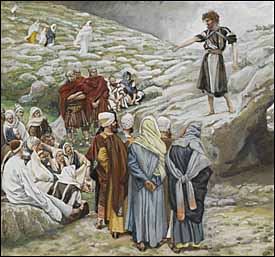 James J. Tissot, detail of "St. John the Baptist and the Pharisees" (1886-1896), watercolor, Brooklyn Museum, New York. Full image. |
John the Baptist, of course, was well aware of his opponents'presence in the crowds and their resistance to his ministry.
"7 But when he saw many of the Pharisees and Sadducees coming to where he was baptizing, he said to them: "You brood of vipers!9 Who warned you to flee from the coming wrath? 8 Produce fruit in keeping with repentance.
9 And do not think you can say to yourselves, 'We have Abraham as our father.'I tell you that out of these stones God can raise up children for Abraham. 10 The ax is already at the root of the trees, and every tree that does not produce good fruit will be cut down and thrown into the fire." (Matthew 3:7-10)
When exposed, a nest of snakes would slither away. "Who warned you," John is asking, "that judgment fire is coming so that you scurry forth?"
John compares the coming judgment to the cutting down and burning of a fruit tree because it no longer produces good fruit. "The ax is already at the root of the trees," thunders the prophet. Judgment is about to begin and will come soon if we do not repent of our sins.
What a hard message! John pulled no punches. John's message to the leaders'hard hearts is the same as it is to us: "Produce fruit in keeping with repentance" and "every tree that does not produce good fruit will be cut down and thrown into the fire" (Matthew 3:8, 10). Decades later, Jesus' brother James put it another way, "Faith without works is dead" (James 2:17, 26).
I fear that Christians today preach grace without repentance, which is a travesty of the true Gospel. We are to repent the best we are able, and then -- and only then -- rely on the grace of God through Jesus Christ to save us. Dear friends, if we are to be disciples of the Kingdom, we must repent and thereafter live lives submitted to Jesus our King.
The Baptizer in the Holy Spirit (Matthew 3:11)
Now John's message points to the One for whom he is preparing: the Messiah, the coming King.
"I baptize you with water for repentance. But after me will come one who is more powerful than I, whose sandals I am not fit to carry. He will baptize you with the Holy Spirit and with fire." (Matthew 3:11)
The point of comparison between John the Baptist and the Messiah is the act of immersing or overwhelming. But the medium in which or with which the baptism takes place differs. John immerses his disciples in water, while the Messiah will immerse his followers in the Holy Spirit.
Spirit Baptism (Matthew 3:11)
The biggest question in this passage is what it means to "baptize with the Holy Spirit." Church doctrines aside, the basic meaning is to immerse or dip a person in the Holy Spirit; to flood a person with the Holy Spirit. Water is a symbol of cleansing. The Holy Spirit, on the other hand, is the actual agent of cleansing and empowerment.
To study the meaning a bit further, let's look at two closely related passages:
"I am going to send you what my Father has promised; but stay in the city until you have been clothed (enduō) with power (dunamis) from on high." (Luke 24:49)
"Do not leave Jerusalem, but wait for the gift my Father promised, which you have heard me speak about. For John baptized with water, but in a few days you will be baptized with the Holy Spirit.... But you will receive power (dunamis) when the Holy Spirit comes on (epiechomai) you; and you will be my witnesses in Jerusalem, and in all Judea and Samaria, and to the ends of the earth." (Acts 1:4, 5, 8; see 11:15-16)
Examine some of the words with me as we expand our understanding a bit:
"Clothe (KJV 'endue') with power." The verb is enduō, "dress, clothe"10 This may be similar to the analogy of baptism, the idea of covering completely with. The word translated "power" is Greek dunamis, from which we get our word "dynamite." To cover with power. What a thought!
"Receive power." The verb here is the extremely common Greek word lambanō, "to receive." The emphasis is not on voluntary acceptance here but upon possessing it. It's your turn to take an action. What would you do if you were given a package of high explosives or a grant of limitless hydroelectric power from a dam high in the mountains? Think what you could do with it! You've received power.
"Come upon." The Greek verb is eperchomai, a compound word that means "come over or upon." It can refer to unpleasant happenings or to an enemy attack. But here it is used of the Holy Spirit coming upon the disciples.11 The word suggests something out of our control that happens to us. Spirit baptism is wholly in God's power and at his time and pleasure.
"Pour out." The Spirit is "poured out" upon believers (Acts 2:17-18, 2:33, 10:45). Similar to the water baptism analogy, in pouring, the water, which is in a vessel above the believer, saturates the believer with the Holy Spirit.
The "baptism of the Holy Spirit" involves being covered with, immersed in, and empowered by the Holy Spirit. The Holy Spirit is the very basis of our life in Christ and our connection to God. Jesus floods us with the Holy Spirit. What a wonderful thought and promise!12
| Q3. (Matthew 3:11) What is the point of comparison between John's
action and the Messiah's action? What is the point of difference? Do you
really long to be overwhelmed by the Holy Spirit? What might prevent
this in your life? What might encourage it?
https://www.joyfulheart.com/forums/index.php?showtopic=995
|
The King Brings Judgment (Matthew 3:12)
"His winnowing fork is in his hand, and he will clear his threshing floor, gathering his wheat into the barn and burning up the chaff with unquenchable13 fire." (Matthew 3:12)
The process of preparing grain involved (1) threshing, that is, crushing, beating or thrashing the grain heads in order to loosen the grain kernels from the surrounding stems and husks; and (2) winnowing, using a kind of wooden pitch fork (a winnowing fork) to throw the threshed grain heads into the breeze, so the lighter chaff will blow downwind, and the heavier grain kernels will fall back to the ground, separating the two. The floor would be "cleared" by threshing and then winnowing all the grain heads until the chaff and grain had been completely separated. The grain was then gathered into baskets and stored in the barn, but the remaining stems and husks piled together and set ablaze.
The verb translated "clear" (NIV, NRSV) "purge" (KJV) is Greek diakathairō, "clean out, cleanse thoroughly."14 The idea of thoroughness and complete cleaning is contained in this compound verb. John the Baptist isn't talking about just regular fire here that would burn itself out when the chaff is consumed, but a kind of eternal, unquenchable fire.
So what is this fire baptism? There are three possibilities:
- A figure of purification of sin as the Holy Spirit does his cleansing work in us as part of the process of sanctification. Indeed, the Spirit's cleansing in us is sometimes painful, but nothing in the context suggests that this is what John had in mind.
- A symbol of the tongues of fire that appeared over the heads of the 120 disciples in the upper room on the Day of Pentecost (Acts 2:3). This, too, is a stretch for John the Baptist. In the Pentecost passage, the fire probably represents the Shekinah, that is, the glory of God rather than fires of purification.
- A prophecy of the eschatological separation of the righteous from the unrighteous, and judgment by the Messiah at the end of the age. This fits contemporary expectations of the Messiah, as well as the words "cleanse thoroughly" and "unquenchable fire" contained in the passage. Jesus' parable of the Wheat and the Tares (Matthew 13:30, 41-42) includes this kind of analogy of separation and final judgment. We see this in Henry Alford's well-known Thanksgiving Hymn, "Come Ye Thankful People, Come."
"For the Lord our God shall come, And shall
take His harvest home.
From His field shall in that day All offenses purge away;
Give His angels charge at last In the fire the tares to cast,
But the fruitful ears to store In His garner evermore."
So John is prophesying of Jesus that he will (1) flood his followers with the Holy Spirit, and (2) judge the unrighteous at the End of the Age. When Christ returns, he will come in judgment. The first time he came in mercy, but when he returns at the End of the Age it will be with final, terrible judgment.
What should disciples learn from this? First, we need to get off the fence and determine whose side we are on. We need to learn a healthy fear of God. Sometimes people talk about Jesus as if he's their buddy. Jesus is no one's buddy. Peter learned quickly that even those close to him cannot presume upon his will without meriting a sharp rebuke (Matthew 16:23). He is our Friend, but not our buddy. He is always our Master.
Second, we need to consider our friends and loved ones, and pray for their salvation. Jesus will surely come in terrible judgment, and unless people repent of their sins, they will perish and experience eternal punishment. There is the exhilarating promise of the baptism of the Holy Spirit, but the sobering warning of judgment for those who do not welcome the Messiah.
Have You Been Baptized?
This passage urges some personal reflection. Have you acknowledged Jesus' power and authority over you as John the Baptist did? Have you been baptized? Have you repented of your sins and submitted yourself to public Christian baptism? If not, why don't you talk with your pastor about it this week? We are disciples! We're not going to put off until a later time the lessons about which Christ is dealing with us now!
Have you been immersed in the Holy Spirit? If you've repented of your sins and asked Christ to be your Master, then He responds with the gift of the Holy Spirit and the resulting new birth. What's going on in your life? Are you swimming in the Spirit or just sipping occasionally? Are you spiritually dry? Do you long for God with a deep thirst? The Messiah wants you flooded with his Spirit, and anything less isn't enough.
Jesus' Baptism (Matthew 3:13-15)
John the Baptist is the local phenomenon. People are streaming to the Jordan by the hundreds, by the thousands, to be baptized. Then, all of a sudden, comes Jesus.
"13 Then Jesus came from Galilee to the Jordan to be baptized by John. 14 But John tried to deter him, saying, 'I need to be baptized by you, and do you come to me?'15 Jesus replied, 'Let it be so now; it is proper for us to do this to fulfill all righteousness.'Then John consented." (Matthew 3:13-15)
Why should Jesus be baptized? Even John the Baptist wondered the same. Though he probably knew Jesus from times when their families met at Passover in Jerusalem each year, John had spiritual eyes. He knew now that his cousin Jesus was the sinless Lamb of God who would take away the world's sin (John 1:29, 36). In Jesus' presence, John the Baptizer realizes his own unworthiness: "I need to be baptized by you" (Matthew 3:14).
So why did Jesus insist upon being baptized? Theologians have pondered this mystery for centuries. Jesus' answer is, "to fulfill all righteousness." "Fulfill" is plēroō, "to make full, fill (full)," then, "to bring to a designed end, fulfill" a prophecy, an obligation, a promise, a law, a request, a purpose, a desire, a hope, a duty, a fate, a destiny, etc.15 "Righteousness" (dikaiosynē) might be considered speaking of specific action, "righteousness in the sense of fulfilling divine expectation, not specifically expressed in ordinances."16 It might refer to solidarity with John's call for repentance to prepare for the kingdom.
But more likely it is Jesus' identification with all those who are being baptized, having responded to John's call for repentance. Jesus is becoming one with them, with us, for he is our brother (Hebrews 2:11). Jesus' words probably contain a reference to Isaiah's prophecy which Jesus knew well: "My righteous servant will justify many, and he will bear their iniquities" (Isaiah 53:11).
The Spirit Rests upon the Son (Matthew 3:16-17)
16 As soon as Jesus was baptized, he went up out of the water. At that moment heaven was opened, and he saw the Spirit of God descending like a dove and lighting on him. 17 And a voice from heaven said, "This is my Son, whom I love; with him I am well pleased." (Matthew 3:16-17)
The One who will baptize with the Spirit is now anointed by the Spirit for his ministry. We see echoes of this event in both Luke and Acts. Now Jesus goes "full of the Holy Spirit" (Luke 4:1), "in the power of the Spirit" (Luke 4:14). Peter declares,
"... How God anointed Jesus of Nazareth with the Holy Spirit and power, and how he went around doing good and healing all who were under the power of the devil, because God was with him." (Acts 10:38)
This is also a God-given sign to John the Baptist:
"Then John gave this testimony: 'I saw the Spirit come down from heaven as a dove and remain on him. I would not have known him, except that the one who sent me to baptize with water told me, "The man on whom you see the Spirit come down and remain is he who will baptize with the Holy Spirit." I have seen and I testify that this is the Son of God.'" (John 1:32-34)
Jesus' Message of Repentance (Matthew 4:17)
Following his baptism, Jesus returns to Galilee, and after John is imprisoned, Jesus takes up his cousin's message:
"From that time on Jesus began to preach, 'Repent, for the kingdom of heaven is near.'" (Matthew 4:17)
Sometimes we see Jesus as the gentle Teacher. But he is also the Prophet who calls to repentance. "The Kingdom, the Reign of God, is at hand," Jesus says. "You must repent." Zacchaeus understood it and repented (Luke 19:1-10). To the woman discovered in adultery, he didn't speak condemnation, but a call to repentance: "Go now and leave your life of sin." (John 8:11)
He speaks the same word to his disciples today. Follow me, but as you follow, you must repent. We cannot be serious about the Reign of Christ if we don't turn from our sins. To pretend to follow Jesus while we are still living in unrepented sin is an affront to his Kingship over us. We begin our study of Jesus and the Kingdom with this word: "Repent, for the Kingdom of heaven is near" (Matthew 4:17).
| Q4. Why is repentance so central to the Kingdom of God? Why is
baptism important to converts to the King? Can Christ reign in an
unrepentant heart? https://www.joyfulheart.com/forums/index.php?showtopic=996
|
Prayer
 A book of the compiled lessons is available in both e-book and paperback formats. |
Father, too often we have heard your word but gone our own way. Help us, we pray, to be a repentant people so that we might be true disciples of the Kingdom. In Jesus' name, we pray. Amen.
Key Verses
"They were baptized by him in the river Jordan, confessing their sins." (Matthew 3:6, NIV)
"Repent, for the Kingdom of heaven is near." (Matthew 4:17, NIV)
References (Abbreviations)
1. Metanoeō, BDAG 640, 1 and 2.
2. Engizō, BDAG 270, 2.
3. Hetoimazō, BDAG 400, a.
4. France, Matthew, p. 106.
5. G.R. Beasley-Murray, "Baptism, Wash," NIDNTT 1:143-150. Beasley-Murray explains, "In secular Greek baptō means (a) dip, (b) dip into a die, and so die, and (c) draw (water). Baptizō is an intensive form of baptō and means (a) dip, and (b) cause to perish (as by drowning a man or sinking a ship" (p. 144).
6. Manual of Discipline 1QS 3:4-9; 6:14-23. See also D.S. Dockery, "Baptism," in DJG, p. 56, who thinks the Qumran washings are the most probable antecedent for John's baptism.
7. G.R. Beasley-Murray, Baptism in the New Testament (Eerdmans, 1962, 1973), pp. 23ff.
8. The Early Church understood water baptism much as John the Baptist did, representing God's cleansing and the washing away of our sins (Acts 22:16). It is a baptism of repentance still, since by submitting to Christian baptism, a person either tacitly or explicitly acknowledges his need for cleansing, and therefore his sins that demand forgiveness and cleansing. On the Day of Pentecost, Peter told his convicted hearers, "Repent and be baptized, every one of you, in the name of Jesus Christ for the forgiveness of your sins. And you will receive the gift of the Holy Spirit" (Acts 2:38).
9. The word "viper" is Greek echidna, "snake." The term ordinarily suggests a poisonous one, such as, Vipera ammodytes, commonly known as sandviper (BDAG 419). The common Palestinian Viper lays up to 20 eggs which hatch in six weeks as eight inch long vipers. John the Baptist had probably run across nests of these poisonous snakes in the desert. Later in his ministry Jesus uses the same expression to describe the Pharisees.
10. Enduō, BAGD 264. The KJV translation "endue" means both "put on, don" as well as "provide, endow," and is often confused with the word "endow," though "endow" comes from a different root that means "gift, dower" (Merriam-Webster).
11. Eperchomai, BAGD 285.
12. Note: Two helpful books that discuss some of these matters in detail are G.R. Beasley-Murray, Baptism in the New Testament (Eerdmans, 1962); and James D.G. Dunn, Baptism in the Holy Spirit (SCM Press Ltd., 1970). The latter book is pretty technical.
13. "Unquenchable" is Greek asbestos, a mineral supposed by the ancients to be inextinguishable when set on fire. Merriam-Webster, p. 66.
14. Diakathairō, BAGD 229, Thayer 137. Diakathairō is a compound word formed from dia- "thoroughly" + kathairō, "to cleanse," properly, from filth, impurity, etc. (Thayer 312).
15. Plēroō, BDAG 829, 4b. It is similar to: so that the just requirement of the law might be fulfilled in us..." (Romans 8:4) and "by dying nobly fulfilled their service to God" (4 Maccabees 12:14).
16. Dikaiosynē, BDAG 248, 3b. France (Matthew p. 120) says that in saying "fitting for us," Jesus is "thinking of something specific to his own and John's role rather than of a general principle: God requires him to be baptized by John."
Copyright © 2026, Ralph F. Wilson. <pastor joyfulheart.com> All rights reserved. A single copy of this article is free. Do not put this on a website. See legal, copyright, and reprint information.
 To be notified about future articles, stories, and Bible studies, why don't you subscribe to our free newsletter, The Joyful Heart, by placing your e-mail address in the box below. We respect your