|
Old Testament
New Testament
Gospels
Acts
Paul's Letters
General Letters
Revelation
Topical Studies
Beginning the Journey (for new Christians). en Español

|
Old Testament
New Testament
Gospels
Acts
Paul's Letters
General Letters
Revelation
Topical Studies

|
Home
Bible Studies
Articles
Books
Podcasts
Search
Menu
Donate
About Us
Contact Us
FAQ
Sitemap


Free
E-mail Bible Study
 Names and Titles of God
Home | Bible Studies | Articles | Books | Podcasts | Search | Menu | Donate | About Us | FAQ | Contact Us
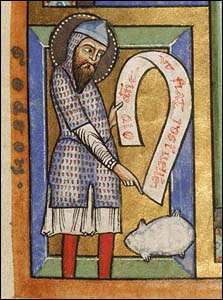 Gideon pointing to the fleece. Illustrated manuscript, German, Hildesheim, about 1170s, Tempera colors, gold leaf, silver leaf, and ink on parchment, 11 1/8 x 7 7/16 in., MS. 64, FOL. 92. Getty Museum. |
Gideon Summons the Tribes to War (6:33-35)
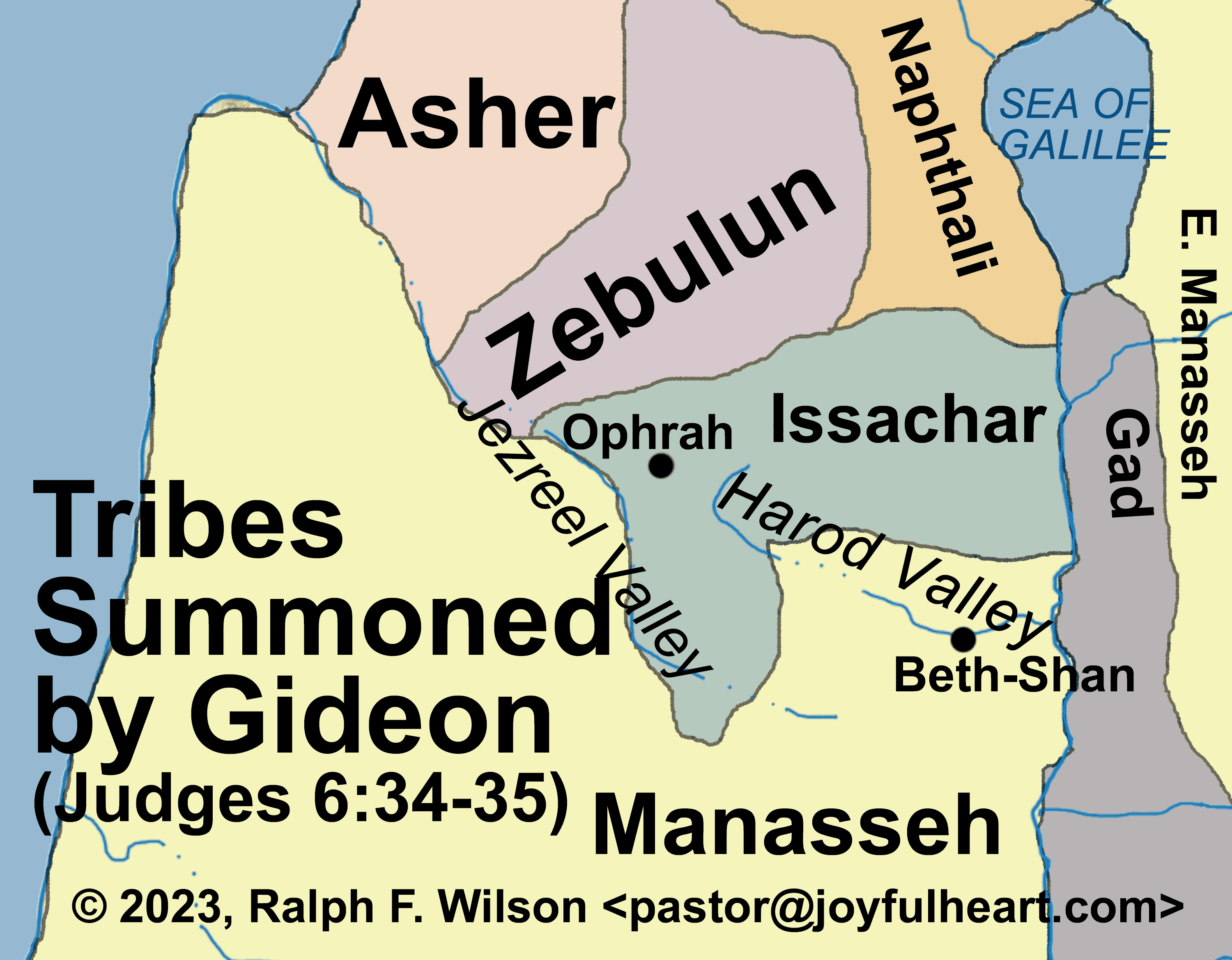
 Tribes Summoned by Gideon (Judges 6:34-35). Larger map. |
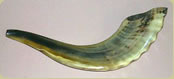
"Now all the Midianites, Amalekites and other eastern peoples joined forces and crossed over the Jordan and camped in the Valley of Jezreel. Then the Spirit of the LORD came upon Gideon, and he blew a trumpet, summoning the Abiezrites to follow him. He sent messengers throughout Manasseh, calling them to arms, and also into Asher, Zebulun and Naphtali, so that they too went up to meet them." (6:33-35)
The center of the Midianite invasion this year is the plain of the Jezreel Valley, where they begin to set up their camps in preparation to systematically ravage the land. In numbers they totally dominate the leaderless Israelite inhabitants.
Then God begins to change the picture in one loud trumpet blast. The Spirit of the Lord comes upon Gideon to take action. "Came upon" (NIV, KJV) or "took possession of" (NRSV) in verse 34 is the Hebrew verb labesh, "dress, be clothed."1 The Spirit of God so dwells with Gideon that he is clothed in God's Spirit. In this, Gideon shares something with the Spirit-anointed kings and priests -- and, in a sense, with Christians today who receive the Holy Spirit as their spiritual birthright (Philippians 4:13).
|
|
At first, Gideon's trumpet summons his clansmen from the clan of Abizier to follow him. They have forgiven him, apparently, from pulling down the altar to Baal and follow him as their leader. Next, Gideon sends messengers to the rest of his tribe, Manasseh, summoning them to battle. He also calls out some of the smaller tribes of Israel -- Asher, Zebulun and Naphtali -- and they respond. But he omits the much larger, dominant tribe of Ephraim, a decision that will come back to cause him trouble later (8:1-3).
| Q1. (Judges 6:33-35) What inspires Gideon to blow the battle horn and
summon an army against the Midianites? What does Gideon have in common with
other judges and leaders of his era? (Hint: see Deuteronomy 34:9; Judges
3:10; 11:9; 13:25; 14:6, 19; 15:14; 1 Samuel 11:6.) https://www.joyfulheart.com/forums/index.php?showtopic=22
|
Putting a Fleece before the Lord (6:36-39)
Under the power of the Spirit Gideon has called up an army, but faced with the enormity of the task he is overwhelmed. He asks for divine assurance that this is really God's will he is pursuing.
"Gideon said to God, 'If you will save Israel by my hand as you have promised -- look, I will place a wool fleece on the threshing floor. If there is dew only on the fleece and all the ground is dry, then I will know that you will save Israel by my hand, as you said.' And that is what happened. Gideon rose early the next day; he squeezed the fleece and wrung out the dew -- a bowlful of water.
"Then Gideon said to God, 'Do not be angry with me. Let me make just one more request. Allow me one more test with the fleece. This time make the fleece dry and the ground covered with dew.' That night God did so. Only the fleece was dry; all the ground was covered with dew." (6:36-39)
First, Gideon clarifies the question that he needs an answer to. He wants to make sure he has the message right -- that "You will save Israel by my hand as you have promised" (6:36). "Save" (NIV, KJV) or "deliver" (NRSV) is the Hebrew verb yāsha`, "save, deliver, give victory, help; be safe; take vengeance, preserve."3 Notice here that Gideon doesn't see himself as the savior. Rather God will save Israel. But Gideon will be the instrument -- "by my hand." This is a curious request for confirmation, since Gideon acknowledges at the outset that this is what he understands God's promise to be. "Promised" (NIV) or "said" (KJV) in verse 36 is the verb dābar, "to speak, declare, converse, command, promise, warn, threaten, sing, etc."4 Gideon just needs to be certain.
We can certainly empathize with Gideon. How often have we felt God's leading, but need assurance again -- and yet again. But God is so gracious. Gideon has obeyed to the extent of his commands so far. He is serious about this request, he just needs assurance.
He sets up the test with a fleece -- the sheared pelt of wool from a sheep that has come off in a single piece. "Fleece" is the Hebrew noun gizzâ, from the verb gāzaz, "to sheer or mow."5 He places the fleece on dry, flat ground in the evening. "Threshing floor" (NIV) or "floor" is the Hebrew noun gōren, which refers specifically to "threshing floor, threshing place, the place where grain was threshed from the stalk and chaff."6
Then Gideon retires for the evening to await the dew (Hebrew tal). May to October are the dry months when no rain falls. But in the evening the temperature in Palestine drops dramatically. Moist west winds blow inland from the Mediterranean. The cold nights cause condensation of the moisture. The amount varies in different regions, but in Gaza there is dew 250 nights of the year.7
When Gideon gets up in the morning the fleece is sopping wet and he is able to wring a bowlful of water from it, but the ground around the fleece is dry. God has confirmed his inquiry.
Gideon wonders, scientist that he is, if by some fluke the wool fleece just absorbed more water. Now he asks God to do the opposite the following night -- the fleece dry and the ground wet.
But his request is humble and tentative -- though bold at the same time. He addresses God: "Do not be angry with me. Let me make just one more request. Allow me one more test with the fleece" (6:39a). He pleads for God's indulgence of his second request.
He acknowledges that God has reason to be angry with him. After all he has allowed himself to be put to the test once already. Why should the Almighty God, after all, have to submit to little exercises invented by mere men? The word "test" (NIV), "prove" (KJV), or "make trial" (NRSV) is the Hebrew verb nāsâ, "test, try, prove, tempt, assay, put to the proof, put to the test."8 A number of people have gotten in bad trouble by "putting God to the test," most famously at Massah and Meribah by demanding that God give them water in the desert (Exodus 17:2, 7; Deuteronomy 6:16; Psalm 78:18, 41, 56; 95:8-9; 106:14; Isaiah 7:12; Matthew 4:7 = Luke 4:12; 1 Corinthians 10:9.).
What's the difference between Gideon's test and ungodly testing of God by the Israelites and by Satan's suggestion that Jesus jump off the temple? These were attempts to manipulate God into doing miracles to somehow prove himself. But what Gideon was asking was for God to do a minor miracle to help Gideon anchor his full faith in the Lord. Gideon's request is in order to establish his faith, whereas sinful testing of God is to get God to do miracles to meet selfish needs.
| Q2. (Judges 6:36-39) Why does Gideon put out a fleece before the Lord
-- twice? Is this a sign of unbelief or of belief? Does this constitute
"testing" God? How does it differ from the sinful testings of God the
scripture warns against? When, if ever, should we ask God to confirm his
direction with a sign? What is the danger of demanding a sign? https://www.joyfulheart.com/forums/index.php?showtopic=23
|
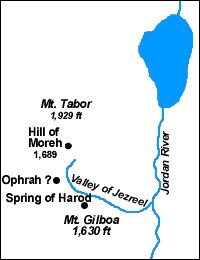 Gideon's Army Encamps (7:1)
"Early in the morning, Jerub-Baal (that is, Gideon) and all his men camped at the spring of Harod. The camp of Midian was north of them in the valley near the hill of Moreh." (7:1)
"Spring of Harod" is probably the present 'Ain Jalud, just under the northern cliffs of Mount Gilboa, at the south edge of the Jezreel Valley. "A plentiful and beautiful spring of clear cold water rises in a rocky cave and flows out into a large pool, whence it drains off, in Nahr Jalud, down the valley past Beisan to the Jordan."9 "The hill or Moreh" just above the Midianite encampment, was across the Jezreel Valley, about three miles north of Gideon's location. It is probably the modern Jebel Dahi, located between Mt. Gilboa and Mt. Tabor on the north side of the Valley of Jezreel.10
Too Big an Army to Give God Glory (7:2-3)
Now that the army had answered the call, God starts speaking troubling things to Gideon:
"The LORD said to Gideon, 'You have too many men for me to deliver Midian into their hands. In order that Israel may not boast against me that her own strength has saved her, announce now to the people, "Anyone who trembles with fear may turn back and leave Mount Gilead." ' So twenty-two thousand men left, while ten thousand remained." (7:2-3)
If I had been Gideon, I would have been embarrassed to obey such a command. Gideon is a new leader. He's concerned with how others perceive his leadership. He has just emerged as a bold, young leader who has, presumably, raised an army of 32,000 on the basis of his "own" personal charisma. What will people think if he dismisses two-thirds of his army by allowing the fearful to go home, no questions asked? It seems most un-general-like. Yes, there is Biblical precedent for such a move (Deuteronomy 20:8). But what will people say?
Gideon has learned two vital lessons:
- That God is surely directing him -- otherwise what is the meaning of the fleece, and
- To obey God even when he doesn't understand the reason for God's command.
If Gideon allows his pride to dissuade him from obedience he puts his whole army and country in jeopardy -- and proves what God has just said about men's propensity to pride at their achievements.
However, God does explain the reasons for dismissing two-thirds of the army:
"You have too many men for me to deliver Midian into their hands. In order that Israel may not boast against me that her own strength has saved her...." (7.2)
"Boast" (NIV) or "vaunt" (KJV) is the Hebrew verb pā΄ar, "glorify, beautify, adorn," which, in the Hithpael, also carries the meaning, "to boast."11 God knows us well. We're so easily tempted to take credit for the things that go well, but blame God when they fail. Our pride is so deceptive, we may not even recognize the signs.
God cannot allow Israel to take credit for the victory, or they'll restore their disastrous pattern of depending upon themselves and failing to rely upon the true God. Until Gideon came along it took seven years of oppression and poverty before they humbled themselves enough to "cry out to the LORD for help" (6:6).
But despite all the pressures upon Gideon, he obeys God even though it seems outwardly foolish. Gideon's humility before God helps him, and he gives the order for the fearful to go on home. After all, God helps him save face by giving him a rationale for his strange command based on Deuteronomy 20:8 -- "Then the officers shall add, 'Is any man afraid or fainthearted? Let him go home so that his brothers will not become disheartened too.' "
Gideon's command to "leave Mount Gilead" is a bit peculiar. Gideon's army is encamped by Mount Gilboa. Mount Gilead is east of the Jordan River. Perhaps this is an otherwise unknown use of Mount Gilead or a transmission error in the early text -- we don't know.
Still Too Many (7:4)
The army is reduced by two-thirds, but 10,000 men is still too many for God's plan.
"But the LORD said to Gideon, 'There are still too many men. Take them down to the water, and I will sift them for you there. If I say, "This one shall go with you," he shall go; but if I say, "This one shall not go with you," he shall not go.'" (7:4)
God instructs Gideon to march the rest of the army down to the water -- presumably the spring of Harod -- where God will "sift them." "Sift" (NIV, NRSV) or "try" (KJV) is the Hebrew verb ṣārap, "smelt, refine, test ... primarily used for gold and silversmiths and for the process of refining metals before they were worked into fine vessels."12 God will refine the army still more.
| Q3. (Judges 7:1-3) Why did God feel Gideon's army was too large? Why
was shrinking the army's size to a tiny band essential in restoring Israel's
faith and allegiance? What kinds of pressures would Gideon be feeling not
to obey God in shrinking his army? How was Gideon able to obey God fully in
this? https://www.joyfulheart.com/forums/index.php?showtopic=25
|
| Q4. Why do we demand that God's directions make sense to us before
we'll follow them? What's the spiritual danger here? We're afraid of being
-- or being perceived as -- religious kooks. How can we balance blind
obedience with getting confirmation through spiritual people whose
discernment we trust? https://www.joyfulheart.com/forums/index.php?showtopic=26
|
Separate the Lappers for Battle (7:5-6)
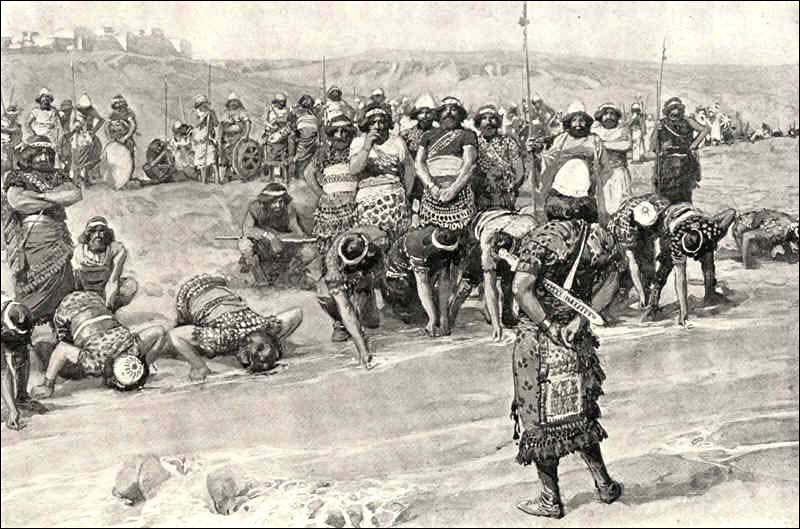 J.J. Tissot, "Gideon chooses the three hundred" (1896-1900), watercolor. Larger image. |
Now Gideon receives even more bizarre instructions from God to pare down his army:
"So Gideon took the men down to the water. There the LORD told him, 'Separate those who lap the water with their tongues like a dog from those who kneel down to drink.' Three hundred men lapped with their hands to their mouths. All the rest got down on their knees to drink." (7:5-6)
While the picture isn't entirely clear, it seems that those who prostrated themselves at water's edge to drink in the cool, refreshing water directly -- they were the rejects. "Kneel down" (NIV) or "boweth down" (KJV) is the Hebrew verb kāra`, "bow down, kneel, sink down to one's knees, kneel down." The same word is used of kneeling in worship.13
A few men, apparently cupped water into their hands and drank it or lapped it from their hands as might a dog. "Lap" is the Hebrew verb lāqaq, "lick, lap."14 These few were selected by the Lord to remain with Gideon. The rest were told to leave.
There's been a lot of discussion why lappers are superior soldiers to kneelers. Lappers are more alert, they say. Lappers are aware of their surroundings and are always ready for battle, they argue. But I don't think lapping was so much a virtue as it was a way of separating out a band of 300 men. At any rate, this way the remaining warriors can't be said to have been selected for their mighty strength -- they were selected for lapping. I see humor here!
| Q5. (Judges 7:5-6) What significance, if any, do you see in selecting
the "lappers" from the "kneelers"? https://www.joyfulheart.com/forums/index.php?showtopic=27
|
Nearly 10,000 Lappers Sent Home (7:7-8)
"The LORD said to Gideon, 'With the three hundred men that lapped I will save you and give the Midianites into your hands. Let all the other men go, each to his own place.' So Gideon sent the rest of the Israelites to their tents but kept the three hundred, who took over the provisions and trumpets of the others." (7:7-8)
Whether they were sent home or just to their encampment isn't fully clear. They went "each to his own place" (7:7). "Place" (NIV) in 7:7 is the Hebrew noun māqôm, which "represents the physical location where something is or ought to be, i.e. its station. So, it is translated 'place, home, room.'"15 Verse 7:8 is a bit ambiguous also: "So Gideon sent the rest of the Israelites to their tents...." "Tents" is the Hebrew noun ΄ōhel, "tent, dwelling, later general for habitation, home."16 But apparently they were sent home, for when the victory is won they are "called out" again from their various tribes.
Nevertheless, before they leave, they are relieved from some of their equipment -- "provisions" and trumpets. "Provisions" (NIV) or "victuals" (KJV) is the Hebrew noun ṣêdâ, "food."17 But here it probably refers to food jars that Gideon's men were to use to cover their torches and enough shophars so that each of the 300 men is now a bugler.
With 300 I Will Deliver You (7:7)
"The LORD said to Gideon, 'With the three hundred men that lapped I will save you and give the Midianites into your hands.'" (7:7)
Though the Midianite army was vast, perhaps 135,000 or more (8:10), if Gideon's original army of 32,000 were to conqueror them they would be considered heroes in battle. Were his reduced army of 10,000 to conqueror them in spite of such great numerical superiority, the 10,000 would be acclaimed mighty men of valor.
But for 300 men to defeat an army of 135,000? Preposterous! That could only be considered a miracle, the intervention of God. Here is God's promise to encourage obedient Gideon on the eve of battle: "With the three hundred men that lapped I will save you and give the Midianites into your hands." (7:7)
In 6:14 the Lord tells Gideon that he will save Israel from the Midianites, but here it is clear who is doing the real saving -- the Lord. Nevertheless, it will be by Gideon's hand and instrumentality. God has found a man who will trust him enough to obey him even when things don't seem to make sense. And that kind of faith, dear friends, is a rare and precious find.
The Lord Encourages Gideon (7:8b-12)
"Now the camp of Midian lay below him in the valley. During that night the LORD said to Gideon, "Get up, go down against the camp, because I am going to give it into your hands. If you are afraid to attack, go down to the camp with your servant Purah and listen to what they are saying. Afterward, you will be encouraged to attack the camp." So he and Purah his servant went down to the outposts of the camp. The Midianites, the Amalekites and all the other eastern peoples had settled in the valley, thick as locusts. Their camels could no more be counted than the sand on the seashore." (7:8b-12)
Now God makes him a promise -- "I am going to give it into your hands" (7:9) -- but Gideon must take action in order to claim the promise. Notice how sensitive the Lord is to Gideon's fears (7:10)? The Lord now engineers an event to give Gideon greater confidence, so that he might be "encouraged" (NIV) or "strengthened" (KJV, NRSV), using the Hebrew verb ḥāzaq, "be(come) strong, strengthen, prevail, harden, be courageous."18
The Lord senses Gideon's fear of actually attacking. After all, he now has 300 men against 130,000 -- "thick as locusts" (7:12). Perhaps Gideon's fear sees them as that many! The word used here for "attack" (NIV) or "go down" (KJV) in verses 9,10, and 11, is the common Hebrew verb yārad, "go down." Here it refers to "a military maneuver to encounter the enemy in battle."19 But Gideon does sneak down to the outskirts of the enemy's camp, where God has a surprise for him.
The Enemy's Barley Bread Dream (7:13-15a)
"Gideon arrived just as a man was telling a friend his dream. 'I had a dream,' he was saying. 'A round loaf of barley bread came tumbling into the Midianite camp. It struck the tent with such force that the tent overturned and collapsed.'
His friend responded, 'This can be nothing other than the sword of Gideon son of Joash, the Israelite. God has given the Midianites and the whole camp into his hands.'
When Gideon heard the dream and its interpretation, he worshiped God." (7:13-15a)
People of that day didn't bake bread in loaf pans, but as round lumps of dough that might bake into perfect wheels. The Midianite guard has seen just one of these loaves in his dream, careening down hill into the camp. In his dream, the small loaf strikes and collapses a tent many times its size.
The other Midianite interprets the dream out loud -- in Gideon's hearing -- as the Lord causing "the sword of Gideon" to defeat the entire Midianite camp. The sword (Hebrew ḥereb) in Gideon's day at the end of the Bronze Age was probably made out of bronze. A century or two later the Phoenicians and Philistines began to use iron and steel swords.18 (See the appendix, "Weapons of the Late Bronze Age" www.jesuswalk.com/joshua/warfare.htm ).
Think how encouraged Gideon must have been to hear the words from his enemy's own mouth, "God has given the Midianites and the whole camp into his hands" (7:14). In response, Gideon "worshiped God" (7:15) The Hebrew word here is ḥāwâ, "to prostrate oneself on the ground, to worship."21
God is so faithful to strengthen his servant -- whom he found fearfully threshing wheat in a winepress -- to the point where he can lead 300 men against 135,000! God can strengthen you, too. If you feel too weak for the task he has set before you, like Gideon, ask him to strengthen your faith. God is in the faith-strengthening business! Now encouraged, Gideon returns to the camp, and calls them from their sleep with the same words with which God called him an hour or two previously: "Get up! The LORD has given the Midianite camp into your hands" (7:15).
| Q6. (Judges 7:13-14) What does the rolling barley loaf mean in the
Midianite's dream? Why does the Lord show Gideon this dream? https://www.joyfulheart.com/forums/index.php?showtopic=28
|
Lessons for Disciples
 Available in paperback, PDF, and Kindle formats. |
What are we disciples supposed to learn from this passage? Several lessons are obvious:
- God is merciful and gracious, understanding of our human frailties. God's willingness to meet Gideon's request for God to give a sign through the fleece is amazing.
- God is ready to assist us to grow in our faith. Both the fleece and the Midianite's dream show God's desire to assist.
- God desires to build our confidence in him, not our own strength. Pride and boasting are destructive.
- God delights to work through those too weak to act on their own.
Prayer
Father, as a leader I fall short. I always want to know "why" before I'll obey without complaining. But I ask you to help me grow to the place where I'll trust both the integrity of your voice and the content of your message so much that I will obey blindly, if need be. Forgive me for my stubborn rationalism, I pray. In Jesus' name. Amen.
Key Verse
"The LORD said to Gideon, 'You have too many men for me to deliver Midian into their hands. In order that Israel may not boast against me that her own strength has saved her....'" (Judges 7:2)
References
Common Abbreviations of References
- Andrew Bowling, lābēsh, TWOT #1075.
- Hermann J. Austel, shāpar, TWOT #2449c.
- John E. Hartley, yāsha`, TWOT #929.
- Earl S. Kalland, dābar, TWOT #399.
- Elmer B. Smick, gāzaz, TWOT #336b.
- Harold G. Stigers, grn, TWOT #383a.
- Jack P. Lewis, ṭll, TWOT, #807a. A.H. Joy, "Dew," ISBE 1:941.
- Marvin R. Wilson, nāsâ, TWOT #1373.
- Quote from R.P. Dugan, "Harod," ISBE 2:618. See also Cundall, Judges, p. 109.
- R.P. Dugan, "Moreh, Hill of," ISBE 3:412.
- Victor P. Hamilton, pā΄ar, TWOT #1726.
- John E. Hartley, ṣārap, TWOT #1972.
- Walter C. Kaiser, kāra`, TWOT #1044. Josephus, Antiquities, 5,6,3, sees the kneeling lappers as more courageous than the 300 who "drank tumultuously, that he should esteem them to do it out of fear, and as in dread of their enemies." The NRSV text for verses 5-6 sees it differently than the NIV: "All those who lap the water with their tongues, as a dog laps, you shall put to one side; all those who kneel down to drink, putting their hands to their mouths, you shall put to the other side. The number of those that lapped was three hundred; but all the rest of the troops knelt down to drink." The NRSV footnote reads: "Hebrew places the words 'putting their hands to their mouths' after the word 'lapped' in verse 6."
- TWOT, lāqaq, #1126.
- Leonard J. Coppes, qûm, TWOT #1999h.
- Jack P. Lewis, ΄āhal, TWOT #32a.
- ṣwd, TWOT, #1886b.
- Carl Philip Weber, ḥāzaq, TWOT #636.
- Edwin Yamauchi, yārad, TWOT #909.
- Edwin Yamauchi, ḥārab, TWOT #732a.
- Edwin Yamauchi, ḥāwâ, TWOT #619.
Copyright © 2026, Ralph F. Wilson. <pastor joyfulheart.com> All rights reserved. A single copy of this article is free. Do not put this on a website. See legal, copyright, and reprint information.
 To be notified about future articles, stories, and Bible studies, why don't you subscribe to our free newsletter, The Joyful Heart, by placing your e-mail address in the box below. We respect your