|
Old Testament
New Testament
Gospels
Acts
Paul's Letters
General Letters
Revelation
Topical Studies
Beginning the Journey (for new Christians). en Español

|
Old Testament
New Testament
Gospels
Acts
Paul's Letters
General Letters
Revelation
Topical Studies

|
Home
Bible Studies
Articles
Books
Podcasts
Search
Menu
Donate
About Us
Contact Us
FAQ
Sitemap

Free
E-mail Bible Study
 Names and Titles of God
Home | Bible Studies | Articles | Books | Podcasts | Search | Menu | Donate | About Us | FAQ | Contact Us
The City of Colossae
Colossae or Colosse was an ancient city in the Lycus River valley, about 100 miles east of the great, cosmopolitan capital city of Ephesus, located in the Roman province of Asia, in present-day Turkey.
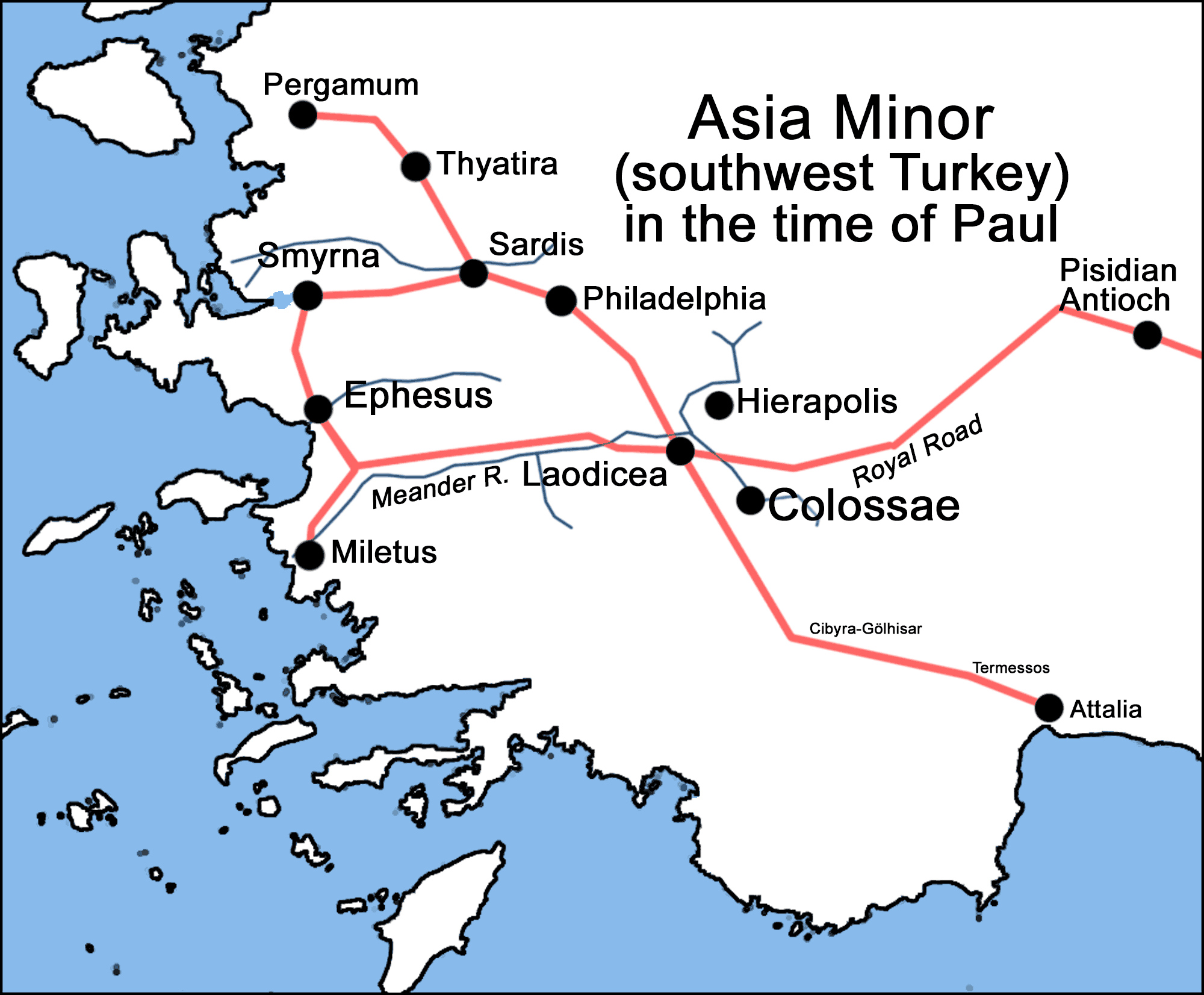
Colossae was the smallest of three cities in the Lycus Valley -- along with Laodicea (12 miles west) and Hierapolis (15 miles northwest). Each of these cities had Christian churches (4:13-16).
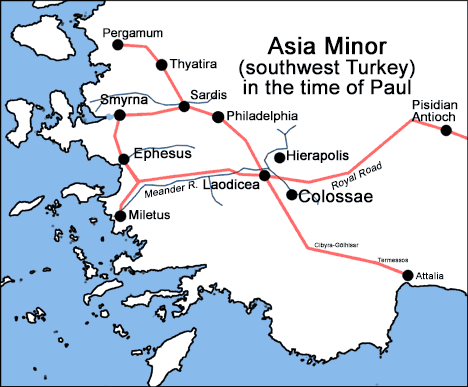 Asia Minor in the time of Paul. Larger map. |
Though these cities were far from the big city, they weren't isolated, since they were situated near the great Persian Royal Road that ran from Ephesus and Sardis in the West to the Euphrates and on to Persia in the East.1
At one point in the fourth or third centuries BC, Colossae had been the most important of the three cities, known for its flourishing textile industry and high-quality dark red wool, known as "Colossian wool." But after the north-south road was moved west to pass through Laodicea, Colossae began to decline.
Roman historian Tacitus mentions an earthquake that destroyed Laodicea in 60-61 AD.2Laodicea was rebuilt quickly. We don't know how long it took to rebuild Colossae. Today, however, nothing remains of Colossae above ground. The tell (acropolis or mound) of the city has not been excavated, though the contour of an outdoor amphitheater is discernable on the site.
The Peoples of Colossae
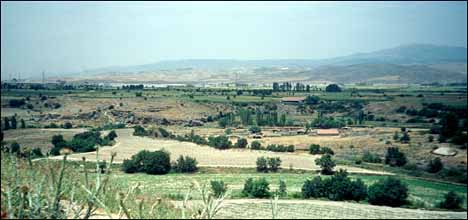
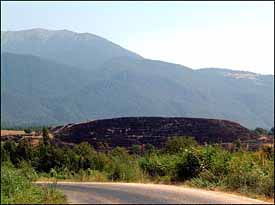 The tell or acropolis of the Colossae has not been excavated. It appears darkened because the vegetation had been burned off recently. Photo copyright by HolyLandPhotos.org. Used by permission. |
The population of Colossae was probably quite diverse -- especially in light of the nearby highway.
We know that Antiochus III had settled about 2,000 Jewish families in the general area in 213 BC.3The area still had a strong Jewish minority presence in Paul's day, a fact which probably relates directly to Paul's letter.
Proximity to the nearby highways ensured that the Colossians were exposed to the latest ideas, which then mixed together with other ideas. Thus the Christian church was subject to syncretism with other religious movements.
Colossians is apparently written primarily to Gentile Christians. We observe:
- Paul's description of their conversion in terms more appropriate to Gentiles, rather than to Jews (1:12, 21)
- He mentions the mystery revealed "among the Gentiles"(1:27)
- The sins mentioned are more typical of Gentiles, than of Jews (3:5)
- He includes neither Old Testament quotations nor any explicit reference to the law.4
Though he writes primarily to Gentile Christians, the heresy that Paul was fighting seems to have Jewish roots, as is discussed below.
History of the Church
While Paul had probably passed through Colossae on his second missionary journey, he didn't found the church at Colossae -- directly. Rather, it was founded by Epaphras, whom Paul mentions in this letter (1:7-8; 4:12-13).
Paul had been preaching in the "big city" of Ephesus, about 100 miles west of Colossae from 53 to 55 AD. His ministry was quite effective, first in the synagogue and later in the rented lecture hall of Tyrannus.
"This went on for two years, so that all the Jews and Greeks who lived in the province of Asia heard the word of the Lord." Acts 19:10)
Paul didn't travel through the province of Asia, but people came to him to learn about Jesus, and then took the message of the gospel to their own hometowns. Epaphras was undoubtedly one of these.
Occasion of the Letter
Paul is in prison "for the sake of the gospel"(4:3, 10), probably in Rome. Epaphras, the pastor of the Colossian church, has come to Paul's place of imprisonment. In his letter to Philemon, Paul speaks of Epaphras as "my fellow prisoner in Christ Jesus" (Philemon 1:23).
No doubt, Epaphras has come to consult with Paul about the heresy that was causing problems in the Colossian church. So Paul writes a letter to the Colossians designed to expose and stop the heresy and to encourage the church in their new Christian faith. Since Epaphras can't return at this time, Paul sends the letter by the hand of his co-worker Tychicus (4:7-8).
Authorship
From earliest times through the mid-1800s, the Letter to the Colossians has been accepted at face value as from "Paul, an apostle of Christ Jesus"(1:1). Colossians is alluded to by Clement of Rome (97-98 AD),5Ignatius (about 110 AD),6and the Letter of Barnabas (182-188 AD),7was included in Marcion's canon (c. 144 AD) and the Muratorian Canon (c. 190-217 AD), and was quoted by Irenaeus (c. 180),8Theophilus of Antioch (176-186 AD),9Clement of Alexandria (c. 193-220),10Tertullian (198-220 AD),11Origen (225-254),12and Eusebius. Colossians is firmly established in the canon of the Christian church.
However, in recent years it has become widely popular to question Pauline authorship of Colossians (as well as Ephesians and Philippians) on the grounds of style and a more advanced theology than Paul's "accepted" letters.
So far as style goes, the vocabulary of Colossians includes a number of words not found elsewhere in Paul's letters. But that can be explained by Paul's two-fold role as both "an apologist for Christianity to the intellectual world of paganism," as well as defending the gospel within the church. F.F. Bruce comments:
"As apologist to the Gentiles, he may have been the first to meet his pagan opponents on their own ground and use their language in a Christian sense, in order to show that the problems to which they unsuccessfully sought an answer elsewhere found their solution in the gospel."13
While Colossians bears differences from other Pauline epistles, it includes the Pauline touch through and through. The arguments positing a different author than Paul are extremely speculative and, frankly, create more problems than they purport to solve. I believe that an excellent case can be made that Colossians was written by the Apostle Paul himself.
Place and Date of Origin
If Paul is the author, as I believe, the question remains: During which of his prison periods was the letter written? Various scholars have argued for his writing it during imprisonments at Ephesus (c. 52-55 AD),14Caesarea (c. 57-59 AD), and Rome (c. 60-62 AD). Arguments for one place or another are based on the best fit of circumstances, companions present, visitors during imprisonment, the nature of the false teaching combated, the state of advance of Pauline theology, and an earthquake in 60-61 AD that devastated Colossae.
However, most scholars who accept Pauline authorship date the Letter to the Colossians during Paul's first imprisonment in Rome, approximately 60-62 AD (Acts 20:31-32). That makes the most sense to me.
The Nature of the "Colossian Heresy"
|
|
The particular heresy that Paul addresses in Colossae is difficult to pin down exactly. It has similarities -- and differences -- with doctrinal problems that Paul addresses in other churches.
Just what is the "Colossian heresy"? As we read between the lines in 2:8-25 we can begin to discern its shape. The heresy seems to have had these elements:
- A belief system, called a "hollow and deceptive philosophy"(2:8).
- Tradition-based, "depends on human tradition"(2:8, 22).
- Elemental spiritual forces underlie the system (2:8).
- Not Christ-centered, the teaching doesn't "depend on ... Christ"(2:8).
- Food restrictions and Jewish "holy days" are involved (2:16).
- Ascetic disciplines are encouraged (2:18, 23).
- Angel worship is central (2:18).
- Visionary experiences are touted (2:18).
- Pride characterizes the proponents (2:18).
- Losing connection with Christ is the result (2:19).
- Rule-keeping is urged (2:20-23).
Most scholars agree on these points. Three more possible points are less certain.
- "Fullness" language (1:19; 2:9, 10) suggests that a "fullness" of spiritual experience couldn't be found in Christ alone. The vocabulary is found in both Gnosticism and Stoicism.
- Circumcision is advocated (2:11, 13; 3:11) -- perhaps.
- Christ is being denigrated -- perhaps -- though this may reflect Paul's cure more than the active teaching of his opponents.15
Who Are the False Teachers?
The identity of the false teachers at Colossae has been widely debated. The major views tend to cluster around four explanations:
- Mystery religions have been argued by some as one of the sources of the heresy, but this is hard to pin down or prove.
- Gnosticism would assume a much later composition of this letter, since full-blown Gnosticism didn't mature until the mid-second century AD. It is possible, however, to see some incipient Gnostic elements in the false teachers' position.16
- Jewish mysticism was one of the strands of Judaism that was flourishing at the time. Bruce argues for a background of Jewish merkabah mysticism, which gave way to exercises designed to facilitate entry into the vision of the heavenly chariot (Hebrew merkābā, of Ezekiel's vision of the wheel within the wheel, Ezekiel 1:15-26).17Wright sees Colossians as a warning against Judaism itself.18
- A mixture of teachings is most likely, I think. We would like to see a simple opponent, but movements are inevitably affected by the winds of thought swirling through the culture. Clinton Arnold argues for a syncretism or combination of Phrygian19folk belief, local folk Judaism, and Christianity.20
We just don't have enough information to determine the exact identity of the Colossian heretics beyond the basic outlines. However, these teachers seem to represent an ascetic and mystical form of Jewish piety mixed with local folk belief, perhaps with Christian overtones, since Paul says that they weren't "holding fast to the Head"(2:19).
Whoever they were, Paul's prescription is a focus on the sufficiency and supremacy of Christ as the antidote to being pulled away to a heresy that promised greater "fullness."
Purpose of the Letter
 A book of the compiled lessons is available in both e-book and paperback formats. |
Colossians seems to have been written with two purposes in mind:
- To encourage and ground this relatively new Christian community, and
- To protect them from the seduction of false teachers, probably from a variety of mystical Judaism, that tended to denigrate these Gentile Christians' faith in Christ in favor of the claims of Judaism.
As you study Colossians, I'm sure you'll not only be blessed with a greater knowledge of Christ, you'll also get some practical handles on living a life consistent with his teaching and values.
References
1. The best source for information on the Royal Road is David French, "Pre- and Early-Roman Roads of Asia Minor. The Persian Royal Road," Iran, Vol. 36 (1998), pp. 15-43 (British Institute of Persian Studies).
2. Tacitus, Annals 14.27. This is probably the same earthquake that destroyed Laodicea, Hierapolis, and Colosse in 64 AD, mentioned by Eusebius (Chronicle 1.21-22).
3. Josephus, Antiquities of the Jews, 12.3.4. As a way to quell a rebellion in Phrygia and Lydia, Antiochus III ordered that Jewish families be relocated from Babylon (where they had been exiled in the sixth century BC) to the area of Phrygia, in the general area where Colossae is located. They were permitted to observe their own laws, given land, and exempted from taxation for 10 years.
4. Moo, Colossians, pp. 28-29.
5. Clement of Rome, 1 Clement 24:1 (Col 1:18).
6. Ignatius, To the Ephesians c. iii, uses the wording of Colossians 1:23.
7. Letter of Barnabas 12. (Col. 1:16).
8. Irenaeus, Against Heresies 3.14.1.
9. Theophilus of Antioch (176-186 AD), Ad Autolycum (Col 1:15).
10. Clement of Alexandria, Stromata 5.12 (Col 2:2b-3).
11. Tertullian, De Praescriptione, c. 7; On the Resurrection of the Flesh, 23 (Col. 1:21).
12. Origen of Alexandria, De Principiis 1.5 (Col. 1:15).
13. Bruce, Colossians, p. 29, citing H. Chadwick, "All Things to All Men," p. 272.
14. Wright (Colossians, pp. 37-42) argues for an Ephesian location around in the early 50s AD. While possible, an Ephesian imprisonment is only hinted at in Scripture (1 Corinthians 15:32; 2 Corinthians 1:8), so I doubt that it was long enough to compose Colossians and the other "prison epistles."
15. Listed by Moo, Colossians, pp. 50-51.
16. Ralph P. Martin, Colossians and Philemon (New Century Bible; London: Oliphants, 1974), pp. 8-19 interprets the heresy in mainly Gnostic terms. But he doesn't demonstrate adequately that these later Gnostic elements were present in Asia Minor at the time Colossians was written.
17. Bruce, Colossians, pp. 19-26.
18. Wright, Colossians, pp. 26-33.
19. Phrygia is the name of the region in which Colossae is located.
20. Arnold's position is endorsed by Moo, Colossians, pp. 57-59.
Copyright © 2026, Ralph F. Wilson. <pastor joyfulheart.com> All rights reserved. A single copy of this article is free. Do not put this on a website. See legal, copyright, and reprint information.
 To be notified about future articles, stories, and Bible studies, why don't you subscribe to our free newsletter, The Joyful Heart, by placing your e-mail address in the box below. We respect your