


|
Old Testament
New Testament
Gospels
Acts
Paul's Letters
General Letters
Revelation
Topical Studies
Beginning the Journey (for new Christians). en Español

|
Old Testament
New Testament
Gospels
Acts
Paul's Letters
General Letters
Revelation
Topical Studies

|
Home
Bible Studies
Articles
Books
Podcasts
Search
Menu
Donate
About Us
Contact Us
FAQ
Sitemap


4. Wise Men and the Christmas Star of Bethlehem (Matthew 2:1-12)
by Dr. Ralph F. WilsonAudio (26:39) | YouTube (25:55)
 Hebrews: Discipleship Lessons
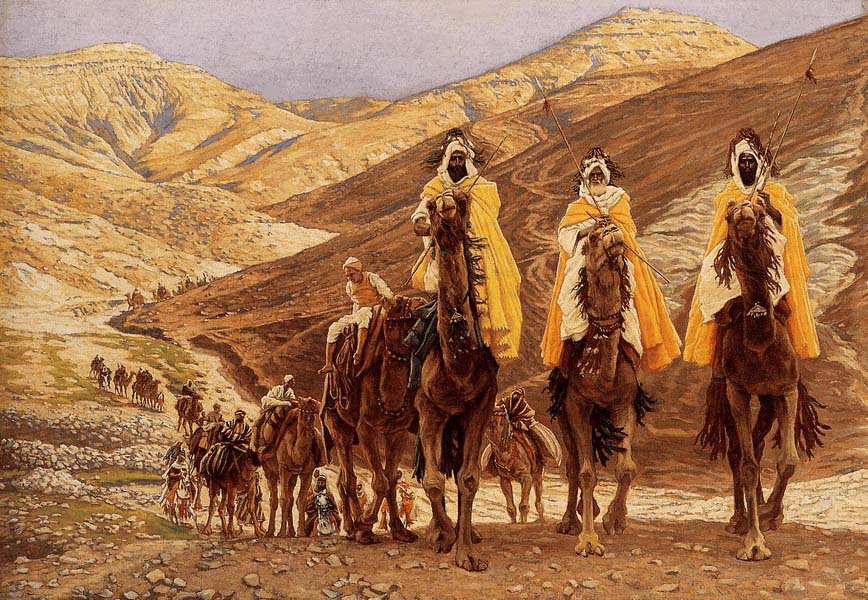 "The Journey of the Magi" (1894) by James Jacques Joseph Tissot (French painter and illustrator, 1836-1902), oil on canvas, Minneapolis Institute of Arts. Larger image. |
"1After Jesus was born in Bethlehem in Judea, during the time of King Herod, Magi from the east came to Jerusalem 2and asked, 'Where is the one who has been born king of the Jews? We saw his star in the east and have come to worship him.'
3When King Herod heard this he was disturbed, and all Jerusalem with him. 4When he had called together all the people's chief priests and teachers of the law, he asked them where the Christ was to be born. 5'In Bethlehem in Judea,' they replied, 'for this is what the prophet has written:
6' "But you, Bethlehem, in the land of Judah,
are by no means least among the rulers of Judah;
for out of you will come a ruler
who will be the shepherd of my people Israel." '
7Then Herod called the Magi secretly and found out from them the exact time the star had appeared. 8He sent them to Bethlehem and said, 'Go and make a careful search for the child. As soon as you find him, report to me, so that I too may go and worship him.'
9After they had heard the king, they went on their way, and the star they had seen in the east went ahead of them until it stopped over the place where the child was. 10When they saw the star, they were overjoyed. 11On coming to the house, they saw the child with his mother Mary, and they bowed down and worshiped him. Then they opened their treasures and presented him with gifts of gold and of incense and of myrrh. 12And having been warned in a dream not to go back to Herod, they returned to their country by another route." (Matthew 2:1-12)
150 years ago John H. Hopkins, Jr. penned the words and music of this haunting carol of the wise men:
"We three kings of Orient are
bearing gifts, we traverse afar..."
They weren't kings. We're pretty sure of that. Nor were there necessarily three of them. Nor did they go by the names Caspar, Melchior and Balthasar.1 But who were they and why did they come? How do they fit into the story of Jesus' infancy?
Who Are the Magi? (1:1)
Let's follow the story as Matthew tells it:
"After Jesus was born in Bethlehem in Judea, during the time of King Herod, Magi from the east came to Jerusalem and asked, 'Where is the one who has been born king of the Jews? We saw his star in the east and have come to worship him.'" (2:1-2)
All of a sudden an elaborate entourage from the East appears in Jerusalem at Herod's court inquiring about the birth of the "King of the Jews."
These men are described as "Wise men" (NRSV, KJV) or "Magi" (NIV). The word is magos, "a (Persian, then also Babylonian) wise man and priest, who was expert in astrology, interpretation of dreams, and various other occult arts."2
Where were they from? The text says "the east" (anatolē), the direction from which the sun rises. Where could that be? There are three main possibilities:
- Parthia or Persia. The term magoi was first associated with the Medes and the Persians. We know that astrology flourished in this area and that the astral lore of the region was applied to royal births.
- Babylon. The Babylonians or Chaldeans had a well developed interest in astronomy and astrology. A large colony of Jews remained there, so astrologers could have learned of Jewish messianic expectations. Also, magoi are referred to in Daniel's description of the Babylonian court.
- Arabia or the Syrian desert. The gifts of gold, frankincense, and myrrh are associated with desert camel trains coming from Midian in northwest Arabia or Sheba in southwest Arabia. Astrology was not unknown and Jewish colonies existed in various cities.3
Which of these is most likely? We can't really say. At any rate, they were men of wisdom and learning from an exotic, far away land bringing a caravan into the capital city of the Jews, seeking a newborn king. They must have attracted attention.
What Kind of "Star" Did They See? (1:2)
"... and asked, 'Where is the one who has been born king of the Jews? We saw his star in the east and have come to worship him.'" (1:2)
"Star" (astēr) wasn't used in a modern scientific sense. Rather it referred to "a luminous body (other than the sun) visible in the sky, star, single star, planet."4 Foerster notes, "astēr almost always denotes a single "star," whereas astron can also be used for a "constellation."5 The phrase "in the east" (NIV, KJV, anatolē) in verses 2 and 9 may well carry the meaning "at its rising" (NRSV), of the "upward movement of celestial bodies."6
Here are some of the possibilities:
- A supernova or "new star." A supernova is an explosion in an existing star that for several weeks or months gives out a great deal of light, sometimes even visible during the day. A dozen novae are discovered each year, but those visible to the naked eye are rare. There is no historical record of a supernova just before Jesus' birth date.
- A comet. Throughout history, comets have captured human imagination. A comet's nucleus is made up of rock, dust, and ices. Its tail can be spectacular. The sun's radiation pressure and solar wind cause an very long tail to form, which points away from the sun. Astronomers have calculated that Halley's comet would have been visible 12-11 BC, years before Jesus' birth about 6 BC.
- A planetary conjunction. Astrologers pay attention to the planets. Apparently there was a conjunction of Jupiter, Saturn, and Mars that occurred in 7-6 BC, and mention seems to have been made of this in cuneiform texts. Some have gone farther. This series of conjunctions over several months took place in the zodiacal constellation of Pisces, which may have been associated with the last days and with the Hebrews. Jupiter was associated with the world ruler among Parthian astrologers. Saturn was identified as the star of the Amorites of the Syrian-Palestine region. These three indicators could have pointed to a world ruler among the Hebrews in the last days. But this is purely speculative, astrology by hindsight. Nor do we have any evidence that such a conjunction of planets would have been actually referred to as a "star."7
We just don't know enough to say authoritatively exactly what the Star of Bethlehem was.
There is a star spoken of in prophecy, however, in a prophecy of Balaam, the errant prophet:
"I see him, but not now;
I behold him, but not near.
A star will come out of Jacob;
a scepter will rise out of Israel." (Numbers 24:17)
The initial reference seems to be to David. Prior to Christ, Jews of the Qumran community saw this prophecy as messianic. Later Judaism considered the messianic claims of Simon bar Kochba ("son of the star," 132-135 AD).8 Could the messianic expectation based on this verse among Jewish communities in the East be the basis of the Magi's interpretation of the star? We don't know.
| Q1. (Matthew 2:1-2; Numbers 24:17) What is the
significance of the Star of Bethlehem that the Magi saw? Why
do you think the Magi came to find the Christ-child when they
saw the star? In what way was does prophecy prefigure this event? https://www.joyfulheart.com/forums/index.php?showtopic=724
|
Why Was Herod Disturbed? (2:3)
"When King Herod heard this he was disturbed, and all Jerusalem with him." (2:3)
A delegation of important people coming to Jerusalem to honor the king or to worship in the temple wouldn't be uncommon. But the Magi's search for a newborn king based on an astronomical phenomenon caused quite a stir. The passive of tarassō means to "be troubled, frightened, terrified."9
Herod was troubled because he saw this newborn as a threat to his own throne. The people were troubled because they had seen what their paranoid king had done when he felt his throne threatened. A later Roman philosopher quotes Roman emperor Caesar Augustus as joking "I'd rather be Herod's sow than Herod's son." Herod didn't eat pigs, but he murdered his sons. Afraid of intrigue among his many sons to become king, two were tried and executed by strangulation just the year before Jesus' birth -- about 7 BC.11 A third was executed five days before Herod's death in 4 BC.
Matthew's report of both Herod and his citizens being "disturbed" at the Magi's report rings true.
Where Was the Messiah to Be Born? (2:4-6)
Herod takes the Magi's quest seriously.
"4When he had called together all the people's chief priests and teachers of the law, he asked them where the Christ was to be born. 5'In Bethlehem in Judea,' they replied, 'for this is what the prophet has written:
6'"But you, Bethlehem, in the land of Judah,
are by no means least among the rulers of Judah;
for out of you will come a ruler
who will be the shepherd of my people Israel."'" (2:4-6)
Note that the Magi came seeking "the one who has been born king of the Jews" (2:1), but Herod asked the scholars where the Messiah (Greek Christos) would be born (2:4). He understood immediately that this child they sought was no normal king, but the Messiah himself.
Herod wasn't a descendent of David. He was rather a Edomite (Idumean) son of a ruling family in whom the Romans had seen a talent for controlling the populace. He had been appointed governor of Galilee (47 BC) and later King of the Jews (37 BC). He realized that if a descendent of David were to rise, his reign and that of his descendents would be over. Messiah or not, this child must be destroyed.
Herod's Plot (2:7-8)
The prophet Malachi (5:2) made it clear that Bethlehem would be the birthplace of the Messiah, so in Bethlehem the quest would continue.
"Then Herod called the Magi secretly and found out from them the exact time the star had appeared. He sent them to Bethlehem and said, 'Go and make a careful search for the child. As soon as you find him, report to me, so that I too may go and worship him.'" (2:7-8)
Herod's questioning of the scholars was public, but his interrogation of the Magi is secret.12 He finds out precisely13 when the star appeared. Later he uses this information to slaughter all the boy babies in Bethlehem two years and under (2:16). Apparently the Magi had seen the sign two years previous.
Now Herod seeks to enlist the Magi as his secret agents: "As soon as you find him, report to me...." (2:8) He claims to desire to worship the newborn Messiah, but his real desire is assassination. "Worship" (NIV, KJV) or "pay homage" (NRSV) is proskuneō, literally, "kiss towards." It means "to express in attitude or gesture one's complete dependence on or submission to a high authority figure, (fall down and) worship, do obeisance to, prostrate oneself before, do reverence to, welcome respectfully."14
Led by the Star (2:9-10)
"After they had heard the king, they went on their way, and the star they had seen in the east went ahead of them until it stopped over the place where the child was. When they saw the star, they were overjoyed." (2:9-10)
It seems that they had seen the star "at its rising" (or "in the East") and had come to Jerusalem, since that is where they expected to find a newborn King of the Jews. But now the star, which seems to have disappeared for a while, now reappears and "went ahead of them." Proagō means "to move ahead or in front of, go before, lead the way, precede."15 Finally it "stopped" (NIV, NRSV) or "stood" (KJV) over the place where the child was." Histēmi, "set, place," here means "to desist from movement and be in a stationary position, stand still, stop."16
The star that inspired their trip in the first place now leads them directly to the very home where the Christ-child dwelt.
Worshipping the King (2:11a)
"On coming to the house, they saw the child with his mother Mary, and they bowed down and worshiped him." (2:11a)
By this time, presumably nearly two years after Jesus' birth, Mary and Joseph were living in a house (oikia17). While most nativity scenes have shepherds bumping into wise men and angels, this almost certainly was not the case. The Holy Family had left the stable and found a house. Probably Joseph had found employment as a carpenter. They had apparently decided not to return to Nazareth, perhaps because of the scandal over Mary's pregnancy prior to marriage. Even though Joseph publicly accepted the child as his own, premarital relations were considered a sin; the couple would have had to deal with considerable prejudice.
But now, outside their home, a caravan of exotic travelers has stopped. Strangely dressed men are approaching while their camels are attended by servants, while other servants are carrying gifts in their hands. Mary scurries around to straighten up while Joseph goes out to meet the strangers.
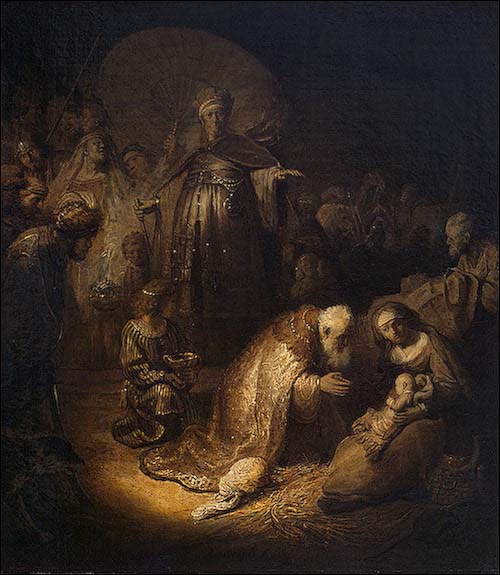 Rembrandt, detail of "The Adoration of the Magi" (1632), Oil on paper pasted on canvas, 45x39 cm, Hermitage Museum, St. Petersburg. Full image. |
We're not told the details, of course, but when the Magi see the child, now a toddler, they bow down (piptō18) and worship (proskuneō) him. Imagine these old men, finely dressed, prostrating themselves on a dirt floor before a small child. They had seen the star and it had reappeared to guide them. These men were convinced -- rightly -- that they were standing before the Messiah, the King of the Jews. Their obeisance was fitting.
| Q2. (Matthew 2:11a) What do we learn from seeing the
Magi prostrating themselves before the child Jesus? What was
the significance of this for them? How can we emulate this
kind of worship? https://www.joyfulheart.com/forums/index.php?showtopic=725
|
Offering Gifts to the King (2:11b)
After lying prostrate for some time, they rise, perhaps at the urging of Joseph.
"Then they opened their treasures and presented him with gifts of gold and of incense and of myrrh." (2:11b)
Whenever foreign dignitaries would appear before a great king they would bring gifts as a sign of obeisance and honor. "Treasures" (NIV, KJV) is probably better translated "treasure chests" (NRSV).19 And as the lids were lifted, the glitter of gold and aroma of precious spices filled the room.
- Gold, of course, was the most precious and valued metal known. It was highly prized. It was not found in Palestine, but had to be imported from the mines of Ophir and elsewhere.20
- Frankincense is derived from three species of the genus Boswellia -- B. carterii, B. papyri-fera, and B. thurifera -- which grow in southern Arabia, India, and elsewhere. The gum is exuded from the incised bark in pale glittering drops. It had a bitter flavor and a strong balsamic odor when heated. The Egyptians used it for fumigation and embalming; the Israelites used it in worship in the Holy Place of the tabernacle and temple (Exodus 30:34).21
- Myrrh is valuable as a perfume and a constituent of sacred anointing oil (Exodus 30:23). Several shrubs produce a perfumed resinous substance described as myrrh, but the one compounded in the anointing oil was probably from Commiphora myrrha or perhaps Balsamodendron myrrha, a low thorny tree distributed across south Arabia and Ethiopia. The sap is pleasantly scented and dries into a solid resin. It could be diluted to form a liquid cosmetic product and may have been used by Egyptians in embalming.22
These may seem inappropriate gifts for a baby, but as munificent gifts from distinguished personages appearing before a king, they would be considered quite appropriate, perhaps as specimens of the products of their country.23 Later Christian writers, including John H. Hopkins, Jr. who wrote "We Three Kings," have seen significance in gold for Christ's royalty, frankincense for his deity, and myrrh for his humanity, ultimately his burial, though none of this is in Matthew's account.24 I can't help think of the song "The Little Drummer Boy" (1958):
"I have no gift to bring ... that's fit to give the King ...
I played my drum for Him ... I played my best for Him ...
Then He smiled at me ... me and my drum."25
The song is popular, though the sentiment is profound. Our best, no matter how seemingly insignificant, is what we owe the King. That is what characterized the Magi's gifts.
Though the Magi's quest had brought Herod's scrutiny upon the child, these gifts were probably sold gradually to provide for the Holy Family during three years of exile in Egypt where they fled to escape Herod's wrath.
| Q3. (Matthew 2:11b) Why was it appropriate for the Magi
bring gifts to the Christ-child? How does the extravagance of
their gifts reflect their heart attitude? What kinds of gifts
are appropriate for us to bring? https://www.joyfulheart.com/forums/index.php?showtopic=726
|
Disobeying Herod (2:12)
"And having been warned in a dream not to go back to Herod, they returned to their country by another route." (Matthew 2:12)
Though Herod had recruited the Magi for his evil plot, God warned them in a dream not to participate, so they left the area without returning through Jerusalem, only six miles to the north. This probably bought the Holy Family a day or two of time to make good their escape.
The story concludes in 2:13-23 with Joseph being warned in a dream and that very night taking his young family -- with the treasures -- and fleeing for Egypt, out of Herod's jurisdiction and reach. It was good that they did flee rather than question God's messenger. As soon as Herod discovered that the Magi had betrayed him, in a furious rage he gave orders to kill all the male children in Bethlehem who were two years of age or under. This amounted to perhaps twenty baby boys, the first martyrs for the Messiah.
What Does All this Mean?
Why does Matthew include the story of the wise men in his Gospel? There were many incidents that he chose to exclude that we find, for example, in Luke's and John's gospels. I see in this account several themes:
- The King Heralded by a Star. Matthew points to the fulfillment (without saying so) of Balaam's ancient prophecy that "A star will come forth from Jacob, and a scepter will rise from Israel" (Numbers 24:17).
- The King Honored by Foreign Nations. One of Matthew's themes is that Christ fulfilled Old Testament prophecy. Here the prophecy isn't cited, but only alluded to: that of foreign rulers bringing their riches to honor the King of Israel (1 Kings 10:2, 10; Psalm 72:10-11, 15; Isaiah 60:5-6, 11). This account points to Jesus' royalty as King of the Jews.
- Enemies of Christ Seek His Death. Here in chapter 2 is the beginning of Jesus' enemies. Herod clearly covets Jesus' claim to be Messiah and seeks to kill him before he can become a threat. Later in Matthew's gospel the "chief priests and teachers of the law" who pointed to his birthplace in Bethlehem conspire to take his life. And ultimately he is crucified for this very charge of being King of the Jews (Matthew 27:11, 37; John 18:33-37; 19:19-22).
- Explanation of Jesus' Infant Sojourns. From Nazareth to Bethlehem, from Bethlehem to Egypt, and then back to Nazareth where he was raised -- Jesus' journeys as an infant needed an explanation in the face of Jewish belittling him as a citizen of Nazareth (John 1:45-46), not from the royal city of Bethlehem.
- The Gospel to the Gentiles. This account also points to another important theme -- that Jesus came to the Jews, but had a mission beyond Israel to the Gentiles (Genesis 12:3; 22:18; 28:14; 49:10; Psalm 22:27; 98:3; Isaiah 49:6; 66:19) In parable (Matthew 21:33-44; 22:2-13), action (Matthew 8:5-13), prophecy (Matthew 24:14), and command (Matthew 28:19; Acts 1:8), Jesus underscores that the gospel must be preached to -- and will be embraced by -- the Gentiles.
| Q4. Read Matthew 8:5-13; 21:33-44; 22:2-13; 24:14; and
28:19. What do they have in common? What relation does the
visit of the wise men have to Matthew's theme of bringing the
Gospel to the Gentiles? How should we be applying this
mandate in our own lives? https://www.joyfulheart.com/forums/index.php?showtopic=727
|
- Devotion by Men of Wisdom. That wise men recognize the Messiah and bow at his feet is also an example to "the wisdom of this world" (1 Corinthians 2:6).
- The Sovereignty of God. Finally, we see in Joseph an obedient servant of God, who hears the angel's warnings in dreams and takes immediate action to protect the Christ-child in his charge. Though the powers of this world may array themselves against the Christ and his people, God is fully able of protecting and preserving them until they have completed their mission. The gifts of the wise men serve to honor the boy-King and to provide for his shelter for years to come. Where one door closes, another opens. God provides!
Prayer
Father, thank you for letting us hear the story of the Magi who knelt before you with devotion and brought you rich gifts. Let us have that kind of wisdom, that we may bring before you with extravagant worship the gifts you have given to us. We love you, Lord Jesus. In your holy name, we pray. Amen.
Key Verses
"After Jesus was born in Bethlehem in Judea, during the time of King Herod, Magi from the east came to Jerusalem and asked, 'Where is the one who has been born king of the Jews? We saw his star in the east and have come to worship him.'" (Matthew 2:1-2)
"On coming to the house, they saw the child with his mother Mary, and they bowed down and worshiped him. Then they opened their treasures and presented him with gifts of gold and of incense and of myrrh." (Matthew 2:11)
References
- These names for the Magi in the West derive from an early 6th century Greek manuscript. However Eastern churches and Armenians have different names for them.
- Magos, BDAG 608. Good discussions are included in Brown, Birth, 167 and Gerhard Delling, "magos, ktl." TDNT 4:356-59.
- Brown, Birth, pp. 168-170.
- Astēr, BDAG 145.
- Werner Foerster, astēr, astron, TDNT 1:503-505.
- Anatolē, BDAG 74.
- Brown, Birth, pp. 171-173.
- Brown, Birth, p. 195, fn. 47 gives references to the Qumran literature. See also R.K. Harrison, Numbers (Baker, 1992), pp. 321-324. In the book of Revelation Jesus says, "I am the Root and the Offspring of David, and the bright Morning Star" (Revelation 22:16). On the Messianic expectation in later Judaism, Foerster (TDNT 1:505) cites Strack and Billerback I, 13c, 17f.
- Tarassō, BDAG 990-991.
- Abrosius Theodosius Macrobius, The Saturnalia. Macrobius was a Roman philosopher of the fourth century AD.
- Josephus, Antiquities, xvi.10.6-11.8; Wars i.27.1-6. Harold W. Hoehner, "Herod," ISBE 2:688-698.
- Lathra, "without others being aware, secretly" (BDAG 581).
- Akriboō, "make detailed inquiry about something, ascertain precisely/exactly." (BDAG 39).
- Proskuneō, BDAG 882-883.
- Proagō, BDAG 864, 2.a.
- Histēmi, BDAG 482-483, B.1.
- Oikia, "a structure used as a dwelling, house" (BDAG 695, 1.a.).
- Piptō, "fall," here, to "fall down, throw oneself to the ground" as a sign of devotion or humility, before high-ranking persons or divine beings, especially when one approaches with a petition. (BDAG 815-816, 1.b.a.Bet).
- Thēsauros, "a place where something is kept for safekeeping, repository ... treasure box or chest." It can also mean that which is stored up, "treasure," but the context of opening here suggests the chest. We get our English word "thesaurus" from this word. (BDAG 456).
- George A. Turner and Ralph W. Vunderink, "Gold," ISBE 2:520-522.
- R.K. Harrison, "Frankincense," ISBE 2:360.
- R.K. Harrison, "Myrrh," ISBE 3:450-451.
- Edersheim, Life and Times 1:214.
- Edersheim, Life and Times 1:214, fn. 1.
- "The Little Drummer Boy," by Katherine K. Davis, Henry Onorati and Harry Simeone. Copyright ©1958, EMI Mills Music Inc., International Korwin Corp. (ASCAP).
Copyright © 2025, Ralph F. Wilson. <pastor joyfulheart.com> All rights reserved. A single copy of this article is free. Do not put this on a website. See legal, copyright, and reprint information.
 To be notified about future articles, stories, and Bible studies, why don't you subscribe to our free newsletter, The Joyful Heart, by placing your e-mail address in the box below. We respect your