|
Old Testament
New Testament
Gospels
Acts
Paul's Letters
General Letters
Revelation
Topical Studies
Beginning the Journey (for new Christians). en Español

|
Old Testament
New Testament
Gospels
Acts
Paul's Letters
General Letters
Revelation
Topical Studies

|
Home
Bible Studies
Articles
Books
Podcasts
Search
Menu
Donate
About Us
Contact Us
FAQ
Sitemap


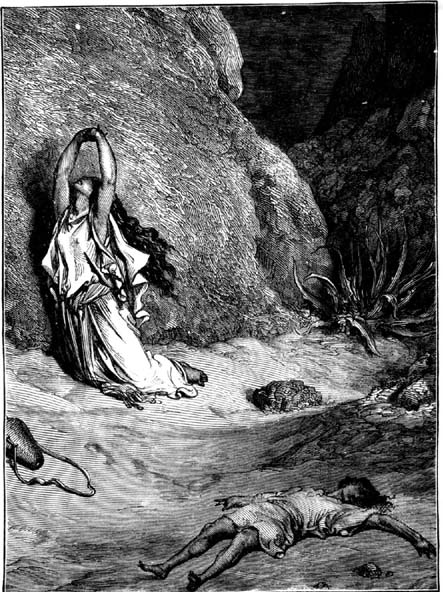
 Gustave Doré (1832-1883), detail of 'Hagar and Ishmael in the Wilderness,' engraving from La Sainte Bible (1865). While Ishmael is depicted as a child by most artists, he must have been about 16 when he and his mother were sent away. Larger image. |
This chapter contains extremes in emotion -- laughter and joy, jealousy, rage, anguish, hopelessness, and finally life beyond despair. As you read it, look to find yourself among the characters and listen for the word God would speak to you in your situation.
The Birth of Isaac to Sarah (21:1-7)-7)
Isaac has been a long time in coming. Ever since Abraham and Sarah were married -- perhaps in Ur of the Chaldeans -- they have wanted children. Since coming to Canaan, God has promised Abraham successively that he would have (1) offspring, then (2) a son, and finally (3) a son by Sarah his wife. There have been obstacles, to be sure. Beautiful Sarah is taken into Pharaoh's harem, then delivered by God. In desperation, she gives her maidservant Hagar to Abraham and now watches as Hagar's son Ishmael grows into a young man. Most recently Sarah has been abducted once again, this time by Abimelech, king of Gerar, and is again delivered by God. Now the day that she gives birth has come and she is overjoyed.
"Now the Lord was gracious to Sarah as he had said, and the Lord did for Sarah what he had promised. Sarah became pregnant and bore a son to Abraham in his old age, at the very time God had promised him. Abraham gave the name Isaac to the son Sarah bore him. When his son Isaac was eight days old, Abraham circumcised him, as God commanded him. Abraham was a hundred years old when his son Isaac was born to him. m.
Sarah said, 'God has brought me laughter, and everyone who hears about this will laugh with me.' And she added, 'Who would have said to Abraham that Sarah would nurse children? Yet I have borne him a son in his old age.'" (21:1-7)
Notice how carefully the narrator records that the Lord did exactly what he had promised he would do, when he said he would do it -- "at the very time God had promised him" (21:2). God has been gracious to Sarah. "Gracious" (NIV), "visited" (KJV), and "dealt with" (NRSV) translate the Hebrew verb pāqad in verse 1. The basic meaning is "to exercise oversight over a subordinate, either in the form of inspecting or of taking action to cause a considerable change in the circumstances of the subordinate either for the better or for the worse."198 God as Sarah's divine overseer and suzerain has watched out for her and blessed her with a child.
All around Abraham's camp there is laughing. Sarah exclaims, "God has brought me laughter and everyone who hears about this will laugh with me" (21:6). The baby's very name "Isaac" means "he laughs." This is the name God gave Abraham when he first told him of the birth. Abraham had fallen facedown and laughed when he heard it (17:17), so God told him, "Your wife Sarah will bear you a son, and you will call him Isaac" -- he laughs (17:19). Isaac's name is forever a reminder of how God keeps his word even though his servants may laugh at the impossibility of the promise.
Q1. (Genesis 21:5-7) The name Isaac means "he laughs." What is Sarah's laughter like now compared to her laughter in 18:12-15 and Abraham's laughter in 17:17? What does this tell you about God's sense of humor?
Ishmael Mocks Isaac (21:8-10)
Time passes and Isaac is weaned, perhaps by the time he is two or three.199 By now Isaac's step-brother Ishmael is perhaps 16 years old.
"The child grew and was weaned, and on the day Isaac was weaned Abraham held a great feast. But Sarah saw that the son whom Hagar the Egyptian had borne to Abraham was mocking, and she said to Abraham, 'Get rid of that slave woman and her son, for that slave woman's son will never share in the inheritance with my son Isaac.'" (21:8-10)
Just what did Ishmael do to so enrage Sarah? "Mocking" (NIV, KJV) or "playing" (NRSV) is the Hebrew verb sāhaq. This is the word used for laughter in verse 6 and the root of Isaac's name, yishāq, "he laughs." But in the Piel stem, it can mean "to mock, to play."200 In our passage there seem to be two possibilities:
- Sarah sees Ishmael playing with her son, as if he's one of the family, and becomes enraged that he is a member of the family. The NRSV's translation "playing with her son Isaac" draws on the Septuagint and Vulgate translations that include the words "with her son Isaac," which are missing in the Hebrew Masoretic text.
- Sarah sees Ishmael mocking or making fun of Isaac -- or maybe even hurting Isaac -- and becomes enraged that this son of a servant girl is bothering her son, Abraham's heir. Paul says that Ishmael "persecuted" Isaac (Galatians 4:29), perhaps referring to this incident -- whether by verbal or physical abuse we don't know.201
At any rate, Sarah comes to Abraham in a tiff and demands, "Get rid of that slave woman and her son, for that slave woman's son will never share in the inheritance with my son Isaac." "Get rid of" (NIV) or "cast out" (KJV, NRSV) is the Hebrew noun gārash. The root denotes "an effective separation between persons or groups, expulsion."202
"Share in the inheritance" (NIV), "be heir with" (KJV), or "inherit along with" (NRSV) is the Hebrew verb yārash, which, in civil matters, means "to become an heir."203 The Code of Hammurabi (18th century BC) indicates that the son of a slave woman had a legal claim on his father's property.
"If his wife bear sons to a man, or his maid-servant have borne sons, and the father while still living says to the children whom his maid-servant has borne: 'My sons,' and he count them with the sons of his wife; if then the father die, then the sons of the wife and of the maid-servant shall divide the paternal property in common. The son of the wife is to partition and choose."204
Could Sarah be asking Abraham to act contrary to legal principles? Perhaps so, if the legal understanding represented by the Code of Hammurabi had influence or standing in Canaan. Abraham's family came from Mesopotamia, so this is possible.205
Q2. (Genesis 21:8-10) What motivates Sarah to demand Ishmael's expulsion from Abraham's family encampment? Is she righteous in this? Have you ever tried to force your spouse to act against his or her principles? Have you ever been forced yourself?
God Consoles Abraham regarding Ishmael (21:11-13)
"The matter distressed Abraham greatly because it concerned his son. But God said to him, 'Do not be so distressed about the boy and your maidservant. Listen to whatever Sarah tells you, because it is through Isaac that your offspring will be reckoned. I will make the son of the maidservant into a nation also, because he is your offspring.'" (21:11-13)
Abraham is devastated. "Distressed/distressing" (NIV, NRSV) or "grievous" (KJV) is the Hebrew verb rā'a', "be bad, evil." Here it seems to refer to the experience of emotional pain.206 Abraham loves this 16-year-old and has looked on him as his heir, one who bears his DNA (though the Hebrews would have thought of this in terms of "seed"). Abraham has watched the child become a young man, hunted with him, and begun to enjoy his company as an almost-grown son. And now Sarah is determined to rid him and Hagar from the family once for all.
But God gives Abraham a three-fold word:
- Abraham is to grant Sarah's demand that Hagar and Ishmael be sent away.
- God reminds him that Isaac, not Ishmael, is to be the true heir to the spiritual promises of God. Perhaps Abraham needs reminding. God has told him this clearly before: "My covenant I will establish with Isaac..." (17:18-21), but perhaps he has put it out of his mind. God tells Abraham that his offspring will be "named"207 through Isaac.
- Abraham is assured that God will indeed bless Ishmael also, since he too is Abraham's son. The blessing is that he will be looked to as the head of a nation (see also 17:20).208 Ishmael loses his inheritance as a son, but gains an inheritance as a nation or people.
Have you ever had to endure a hard thing, something beyond you and your ability to control events? This is how Abraham felt. Abraham still aches from the pain of loss, but God consoles him with clear direction as well as insight into what God is doing.
Hamilton comments,
"In one point Sarah is correct, but for the wrong reason: Ishmael will not share the inheritance with Isaac, but that is not because of Sarah's pettiness or jealousy, or skullduggery. It is because God has decreed that Abraham's line of promise will be continued through Isaac. Here is an instance of God using the wrath of a human being to accomplish his purposes. A family squabble becomes the occasion by which the sovereign purposes and programs of God are forwarded."209
Verses 11-13 remind me of Judges 14:14, where Sampson impetuously chooses a Philistine wife against his parents' wishes. The narrator explains, "His parents did not know that this was from the Lord, who was seeking an occasion to confront the Philistines...." Throughout the Bible, God is at work, in spite of the pettiness or sinfulness of human beings, to work his will and bring about his purposes.210 Note that after Sarah's death, Abraham marries again and fathers six sons, but also sends them away from his son Isaac -- this time to the east, bearing gifts from his fortune to help sustain them (25:6).
There is no way to second-guess God. But consider what we're told about Ishmael's character. In 16:12 (and confirmed in 25:18) we are told, "He will be a wild donkey of a man; his hand will be against everyone and everyone's hand against him, and he will live in hostility toward all his brothers." Isaac's character seems to be much more docile. If Ishmael had not been sent away when he was, Isaac might not have been able to withstand him.
This passage brings up pain for many people. You may have been on the receiving end of rejection -- from your father or mother, from your wife or husband. You may have been sent away and are still struggling with the emotional scars. Where is God? He is with you! God has not forsaken you, in spite of the injustice and hurt and pain you have suffered. Just as God sustained Hagar and Ishmael with his special help, so God will sustain you.
Recently, I heard a woman testify that she never knew her father. People called her "illegitimate." But one day she met Jesus and became a part of the family of God. "What can be more legitimate than to be part of God's family?" she exalted. God looks out for the widow and the orphan -- especially.211 "God sets the lonely in families" (Psalm 68:6) -- and for many, that family is the fellowship of the family of God.
Q3. In what ways has God blessed Abraham in this difficult chapter 21? Given what we know about Ishmael's character (Genesis 16:12; 25:18), how has Abraham been blessed that he sent him away? How has Isaac been blessed? What might have happened if Ishmael hadn't been sent away? Have you ever been rejected or sent away? Where is God in all of this?
Abraham Sends Hagar and Ishmael Away (21:14-16)
"Early the next morning Abraham took some food and a skin of water and gave them to Hagar. He set them on her shoulders and then sent her off with the boy. She went on her way and wandered in the desert of Beersheba.
When the water in the skin was gone, she put the boy under one of the bushes. Then she went off and sat down nearby, about a bowshot away, for she thought, 'I cannot watch the boy die.' And as she sat there nearby, she began to sob." (21:14-16)
Abraham does this very hard thing "early the next morning" (21:14) after God had spoken to him, just as he will begin his journey to sacrifice Isaac on Mt. Moriah "early the next morning" (22:3). Abraham doesn't put off doing the hard things, perhaps because he knows if he delays, he may never follow through. Abraham is obedient to God.
Hagar wanders hopelessly in the desert around Beersheba where Abraham has been staying.212 When their water runs out, she lays her dying teenager under the meager shelter of a desert shrub and goes where she can't see him. In her hour of desperation, she utters one of the first prayers recorded in the Bible, "Let me not look on the death of the child" (21:16).213
An Angel Helps Hagar and Ishmael (21:17-21)
Now Hagar begins to cry.214 But it is not her cry, but Ishmael's cry that prompts God's action. Ishmael is the special recipient of Abraham's blessing -- and God's concern.
"God heard the boy crying, and the angel of God called to Hagar from heaven and said to her, 'What is the matter, Hagar? Do not be afraid; God has heard the boy crying as he lies there. Lift the boy up and take him by the hand, for I will make him into a great nation.'
Then God opened her eyes and she saw a well of water. So she went and filled the skin with water and gave the boy a drink.
God was with the boy as he grew up. He lived in the desert and became an archer. While he was living in the Desert of Paran, his mother got a wife for him from Egypt." (21:17-21)
This is the second time that an angel of the Lord speaks to Hagar to protect her and Ishmael (see 16:7-12). This time the angel tells her not to be afraid, that God has heard the boy's voice. That she is not to quit, but to pick up her son and take him by the hand. Then her eyes are opened to see a well in the middle of the desert. Where death and desolation was all she could see a minute before, now she sees hope. God promises a future for Ishmael and God provides the sustenance they need to survive.
Growing up in the desert or wilderness may seem like a bleak prospect to you, but, as part of Abraham's household, Hagar and Ishmael have been encamped at the edge of the desert for years. If they have water, they know how to survive. Mother and nearly-grown son now begin a life in the wilderness of Paran. This location seems to be in the northeast section of the Sinai peninsula, southwest of Edom and south of the wilderness of Zin near the Judean mountains, but as far north as Kadesh or even Beer-sheba (Numbers 13:3, 26).215 Ishmael grows to manhood in the desert and becomes a skilled archer, no doubt killing small animals that provide clothing and food for them. When he is older, Hagar returns to her native Egypt and finds a wife for her son.
Hagar and Ishmael have been dealt a harsh blow, but with God's help they both survive and eventually prosper. We don't see Ishmael again until he and Isaac together bury their father 73 years hence (25:9). The Bible lists the names of Ishmael's 12 sons, who become tribal leaders in their own right (25:13-16). Ishmael himself lives to the age of 137 (25:17). The "nation" that Ishmael's offspring begin to populate encompasses "the area from Havilah to Shur, near the border of Egypt, as you go toward Asshur." (25:18)
Abraham Swears Faithfulness to Abimelech at Beer-sheba (21:22-24)
The narrator gives us another brief glimpse of life on the desert frontier -- water rights -- this time concerning Abraham's dealings with Abimelech. If you recall in Genesis 20 (which we considered in Lesson 2), about a year before Isaac's birth, Abraham and Sarah had sojourned in Gerar, possibly because of a famine or drought. At that time Abraham, fearful of being killed, tells Abimelech, the Philistine king of Gerar, that Sarah is his sister. Sarah is taken into the king's household, but doesn't have sexual relations with him before God warns Abimelech, who immediately sets things right. Abimelech offers 1000 shekels of silver to cover the offense against Sarah and "brought sheep and cattle and male and female slaves and gave them to Abraham" (20:14-16).
I recall these events to remind us that Abimelech and Abraham already have some history together.
"At that time Abimelech and Phicol the commander of his forces said to Abraham, 'God is with you in everything you do. Now swear to me here before God that you will not deal falsely with me or my children or my descendants. Show to me and the country where you are living as an alien the same kindness (hesed) I have shown to you.' Abraham said, 'I swear it.'" (21:22-24)
Why does Abimelech come with Phicol, his general, to parley with Abraham? Because he sees God's blessing on him and fears him. He has heard the account of Abraham and his private army of 310 men defeating the Mesopotamian army. Abraham has lied to him before -- to prevent being killed when Abimelech abducts his "sister." And God has told Abimelech that Abraham is a prophet. Abimelech has seen Abraham's prayer heal him and his wives. Abraham is a man to be reckoned with and Abimelech doesn't exactly trust him.
So Abimelech and his general come to Abraham, not as a military force seeking to impose a treaty upon Abraham, but as a weaker people seeking to protect themselves from one who might be a threat to them. Abimelech uses covenant language in his request. In verses 27 and 32 -- "made a treaty" (NIV) or "made a covenant" (KJV, NRSV) -- the narrator uses two words we've seen in Genesis 15 (Lesson 4) -- the verb kārat, "cut (make) a covenant" and the noun berit, "covenant, treaty." "Deal falsely" in verse 23 is another word associated with covenants. The Hebrew verb shāqar means, "deal falsely, be false." It is used of the breaking of a promise, being false to a treaty or commitment.216 Abimelech asks Abraham to take a solemn oath to be faithful to their relationship with each other.
"Kindness" (NIV, KJV) or "dealt loyally" (NRSV) in verse 23 is the Hebrew noun hesed. There is some dispute among scholars about whether hesed involves obligation "practiced in an ethically binding relationship of relatives, hosts, allies, friends, and rulers" or whether hesed is freely given, where "kindness" or "mercy" are more appropriate translations. Perhaps the KJV translation "loving kindness," though archaic, is close to the mark.217 According to Hamilton, by the word hesed, Abimelech calls Abraham to "behavior which is appropriate to a covenant relationship,"218 that is, kindness, mercy, and faithfulness to his word.
Abimelech asks Abraham to swear to these things and Abraham takes a solemn oath. "Swear" in verse 24 is the Hebrew verb sheba', "swear, seven." The verb might be translated literally as "to seven oneself" or "to bind oneself by seven things."219
Abimelech Acknowledges Abraham's Ownership of a Well (21:25-32)
We get a hint of this seven-fold nature of swearing in the next part of these negotiations.
"Then Abraham complained to Abimelech about a well of water that Abimelech's servants had seized. But Abimelech said, 'I don't know who has done this. You did not tell me, and I heard about it only today.'
So Abraham brought sheep and cattle and gave them to Abimelech, and the two men made a treaty. Abraham set apart seven ewe lambs from the flock, and Abimelech asked Abraham, 'What is the meaning of these seven ewe lambs you have set apart by themselves?'
He replied, 'Accept these seven lambs from my hand as a witness that I dug this well.'
So that place was called Beersheba, because the two men swore an oath there.
After the treaty had been made at Beersheba, Abimelech and Phicol the commander of his forces returned to the land of the Philistines." (21:25-32)
Abimelech secures what he needs -- a peace treaty from an increasingly powerful neighbor. As negotiations progress, Abraham also brings requests to the table. It turns out that Abimelech's men have stolen a well that Abraham's men have dug. In the desert, water rights are vital to survival. Abimelech disclaims any knowledge of his men's actions and questions Abraham by saying, "This is the first I've heard about this!"
But as they are exchanging gifts to seal their treaty,220 Abraham makes it a point to show Abimelech the seven female lambs he has set apart. Abimelech asks about them, hoping to get even more in the bargain. This is what Abraham has been waiting for. He offers the seven lambs to Abimelech with the agreement that by accepting them, Abimelech accepts Abraham's stipulation that the well is Abraham's.221 So Abimelech accepts the seven ewe lambs -- with the strings attached that he give up claim to the well.
Up to this time Beer-sheba has not been a town, but a settlement near a well. Now it is named Beer-sheba, which means "well of seven," in reference to the seven ewe lambs that confirmed in an oath Abraham's claim to the well. The Hebrew words for "seven" and "oath" are the same (shāba').
Abraham Calls on El-Olam in Beer-sheba (21:33-34)
"Abraham planted a tamarisk tree in Beersheba, and there he called upon the name of the LORD, the Eternal God. And Abraham stayed in the land of the Philistines222 for a long time." (21:33-34)
As we've seen in the past, Abraham has often dwelt near trees. The tamarisk tree may be a kind of monument to God's faithfulness. Later, Jacob sets up a pillar (28:22) and altar (33:20) in God's honor. However, there is no evidence that Abraham offers under the trees the kind of pagan worship for which the Canaanites were known -- idolatry and prostitution practiced "under every green tree."223
The Eternal God (21:33)
In Beer-sheba, Abraham realizes something important and special about God -- he "called upon the name of the LORD, the Eternal God." Here Abraham uses a different name for God -- in Hebrew el-'ôlām. El, of course, is the generic word for God. 'ôlām means "forever, everlasting." The word is used more than three hundred times to indicate indefinite continuance into the very distant future, and occasionally to refer to the past as well.224
Abraham is an old, old man, but he recognizes that God will outlive him and live on and on to bless his descendants after him. Abraham now understands God as the One, who in Isaiah's words, "inhabits eternity" (Isaiah 57:15, NRSV). God is "from everlasting to everlasting" (Psalm 41:13), his throne has been established "from all eternity" (Psalm 93:2). We are just tiny specks in the great expanse of time. "What is man that you are mindful of him, the son of man that you care for him?" (Psalm 8:4).
The amazing thing is that this eternal God cares about Abraham -- and you and me. He doesn't owe us anything. He has no obligation toward us. We are peons in his presence, but by his grace he reaches out toward us.
In the Middle Bronze Age he talks to Abraham and loves him, he blesses him and his children after him. The Eternal God refers to Abraham as his "friend" (James 2:23; Isaiah 41:8). In the twenty-first century, this same Eternal God talks to us, loves us, and befriends us.
Just as Abraham was struck with the realization of God's eternity, so we discover that "Jesus Christ is the same yesterday and today and forever" (Hebrews 13:8). Jesus and his Father are "the Alpha and the Omega, the First and the Last, the Beginning and the End" (Revelation 1:8, 17-18; 21:6; 22:13). Hallelujah!
 Available as PDF, Kindle, and paperback books. |
When we unite our lives with Jesus Christ by faith and baptism, we unite ourselves with the Eternal One and will share eternal life with him for ever and ever. In this eternal life, God completes he plan for us that we read in John 3:16: "For God so loved the world, that he gave his only begotten son, that whosoever believes in him shall not perish, but have everlasting life" -- with the Eternal God.
Q4. (Genesis 21:33) How does the realization that God is El-Olam, the Eternal God, affect you? How does it alter the way you live your life?
Prayer
Thank you, Eternal God, El-Olam, for your awesome love toward Abraham and me, and my brothers and sisters. We don't deserve your love, but you love us in spite of ourselves. We struggle with your plan for our lives. Sometimes we face hard things that we don't understand -- and may never understand in this lifetime. But we do trust you. O Eternal One, who revealed yourself in Jesus Christ. We do trust you. Amen and Amen!
Key Verses
"But Sarah saw that the son whom Hagar the Egyptian had borne to Abraham was mocking, and she said to Abraham, 'Get rid of that slave woman and her son, for that slave woman's son will never share in the inheritance with my son Isaac.'" (Genesis 21:9-10)
"Abraham planted a tamarisk tree in Beersheba, and there he called upon the name of the Lord, the Eternal God." (Genesis 21:33)
Endnotes
[198] Pāqad, TWOT #1802, citing Speiser, BASOR 149:21, for a root meaning of "attend to with care" or "take note."
[199] We're not sure at what age a child was weaned, perhaps as old as three (2 Maccabees 7:27) or even older (1 Samuel 1:22, 24).
[200] J. Barton Payne, yishāq, TWOT #1905; Hamilton, Genesis 2:78-79. The word is used of Lot's sons-in-law thinking that Lot was mocking them when he warned them of Sodom's imminent destruction (19:14). Later in his life, Isaac was observed "sporting with Rebekah his wife" (26:8), that is caressing or fondling her. When Joseph rejected her, Potiphar's wife complains that her husband brought the Hebrew slave into their house "to insult us" (NRSV), "to mock us" (KJV), "to make sport of us" (NIV). This verb can refer to children playing (Zechariah 8:5), tambourines and dancing (1 Samuel 18:6-7) or to celebrate (2 Samuel 6:5, 21).
[201] The Greek verb is diōkō, "to harass someone, especially because of beliefs, persecute" (BDAG 254).
[202] Harold G. Stigers, gārash, TWOT #388. Adam and Eve were driven out of the Garden of Eden (3:24), Cain expelled for murdering Abel (4:14), and the Israelites are expelled from Egypt (Exodus 6:1; 10:11; 11:1; 12:39). The word also functions in the Old Testament as the term for divorce, though Sarah isn't asking Abraham to divorce Hagar, but to disinherit Hagar's son Ishmael.
[203] John E. Hartley, yārash, TWOT #920. In military matters yārash means to gain control over a certain area by conquering and expelling the current inhabitants of that area, "dispossess, drive out, cast out, seize." In Israel's history it takes on its double force -- to inherit and to dispossess.
[204] Code of Hammurabi, §§ 170.
[205] Hamilton, Genesis 2:80, note 27.
[206] G. Herbert Livingston, rā'a', TWOT #2191.
[207] "Reckoned" (NIV), "called" (KJV), or "named for you" (NRSV) is the common Hebrew verb qārā', "call, name" (Leonard J. Coppes, TWOT #2063.
[208] Gerard Van Groningen, gôy, TWOT #326e. "Nation" in verses 13 and 18 is the Hebrew noun gôy, "nation, people ... referring to specifically defined political, ethnic or territorial groups of people."
[209] Hamilton, Genesis 2:81.
[210] Joshua 11:20; 1 Kings 12:15; 2 Kings 6:3; 2 Chronicles 10:15; 2 Chronicles 22:7; 25:20; Psalm 115:3.
[211] Deuteronomy 10:18; Psalm 10:14-18; 68:5; 103:6; 146:9; Proverbs 23:10-11; Jeremiah 49:11; James 1:27.
[212] "Wandered" is the Hebrew verb tā'ā, "err, stagger, stray, wander." This is the verb used in the familiar passage, "All we like sheep have gone astray..." (Isaiah 53:6) (Ronald F. Youngblood, TWOT #2531). Hamilton (Genesis 2:83, note 34) translates it, "wandered hopelessly," citing Trible (Other Woman, p. 234): "The verb wander (t'h) connotes uncertainty, lack or loss of direction, and even destitution."
[213] Unlike the NIV, which records Hagar's reflections as a thought, the Hebrew uses the word 'āmar, which usually means, "speak, say" (Charles L. Feinberg, TWOT #118).
[214] "Began to sob" (NIV) translates two verbs "she lifted up her voice and wept" (KJV, NRSV). "Wept" is the Hebrew verb bākā, "to weep, cry, shed tears" (John N. Oswalt, TWOT #243).
[215] Hamilton, Genesis 2:85; Victor P. Hamilton, TWOT #1728.
[216] Hermann J. Austel, shāqar, TWOT #2461.
[217] R. Laird Harris, hesed, TWOT #698.
[218] Hamilton, Genesis 2:89, who cites Sakenfeld, Meaning of Hesed, p. 72.
[219] Sheba', BDB 989; Gary G. Cohen, TWOT #2318.
[220] The gifts should not be seen as a bribe, but "a gift to cement a pact of friendship" (Hamilton, Genesis 2:91).
[221] Hamilton (Genesis 2:92) observes: "In accepting the ewe lambs Abimelech becomes involved in a legal transaction which binds him as a witness to the fact that Abraham is the legitimate owner of this particular well. The lambs are to be 'a witness' (or 'proof,' 'ēdā). No sacrificial activity is involved, nor is there any covenant meal. The parties swear to the pact simply in words. In accepting the lambs, Abimelech releases rights over the well and concedes ownership to the patriarch." Perhaps you can recall a similar kind of legal transaction in the Book of Ruth (chapter 4). Boaz offers Naomi's next of kin the opportunity to redeem a piece of land, that is buy it from Naomi, but when the man accepts it Boaz mentions that with the land he is obligated to take Ruth and beget children by her. The cost of the "gift" is too much, and the man relinquishes his right to Ruth -- and Boaz is free to marry her.
[222] Hamilton sees the Philistines of Genesis as the first wave of Sea Peoples from the Aegean, and that the later Philistines represent the last wave (about 1200 BC). "These early Philistines would then represent some earlier Aegean group, such as the Caphtorim from Crete" (Hamilton, Genesis 2:94).
[223] Deuteronomy 12:2; 1 Kings 14:23; 2 Kings 16:4; 17:10; 2 Chronicles 28:4; Isaiah 57:5; Jeremiah 2:20; 3:6, 13; 17:2; Ezekiel 6:13; 20:47.
[224] Allan A. MacRae, 'ôlām, TWOT #1631a.
Copyright © 2026, Ralph F. Wilson. <pastor joyfulheart.com> All rights reserved. A single copy of this article is free. Do not put this on a website. See legal, copyright, and reprint information.
 To be notified about future articles, stories, and Bible studies, why don't you subscribe to our free newsletter, The Joyful Heart, by placing your e-mail address in the box below. We respect your