|
Old Testament
New Testament
Gospels
Acts
Paul's Letters
General Letters
Revelation
Topical Studies
Beginning the Journey (for new Christians). en Español

|
Old Testament
New Testament
Gospels
Acts
Paul's Letters
General Letters
Revelation
Topical Studies

|
Home
Bible Studies
Articles
Books
Podcasts
Search
Menu
Donate
About Us
Contact Us
FAQ
Sitemap


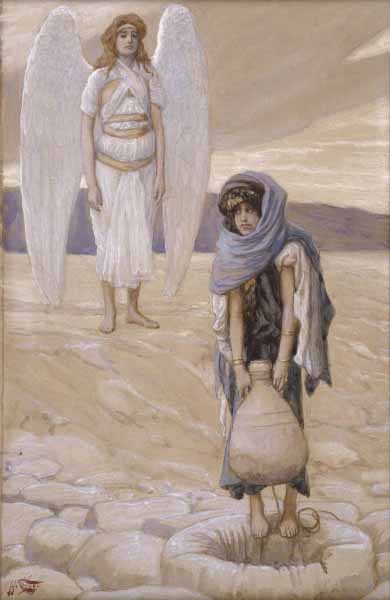
 James Tissot (French painter, 1836-1902), "Hagar and the Angel in the Desert" (1896-1900), watercolor on paper, The Jewish Museum, New York. Larger image. |
This passage seems strange to modern ears. Desperate. Harsh, perhaps. But barrenness is no stranger to the 21st century. Many couples struggle with infertility. Some succeed in getting pregnant. Clinics offer fertility treatments. Some couples adopt. A few opt for the child to be born by a surrogate mother. That's essentially what Sarah finally did -- with consequences she didn't like or expect.
In the process we learn something about the faith-levels of Abraham and Sarah. And we see faith in an unexpected person -- Hagar, an Egyptian slave.
Sarah Gives Hagar to Abraham (16:1-4a)
"Now Sarai, Abram's wife, had
borne him no children. But she had an Egyptian maidservant named Hagar; so she
said to Abram, 'The Lord has kept me from having children. Go, sleep with my
maidservant; perhaps I can build a family through her.'
Abram agreed to what Sarai said. So after Abram had been living in Canaan ten
years, Sarai his wife took her Egyptian maidservant Hagar and gave her to her
husband to be his wife. He slept with Hagar, and she conceived." (16:1-4a)
Now this arrangement may seem rather immoral to you, but it was perfectly legal in Abraham's world. Sarah, still barren at the age of 65 has given up on childbirth. Now she decides to "obtain children" (KJV, NRSV) by her servant girl, Hagar. The Hebrew verb is bānā, "build, rebuild,"114 suggesting the NIV translation, "build a family" (Ruth 4:11; Deuteronomy 25:9).
This was a marriage practice attested over two millennia and found in the Hammurabi Code (§146), a Nuzi text, an Old Assyrian marriage contract, and a Neo-Assyrian text.115 According to well-established law, a barren wife could give her maid to her husband so that she might vicariously bear a child through her (30:3-4). A firstborn son born of such a union would become Abraham's heir unless the primary wife later bore a son herself.116 Two generations later Leah and Rachel will give their handmaids to Jacob to bear more children (Genesis 30:1-8).
Hagar was an Egyptian maidservant, Hebrew shiphâ, "female servant," though generally "those mentioned in the Old Testament are personal maids-in-waiting to a married woman."117 She was probably acquired as a gift from Pharaoh, when Abraham and Sarah were in Egypt during a famine a few years before (12:16). The meaning of Hagar's name isn't certain, but it might be part of an Egyptian title which means "royal concubine" or an Egyptian word suggesting stamina.118
She becomes Abraham's "wife" in verse 3, though the Hebrew noun 'ishshâ, "woman, wife, female" in Genesis can be used describe something in between a full wife and a concubine (usually pilegeš in the Old Testament).119 Sarah remains the primary wife, the "mistress" (Hebrew geberet).120 Abraham has sex121 with Hagar and she conceives without any trouble.122
Hagar Despises Sarah and is Driven Away (16:4b-6)
The trouble comes, however, when she realizes she is pregnant and begins to take pride in it.
"When she knew she was
pregnant, she began to despise her mistress. Then Sarai said to Abram, 'You are
responsible for the wrong I am suffering. I put my servant in your arms, and
now that she knows she is pregnant, she despises me. May the Lord judge between
you and me.'
'Your servant is in your hands,' Abram said. 'Do with her whatever you think
best.' Then Sarai mistreated Hagar; so she fled from her." (16:4b-6)
"Despise" (NIV, KJV) or "looked with contempt on" (NRSV) in verses 4 and 5 is the Hebrew verb qālal, "be slight, trifling, of little account." The primary meaning "to be light or slight," applied to individuals.123
Whether Hagar's pride in her pregnancy is subtle or overt, Sarah picks up on it immediately. She, the primary wife, has failed to perform her most important duty in that culture -- to produce a male offspring -- while her young servant-girl is walking around pregnant and happy. Sarah is jealous -- and angry. She blames Abraham:
"You are responsible for the wrong I am suffering. I put my servant in your arms, and now that she knows she is pregnant, she despises me. May the Lord judge124 between you and me." (16:5)
Abraham is caught in the middle of a situation proposed by Sarah herself, not Abraham. But, nonetheless, he is accused of "wrong" -- Hebrew hāmās, "violence, wrong" from the root "to wrong, do violence to, treat violently."125 What is he supposed to do? He doesn't know, so he does nothing -- like many men.
He is passive and tells Sarah to do what she thinks best. He quiets his jealous wife's tongue, perhaps, but in so doing is unjust to Hagar.
Proverbs contains an apt description of just this situation:
"Under three things the earth
trembles,
under four it cannot bear up...
a maidservant (shiphâ) who displaces her mistress (geberet)."
(Proverbs 30:21, 23)
In her jealousy, Sarah turns her rage from Abraham to Hagar and makes life very hard for her. "Mistreated" (NIV), "dealt hardly" (KJV), or "dealt harshly" (NRSV) is translated from the verb 'ānā, "afflict, oppress, humble." The primary meaning of this root is "to force" or "to try to force submission" and "to punish or inflict pain upon."126 Probably Sarah begins to beat her, and, understandably, Hagar, runs for her life127 -- and for the growing life within her.
Q1. (Genesis 16:1-6) Why does Sarah take her anger out on Abraham? Why does she take her anger out on Hagar? Is she trying to get rid of Hagar or the baby? In what sense is Hagar's pride Abraham's fault? In what sense is Hagar's affliction Abraham's fault? What situation in your family does this remind you of?
Hagar Is Met by an Angel (16:7-10)
Sarah runs Hagar off with Abraham's tacit assent. But the "angel of the Lord" -- who turns out to be a manifestation of Yahweh himself (verse 9) -- hasn't forgotten her.
"The angel of the Lord found
Hagar near a spring in the desert; it was the spring that is beside the road to
Shur. And he said, 'Hagar, servant of Sarai, where have you come from, and
where are you going?'
'I'm running away from my mistress Sarai,' she answered.
Then the angel of the Lord told her, 'Go back to your mistress and submit to
her.'" (16:7-9)
It's pretty clear that Hagar is on the way back to her home in Egypt -- the only place she can go to get help with her baby on the way. She is on the Road to Shur, probably a caravan route from Beer-sheba through the desert to Egypt,128 stopped at a spring129 beside the road, needing to drink and store whatever water she can before crossing the Wilderness of Shur. The exact location of the spring isn't known.
The Lord knows her name, her status as a servant, and her mistress's name. God has not forgotten her. It's interesting to note that in the text Abraham and Sarah never call Hagar by name. She is just "the servant girl." But God calls her by name. They think of Hagar as a slave and foreigner, but God looks at her as a person, a woman whom he has called for his divine purposes. Abraham and Sarah may have looked at her as an expedient way to have children, but God sees her differently. He knows her. He sees her real situation -- and cares for her.
The angel asks where she's come from and where she's going, much like the Lord inquires of Adam ("Where are you?" 3:9) and Elijah ("What are you doing here, Elijah?" 1 Kings 19:9). God sometimes calls us to account in our wanderings from his perfect will. Hagar's reaction to Sarah's mistreatment is a predictable human response, but God's plan is different than hers.
"Go back to your mistress and submit to her," the angel of the Lord tells her. "Submit" is the Hebrew verb 'ānā, which can be translated in the Hithpael stem, "to humble oneself, submit oneself to reproach."130 Hamilton renders it, "accept ill-treatment at her hand."131 This is the same word used in verse 6 and translated "mistreated, dealt harshly" in the Piel stem.
Does the Lord call on Hagar to exchange her earlier disrespect for Sarah with a humble attitude? Perhaps that's what's going on here. Perhaps Abraham's faith in Yahweh needs a chance to rub off on Hagar and Ishmael for a while longer until they are finally sent away (21:8-21).
We are so quick to run from discomfort and pain, from relationships that are less than ideal. Sometimes that is God's will to protect us -- it certainly was in Moses' case, for example. But sometimes God calls us to endure hardship and harshness for a higher, redemptive purpose (1 Peter 2:18-25). Sometimes God's purposes and people are forged through hardship.
Q2. (Genesis 16:7-9) Why does the angel ask Hagar something that the angel already knows? ("Where have you come from, and where are you going?") Why does the angel send her back to Sarah? Have you ever reacted and got yourself out of the place God wanted you?
The Angel's Promises to Hagar Regarding Ishmael (16:10-12)
The angel gently commands her to return, but then speaks to her of her son and of the future:
"The angel added, 'I will so increase your descendants that they will be too numerous to count.' The angel of the Lord also said to her:
'You are now with child
and you will have a son.
You shall name him Ishmael,
for the Lord has heard of your misery.
He will be a wild donkey of a man;
his hand will be against everyone
and everyone's hand against him,
and he will live in hostility
toward all his brothers.'" (16:11-12)
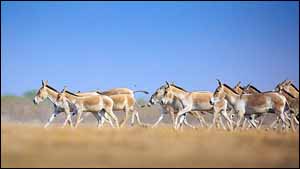 Asiatic Wild Ass (Equus hemionus, whose habitat is in waste places. Image: Sumeet Moghe, Creative Commons Attribution 4.0. Larger image. |
God starts speaking to her. Here's some of what he tells her:
- You will have a son.
- His name is Ishmael (which means, "God hears," from 'el "God" + shāma' "hears", similar to the name "Samuel")
- Yahweh as heard of your misery132 -- an explanation of Ishmael's name.
- Ishmael will be a wild donkey of a man.
- He will live in hostility toward all.133
What does it mean that Ishmael is a "wild donkey" (NIV) or "wild ass" (NRSV)?134 It indicates "one free from the restraints of sedentary life" -- a roamer, a desert nomad.135 But comparing Ishmael to an animal may also carry a derogatory and derisive tone.136 Yahweh's promise of "descendants that they will be too numerous to count" must have been exhilarating to Hagar. Obviously, it is an echo -- and fulfillment -- of God's similar promises to Abraham. But God's assessment of Ishmael's life seems bleak.
The God Who Sees Me -- El-Roi (16:13-14)
It's rather amazing that instead of reacting to the content of Yahweh's message, Hagar marvels that God knows about her and cares about her at all. And in her joy she becomes the only character in the Bible to actually name God -- man or woman!
"She gave this name to the Lord who spoke to her: 'You are the God who sees me,' for she said, 'I have now seen the One who sees me.' That is why the well was called Beer Lahai Roi; it is still there, between Kadesh and Bered." (16:13-14)
"God who sees me" puts together 'el, the generic word for God with the noun rŏ'î, "looking, appearance."137 It is one thing to know in theory that God knows you and loves you. It is an entirely different thing to be suddenly aware of God's presence and personal care over you. Some of my most memorable personal times with God have been in the awestruck realization that he knows me and loves me -- that he sees me, not with judgment, but with love and care.
Hagar's experience -- and the spring at which it took place became well-known in Israel, for a well by the name Beer Lahai Roi, "Well of the Living One who Sees Me," was remembered when the story was written down.
Q3. (Genesis 16:13-14) What is the significance of Hagar's name for God -- El Roi, the God Who Sees? What does it mean to a person who is discouraged and losing hope? What does it mean to you personally?
Ishmael is Born to Abraham and Hagar (16:15-16)
Hagar is obedient to the God Who Sees, and returns to her mistress, to whatever Sarah would do to her, and to the destiny that Yahweh has promised her.
"So Hagar bore Abram a son, and Abram gave the name Ishmael to the son she had borne. Abram was eighty-six years old when Hagar bore him Ishmael." (16:15-16)
It's noteworthy that in verses 15 and 16 Sarah is no longer mentioned. Hagar's son is born to Abraham, and Abraham himself (not Sarah) names him, bestowing on him the name that the Lord had revealed to Hagar, Ishmael, "God hears." Instead of shifting responsibility for the child to his wife, he takes it upon himself where it belongs. Though the scripture doesn't tell us, I sense that Abraham also took upon himself the responsibility to protect Hagar and Ishmael from Sarah. And though difficulties would lie ahead for them, God saw and God heard, and God watched out for this Egyptian slave and her child. Why? Because God was keeping his promises to Abraham and to his offspring -- the promise that continues on to this day.
Lessons for Disciples
 Available as PDF, Kindle, and paperback books. |
What are we to learn from this passage? It wasn't one they spent much time on in Sunday school when I was a boy. But the more I think about it, the more profound is its teaching. Here's what it is speaking to me:
- God-fearing people sometimes try to fulfill God's will in their own ways -- and complicate things. But God can even be in their mistakes and use their mistakes to work out his plans.
- God-fearing people like Abraham and Sarah can still be at a place when they give in to jealousy and cruelty, anger and irresponsibility, and pride of class, position, and status. None of this is whitewashed in Scripture.
- God calls people who are foreigners, unbelievers, and of low social status to exalt, bless, and use. God, the protector of the downtrodden, delights in helping the despised. Hagar stands alone in the Bible as one who assigns a name to the deity and is the only woman who receives a promise of numerous progeny. Yahweh appears directly to her in the form of an angel and she is never the same again.
- God calls us not to ease our own way, but to go His way, even if it means hardship and suffering. We are not called to pleasure, but to the will of God. He calls us to obey even when it is hard -- and honors us (and Hagar) when we do so.
Q4. What lesson is God teaching you out of Hagar's experience? Which situation that God is calling you to is most difficult for you to submit to?
Prayer
Father, my heart goes out to Hagar. She has suffered slavery, jealousy, mistreatment, and yet you see her and have a plan for her life. Lord, you have a plan for my life, too, and for the lives of my brothers and sisters. Help me to be willing to submit to whatever situation you call me to. Let me not be too inflexible and too proud to walk the path you've set for me. Help me to follow Hagar's example of obedience to You. In Jesus' name, I pray. Amen.
Key Verse
"She gave this name to the Lord who spoke to her: 'You are the God who sees me,' for she said, 'I have now seen the One who sees me.'" (Genesis 16:13)
Endnotes
[114] Bruce K. Waltke, bānā, TWOT #255.
[115] Detailed in Hamilton, Genesis 1:444-445. See also Robin Gallaher Branch, "Sarah," DOTP 733-736; Victor H. Matthews, "Family Relationships," DOTP 291-299; and Mary J. Evans, "Women," DOTP 897-904.
[116] Hermann J. Austel, TWOT #2442a.
[117] Ibid.
[118] Hamilton, Genesis 1:441. Paul B. Overland, ("Hagar, DOTP 376-379) suggests it may be related to an Arabian term meaning "splendid" or "flight," or to an Egyptian word suggesting stamina, deriving from hgr, "fortress."
[119] Thomas E. McComiskey, TWOT #137a. Though Spiser (Genesis, p. 117, note 3) claims that this word includes both "wife" and "concubine," Hamilton (Genesis 1:445-446) concludes that in Genesis the situation is different, that no word really covers the in-between type of concubine-wife that would describes Abraham's and Jacob's concubines, so in Genesis pilegeš and 'ishshâ are used as synonyms.
[120] "Mistress" in verse 4, 8, and 9 is the Hebrew noun geberet, "lady, queen, mistress" from the verb gābar, prevail, be mighty, have strength, be great." A related word gibbôr means "mighty man, warrior" (John N. Oswalt, TWOT 310e).
[121] "Slept with" (NIV) or "went in to" (KJV, NRSV) is the common Hebrew verb bô', "go in, enter," used in many contexts -- such as entering a house. It is used idiomatically for death ("go to the fathers") and for sexual relations ("come in to her") (Elmer A. Martens, TWOT #212).
[122] "Conceived" in verses 4 and 11 is the Hebrew hārā, "be with child, conceive", generally used to state the results of sexual intercourse (Harold G. Stigers, TWOT #515a).
[123] Leonard J. Coppes, qālal, TWOT #2028. Hamilton objects to translating qālal as "despise" (which would require the Piel form), and renders the phrase, "her mistress lost status in her estimation" (Hamilton, Genesis 1:442, note 8).
[124] "Judge" in verse 5 is the Hebrew verb shāpat, "judge, govern, to exercise the process of government," here "to decide cases of controversy as judge in civil, domestic, and religious cases" (TWOT #2443).
[125] R. Laird Harris, hāmās, TWOT #678a.
[126] Leonard J. Coppes, 'ānā, TWOT #1652.
[127] "Fled" (NIV, KJV) or "ran away" (NRSV) in verses 6 and 8 is the Hebrew verb bārah, "flee, run away, chase, drive away, put to flight," usually fleeing from an enemy or enemies (Earl S. Kalland, TWOT #284).
[128] John Alexander Thompson, "Shur," ISBE 4:497-498. So Beitzel, Moody Atlas, p. 82-83, Map 23.
[129] "Spring" (NIV, NRSV) or "fountain" (KJV) is the Hebrew noun which "designates a flow of water from an opening in a hillside or valley. It should be distinguished from 'well' or 'cistern'" (Carl Schultz, TWOT #1613a).
[130] 'Ānā, TWOT #1652.
[131] Hamilton, Genesis 1:452. See also Overland, "Hagar," DOTP p. 378.
[132] "Misery" (NIV) and "affliction" (KJV, NRSV) derives from the same verb 'ānā, that is translated "mistreat" and "submit" in verses 6 and 9 above.
[133] "In hostility" (NIV), "at odds with" (NRSV), "in the presence of" (KJV) is the Hebrew noun pānīm, "face" (TWOT 1782a). However, Hamilton (Genesis 1:455) translates it as "in defiance of, against," drawing upon parallels in Exodus 20:3; Deuteronomy 21:16; and Isaiah 65:3.
[134] "Wild donkey" (NIV) or "wild ass" (NRSV) is the Hebrew pere', also found in Hosea 8:9 and Jeremiah 2:24 (TWOT #1805a).
[135] Eugene H. Merrill, "Ishmael," DOTP 450-451.
[136] Hamilton, Genesis 1:454. This is the Asiatic wild ass, the onager (Equus hemionus), whose habitat is in waste places (Job 39:5-8; Isaiah 32:14; Jeremiah 2:24; 14:6; Hosea 8:9).
[137] Robert D. Culver, rŏ'î, TWOT #2095f.
Copyright © 2026, Ralph F. Wilson. <pastor joyfulheart.com> All rights reserved. A single copy of this article is free. Do not put this on a website. See legal, copyright, and reprint information.
 To be notified about future articles, stories, and Bible studies, why don't you subscribe to our free newsletter, The Joyful Heart, by placing your e-mail address in the box below. We respect your