|
Old Testament
New Testament
Gospels
Acts
Paul's Letters
General Letters
Revelation
Topical Studies
Beginning the Journey (for new Christians). en Español

|
Old Testament
New Testament
Gospels
Acts
Paul's Letters
General Letters
Revelation
Topical Studies

|
Home
Bible Studies
Articles
Books
Podcasts
Search
Menu
Donate
About Us
Contact Us
FAQ
Sitemap


 The Discipleship Process
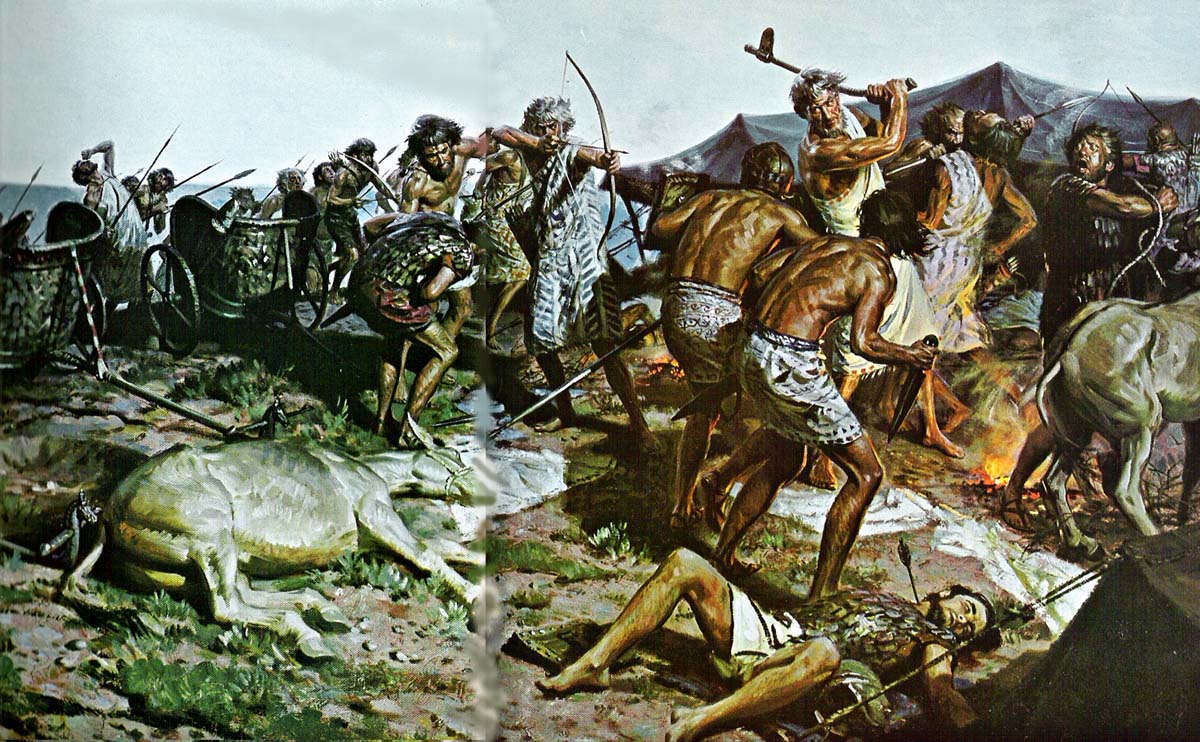
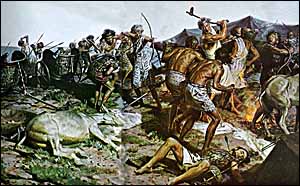 'In Swift Vengeance,' Abraham in a surprise attack on the Mesopotamian kings, by American Illustrator Tom Lovell (1909-1997), in Everyday Life in Bible Times (National Geographic Society, 1968), pp. 94-95. Larger image. |
If you thought Abraham was a wimp, a coward, and cad for lying to save his own skin and failing to confront the kings who abducted Sarah in Egypt and Gerar, perhaps these two chapters will help you see the action-figure side of Abraham -- and a man firmly committed to righteousness. We'll move quickly over the narrative, spending more time at significant points.
Abraham Moves Back to Bethel (13:1-4)
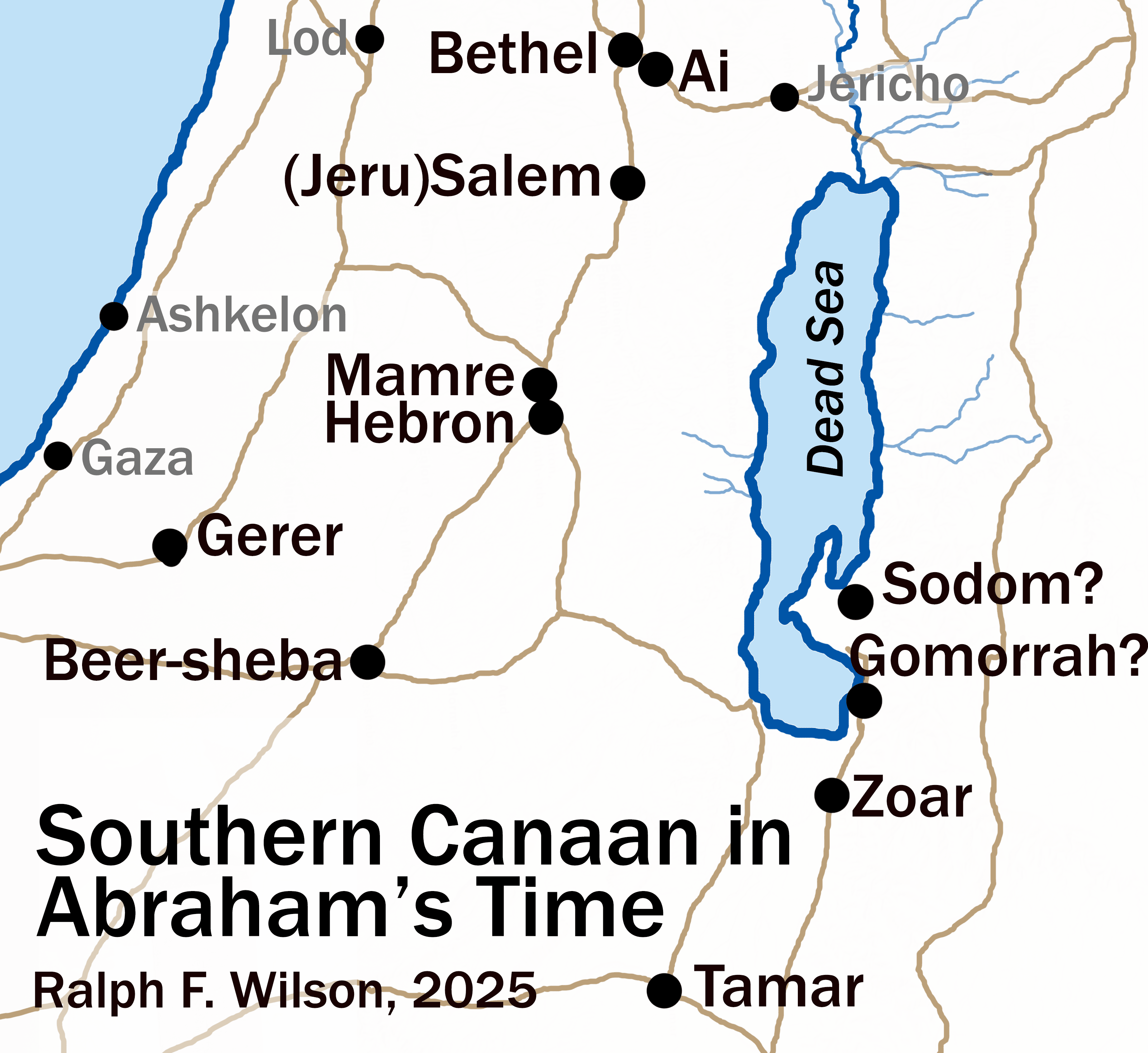
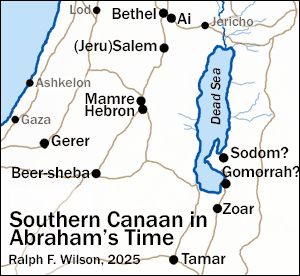 South Canaan in Abraham's Time. Larger map. |
"So Abram went up from Egypt to the Negev, with his wife and everything he had, and Lot went with him. Abram had become very wealthy in livestock and in silver and gold. From the Negev he went from place to place until he came to Bethel, to the place between Bethel and Ai where his tent had been earlier and where he had first built an altar. There Abram called on the name of the Lord." (13:1-4)
When forced by famine to live in areas controlled by a strong king -- such as Egypt and Gerar -- Abraham was vulnerable. But living near the settlements that thinly populated Canaan during his day, Abraham is much safer. He is a nomadic shepherd, who travels "from place to place" where he can find grazing land for his increasing flocks and herds.58 After he is expelled from Egypt for deceiving Pharaoh about being Sarah's "brother," he returns to the Negev desert -- probably the region around Beersheba. By this time, apparently, the drought is over and Abraham can sustain himself there again.
Is Material Wealth a Sign of God's Blessing? (13:2)
The narrator notes that "Abram had become very wealthy in livestock and in silver and gold" (13:2). Why is this mentioned? Partly to set the stage for the conflict with his nephew Lot, but partly to demonstrate God's blessing on Abraham in response to God's promise to him:
"I will make you into a great
nation
and I will bless you;
I will make your name great,
and you will be a blessing.
I will bless those who bless you,
and whoever curses you I will curse...." (12:2-3)
Pharaoh may have cursed or wronged Abraham (and suffered for it), but God had blessed him.
However, is material wealth a true sign of God's blessing? A number of passages in the Old Testament clearly indicate that it is one of the kinds of blessings God can bring.59 God's blessing often includes physical wealth.
However, many wealthy people don't serve God. Material blessings are not a sure indicator of God's favor. Perhaps you've heard the teaching that poverty is a curse and wealth is a sign of blessing. That if you are poor, you are out of God's will for you and experiencing God's curse. This teaching is a gross over-simplification, a thin mask for greed, and encourages greed in those who sit under this teaching.
Jesus "preached good news to the poor," and "had no place to lay his head." He was poor, though he had rich friends (and a rich Father). Was he suffering God's curse? Of course not! Paul experienced times of abundance and times of scarcity. Was the scarcity due to his sin? No. Moreover, he warns Timothy: "People who want to get rich fall into temptation and a trap" (1 Timothy 6:9).
God blessed Abraham with wealth and we rejoice. God may bless you with wealth and that is a good thing. Or you may be relatively poor in material possessions all your life and be blessed by God in other ways (James 2:9). That is for God to choose. God brings many different kinds of blessings. To equate blessing with material wealth is an oversimplification.
Q1. (Genesis 13:2) Does Abraham's material wealth reflect God's blessing on him? Does material wealth always reflect God's blessing? Does physical poverty always reflect God's curse?
Now Abraham returns to a previous camp near Bethel where the Lord had appeared to him before (12:8). He repairs the altar he had built there and worships the Lord afresh in that place -- "There Abram called on the name of the Lord."60
Quarrelling over Pasture Land (13:5-9)
"Now Lot, who was moving about with Abram, also had flocks and herds and tents. But the land could not support them while they stayed together, for their possessions were so great that they were not able to stay together. And quarreling arose between Abram's herdsmen and the herdsmen of Lot. The Canaanites and Perizzites were also living in the land at that time.
"So Abram said to Lot, 'Let's not have any quarreling between you and me, or between your herdsmen and mine, for we are brothers. Is not the whole land before you? Let's part company. If you go to the left, I'll go to the right; if you go to the right, I'll go to the left.'" (13:5-9)
Though he is the older family member and would have the right to the best land, Abraham allows Lot to have his choice to avoid strife. God has promised Abraham land and he is trusting God to provide for him.
Lot Chooses the Plain of Jordan and Sodom (13:10-12)
"Lot looked up and saw that the whole plain of the Jordan was well watered, like the garden of the Lord, like the land of Egypt, toward Zoar. (This was before the Lord destroyed Sodom and Gomorrah.) So Lot chose for himself the whole plain of the Jordan and set out toward the east. The two men parted company: Abram lived in the land of Canaan, while Lot lived among the cities of the plain and pitched his tents near Sodom." (13:10-12)
Abraham and Lot have been living in the hill country of Canaan and the Negev desert. But the Jordan River valley seemed like a much richer grazing area, similar to the well-watered Nile delta. So Lot chooses the lush Jordan River valley and encamps near Sodom.61
Where were the cities Sodom and Gomorrah? No one knows for sure. Some think they are at the north end of the Dead Sea, visible perhaps from Bethel (13:10, "Lot looked up and saw..."), though most believe these cities were near the south end of the Dead Sea in an area now submerged.62 Zoar also seems to have been located at the south end of the Dead Sea.63.
Sinful Sodom (13:13)
The key sentence in this section is:
"Now the men of Sodom were wicked and were sinning greatly against the Lord." (13:13)
"Wicked" is the Hebrew verb rā'a', "be bad, evil." It is frequently used as the antonym of good, as in "good and evil."64 "Sinners" (NIV) is the Hebrew noun hattā', which "designates a habitual sinner who is subject to punishment because of his or her practices."65
The inhabitants of Sodom are sinful, but the kings of Sodom and Gomorrah are evil as well -- both their names in 14:2 mean "evil, wicked." "Bera" is apparently related to the verb rā'a', "be evil," while "Birsha" may be related to the verb rāŝa', "be wicked," and means "in wickedness."66 The narrator sends a strong message to the reader concerning the wickedness of these cities and their kings. We'll see in chapter 14 that Abraham pointedly refuses to take anything from Sodom's king -- probably because he disapproved of the city's sins. Of course, God destroys Sodom and Gomorrah because of their wickedness (Genesis 19).
We may have little choice about the people around us. But when we do have a choice and choose to live in places of gross sin, we also choose to expose our sons and daughters to degraded moral standards, to put our families in physical danger, and to make ourselves vulnerable to God's punishment upon the wicked. Lot is attracted by the well-watered land, but ignores the moral character of the inhabitants.
God Promises Canaan to Abraham (13:14-17)
Lot has the choice land, but Abraham has God's promise:
"The Lord said to Abram after Lot had parted from him, 'Lift up your eyes from where you are and look north and south, east and west. All the land that you see I will give to you and your offspring forever. I will make your offspring like the dust of the earth, so that if anyone could count the dust, then your offspring could be counted. Go, walk through the length and breadth of the land, for I am giving it to you.'" (13:14-17)
God has been speaking to Abraham for years now. First, to call him from Ur and later Haran to travel to Canaan. Then to promise him the land and offspring. Here God restates his two-fold promise to Abraham.
- Land. God will give to Abraham's offspring all the land he can see in any direction. God encourages him to walk through "his" land and check it out, perhaps as an act of taking possession of it.67
- Offspring. Abraham's descendants will be so many that they can't be counted. God uses tiny grains of dust as an analogy to illustrate the uncountable, vast number of Abraham's offspring.
Abraham Moves to Hebron (13:18)
God's promise may have initiated a period of "walking" the land followed by settling at Hebron, near the great trees of Mamre.
"So Abram moved his tents and went to live near the great trees of Mamre at Hebron, where he built an altar to the Lord." (13:18)
Incidentally, Mamre is a person (or perhaps tribal leader). Later, Abraham allies himself with Mamre, and his brothers Aner and Eschol (14:13, 24). The significance of Chapter 13 is mainly to set up events for successive chapters of Abraham's saga. We learn that:
- Lot moves to Sodom.
- Sodom is a place of wickedness and sin.
- God renews his promise to Abraham of land and numerous offspring.
- Abraham moves to Hebron where he gains valuable allies.
Four Mesopotamian Kings Punish Rebellious Vassal Cities (14:1-12)
Now we're ready for Genesis 14, which is pretty confusing, with lots of unpronounceable personal and place names. Read the text and then I'll try to simplify it for you.
Mesopotamian Kings Come to Punish Rebellious City-States (14:1-4)
|
|
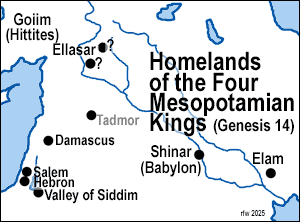
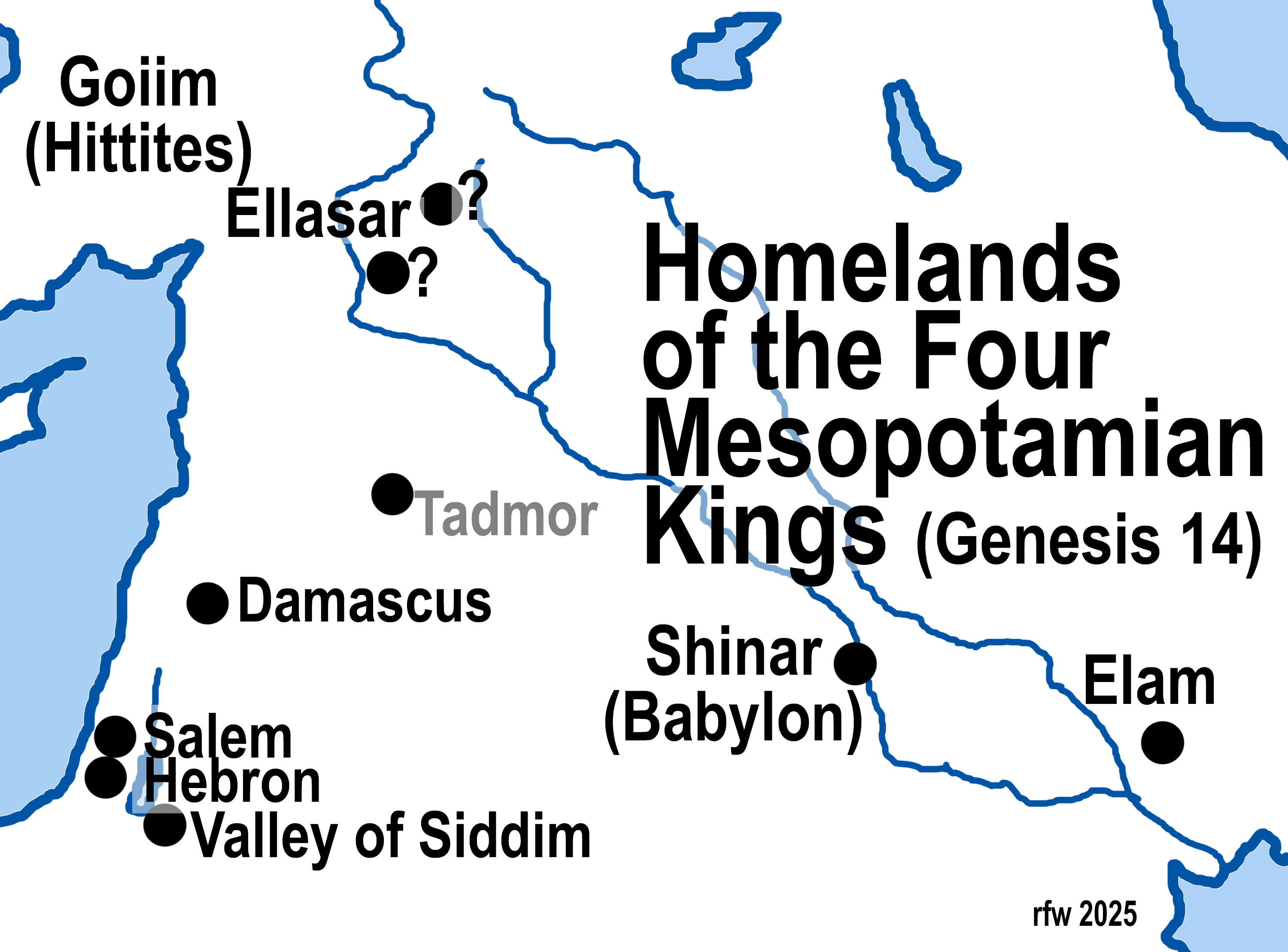
"At this time Amraphel king of Shinar, Arioch king of Ellasar, Kedorlaomer king of Elam and Tidal king of Goiim went to war against Bera king of Sodom, Birsha king of Gomorrah, Shinab king of Admah, Shemeber king of Zeboiim, and the king of Bela (that is, Zoar). All these latter kings joined forces in the Valley of Siddim (the Salt Sea). For twelve years they had been subject to Kedorlaomer, but in the thirteenth year they rebelled." (14:1-4)
Four Mesopotamian Kings First Attack other Rebellious Cities (14:5-7)
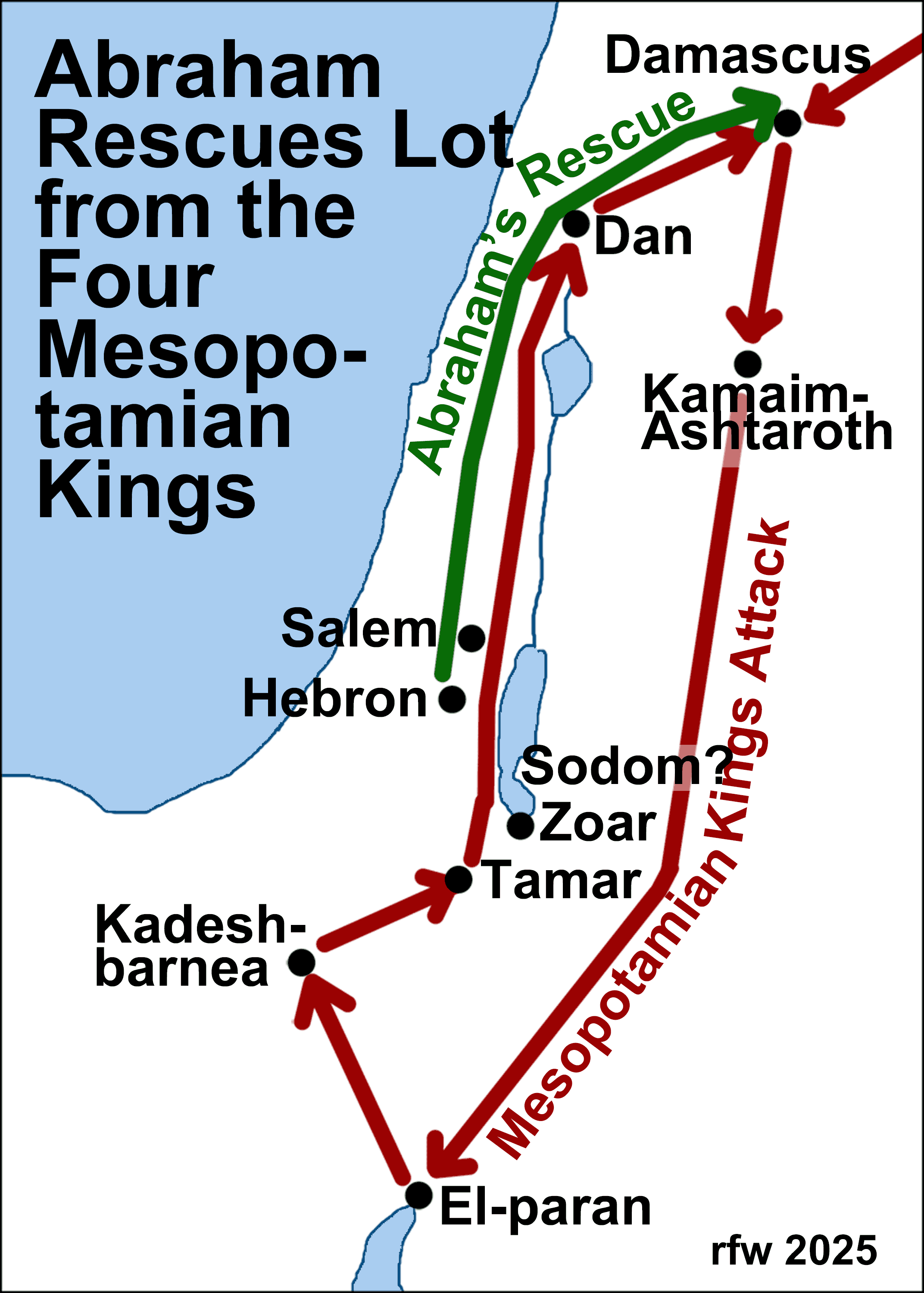
"In the fourteenth year, Kedorlaomer and the kings allied with him went out and defeated the Rephaites in Ashteroth Karnaim, the Zuzites in Ham, the Emites in Shaveh Kiriathaim and the Horites in the hill country of Seir, as far as El Paran near the desert. Then they turned back and went to En Mishpat (that is, Kadesh), and they conquered the whole territory of the Amalekites, as well as the Amorites who were living in Hazazon Tamar." (14:5-7)
The Battle Takes Place in the Valley of Siddim Defeating the Vassals (14:8-10)
|
|
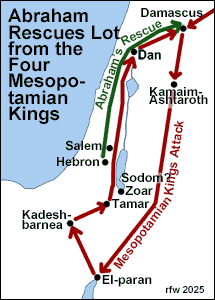
"Then the king of Sodom, the king of Gomorrah, the king of Admah, the king of Zeboiim and the king of Bela (that is, Zoar) marched out and drew up their battle lines in the Valley of Siddim against Kedorlaomer king of Elam, Tidal king of Goiim, Amraphel king of Shinar and Arioch king of Ellasar -- four kings against five. Now the Valley of Siddim was full of tar pits, and when the kings of Sodom and Gomorrah fled, some of the men fell into them and the rest fled to the hills." (14:8-10)68
Lot Is Taken Captive (14:11-12)
"The four kings seized all the goods of Sodom and Gomorrah and all their food; then they went away. They also carried off Abram's nephew Lot and his possessions, since he was living in Sodom." (14:11-12)
Let's try to make some sense out of this.
- A group of four Mesopotamian kings (see map for their homelands) had conquered a number of city-states in Palestine. (Though we know the kings are Elamite, Amorite, Harrian, and Hittite, we can't currently match any of these kings with other historical records.)
- Five city-states at the south end of the Dead Sea have been tribute-paying vassals for twelve years. In year 13 they rebel and stop paying tribute.
- In year 14, the four Mesopotamian kings bring their armies to punish the five rebellious city-states.
- Following a battle in the Valley of Siddim with the armies from the rebellious cities, the Mesopotamians sack the cities and take many inhabitants captive.
- The Mesopotamian kings, with their loot and captives, head back from where they came from.
Most of this is background information. What's important is that Lot, Abraham's nephew, is one of those taken captive.
Abraham's Allies (14:13-14)
"One who had escaped came and reported this to Abram the Hebrew. Now Abram was living near the great trees of Mamre the Amorite, a brother of Eshcol and Aner, all of whom were allied with Abram. When Abram heard that his relative had been taken captive, he called out the 318 trained men born in his household and went in pursuit as far as Dan." (14:13-14)
If Lot had been taken captive by an individual or a small group of raiders, Abraham would be duty bound to attempt to rescue his blood relative. But Lot has been captured by large foreign armies. Nevertheless, Abraham pulls together his allies and his own men. "Allies" (NIV) or "confederate" (KJV) is the Hebrew noun berit, "covenant, treaty, agreement between nations or individuals."69 He convinces Mamre, Eshcol, and Aner -- his Amorite neighbors in the area around Hebron -- to join him. Together they pursue the Mesopotamian army that has moved north to Dan.
Surprisingly, Abraham has at his disposal "318 trained men born in his household." He is obviously a wealthy slaveholder. "Trained men" is the Hebrew noun hānīk, "armed retainer."70 Hamilton notes that "the term is applied to a slave or servant whose major function is to provide military assistance. They are not shepherds who grabbed a spear or a sling and headed north for some 125 miles. They are individuals capable of making a successful attack against imposing odds."71
Abraham Attacks at Night (14:15-16)
"During the night Abram divided his men to attack them and he routed them, pursuing them as far as Hobah, north of Damascus. He recovered all the goods and brought back his relative Lot and his possessions, together with the women and the other people." (14:15-16)
Abraham finds the Mesopotamian army at Dan. This may not have been the full army, but could have been an escort group bringing the spoil and prisoners of war back to Mesopotamia. Abraham sets the strategy, which involves two elements:
- A night attack for maximum confusion
- A divided force attacking from several directions
The result is a surprise that scares the soldiers into fleeing for their lives.72 Then Abraham's men chase them for 50 miles or more, to north of Damascus. It is a complete rout. Abraham's objective is not to destroy the Mesopotamian army, however, but to rescue Lot. Indeed, Lot and all the captives, plus all the property seized by the Mesopotamians during their Palestinian campaign, are recovered. Abraham marches home a victor.
Q2. (Genesis 14:13-16) What does Abraham's military expedition to rescue Lot from the Mesopotamian kings tell us about his character? About his abilities? About the way he deals with neighbors? What is here for us to emulate?
Abraham Meets Two Kings near Jerusalem (14:17-18)
On the road back to Hebron, Abraham comes to Salem (now Jerusalem), to the Valley of Shaveh, just south of present-day Jerusalem.73
"After Abram returned from defeating Kedorlaomer and the kings allied with him, the king of Sodom came out to meet him in the Valley of Shaveh (that is, the King's Valley). Then Melchizedek king of Salem brought out bread and wine. He was priest of God Most High...." (14:17-18)
Two kings meet Abraham there -- Melchizedek, king of Salem, and Bera, king of Sodom. The king of Sodom has come to negotiate for his subjects' release. The king of Salem, as host, brings food and provisions for the soldiers. While bread is a staple food, wine probably indicates that this is a celebration of the victory, since it was typically reserved for special occasions. To defeat the great Mesopotamian army is an amazing victory for these small city-states to accomplish! (As a Christian, I'm tempted to see the Eucharist in the hands of this priest of God, but that's reading something into this text that isn't there.)
These two kings are clear opposites -- and the reader is expected to understand this.
King of Salem
- Melchizedek = "king of righteousness"
- Righteous
- Salem = "peace"
- Abraham accepts Melchizedek's food and blessing.
- Priest of the Most High God
King of Sodom
- Bera = "be evil" (14:2)
- Sinful
- Sodom = a symbol for sinfulness
- Abraham rejects the offer of Sodom's captured property.
- (worshipper of false gods)
Abraham Is Blessed by Melchizedek (14:18-20a)
See how Melchizedek honors Abraham:
"Then Melchizedek king of Salem brought out bread and wine. He was priest of God Most High, and he blessed Abram, saying,
'Blessed be
Abram by God Most High,
Creator of heaven and earth.
And blessed be God Most High,
who delivered your enemies into your hand.'" (14:18-20a)
Melchizedek offers refreshment -- a sign of peace, perhaps even a fellowship meal that would bind them closer as allies. He blesses Abraham and then God, and attributes Abraham's victory to God.
God Most High -- El Elyon
Just who is this "God Most High"? Melchizedek's name for God is a pair of words, Hebrew 'el 'elyon (found also in Psalm 78:35). 'Ēl is the generic term for God.74 Hebrew 'elyôn, "most high," (from the root 'ālā, "go up, climb, ascend). "'Elyôn, as a divine name signifying the supremacy of the deity, is known from both Ugaritic and Phoenician texts appearing there as epithets of the highest gods of the pantheons."75 Melchizedek sees El Elyon as being "Creator of heaven and earth" (14:19b) in the same way as Abraham does (14:22) -- in other words, both Melchizedek and Abraham see El Elyon as totally supreme over everything in earth and heaven.76 Abraham clearly identifies El Elyon with Yahweh in 14:22 and seems to welcome Melchizedek's blessing. He sees Melchizedek as a priest serving the same God that Abraham himself serves.
Abraham Tithes to Melchizedek (14:20b)
Then Abraham does a remarkable thing:
"Then Abram gave him a tenth of everything." (14:20b)
What is the significance of one tenth of all the spoils of war being given to Melchizedek? He didn't even participate in the rescue mission. "Tenth" (NIV, NRSV) or "tithes" (KJV) is the Hebrew noun ma'ăsēr, "tithe, tenth part."77 Tithing, or giving one tenth, was practiced by many ancient Near Eastern peoples -- in Egypt, Syria, Babylon, Assyria, and Urgarit, though none had such a defined or specific practice as eventually developed in Israel.78
Before tithing was made part of the Mosaic law, we see two examples of tithing in Genesis -- here and Jacob's promise as an act of worship in response to a dream of a ladder into heaven at Bethel, "of all that you give me I will give you a tenth" (28:22). Though sometimes tithing indicates submission to a king (1 Samuel 8:15, 17), here it is clearly is an act of worship, which immediately follows Melchizedek's blessing of both Abraham and God Most High:
"'Blessed be
Abram by God Most High,
Creator of heaven and earth.
And blessed be God Most High,
who delivered your enemies into your hand.'
Then Abram gave him a tenth of everything." (14:19-20)
By tithing to God's priest Melchizedek, Abraham is worshipping God for giving him the victory. Melchizedek, the king, hadn't helped in the military victory and isn't entitled to a share of the spoils, but Melchizedek, the priest and representative of God, receives Abraham's gift as an act of worship of God Most High. Abraham, as the general of the expedition, divides up the spoils of war and begins with God who had given them the victory.
Q3. (Genesis 14:20) What is the significance of Abraham giving one tenth of the spoils of war to Melchizedek? Does tithing today represent the same kind of worship? Why should we tithe to God first (like Abraham did) before dividing up our paychecks to pay our bills?
Who Is Melchizedek?
Much has been written about Melchizedek, though he is mentioned in only a very few scripture passages.79 There is no indication that he was an incarnation of God or Jesus. He is a priest who recognizes the sovereignty of the One God. As such, Abraham honors God by paying tithes to him.
Though some scholars may contest this on etymological grounds,80 I take the author of Hebrews' interpretation that his name is to be translated as "king of righteousness" (Hebrews 7:2). Some contest the identification of Salem with Jerusalem, but this seems to be confirmed by identifying the location of the "Valley of Kings" as just south of Jerusalem (14:17; 2 Samuel 18:18).
In a messianic psalm, David sees the Messiah as David's own Lord, who will reign on Yahweh's behalf and who is also "a priest forever, in the order of Melchizedek" (Psalm 110:4).81 The writer of Hebrews takes up this theme to illustrate how Christ can be a high priest without being descended from the tribe of Levi, Israel's priestly family (Hebrews 5:6, 10; 6:20; 7:1, 10-11, 15, 17).
Abraham Refuses to Take from the King of Sodom (14:21-24)
The wicked king of Sodom makes a seemingly generous suggestion to Abraham concerning how to divide up the spoils:
"Give me the people and keep the goods for yourself." (14:21)
In other words: Return the captured citizens of Sodom to me, but feel free to keep for yourself any of the recovered property that had been taken from Sodom.
But Abram said to the king of Sodom, "I have raised my hand to the Lord, God Most High, Creator of heaven and earth, and have taken an oath that I will accept nothing belonging to you, not even a thread or the thong of a sandal, so that you will never be able to say, 'I made Abram rich.' I will accept nothing but what my men have eaten and the share that belongs to the men who went with me -- to Aner, Eshcol and Mamre. Let them have their share." (14:22-24)
Why does Abraham so firmly reject the King of Sodom's offer that would allow him to keep the spoil taken from the sack of Sodom? Is it altruism? Hamilton suggests that Abraham may be following "royal etiquette" based on a Ugaritic text where one king, Niqmaddu, tries to give a gift to Suppiluliuma, who assisted him in battle, but refuses the reward with the words,
"Suppiluliuma, the great king, will not touch anything, be it straw or splinter."82
I'm not convinced that this is all that is going on here. Abraham is particularly concerned that the king of Sodom might boast, "I have made Abram rich." Abraham returns the people and goods, but separates himself from further involvement with a wicked king, city, and goods. He receives Melchizedek, king of righteousness, but rejects the king of wickedness. Abraham does ally himself with those of a different religion, but has nothing to do with a wicked king who is patently evil.
Q4. (Genesis 14:21-24) Why does Abraham refuse to take the spoils of war that the king of Sodom offers him? What does this tell us about Abraham's character? What is the lesson here for us to learn?
Lessons from Abraham's Foray into International Politics
What are the disciple lessons of these two chapters?
- We can trust God to take care of our needs, even though others seem to help themselves -- like Lot who took the well-watered land.
- We are to assist our relatives -- and others -- when we are able, when we see them in trouble.
- We see an example of courage and boldness to emulate.
- We are to worship God with our material wealth, as an indication that he brings the victory, and that "it is he who gives you the ability to produce wealth, and so confirms his covenant" (Deuteronomy 8:18).
- We are to be careful not to ally ourselves with the wicked any more than is necessary.
In this passage we see the continued working out of God's initial promise to Abraham:
 Available as PDF, Kindle, and paperback books. |
"I will make you into a great
nation
and I will bless you;
I will make your name great,
and you will be a blessing.
I will bless those who bless you,
and whoever curses you I will curse;
and all peoples on earth
will be blessed through you." (12:2-3)
Those who attacked Abraham's nephew Lot are cursed, while Abraham begins his ministry of blessing all the peoples of the earth, beginning with the abducted residents of the Cities of the Plain, just as our Father sends his blessings of sun and rain "on the evil and the good" and "on the righteous and the unrighteous" (Matthew 5:45).
Prayer
Father, help me to walk the narrow path of showing love to your enemies without losing my integrity. Sometimes I've been afraid to tackle tough situations. Give me the boldness and courage I need to do your will. Finally, I ask you to help me to worship you with my material wealth in proportion to how you've blessed me. Keep me from greed and draw me closer to you. In Jesus' name, I pray. Amen.
Key Verses
"Then Melchizedek king of Salem brought out bread and wine. He was priest of God Most High, and he blessed Abram, saying,
'Blessed be Abram by God
Most High,
Creator of heaven and earth.
And blessed be God Most High,
who delivered your enemies into your hand.'
Then Abram gave him a tenth of everything." (Genesis 14:18-20)
Endnotes
[58] "From place to place" (NIV), "journeys" (KJV), and "by stages" (NRSV) in verse 3 is the Hebrew noun massa', "pulling up, breaking camp," from the root verb nāsa', "to pull out tent-pegs," that is, to break camp (Marvin R. Wilson, TWOT #1380a).
[59] Deuteronomy 7:13; 8:17-18; 15:4-5; Job 1:10; Proverbs 10:22; Hosea 2:8; Malachi 3:10-12.
[60] On to "call on the name of the Lord" see Lesson 1 (12:9).
[61] "He pitched his tent" (NIV) is the 'āhal, which could be rendered "acquire grazing rights" (Hamilton, Genesis 1:393-394). See also Jack P. Lewis, TWOT #32.
[62] "Sodom," Archaeological Encyclopedia, p. 354. David M. Howard, Jr., "Sodom," ISBE 4:560-561. Roland K. Harrison, "Cities of the Valley," ISBE 1:704, notes that, "Archaeological investigation has shown that ca. 2000 BC, a devastating natural catastrophe occurred there, which denuded the area of sedentary occupation for over a half a millennium." Apparently when this passage from Genesis was edited, the Valley of Siddim was then covered by the Salt Sea (i.e., Dead Sea), according to Amos Frumkin and Yoel Elitzur, "The Rise and Fall of the Dead Sea, Biblical Archaeology Review, November-December 2001, pp. 42-50. Martin H. Heicksen, "Plain, Cities of the," DBA 366-367.
[63] The Mishnah (Yebam. 16.7) calls Zoar "the City of Palms" and Ptolemy (Onom. 231, 261) claimed that Zoar was widely famous for its balsam and date palms (Hamilton, Genesis 1:393). Though scholars aren't sure, the site is probably along the Brook Zered at the south end of the Dead Sea (David M. Howard, Jr., "Zoar," ISBE 4:1203).
[64] G. Herbert Livingston, rā'a', TWOT #2191.
[65] The noun hattā' is from the root hātā', "sin, incur guilt," the Old Testament's principal word for sin (G. Herbert Livingston, TWOT, #638b).
[66] Hamilton, Genesis 1:401.
[67] God's instruction to walk through the land may be related to Near Eastern laws of property transfer that may require the purchaser to take some creative act -- such as walk the property -- to take possession. Hamilton (Genesis 1:395, n. 16) cites Y. Muffs, Studies in the Aramaic Legal Papyri from Elephantine (Brill, 1969), p. 24, n. 2.
[68] The word "tar pits" (NIV) or "slime pits" (KJV) is the Hebrew noun hēmār, "bitumen, asphalt." The material was abundant in the Dead Sea area, was used in Babylon as mortar, and exported to Egypt for mortar sealant (Gerard Van Groningen, TWOT #683b). Roland K. Harrison ("Sodom," DBA 418-419) concludes that God's destruction of Sodom most probably was produced by the combustion of petroleum gases emanating from the bituminous deposits in the area. This doubtless was accompanied by seismic disturbances, which caused the plain to sink some 20 feet under the surface of the Dead Sea. In 1953, "Israel's first oil well went into production just north of Jebel Usdum (the Mount of Sodom"), indicating significant petroleum deposits in the region."
[69] Elmer B. Smick, berit, TWOT #282a.
[70] This word is used by Palestinian chieftains as mentioned in the Egyptian Execration Texts, 19th-18th centuries BC and 15th century BC cuneiform inscription (Victor P. Hamilton, TWOT #693a).
[71] Hamilton, Genesis 1:406.
[72] "Routed" (NIV, NRSV) or "smote" is the Hebrew verb nākâ, "smite, strike, hit, beat, slay, kill" (Marvin R. Wilson, TWOT #1364).
[73] This is also called the King's Valley and is mentioned in 2 Samuel 18:18 as the location of Absalom's monument, at the confluence of the Kidron Valley and the Valley of Hinnom, just south of Jerusalem (Hamilton, Genesis 1:408).
[74] Jack B. Scott, TWOT #93a. 'Ēl is found (though not here) in the plural, 'ĕlōhīm.
[75] G. Lloyd Carr, TWOT #1624h; Stephen J. Andrews, "Melchizedek," DOTP 562-564; De Vaux, Ancient Israel, p. 310.
[76] "Creator" (NIV), "maker" (NRSV), and "possessor" (KJV) is the Hebrew verb qānâ, "get, acquire, create." Here the idea of "create" seems both possible and likely (Leonard J. Coppes, TWOT #2039 and Hamilton, Genesis 1:410-412).
[77] Ronald B. Allen, ma'ăsēr, TWOT #1711h.
[78] Eugene E. Carpenter, "Tithe," ISBE 4:861-864.
[79] Genesis 14:18; Psalm 110:4; Hebrews 5:6, 10; 6:20; 7:1, 10-11, 15, 17.
[80] Hamilton, Genesis 1:409-410; Stephen J. Andrews, "Melchizedek," DOTP 562-564.
[81] "Order" (NIV, NRSV, KJV) or "succession" (NEB) is the Hebrew noun dibrâ, which should probably be translated "'according to the case of, on the model of,' here implying succession of some kind" (Leslie C. Allen, Psalm 101-150 (Word Biblical Commentary 21; Word, 1983), p. 81, n. 4c).
[82] Hamilton, Genesis 1:413-414.
Copyright © 2026, Ralph F. Wilson. <pastor joyfulheart.com> All rights reserved. A single copy of this article is free. Do not put this on a website. See legal, copyright, and reprint information.
 To be notified about future articles, stories, and Bible studies, why don't you subscribe to our free newsletter, The Joyful Heart, by placing your e-mail address in the box below. We respect your