|
Old Testament
New Testament
Gospels
Acts
Paul's Letters
General Letters
Revelation
Topical Studies
Beginning the Journey (for new Christians). en Español

|
Old Testament
New Testament
Gospels
Acts
Paul's Letters
General Letters
Revelation
Topical Studies

|
Home
Bible Studies
Articles
Books
Podcasts
Search
Menu
Donate
About Us
Contact Us
FAQ
Sitemap


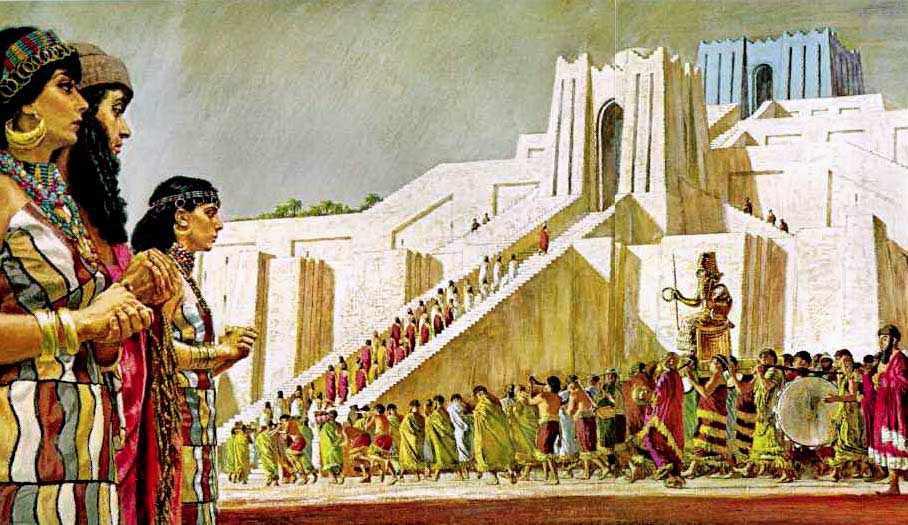
 'Stairway for the Gods,' ziggurat of Ur dedicated to Sin, the moon-god, by American illustrator John McDermott (1919-1977) for Everyday Life in Bible Times (National Geographic Society, 1968), pp. 58-59. Larger image. |
As we begin our study of the life of Abraham, we'll be traveling back through time nearly 4,000 years into a semi-nomadic, Middle Bronze Age culture far removed from our own. While many of the customs will be explained in the lessons to follow, here's an introduction to Abraham's life and times. (Note: Unless otherwise designated, all scripture references are to Genesis.)
Career
You can't adequately sum up Abraham's career in a single paragraph, but for the sake of perspective, here's an attempt:
Abraham was a semi-nomadic shepherd to whom God revealed himself, made promises, and entered into covenant concerning Abraham's offspring and the land that they would inherit in the future. Abraham's belief in these promises was counted by God as righteousness and his faith shaped his life. Ultimately these promises find their fulfillment in Jesus the Messiah and all those who trust in Yahweh, the true God, Abraham's spiritual children.
Abraham was called both a Hebrew (14:13) and an Aramean.1 He was born in Ur and moved to Haran with his father Terah. At God's call, he traveled to Canaan and lived for a while in various localities, in particular: Shechem, Hebron, Bethel, and the Negev desert, with sojourns to Egypt and Gerar. Genesis records that he led a band of armed men to rescue his nephew Lot from kings who had captured him, interceded for Sodom and Gomorrah (Lot's wicked residence), paid tithes to the Melchizedek, King of (Jeru)Salem, and entertained angels. He bore a son, Ishmael, by his wife's servant who became the father of the Arab nations. His heir, Isaac, was born to Abraham and Sarah in their old age by supernatural intervention by God. His devotion to God was such that he was willing to sacrifice his only son. He grew wealthy, married again after Sarah's death, and died at the age of 175 years. There it is in a nutshell, but we'll spend 10 lessons discussing the significance of his life.
Abraham's Names
You'll notice that Abraham and Sarah are referred to as "Abram" and "Sarai" in chapters 11 to 16 until God changes their names in 17:5 and 17:15. While the scientific etymology may be uncertain, the scripture indicates the meaning of their names as follows. 'Ab is the Hebrew word for "father."
Abram - "Exalted father"
Abraham - "Father of Multitudes"
Sarai - "Princess" or "Chieftainess"
Sarah - "Princess" or "Chieftainess"2
Nevertheless, I'll be using the names Abraham and Sarah throughout this study to avoid unnecessary confusion.
Moon Worship in Ur and Haran
Abraham's ancestors were idolaters and polytheists (worshippers of many gods). Joshua reminds the people, "Long ago your forefathers, including Terah the father of Abraham and Nahor, lived beyond the River and worshiped other gods" (Joshua 24:2). Jacob's wife Rachel, who probably grew up with Terah's religion, stole her father's "household gods" (31:32-35; 35:2-4).
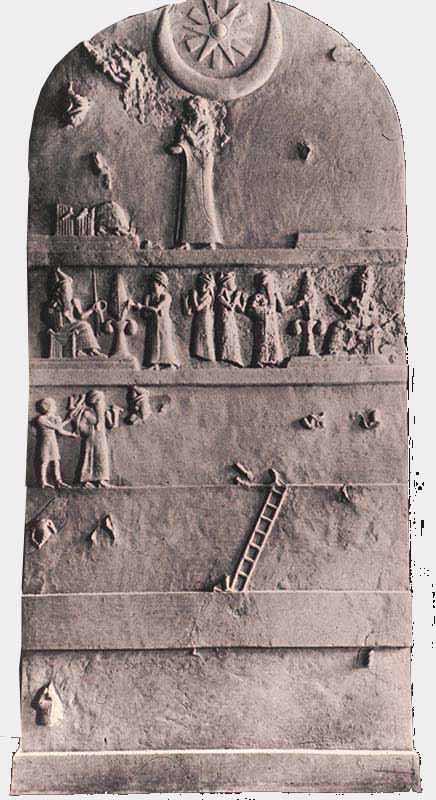
Archaeology shows that both Ur in Lower Mesopotamia and Haran in Upper Mesopotamia were centers of moon worship. Even the names Terah, Laban, Sarah, and Milcah contain elements that reveal allegiance to the moon-god.3
Sumerian culture in southern Mesopotamia had a number of gods in its pantheon: four leading deities -- An, Enlil, Enki, and Ninhursag -- and three chief astral deities -- Nanna (the moon), Nanna's son Utu (the sun), and Nanna's daughter Inanna. Enlil was considered the chief god, with his cult center at the city of Nippur. Other Sumerian cities had their own special deities as well. Nanna, the moon-god, was the main deity of the Sumerian city of Ur, later known by its Semitic name, Sin.4 This male deity was also known in the north from several inscriptions to "Sin/Shahar, the Lord of Haran,"5 and was the tutelary god of Haran. The moon-god's symbol was the crescent moon.
|
|
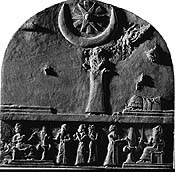
Worship in Sumer involved temples as well as ziggurats with small temples on the top. These temples were staffed by priests (who offered sacrifices and made libations), singers and musicians, as well as male and female prostitutes (whose activities many scholars relate to the fertility cult).6 Much later than Abraham, the Israelites are warned against worship of the moon, sun, and stars (Deuteronomy 4:19; 17:2-5), though this kind of worship continued under idolatrous kings (2 Kings 23:5-12).
Abraham's Religion
Abraham's faith grew as God revealed himself. By the time we see him in Genesis 12 he is a monotheist, a worshipper of one God. He apparently used two words for God -- El, the generic Canaanite name for the cosmic deity and Yahweh. Yahweh is sometimes translated "Jehovah" in the KJV and expressed as the "LORD" in the KJV, NIV, RSV, NRSV, etc., following the Jewish tradition of not pronouncing the divine name, but substituting Adonai, "Lord," instead.7 Abraham called this God by several other names compounded with Yahweh and El:
- God Most High (El Elyon, 14:19, 22, "maker of heaven and earth")
- Almighty God (El Shaddai, 17:1)
- Everlasting/Eternal God (El Olam, 21:33, = "Yahweh")
- Jehovah-Jireh (22:14, "The Lord the Provider")
Abraham's monotheism contrasts sharply with the polytheism of his forebears (Joshua 24:2). He believed God to be the Lord of the cosmos (14:22; 24:3), supreme judge of mankind (15:14;18:25), controller of nature (18:14; 19:24; 20:17), highly exalted (14:22) and eternal (21:33). Whenever God spoke to him, he obeyed immediately in faith.8
Abraham's relationship with God was personal rather than formal. However, Abraham and the other patriarchs practiced various forms of worship, including building altars, offering sacrifices, calling on the name of Yahweh, circumcision, prayer, making vows, and tithing -- as well as planting trees and setting up monuments. We'll examine these further as we study the details of Abraham's life.
Authorship of Genesis and the Pentateuch
Though the traditional view is that Moses was the author of the Pentateuch, since the Enlightenment there has been growing speculation on who the authors were. The most celebrated and complex theory of authorship was advanced by German Old Testament scholar Julius Wellhausen (1844-1918), which is referred to as "the Documentary Hypothesis." He posited four strands of sources which are abbreviated JEDP:
J - Yahwistic
E - Eloistic
D - Deuteronomic
P - Priestly
The Yahwistic strand could be identified, so goes the theory, by the editor's use of Yahweh (Jehovah) or LORD for God; the Eloistic strand by the use of El for God. Wellhausen was widely influential and the theory grew more and more complex -- and speculative. These days, however, Wellhausen's JEDP theory is in disarray. R.N. Whybray commented in 1995 on the state of Pentateuchal studies:
"There is at the present moment no consensus whatever about when, why, how, and through whom the Pentateuch reached its present form, and opinions about the dates of composition of its various parts differ by more than five hundred years."9
Certainly Jesus, the Jews, and the early church all believed that the Pentateuch (which the Jews referred to as "the law") was inspired by God and attributed it as a whole to Moses. It's likely that the materials Moses or other early editors worked with represent oral and written traditions dated much earlier than Moses himself. Whether Moses was the first to write down the stories of Abraham and his descendants or served as an editor himself, we just don't know.10 Our focus will not be on speculative theories of sources, but on the Book of Genesis that comes down to us in the Bible and the meaning of that revelation.
Dating of Abraham
Just when did Abraham live? We can't know that for sure either. It is difficult to find fixed events in Genesis that can be connected absolutely to dates established from archaeology.
One approach to dating Abraham is to backtrack from the first fixed event we find in the Bible -- a statement that Solomon laid the temple foundation in the 480th year after the exodus (1 Kings 6:1), which would date the exodus at about 1447-1446 BC. Working backward from the genealogies and other data in the Pentateuch puts the birth of Abraham in 2166 BC, and frames Abraham's life from 2166 to 1991 BC.11 However, there are several problems with this approach. First, textual: the Greek Septuagint and the Samaritan Pentateuch agree with Paul (Galatians 3:17) that the 430 years of Exodus 12:40 apply to the whole timespan between Abraham and the Exodus, not just the Israelite stay in Egypt as the Hebrew Masoretic text would suggest, bringing Abraham's birth year to 1952.12 Second, genealogies in Bible occasionally skip generations.
Another approach to dating Abraham uses a combination of history and archaeology. One prong is the dating of the destruction of Sodom and Gomorrah (Genesis 19) by some kind of cataclysmic event, which archaeological evidence seems to point to around 1900 BC.13
You can also compare the lifestyle described in Genesis to archaeological findings to find a match. At the end of the Early Bronze Age (2400 to 2000 BC), Palestine was in a post-urban phase, with numerous settlements, camps, and cemeteries in the Jordan Valley and the Negev-Sinai. The Palestine described in Genesis also was sparsely populated, with few if any urban centers. By about 1800 BC, a number of urban centers had developed -- Dan, Hazor, Akko, Shechem, Aphek, Jerusalem, Jericho, and Ashdod. By 1600 BC, there were a number of heavily fortified sites, such as Gezer and Shechem. But, by 1550 BC, nearly every city in Palestine had been destroyed by the Egyptians driving out the Hyksos from Egypt.14
The Hyksos, a Semitic rather than Egyptian people, ruled over Syria, Palestine, and Egypt from 1650 to 1542 BC until they were driven out by the Egyptian Amosis (Pharaoh Amenhotep I), founder of the Eighteenth Dynasty. It is easier to image the non-Egyptian slave Joseph rising to the position of second in the kingdom under a Hyksos ruler (1786 to 1575 BC), than under an Egyptian ruler, either before or after the Hyksos period. The period after the Hyksos dynasties would be expected to yield the pharaoh "who knew not Joseph" (Exodus 1:8), who would oppress the Semitic peoples remaining in Egypt.15
Depending upon how one views the evidence, Abraham might fit into Middle Bronze I (2100-1900 BC, Nelson Glueck and William F. Albright), Middle Bronze II (1900-1550, Ephraim A. Speiser), or the Amarna Period of the Late Bronze Age (early 14th century, Cyrus H. Gordon).16 Of course, there are no archaeological findings that refer specifically to Abraham, Isaac, and Jacob, so where they fit into the archaeological periods isn't precise, but we can place the birth of Abraham with some degree of confidence between 2100 and 1800 BC.17
Chronology
For your interest I have included a chronology of Abraham's life so you can see how these events fit together. Where possible, I've included his approximate age and appropriate references to the event in Genesis.
- Born in Ur (11:27, 32; 12:4)
- Departs from Haran, age 75 (12:4)
- Sojourn in Egypt during famine (12:10-20)
- Rescue of Lot from Mesopotamian Kings (14:1-24)
- Marriage to Hagar, age 85 (16:3)
- Birth of Ishmael, age 86 (16:16)
- Reaffirmation of covenant, age 99 (17:1)
- Destruction of Sodom and Gomorrah, age 99 (19:24)
- Sojourn in Gerar, age 99 (20:1-18)
- Birth of Isaac, age 100 (21:2; cf. 21:5)
- Offering of Isaac (22:1-19)
- Death of Sarah, age 137 (23:1-2; cf. 17:17)
- Marriage of Isaac to Rebekah, age140 (25:20)
- Birth of Jacob and Esau, age 160 (25:26)
- Death of Abraham, age 175 (25:7)
Chief Places Abraham Lived
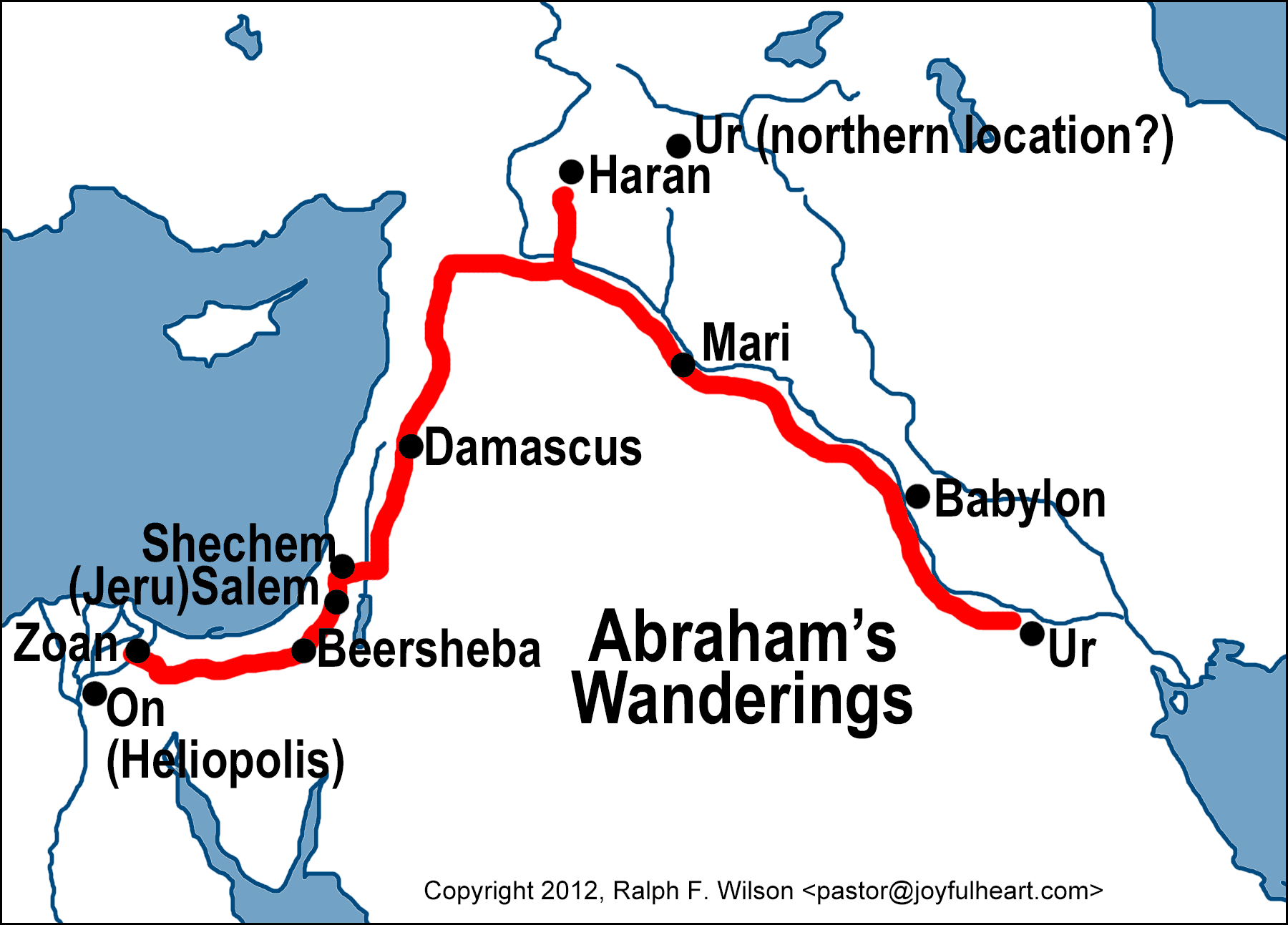
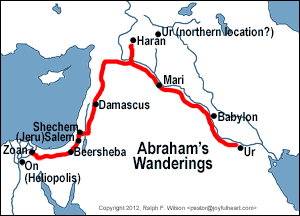 Abraham's Wanderings. Larger map. |
As a semi-nomadic shepherd and donkey trader, Abraham moved frequently. Here are some of the places he lived.
Ur
In the 1920s and 1930s Sir Leonard Wooley excavated Sumerian Ur, on the Euphrates in Lower Mesopotamia, assuming this to be Abraham's birthplace. More recent scholars, however, beginning with Cyrus Gordon, have expressed doubt about this southern location for Ur:
- Sumerian Ur is never called "Ur of the Chaldeans" in hundreds of references in cuneiform texts.
- The Chaldeans were related to the Arameans, and didn't penetrate the area of southern Mesopotamia until about 900 BC.
- Genesis 24:4, 7 seems to put Abraham's birthplace in Upper Mesopotamia where Laban lived.
- An Elba tablet refers to "Ur in Haran."18
Nevertheless, a southern location for Ur is still quite tenable. Migrations from southern Mesopotamia accord with records of migrations of Amorites into Babylonia from the end of the third millennium BC onward. We also know of the very strong religious connection between Sumerian Ur and Haran. Whatever the actual location of "Ur of the Chaldeans," it doesn't matter to the story of Abraham obeying God's call.
 Abraham in the Promised Land. Larger map. |
Haran
The site of Haran, a strategic city in ancient times, lies along the Jullab River, near the source of the Balikh River, 24 miles southeast of the Turkish city Urfa, and 60 miles north of the confluence of the Euphrates and Balikh Rivers. It is located on the main road that ran from Nineveh to Carchemish and was regarded of considerable importance by the Assyrian kings. Its chief cult was that of the Mesopotamian moon-god Sin. It was probably founded as a merchant outpost by the Sumerian city of Ur in the late third millennium BC. The name Haran means "highway, road, or caravan" in Akkadian.
Today a village on this site consists of beehive shaped houses. There is only a small amount of archaeological evidence available, but it includes inscriptional evidence for the Sin temple (from the beginning of the second millennium), a stella of the moon-god, and violent destruction about 610 BC by the Scythians, Medes, and Chaldeans.19
Shechem
Upon coming to Canaan, Abraham first settled in Shechem (12:6). Years later, Jacob's family lived near the city (33:18).
The ancient walled city of Shechem guarded the pass between Mount Ebal and Mount Gerizim, on the main road from Jerusalem to the north. In Abraham's day it was a city-state that had been founded about 1900 BC, in the Amorite period of the Middle Bronze IIA era. It is referred to in Egyptian inscriptions both of conquered cities and among Asiatic enemies of Egypt. Abraham probably didn't live within the city, but camped outside, in the area of the Tree of Moreh.20
Hebron
Hebron (meaning "league" or "confederacy") is about 19 miles SSW of Jerusalem, close to the Tree of Mamre, where Abraham lived during several periods in his life (13:18; 14:13; 18:1), built an altar, and witnessed an appearance of the Lord. At Sarah's death, he purchased a burial cave at nearby Machpelah from Ephron the Hittite (23:1-20). Numbers 32:22 says that Hebron was built seven years before the Egyptian city of Zoan (Tanis), probably a Hyksos building project, dating it at approximately 1700 BC, though it had probably been inhabited since the Early Bronze period onward. The traditional site of the cave of Machpelah is now marked by a mosque, formerly a Crusader church. Little archaeological excavation has been done here.21
Bethel
Bethel, on the main north-south watershed route about 12 miles north of Jerusalem, was probably founded about 2000 BC. In the early Hyksos period, about 1750 BC, a city wall on the north side was reinforced with a wide clay revetment.22
Ai
Ai was founded about 3000 BC, protected by an elaborate defense system of three walls. It was destroyed a thousand years later by Amorite invaders.23
Beer-sheba
 Available as PDF, Kindle, and paperback books. |
Beersheba was a settlement in the northern Negev desert, since it was a location where water could be found in the desert. The name means "well of seven." Tell es-Seba', the site of the ancient town, is located at the juncture of the Wadi Seba' and the Wadi Khelil. It contains rich alluvial soil where crops could be grown -- and Abraham's herds could be grazed. There doesn't seem to be a city there in Abraham's time; the region was controlled by Gerar, the nearest commercial center.24
Gerar
Gerar was a town in the western Negev desert, near Gaza, apparently controlled by Philistine or sea tribes during the patriarchal period (26:1, 8). Abraham spent some time in Gerar (20:1-18) during his desert wanderings. Though we're not sure of the exact location, it has been tentatively identified with Tell Abu Hureirah.
Endnotes
[1] Deuteronomy 26:5; cf. Genesis 25:20; 28:5; 31:20, 24.
[2] Robin Gallaher Branch, "Sarah," DOTP 733-736; Paul R. Williamson, "Abraham," DOTP 8-17.
[3] Kidner, Genesis, p. 111. Sarai (Sarah) is the equivalent of sarratu, "queen," an Akkadian translation of a Sumerian name for Ningal, the female partner of the moon-god Sin. Milcah is the same as the name of the goddess Malkatu, the daughter of Sin. Laban means "white," or "white one," a poetic name for the full moon (Hamilton, Genesis 1:363).
[4] Robert H. Stein, "Sumer," ISBE 4:653-662. According to Sumerian myths, Sin was the child that resulted from Enlil's rape of Ninlil. Sin's wife was Ningal. Together they had three children, each of whom became prominent deities: Shimachu, the sun-god, Ereshkigal, queen of the underworld, and the youngest, Inanna (known as Ishtar in Semitic lands), who became Queen of Heaven (from James W. Bell's Ancient Sumeria).
[5] Alfred J. Hoerth, Gerald L. Mattingly, and Edwin M. Yamauchi, Peoples of the Old Testament World (Baker Book House/Lutterworth Press, 1994), p. 226.
[6] Stein, ISBE 4:660.
[7] It may appear in Exodus 3:8 that God had never before been called Yahweh, but that clearly isn't the case. The revelation of I AM to Moses was new, but Yahweh had been worshipped by Abraham and his descendants and had found its way into the names of their children for generations. "In Exodus 6:3 the Lord explains to Moses that by his name Yahweh he had not been "known" to the patriarchs, meaning "know" (see yada') in its fullest sense: the name was in use (12:8; 15:2, 7, 8) but was not appreciated in the redemptive significance that it acquired under Moses. (J. A. Motyer, The Revelation of the Divine Name, cited in TWOT #484).
[8] Roland K. Harrison, "Abraham," ISBE 1:17.
[9] R.N. Whybray, Introduction to the Pentateuch (Eerdmans, 1995), pp. 12-13, cited in T. Desmond Alexander, "Authorship of the Pentateuch," DOTP 61-72.
[10] Alexander, DOTP 61-72; Hamilton, Genesis 1:11-38.
[11] Eugene H. Merrill, "Chronology," DOTP 121, Table 3.
[12] John N. Oswalt, "Chronology of the OT," ISBE 1:673-685.
[13] Roland K. Harrison, "Cities of the Valley," ISBE 1:704; Roland K. Harrison, "Abraham," ISBE 1:17.
[14] Mark W. Chavalas, "Archaeology," DOTP 37-49. John Arthur Thompson, "Shechem," DBA, 410-411.
[15] Barry J. Beitzel, The Moody Atlas of Bible Lands (Moody Press, 1985), pp. 82-86. Beitzel sees the patriarchal sojourn in Canaan from 1875 to 1660 BC, with Joseph promoted about 1670 BC, in the middle of the Hyksos occupation of Egypt.
[16] Hamilton, Genesis 1:59-67.
[17] Oswalt, ISBE 1:677.
[18] So Hamilton, Genesis 1:363-365; Beitzel, Moody Atlas, p. 80; William Osborne, "Ur," DOTP 876; and Hershel Shanks, "Abraham's Ur: Is the Pope Going to the Wrong Place," Biblical Archaeology Review, January-February 2000, pp. 16-19, 66-67. The northern Ur theory is rebutted by Alan R. Millard, "Where Was Abraham's Ur? The Case for the Babylonian City," Biblical Archaeology Review, May-June 2001, pp. 52-53, 57.
[19] Mark W. Chavalas, "Haran," DOTP 379-381; Robert J. Hughes, III, "Haran," ISBE 2:614.
[20] G. Ernest Wright and E.F. Campbell, "Shechem," ISBE 4:458-462.
[21] Negev, Archeological Encyclopedia of the Holy Land, pp. 171-172. John J. Davis, "Hebron," DAT 232-233.
[22] William Ewing and Roland K. Harrison, "Bethel," ISBE 1:465-467.
[23] Roland K. Harrison, "Ai," ISBE 1:81-84.
[24] Anson F. Rainey, "Beer-sheba," ISBE 1:448-451.
Copyright © 2026, Ralph F. Wilson. <pastor joyfulheart.com> All rights reserved. A single copy of this article is free. Do not put this on a website. See legal, copyright, and reprint information.
 To be notified about future articles, stories, and Bible studies, why don't you subscribe to our free newsletter, The Joyful Heart, by placing your e-mail address in the box below. We respect your