


|
Old Testament
New Testament
Gospels
Acts
Paul's Letters
General Letters
Revelation
Topical Studies
Beginning the Journey (for new Christians). en Español

|
Old Testament
New Testament
Gospels
Acts
Paul's Letters
General Letters
Revelation
Topical Studies

|
Home
Bible Studies
Articles
Books
Podcasts
Search
Menu
Donate
About Us
Contact Us
FAQ
Sitemap

3. Woman, Behold Your Son (John 19:26-27)
by Dr. Ralph F. Wilson
Audio (11:59)
 Hebrews: Discipleship Lessons
|
|
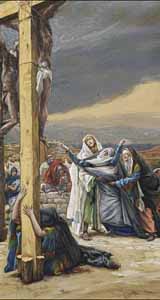
"25 Near the cross of Jesus stood his mother, his mother's sister, Mary the wife of Clopas, and Mary Magdalene. 26 When Jesus saw his mother there, and the disciple whom he loved standing nearby, he said to his mother, 'Dear woman, here is your son,' 27 and to the disciple, 'Here is your mother.' From that time on, this disciple took her into his home." (John 19:25-27)
Jesus' Mother at the Foot of the Cross
Of the four gospel writers, John is the only one who records Mary's presence at the cross. But it would be expected that Jesus' mother be in Jerusalem at Passover -- after all, we read, "Every year his parents went to Jerusalem for the Feast of the Passover" (Luke 2:41). Probably after Joseph's death -- presumed to have taken place before Jesus began his ministry -- Mary would come up to Jerusalem for the Feast with friends and relatives.
Now her son is in trouble -- arrested, tried, condemned, and now dying. Surely, Mary's place is close to her son. And so Simeon's prophecy given at Jesus' dedication comes to pass:
"And a sword will pierce your own soul too." (Luke 2:35b)
She is near him now, but her heart is broken. She is consoled by friends.
The Identity of the Other Women
Just who are these friends? Verse 25 seems to include Mary plus three other women.16 These are probably the same women who appear in the Synoptic Gospels. Matthew explains: "Many women were there, watching from a distance. They had followed Jesus from Galilee to care for his needs" (Matthew 27:55; Luke 8:3).
In addition to Mary, the women at the cross seem to be:
|
John 19:25 |
Matthew 27:56 |
Mark 15:40 |
|
Jesus' mother's sister |
the mother of Zebedee's sons |
Salome |
|
Mary (wife) of Clopas |
Mary the mother of James and Joses |
Mary the mother of James the younger and of Joses |
|
Mary Magdalene |
Mary Magdalene |
Mary Magdalene |
Mary Magdalene is mentioned consistently in all three gospels.
|
|
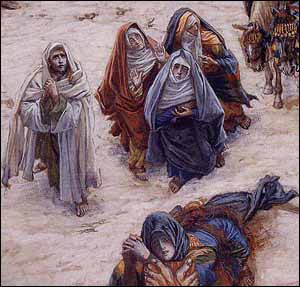
Mary (the wife) of Clopas seems to correspond easily to "Mary the mother of James the younger and of Joses (Joseph)" (Mark 15:40; Matthew 27:56). She is probably "the other Mary" who was with Mary Magdalene at the tomb Friday night and on Sunday morning (Matthew 27:61; 28:1).17
The third woman, Jesus' mother's sister, may well be Salome, who is the mother of James and John, the sons of Zebedee.18 This would make James and John to be Jesus' cousins. It would make sense. James and John are part of Jesus' inner circle with Peter. It also explains why their mother might presume to ask that her sons sit on Jesus' right and left in his kingdom (Matthew 20:20-21). She had been rebuked by Jesus on that occasion, but here she is at the foot of the cross consoling Mary, Jesus' mother, her sister.
The Disciple Whom Jesus Loved
Now the story unfolds further.
"26 When Jesus saw his mother there, and the disciple whom he loved standing nearby, he said to his mother, 'Dear woman, here is your son,' 27 and to the disciple, 'Here is your mother.' From that time on, this disciple took her into his home." (John 19:26-27)
Who is this "disciple whom he loved"? We see this phrase only four other times -- and only in John's Gospel.19 This disciple is clearly identified as the author of the Gospel of John (John 21:24). Church tradition20 identifies this disciple with St. John the Apostle. Perhaps the Gospel writer doesn't identify himself by name out of modesty.
|
|
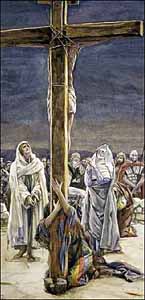
This disciple whom Jesus loved, St. John, one of three disciples closest to him, is the only male disciple who is at the foot of the cross as Jesus is dying. The others are too afraid to be so closely identified with a man condemned by the Romans, as well as by the leaders of their own people (Mark 14:50; Luke 23:49). But John is nearby -- perhaps to accompany his own mother (Mary's sister).
Woman, Here Is Your Son
"26b He said to his mother, 'Dear woman, here is your son,' 27 and to the disciple, 'Here is your mother.' From that time on, this disciple took her into his home." (John 19:26b-27)
Jesus' Third Word from the cross to this small band of faithful friends huddled below is fascinating for all it implies.
First, Jesus addresses his mother not as "Mother," but as "woman," translated appropriately as "dear woman" by the NIV. We might sense a coldness in the term as used in our culture, but in Jesus' culture, it was perfectly proper for a man to address a woman this way -- but still strange for a son to a mother.21 The reason for this more formal address is probably that Jesus intends his words to be understood as a formal testamentary disposition under Jewish family law.22
As Mary's firstborn, Jesus is legally responsible for her welfare, to ensure that she has a place to live and food to eat during her widowhood. Jesus entrusts his mother to John's care instead and John takes this commission seriously:
"From that time on, this disciple took her into his home."23 (John 19:27b)
The Love of a Son for His Mother
Some see Jesus' Third Word as more than an act of filial devotion, but rather the Beloved Disciple (the Ideal Disciple) now joined to Mary (the new Eve). They picture Mary as being appointed as mother, not only of the Beloved Disciple, but of all disciples, hence of the Church.24
However, the text explains its meaning rather clearly: "From that time on, this disciple took her into his home" (John 19:27b). So the point of this verse is not that Mary is being appointed Mother of the Church. Rather, Jesus is clearly appointing John as responsible in his stead to care for his mother in her widowhood.
What Does This Word from the Cross Teach Us?
As I reflect on this Third Word from the Cross, I begin to see something about the extent of Jesus' love. Here he is dying in agony, gasping for each breath. He sees his mother, the one who comforted him through all of childhood's cuts and bruises, teases and taunts. When he was a boy he would run home to mother and instantly be wrapped in her protective, comforting mother-love.
But now as he sees her at the foot of the cross, heartbroken, weeping, inconsolable, his heart goes out to her. Rather than being consumed by an understandable concern for his own welfare, he is touched by hers.
She is a widow -- soon to be a widow who will be known as mother to that crucified criminal, Jesus. Life will not be easy for her. The other children in the family (whether hers or Joseph's we just don't know) don't believe in him as she does (John 7:3-5). Though it might eventually be judged their legal duty to care for her, perhaps Jesus senses that such care would be less than what she deserves.25
What Are We to Learn from the Third Word?
What are we as Jesus' disciples to learn from this Word from the cross?
1. Love for our Family
First, we must love our parents -- no matter what. Sometimes our parents misunderstand us or disapprove of decisions we make. Sometimes they can hurt us grievously. I can remember my dad's disapproval of me becoming a pastor in a "denominational" church and the pain I felt from that rejection. But I must love my dad.
Jesus, too, had felt the hurt of misunderstanding from his family -- even his mother. It's apparent that during part of his ministry, at least, his family didn't understand him.
- At the Wedding at Cana (John 2:1-11), Mary pushed Jesus to change the water into wine, even though he tells her, "My time has not yet come."
- His family thought, "He is out of his mind," and went to take charge of him (Mark 3:21, 31-35) -- his brothers apparently along with Mary.
- "Even his own brothers did not believe in him." (John 7:5)
But whether they understand or even approve of us -- whether we can even trust them at this point in our lives -- we are told: "Honor your father and your mother" (Exodus 20:12). Christ-powered love can help heal the hurts from our families. We must love our parents.
2. Responsibility for our Family
Second, we are responsible for family obligations. Jesus was clear that his disciples must put commitment to him above family relationships -- sometimes even using hyperbole to drive this point home.26 Our obedience to Christ must become primary and obedience to parents must become secondary.
Having said that, just because we are Christians doesn't mean that we are absolved of family obligations. The Apostle Paul is adamant:
"If anyone does not provide for his relatives, and especially for his immediate family, he has denied the faith and is worse than an unbeliever." (1 Timothy 5:8)
When we are immature believers, sometimes we take rash actions towards our families that in retrospect weren't filled with Christ's love. Our priorities, however, are clear: (1) God himself, (2) our families, (3) our work for God.
How do we reconcile our primary commitment to Jesus with responsibility for our families? Sometimes with great difficulty. But to put Christ first doesn't mean that we are free to neglect our other priorities -- it means only that we get our priorities in proper relation to each other. God will give us wisdom to work this out.
Here at the end of his life, we see in Jesus the tender love of a son for his mother -- a mother who had sometimes misunderstood him. As he dies he settles his earthly obligations as best he can, we hear him say, "Dear woman, here is your son ... Here is your mother" (John 19:26-27).
Prayer
Father, we see Jesus' example of love and responsibility. As wonderful and loving as family relationships can be, they are often complex and sometimes hurtful. We ask you to help us sort them out. Show us how to love you at the same time we love our family members. Give us the divine wisdom that we need so that we can love as Jesus loves. In His name, we pray. Amen.
Question for Personal Meditation
Q3. (John 19:26-27) Why does Jesus make
St. John responsible for his mother Mary? What does this tell us about Jesus?
How should we apply this in our own lives?
|
Questions for Group Discussion
- What do you think Mary is feeling while she is waiting at the cross for Jesus to die? What kinds of thoughts are going through her mind? (John 19:29-27)
- Why, of all the disciples, do you think John is at the cross?
- Why didn't Jesus make his brothers responsible for Mary? Why John?
- What does this Third Word teach us about Jesus?
- What are the implications of Jesus' Third Word for our own personal family relationships?
References
16. Some commentators see this as two or three women, but these explanations of the sentence don't make as much sense.
17. An early church tradition mentioned by Chrysostom (347-407 AD) identifies Alphaeus, the father of an apostle named James (Matthew 10:3), with this Clopas, father of "James the Less," though this is uncertain. A.W. Fortune, "Alphaeus," ISBE 1:100. Tradition also sees this Alphaeus / Clopas as the brother of St. Joseph (Eusebius, Church History, 3.11.2; cf. "Clopas," ISBE 1:724). See also R. Laird Harris, "James (2)," ISBE 2:958-959.
18. See Kathleen E. Corley, "Salome," ISBE 4:286; Beasley-Murray, John, p. 348.
19. John 13:23; 20:2; 21:7; 21:20.
20. Irenaeus (died 202 AD) writes: "Afterwards, John, the disciple of the Lord, who also had leaned upon His breast, did himself publish a Gospel during his residence at Ephesus in Asia." Irenaeus, Against Heresies, 3.1.1. The identification is also made by Polycrates, Bishop of Ephesus, who is quoted by Eusebius in Church History 3.31.3 and 5.24.2-3.
21. Brown, Death of the Messiah, p. 1020. He notes that the word is not found elsewhere for a son addressing his mother (citing P. Benoit, Jesus and the Gospel (Herder, 1973), p. 86).
22. Beasley-Murray, John, p. 349. We see somewhat similar formula-like language in the Book of Tobit, part of the Apocrypha that appears in Catholic, Orthodox, and Anglican Bibles. When Tobit is engaged to Sarah, Tobit is told: "Take your kinswoman; from now on you are her brother and she is your sister. She is given to you from today and forever" (Tobit 7:11, NRSV).
23. While the bulk of church tradition considers Mary's grave to have been in the Valley of Kidron near Jerusalem some later sources write that she died in Ephesus where John was residing (Barnabas Meistermann, "Tomb of the Blessed Virgin Mary," The Catholic Encyclopedia (vol. 14; Robert Appleton Company, 1912)).
24. Outlined by Brown, Death of the Messiah, pp. 1021-1022.
25. Catholics and Orthodox disagree with Protestants on whether these named brothers and sisters (Matthew 13:55; Mark 6:3) are Joseph's children by a previous wife or Mary's other children. Origin (c. 185-254) wrote, "They [of Nazareth] thought, then, that He was the son of Joseph and Mary. But some say, basing it on a tradition in the Gospel according to Peter, as it is entitled, or 'The Book of James,' that the brethren of Jesus were sons of Joseph by a former wife, whom he married before Mary. Now those who say so wish to preserve the honor of Mary in virginity to the end, so that that body of hers which was appointed to minister to the Word which said, "The Holy Ghost shall come upon thee, and the power of the Most High shall overshadow thee," might not know intercourse with a man after that the Holy Ghost came into her and the power from on high overshadowed her" (Origin, Commentary on Matthew, 17).
26. Matthew 10:37-38; Luke 14:26; Matthew 19:29; Mark 10:29-30; Luke 18:29-30; Mark 8:21-22.
Copyright © 2026, Ralph F. Wilson. <pastor joyfulheart.com> All rights reserved. A single copy of this article is free. Do not put this on a website. See legal, copyright, and reprint information.