|
Old Testament
New Testament
Gospels
Acts
Paul's Letters
General Letters
Revelation
Topical Studies
Beginning the Journey (for new Christians). en Español

|
Old Testament
New Testament
Gospels
Acts
Paul's Letters
General Letters
Revelation
Topical Studies

|
Home
Bible Studies
Articles
Books
Podcasts
Search
Menu
Donate
About Us
Contact Us
FAQ
Sitemap


You Will Take Me into Glory (Psalm 73:24)
Free
E-mail Bible Study
 Names and Titles of God
Home | Bible Studies | Articles | Books | Podcasts | Search | Menu | Donate | About Us | FAQ | Contact Us
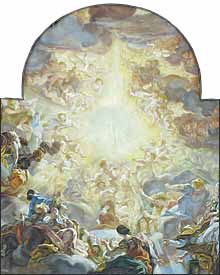 Giovanni Battista Gaulli (Baciccio), detail of the Baroque ceiling vault of the Jesuit Church of the Gesù (1679), fresco and paint, Rome. Larger image. |
"You guide me with your counsel,
and afterward you will take me into glory." (Psalm 73:24, NIV)
Is the psalmist talking about God "taking me to heaven when I die" (as Evangelicals might put it), or does it mean that God will give me honor toward the end of my life, as suggested by the NRSV translation?
"... And afterward you will receive me with honor." (Psalm 73:24, NRSV)
The words can be fairly translated either way. But which is it? I’ll explain why I’m convinced that this verse actually teaches that we will be taken into God’s glorious presence when we die.
Old Testament Hints of an Afterlife
Granted, there are only a few clear Old Testament references to life after death. Early followers of Yahweh didn’t have a clear vision of an afterlife. Many saw the grave (Sheol) as final (Psalm 6:5; 115:17Genesis 37:35; Psalm 49:10-11; etc.). They thought in terms of being "gathered to their ancestors" in death (2 Kings 22:20, etc.).
But here and there we see hints of a continued existence after death.
"If I make my bed in Sheol, you are there!" (Psalm 139:8b)
"God will redeem my life from the grave;
he will surely take me to himself." (Psalm 49:15)
"I know that my Redeemer lives,
and that in the end he will stand upon the earth.
And after my skin has been destroyed,
yet in my flesh I will see God." (Job 19:25-26)
Indeed, we begin to see clear prophecies of resurrection:
"He will swallow up death forever.
The Sovereign Lord will wipe away the tears from all faces." (Isaiah 25:8)
"But your dead will live; their bodies will
rise.
You who dwell in the dust, wake up and shout for joy." (Isaiah 26:19a)
"Multitudes who sleep in the dust of the earth
will awake:
some to everlasting life, others to shame and everlasting contempt." (Daniel
12:2)
We believe in progressive revelation. Gradually, God begins to reveal to his people that death is not the end. So by the time the New Testament is written, the Pharisees -- and Jesus and the apostles -- share a strong belief in life after death and resurrection.1
Context of Psalm 73
How can we determine whether Psalm 73:24 is one of those bright Old Testament revelations of life after death? Let’s begin with context.
The author is struggling with the age-old problem of evil -- why the innocent suffer and the wicked prosper. Here’s a quick outline of the psalm.
- Carefreeness. The wealthy and wicked seemed to enjoy a trouble-free life (verses 1-7).
- Impunity. They sin and seem to get away with it (verses 8-12).
- Envy. The psalmist is envious! (verses 13-14).
- Revelation. But then he goes into the temple where he receives a revelation that helps him see the truth (verse 15-17).
- Impending justice. The godless are teetering on a very fine edge and will soon be destroyed (verses 18-20).
- Reassessment. The psalmist recognizes his envy and foolishness (verses 21-22).
- Blessings. The psalmist recounts all the ways God has blessed him (verses 23-26).
- Summary. The wicked will perish, but it is good to be near God (verses 27-28).
Our passage falls in the section where the psalmist is telling of all his blessings (verses 23-26). He recognizes:
- Presence of God. "I am continually with you" (verse 23).
- Guidance. "You guide me with your counsel" (verse 24a).
- Eventual honor or glory -- this is the question we’re focusing on (verse 24b).
- Portion. God is the psalmist’s portion in heaven2 and on earth (verse 25).
- Strength (verse 26). The psalmist may not have strength, but God is his strength and encouragement and "portion" (inheritance) forever. In a moment, we’ll come back to the meaning of "my flesh ... may fail" and of the word "forever."
Dating
While it’s hard to precisely date Psalm 73, we have a couple of clues. (1) Asaph is the name of a temple singer appointed by David, with descendants who form a company of Levitical singers for the temple services. (2) Verse 17 mentions entering the "sanctuary."3 While this could be the Tabernacle or the tent David pitched for the ark, it is likely to refer to Solomon’s Temple. This gives a range of probable dates from 950 to 700 BC, with the destruction of the temple in 587 BC as an end date. This is well before the development of a general belief in an afterlife in Judaism.4
Important Words (Psalm 73:24b)
Now let’s focus in on some important words in our verse:
"You guide me with your counsel,
and afterward you will take me into glory." (Psalm 73:24)
The adverb "afterward" indicates a later time, whether during his lifetime or after his death isn’t specified.5
The verb, a very common one, is lāqaḥ, "take, fetch, bring." The verb has a variety of meanings.6 The NRSV seems to employ the meaning "take = receive, acquire,"7 though that seems awkward to me. More likely is "to take" a person with one,8 "to lead."9 Or perhaps God "taking" a person to be with him. Twice in the Old Testament, lāqaḥ is used with the sense of "assumption" (the taking up of a person into heaven). God "takes" Enoch without death (Genesis 5:24) and takes Elijah in a chariot of fire (2 Kings 2:10).10 We also read:
"God will redeem my life from the grave;
he will surely take (lāqaḥ)
me to himself." (Psalm 49:15)
The New Testament also uses this concept regarding God’s care of his people after death:
"Father, into your hands I commit my spirit." (Luke 23:46)
"Lord Jesus, receive my spirit." (Acts 7:59)
"I will come back and take you to be with me that you also may be where I am." (John 14:3)
The Meaning of kābôd ("glory, honor," Psalm 73:24b)
The key question in this verse is how to understand the noun kābôd, "glory, honor."11 In our passage, does it refer to God’s glory or to a man’s honor?
Kābôd as Man’s Honor
With regard to humans, kābôd can cover a range of meanings, such as honor, fame, and public esteem. It can be used of reputation, respect, or social standing, as opposed to shame and lack of standing.12 Honor is often linked with wealth and prosperity,13 "splendor, magnificence."14
One school of thought about this verse, sees kābôd as referring to "honor." God’s recognition is the primary idea:
"... And afterward you will receive me
with honor." (Psalm 73:24b, NRSV)15
"... And afterward, with glory, you will receive me." (Marvin Tate).16
Kābôd as God’s Glory
The other option is to see kābôd here as referring to God’s glory, to his power and authority.17 The glory of God’s holy Presence is often expressed in blinding light and fire, in fearfulness and awe.18
If kābôd in Psalm 73:24b refers to God’s glory (and I think it does), then it refers to the glory of his Presence that overwhelms people like Moses19 and Isaiah.20 The pillar of fire and pillar of cloud that abide over the Tabernacle in the Wilderness21 clearly represent Yahweh’s glorious Presence.22 Thus, our verse would mean:
"... And afterward you will take me into [the] glory [of your presence]." (Psalm 73:24b)
Context of Death and Eternity (Psalm 73:26)
What convinces me that we should take kābôd here as God’s glory in an afterlife, rather than man’s honor, is verse 26, where the psalmist is clearly talking about death and eternity.
"My flesh and my heart may fail,
but God is the strength of my heart and my portion forever." (Psalm
73:26)
"Flesh" refers to one’s physical nature, 23 while "heart," here, probably refers to one’s inner life rather than the physical heart muscle.24 Flesh and heart together speak of the whole person. The verb "fail" (kālâ) means "come to an end."25 We see these words again in a proverb about death.
"At the end of your life you will groan,
when your flesh26
and body27
are spent (kālâ)." (Proverbs 5:11)
Back to our passage, the psalmist declares,
"My flesh and my heart may fail,
but God is the strength of my heart and my portion forever." (Psalm 73:26)
In other words, despite my own death, God is still with me. Amazing! In verse 26, the psalmist he asserts that God is:
- The strength of my heart or inner life, and
- My portion forever.
"Portion" is ḥēleq, "share of property" It often refers to a share in an inheritance.28 Here, it is metaphorical of the relation between God and his faithful servant.29 The psalmist declares that God himself is my portion, my share, my inheritance without any end. "Forever" (ʿôlām) refers to "indefinite continuance into the very distant future."30
Though the psalmist’s body will die and life will leave his body, he anticipates an eternal future with God.
Taken into Glory
"... Afterward you will take me into glory." (Psalm 73:24b)
We’ve established that our verse is talking about being taken into glory when we die. But what does this mean? Be patient as I try to unpack for you what the Scripture teaches.
It’s helpful to begin with what it meant for Christ to enter into glory. Jesus begins with humanness, with humility. Paul tells us:
"He made himself nothing,
taking the very nature of a servant,
being made in human likeness.
And being found in appearance as a man,
he humbled himself
and became obedient to death --
even death on a cross!
Therefore God exalted him to the highest place
and gave him the name that is above every name,
that at the name of Jesus every knee should bow,
in heaven and on earth and under the earth,
and every tongue confess that Jesus Christ is Lord,
to the glory of God the Father." (Philippians 2:6-11)
Son of Man
On earth, Jesus calls himself the Son of Man. Jesus is humble. His feet grow sore and his body weary from long days walking the dusty roads of Galilee declaring the good news. Many misunderstand him, write him off, underestimate him. But Jesus teaches his disciples of a time of glory to come.
"... The Son of Man will be ashamed of him when he comes in his Father’s glory with the holy angels." (Mark 8:38)
"When the Son of Man comes in his glory, and all the angels with him, he will sit on his throne in heavenly glory." (Matthew 25:31)
Daniel’s prophecy connects the dots for us between God, Jesus, and his coming glory. The key link is Jesus’ title Son of Man.
"13 In my vision at night I looked, and there before me was one like a son of man, coming with the clouds of heaven. He approached the Ancient of Days and was led into his presence. 14 He was given authority, glory and sovereign power; all peoples, nations and men of every language worshiped him. His dominion is an everlasting dominion that will not pass away, and his kingdom is one that will never be destroyed." (Daniel 7:13-14)
When Jesus, the holy Son of God, is arrested and brought before the high priest, he is questioned. Previously he has remained silent, but now he answers the high priest’s direct question.
"‘Are you the Christ, the Son of the Blessed
One?’
‘I am,’ said Jesus. ‘And you will see the Son of Man sitting at the right
hand of the Mighty One and coming on the clouds of heaven.’" (Mark
14:61-62)
The high priest is outraged. They scourge him, spit on him, humiliate him, and ultimately crucify him. There is a time of humility here on earth, but it is followed for Jesus by unimaginable glory in the presence of God.
Entering into Glory
After his resurrection, Jesus helps his disciples make sense of his death, burial, and resurrection in light of the Scriptures.
"Did not the Christ have to suffer these things and then enter his glory?" (Luke 24:26)
Jesus’ disciples have faith-glimpses of Christ’s coming glory before it happens:
-
James and John: "Let one of us sit at your right and the other at your left in your glory." (Mark 10:37)
-
Thief on the cross: "Jesus, remember me when you come into your kingdom." (Luke 23:42)
Christ enters into or takes his rightful place as King in the Kingdom of God, which is another way of saying, "he comes into his glory."
Sharing His Glory
When we enter into glory, or are taken into glory, it is not our own glory we will experience. It is his glory, God’s glory that overwhelms us and thoroughly saturates us. In a sense, since we are united with Christ, we get to share his glory in heaven. This is what we have to look forward to!
"Now if we are children, then we are heirs -- heirs of God and co-heirs with Christ, if indeed we share in his sufferings in order that we may also share in his glory." (Romans 8:17)
"He called you to this through our gospel, that you might share in the glory of our Lord Jesus Christ." (2 Thessalonians 2:14)
"When Christ, who is your life, appears, then you also will appear with him in glory." (Colossians 3:4)
"I appeal as a fellow elder, a witness of Christ’s sufferings and one who also will share in the glory to be revealed." (1 Peter 5:1)
"Christ in you, the hope of glory." (Colossians 1:27)
This is not just a sudden burst of glory, like fireworks that soon fade, it is an "eternal glory," one that never ever ends (2 Corinthians 4:17; 2 Timothy 2:10). Meditate on that!
Conclusion
We believers have a wonderful promise!
"23 Yet I am always with you;
you hold me by my right hand.
24 You guide me with your counsel,
and afterward you will take me into glory." (Psalm 73:23-24)
Through this life God will be with us and guide us by his Holy Spirit. And when we die, God will take us to be with him in the glory of his Presence!
"And the God of all grace, who called you to his eternal glory in Christ, after you have suffered a little while, will himself restore you and make you strong, firm and steadfast." (1 Peter 5:10)
Hallelujah!
Prayer
Father, thank You for assurance You have given us of everlasting life. Thank You for the assurance that when we die, You will conduct us into your glorious presence. Thank You that Jesus has been preparing a place for us in our Father’s house. Thank You! In Jesus’ name, we pray. Amen.
End Notes
[1] In Jesus' day, not all Jews believed in an afterlife. "The Sadducees say that there is no resurrection, and that there are neither angels nor spirits, but the Pharisees acknowledge them all" (Acts 23:8). In addition, Josephus writes (Wars of the Jews 2.8.14) that "the Sadducees ... take away the belief of the immortal duration of the soul, and the punishments and rewards in Hades."
[2] Note, the psalmist is using "heaven" = "sky" rather than "heaven" = an afterlife with God, a usage that was later. The ancients believed God inhabits the heavens, but didn’t use "heaven" to mean an afterlife with God.
[3] The noun miqdāš means "holy place, sanctuary," from the verb qādaš, "to be holy." It can refer to a holy set-apart place for worship, both of the Tabernacle in the Wilderness, as well as Solomon’s Temple. The word can even be used of pagan places of worship (Thomas E. McComiskey, TWOT #1190f; Holladay 211).
[4] The original Asaph is a Levite who lives in David’s time and is placed in charge of music at the tent David pitches for the ark (1 Chronicles 15:16-19; 16:5, 7, 37; etc.). His descendants continue this ministry in Solomon’s Temple (1 Chronicles 25:1-2; 2 Chronicles 35:15; 1 Esdras 1:15). Asaph is credited with eleven psalms (Psalms 50, 73-82).
[5] "Afterword" is ʾaḥar, an adverb of both place and time, here, "after, afterwords" (TWOT #68b; Holladay 10 II 3).
[6] The Qal stem of lāqaḥ can mean: (1) ‘take, lay hold of, seize’; (2) ‘take’ a person or animal with you, (3) ‘take = receive,’ acquire, metaphorically, obey commandments, (4) ‘take up’ = ‘shelter’, (5) ‘fetch, bring’, (6) ‘take on’ as a slave or daughter, (7) take a wife, (8) ‘take away’ something, (9) (God) carries off (Enoch), etc. (Holladay 179, Qal).
[7] Lāqaḥ, Holladay 179, Qal 3.
[8] Lāqaḥ, Holladay 179, Qal 2.
[9] Tate, Psalms, p. 230, note 24a, citing Cohen and Dahood.
[10] Tate (Psalms, p. 230) doesn’t necessarily agree with this, but cites three Psalms commentators: Briggs, Kraus, and Weiser. "(God) carries off someone" (Holladay 178, 9).
[11] "Glory" (NIV, ESV, KJV), "honor" (NRSV, Lexham), "glorious destiny" (NLT), "the wake of your glory" (NJB) is the Hebrew noun kābôd, "glory, honor" (TWOT #943d; Holladay 150).
[12] Psalm 4:2; Hosea 4:7; Hosea 9:10-11; Genesis 45:13; Job 19:9; 2 Chronicles 32:33; Habakkuk 2:16.
[13] Proverbs 3:16; 8:18; 22:4; 1 Kings 3:13.
[14] Isaiah 10:8; 35:2; Haggai 2:3.
[15] So Beth Tanner, Psalms (NICOT), p. 588.
[16] Tate, Psalms, p. 227.
[17] Psalm 19:2; 24:7-10; Ezekiel 39:21.
[18] Deuteronomy 5:24; Exodus 16:10; 24:17; 33:18; 40:34-38; Numbers 14:10; 16:19; 17:7; Deuteronomy 31:15; Ezekiel 1:28; 10:4; 43:4-5.
[19] Exodus 34:29.
[20] Isaiah 6:1-8.
[21] Exodus 40:34-38; cf. Numbers 9:15-23.
[22] Exodus 13:21-22; 14:19-20, 24; 33:9-10; Numbers 12:5; 14:14; Deuteronomy 31:15; Nehemiah 9:12; Psalm 99:7.
[23] "Flesh" (šĕʾēr) refers to the physical body, not Paul’s idea of fallen sinful nature (TWOT #2308a). šĕʾēr is indistinguishable from the more common noun bāśār (Holladay 357). šĕʾēr can have the transferred sense of our external existence (Eduard Schweizer, sarx, TDNT 7:108-110).
[24] "Heart" (lēbāb) refers to the internal organ, but can be abstracted to "the totality of man’s inner or immaterial nature." In only a few cases it has its concrete physical meaning (1 Samuel 25:37; 2 Kings 9:24; Exodus 28:29) (Andrew Bowling, TWOT #1071a).
[25] "Fail" is the Qal perfect of kālâ, with the idea of "to bring a process to an end" (John N. Oswalt, TWOT #982); "disappear, perish" (Holladay 158, Qal 3).
[26] Bāśār = šĕʾēr, "flesh."
[27] šĕʾēr, "flesh, body."
[28] Donald J. Wiseman, ḥēleq, TWOT #669a. Psalm 142:5 sees God as our portion in life. Psalm 73:26 implies that he is also our portion in death forever. Also Psalm 16:5; 119:57; Lamentations 3:24; Jeremiah 10:16; 51:19; Deuteronomy 10:9; Numbers 8:10.
[29] ḥēleq, Holladay 107, II, 3.
[30] "Forever" is ʿôlām, "forever, ever, everlasting," "indefinite continuance into the very distant future." (Allan A. MacRae, TWOT #1631a). As an adverb, "for all time, for ever" (Genesis 3:22; Psalm 61:4) (Holladay 267).
Copyright © 2026, Ralph F. Wilson. <pastor joyfulheart.com> All rights reserved. A single copy of this article is free. Do not put this on a website. See legal, copyright, and reprint information.
 To be notified about future articles, stories, and Bible studies, why don't you subscribe to our free newsletter, The Joyful Heart, by placing your e-mail address in the box below. We respect your