|
Old Testament
New Testament
Gospels
Acts
Paul's Letters
General Letters
Revelation
Topical Studies
Beginning the Journey (for new Christians). en Español

|
Old Testament
New Testament
Gospels
Acts
Paul's Letters
General Letters
Revelation
Topical Studies

|
Home
Bible Studies
Articles
Books
Podcasts
Search
Menu
Donate
About Us
Contact Us
FAQ
Sitemap


His Love (ḥesed) Endures Forever (Psalm 136)
Free
E-mail Bible Study
 Names and Titles of God
Home | Bible Studies | Articles | Books | Podcasts | Search | Menu | Donate | About Us | FAQ | Contact Us
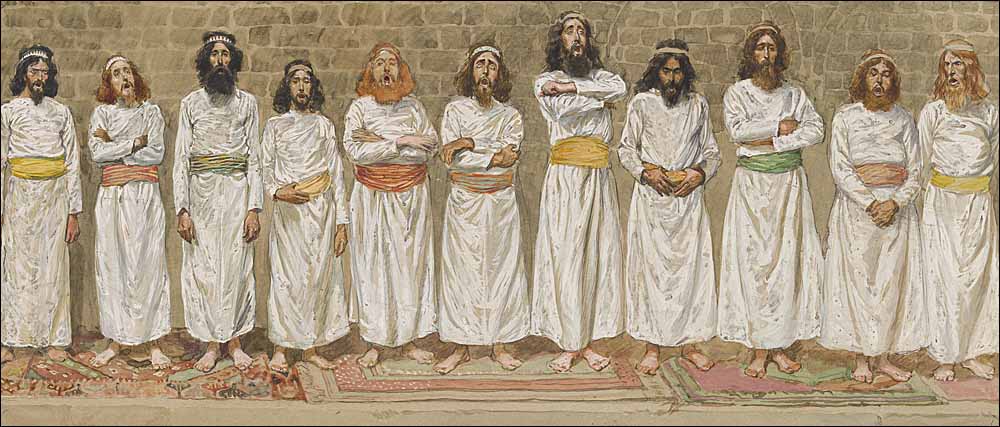
 Worship in the temple featured levitical singers, such as the families of Asaph and Zadok. James J. Tissot, 'The Choristers' (1896-1902), gouache on board, 4.75x11 in, Jewish Museum, New York. Larger image. |
It's easy to skim over Psalm 136 as boring. After all, it repeats the line "for his love endures forever" some twenty-six times, if you count them up. A bit excessive? Perhaps not.
Clearly, this psalm is intended for congregational worship, where the leader will sing out the first line and the people respond with "for his love endures forever." A voice and a chorus, kind of like a responsive reading. A line about God's greatness sung in the high tenor voice of an ancient temple cantor and a chorus of response by the people gathered for worship: "for his love endures forever." If you were part of that throng crowding the temple courts, it would be memorable!
That speaks to the use of the psalm. But I want to get to the meaning, the point of the psalm.
As I begin to ponder and take little rabbit trails to explore the psalm, I am intrigued by several things:
- Names. Several names of God are employed.
- Acts. The nature, character, and actions of God are described.
- Eternity. The idea of enduring forever is prominent -- never ending, always continuing.
- Love. "Steadfast love" is repeated 26 times. Precisely what does that mean?
- Giving thanks. Four times we are commanded to give thanks.
Let's explore this psalm together -- get your Bible out!
1. Names of God
Four names of God are used in this psalm.
Yahweh (verse 1)
The first line reads:
"Give thanks to the Lord, for he is good." (Psalm 136:1a)
As you are probably aware, LORD in caps (or small caps) in English Bibles signifies that the underlying Hebrew word is Yahweh. By custom, God's name Yahweh was not pronounced by pious Jews, so as not to break the Third Commandment (Exodus 20:7). Rather, the Hebrew word ʾādôn ("Lord") was substituted instead.
Yahweh (yhwh) seems to be derived from the Hebrew verb for "to be" (hāyâ) -- God IS! God reveals his name to Moses at the burning bush:
"I AM who I am....
Tell them, 'I AM has sent me to you.'" (Exodus 3:13-14)
Jesus says,
"'I tell you the truth, before Abraham was born, I am!'" (John 8:58)
This is echoed in Revelation
"'I am the Alpha and the Omega,' says the Lord God,
'who is, and who was, and who is to come, the Almighty.'" (Revelation 1:8)
Yahweh IS. There is never a time when he is not. He has no beginning and no end. He is eternal -- and so, incidentally, his steadfast love is eternal, as we'll see shortly.
God (Elohim) of gods (verse 2)
The second verse begins,
"Give thanks to the God of gods...." (Psalm 136:2a)
"God" is the noun ʾĕlōhîm, the plural of ʾĕlōah, "God," from ʾēl, the generic word for God in Hebrew. ʾēl is an ancient Semitic term that is found in some form in all Semitic languages except Ethiopic.1 Arabic "Allah," for example, seems to come from this root (al-ilāh, "the God"). We'll see, the generic ʾēl in verse 26.
In verse 2, however, the plural ʾĕlōhîm is used -- twice. ʾĕlōhîm is used much more often than either ʾēl or ʾĕlōah to refer to Yahweh, the unique God who reveals himself to the Hebrew people through Abraham and the Patriarchs. The plural form can be thought of as an "intensive plural" or "plural of majesty." We Christians understand this plural as describing the Godhead or trinitarian nature of God. This form ʾĕlōhîm occurs in Hebrew but not in other Semitic languages. The second plural ʾĕlōhîm refers to the numerous so-called "gods" worshipped by the Canaanite tribes
"Give thanks to the God of gods...." (Psalm 136:2a)
Our God is "Elohim of the elohim," the Great God over all so-called gods (Psalm 95:3). He is the King over all kings and the Lord over all lords.
Lord (Adon) of lords (verse 3)
This brings us to the next verse:
"Give thanks to the Lord of lords.... (Psalm 136:3a)
"Lord" is ʾādôn, "lord, master, owner." It can be used of husbands, masters, owners, and great personages among men. But many times, especially in the Psalms, it refers to God who is Master of all.2 He is the sovereign Lord who exercises authority over every other authority in heaven and on earth. Jesus is spoken of this way as well (Matthew 28:18; Ephesians 1:21-22).
God (El) of heaven (verse 26)
We've seen Yahweh, God (ʾĕlōhîm), Lord (ʾādôn), and now a fourth name in verse 26 -- the generic ʾēl, "God."
"Give thanks to the God of heaven...." (Psalm 136:26a)
This particular phrase, "God of heaven" identifies God as the one who made the heavens and lives in the heavens, distinguished from gods that were idols or earth-bound. The phrase is used particularly during the period when the Persians allow the exiled Israelites to return to Jerusalem.3 (More on this in my study, Names and Titles of God (JesusWalk Publications, 2010).
2. The Nature and Character of God (verses 4-25)
After beginning commands to give thanks to Yahweh, the God of gods, the Lord of lords (verses 1-3), the psalmist begins to describe God by what he does:
"Give thanks ... to him
who alone does great wonders,
for his steadfast love endures forever." (Psalm 136:4)
The psalmist has spoken of God's goodness and righteousness (verse 1) and his preeminence over all other so-called gods (verses 2-3). Now in a number of verses he specifies the deeds and character of the Lord he loves.
- Creation. God's great works of creation of the universe (verses 4-9)
- Deliverance. God's deliverance of Israel out of Egypt and through the wilderness (verses 10-16)
- Might. God's might in striking down kings and kingdoms of the Canaanites and giving the land as "a heritage to Israel his servant" (verses 17-22)
- Rescue. God's rescue of his people when they were struggling (verses 23-25)
And after each statement of God's work, the people respond:
"His steadfast love endures forever!"
Again and again, over and over, they shout with joy:
"His steadfast love endures forever!"
3. Enduring Forever (ʿôlām)
We'll talk about this steadfast love in a moment. But this repeated refrain reminds me that God's steadfast love never ends.
Think about that.
There will never be a time when God's love won't be there for you. In spite of all the sins and struggles of God's people, his steadfast love remains.
The Hebrew phrase is lĕʿôlām. The preposition lĕ means "to, towards" (spatially), and "until" (temporally).4 The noun ʿôlām is used more than 300 times "to indicate indefinite continuance into the very distant future." Barr says,
"We might best state the 'basic meaning' as a kind of range between 'remotest time' and 'perpetuity.'"5
Ponder that! God's steadfast love began with him long before creation and will continue in him long after this spinning globe is but a distant memory. His love never ends.
4. Steadfast Love (ḥesed)
Now let's focus on this steadfast love. The word translated "love" or "steadfast love" is ḥesed. It is indeed one of the key Hebrew words that describes God and his actions in the Old Testament. Therefore, it is important to take a bit of time to understand its richness.
A Definition of Ḥesed
Ḥesed has been translated into English in a variety of ways that relate to love -- "love"6 (NIV), "steadfast love" (ESV, NRSV), "faithful love,"7 "loyal love,"8 and "loving devotion."9 Another group of translations revolve around character qualities involving charitable actions -- "mercy,"10 "grace,"11 "lovingkindness,"12 and "kindness."13 No single English word is able to capture the breadth and richness of the word.
Scholars have a problem in getting to a precise understanding of this particular word, because we can't be sure of its derivation. Thus its meaning has to be solely derived from context, from usage. Ḥesed occurs some 250 times in the Old Testament, half of which are in the Psalms -- especially Psalm 136! When you distill all those verses down,14 the core meaning of ḥesed begins to emerge -- intense loyalty and kindness within a relationship,15 especially when it surpasses ordinary kindness or is undeserved. The word usage doesn't require a formal covenant relationship; it can be between a father and son, husband and wife, master and servant. One of the central themes of the Book of Ruth is ḥesed (here translated "kindness) -- both God's ḥesed and ḥesed within the extended family.16
Though sometimes the word is used regarding human relationships, three-quarters of the references in the Old Testament are to God's ḥesed to his people.17
Ḥesed is....
Here is how some scholars express the particular sense of ḥesed:
"Tenacious fidelity in a relationship, readiness and resolve to continue to be loyal to those to whom one is bound" -- Brueggemann18
"The disposition of one person toward another that surpasses ordinary kindness and friendship; it is the inclination of the heart to express 'amazing grace' to the one who is loved -- Heath19
"The intentional kindness, generosity or loyalty of a superior to an inferior, especially when it is undeserved."-- Oswalt20
"The word that most often serves as a substantive for grace in the Old Testament" -- Duffy21
Steadfast Love and Faithfulness
Ḥesed is closely related to faithfulness (ʾĕmûnâ,ʾĕmet), since the words are used in parallel on a number of occasions. For example:
"I will sing of the
steadfast love of the Lord forever;
with my mouth I will make known your
faithfulness
to all generations.
For I said, 'Steadfast love will be
built up forever;
in the heavens you will establish your
faithfulness.'"
(Psalm 89:1-2)
Yahweh's faithfulness remains steadfast, even though Israel's does not. Israel's ḥesed is weak compared to God's.
"Your love (ḥesed)
is like a morning cloud,
like the dew that goes early away." (Hosea 6:4; cf. 4:1)
On the other hand, Yahweh binds Israel to himself with strong bonds:
"I will betroth you to me forever. I will betroth you to me in righteousness and in justice, in steadfast love and in mercy. I will betroth you to me in faithfulness. And you shall know the Lord." (Hosea 2:19-20)
As Paul writes to Timothy:
"If we are faithless,
he will remain faithful,
for he cannot disown himself." (2 Timothy 2:13)
God's steadfast love, his unending faithfulness is part of his core character. It is indivisible from God himself.
5. Giving Thanks (verses 1, 2, 3, 26)
My final observation is that the command "Give thanks"22 is repeated four times (verses 1, 2, 3, and 26).
Why should we give thanks? We are given the reasons: "he is good" (verse 1), and then for his actions as Creator (verses 4-9), Deliverer (verses 10-16), Mighty Warrior (verses 17-22), and Merciful One (verses 23-25).
Do you need reasons to thank God and acknowledge his greatness? The psalmist provides two dozen. But you also have your own.
"Count your blessings, name them one by
one....
Count your many blessings, see what God hath done."23
If you feel selfish for thanking God only when he does things for you, don't worry. In our psalm, we are commanded to recall what he has done and give him thanks for it.
But surely the foundational reason we thank him is because of his character. Who he is. Yahweh is "good" and righteous (verse 1), but especially his love is faithful, unchangeable. Unmoving. He is reliable in mercy.
We are to thank him "for" or "because of" (Hebrew kî24) --
"... his steadfast love endures forever."
Ḥesed and Grace
The ḥesed of the Old Testament becomes the grace and agape love of the New. His love never fails. Israel sinned. David gave in to temptation. We fail. No matter. His love never fails! It endures forever! Hallelujah.
In Jeremiah's gloomy Book of Lamentations, he writes at the blackest time of Israel's history. It is shortly after the temple is destroyed and burned, when thousands of people are slaughtered and tens of thousands are taken in bonds to the empty sadness of forced exile in Babylon. The darkness of God's wrath overwhelms Jeremiah. But then in the middle of Lamentations, these words of hope shine out. Hope in God's enduring character. Hope in his steadfast love that endures on and on and never quits.
"The steadfast love (ḥesed) of the Lord never ceases;
his mercies25
never come to an end;
they are new every morning;
great is your faithfulness."26 (Lamentations
3:22-23)
My friend, don't grow impatient when you read Psalm 136 and repeat "for his love endures forever" twenty-six times. These words are our shout of hope and gratitude and triumph. Hallelujah to our God!
Prayer
O Lord, help us never tire of saying, "Your steadfast love endures forever!" Because it is true. Because Your love is amazing. Because Your mercy exceeds anything we've ever experienced. And it will be there for us forever. Thank you, O faithful God, that Your steadfast love endures ... forever! We pray with thanksgiving in the name of Jesus, Who displays Your steadfast love on the cross. Amen!
End Notes
[1] Jack B. Scott, ʾēl, TWOT #93a.
[2] ʾādôn, TWOT #27b. Occasionallyʾādôn refers to God with the "plural of majesty" (Psalm 16:2). "Adonai" means, "my Lord."
[3] 2 Chronicles 36:23; Ezra 1:2; 5:12; 6:9, 10; 7:12, 21, 23 (twice); Nehemiah 1:4, 5; 2:4, 20; Daniel 2:18, 19; 2:28, 37, 44; 5:23; Jonah 1:9
[4] Lĕ, Holladay 168, 3a.
[5] Allan A. Macrae, ʿôlām, TWOT #1631a, citing James Barr, Biblical Words for Time (Studies in Biblical Theology, First Series; Alec R. Allenson, Inc., 1969), p. 73. Macrae notes, however, that occasionally it is used of a not-so-remote past.
[6] "Love" -- NIV, Holman Christian Standard, The Message, Good News, New Century.
[7] "Faithful love" -- NLT, Common English Bible.
[8] "Loyal love" -- Lexham English Bible.
[9] "Loving devotion" -- Berean Standard Bible.
[10] "Mercy" -- KJV, NKJ, Douay-Rheims, Wycliffe.
[11] "Grace" -- Complete Jewish Bible.
[12] "Lovingkindness" -- KJV, NASB, ASV, Darby.
[13] "Kindness" -- Young's Literal Translation.
[14] Important scholarly studies of hesed in the Old Testament include a seminal study by Nelson Glueck, Ḥesed in the Bible (1927); later corrections by Katharine Dobb Sakenfeld, The Meaning of Hesed in the Hebrew Bible: A New Inquiry (Harvard Semitic Monographs, vol. 17; Missoula, Montana: Scholars Press, 1978); and Gordon R. Clark, The Word Hesed in the Hebrew Bible (Journal for the Study of the Old Testament, Supplement Series 157; Sheffield, JSOT Press, 1993).
[15] Though this is the basic idea, the semantic range of ḥesed is broad. Whitley concludes, "Primarily denoting strength or might, the concept developed to include such notions as fortitude, confidence, pledge, resolution, and health" (Charles F. Whitley, "The Semantic Range of Hesed," Biblica, Vol. 62, No. 4 (1981), pp. 519-526).
[16] Naomi: "May the Lord show kindness (ḥesed) to you, as you have shown to your dead and to me" (Ruth 1:8). Naomi said to her daughter-in-law, probably about Yahweh: "He has not stopped showing his kindness (ḥesed) to the living and the dead" (Ruth 2:20; Leon Morris, Ruth (Tyndale Old Testament Commentaries; Inter-Varsity Press, 1968), p. 280). Boaz to Ruth: "This kindness (ḥesed) is greater than that which you showed earlier" (Ruth 3:10).
[17] Clark, The Word Hesed in the Hebrew Bible (1993), cited by Gary Long, Journal of Near Eastern Studies (58:1), pp. 67-69.
[18] Walter Brueggemann, Theology of the Old Testament: Testimony, Dispute, Advocacy (Fortress Press, 2005), p. 217, cited by D. I. Block, "God," DOTHB, p. 343.
[19] E. A. Heath, "Grace," in DOTP, p. 372.
[20] John N. Oswalt, "God," DOTWPW, p. 248.
[21] Steven J. Duffy, The Dynamics of Grace: Perspectives in Theological Anthropology (Collegeville, MN: Liturgical Press, 1993), p. 20, cited by cited by E. A. Heath, "Grace," in DOTP, p. 372. See also James A. Montgomery, "Hebrew Hesed and Greek Charis," Harvard Theological Review (Vol 32, No. 2), April 1939, pp. 97-102.
[22] "Give thanks" is the Hiphil imperative of yādâ, "praise" (with the object being God) (Holladay, II, Hiphil, 2b). "The primary meaning of this root is 'to acknowledge or confess sin, God's character and works, or man's character'" (Ralph H. Alexander, TWOT #847).
[23] "Count Your Blessings" (1897), by Johnson Oatman, Jr. (1856-1922).
[24] Kî, Holladay 155, II2; TWOT #976).
[25] Raḥămîm, "tender mercy, compassion." (TWOT #2146b).
[26] ʾĕmûnâ, "firmness, faithfulness, fidelity, steadiness" (TWOT #). "Reliability" of God (Holladay 19, 2b).
Copyright © 2026, Ralph F. Wilson. <pastor joyfulheart.com> All rights reserved. A single copy of this article is free. Do not put this on a website. See legal, copyright, and reprint information.
 To be notified about future articles, stories, and Bible studies, why don't you subscribe to our free newsletter, The Joyful Heart, by placing your e-mail address in the box below. We respect your