


|
Old Testament
New Testament
Gospels
Acts
Paul's Letters
General Letters
Revelation
Topical Studies
Beginning the Journey (for new Christians). en Español

|
Old Testament
New Testament
Gospels
Acts
Paul's Letters
General Letters
Revelation
Topical Studies

|
Home
Bible Studies
Articles
Books
Podcasts
Search
Menu
Donate
About Us
Contact Us
FAQ
Sitemap


Free
E-mail Bible Study
 Names and Titles of God
Home | Bible Studies | Articles | Books | Podcasts | Search | Menu | Donate | About Us | FAQ | Contact Us
One of the greatest military victories in the Bible was won by an army that never drew a sword or threw a javelin. Believe it or not, the battle was won with praise, and this passage holds many lessons for Jesus' disciples.
Before you read on, stop right now and read 2 Chronicles 20:1-30. Then continue.
The story begins when several enemies gang up together to attack Jehoshaphat, one of the "good kings" of Judah. Jehoshaphat (reigns about 873-849 BC) believes in the Lord and follows him steadfastly, but suddenly his faith is put to the test.
The Threat
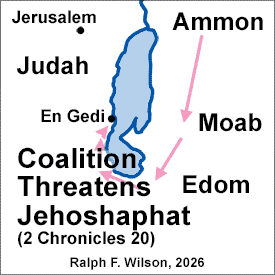 Coalition of armies of Moab, Ammon, and Edom prepares to attack Judah from En Gedi (2 Chronicles 20:2). Larger map. |
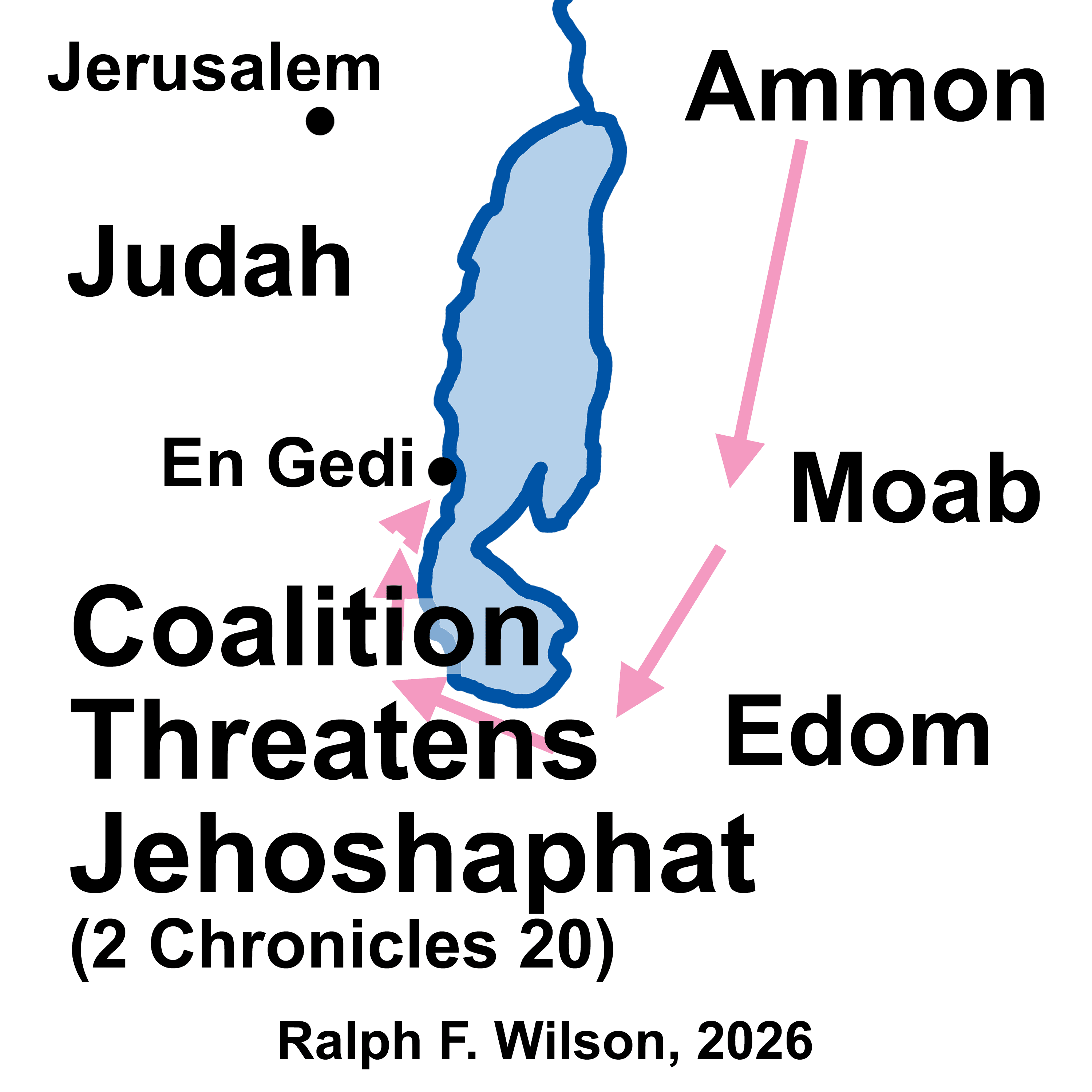
The drama begins when a sentry rushes into the throne room to report that a huge force massing at En Gedi, an oasis on the west shore of the Dead Sea. The horde is made up of the united armies of Moab, Ammon, and Edom (sometimes known as Mount Seir), along with some Meunites.1
"A vast army2 is coming against you from Edom, from the other side of the Sea. It is already in Hazazon Tamar (that is, En Gedi)." (2 Chronicles 20:2)
From their camp at En Gedi, the united armies are poised to enter the Judean highland and attack Judah from the southeast, where fortifications are fewer,3 probably led by Mesha, king of Moab,4 who has joined his army with those of two neighboring kingdoms in an attempt to defeat the Southern Kingdom of Judah.
Jehoshaphat's Prayer (2 Chronicles 20:3-6)
Jehoshaphat's reaction tells us a lot about both the king and the seriousness of the situation.
"Alarmed,5 Jehoshaphat resolved to inquire of the Lord, and he proclaimed a fast for all Judah. The people of Judah came together to seek help from the Lord; indeed, they came from every town in Judah to seek6 him." (2 Chronicles 20:3-4)
The kingdom faces invasion and destruction, but it doesn't have the manpower or resources to resist the overwhelming force moving toward an unprotected flank.
In this national emergency, Jehoshaphat calls the nation to seek7 Yahweh. The people fast to humble themselves before God and gather in the in the "new courtyard" or outer court of the temple.8 Now Jehoshaphat's voice rises before the hushed crowd. It isn't a priest who stands to lead in prayer, but the Davidic king himself.
"O LORD, God of our fathers, are you not the God who is in heaven? You rule over all the kingdoms of the nations. Power and might are in your hand, and no one can withstand you." (2 Chronicles 20:6)
The nations are in your power, O God. Now he recounts instances of how God has delivered them in the past. He also notes the specific promises made to them at the dedication of the temple, recalling God's word to Solomon about instructions of what to do when calamity strikes. God had told them:
"If my people, who are called by my name, will humble themselves and pray and seek my face and turn from their wicked ways, then will I hear from heaven and will forgive their sin and will heal their land." (2 Chronicles 7:14)
They have gathered in the temple. They have humbled themselves with fasting. And Jehosaphat reports to God that they have met the conditions of that promise:
"If calamity comes upon us, whether the sword of judgment, or plague or famine, we will stand in your presence before this temple that bears your Name and will cry out to you in our distress, and you will hear us and save us." (2 Chronicles 20:8)
He proceeds to lay before Yahweh the immediate threat of invasion from Ammon, Moab, and Edom -- nations that Israel spared when they came from Egypt into Canaan.
Our Eyes Are Upon You (2 Chronicles 20:12)
Finally, Jehoshaphat comes to his request:
"O our God, will you not judge9 them? For we have no power10 to face this vast army that is attacking us. We do not know what to do, but our eyes are upon you." (2 Chronicles 20:12)
When is weakness power? Jehoshaphat's prayer is at once a statement of complete inadequacy as well as trust. We don't have the raw power to withstand such an overwhelming force. We have no options whatsoever! We just don't know what to do! We look to you, O God. You judge them with your power.
The key clause here declares their faith.
"Our eyes are upon you!" (2 Chronicles 20:12)
When I was in college, I attended a small wood-frame church in Los Angeles where these words had been painted on the arch over the platform: "Our eyes are upon Thee!" It is a powerful statement of faith!
Time and time again, when Jesus shows the power of God in action, he calls people to put their own faith in God, and encourages them, "Your faith has saved you."11
The Battle Is the Lord's (2 Chronicles 20:14-18)
Jehoshaphat prays, and then there seems to have been a period of silence -- we don't know how long.
"All the men of Judah, with their wives and children and little ones, stood there before the Lord." (2 Chronicles 20:13)
Then all of a sudden, a Levite in the crowd experiences God's power.
"Then the Spirit of the LORD came upon Jahaziel ... a Levite and descendant of Asaph, as he stood in the assembly." (2 Chronicles 20:14)
Jahaziel, whose name means, "God sees," seems to be Levitical singer, part of the famous Asaph family that wrote twelve psalms in our Bible.12 Asaph "the Seer"13 had founded the temple choir as chief musician.14 Prophecy was not new to this family. They "prophesied" along with their accompanied singing worship (1 Chronicles 25:1).
Jahaziel speaks with a voice loud enough for all to hear, the sound echoing off the temple buildings and the colonnade all around.
"Listen, King Jehoshaphat and all who live in Judah and Jerusalem! This is what the LORD says to you: ‘Do not be afraid or discouraged because of this vast army. For the battle is not yours, but God's.'" (1 Chronicles 20:15)
He isn't speaking on his own authority. He speaks for Yahweh himself! Through the prophet, God's first words to the assembled people are words of encouragement.
"Do not be afraid or discouraged because of this
vast army.
For the battle is not yours, but God's."
God's people have faced insurmountable odds in the past. At the brink of the Red Sea, after escaping Egypt, they see the dust of Pharaoh's chariots racing across the plain toward them, Moses speaks prophetically:
"Do not be afraid. Stand firm and you will see the deliverance the LORD will bring you today.... The LORD will fight for you; you need only to be still." (Exodus 14:13-14)
The Philistine giant Goliath has terrified Israel's armies, but the Spirit comes upon the shepherd-boy David empowering him to face the huge man of war. With a whirling sling in his hand, he shouts to the giant and to the Philistine army:
"The battle is the LORD's, and he will give all of you into our hands." (1 Samuel 17:47b)
Yes, when God's people are attacked, when they humble themselves and trust him. Their Savior and God fights for them.
The Enemy Moves through the Desert (2 Chronicles 20:16)
Now, amazingly, through his prophet, God gives specific military intelligence and battle instructions.
"Tomorrow march down against them. They will be climbing up by the Pass15 of Ziz, and you will find them at the end of the gorge in the Desert of Jeruel." (2 Chronicles 20:16)
Let me explain the geography. The major cities of Judah lie along a mountain chain called the hill country of Judah or Judean mountains. East of this, the hills drop down to an arid wasteland plateau known as the Judean Desert (wilderness of Judah) that extends perhaps 20 miles (32 kilometers) or so east to the Judean Cliffs, a steep escarpment that drops precipitously into the Dead Sea rift valley, 1,150 to 1,650 feet (350 to 500 meters) below.
David plays cat-and-mouse with Saul's army in this desert (1 Samuel 23-24, 26). John the Baptist is raised here (Luke 1:80; 3:2). Jesus retreats here for 40 days while he is tempted by the devil (Luke 4:1; Matthew 4:1). It is a dry and daunting place. Nearly all the wadis (intermittent streams) are bone-dry except during the rainy season. Then they turn into flash-flood torrents.
The particular portion of the wilderness where the armies of Moab, Ammon, and Edom will be found (the Desert of Jeruel16) seems to be in the stream bed or gorge of the Nahal Arugot Elyon, a wadi that drains the western highlands as it winds its way from near the Judean town of Tekoa southeast through the desert to the Nahal Arugot where it joins other branches to empty into the Dead Sea.
But now the massive opposing army is well on its way. By the time the report reaches Jehoshaphat, at least a day has elapsed -- maybe more. By now, the enemy troops have endured an exhausting climb of about 1,300 feet (390 meters) along a steep, winding, and narrow path in the gorge cut by the Nahal Arugot up to the plateau of the Judean desert. By the time Jehoshaphat's troops march out from Jerusalem towards Tekoa the next morning, the enemy horde has traversed much of the way along the streambed to meet them.
You Will Not Have to Fight (2 Chronicles 20:17)
Now the prophet gives further instructions. Startling instructions.
"You will not have to fight17 this battle. Take up your positions; stand firm and see the deliverance18 the LORD will give you, O Judah and Jerusalem. Do not be afraid;19 do not be discouraged.20 Go out21 to face them22 tomorrow, and the LORD will be with you." (2 Chronicles 20:17)
What does this mean -- "take your positions"23 and "go out against them"? They are to armor-up, take their weapons, and march in military formation ready to fight at a moment's notice. But in this case, they won't have to! Strange! The next instruction is, "Stand firm"24 -- don't do anything except observe. Then "see the deliverance the LORD will give you."
Having God fight for you doesn't usually mean you have to do no fighting yourself.
With the exception of Jericho, the Israelites are quite engaged in warfare as they conquer other Canaanite cities,25 all the time aware that the Lord is fighting with them and through them to bring success, light casualties, etc. They don't defeat their enemies by their own strength -- though they must fight with courage. It is God's favor that causes their enemies to fall before them, and ultimately win the land of Canaan in answer to God's promise.
"Joshua conquered all these kings and their land in a single campaign, for the LORD, the God of Israel, was fighting for his people."26 (Joshua 10:42)
But in our situation, as the massed armies are marching to meet Jehoshaphat in battle, the prophet's words are different. Though they are to take up arms and march to the battle, they won't have to fight at all! Very strange.
The Response of Worship (2 Chronicles 20:18-19)
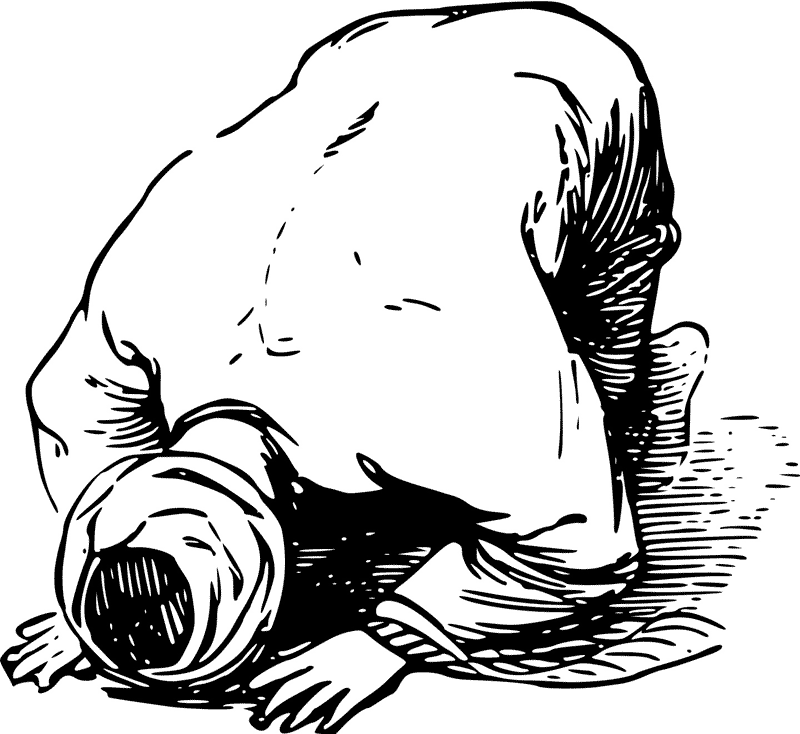
 Bowing with face to the ground. Image: OpenClipart-Vectors, Pixabay.com. Larger image. |
The prophet's words have a powerful effect on the people:
"Jehoshaphat bowed27 with his face to the ground, and all the people of Judah and Jerusalem fell down28 in worship29 before the Lord." (2 Chronicles 20:18)
They have been fasting and praying for God's help. Now God has responded with a clear word. The people immediately prostrate themselves on the ground before Yahweh. Prostration is still practiced. Full prostration is practiced in liturgical Christian traditions to this day. Muslims practice "face-to-the-ground" prostration a total of 34 times a day.30 It is an act of utter humility and obeisance.
After some time prostrated on the ground, a few Levites31 get up and begin praise Yahweh loudly (2 Chronicles 20:19, perhaps leading the gathered people into vocal worship according to their practice as a temple order of Levitical singers.32 We see repentance, humbling, prayer, answer, awe, and praise.
Marching the Army into the Wilderness (2 Chronicles 20:20)
"Early in the morning they left for the Desert of Tekoa." (2 Chronicles 20:20)
When you think about it, marching out with the army early the next morning must have taken a great deal of rapid deployment. Army logistics people work frantically. Soldiers are called up, fitted out, formed into units, ready to go. No one gets much sleep. The very next day before dawn, they march south from Jerusalem, through Bethlehem, then on to the ancient village of Tekoa, birthplace of the prophet Amos. Ancient Tekoa33 is about 10 miles (16 kilometers) south of the capital, a good half-day's march for the troops.34
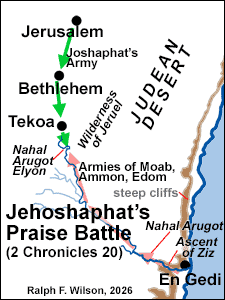 Jehoshaphat's Praise Battle (2 Chronicles 20:1-30). Larger map. |
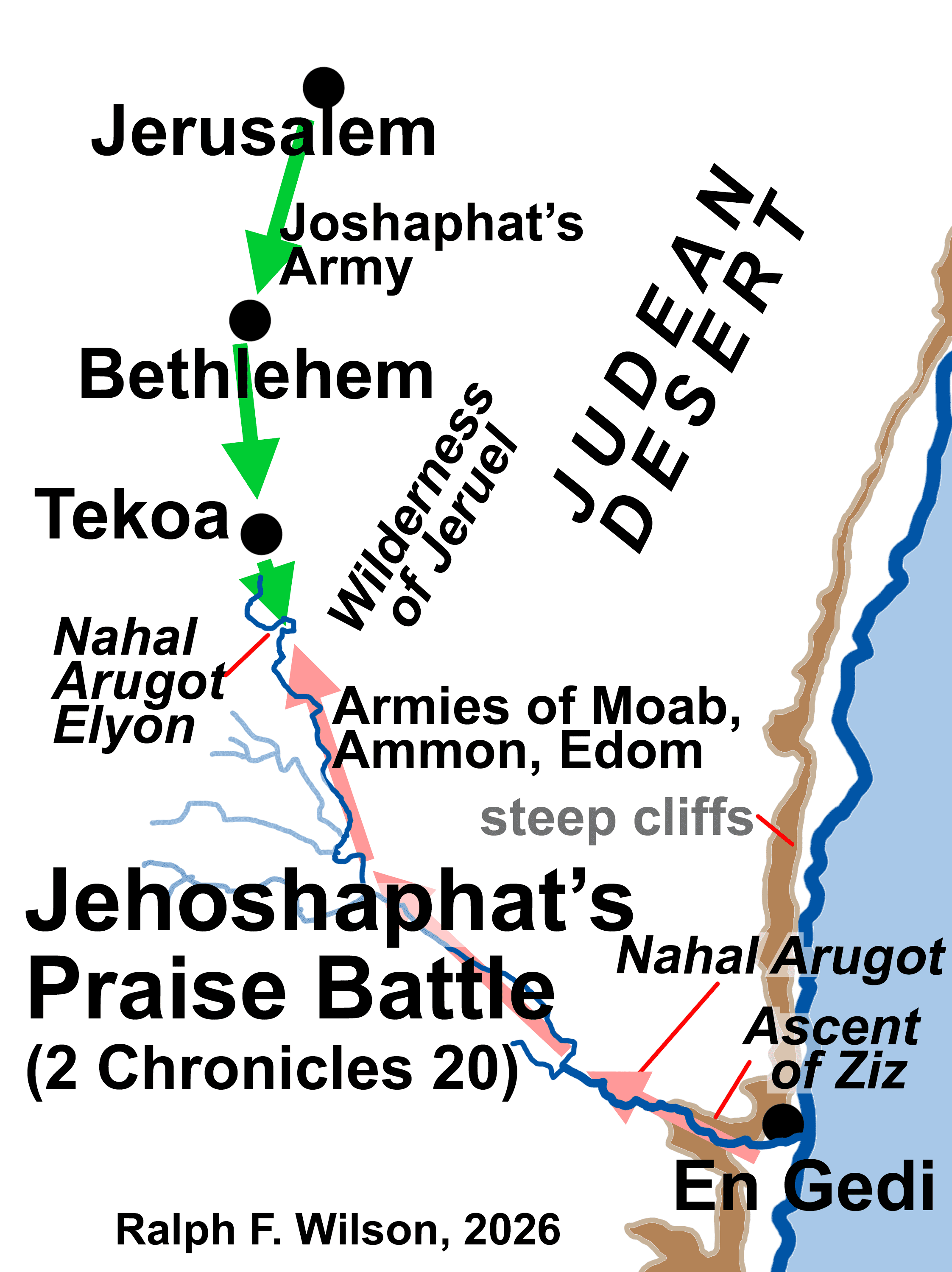
In the desert southeast of Tekoa you find the northern branch of a system of wadis that drain into the Nahal35 Arugot, eventually flowing into the Dead Sea at En Gedi. The northern branch is called Nahal Arugot Elyon or Wadi el-Jihar. It was along this dry streambed that the coalition forces of Moab, Ammon, and Edom marched to invade Judah. And it is here that the battle ends before it begins. But we're getting ahead of ourselves.
As they set out, Jehoshaphat stands and says loudly:
"Listen to me, Judah and people of Jerusalem! Have faith36 in the LORD your God and you will be upheld;37 have faith38 in his prophets and you will be successful."39 (2 Chronicles 20:20b)
It is a monarch's word of encouragement to the troops going forth to battle. Trust God. Trust the prophet who spoke to us by God's Spirit. Go and you will be successful.
The Power of Praise (2 Chronicles 20:21-22)
But Jehoshaphat doesn't just send them off with an encouraging word. After talking with the people about it, the king puts words into action by appointing a squad of Yahweh-praisers to march in front of the armed troops.
"After consulting40 the
people, Jehoshaphat appointed men to sing to the LORD and to praise him for the
splendor41
of his holiness as they went out at the head of the army, saying:
‘Give thanks to the LORD,
for his love endures forever.'" (2 Chronicles 20:21)
The army -- the nation -- is relying on Yahweh. Why? Because his love (hesed) endures forever. His faithful love never ceases (Lamentations 3:22-23). Therefore, he is to be thanked -- ahead of time -- for what his is about to do. This order of march reminds me of Psalm 149:
"May the praise of God be in their mouths
and a double-edged sword in their hands...." (Psalm 149:6)
Indeed, the Scripture seems to indicate that their songs and praises of faith actually trigger the victory.
"As they began to sing and praise, the LORD set ambushes against the men of Ammon and Moab and Mount Seir who were invading Judah, and they were defeated."42 (2 Chronicles 20:22).
The NLT puts it vividly: "At the very moment43 they began to sing and give praise...." The text is clear, when they "began"44 to sing and praise, Yahweh initiated the events that caused the enemy defeat.
This reminds me of Jesus telling the ten lepers to go show themselves to the priest who would certify that their leprosy was gone. Luke records: "And as they went, they were cleansed" (Luke 17:14). Faith shows itself in taking action based on believing that God will do what he said.
The Enemy Armies Massacre Each Other (2 Chronicles 20:22-34)
An army led by praise advances south towards the Judean Desert. And suddenly, a vast horde marching north begins to disintegrate into utter confusion.
"22 As they began to sing and praise, the LORD set ambushes against the men of Ammon and Moab and Mount Seir who were invading Judah, and they were defeated. 23 The men of Ammon and Moab rose up against the men from Mount Seir to destroy and annihilate them.45 After they finished slaughtering46 the men from Seir, they helped to destroy47 one another. 24 When the men of Judah came to the place that overlooks the desert and looked toward the vast army, they saw only dead bodies lying on the ground; no one had escaped." (2 Chronicles 20:22-24)
Verse 22 says literally, "The LORD set ambushes"48 against the enemies. These weren't the kinds of ambush where the stagecoach is hemmed in by canyon walls and the bandits descend upon it from hiding. Rather, the LORD causes some event or misadventure that triggers a deadly melee. Several factors set up even a small event to escalate into a major battle.
1. Confinement. You have armies from three different kingdoms in close quarters with each other in a streambed, hemmed in by the walls of a gully or canyon that tends to confine them in a narrow space.
2. Language and cultural differences. They all speak a similar Northwest Semitic Canaanite language, but each with a local dialect, perhaps as different as a Yankee talking to someone with a drawl of the deep South. Misunderstanding is the result. And they had no distinctive uniforms to instantly distinguish them from each other in the heat of hand-to-hand battle.
3. Distrust. Add to that suspicion. From time-to-time Moab, Ammon, and Edom have all fought wars against each other producing lingering grudges.
4. Exhaustion and Heat. Put together natural distrust and communication barriers along with exhaustion from the long march, the heat of the desert, and the lack of water, and you have the recipe for disaster.
The fire is laid. The tinder is dry. Now Yahweh lights the match with some sort of ambush -- a surprise, a mistaken identification, a skirmish, then all-out attack. At first, the Moabites and Ammonites attack their ancient foes the Edomites, but after a while, everyone fights against everyone else. Before long, there are only corpses in the wadi floor with the vultures circling and landing. This is what Jehoshaphat's army sees from the "watch tower" or "lookout point" at the edge of the desert.49
"When the men of Judah came to the place that overlooks the desert and looked toward the vast army, they saw only dead bodies lying on the ground; no one had escaped." (2 Chronicles 20:24)
Plundering (2 Chronicles 20:25)
"So Jehoshaphat and his men went to carry off their plunder...." (2 Chronicles 20:25)
Plundering the dead, even enemy bodies, is abhorrent to us. It seems indecent, disrespectful of the dead. And it is. But until relatively recently, plundering and stripping of dead soldiers had been the norm for thousands and thousands of years. Often, that was the way soldiers got paid. Plundering the dead was finally banned at the Hague (1907) and Geneva Conventions (1949). And pillage was only declared a war crime under the Rome Statute of the International Criminal Court in 1998. It's not fair to judge Iron Age soldiers by twenty-first century standards.
"So Jehoshaphat and his men went to carry off their plunder, and they found among them a great amount of equipment and clothing and also articles of value -- more than they could take away. There was so much plunder that it took three days to collect it." (2 Chronicles 20:25)
What valuables might you find on a soldier? Clothing, swords, shields, spears, knives, helmets, and armor. But ordinary soldiers also carried small amounts of wealth in bags or pouches, such as silver pieces, bronze or copper scraps, as well as cultic objects or charms, rings, earrings, amulets, and necklaces. An army would be followed by a train of donkeys and mules carrying food -- sacks of grain, dried fish or meat, jars of olive oil, wineskins, cooking utensils, tents, and whatever else was needed to sustain the army in a foreign land. In addition, the army would be followed by herds of sheep and goats to feed the soldiers.
Mentioning the three days needed to gather the plunder is a way of saying that God had turned what had been an impending national disaster into a rich bonanza for the Judean troops -- though none of them even had to draw a sword!
Gathering to Praise (2 Chronicles 20:26-30)
At the end of all the looting, the Judean soldiers gather together to praise God.
"On the fourth day they assembled in the Valley of Beracah, where they praised (bārak50) the Lord. This is why it is called the Valley of Beracah to this day." (2 Chronicles 20:26)
"Beracah" means "blessing."51 The "Valley of Blessing" is most likely the present-day Wâdī el-Arrûb, a broad valley near ancient Tekoa on the main road from Hebron to Jerusalem, featuring an ancient ruin (Khirbet Bereikut), which seems to preserve the Hebrew name (bārak > Beracah > Bereikut).52
"27 Then, led by Jehoshaphat, all the men of Judah and Jerusalem returned joyfully to Jerusalem, for the Lord had given them cause to rejoice over their enemies. 28 They entered Jerusalem and went to the temple of the Lord with harps and lutes and trumpets.
29 The fear of God came upon all the kingdoms of the countries when they heard how the LORD had fought against the enemies of Israel. 30 And the kingdom of Jehoshaphat was at peace, for his God had given him rest on every side." (2 Chronicles 20:27-30)
It shouldn't be lost on us that they sing praises after the prophet Jahaziel speaks, they march out with Levites singing praises leading the way, gather in the Valley of Blessing after the battle, and return to the temple praising God with all sorts of instruments. Praise is featured in this account from beginning to end.
Lessons for Today
This wonderful account is rich in lessons for us today. You might be able to combine some of these for a tidy sermon, but I see six important truths to lay hold of.
1. Hope. God can turn evil into good. What begins with terror and fear concludes with rejoicing. God has turned a potential catastrophe into an event that glorifies him and enriches not only the people's faith, but also their material wealth. God can enrich us even when we are attacked. Spiritual jujitsu.
2. Prophecy can be key. By a gift of the Holy Spirit, through a prophetic word, Yahweh changes fear into hope. Of course, prophecy can be misused and disdained (1 Thessalonians 5:19-21). But as a timely word from God, prophecy can be a powerful agent of change within a congregation (verses 14-17; Corinthians 14:24-25).
3. Faith is fundamental. "Our eyes are upon you" (verse 12) is one way of saying we are trusting in the Lord. Jesus tells us, "Your faith saves you."
4. Praise is a spiritual weapon. Praise is itself a spiritual weapon, since praise -- the language of faith -- triggers God's action. The appropriate response to God's promises is humility and worship, then praise (verse 19). Understand this: praise is not flattery in order to manipulate God into doing something for us as if he were some sort of narcissistic monarch. No. Praise expresses our trust and confidence in God.
5. We must prepare for battle. We must prepare ourselves for spiritual warfare, even though, in some encounters, Yahweh will do all the fighting necessary (verse 17). "Put on the whole armor of God" (Ephesians 6:10-18).
6. God fights our battles. We sometimes see our personal struggles as inevitable and must be conquered alone, like the African-American spiritual, "You must walk this lonesome valley; you must walk it by yourself...." It holds a bit of truth, but the full truth is that God will walk there with you and will fight on your behalf. You are his son, his daughter. Your struggles touch his Father-heart. Yahweh is willing to fight your battles with you, if you are willing to trust him.
The overall theme of this passage is trust in the Almighty, Wonder-Working God, and praise that expresses that faith. What place does praise currently have in your spiritual life, my friend? Know this: as your praise grows, so will your victories in Jesus.
Prayer
Father, teach us to trust You. Teach us to praise, to speak aloud the language of faith. We truly believe in You and in Your saving power. Show us how to express it to you. Teach us. Help us, we pray in Jesus' mighty name. Amen.
End Notes
[1] Some Septuagint manuscripts also include "some of the Meunites" in this group. The Meunites are mentioned here and there, but we don't know much about them (Judges 10:12; 1 Chronicles 4:41; 2 Chronicles 26:7; F. E. Young, "Meunim," ISBE 3:342).
[2] "Vast army" (NIV), "great multitude" (ESV, NRSV, KJV) is rab + hāmôn, "abundance, tumult" (TWOT #505a). "Crowd, army" (Holladay 81, 5).
[3] No doubt the enemy armies march around the Dead Sea to the south, since it is too deep to ford, even at its narrowest point, the Lynch Strait. Because the southern basin of the Dead Sea is much shallower than the northern basin, some assume that the troops forded the Dead Sea at the west end of the Lisan Peninsula. This is unlikely, since the so-called "ford" was likely to be 30 feet (10 meters) deep at the time. Prior to the 1930s, the elevation of the Dead Sea was about 1,280 1,286 feet (390-392 meters) below sea level. Since the 1930s, due to water diversion for agriculture, the Dead Sea has shrunk, so that by the late 1970s, the shallower Lynch Strait had dried to a mud flat about 1,316 to 1,390 feet (401 to 402 meters) below sea level. Thus, at pre-1930s levels, the Lynch Strait was covered by about 10 or 11 meters of water -- way too deep to ford! Things might have been different in ancient times, but we can't assume such a low lake level. In spite of this, some commentators have assumed the armies forded the Dead Sea at the Lynch Strait (Martin J. Selman, 2 Chronicles: A Commentary (Tyndale Old Testament Commentaries; InterVarsity Press, 1994), p. 423; Yohanan Aharoni, et al., The Macmillan Bible Atlas (Third Edition; Macmillan, 1993), map #129). An 1823 map shows "the place at the Ford where the Party that had crossed were discovered" (in Charles Leonard Irby and James Mangles, Travels in Egypt and Nubia, Syria and Asia Minor: during the years 1817 & 1818, p. 507). However, this map was based on speculation, not scientifically determined.
[4] Mesha, king of the Moabites is on the rise. Earlier, Jehoshaphat had assisted King Omri of Israel against Moab in battle (2 Kings 3). Subdued, Moab was under the control of the Northern Kingdom of Israel. But at the death of Omri's successor, King Ahab, Mesha rebels and breaks free. Now he is on the move. Mesha's victories (though not his defeats) are recorded on the Mesha Stele or Moabite Stone (840 BC). The basalt monument stone was discovered in 1868-70 and is presently at the Louvre Museum, Paris. See Wikipedia article: "Mesha Stele."
[5] "Alarmed" (NIV), "was afraid" (ESV, NRSV), "feared" (KJV), "was terrified" (NLT) is the Qal of yārēʾ, "fear, be afraid" (TWOT #907; Holladay 142, 3a).
[6] "Seek help" (NIV) is Piel infinitive of bāqash. "Our root basically connotes a person's earnest seeking of something or someone which exists or is thought to exist (TWOT #276). "Seek someone's presence," especially Yahweh (Holladay 46, 4).
[7] "Inquire of" (NIV), "seek" (ESV) is literally "set his face to seek the Lord" (KJV). "Seek" is the Qal infinitive of dārash, here, "turn (in petition) to Yahweh" (Holladay, 75, 7; TWOT #455)."
[8] The outer court (BDB 345, 3b).
[9] "Judge" (NIV, KJV), "execute judgment" (ESV, NRSV), "stop" (NLT) is the Qal of shāpaṭ, "judge, govern" (TWOT #2443). "Judge = punish, execute judgment" (Holladay 380, Qal 6). The idea of asking God to "judge" these nations, suggests that Jehoshaphat is calling on Yahweh to decide on the basis of fairness. These are nations that Yahweh had specifically told them to spare when the Israelites entered the land under Moses, yet they are now attacking Israel that refrained from attacking them (Deuteronomy 2:4-5, 9, 19).
[10] "No power" (NIV), "no might" (KJV) "powerless" (ESV, NRSV, NLT) is the negative particle plus the noun kôaḥ, "strength, power, ability, might, force, substance." "Capacity to act, understood both in physical and figurative terms/... Usually physical strength is intended. By extension the word comes to connote general ability to cope with situations" (John N. Oswalt, TWOT 973a).
[11] Jesus says, "Your faith has saved you" to several whom he healed: the sinful woman who anointed him (Luke 7:50); the woman with the hemorrhage (Luke 8:48); the thankful leper (Luke 17:19); and blind Bartimaeus (Mark 10:52). Healing is also tied to faith with the Syrophoenician woman (Matthew 15:28), the centurion's servant (Matthew 8:10); a royal official's son (John 4:50); the man whose son has seizures (Mark 9:23-25); etc.
[12] Psalms 50 and Psalms 73-83.
[13] 2 Chronicles 29:30.
[14] 1 Chronicles 15:17-19 and chapter 16.
[15] "Pass" (NIV), "ascent" (ESV, NRSV, NLT), "cliff" (KJV) is maʿăleh, "ascent" (TWOT #1624j), from the verb ʿālâ, "to go up, ascend." "(Path of) ascent, way up, steep path" (Holladay, 207, 1b).
[16] "Jeruel," ISBE 2:998.
[17] "Fight" is the Niphal infinitive construct of lāḥam, "fight, do battle" (TWOT #1104). "Come to close quarters, do battle" (Holladay, 175, Niphal).
[18] "Deliverance" (NIV), "salvation" (ESV, KJV), "victory" (NRSV, NLT) is yĕshûʿâ, "salvation" (TWOT #929b).
[19] "Be afraid" (ESV, NIV, NLT), "fear" (NRSV, KJV) is the Qal imperfect of yārēʾ, "fear, be afraid" (TWOT #907).
[20] "Be discouraged" (NIV, NLR), "be dismayed" (ESV, NRSV, KJV) is the Niphal imperfect of ḥātat, "be terrified" (Holladay, 121, Niphal 3). Holladay has "to discourage" as the meaning of the Piel perfect.
[21] "Go out" is the Qal imperative of yāṣāʾ, "go out, come out, go forth" (TWOT #893).
[22] "To face them" (NIV), "against them" (ESV, NRSV, KJV, NLT) is the preposition lipnê, "in the presence of, before...." In the meaning 'before' the following object is most frequently a person, God or man, 'before' in the sense of 'in full view of, under the eye of, at the disposal of, in the estimation of'" (Victor P. Hamilton, TWOT #1782b).
[23] "Take your positions" (NIV, NRSV, NLT), "hold your position" (ESV), "set yourselves" (KJV) is the Hithpael imperative of yāṣab, "take one's stand, position; stand (firm)" (Holladay, 140). The word is found only in the Hithapel stem.
[24] "Stand firm" (NIV, ESV), "stand still" (NRSV, KJV, NLT) is the Qal imperative of ʿāmad, "(move to) stand" (Holladay, 275, Qal 1).
[25] Joshua 1:14-15; 10:10-11, 20, 26, 28-39; etc.
[26] It is the Lord who fights for Israel: Exodus 14:14, 25; Deuteronomy 1:30; 3:22; Joshua 10:14; 11:6-8; Nehemiah 4:14-15; etc.
[27] "Bowed" is the Qal of qādad, "bow down.... This root refers to the bowing of one's head accompanying and emphasizing obeisance (Leonard J. Coppes, TWOT #1985). "Bow down, kneel down" always followed by hishtaḥăwâ, "worship" (Holladay 312).
[28] "Fell" is the Qal of nāpal, "fall, lie, be cast down, fall" (TWOT #1393), here "let oneself fall (intentionally), throw oneself down" (Holladay 241, 7).
[29] "Worship/worshipping" is the Eshtaphal (or Histafal) stem of ḥāwâ (hishtaḥăwâ), "to prostrate oneself, to worship.... Prostration was quite common as an act of submission before a superior" (Edwin Yamaguchi, TWOT #619). "Bow down deeply, do obeisance" (Holladay 97, 1).
[30] In the Muslim Sujud, "seven bones" or parts of the body must touch the ground -- the forehead including the nose, both hands, both knees, and the toes of both feet.
[31] The Kohathites and Korahites are from are different Levitical families than the prophet, who is a Levite from the family of Asaph.
[32] 1 Chronicles 15:16-24; chapter 25; 2 Chronicles 5:12-14; 29:25-30.
[33] Tekoa is represented today by the Palestinian town of Tuquʿ, near Khirbet Teqûʿ, an unexcavated site of 4-5 acres (1.5-2 ha) (ISBE 4:746). It should not be confused with the nearby 1977 Israeli settlement of Tuquʿ in the West Bank area (Wikipedia article "Tekoa (Israeli Settlement)").
[34] In ancient days, troops typically marched 10 to 20 miles per day, faster during a forced march.
[35] Modern Hebrew nahal refers to a watercourse, ravine, or small valley with flowing or intermittent water.
[36] "Have faith" is the Hiphil imperative of ʾāman, "view something as reliable, believe," then, "put trust in (person)" (Holladay 20, Hiphil 2 and 3).
[37] "Be upheld" (NIV), "established" (ESV, NRSV, KJV), "be able to stand firm" (NLT) is the Niphal imperfect of ʾāman, "have stability, remain, continue" (Holladay, 20, Niphal 2).
[38] "Have faith" is the Hiphil imperative of ʾāman (second instance in the command).
[39] "Will succeed" (NIV, ESV, NRSV), "will prosper" (KJV) is the Hiphil imperative of ṣālēaḥ, II, "be successful, succeed, enjoy success" (Holladay 306, Hiphil 1).
[40] "Consulting" (NIV, NLT), "taken counsel" (ESV, NRSV), "consulted with" (KJV) is the Niphal of yāʿaṣ, "take counsel together, deliberate" (Holladay 138, Niphal 2).
[41] "Splendor" is the noun hădārâ, "adornment, glory" Each time the RSV translates this couplet "holy array" with the exception of Ps 110:3 where it opts for the translation "holy mountains" (reading a different text). On the other hand, the KJV consistently translates the couplet, "the beauty of holiness." Now, in the light of Ugaritic evidence, a third option presents itself. A third translation could be, "prostrate yourselves before the Lord when he appears in holiness" (Victor P. Hamilton, TWOT #477c). "Attire, grandeur (of king)" (Holladay 77).
[42] "Defeated" (NIV), "routed" (ESV, NRSV), "smitten" (KJV), "to start fighting among themselves" (NLT) is the Niphal stem of the verb nāgap, "to strike," here, in the Niphal, "be beaten" (Holladay 227, Niphal).
[43] "When," (ESV, KJV), "as" (NIV, NRSV), "at the very moment " (NLT) is the preposition bĕ, "with" and the noun ʿēt, "time, space of time, appointed time, proper time." The basic meaning of this word relates to time conceived as an opportunity or season (Leonard J. Coppes, TWOT #1650b).
[44] "Began" is the Hiphil stem of ḥālal II, "begin" (TWOT #661, Hiphil); "(untie >) "begin" (Holladay 105, Hiphil 2).
[45] The phrase translated variously, "to destroy and annihilate" (NIV), "devote to destruction" (ESV), "destroying utterly" (NRSV), "utterly to slay and destroy" (KJV), "destroyed" (NLT) comes from the infinitive construct of two verbs: (1) ḥāram, "devote to the ban (ḥērem), dedicate to destruction, destroy" (Holladay 117, Hiphil 1; TWOT #744); and (2) shāmad, "exterminate" (Holladay 375, Hiphil; TWOT #2406).
[46] "Finished slaughtering" (NIV), "made an end of" (ESV, NRSV, KJV), "destroyed" (NLT) is the Piel infinite construct of kālâ, "bring a process to completion," here in the Piel stem, means, "destroy, exterminate" (32 times) (Holladay 158, Piel 3c; TWOT #983).
[47] "Helped to destroy" is two words: the Qal of the verb ʿāzar, "help, support, come to the aid of" (TWOT #1598; Holladay 270); and the noun mashḥît, "destruction" (Holladay 218, 2), from the verb shāḥat, "destroy."
[48] "Ambushes" is the Piel participle of ārab, "to lie in wait, ambush" (TWOT #156). Piel is "put people in ambush" (Holladay 26, Piel).
[49] "Place that overlooks the desert" (NIV), "watchtower of the wilderness" (ESV, NRSV, KJV), "the lookout point in the wilderness" (NLT) is the noun miṣpeh, "watchtower, lookout point" (TWOT #1950b); "watch-tower, observation-post" (Holladay 211), from ṣāpâ I, "look out or about, watch."
[50] "Praised" (NIV), "blessed" (ESV, NRSV, KJV), "praised and thanked" (NLT) is the Piel stem of bārak, "to kneel, bless, praise, salute" (John N. Oswalt, TWOT #285).
[51] Bĕrākâ, "'blessing,' either the verbal enduement with good things or a collective expression for the good things themselves" (John N. Oswalt, TWOT #285b).
[52] E. W. G. Masterman, "Beracah, Valley of," ISBE 1:461; H. G. M. Williamson, 1 and 2 Chronicles (The New Century Bible Commentary; Eerdmans, 1982), p. 300.
Copyright © 2026, Ralph F. Wilson. <pastor joyfulheart.com> All rights reserved. A single copy of this article is free. Do not put this on a website. See legal, copyright, and reprint information.