


|
Old Testament
New Testament
Gospels
Acts
Paul's Letters
General Letters
Revelation
Topical Studies
Beginning the Journey (for new Christians). en Español

|
Old Testament
New Testament
Gospels
Acts
Paul's Letters
General Letters
Revelation
Topical Studies

|
Home
Bible Studies
Articles
Books
Podcasts
Search
Menu
Donate
About Us
Contact Us
FAQ
Sitemap


Free
E-mail Bible Study
 Names and Titles of God
Home | Bible Studies | Articles | Books | Podcasts | Search | Menu | Donate | About Us | FAQ | Contact Us
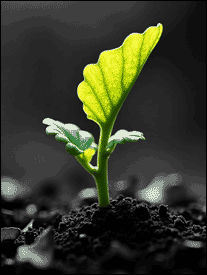 "Now it springs up; do you not perceive it?" (Isaiah 43:19). Image: EglantineShala, Pixaby.com |
How do you restore hope when life has been utterly shattered? When next year looks as bleak as the one gone by?
Yahweh undertakes this task of restoration of his shattered people by speaking words of hope through his prophet Isaiah. Curiously, in an amazing series of chapters, Isaiah speaks of Judah's fall and exile in Babylon long before it even takes place. He then includes the words of encouragement they will need to leave the land of their oppressors and return to Jerusalem.
Yahweh calls to his prophet,
"Comfort, comfort my people,
says your God.
Speak tenderly to Jerusalem,
and proclaim to her
that her hard service has been completed...." (Isaiah 40:1-2)
In earlier chapters, Isaiah's task has been to call to repentance. Now he becomes the bringer of hope -- centuries in advance.1
You, like Israel of old, may have experienced a difficult season of life, with hope drained by circumstance and heart utterly exhausted by life's trials. Here is a word of encouragement from God to you.
"18 Forget the former things;
do not dwell on the past.
19 See, I am doing a new thing!
Now it springs up; do you not perceive it?
I am making a way in the desert
and streams in the wasteland.
20 The wild animals honor me,
the jackals and the owls,
because I provide water in the desert
and streams in the wasteland,
to give drink to my people, my chosen,
21 the people I formed for myself
that they may proclaim my praise." (Isaiah 43:18-21)
Let's meditate this passage for a few minutes.
Forget the Former Things (Isaiah 43:18)
Past hurts have a way of crippling us. Deep pain, utter failure, unrelenting anguish. While they are part of our past, God tells us to turn way from these and refuse to let them be our focus going forward.
"Forget the former things;
do not dwell on the past." (verse 18)
This prophecy is written in typical poetic Hebrew synonymous parallelism, where the second line tends to amplify the first line, and even carry it forward.
"Forget" (NIV) is probably better "remember not" (ESV, NRSV, KJV).2 We can't wipe past events from our memory. But we can refuse to constantly call them to mind, to go back to them, and relive them again and again. The second line directs us, "Do not dwell on" (NIV) or "consider" (ESV, NRSV, KJV) the past. The sense of the word is "give one's attention to."3
Some people can't seem to move beyond a terrible place with the result that the past event comes to define them. Yes, our past is always there, but if we live there and constantly return to our pain, we can't escape it. We must move on. In verse 18, God gently commands us to let it go. He invites us to move from pain to hope, from defeat to a new future.
God Is Doing a New Thing (Isaiah 43:19)
Now, the prophet points forward to what our dynamic Creator is in the process of creating.
"See, I am doing a new thing!
Now it springs up; do you not perceive it?" (verse 19a)
If we are not careful, harbingers of change can come, but we may miss them if we aren't alert. In verse 19, "springs forth" or "springs up" draws on a Hebrew word used to describe growing, budding, sprouting.4 New plants. New trees. New things growing in your life. They start with a small seed. You see nothing for a time, and then seemingly overnight a few leaves pop to the surface, and, before you know it, a small plant begins to shoot up.
"... Do you not perceive5 it?" (verse 19b)
Can you see it? the prophet asks. Did you miss it? Open up your eyes!
"See, I am doing a new thing!" (verse 19a)
"See" (NIV) or "behold" (ESV, KJV) is a command to pay attention to what God is doing.6 The Hebrew word translated here as "doing"7 is used frequently of the Maker in the creation accounts in Genesis 1 and 2. The One who speaks worlds into existence is in the process of forming a new future for you. Already the seed has germinated; the new plant is growing. The Creator isn't finished with you yet. "His mercies are new every morning. Great is his faithfulness!"8 There is hope!
A Way through Your Desert (Isaiah 43:19b)
Now the Lord compares this new future he is creating for you to something new in wild and desolate places.
"I am making a way in the desert
and streams in the wasteland." (verse 19b)
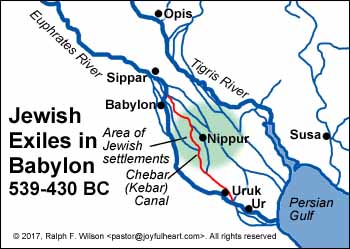 Location of the Jews in Exile. Larger map. |
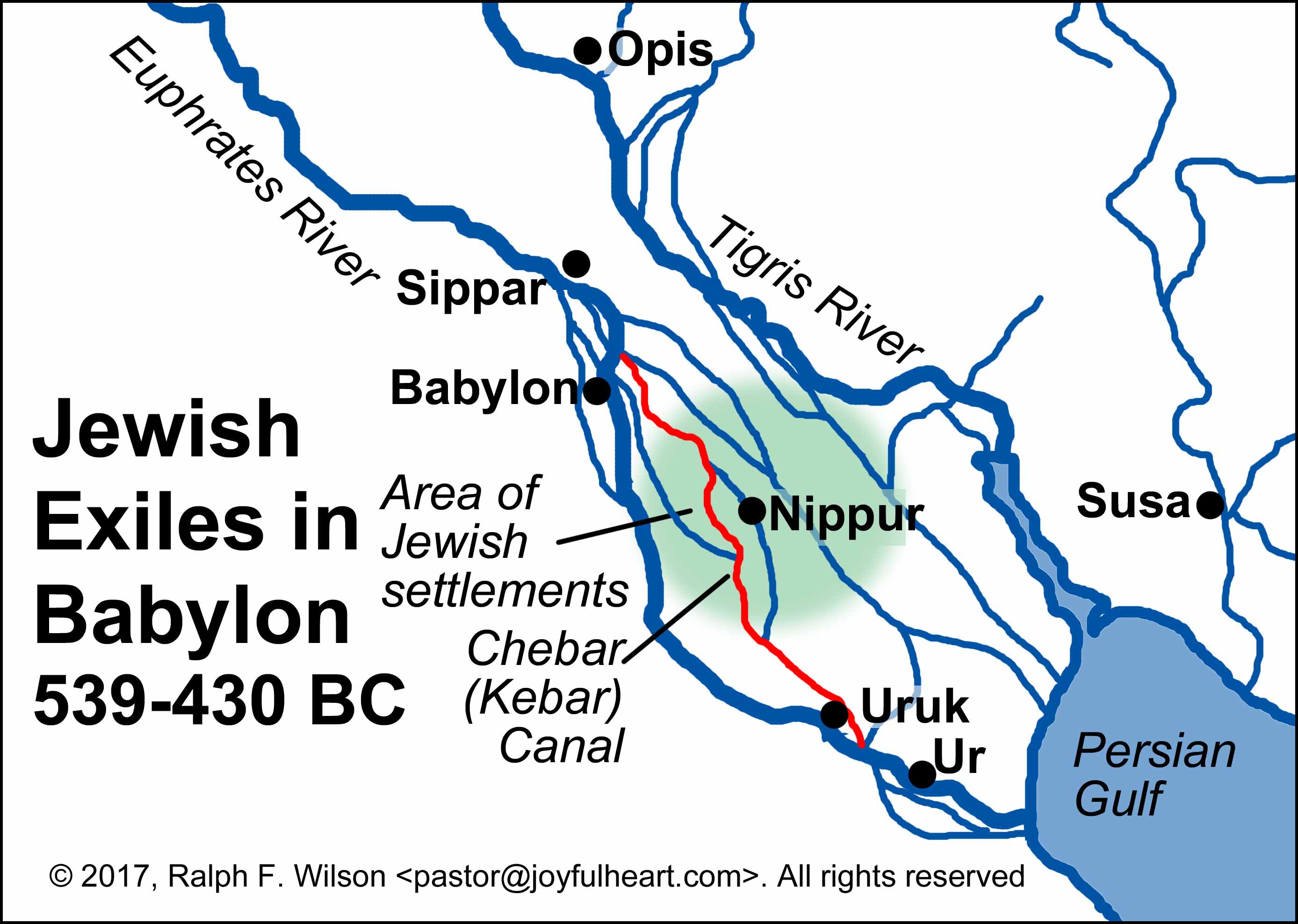
In Babylon, God's people were living in exile on a fertile river plain between the Tigris and Euphrates Rivers. But they had crossed the Arabian desert on their forced march to labor in Babylon. They remembered the 40 years in the deserts of the Sinai and Negev after their deliverance from Egypt. They knew all too well about the waterless desert.9 In our passage, the desert represents their bleak lives. Their hopelessness. And in their desert experience, God speaks to them.
"I am making10
a way in the desert
and streams in the wasteland." (verse 19b)
The verb "make/making" is interesting. The basic idea of this word is to deliberately put or place something in a location. In the very place of your despair -- in the arid expanse of your hopelessness -- God is placing a two-fold miracle,
- A Way. In the desert, now you begin to see a path, a way forward, a journey home.11
- Streams or rivers.12 The prophet isn't talking about an oasis here, nor a wadi that is filled with water only during heavy rains. He speaks of continuous flowing water. Desert and river are polar opposites. The prophet is talking about a miracle that God will do.
Honor, Glory, and Praise
Now God through Isaiah speaks about praise and honor -- first being honored by the wild desert creatures and then praised by human beings.
"20 The wild animals13 honor14 me,
the jackals15
and the owls,16
because I provide17
water in the desert
and streams in the wasteland,
to give drink18
to my people, my chosen,
21 the people I formed for myself
that they may proclaim my praise."
(verses 20-21)
The inhabitants of the desert honor God for providing them water in the country in which they eke out an existence. But for the humans that are just passing through the desert places, the water is God's gracious provision until they reach the Promised Land.
Notice how he describes the humans -- you and me.
- "My people" -- he identifies with us as his own.
- "My chosen"19 -- people that he has especially picked out and selected to belong to him.
- "Formed20 for myself" -- God has formed and fashioned us as a potter does his clay pot, with his own gentle hands upon the clay as it spins upon the wheel, now shaping, now thinning, now pressing to fashion the raw clay into a vessel of beauty and usefulness.
Finally, Isaiah points to our purpose -- praise.
"... The people I formed for myself
that they may proclaim21
my praise."22
(verse 21)
My friend, you and I were selected and formed by God himself so that we might not only appreciate and enjoy him in mutual love, but also to proclaim to others his greatness. We praise him in our times of worship, but we also brag on our God when talking to others. We are his witnesses here on earth. We have so experienced his blessings that it seems selfish to keep it to ourselves.
God has formed and blessed you, saved and delivered you, and is restoring and healing you so that you might have a fresh reason to spread his praises far and wide. Isaiah declared God's words of encouragement to Israel. To whom will your share His hope today?
"18 Forget the former things;
do not dwell on the past.
19 See, I am doing a new thing!
Now it springs up;" (verses 18-19a)
No longer must we live in the depression of defeat and hopelessness. By his grace we drink the fresh waters he provides in our wilderness places and are renewed, refreshed, and retooled to serve him with joy. Hallelujah! Amen!
Prayer
Father, I know that many who read these words have suffered much. Some have been beaten down and defeated one too many times. I pray that your Word might heal and restore them today. Bring a miracle of renewed hope in their hearts and encourage them in faith. In Jesus' name, I pray. Amen.
End Notes
[1] Isaiah was active about 750 to 700 BC. There were three deportations to Babylon -- in 604, 597, and finally in 587 BC when Jerusalem and the temple were destroyed. The first return from exile began in 537 BC. The Second Temple was built and dedicated in 515 BC.
[2] "Forget" (NIV), "remember not" (ESV, NRSV, KJV) is two words in Hebrew, the negative particle 'al and the Qal imperfect verb zākar, "think (about), meditate (upon), pay attention to, remember, recollect." Our use refers to completely inward mental acts, such as "remembering" or "paying attention to" (TWOT #551; Holladay, p. 88).
[3] "Do not dwell" (NIV), "consider" (ESV, NRSV, KJV) is two words, 'al, "not" and the Hithpolel imperfect of the verb bîn, "understand, consider, perceive," here, "give (one's) attention" (Holladay, p. 38, Hithpolel 2). The Hithpolel stem is used for reflexive or reciprocal action, expressing "to do something to oneself."
[4] "Springs up/forth" is the Qal imperfect of the verb ṣāmaḥ, "sprout, spring up." (TWOT #1928).
[5] "Perceive" (NIV, ESV, NRSV), "know" (KJV) is the Qal imperfect verb yādaʿ, "know." In certain contexts, it means "to distinguish," here, to distinguish between what your life has been and what God is beginning to do in you (TWOT #848). "Recognize, perceive" (Holladay 128, Qal 3).
[6] Hinnēh, "behold, lo, see" is an interjection demanding attention (TWOT #510a).
[7] "Am doing" (NIV, ESV), "about to do" (NRSV), "will do" (KJV) is the Qal participle of the verb ʿāśâ, "do, make, fashion, accomplish" (TWOT #1708).
[8] The words are drawn from Lamentations 3:22-23.
[9] "Desert" (NIV), "wilderness" (ESV, NRSV, KJV) is midbār, "wilderness, desert," large areas of land in which oases or cities and towns exist here and there (TWOT #399l). "Wasteland" (NIV), "desert" (ESV, NRSV, KJV) is yĕshîmôn, "waste, desert," from yāsham, 'be desolate, ruin" (TWOT #927b).
[10] "Making" (NIV) is the Qal imperfect of śûm, "put, place, set, appoint, make." (TWOT #2243; Holladay 351, Qal 1).
[11] "Way" is derek, "way, road." It can also mean "journey" (TWOT #453a).
[12] "Streams" is the plural of the noun nāhār, "river, stream," from the verb nāhar, "to flow, stream" (TWOT #1315a).
[13] "Wild animals" (NIV, NRSV), "wild beasts" (ESV), "beasts of the field" (KJV) is two words: ḥayyâ, "living thing, animal," used mostly of wild animals in contrast to domestic animals (TWOT #644c); and śāday, "field, land, open field, country," here, perhaps, with the connotation, "unfrequented country exposed to violence" (TWOT #2236a).
[14] "Honor" is the Piel imperfect of kābēd, "to honor." The related Hebrew noun kābôd is translated "glory," God's weighty presence, the subject of honor and glory (TWOT #943).
[15] "Jackels" (NIV, ESV, NRSV), "dragons" (KJV) is the plural of tan, "jackal, Canis aureus" (Holladay, p. 392). This is the Golden Jackal common to Eurasia. It is not closely related to the African jackal (Genus Lupulella), but is closer to wolves and coyotes (Genus Canis). The Syrian Golden Jackel (Canis aureus syriacus) is a medium size Canid, weighing 11 to 26 pounds (5 to 12 kg). It can reach speeds up to 30 miles per hour (48 km/h) when chasing its prey. It hunt in groups of two or more.
[16] "Owls" (NIV, KJV), "ostriches" (ESV, NRSV) is the plural of yaʿănâ, traditionally translated "ostrich (Struthio camelus)," but is more probably a kind of owl (Holladay, p. 138).
[17] "Provide" is the Qal perfect of the extremely common verb nātan, "give" (TWOT #; Holladay, p. 249).
[18] "To give drink" is the Hifil infinitive construct of shāqâ, to give drink, irrigate" (TWOT #2452).
[19] "Chosen" is bāḥîr, "chosen, elect," used exclusively of God's choosing or election (TWOT #231c), from bāḥar, "to choose, elect, decide for."
[20] "Formed" is the Qal perfect of yāṣar, "fashion, form, frame." While the word occurs in synonymous parallelism with bārāʾ "create" and ʿāśâ "make" in a number of passages, its primary emphasis is on the shaping or forming of the object involved. It describes the function of the divine Potter forming man and beasts from the dust of the earth (Genesis 2:7-8, 19; Jeremiah 18:1-6) (Thomas E. McComiskey, TWOT #898).
[21] "Proclaim" (NIV), "declare" (ESV, NRSV), "shew forth" (KJV) is the Piel imperfect of sāpar, "count, recount." In the Piel stem, the iterative concept "recount" takes on the added idea of "tell, declare, show forth" (R. D. Patterson, TWOT #632).
[22] "Praise" is tĕhillâ, "This root connotes being sincerely and deeply thankful for and/or satisfied in lauding a superior quality(ies) or great, great act(s) of the object. Synonyms are: yādâ (Hiphil) "to praise, give thanks"; rānan "to sing or shout joyfully"; shîr "to sing (praises)"; bārak (Piel) "to praise, bless"; gādal (Piel), "to magnify"; rûm (Polel), "to exalt"; zāmar (Piel), "to sing, play, praise" (Leonard J. Coppes, TWOT #500).
Copyright © 2026, Ralph F. Wilson. <pastor joyfulheart.com> All rights reserved. A single copy of this article is free. Do not put this on a website. See legal, copyright, and reprint information.