


|
Old Testament
New Testament
Gospels
Acts
Paul's Letters
General Letters
Revelation
Topical Studies
Beginning the Journey (for new Christians). en Español

|
Old Testament
New Testament
Gospels
Acts
Paul's Letters
General Letters
Revelation
Topical Studies

|
Home
Bible Studies
Articles
Books
Podcasts
Search
Menu
Donate
About Us
Contact Us
FAQ
Sitemap


4. The Present-Day Significance of Christ's Resurrection
Free
E-mail Bible Study
 Experiencing the Psalms
Home | Bible Studies | Articles | Books | Podcasts | Search | Menu | Donate | About Us | FAQ | Contact Us
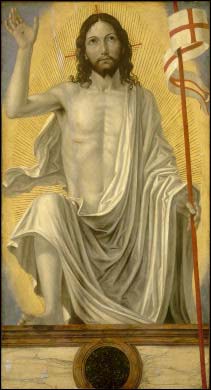 Ambrogio di Stefano Bergognone (Milanese painter, ca. 1460-1523), Christ Risen from the Tomb (c. 1490), National Gallery of Art, Washington, DC. Larger image. |
We've considered resurrection in the Old and New Testaments, studied the events of Jesus' resurrection on the third day, and examined the convincing proofs that Jesus is indeed risen from the dead. But those things are past events. What does the resurrection mean to us now?
It is very difficult to be comprehensive about the meaning of the resurrection. It is mentioned specifically in 18 of the 27 New Testament books and implied in the rest, so there are many verses that relate to this subject. However, as I survey the New Testament, four overarching themes stand out to me:
- Jesus' Resurrection Is God's Seal of Approval on Jesus
- Jesus' Resurrection Validates our Salvation
- Jesus' Resurrection Typifies our Spiritual Union with Him
- Jesus' Resurrection Is the Harbinger of our Own Resurrection on the Last Day
1. Jesus' Resurrection Is God's Seal of Approval on Jesus
The first theme is that Jesus' resurrection is God's vindication of Jesus' life, ministry, person, and divinity.
When Jesus died a criminal's death on the hill of Golgotha outside of Jerusalem, hope died with him. His disciples and many others had come to believe in him as the Messiah. Some even believed he was the Son of God, that is, divine. Then the scourge tore into his back, merciless nails were pounded through his hands and feet, his body was jerked erect as the cross was pulled vertical and dropped into its hole in the parched earth. For six hours he hung there and finally died. His disciples took his body down and tenderly buried him.
But that day a glorious movement of the Kingdom of God was buried, too. Or so it seemed. Then Easter morning God raised him from the dead. It was as if God was attesting to the authenticity of his Son, validating his teachings, and saying in the most unmistakably graphic terms what he had said in words at Jesus' Baptism: "This is my beloved Son, in whom I am well pleased" (Matthew 3:17). This was a strong element of early preaching in Jerusalem, which contrasted the Jews' killing of Jesus with God's raising him:
"God has raised this Jesus to life.... Therefore let all Israel be assured of this: God has made this Jesus, whom you crucified, both Lord and Christ." (Acts 2:32, 36)
"The God of our fathers raised Jesus from the dead -- whom you had killed by hanging him on a tree. God exalted him to his own right hand as Prince and Savior that he might give repentance and forgiveness of sins to Israel." (Acts 5:30-31)
"For he has set a day when he will judge the world with justice by the man he has appointed. He has given proof1 of this to all men by raising him from the dead." (Acts 17:31)
"[He] was declared with power to be the Son of God by his resurrection from the dead: Jesus Christ our Lord." (Romans 1:4)
It is one thing for claims to be made about who Jesus was. But God set his own seal upon him at the resurrection validating those claims. After all, if God has raised him from the dead, who but a fool would try to prove that he is a mere man.
| Q1. What kind of credibility would Jesus'
ministry have had if he were not raised from the dead,
especially when he predicted it ahead of time? In what way is
the resurrection God's seal of approval on him? https://www.joyfulheart.com/forums/index.php?showtopic=580
|
2. Jesus' Resurrection Validates our Salvation
A related theme is more specific, that Jesus' resurrection validates our own salvation. I've often pondered over a passage in Romans:
"He was delivered over to death for (dia) our sins and was raised to life for (dia) our justification." (Romans 4:25)
A simplistic way to construe this is to assume that Jesus' death on the cross atoned for our sins, while in a separate event Jesus' resurrection took care of declaring us pardoned and blameless. The key word in this verse is the preposition dia, used in both clauses, which can mean either "because of" (retrospective) or "with a view to, to bring about" (prospective).2
But I don't think Paul sees these as separate events, but both part of the whole, in a construction reminiscent of Hebrew synoptic parallelism or progressive parallelism that we often see in Hebrew poetry. What is sure is that the resurrection here validates our salvation and completes it. Indeed, without the resurrection, Jesus' death would mean ... only that he was dead. As Paul indicates in the strongest possible terms:
"13 If there is no resurrection of the dead, then not even Christ has been raised. 14 And if Christ has not been raised, our preaching is useless and so is your faith. 15 More than that, we are then found to be false witnesses about God, for we have testified about God that he raised Christ from the dead. But he did not raise him if in fact the dead are not raised. 16 For if the dead are not raised, then Christ has not been raised either. 17 And if Christ has not been raised, your faith is futile; you are still in your sins. 18 Then those also who have fallen asleep in Christ are lost. 19 If only for this life we have hope in Christ, we are to be pitied more than all men." (1 Corinthians 15:13-19)
It is because Christ has been raised from the dead that we have assurance or proof that God has completed our salvation. Because God vindicated Jesus by raising him from the dead, we know that his promises of forgiveness of sins are true, that we have been saved, rescued, delivered. Several times the resurrection is referred to as the basis of our confidence in salvation:
"Who will bring any charge against those whom God has chosen? It is God who justifies. Who is he that condemns? Christ Jesus, who died -- more than that, who was raised to life -- is at the right hand of God and is also interceding for us." (Romans 8:33-34)
"Through him you believe in God, who raised him from the dead and glorified him, and so your faith and hope are in God." (1 Peter 1:21)
"Therefore, since we have a great high priest who has gone through the heavens, Jesus the Son of God.... Let us then approach the throne of grace with confidence, so that we may receive mercy and find grace to help us in our time of need." (Hebrews 4:14, 16)
Because he lives we have confidence that our salvation is not a pipe dream based on empty hopes, but a firm expectation based on Jesus' resurrection from the dead.
| Q2. In what way does Christ's
resurrection somehow validate that we are saved and forgiven
by God? If we didn't believe Christ had been actually raised
from the dead, how might we have doubts about our salvation? https://www.joyfulheart.com/forums/index.php?showtopic=581
|
3. Jesus' Resurrection Typifies our Spiritual Union with Him
A third theme in the New Testament that expresses Jesus' death and resurrection as a kind of analogy to our spiritual life. This gets a bit complex, so hang in here with me. Paul is arguing that we must stop living in sin:
"Don't you know that all of us who were baptized into Christ Jesus were baptized into his death? We were therefore buried with him through baptism into death in order that, just as Christ was raised from the dead through the glory of the Father, we too may live a new life. If we have been united (sumphutos4) with him like this in his death, we will certainly also be united with him in his resurrection." (Romans 6:3-5)
Here Paul sees the act of baptism as a type of Jesus' own death and resurrection, and a vivid reminder of our union with him in both his death and resurrection.
| Christ | Death and burial | Resurrection |
| Baptism | Immersed in the water | Brought out of the water |
| Believers | United with him in his death | Shall be united with him (in the future) in his resurrection |
In Colossians we find a similar figure:
"... Having been buried with him in baptism and raised with him through your faith in the power of God, who raised him from the dead." (Colossians 2:12)
As A.T. Robertson puts it, "Baptism is a picture of the past and of the present and a prophecy of the future, the matchless preacher of the new life in Christ."5
Peter, too, carries on this theme of resurrection as a symbol of regeneration:
"In his great mercy he has given us new birth into a living hope through the resurrection of Jesus Christ from the dead...." (1 Peter 1:3)
In a number of passages, Paul speaks of being co-crucified with Christ and co-resurrected with Christ, beginning with the Romans 6 baptismal passage we just looked at, which continues:
"6 For we know that our old self was crucified with him.... 8 Now if we died with Christ, we believe that we will also live with him.... 11 In the same way, count yourselves dead to sin but alive to God in Christ Jesus." (Romans 6:6, 8, 11)
Elsewhere, Paul repeats this theme, with the same ethical imperative to live out our "new life" with integrity:
"I have been crucified with Christ and I no longer live, but Christ lives in me. The life I live in the body, I live by faith in the Son of God, who loved me and gave himself for me." (Galatians 5:20)
"Since, then, you have been raised with Christ, set your hearts on things above, where Christ is seated at the right hand of God. Set your minds on things above, not on earthly things. For you died, and your life is now hidden with Christ in God. When Christ, who is your life, appears, then you also will appear with him in glory." (Colossians 3:1-4)
We also see Jesus' resurrection and subsequent ascension to glory at the Father's right hand as a type of our own spiritual life:
"That power is like the working of his mighty strength, which he exerted in Christ when he raised him from the dead and seated him at his right hand in the heavenly realms..." (Ephesians 1:19b-20)
"1 As for you, you were dead in your transgressions and sins.... 4b But because of his great love for us, God, who is rich in mercy, 5 made us alive with Christ even when we were dead in transgressions -- it is by grace you have been saved. 6 And God raised us up with Christ and seated us with him in the heavenly realms in Christ Jesus...." (Ephesians 2:1, 4b-6)
At Christ's right hand we share his power and privileges in the spiritual world. Our being co-raised with Christ typifies the grace of God to us. This may be a spiritual expression, but if you have tasted of its reality, then you know something of the wonder of what Paul is expressing here.
| Q3. How does Christ's death and
resurrection provide an analogy for baptism according to
Romans 6:3-5 and Colossians 2:12? According to Ephesians
2:4-6, while being "raised with Christ" is still spiritual,
not physical, in what way does this union impart real
spiritual power? https://www.joyfulheart.com/forums/index.php?showtopic=582
|
4. Jesus' Resurrection Is the Harbinger of our Own Resurrection on the Last Day
Our resurrection is not only a spiritual metaphor. The New Testament is abundantly clear that Christ's resurrection is a harbinger or precursor of our own resurrection at the Last Day. We'll study this in greater detail in the final lesson in this series, but for now, let's observe that in Christ's resurrection is the promise of our own. Of the many New Testament promises along this line, here are a few:
"By his power God raised the Lord from the dead, and he will raise us also." (1 Corinthians 6:14)
"... The one who raised the Lord Jesus from the dead will also raise us with Jesus and present us with you in his presence." (2 Corinthians 4:14)
Christ's resurrection from the dead is the first, the prototype resurrection, but it is not to be the last. He is "the firstfruits of those who have fallen asleep" (1 Corinthians 15:20), "the firstborn from the dead" (Revelation 1:5) He opens up the way for the rest of us:
"I am the Living One; I was dead, and behold I am alive for ever and ever! And I hold the keys of death and Hades." (Revelation 1:18)
That is our promise, that Christ's resurrection is the focus of our own hope for eternal life. Not just some kind of disembodied immortal soul, but a bodily resurrection like Christ's own. As Job fervently hoped nearly three thousand years ago.
"I know that my Redeemer lives,
and that in the end he will stand upon the earth.
And after my skin has been destroyed,
yet in my flesh I will see God;
I myself will see him
with my own eyes -- I, and not another.
How my heart yearns within me!" (Job 19:25-27)
| Q4. What assurance do you have that you
will be physically resurrected rather than experience
disembodied immortality? What does it mean that Jesus is the
"firstfruits" (1 Corinthians 15:20) and "firstborn"
(Revelation 1:5) from the dead? https://www.joyfulheart.com/forums/index.php?showtopic=583
|
Indeed, the resurrection of Christ is a central theme in the New Testament. Because of his resurrection we are assured:
- That he is indeed the divine Son of God,
- That our sins are forgiven and our salvation is secure,
- That we are united with him and the power of his resurrection, and
- That we too will be bodily raised from the dead as he was.
For the Apostle Paul, the resurrection was an integral part of his fervent prayer for the present and his longing for the future:
"I want to know Christ and the power of his resurrection and the fellowship of sharing in his sufferings, becoming like him in his death, and so, somehow, to attain to the resurrection from the dead." (Philippians 3:10-11)
The Encouragement of Resurrection
What effect is Christ's resurrection and the hope of our own resurrection to have on us Christians? Paul concludes 1 Corinthians 15 with these words, beginning with a "therefore" that sums up the entire chapter's hope of resurrection:
"Therefore, my beloved brethren, be steadfast, immovable, always abounding in the work of the Lord, knowing that in the Lord your labor is not in vain." (1 Corinthians 15:58, RSV)
You may have faced -- or be facing -- horrendous challenges as you seek to follow Christ in this life. Don't become discouraged. You may be feeling that your body is giving out, falling apart. Don't quit. On the solid hope of the resurrection to come, Paul exhorts us with these words.
"Steadfast"
is hedraios, "pertaining to being firmly or solidly in place, firm, steadfast."6"Immovable"
is ametakinētos, "unshifting, unchanging, immovable."7 The words of a great African American spiritual develop this theme from Psalm 1:"I shall not be, I shall not be moved,
I shall not be, I shall not be moved,
Just like a tree planted by the water, Lord,
I shall not be moved!"
Paul exhorted the Colossian believers to: "Continue in your faith, established and firm, not moved from the hope held out in the gospel" (Colossians 1:23). Don't be shaken by the world that is crashing and burning around you. "Let nothing move you!" (1 Corinthians 15:58, NIV).
The next phrase is "always abounding in the work of the Lord." "Abounding" is perisseuō, "to be in abundance, abound." With regards to wealth, the word denotes, "be extremely rich or abundant, overflow." With regards to people serving Christ it means, "be outstanding, be prominent, excel."8
In our weariness, in our times of discouragement and despair, we are to remember whose work this is -- the Lord's! Paul then mentions your "labor" (kopos), "engagement in activity that is burdensome, work, labor, toil"9 -- and that sometimes describes our work for the Lord. But two phrases modify "labor" here and make all the difference:
- Not in vain. Kenos means "empty," which means here "pertaining to being without purpose or result, in vain."10 Your work is not empty, not in vain. Why? The next phrase explains that it is:
- In the Lord. It isn't your work, but the Lord's work. It isn't your labors, but the task to which he, the Lord of the Harvest, has set you to do for him. No matter that things don't always come together. Your work counts because it is his work, conducted for him in obedience to him. Others may discount it, but he doesn't forget. Your labor is "in the Lord."
 Now all the lessons are available together in e-book and printed book formats. |
My dear friend, Christ is risen! And the promise of resurrection is yours also. Your work, as small as it may seem sometimes, is "in the Lord" and valued by him. So your mission, should you choose to accept it, is to remain "steadfast, immovable, always abounding in the work of the Lord." Why? Christ the Risen One is coming and when he comes we shall rise from the dead in glory! It will be worth it!
What is the meaning of the resurrection for us today? Bill and Gloria Gaither put it rather clearly in their popular song:
"Because He lives I can face tomorrow
Because He lives all fear is gone
Because I know He holds the future
And life is worth the living
Just because He lives."11
| Q5. (1 Corinthians 15:58) What does
being steadfast and immovable have to do with the hope of the
resurrection? Why is our labor not in vain in the
Lord? https://www.joyfulheart.com/forums/index.php?showtopic=584
|
Prayer
Father, thank you for the joy, assurance, and hope that we believers can have through the resurrection. Bring it even sharper into focus for us as we seek to know you better in the power of Christ's resurrection. In Jesus' name, we pray. Amen.Key Verses
"God has raised this Jesus to life.... Therefore let all Israel be assured of this: God has made this Jesus, whom you crucified, both Lord and Christ." (Acts 2:32, 36)"Don't you know that all of us who were baptized into Christ Jesus were baptized into his death? We were therefore buried with him through baptism into death in order that, just as Christ was raised from the dead through the glory of the Father, we too may live a new life. If we have been united with him like this in his death, we will certainly also be united with him in his resurrection." (Romans 6:3-5)
"And if Christ has not been raised, your faith is futile; you are still in your sins." (1 Corinthians 15:17)
References
- Pistis here has the older classical meaning of "guarantee" or "assurance" in the sense of a pledge or oath with the two nuances of "trustworthiness" and "proof" (Rudolf Bultmann, pisteuō, ktl., TDNT 6:197-228; cf. Robertson, Word Pictures, in loc.).
- William Sanday and Arthur C. Headlam, A Critical and Exegetical Commentary on the Epistle to the Romans (International Critical Commentary; Fifth Edition; Edinburgh: T&T Clark, 1902), p. 116; John Murray, The Epistle to the Romans (New International Commentary on the New Testament; Eerdmans, 1959, one volume edition 1968), p. 154-157; C.K. Barrett, A Commentary on the Epistle to the Romans (Harper's New Testament Commentaries; Harper & Row, 1957), p. 100; Leon Morris, The Epistle to the Romans (Pillar Commentary; Eerdmans, 1988), pp. 214-216.
- The phrase "gone through the heavens," of course, refers specifically to Jesus' ascension and glorification at the right hand of the Father. It assumes, of course, the resurrection that preceded it.
- "United" (NIV, NRSV) "planted together" (KJV) is sumphutos, from sumphuō, "planted together, born together with, of joint origin," then "grown together, united with" (Thayer, 2.).
- Robertson, Word Pictures, on Romans 6:5. In a difficult passage, 1 Peter 3:21 also refers to this association with baptism, resurrection, and new life.
- Hedraios, BDAG 276.
- Ametakinētos, BDAG 53.
- Perisseuō, BDAG 805.
- Kopos, BDAG 558-559, 2.
- Kenos, BDAG 539, 3.
- "Because He Lives," words and music by William J. and Gloria Gaither (© 1971, William J. Gaither, Inc.; Gaither Copyright Management)
Copyright © 2026, Ralph F. Wilson. <pastor joyfulheart.com> All rights reserved. A single copy of this article is free. Do not put this on a website. See legal, copyright, and reprint information.
 To be notified about future articles, stories, and Bible studies, why don't you subscribe to our free newsletter, The Joyful Heart, by placing your e-mail address in the box below. We respect your