


|
Old Testament
New Testament
Gospels
Acts
Paul's Letters
General Letters
Revelation
Topical Studies
Beginning the Journey (for new Christians). en Español

|
Old Testament
New Testament
Gospels
Acts
Paul's Letters
General Letters
Revelation
Topical Studies

|
Home
Bible Studies
Articles
Books
Podcasts
Search
Menu
Donate
About Us
Contact Us
FAQ
Sitemap


9. A Partnership in Giving and Receiving (Philippians 4:10-23)
Audio (30:59)
Free
E-mail Bible Study
 Names and Titles of God
Home | Bible Studies | Articles | Books | Podcasts | Search | Menu | Donate | About Us | FAQ | Contact Us
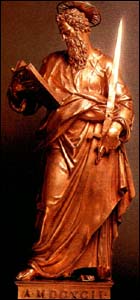 'St. Peter' (c. 1585) Sebastiano Torrigiani (Italian sculptor, d. 1596), Gilt bronze, height 87.6 cm, St. Peter's, Rome, Vatican. |
Paul has taught the Philippian believers how to pray. He has imparted the urgency of his own heart to know Christ in all his fullness. He has instructed them about humility and Christ's example, about sanctification, and about Christian character. Now he concludes with a few personal notes that reveal even more promises for our Christian lives.
The Philippians' Concern for Paul (4:10)
He begins with rejoicing, a characteristic theme of this letter.
"I rejoice greatly in the Lord that at last you have renewed your concern for me. Indeed, you have been concerned, but you had no opportunity to show it." (4:10)
This is not just rejoicing, but great rejoicing in the Philippians' concern for him. They have sent money to him again and again. He wants to tell them how much their concern means to him, but without sounding needy or greedy -- and without offending them. He is walking a fine line.
Poverty and Wealth (4:11-12)
"I am not saying this because I am in need, for I have learned to be content whatever the circumstances. 12I know what it is to be in need, and I know what it is to have plenty. I have learned the secret of being content in any and every situation, whether well fed or hungry, whether living in plenty or in want." (4:11-12)
In Paul's current situation he is in need of help from others, since he can't work and must pay for rent and food for his private dwelling (Acts 28:30-31). "Need" (NIV, NRSV) and "want" (KJV) in verse 11 is the Greek noun hysterēsis, "the condition of lacking that which is essential, "need, lack, poverty" (the related verb hystereō is in 4:12c).[212]
But he talks about need and plenty as exterior conditions, none of which affect his inner life. He uses three pairs of words to describe this.
4:12a - "have plenty" (perisseuō[213]) vs. "in need" (tapeinoō[214])
4:12b -- "well fed" (chortazō[215]) vs. "hungry" (peinaō[216])
4:12c -- "in plenty (perisseuō) vs. "in want" (hystereō[217])
Some preachers teach that poverty is a curse and that a faith-filled Christian's inheritance here on earth is prosperity.[218] I doubt that Paul would have subscribed to such a teaching. For him it would have run counter to a Christian's need to be at Jesus' disposal, rather than seeking the luxuries of life. "Endure hardship with us," he told Timothy, "like a good soldier of Christ Jesus" (2 Timothy 2:3). If luxuries come, "Praise the Lord!" If poverty is our lot, "Praise the Lord anyway." Paul has seen both in his lifetime. His apostolic mission has required intense hardship. To the Corinthian church he recounted:
"Five times I have received from the Jews the forty lashes minus one. Three times I was beaten with rods. Once I received a stoning. Three times I was shipwrecked; for a night and a day I was adrift at sea; on frequent journeys, in danger from rivers, danger from bandits, danger from my own people, danger from Gentiles, danger in the city, danger in the wilderness, danger at sea, danger from false brothers and sisters; in toil and hardship, through many a sleepless night, hungry and thirsty, often without food, cold and naked." (2 Corinthians 11:24-27)
On the other hand, at times he had been entertained by wealthy Christians who insisted that he accept their hospitality (Acts 16:14-15). He had seen the extremes of poverty and abundance.
Q1. (4:11-12) How can a "prosperity doctrine" threaten
Christian ministry? To what prime motivation in us does such a teaching often
appeal? In balance, what does the Bible teach about poverty and riches?
https://www.joyfulheart.com/forums/index.php?act=ST&f=81&t=337
Christian Contentment (4:11-13)
"11 I am not saying this because I am in need, for I have learned to be content whatever the circumstances. 12 I know what it is to be in need, and I know what it is to have plenty. I have learned the secret of being content in any and every situation, whether well fed or hungry, whether living in plenty or in want. 13 I can do everything through him who gives me strength." (4:11-13)
Though I am sure he preferred ease rather than stress, none of these outward conditions moved him because his life was centered elsewhere. To the Colossian church he had written:
"Since, then, you have been raised with Christ, set your hearts on things above, where Christ is seated at the right hand of God. Set your minds on things above, not on earthly things. For you died, and your life is now hidden with Christ in God." (Colossians 3:1-3)
Though Paul had his eyes set on an other-worldly goal, he very much lived in this world -- trusting Christ at each step of the journey, in each crisis and in each victory.
"I have learned the secret of being content in any and every situation," he says. "Content" is the Greek adjective autarkēs, "content, self-sufficient, satisfied."[219] The term was used in ancient Greek Stoic and Cynic ethics as the essence of all virtues. The Stoics taught that "man should be sufficient unto himself for all things, and able, by the power of his own will, to resist the force of circumstances."[220] Seneca observed, "The happy man is content with his present lot, no matter what it is, and is reconciled to his circumstances."[221]
But Paul is no Stoic. Instead of claiming self-sufficiency, he claims God-sufficiency. It isn't sure that he used the word in its Stoic sense at all, but rather in a more general sense that was widely used in everyday life, "sufficient quantity."[222] His sufficiency is in Christ alone.
Apparently his realization that Christ's strength was sufficient came as a sudden realization. The verb translated "learned the secret" uses Greek tenses that indicate the realization had happened suddenly at a particular point in time in the past.[223] At one point Paul is struggling with his circumstances. Then it dawns on him that Christ is sufficient to any circumstance in which he might find himself!
Paul uses an interesting Greek verb to describe this revelation. "Learned the secret" (NIV, NRSV) and "am instructed" (KJV) is the verb mueō, a technical term of the mystery religions, "initiate (into the mysteries)." Then generally, "to teach fully, instruct; to accustom one to a thing; to give one an intimate acquaintance with a thing."[224]
I Can Do All Things through Christ (4:13)
When Paul learned this we don't know, but it has become a way of life for him, a way of life that he passes on to his readers:
"I can do everything through him who gives me strength." (4:13)
The Greek text used as the basis of the King James Version includes the phrase "through Christ" instead of "through him," but the earlier Greek manuscripts didn't include "through Christ."[225] Of course, the meaning is the same whichever text is used.
Paul sees Christ as the source of his strength. "Can do" is the verb ischuō, "be strong, prevail," which means here "to have requisite personal resources to accomplish something, have power, be competent, be able."[226] "Strengthens" (NRSV) is the verb endynamoō, "cause to be able to function or do something, strengthen," from dynamoō, "strengthen," and dynamis, "power, might, strength."[227]
Quoted out of context, some have held that this verse teaches that Paul can do anything he wants to. But in context, it means that Paul can rely on Christ's strength to face any circumstance that comes to him in the course of his life and ministry. An old gospel hymn draws on these dual themes of contentment and a reliance on Jesus' strength:
"I am weak, but Thou art strong;
Jesus, keep me from all wrong;
I'll be satisfied as long
As I walk, let me walk close to Thee."[228]
Paul's statement has power. Many times we feel weak and inadequate, but now we can have both hope and courage. This verse teaches that nothing you face is too great for Christ who will strengthen you for the occasion.
Q2. (4:11-13) What is the basis of Paul's contentment?
Does this contentment undermine ambition? What is necessary for us to achieve
this kind of contentment?
https://www.joyfulheart.com/forums/index.php?act=ST&f=81&t=338
Profit Accruing to an Investment in Ministry (4:14-16)
Paul worked through the awkwardness of both thanking the Philippian church for their financial help -- and saying that he isn't fishing for more -- at the same time insisting that Christ is his sufficiency. Now he continues with thankfulness, recounting their record of giving:
"14 Yet it was good of you to share in my troubles. 15 Moreover, as you Philippians know, in the early days of your acquaintance with the gospel, when I set out from Macedonia, not one church shared with me in the matter of giving and receiving, except you only; 16 for even when I was in Thessalonica, you sent me aid again and again when I was in need. 17 Not that I am looking for a gift, but I am looking for what may be credited to your account. 18 I have received full payment and even more; I am amply supplied, now that I have received from Epaphroditus the gifts you sent." (4:14-18)
It seems sad that the Philippian church was the only regular contributor in those early days of Paul's ministry. Later on it may have been different, but in the early days, the Philippians were God's financial lifeline for Paul. Sometimes we think that missionaries have many churches supporting them. Many times it is only a few. Your church can make a difference in getting the gospel out!
"The matter of giving and receiving" is an interesting phrase. Both verses 15 and 17 contain words that were commonly used in commercial transactions:
"Share" is the verb koinōneō, "to share, have a share," here "give or contribute a share."[229] The Philippians' financial investment made them shareholders or partners in the missionary enterprise in which Paul was engaged. The RSV translates this "entered into partnership."
"Account" (Goodspeed, Williams), "matter" (NIV, NRSV, NASB) and "concerning" (KJV) is the Greek noun logos. The prepositional phrase eis logon is a commercial technical term meaning "in settlement of an account." With "giving and receiving" it may mean "in settlement of a mutual account."[230]
"Giving" is Greek dosis, "giving, debit."[231]
"Receiving" is Greek lēmpsis, "receiving, credit."[232]
"Credited" (NIV), "abound" (KJV), and "accumulates" (NRSV) is the verb pleonazō, "become great, grow, increase."[233]
"Profit" (NRSV) or "fruit" (KJV) is the noun karpos, "fruit," which here has the sense of "advantage, gain, profit"[234] that is resulting from the investment.
"Account," Greek logos, is the same word we saw in verse 16.
It is quite clear that Paul thought of the Philippians' financial contributions (and sending Epaphroditus to assist) in terms of a business partnership -- Paul supplied the labor while the Philippians supplied the financial backing. The "profit" or "fruit" that resulted in men, women, and children won to Christ and serving as disciples in new churches -- that was credited to their heavenly account just as much as it was to Paul's account. They would both share in the reward. The idea here is that as the enterprise matures, the investor will receive more than he has invested. Both the ideas of reciprocity and multiplication are present.
I know that some televangelists have shamelessly manipulated supporters with this partnership analogy, usually by appealing to their greed.
Financial Investment with a Spiritual Return
However, the concept of financial investment with a greater return is clearly supported in Scripture. You can also see glimpses of this idea of reciprocity (giving and receiving) and increase in God's promise to tithers in Malachi:
"Bring the whole tithe into the storehouse, that there may be food in my house. Test me in this," says the LORD Almighty, "and see if I will not throw open the floodgates of heaven and pour out so much blessing that you will not have room enough for it." (Malachi 3:10)
Paul expresses the principle in an agricultural context of sowing and reaping:
"6Remember this: Whoever sows sparingly will also reap sparingly, and whoever sows generously will also reap generously. 7Each man should give what he has decided in his heart to give, not reluctantly or under compulsion, for God loves a cheerful giver. 8And God is able to make all grace abound to you, so that in all things at all times, having all that you need, you will abound in every good work.... 10Now he who supplies seed to the sower and bread for food will also supply and increase your store of seed and will enlarge the harvest of your righteousness. 11You will be made rich in every way so that you can be generous on every occasion, and through us your generosity will result in thanksgiving to God." (2 Corinthians 9:6-8, 10-11)
Jesus himself taught this principle of giving and receiving:
"Give, and it will be given to you. A good measure, pressed down, shaken together and running over, will be poured into your lap. For with the measure you use, it will be measured to you." (Luke 6:38)
"Anyone who receives a prophet because he is a prophet will receive a prophet's reward, and anyone who receives a righteous man because he is a righteous man will receive a righteous man's reward. And if anyone gives even a cup of cold water to one of these little ones because he is my disciple, I tell you the truth, he will certainly not lose his reward." (Matthew 10:41-42)
The principle of receiving a reward also is involved in giving to the poor:
"He who is kind to the poor lends to the LORD,
and he will reward him for what he has done." (Proverbs 19:17)
"When you give a luncheon or dinner, do not invite your friends, your brothers or relatives, or your rich neighbors; if you do, they may invite you back and so you will be repaid. But when you give a banquet, invite the poor, the crippled, the lame, the blind, and you will be blessed. Although they cannot repay you, you will be repaid at the resurrection of the righteous." (Luke 14:12-14)
You've probably heard the cliché, "You can't outgive God!" But, dear friends, if Scripture is true, and I believe that it is, this is no cliché, but a spiritual truth. There are dividends on the investment now in this life, as well as far into eternity.
Have you been afraid to really tithe (I mean give 10% of your income) to your church for fear that you wouldn't have enough money? Meditate on the insights of these passages and let faith begin to raise your sights.
Q3. (4:14-16) How were the Philippians' financial gifts
credited to their heavenly account, do you think? How was their giving linked to
temporal blessings?
https://www.joyfulheart.com/forums/index.php?act=ST&f=81&t=339
A Fragrant Offering (4:18)
Now Paul moves from the sphere of commercial vocabulary to the sphere of sacrificial vocabulary. How does God look on our offerings? As merely our due? No, not when offered for the right motive of love...
"They are a fragrant offering, an acceptable sacrifice, pleasing to God." (4:18)
The barbecue smell of burnt offerings is perhaps the basis of "fragrant offering," spoken of in both the Old and New Testaments (Genesis 8:21; Exodus 29:18, 25, 41; Leviticus 1:9, 13, 17; 2 Corinthians 2:15-16; Ephesians 5:2).
An "acceptable sacrifice" refers to it being a sacrifice that God has prescribed and that is appropriate (2 Peter 2:5; Romans 12:1; 15:16; 1 Peter 2:5). The idea of a sacrifice that is pleasing to God has an ancient history that goes back to the tabernacle in the wilderness (Exodus 28:38; Leviticus 1:3; 7:18; 22:19-20; Proverbs 21:3; Jeremiah 6:20). "Pleasing to God" is another rich sacrificial theme. The purpose of sacrifice is not selfish -- to remove our sin -- but Godward, to please God and express our love to him (Hebrews 13:16).
What is the motivation for your financial gifts to God's kingdom? Guilt? Obedience to a law? Earning points to offset your bad deeds? Greed? Or it is love -- a heart's desire to please your Father?
God Will Abundantly Meet Every Need (4:19-20)
After thanking the Philippian believers for their generous financial gifts, Paul offers them a wonderful promise:
"And my God will meet all your needs according to his glorious riches in Christ Jesus. To our God and Father be glory for ever and ever. Amen." (4:19-20)
This is one of my favorite promises in the Bible. It is not a general promise, however, but one conditioned upon giving of your own resources to God and his kingdom work. The promise has three parts:
"And my God." Paul isn't being possessive here, but confident. This is the God he knows and has served for the past 30 years. He know the character of his God and trusts him. God has met Paul's needs, so he offers his assurance and pride in his God by the phrase "and my God..."
"Will meet all your needs." "Meet" (NIV), "supply" (KJV), "fully satisfy" (NRSV) is the Greek verb plēroō, "to make full, fill, fulfill,"[235] "will fully supply."[236] Some, such as Chrysostom and Luther, have seen this as a wish-prayer or petition for the church: "May God fill your every need...." But the future indicative verb here indicates here a clear declaration or promise.[237] What need (chreia, "need, lack, want, difficulty"[238]) do you have? God has promised to fully supply whatever (pas, "each, every, any") need you have! Notice that the promise is to supply needs, though God may not supply them the way you want. Watch, however, to see just how God keeps his word to you regarding your needs.
"According to his glorious riches in Christ Jesus." The first of these two prepositional phrases speaks to the degree of fulfillment. The preposition kata is a "marker of norm of similarity or homogeneity, 'according to, in accordance with, in conformity with.'"[239]The fulfillment of the need will be to the extent of and on the scale of God's "riches." The noun ploutos refers first to an "abundance of many earthly goods, wealth." Then it can be extended to "a plentiful supply of something, a wealth, an abundance."[240] The noun "riches" is modified by the two prepositional phrases: (1) "in glory" (KJV, NRSV) translated "glorious riches" in the NIV; and (2) "in Christ Jesus."
The extent to which God will meet your needs is relative to the scale of his bank account, not yours! You may be so far down in resources -- financial, emotional, social, familial, spiritual -- that you can't imagine any way that God could help you. But his resources, his "glorious wealth" is the measure from which God will meet your needs. Don't think small. Pray and expect that God will "fully provide for" your needs. Most of the time our hesitance to believe that God will fully meet our needs is based more on our unbelief than our humility.
I've met people who are hesitant to pray that God would meet their needs on the basis that it might trouble him and that he shouldn't be troubled by something as small as your need. But that is false doctrine. If God were to meet your need one hundred times in excess of your need, it would not draw down his resources or his wealth. Not one bit! You cannot deplete God's wealth by answered prayer.
I encourage you to meditate on this verse -- in context. Give to God and to others so that you meet the conditions of the context -- the Philippians were generous givers. Then don't hesitate to "let your requests be made known to God" (4:6, KJV). And trust God to meet the need no matter how great.
Jesus taught much the same thing in the Sermon on the Mount to disciples who were worrying about what they would eat and what they would wear. Jesus acknowledged, "Your Father knows that you need them." Then he gave this command:
"But seek first his kingdom and his righteousness and all these things will be given[241] to you as well" (Matthew 6:33).
Q4. (4:19-20) In this context, what is the condition that
must be met for the promise to be valid? What is the limit of the fulfillment of
the promise? In your own words, what does the promise mean to you?
https://www.joyfulheart.com/forums/index.php?act=ST&f=81&t=340
Final Greetings (4:21-22)
Now Paul's letter is drawing to a close.
"Greet all the saints in Christ Jesus. The brothers who are with me send greetings. All the saints send you greetings, especially those who belong to Caesar's household." (4:20-22)
Though mention of Caesar's household doesn't prove that Paul was in Rome (it could refer to Caesar's servants in Caesarea, for example), it is another way that Paul is pointing to the spiritual revival taking place because of his imprisonment and contact with guards and others in the service of Caesar. What sweet irony! Paul sends warm Christian greetings from the servants of the church's arch enemy, the Roman emperor.
Benediction (4:23)
Paul concludes with a benediction, similar to how he concludes his other letters:
"The grace of the Lord Jesus Christ be with your spirit. Amen." (4:23)
 Available in PDF, Kindle, and paperback formats |
Paul begins and ends with grace. In some of his letters he concludes with the prayer that grace will "be with you" (Romans 16:20; 1 Corinthians 16:23; 2 Corinthians 13:14). "Be with your spirit" strengthens and individualizes this grace-benediction, to denote that Christ's grace is "to rest and abide upon the spirit of each one of his readers."[242]
Paul's final word to the Philippians is his response to this benediction: "Amen!"-- "it is true."
Prayer
Father, thank you for the wonder of your gracious promises to us. You don't owe us anything. You don't have to obligate yourself to us by promises. But you do because of your amazing love for us in Christ Jesus. I believe, help my unbelief. Help me to grow in faith so that my faith in your promises may honor you with the response of belief, rather than dishonor you with unbelief. In Jesus' name, I pray. Amen.
Key Verses
"I know what it is to be in need, and I know what it is to have plenty. I have learned the secret of being content in any and every situation, whether well fed or hungry, whether living in plenty or in want. I can do everything through him who gives me strength." (Philippians 4:12-13)
"And my God will meet all your needs according to his glorious riches in Christ Jesus." (Philippians 4:19)
Endnotes
[212] Hysterēsis, BDAG 1044. The related verb is used in verse 12 -- hystereō.
[213] "Have plenty" (NIV, NRSV) and "abound" (KJV) is the verb perisseuō, "to be in abundance, abound, be rich" (BDAG 805).
[214] "Be in need" (NIV), "be abased" (KJV), and "to have little" (NRSV) is the verb tapeinoō, "to lower." Here it has the meaning "to be subject to strict discipline, constrain, mortify," an austere regimen: "I know how to do with little" (BDAG 990).
[215] "Well fed" (NIV, NRSV) and "be full" (KJV) is the verb chortazō, to fill with food, "feed, fill" (BDAG 1087).
[216] "Hungry" is the verb peinaō, to feel the pangs of lack of food, "hunger, be hungry" (BDAG 792).
[217] The basic meaning of hystereō is "to miss." In verse 12 it connotes "to experience deficiency in something advantageous or desirable, "lack, be lacking, go without, come short of" (BDAG 1043-1044).
[218] For a more extended discussion, see my article, "A Brief Critique of the Prosperity Message," in 2 Corinthians: Discipleship Lessons (JesusWalk, 2011), chapter 10. (www.jesuswalk.com/2corinthians/prosperity-message.htm).
[219] Autarkēs, BDAG 152; O'Brien 520.
[220] Autarkēs, Vincent 143.
[221] Seneca, De Vita Beata 6, cited by O'Brien 521.
[222] Gerhard Kittel, "arkeō, ktl," TDNT 1:466-467.
[223] In 4:11 it uses the Aorist tense (single point in past time). In 4:12 it is found in the perfect tense.
[224] Mueō, BDAG 660; Thayer.
[225] "Through Christ" is included in Greek manuscripts: Aleph2 D2 L P etc. It is lacking in Aleph B D* I etc.
[226] Ischuō, BDAG 484.
[227] Endynamoō, BDAG 333.
[228] Author unknown, traditional folk song.
[229] Koinōneō, BDAG 552.
[230] Logos, BDAG 600-601.
[231] Dosis, BDAG 259.
[232] Lēmpsis, BDAG 593.
[233] Pleonazō, BDAG 824.
[234] Karpos, BDAG 509-510.
[235] Plēroō, BDAG 827-829.
[236] O'Brien 545.
[237] O'Brien 545-546.
[238] Chreia, BDAG 1088.
[239] Kata, BDAG 511-513, 5. Fee (453-454) takes kata as "in keeping with" ... "in accordance with this norm," not "out of."
[240] Ploutos, BDAG 832.
[241] Prostithēmi, "to add to something that is already present or exists, add, put to," then "to provide, give, grant" (BDAG 885).
[242] G.F. Hawthorne, Philippians (Word Bible Commentary; 1983), p. 215, cited in O'Brien 555.
Copyright © 2026, Ralph F. Wilson. <pastor joyfulheart.com> All rights reserved. A single copy of this article is free. Do not put this on a website. See legal, copyright, and reprint information.
 To be notified about future articles, stories, and Bible studies, why don't you subscribe to our free newsletter, The Joyful Heart, by placing your e-mail address in the box below. We respect your