


|
Old Testament
New Testament
Gospels
Acts
Paul's Letters
General Letters
Revelation
Topical Studies
Beginning the Journey (for new Christians). en Español

|
Old Testament
New Testament
Gospels
Acts
Paul's Letters
General Letters
Revelation
Topical Studies

|
Home
Bible Studies
Articles
Books
Podcasts
Search
Menu
Donate
About Us
Contact Us
FAQ
Sitemap


6. That I May Know Him (Philippians 3:1-11)
Free
E-mail Bible Study
 Names and Titles of God
Home | Bible Studies | Articles | Books | Podcasts | Search | Menu | Donate | About Us | FAQ | Contact Us
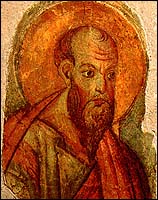 'Saint Paul,' Roma, 2nd half of 13th century (fresco fragments; 38 cm x 27 cm), Fabbrica of St. Peter's, Vatican Museum. |
Have you ever felt desperate to know God? To break through that impenetrable "distance" or fog and feel God's presence intimately? You sense a bit of this hunger for God in Marie Barnett's praise song, "Breathe," as the refrain cries out:
"And I...... I'm desperate for you.
And I...... I'm lost without you."[137]
Paul felt that longing, that yearning, too. In this eloquent passage we hear his heart's cry for God -- a prayer that I pray along with him. "I want to know Christ!"
But how does this fit in the Letter to the Philippians? How does it come up? Paul is very concerned about some enemies who are trying to undermine the Gospel in Philippi.
The Threat from Judaizers (3:1-2)
"1Finally, my brothers, rejoice in the Lord! It is no trouble for me to write the same things to you again, and it is a safeguard for you.
2Watch out for those dogs, those men who do evil, those mutilators of the flesh. 3For it is we who are the circumcision, we who worship by the Spirit of God, who glory in Christ Jesus, and who put no confidence in the flesh." (3:1-3)
Paul has apparently written them before on this issue, and is unapologetic about bringing the matter up again as a "safeguard" for them against false doctrine.[138]
Who are these "dogs" that he refers to? For Jews and other Middle Easterners, a dog wasn't "man's best friend," but an unclean scavenger. To call someone a "dog" was an insult and demonstrates Paul's disgust at the false teaching they were pressing upon the church.
The "dogs" were what we call Judaizers. They were not only Jewish Christians who kept the Jewish law and worshipped Jesus as the Messiah. They were also quite vocal about their belief that a person couldn't become a Christian unless he became a Jew first -- and submit to circumcision as the ancient rite of admission into the Jewish community. Paul uses the phrase "mutilators of the flesh" to caricature their position on circumcision.
Paul had met these people before during his earlier ministry in the Gentile city of Antioch.
"Some men came down from Judea to Antioch and were teaching the brothers: 'Unless you are circumcised, according to the custom taught by Moses, you cannot be saved.' This brought Paul and Barnabas into sharp dispute and debate with them. So Paul and Barnabas were appointed, along with some other believers, to go up to Jerusalem to see the apostles and elders about this question." (Acts 15:1-2)
A watershed decision was made by the Jerusalem Council headed by James, (senior pastor of the Jerusalem Church, Jesus' brother, and author of the Letter of James), that was vital to the expansion of the Christian movement. Led by the Holy Spirit, the Council sent a circular letter to the churches to the effect that Gentile believers were not to be "burdened" with the requirement of circumcision (15:28-29).
The True Circumcision (3:2-3)
"For it is we who are the circumcision, we who worship by the Spirit of God, who glory in Christ Jesus, and who put no confidence in the flesh." (3:2-3)
Paul says "it is we who are the circumcision...." In other words, Christian believers, not Jews who have rejected the Messiah, are the true heirs of the people of God. Paul is in step with Old Testament prophets from Moses to Jeremiah in recognizing that the outward act of circumcision is not the ultimate issue, but is a symbol of heart commitment and love for the Lord:
"Circumcise your hearts, therefore, and do not be stiff-necked any longer." (Deuteronomy 10:16)
"The Lord your God will circumcise your hearts and the hearts of your descendants, so that you may love him with all your heart and with all your soul, and live." (Deuteronomy 30:6)
"Circumcise yourselves to the Lord,
circumcise your hearts,
you men of Judah and people of Jerusalem,
or my wrath will break out and burn like fire
because of the evil you have done --
burn with no one to quench it." (Jeremiah 4:4)
"A man is not a Jew if he is only one outwardly, nor is circumcision merely outward and physical. No, a man is a Jew if he is one inwardly; and circumcision is circumcision of the heart, by the Spirit, not by the written code." (Romans 2:28-29)
"In him you were also circumcised, in the putting off of the sinful nature, not with a circumcision done by the hands of men but with the circumcision done by Christ." (Colossians 2:11)
To the Philippians Paul gives three evidences that the Christians indeed are the people of God rather than the unbelieving Jews:
- Worship by the Spirit of God. Jesus had told the Samaritan woman, "A time is coming and has now come when the true worshipers will worship the Father in spirit and truth, for they are the kind of worshipers the Father seeks" (John 4:21, 23). Spiritual worship is prayer, praise, and a life lived in dedication to God.
- Glory in Christ Jesus. "Glory" (NIV), "rejoice" (KJV), and "boast" (NRSV) is the Greek verb kauchaomai, "to take pride in something -- boast, glory, pride oneself, brag," perhaps best rendered here as "exult."[139] We are the true people of God, says Paul, because we exult that the Messiah has come in Jesus.
- Put no confidence in the flesh. "Flesh" is the Greek noun sarx. It can be used in several senses, most commonly "physical matter that makes up the living bodies of humans and animals." But Paul often uses it in the sense of "sinful human nature that is rebellious against God."[140] Here Paul probably has both senses of the word in mind, referring to both physical circumcision and sinful human nature as opposed to spiritual obedience to God.
"Confidence in the flesh," according to Martin, is a way of expressing "the innate tendency on the part of the religious person to obtain a standing before God and to secure, by one's own effort, approval and acceptance with him."[141]
Paul's Religious Credentials (3:4-6)
"Confidence in the flesh" has to do with what man thinks important. So Paul spells out his own Jewish credentials and implicitly challenges his opponents to match them:
"3b... Who put no confidence in the flesh. 4 though I myself have reasons for such confidence. If anyone else thinks he has reasons to put confidence in the flesh, I have more. 5 circumcised on the eighth day, of the people of Israel, of the tribe of Benjamin, a Hebrew of Hebrews; in regard to the law, a Pharisee; 6 as for zeal, persecuting the church; as for legalistic righteousness, faultless." (3:3b-6)
Paul displays seven credentials, four of which he gained by birth and three by his own action:
- Circumcision -- "circumcised on the eighth day." He was no convert to Judaism who would have been circumcised later, but was born into it.
- Citizenship -- "of the people of Israel." He was not a Gentile proselyte, but a Jew.
- Genealogy -- "of the tribe of Benjamin." The tribe of Benjamin was small, but prominent in that the first king of Israel was from this tribe -- Saul, after whom Paul was named. The Benjaminites also prided themselves on holding the ancient territory surrounding the Holy City of Jerusalem.
- Family Heritage -- "a Hebrew of Hebrews." Unlike Jewish proselytes, he spoke Hebrew and Aramaic and was the son of a family that did so.
- Orthodoxy -- "in regard to the law, a Pharisee." He had been a strict Pharisee, educated at the feet of Gamaliel, a highly respected rabbi (Acts 5:34-40; 22:3).
- Zeal -- "as for zeal, persecuting the church." He had been so zealous for orthodox, Pharisaical Judaism that he had persecuted the church (Acts 9:1-2).
- Righteousness -- "as for legalistic righteousness, faultless."[142] We'll consider the idea of righteousness (dikaiosynē) later in this passage. Here Paul is referring to a righteousness that is supposedly earned by obeying the commands of God as strictly interpreted by the Pharisees.
Few could match such credentials -- certainly not the petty Judaizers who were troubling the Philippian church.
Q1. (3:2-6) How does "confidence in the flesh" show up in
your congregation? Have you ever struggled with it?
https://www.joyfulheart.com/forums/index.php?act=ST&f=78&t=325
Paul's Heart Cry (3:7-9)
But now you begin to hear Paul's soul, his cry for something better, something that will satisfy the heart:
"7 But whatever was to my profit I now consider loss for the sake of Christ. 8 What is more, I consider everything a loss compared to the surpassing greatness of knowing Christ Jesus my Lord, for whose sake I have lost all things. I consider them rubbish, that I may gain Christ 9 and be found in him...." (3:7-9a)
French commentator Bonnard calls verses 4-7, "one of the most remarkable personal confessions which antiquity has bequeathed to us."[143] You are hearing the core of the Apostle.
Gain vs. Loss (3:7-8)
By dissecting this confession, we risk reducing it to the sum of parts that by no means equals the impact of the whole passage. But let's see what Paul is saying.
"Profit" (NIV) or "gain" (KJV, cf. NRSV) is the Greek noun kerdos, "that which is gained or earned, a gain, profit."[144] "Loss," found in verses 7 and 8 is the Greek noun zēmia, "damage, disadvantage, loss, forfeit," with the implication of sustaining hardship or suffering.[145]
Why "loss"? Why isn't he merely neutral towards his religious credentials? First, because they are empty in themselves. They don't satisfy the heart. Second, the pride they represent stands in the way of grasping something much more valuable -- knowing Christ intimately. When you weigh the value of one vs. the other, his religious credentials tip the scale as "rubbish" (NIV, NRSV) or "dung" (KJV). The Greek noun skybalon means "dung, muck," both as excrement and food gone bad.[146] To return to his former place is absolutely abhorrent to Paul.
Does Paul have to reject his rich Jewish heritage to be a Christian? No. His letters are filled with appreciation for God's blessings to the Jews. What he rejects is the false assumption that one can earn righteous standing before God by one's credentials and a well-lived life. That he categorically rejects.
But Paul has "lost all things" (3:8b). He has forfeited his promising career as a respected Jewish Rabbi to follow Jesus the Messiah. Paul, like each of us, had to choose his own path. Paul chose Christ, because he saw Christ's overwhelming worth when compared to his former path.
Q2. (3:2-6) Why isn't Paul merely neutral about his
religious pedigree? Why does he consider it loss, dung, an obstacle? In what way
could your religious background be an impediment to your faith?
https://www.joyfulheart.com/forums/index.php?act=ST&f=78&t=326
Knowing Christ Jesus My Lord (3:8b)
"I consider everything a loss compared to the surpassing greatness of knowing Christ Jesus my Lord, for whose sake I have lost all things. I consider them rubbish, that I may gain Christ 9and be found in him...." (3:8b-9a)
What does it mean to "know Christ"? Paul's use of the term "knowledge" doesn't derive from the Greek mystery religions and philosophical schools that abounded in his day, but from the Hebrew scriptures.
In the Old Testament, knowledge (Hebrew yāda`) denotes "living in a close relationship with something or somebody, such a relationship as to cause what may be called communion."[147] The prophets look forward to that day of intimately knowing God.
"They shall not hurt nor destroy in all my holy
mountain:
for the earth shall be full of the knowledge (dē`ā) of the Lord,
as the waters cover the sea." (Isaiah 11:9; cf. Habakkuk 2:14)
"No longer will a man teach his neighbor,
or a man his brother, saying, 'Know (yāda`) the Lord,'
because they will all know (yāda`) me,
from the least of them to the greatest,"
declares the Lord.
"For I will forgive their wickedness
and will remember their sins no more." (Jeremiah 31:34)
"Let us know (yāda`), let us press on to
know (yāda`) the Lord;
his appearing is as sure as the dawn;
he will come to us like the showers,
like the spring rains that water the earth." (Hosea 6:3)
But this longing to know God can find fulfillment among Christians under the New Covenant because of the Holy Spirit who can reveal to us the very mind of Christ (1 Corinthians 2:16). Martin notes: "The Pauline expression 'to know Christ' is intimate, and glows with the warmth of a direct relationship; it may be therefore be taken as equivalent to 'fellowship with Christ,' to which Paul was introduced on the day of his conversion (cf. 2 Corinthians 4:6)."[148] This is what it means to be "in Christ," a phrase found throughout Paul's writings.
To be intimate with the Messiah is of "surpassing greatness" (NIV), "surpassing value" (NRSV), and "excellency" (KJV). This Greek participle of hyperechō means, "to surpass in quality or value -- be better than, surpass, excel."[149] In our contemporary parlance we talk about, "chocolate to die for." But Paul meant it literally. To know Christ is worth giving up everything.
Being Found in Christ (3:9)
Consider the last phrase of this amazing passage:
"8b I consider everything a loss compared to the surpassing greatness of knowing Christ Jesus my Lord, for whose sake I have lost all things. I consider them rubbish, that I may gain Christ 9 and be found in him...." (3:8b-9a)
What does it mean, "to be found in Christ"? I believe that he is referring to Judgment Day, the Day when all is revealed. On that Day Paul wants it to be discovered that he is "in Christ," knows Christ, trusts Christ, lives and dies for Christ. When all is said and done, will you be "found in Christ" on that Day?
Righteousness by Faith not Law (3:9b)
Now we turn to one of the great themes of Paul the Apostle -- justification by faith. Paul wants to be found in him....
"Not having a righteousness of my own that comes from the law, but that which is through faith in Christ -- the righteousness that comes from God and is by faith." (3:9b)
What is this righteousness? The Greek noun dikaiosynē has three basic meanings: (1) justice or fairness, (2) right standing, and (3) upright behavior, uprightness.[150] The verb form of this word, dikaioō, can carry a similar range of meaning, but in this regard carries the idea, "to be acquitted, be pronounced and treated as righteous, be justified."[151]
Paul contrasts two types of righteousness in verse 9:
Source of righteousness: Law
Means of righteousness: Personal obedience
Source of righteousness: God
Means of righteousness: Faith
Righteousness under law considers a person righteous because of his or her own upright behavior. Righteousness by faith, considers a person righteous because God has declared it so and as judge considers a person so.
In brief, here's how it works. God agrees with our confession of sins that we are guilty and that there must be a penalty for sin. Once the penalty has been paid (crudely called in criminal law, "our debt to society"), then we are free. Yes, ex-cons, but free. Our penalty for rebellion and treason against the Most High God is death. That penalty has been paid by Jesus Christ on the cross. Thus God declares the penalty paid and that we are righteous, that is, in a right standing with God once more.
Righteousness Received by Faith
This concept is difficult to grasp. It is hard to believe, since it is such amazing news. How can someone else take my sin? Who would do that? Don't I have to bear it and the consequences of it? How can this be?
The core of the Christian faith is that we believe Jesus died for our sins on the cross and was raised from the dead for our salvation. Either it is true or it isn't. Either the crucifixion and resurrection are Christian myths or they actually happened in history and are spiritual facts of life.
If the crucifixion and resurrection actually happened, and I believe they did, then Jesus, the Holy One, took all of the degradation of our unholiness upon himself, "the righteous for the unrighteous" (1 Peter 3:18), in order to remove our sin and guilt from us. (Also ponder Isaiah 53 to understand this better.) This is what Paul means when he refers in our passage to "the righteousness that comes from God and is by faith."
But what does faith have to do with it? Though Christ has died for the sins of the whole world (John 1:29; 3:15-17; 1 Timothy 2:4, 6; 4:10; 1 John 2:22; 4:14), that salvation takes effect only for those who put their trust in him. Faith confirms what God has done and activates this salvation for oneself.
The Greek word "faith," which occurs twice in our verse, is the Greek noun pistis, "state of believing on the basis of the reliability of the one trusted -- trust, confidence, faith in the active sense = 'believing.'"[152] Throughout the New Testament, and occasionally in the Old, we see this theme. It began with Abraham: "Abram believed the Lord, and he credited it to him as righteousness" (Genesis 15:6). The Prophet Habakkuk said, "The just shall live by faith" (Habakkuk 2:4), a theme on which Paul expanded (Romans 1:17; Galatians 3:11; cf. Hebrews 10:38). Notice in the following verses the clear linkage between faith (believing) and salvation or righteousness:
"Go into all the world and preach the good news to all creation. Whoever believes and is baptized will be saved, but whoever does not believe will be condemned." (Mark 16:15-16)
"... That everyone who believes in him may have eternal life. For God so loved the world that he gave his one and only Son, that whoever believes in him shall not perish but have eternal life." (John 3:15-16)
"This righteousness from God comes through faith in Jesus Christ to all who believe. There is no difference for all have sinned and fall short of the glory of God." (Romans 3:22-23)
"For it is with your heart that you believe and are justified, and it is with your mouth that you confess and are saved." (Romans 10:10)
These verses could be multiplied many times over in John 1:12; 5:24; 6:47; Romans 1:17; 4:5, 13; 9:30; 10:6; Galatians 2:16 and many others.
Jesus died for your sins. You believe it to be true. You speak it with your mouth (that is, confess it). And you receive salvation and righteousness in return. Yes, your faith is weak when you are a new Christian. Sometimes you are like the man whose son was healed, who said, "I believe, help my unbelief" (Mark 9:24, NRSV). But you grow in understanding and faith and experience.
If you have never actually consciously put your faith in Christ do it now. Say to him in prayer, "Lord, I trust you to forgive my sins and give me eternal life. Help me to follow you now in my life. Amen." You've talked to God. Now tell someone else -- a relative, a Christian friend, a pastor. On his part, now God will give you the gift of the Holy Spirit, will lead and guide you, and will not hold your sins against you ever again. Promise! The next step is to ask a pastor about baptism. Paul, though he was a very righteous man from a religious point of view, valued this salvation by faith above all things:
"Not having a righteousness of my own that comes from the law, but that which is through faith in Christ -- the righteousness that comes from God and is by faith." (3:9b)
Q3. (3:9) How does righteousness obtained through faith
differ from righteousness obtained through law observance? How seriously does
righteousness by law observance infect your congregation? Society's view of
Christianity in general? Why is this concept of justification or righteousness
by faith so difficult to grasp?
https://www.joyfulheart.com/forums/index.php?act=ST&f=78&t=327
Knowing Christ Intimately (3:10)
Paul's salvation is secure in Christ. But his soul longs for an even greater intimacy with Jesus than he has already obtained.
"I want to know Christ and the power of his resurrection and the fellowship of sharing in his sufferings, becoming like him in his death, and so, somehow, to attain to the resurrection from the dead." (3:10-11)
"Know" is the Greek verb ginōskō, "to arrive at a knowledge of someone or something -- know, know about, make acquaintance of."[153] This knowledge is not esoteric enlightenment such as the mystery religions spoke about, but a growing personal relationship. The relationship begins when we first put our faith in Christ and grows over a lifetime. Sometimes our relationship seems stable. Sometimes it seems to wane. Occasionally, we might experience what St. John of the Cross described as "the dark night of the soul."[154] But there are also times of rapid growth, of spiritual breakthroughs, of renewal and refreshing of the soul. Paul is crying out for more. He is hooked on God and only more of God can satisfy his soul.
Paul is content to know Christ in his fullness even if it is sometimes painful, even if it costs him something. He longs not only to know Christ, but also:
"... the power of his resurrection and the fellowship of sharing in his sufferings, becoming like him in his death, and so, somehow, to attain to the resurrection from the dead." (3:10-11)
He seeks to experience God's power -- on the scale of the power revealed at Christ's resurrection. In Ephesians he prays for this power for the Ephesian Christians:
"I pray also that the eyes of your heart may be enlightened in order that you may know ... his incomparably great power for us who believe. That power is like the working of his mighty strength, which he exerted in Christ when he raised him from the dead...." (Ephesians 1:18-20)
Paul is no stranger to suffering for Christ. He knows that in the experience of persecution and suffering for the Name there is great consolation of the Spirit, so he prays for "the fellowship of sharing in his sufferings." (Here is the word koinōnia, "fellowship, sharing" again.[155])
Paul also looks to Christ's death, that he might share that too, "becoming like him in his death." Whether Paul is speaking of spiritual death to his old life or literal martyrdom like Jesus himself it's not clear -- probably both.[156]
Finally, Paul looks forward to physical resurrection at Christ's return -- "and so, somehow, to attain to the resurrection from the dead." The phrase "and so, somehow," doesn't indicate doubt whether he will be raised from the dead, but uncertainty about his immediate future -- whether he will be released or executed.[157]
 Available in PDF, Kindle, and paperback formats |
At Christ's coming we will experience the resurrection of our bodies. Whether we've been buried, cremated, buried at sea or still alive at Christ's appearing it doesn't matter. God's power will create for us new resurrection bodies -- no longer physical (though able to relate to physical world like Christ's resurrection body) but essentially spiritual (1 Corinthians 15:42-57). This doesn't mean just a "spiritual" resurrection, however, but a bodily resurrection. Christ's physical body was raised on the third day; the tomb was empty. The disciples could touch him, feel his hands and feet, and observe him eat food. The physical. But it was more. Jesus in his resurrection body entered locked rooms and ascended into heaven. We Christians are promised a body by God, who "will transform our lowly bodies so that they will be like his glorious body" (3:21). "When he appears, we shall be like him, for we shall see him as he is" (1 John 3:2).
Do you long to know Jesus better -- really know him? That is my longing, too. Grant it, Lord Jesus.
Q4. (3:8-10) What does it mean to "know" Christ? Does
this mean to have faith? Or to have a personal relationship? Is it possible to
have a personal relationship with Christ without faith? Is it possible to have
faith without a personal relationship? Where are you on your quest to know
Christ?
https://www.joyfulheart.com/forums/index.php?act=ST&f=78&t=328
Prayer
Father, sometimes I sense that I am living far below your best for me. Far below that intimacy with you which is my privilege in Christ. Forgive me. Renew in my heart an intense longing for more, that I might seek you diligently and find in you my heart's desire. In Jesus' name, I pray. Amen.
Key Verses
"What is more, I consider everything a loss compared to the surpassing greatness of knowing Christ Jesus my Lord, for whose sake I have lost all things. I consider them rubbish, that I may gain Christ and be found in him, not having a righteousness of my own that comes from the law, but that which is through faith in Christ -- the righteousness that comes from God and is by faith." (Philippians 3:8-10)
Endnotes
[137] "Breathe," by Marie Barnett, ©1995 Mercy/Vineyard Publishing / ASCAP.
[138] "Safeguard" (NIV, NRSV) or "safe" (KJV) is the Greek noun asphalēs, which has the basic meaning of "firm, not shaky." Here it means "pertaining to being in someone's best interest, safe, secure" (BDAG 147; Thayer).
[139] Kauchaomai, BDAG 536, Martin 143. Kauchaomai is one of Paul's favorite words, used 35 times in his writings and only twice elsewhere in the New Testament.
[140] Richard J. Erickson, "Flesh," DPL 303-306.
[141] Martin 143. "put confidence" (NIV) in verse 3 and 4b is the Greek participle of the verb peithō, "to be so convinced that one puts confidence in something -- depend on, trust in." (BDAG 792). "Confidence" in verse 4a is the Greek noun pepoithēsis, "a state of certainty about something to the extent of placing reliance on -- trust, confidence" (BDAG 796).
[142] "Faultless" (NIV) or "blameless" (NRSV, KJV) is the Greek adjective amemptos, which we've seen before in 2:15.[With the a- prefix to show the negative, it comes from the verb memphomai, "to blame."
[143] P. Bonnard, L'Epître de Saint Paul aux Philippiens (Commentaire du Nouveau Testament, 1950), cited in Martin 144.
[144] Kerdos, BDAG 541. The word is also found in Philippians 1:21. The related verb kerdainō is found in verse 8, "to acquire by effort or investment, to gain" (BDAG 541).
[145] Zēmia, BDAG 427-428. The related verb zēmioō, "to experience the loss of something with the implication of undergoing hardship or suffering -- suffer damage or loss, forfeit, sustain injury" (BDAG 428).
[146] O'Brien 390. "Useless or undesirable material that is subject to disposal -- refuse, garbage." It was used in Greek in various senses -- excrement, manure, garbage, kitchen scraps" (BDAG 932). Spicq says about this verse, "to convey the crudity of the Greek... : 'It's all crap.'"
[147] T.C. Vriezen, An Outline of Old Testament Theology (Oxford, 1958), p. 129, cited by O'Brien 388. Greek noun gnōsis, "knowledge." It is used of (1) "comprehension or intellectual grasp of something" and (2) "the content of what is known." In the latter sense it can involve personal acquaintance with someone, in this case, Christ (BDAG 203-204).
[148] Martin 149.
[149] Hyperechō, BDAG 1033. Paul uses this word three times in Philippians: here, 2:3 and 3:8.
[150] Dikaiosynē, BDAG 247-249.
[151] Dikaioō, BADG 197. Leon Morris, The Apostolic Preaching of the Cross (Eerdmans, 1955, reprinted 1972), chapter 7, concludes that declaring someone righteous is the basic idea of dikaioō, not making someone righteous.
[152] Pistis, BDAG 818-819. In the phrase "by faith" (NIV, KJV) or "based on faith" (NRSV) we find the preposition epi, "upon." Depending on the context it can have a number of connotations. Here it is a "marker of basis for a state of being, action, or result -- on." This phrase can be translated, "on the basis of faith" (BDAG 364).
[153] Ginōskō, BDAG 199-201.
[154] This is described well by Richard J. Foster in his book, Prayer: Finding the Heart's True Home (HarperSanFrancisco, 1992).
[155] "Fellowship" (NIV, KJV) or "sharing" (NRSV) is the Greek noun koinōnia, which we've seen before in Philippians. Here it means, "participation, sharing in something" (BDAG 552-553).
[156] "Becoming like" (NIV, NRSV) or "being made conformable" (KJV) is the Greek verb symmorphizō, "to cause to be similar in form or style to something else, grant or invest with the same form as" (BDAG 958). The adjectival form symmorphos appears in 3:21 -- "pertaining to having a similar form, nature or style, similar in form."
[157] The Greek particle pōs, is used here as an adverb, a marker of undesignated means or manner, "somehow, in some way, perhaps" (BDAG 901). Here the uncertainty is whether he will come to the resurrection by martyrdom or at the return of Christ. He is uncertain about his death (Martin 153-154; O'Brien 411-413).
Copyright © 2026, Ralph F. Wilson. <pastor joyfulheart.com> All rights reserved. A single copy of this article is free. Do not put this on a website. See legal, copyright, and reprint information.
 To be notified about future articles, stories, and Bible studies, why don't you subscribe to our free newsletter, The Joyful Heart, by placing your e-mail address in the box below. We respect your