


|
Old Testament
New Testament
Gospels
Acts
Paul's Letters
General Letters
Revelation
Topical Studies
Beginning the Journey (for new Christians). en Español

|
Old Testament
New Testament
Gospels
Acts
Paul's Letters
General Letters
Revelation
Topical Studies

|
Home
Bible Studies
Articles
Books
Podcasts
Search
Menu
Donate
About Us
Contact Us
FAQ
Sitemap


3. He Emptied Himself (Philippians 2:1-11)
Free
E-mail Bible Study
 The Discipleship Process
Home |
Bible Studies |
Articles |
Books |
Podcasts |
Search |
Menu |
Donate |
About Us |
FAQ |
Contact Us
The Discipleship Process
Home |
Bible Studies |
Articles |
Books |
Podcasts |
Search |
Menu |
Donate |
About Us |
FAQ |
Contact Us
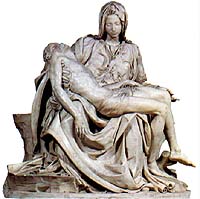 Jesus humbled himself to death, even death on a cross. This is the famous marble sculpture by Michelangelo, 'The Pieta' (1498-99), 174 x 195 cm (5 3/4 x 6 ft), Basilica of St Peter, Vatican. |
I can't help but conclude that the Philippian church had a problem with unity -- and with the humility required to achieve that unity. If not, why would Paul spend a significant part of this short letter exhorting them about it?
Our churches today also need unity and humility. We need to understand that following Jesus means following him as a servant who humbles himself -- or we'll never really understand him. So let's begin as Paul sets up the issues in the first few verses. This passage has six sections:
- An appeal to Christ's blessings and benefits (2:1)
- A call to unity (2:2)
- A warning against selfishness (2:3a)
- A call to humility and selfless love (2:3b-4)
- The ultimate example of selfless humility displayed in Christ (2:5-8)
- God's exaltation of Jesus to the highest place (2:9-11)
An Appeal to Christ's Blessings and Benefits (2:1)
Paul pleads with the Philippian Christians to listen to what he has to say, to open their spiritual ears.
"If you have any encouragement from being united with Christ, if any comfort from his love, if any fellowship with the Spirit, if any tenderness and compassion, then make my joy complete by being like-minded...." (2:1-2a)
Paul is saying, if Christ has benefited you in any way, I beg you to listen to me. Let's look at the benefits that Paul piles one on top of another in verses 1-2 as inducements to unity.
"Encouragement" (NIV, NRSV) or "consolation" (KJV, Greek paraklēsis) here means "the act of emboldening another in belief or course of action" and "lifting of another's spirits."[66] Paul is saying, if Christ has encouraged you by being united to him, listen!
"United with Christ" (NIV) is the phrase en Christō that we see throughout Philippians and all of Paul's writings. (See the Introduction for a study of the phrase in Philippians.) Any internal unity the church is going to experience must be preceded by an individual unity with Christ by each of the members of the church.
"Comfort" (NIV, KJV) or "consolation" (NRSV, Greek paramythion) means "pertaining to that which offers encouragement, especially as consolation, means of consolation, alleviation ... solace."[67] Here Paul is particularly referring to the comfort derived from realizing that you are intensely loved by God.
"Fellowship" (NIV, KJV) or "sharing" (NRSV) is the Greek word we've see a number of times in Philippians, the noun koinōnia, "sharing, partnership, fellowship." (See a more complete word study in the Introduction.) Paul is reminding them of their participation in the Holy Spirit as an inducement to listen.
"Tenderness" (NIV), "compassion" (NRSV), "bowels" (KJV) is the Greek noun splanchnon, "of the seat of the emotions, heart ... the seat and source of love, sympathy, and mercy."[68] (We also saw this word in 1:8).
"Compassion" (NIV), "mercies" (KJV), "sympathy" (NRSV) is the Greek noun oiktirmos, "display of concern over another's misfortune, pity, mercy, compassion."[69] Here, paired with splanchnon, the words together mean "tender compassion."[70] Paul is pleading: If you have any tenderness in you, any compassion, then listen to me!
If your blessings from being a Christian mean anything to you, Paul implores, listen to me: You must have the attitude of humility within you that Jesus Christ himself has.
A Call to Unity (2:2)
Having made his appeal to what they have in Christ, now Paul gets to the point -- a command:
"Make my joy complete by being like-minded, having the same love, being one in spirit and purpose." (2:2)
"Like-minded" uses the Greek verb phroneō, "to think," which occurs three times in our passage, twice in verse 2 and again in verse 5. "Like-minded" (NIV, KJV) or "of the same mind" (NRSV) translates a combination of two words autos, "same" and phroneō. Here the verb means "to have an opinion with regard to something, think, form or hold an opinion, judge." Later in this verse it is used with the numeral "one" (heis) and translated, "being one in ... purpose" (NIV), "of one mind" (KJV, NRSV)."[71]
Think the same, Paul commands us. Is he appealing to some kind of politically correct "group think"? I don't believe so. Paul recognizes and applauds differences in people (1 Corinthians 12). But he calls them to the same attitude of mind, the same humility, the same way of thinking about life and others, the same kind of selflessness. Think the same when it comes to selfless humility, he tells us.
- Same attitude of mind
- Same love
- Same spirit
- Same purpose
"Being one in spirit" (NIV), "being of one accord" (KJV), "being in full accord" (NRSV) translates the Greek noun sympsychos, literally, "united in spirit," "harmonious."[72] This is a compound word from syn, "together, united with" and psychē, "soul." Put together, the compound word means, "harmonious in soul, souls that beat together, in tune with Christ and with each other."[73]
A Warning against Selfishness (2:3a)
Paul has called them to unity with positive exhortations. Now he calls them by warning them against the negatives, the destroyers of unity.
"Do nothing out of selfish ambition or vain conceit." (2:3a)
What are the false motives that can destroy unity? Selfishness and vanity.
"Selfish ambition" (NIV, NRSV) and "strife" (KJV) we saw already. In explaining the false motives of his opponents in Rome (1:17), he has set them up to consider their motives within their own congregation. The Greek noun is eritheia, "selfishness, selfish ambition." The word is a rare one, found prior to New Testament times only in Aristotle as "a self-seeking pursuit of political office by unfair means."[74]
"Vain conceit" (NIV), "vain glory" (KJV), and "conceit" (NRSV) is the Greek noun kenodoxia, "a vain or exaggerated self-evaluation, vanity, conceit, excessive ambition."[75]
If you've been around the church very long you've seen these: Powerbrokers who keep a lock hold on the church because it is their way to retain power. And those who are puffed up in their opinion of themselves and their importance. These attitudes are death to unity within the church.
A Call to Humility and Selfless Love (2:3b-4)
Paul has considered the opposites. Now he expounds on the virtues of humility.
"... But in humility consider others better than yourselves. Each of you should look not only to your own interests, but also to the interests of others." (2:3b-4)
In the Greek world of Paul's day, humility was looked down upon, considered a sign of weakness. But Christians know that it is their hallmark, the way of life of their Master. Far from being weak, humility takes the strength of the Holy Spirit since, it goes against our human nature.
"Humility" (NIV, NRSV) and "lowliness of mind" (KJV) is the Greek noun tapeinophrosynē, "humility, modesty."[76] This is not an emotionally-needy, false humility that fishes for compliments in order to feel good about oneself. Nor is it a Uriah Heep slimy humility that is all show in order to manipulate others. This is genuine humility that will actually "consider[77] others better than yourselves." Wow! How do we do that with authenticity?
Some resort to a negative humility of self-deprecation, inability to take a compliment. There is a sort of Christian piety that runs itself down obsessively. We see the mild form of this in Paul's statement: "Christ Jesus came into the world to save sinners; of whom I am chief" (1 Timothy 1:15). Paul realizes his unworthiness to be an apostle (1 Timothy 1:13; 1 Corinthians 5:19; Ephesians 3:8), but he isn't obsessed with it. That isn't the source of his humility. The famous hymn "Amazing Grace" begins "Amazing grace, how sweet the sound / that saved a wretch like me." But the focus of the song is not groveling, but amazement and wonderment in the grace of God that has always been with us and always will be. The focus is God. Real Christian humility isn't found in self-deprecation.
A positive, winsome humility, on the other hand, has its focus on God and on others, rather than self. This is the sort of humility that Paul is urging. This is the way to understand Paul's phrase in our passage: "In humility consider others better than yourselves." "Better than" is the Greek participle of hyperechō means here, "to surpass in quality or value, be better than, surpass, excel."[78] It is an attention on others, on their strengths and virtues that is Christian humility at its finest. In a word, this humility has at its root love! Negative humility focuses on self and one's inadequacies. But positive Christian humility is motivated by love and a focus on others. See the next verse:
"Each of you should look not only to your own interests, but also to the interests of others." (2:4)
"Look to" (NIV, NRSV) is the Greek verb skopeō, "pay careful attention to, look (out) for, notice."[79] Paul isn't encouraging us to be busybodies, always prying into others' affairs (2 Thessalonians 3:11; 1 Timothy 5:13). But rather to care about others' needs over our own. Paul's example in this brief letter is his assistant Timothy: "I have no one else like him," writes Paul, "who takes a genuine interest in your welfare. For everyone looks out for his own interests, not those of Jesus Christ" (2:20-21).
Q1. (2:1-4). To achieve unity in your congregation, why
is humility necessary? Can you give an example of how lack of humility caused a
division in your church? What are you doing to bring unity in your church?
https://www.joyfulheart.com/forums/index.php?act=ST&f=75&t=313
The Ultimate Example of Selfless Humility Displayed in Christ (2:5-11)
Now having talked about the importance of humility and defined it positively and negatively, Paul gives us the supreme example.
"Your attitude[80] should be the same as that of Christ Jesus." (2:5)
What follows seems to be an early Christological hymn that Paul inserts. It focuses on Christ's humility that is based on love for the Father. Paul may have drawn on a Christian hymn that was circulating among the churches or penned it himself for the occasion of this letter. Ralph Martin outlines the arguments for the hymn structure:
"The evidence for this is found in the stately and solemn ring of the words and the way in which the sentences are constructed. The words are obviously carefully chosen, with the result that, when the verses are read aloud [in Greek], the stress falls in such a way as to give a rhythmical cadence to the lines.... We must also take into account the presence of extremely rare words."[81]
Important Christology
Christology, or the study of Christ, owes a great deal to these few verses, for the hymn focuses on Christ's relationship to God the Father -- his humiliation, his crucifixion, and his exaltation.
These verses also provide important underpinnings to our understanding of the Trinity, especially as formulated in the Nicene Creed. Let me explain about the Nicene Creed so you'll know the importance of what you are seeing in 2:6-11.
In the fourth century church there was a lot of disagreement about the nature of Christ's divinity.
- Alexander, Bishop of Alexandria understood Jesus and God the Father to be equal in their divinity, though separate persons. He believed that Jesus was always with God (John 1:1-2) and that there never was a time that Jesus did not exist.
- Arius, also of Alexandria, understood Jesus to be a lesser divinity. That there was a time when Jesus didn't exist. That Jesus was exalted to his high position because of his obedience to God in redeeming man. Present-day Jehovah's Witnesses hold some of the same positions as Arius, and in some ways Arian beliefs underlie LDS understandings of Christ as well.
Back in the fourth century, bishops of the various cities began to take sides with a great deal of acrimony. In order to bring peace in his empire, Emperor Constantine (the first so-called "Christian" emperor) called for the Council of Nicea which took place at Nicea (present day Iznik in northern Turkey) in 325 AD.
Here 250 to 300 bishops of the church gathered to better understand what the church believed about Christ's nature and what the Scriptures taught. Of course, there were politics and, unfortunately, lots of acrimony.
Their conclusions are stated succinctly in the Nicene Creed. Contrary to what some anti-trinitarians claim, the content of the Nicene Creed was not imposed by Constantine. He only forced the bishops to get together and come to unity over the issue. The result came from the Scriptures and the Spirit of God working in the churches and the bishops to understand the truth.[82] (You may read the Nicene Creed in Appendix 1.)
Let's examine this Christian hymn found in 2:6-11 in some detail. The meaning of these verses has been vigorously debated by scholars, but I'll try to simplify the issues for you. Hang in here with me. The issues are a bit technical, but are vitally important to how we understand who Christ is!
In Very Nature God (2:6a)
Paul begins by describing the state of the preexistent Christ. Paul shares with other New Testament writers the conviction that Christ existed from before time began (John 1:1-2; Colossians 1:17; Hebrews 7:3; 13:8; Revelation 22:13, cf. Proverbs 8:22-31). The Nicene Creed states it this way: "begotten of the Father before all worlds."
"Who, being[83]
in very nature God,
did not consider equality with God something to be grasped...." (2:6)
"Nature" (NIV) or "form" (KJV, NRSV) in both verses 6 and 7 is the Greek noun morphē, "form, outward appearance, shape."[84] In the Greek papyri, morphē refers to that "form which truly and fully expresses the being which underlies it."[85] (Paul uses the same word morphē in verse 7, "taking the very nature of a servant.") Does this mean that the preexistent Christ only had the shape of God? Or that he was God? I believe that it is saying that he was God. Jesus was and is divine -- pure and simple.[86]
In order to make this unambiguous, the framers of the Nicene Creed introduced a Greek word that doesn't appear in the actual New Testament, homoousios, "of the same substance, consubstantial." The Nicene Creed states this relationship of the preexistent Christ to the Father in this way:
"God of God, Light of Light, very God of very
God;
begotten, not made, being of one substance (homoousios) with the Father."
In other words, to put it rather crudely, Jesus is made of the very same divine "stuff" that the Father is made of.
Clinging to Equality with God (2:6b)
To clarify this further, this Christian hymn considers "equality with God":
"Who, being in very nature God,
did not consider equality with God something to be grasped...." (2:6)
"Equality" (Greek isos) means "pertaining to being equivalent in number, size, quality; equal."[87] But did the preexistent Christ have this equality with God? It all hinges on the meaning of a very rare Greek word, used only here in the New Testament, the Greek noun harpagmos. It is translated variously: "Something to be grasped" (NIV, RSV), "something to be exploited" (NRSV), and "robbery" (KJV). The basic meaning, "a violent seizure of property, robbery," can move to, "something to which one can claim or assert title by gripping or grasping, something claimed."[88] Whatever, the exact meaning of harpagmos, it seems clear that the preexistent Christ already possessed equality with God, and determined not to clutch at it or cling to it, but rather to obey his Father and humble himself.[89]
Q2. (2:6) In your own words, what does it mean that
Christ didn't cling to his equality with God? How specifically does this passage
teach that Jesus is divine?
https://www.joyfulheart.com/forums/index.php?act=ST&f=75&t=314
Emptied Himself (2:7-8a)
The hymn has discussed Christ's preexistent state. Now it turns to his human state.
"... But made himself nothing,
taking the very nature of a servant,
being made in human likeness.
And being found in appearance as a man...." (2:7-8a)
The meaning of the Greek words themselves are clear enough. "Made himself nothing" (NIV), "made himself of no reputation" (KJV), and "emptied himself" (NRSV) is the Greek verb kenaō, literally, "to make empty, to empty,"[90] and figuratively or metaphorically, "to make of no effect." Used with the emphatic "himself" makes it clear that this was a voluntary action by the preexistent Christ.[91] We may see echoes here from the Suffering Servant passage in Isaiah 53:12 where, "he poured out himself to death."
But just what did this kenosis ("emptying") entail? The Danker says that kenaō is used of "divestiture of position or prestige." When used in Philippians of Christ, "he emptied himself, divested himself of his prestige or privileges."[92]
Did he give up the form or nature of God, that is, his actual divinity? Or did he give up some of the "relative attributes" of deity -- omniscience, omnipresence, and omnipotence -- while retaining the "essential attributes" -- holiness, love, and righteousness, as some exponents of the Kenotic view have taught? Frankly, this text in Philippians doesn't really tell us exactly of what he emptied himself. But we know from the text that he:
- Became a slave and
- A human being.
"He took on the form (morphē) of a slave," an expression of servility. This is in contrast to expression of divinity in the preexistent Christ, "although he was in the form (morphē) of God."[93]
The hymn says he was "made in human likeness." "Likeness" is the Greek noun homoiōma, "state of being similar in appearance, image, form," used thus both here and in Romans 8:3. Danker comments, "In the light of what Paul says about Jesus in general it is probable that he uses our word to bring out both that Jesus in his earthly career was similar to sinful humans and yet not totally like them."[94]
According to our text he was human in two ways:
- By birth (ginomai, NIV and KJV "being made, NRSV, "being born") and
- In appearance (schēma).
The Greek noun schēma means "the generally recognized state or form in which something appears, outward appearance, form, shape of a person."[95]
Was Jesus really human or just pretending to be? A second century Christian heresy, Docetism, held a Hellenistic dualistic view that spirit is good and flesh is evil, thus Jesus could not have become flesh and thus partaken in human evil. Ergo, Jesus must have been merely pretending to be human.
But from its earliest days, the apostles insisted that Jesus indeed had become human. The Apostle John made this confession a test of a genuine Christian:
"This is how you can recognize the Spirit of God: Every spirit that acknowledges that Jesus Christ has come in the flesh is from God, but every spirit that does not acknowledge Jesus is not from God" (1 John 4:2-3a).
The Council of Nicaea affirmed that Christ had not only become human, but in human form was both fully God and fully human, not half divine and half human. As John's Gospel declares:
"In the beginning was the Word, and the Word was with God, and the Word was God.... And the Word became flesh and dwelt among us, full of grace and truth; we have beheld his glory, glory as of the only Son from the Father." (John 1:1, 14, RSV)
The Nicene Creed states this truth thus:
"Who, for us men for our salvation, came down
from heaven,
and was incarnate by the Holy Spirit of the virgin Mary,
and was made man;
and was crucified also for us under Pontius Pilate;
He suffered and was buried;
and the third day He rose again, according to the Scriptures;
and ascended into heaven, and sits on the right hand of the Father;
and He shall come again, with glory, to judge the quick and the dead;
whose kingdom shall have no end."
Q3. (2:7-8) Was Jesus really a human being or only
pretending to be one? What do these verses teach? What difference does it really
make whether or not Jesus was human?
https://www.joyfulheart.com/forums/index.php?act=ST&f=75&t=315
Obedient to Death (2:8b)
The humiliation of the transcendent Almighty God to become a human being might be compared to a human taking the form of a slug or a mosquito. But this voluntary humiliation was not enough. In addition, he took on the humiliation of death, and a very painful and shameful death at that:
"He humbled[96]
himself
and became obedient[97]
to death --
even death on a cross!" (2:8b)
Jesus' death on the cross is comparable to being executed as a criminal by the electric chair or a slow public death by hanging -- a shameful and tortured death, nothing as painless or private as lethal injection.
Paul's point all along is that Jesus set the ultimate example of humbling oneself rather than insisting on one's own way with selfish ambition and vain glory. Jesus did this twice over -- first in his humbling by becoming a human being and whatever loss of divine power and prestige that required. Then again by voluntarily assenting to the most shameful and painful death imaginable in his day. Jesus humbled himself, Paul insists, and we must, too.
Exalted to the Highest Place (2:9-11)
Christ -- one equal with God -- emptied himself, humbled himself, and gave himself up to a tortured death for us. Now the hymn builds to its glorious conclusion:
"9 Therefore God exalted him to the
highest place
and gave him the name that is above every name,
10
that at the name of Jesus every knee should bow,
in heaven and on earth and under the earth,
11 and every tongue confess that Jesus Christ is Lord,
to the glory of God the Father." (2:9-11)
Why does this stanza of the hymn begin with "therefore"? Is it a reward for Christ's obedient humiliation or an assertion of his victory over the principalities and powers? Neither. It is best understood as God's vindication of Christ's humiliation unto a shameful death. It is God's "yes" to Christ's equality with God.[98]
"Exalted ... to the highest place" (NIV) or "highly exalted" (KJV, NRSV) is the Greek verb hyperypsoō, "to raise to a high point of honor, raise, exalt." Here, "to raise someone to the loftiest height."[99] Paul is referring to Christ's resurrection from the dead, of course, but even more to his ascension into heaven, where "God exalted him to his own right hand as Prince and Savior" (Acts 5:31; cf. 2:33). This passage has strong echoes from of Isaiah 53:
"Therefore I will give him a portion among the
great,
and he will divide the spoils with the strong,
because he poured out his life unto death,
and was numbered with the transgressors.
For he bore the sin of many,
and made intercession for the transgressors." (Isaiah 53:12)
Humility, followed by being exalted by God, is a theme that runs through the New Testament, especially in Jesus' own teaching:
"Therefore, whoever humbles himself like this child is the greatest in the kingdom of heaven." (Matthew 18:4)
Concerning seeking to be called exalted titles by men: "For whoever exalts himself will be humbled, and whoever humbles himself will be exalted." (Matthew 23:12)
Take the lowest place when you are a guest at a banquet: "For everyone who exalts himself will be humbled, and he who humbles himself will be exalted." (Luke 14:11)
On the Pharisee and tax collector praying in the temple: "I tell you that this man, rather than the other, went home justified before God. For everyone who exalts himself will be humbled, and he who humbles himself will be exalted." (Luke 18:14)
"Humble yourselves before the Lord, and he will lift you up." (James 4:10)
"Humble yourselves, therefore, under God's mighty hand, that he may lift you up in due time." (1 Peter 5:6)
It is no accident that genuine, self-imposed humility is the only way that love and unity can flourish in the Church, the Body of Christ. And Jesus himself leads the way.
Q4. (2:9-11) We know we're supposed to humble ourselves
like Jesus did. But how can we know whether or not God will exalt us? Why do we
get impatient with this? What does our impatience sometimes lead to?
https://www.joyfulheart.com/forums/index.php?act=ST&f=75&t=316
A Name Above Every Name (2:9b-10)
9Therefore God exalted him to the highest place
and gave him the name that is above every name,
10that at the name of Jesus every knee should bow,
in heaven and on earth and under the earth,
11and every tongue confess that Jesus Christ is Lord,
to the glory of God the Father." (2:9-11)
Part of Christ's exaltation is God giving to him "the name that is above every name." What is this name? There are two possibilities.
- Jesus. Certainly the name of Jesus is an exalted one. It means "Yahweh saves" (cf. Matthew 1:21) and was similar to the name of Moses' successor Joshua. "In the name of Jesus Christ..." is used with power and for baptism by the early disciples (Acts 2:38; 3:6; 16; 4:10, 18; 5:40; 8:12; 9:27; 10:48; 16:18; 26:9).
- Lord. What it means when every tongue confesses "that Jesus Christ is Lord" is "that Jesus the Messiah is Yahweh -- God himself." The Hebrew word Adonai, "lord" was used in the Jewish reading of the Hebrew Scriptures to substitute for the Divine name, Yahweh. Thus "Lord" became equivalent to God himself. To call Jesus "Lord" is to declare him divine and due the same level of worship as God the Father.
Probably we should understand the "name" as "Lord." "At the name of Jesus" means "at the name which belongs to Jesus," that is, the divine title of "Lord", which the Father has bestowed on him. Jesus, once identified with humiliation and shameful death is now endued with the highest majesty and power, that of divine Lord. Now is fulfilled Isaiah's ancient prophecy:
"For to us a child is born,
to us a son is given,
and the government will be on his shoulders.
And he will be called
Wonderful Counselor, Mighty God,
Everlasting Father, Prince of Peace." (Isaiah 9:6)
This is the authority that Jesus exercised at the Great Commission when he declared,
"All authority in heaven and on earth has been given to me" (Matthew 28:18).
O'Brien notes, "In his exalted state, Jesus has a new rank involving the exercise of universal lordship. This gain was in official, not essential, glory since Jesus did not become divine through exaltation."[100]
Every Knee Shall Bow (2:10-11)
As a result of this exaltation all are subject to Jesus:
"that at the name of Jesus every knee should
bow,
in heaven and on earth and under the earth,
and every tongue confess[101]
that Jesus Christ is Lord,
to the glory of God the Father." (2:10-11)
This verse recalls Isaiah 45:23b
"Before me every knee will bow;
by me every
tongue will swear."
Is this submission and confession voluntary? Not by all. Though Jesus is now exalted to this highest place, not all acknowledge him as divine Lord, as the writer of Hebrews observes:
"In putting everything under him, God left nothing that is not subject to him. Yet at present we do not see everything subject to him. But we see Jesus, who was made a little lower than the angels, now crowned with glory and honor because he suffered death, so that by the grace of God he might taste death for everyone." (Hebrews 2:8-9)
It remains for the Last Day for Christ's exaltation to be made plain to all. The Antichrist will be dethroned,
"whom the Lord Jesus will overthrow with the breath of his mouth and destroy by the splendor of his coming" (2 Thessalonians 2:8).
They will make war against the Lamb, but the Lamb will overcome them because he is Lord of lords and King of kings -- and with him will be his called, chosen and faithful followers." (Revelation 17:14)
In Romans 14:10-11, Paul identifies this time of kneeling and confessing with "God's judgment seat" or "the judgment seat of Christ" (2 Corinthians 5:10). Judgment will take place "in the presence of God and of Christ Jesus, who will judge the living and the dead" (2 Timothy 4:1).
In Revelation 20:11-15 we see this awesome courtroom with the great white throne of judgment where all are called to judgment and no longer show any rebellion in the face of his holy righteousness.
 Available in PDF, Kindle, and paperback formats |
Ultimately, worship of all shall ascend to Christ,
"Worthy is the Lamb, who was slain,
to receive power and wealth
and wisdom and strength
and honor and glory and praise." (Revelation 5:12)
Come soon, Lord Jesus.
Prayer
Lord, so often I see in myself a desire to be appreciated by others, to be recognized, to be somebody, to push myself forward. Then I see Jesus who humbled himself to the lowest place -- for me. Give me enough faith that you will exalt the humble so I will stop attempting to do it for you. Forgive me. In Jesus' name, I pray. Amen.
Key Verses
It's hard to pick just a single verse or two from this passage, so ...
"6Who, being in very nature God,
did not consider equality with God something to be grasped,
7but made himself nothing,
taking the very nature of a servant,
being made in human likeness.
8And being found in appearance as a man,
he humbled himself
and became obedient to death--
even death on a cross!
9Therefore God exalted him to the
highest place
and gave him the name that is above every name,
10that at the name of Jesus every knee should bow,
in heaven and on earth and under the earth,
11and every tongue confess that Jesus Christ is Lord,
to the glory of God the Father." (Philippians 2:6-11)
Endnotes
[66] Paraklēsis, can carry the meanings "encouragement," "strong appeal," or "comfort" (BDAG 766).
[67] Paramythion, BDAG 769. While this can have a similar meaning to paraklēsis, in this verse paraklēsis carries the idea of encouragement while paramythion carries the idea of comfort or solace in struggle.
[68] Splanchnon, BDAG 938.
[69] Oiktirmos, BDAG 700.
[70] The pairing of these words is a hendiadys, "the expression of an idea by the use of usually two independent words connected by 'and' instead of the usual combination of independent word and its modifier" (Merriam Webster's Collegiate Dictionary (Eleventh Edition; Merriam-Webster, 2004), p. 581).
[71] Phroneō, BDAG 1065-1066.
[72] Sympsychos, BDAG 961.
[73] Robertson, Word Pictures in the New Testament.
[74] Eritheia, BDAG 392.
[75] Kenodoxia, BDAG 538.
[76] Tapeinophrosynē, BDAG 989. Elsewhere in the Greek language you can find the verb used in a pejorative sense, but in the New Testament it is used only in a favorable sense.
[77] "Consider" (NIV), "esteem" (KJV), and "regard" (NRSV) is the Greek verb hēgeomai, "to engage in an intellectual process, think, consider, regard." With the double accusative, as in 2:3a, it means "look upon, consider someone or something (as) someone or something" (BDAG 434).
[78] Hyperechō, BDAG 1033.
[79] Skopeō, BDAG 931.
[80] "Attitude" (NIV) or "let this mind be in you" (KJV, cf. NRSV) is the Greek verb phroneō, which we saw twice in 2:2. Here it means "to develop an attitude based on careful thought, be minded, be disposed" (BDAG 1065-1066).
[81] Martin, Philippians, pp. 110-111. He has also developed this in his monograph, An Early Christian Confession. Philippians 2:5-11 in Recent Interpretation (London, 1960).
[82] The history and issues behind the Nicene Creed are well laid out in "Debating Jesus' Divinity: The; Council of Nicaea and Its Bitter Aftermath," Christian History and Biography, Issue 85, Winter 2005.
[83] "Being" (NIV, KJV) or "though he was" (NRSV) is the Greek present active participle of hyparchō, "to be," a widely used substitute in Hellenic Greek for einai.
[84] Morphē, BDAG 659.
[85] J.H. Moulton and G. Milligan, The Vocabulary of the Greek Testament, 417, cited by G.F. Hawthorne, Philippians (Word Biblical Commentary; Waco, 1983), p. 83.
[86] O'Brien, Philippians 207-211, details five different understandings of morphē in this verse. From a study of the grammar of verse 6 he concludes, "This then, is what it means for Christ to be 'in the form of God;' it means 'to be equal with God,' not in the sense that the two phrases are identical, but that both point to the same reality" (p. 207).
[87] Isos, BDAG 480-481.
[88] Harpagmos, BDAG 133-134.
[89] J.B. Lightfoot argues that harpagmos means "a prize" or "treasure," and interpreted the phrase, "He ... did not treat His equality with God as a prize, a treasure to be greedily clutched and ostentatiously displayed," that is, he already possessed divine equality and resolved not to cling to it (Lightfoot 134). A recent study by R.W. Hoover, indicates that the Greek phrase was a common idiomatic expression that meant, "to regard something as a stroke of luck, a windfall, a piece of good fortune." Thus, the meaning would be "he did not regard being equal with God as something to take advantage of," or, more idiomatically, "as something to use for his own advantage." This understanding assumes that equality with God represents a status which belonged to the preexistent Christ. (Cited and explained by O'Brien [pp. 214-216], who is convinced by Hoover's philological conclusions.)
[90] Kenaō, BDAG 539.
[91] O'Brien 216-217.
[92] Kenaō, BDAG 539.
[93] Morphē, BDAG 659.
[94] Homoiōma, BDAG 707.
[95] Schēma, BDAG 981.
[96] "Humbled" is the Greek verb tapeinoō, "to cause someone to lose prestige or status, humble, humiliate, abase" (BDAG 990). A related word occurs in the Greek Septuagint translation of Isaiah 53:8, "in his humiliation...."
[97] "Obedient" is the Greek adjective hypēkoos, "obedient" (BDAG 1035) from the verb hypakouō, "to follow instructions, obey, follow, be subject to" (BDAG 1028-1029).
[98] Fee 220.
[99] Hyperypsoō, BDAG 1034.
[100] O'Brien 238.
[101] "Confess" is the Greek verb exomologeō, here means, "to declare openly in acknowledgement, profess, acknowledge" (BDAG 351).
Copyright © 2026, Ralph F. Wilson. <pastor joyfulheart.com> All rights reserved. A single copy of this article is free. Do not put this on a website. See legal, copyright, and reprint information.
 To be notified about future articles, stories, and Bible studies, why don't you subscribe to our free newsletter, The Joyful Heart, by placing your e-mail address in the box below. We respect your