


|
Old Testament
New Testament
Gospels
Acts
Paul's Letters
General Letters
Revelation
Topical Studies
Beginning the Journey (for new Christians). en Español

|
Old Testament
New Testament
Gospels
Acts
Paul's Letters
General Letters
Revelation
Topical Studies

|
Home
Bible Studies
Articles
Books
Podcasts
Search
Menu
Donate
About Us
Contact Us
FAQ
Sitemap


2. Struggles that Advance the Gospel (Philippians 1:12-30)
Free
E-mail Bible Study
 Names and Titles of God
Home | Bible Studies | Articles | Books | Podcasts | Search | Menu | Donate | About Us | FAQ | Contact Us
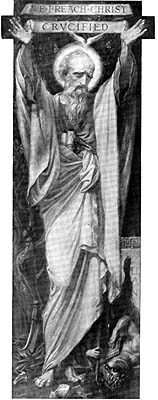 'St. Paul the Aged' (1910), by Frederic James Shields (British painter, 1833-1911), Chapel of the Ascension, Bayswater Road, London. Destroyed by enemy action in WW II. |
If only everything went smoothly. If only we didn't have problems. If only ... if only. We tell ourselves that if only this or that weren't in our way, we would have a better Christian life and witness. This passage tells a different story, that in spite of -- no, because of -- our problems, Christ can be glorified in our lives. What an important mindset for disciples to take hold of! This attitude of mind can be ours. Let's examine this remarkable point of view in the Apostle Paul's letter to the Philippian church.
Christ Is Preached throughout the Entire Palace Guard (1:12-13)
Paul writes to his beloved Philippian friends from captivity:
"12Now I want you to know, brothers, that what has happened to me has really served to advance the gospel. 13As a result, it has become clear throughout the whole palace guard and to everyone else that I am in chains for Christ." (1:12-13)
Paul was held either in a Roman building (Acts 23:35) or under house arrest (Acts 28:16). There's some dispute about where he was -- Rome, Ephesus, or Caesarea. There's something to be said for each view, though the traditional view that he wrote from Rome seems stronger to me. Fortunately, it makes little difference to how we are to understand his letter. Wherever he was, he was not alone, but "with a soldier to guard him" (Acts 28:16).
In the Roman world Paul's imprisonment was legally not considered a penalty for a crime, but a sort of "holding tank" used to detain those awaiting trial or execution.[28] Presumably, Paul was imprisoned in Rome awaiting his trial before Caesar himself (or one of Caesar's personal representatives),[29] which was a right he claimed as a Roman citizen. Though guarded during this time, he was granted freedom to entertain guests (Acts 28:17, 23, 30) and carry on his preaching and teaching, at least to those who came to where he was (Acts 28:17-31). Ramsay tells us that a light chain fastened Paul's wrist to that of the soldier.[30] J.B. Lightfoot explains:
"According to Roman custom he was bound by the hand to the soldier who guarded him, and was never left alone day or night. As the soldiers would relieve guard in constant succession, the praetorians one by one were brought into communication with the 'prisoner of Jesus Christ,' and thus he was able to affirm that his bonds had borne witness to the Gospel 'throughout the imperial regiments.'"[31]
The soldiers here were members of the praitōrion, "the praetorium," variously translated, "palace guard" (NIV), "palace" (KJV), and "imperial guard" (NRSV). Originally, the word referred to the praetor's tent in camp, with its surroundings. Over time it came to designate the governor's official residence, as reflected in the gospels,[32] and finally, as in Philippians, the members of this elite guard.[33]
Can you imagine being a soldier alone with and chained to the Apostle Paul for a straight six hour shift? Many soldiers, no doubt, became Christians as a result, and their influence began to spread throughout their entire unit, to their families, and beyond. Whether or not they became Christians, they all knew that Paul's imprisonment was because of his testimony for Christ, not because he was some kind of political prisoner.
No wonder Paul declares: "What has happened to me has really served to advance the gospel" (1:12). "To advance" (NIV), "furtherance" (KJV), "to spread" (NRSV) is the Greek noun prokopē, "a movement forward to an improved state, progress, advancement, furtherance."[34]
We might be tempted to complain about our difficult situation. Not Paul. He knew that it wasn't about him, but about Christ and his kingdom. And so he sees progress rather than difficulties.
Other Christians Emboldened (1:14)
"Because of my chains, most of the brothers in the Lord have been encouraged to speak the word of God more courageously and fearlessly." (1:14)
Why were the Roman Christians encouraged?[35] Because they saw in Paul the example of a person who was an unafraid and faithful witness. If Paul could be an effective witness in spite of the peril, so could they.
The word translated "courageously" (NIV), "bold" (KJV), and "boldness" (NRSV) is the Greek verb tolmaō, "to show boldness or resolution in the face of danger, opposition, or a problem, dare, bring oneself to (do something)."[36] Courage is not the absence of fear, but resolution and action in the face of danger. Yet, the word "fearlessly" is used here, too, since their faith in eternal life after death is their answer to fear. They are emboldened by the example of one man whose ability to preach is severely limited by his chains, yet who continues to preach where God gives him opportunity. Out of goodwill for Paul, seeing that he can no longer preach the gospel publicly, they pick up the slack, preaching with passion and boldness.
Q1. (1:12-14) From the standpoint of witness to others,
you are much more credible when you are undergoing personal struggles, stress,
and problems. Why is this so? Why was Paul's witness so powerful? What personal
struggle are you going through that could enhance your testimony if you handled
it right?
https://www.joyfulheart.com/forums/index.php?act=ST&f=74&t=309
Preaching for the Wrong Motives (1:15-18a)
But other Christians, those in Rome who resented Paul, preached for other motives:
"15 It is true that some preach Christ out of envy and rivalry, but others out of goodwill. 16 The latter do so in love, knowing that I am put here for the defense of the gospel. 17 The former preach Christ out of selfish ambition, not sincerely, supposing that they can stir up trouble for me while I am in chains. 18 But what does it matter? The important thing is that in every way, whether from false motives or true, Christ is preached. And because of this I rejoice." (1:15-18)
Don't be surprised that Paul had enemies among the Christians. Show me any man or woman who is effective in the work of Christ, especially in a visible role, and I'll show you petty enemies who seek to undermine, slander, and distort. When Billy Graham was in his prime, he had a small but determined group of Christian enemies who publicly criticized him for his openness to work with denominations that they considered apostate and for his stand on unsegregated crusade seating in an era when that was considered taboo.
Paul was criticized for his openness to uncircumcised Gentiles, his willingness to eat with them, to baptize them, and to allow them leadership roles in the church (Galatians 2:11-16). He was probably criticized for his lack of oratorical skills (1 Corinthians 2:1) and for his unwillingness to be quiet about his "strange" beliefs about the Gospel to the Gentiles. He had enemies.
They preached out of envy[37] and rivalry,[38] rather than out of a love for the lost or out of goodwill towards Paul.[39]
From the standpoint of Rome, Paul is on trial to determine whether or not Christianity should be considered a protected religion (religio licita) like Judaism. And whether those who claim "Jesus as Lord" can also recognize Caesar as "lord," or be considered guilty of treason.[40] Paul sees his role as "the defense" of the Gospel.[41] Moreover, he sees this as a divine appointment.[42]
On the one hand you have faith-filled, bold witness. On the other you have "selfish ambition," Greek eritheia, used in Aristotle to denote a self-seeking pursuit of political office by unfair means,[43] the opposite of sincerity.[44] Perhaps they intend by their preaching to "rub it in" that Paul is incapacitated and unable to preach, and in doing so both make him feel bad[45] and undercut his support within the Roman church.
Paul sees through their base motives[46] and rejoices all the more. His goal is to see the Gospel preached fully in Rome, and by their preaching for whatever motive, they are helping to accomplish that. Paul claims his right to rejoice, even in the midst of conflict.
Rejoicing that Christ Will Be Exalted (1:18b-20)
"18b Yes, and I will continue to rejoice, 19 for I know that through your prayers and the help given by the Spirit of Jesus Christ, what has happened to me will turn out for my deliverance. 20I eagerly expect and hope that I will in no way be ashamed, but will have sufficient courage so that now as always Christ will be exalted in my body, whether by life or by death." (1:18b-20)
"Rejoice," along with "joy," are two of the important keywords in Philippians. (See the detailed study on these words in the Introduction.)
Christians are preaching in order to cause Paul pain. His response? I choose to rejoice! Rejoicing characterizes his attitude toward life, because he is confident that he is "in Christ," that Christ controls his destiny, and that he can rest in trust towards God. He is free to rejoice knowing that God is in control.
The issue of rejoicing, of course, is one of control. Worry and fear, anger and resentment are responses to out-of-control situations. But to the extent we believe that God is in control, then we can rejoice freely, we can be filled with joy -- even in the midst of our struggles. To the Romans, Paul wrote:
"We know that all things work together for good for those who love God, who are called according to his purpose." (Romans 8:28, NRSV)
If you actually believe that, your problems no longer control your response.
Q2. (1:18b-19) Why is our ability to rejoice so dependent
upon our faith that God is in control, working even in the midst of difficulty?
What must you believe in order to be able to rejoice in the midst of problems?
What is your basis for believing that?
https://www.joyfulheart.com/forums/index.php?act=ST&f=74&t=310
Prison Will Turn to Paul's Deliverance (1:19)
"Yes, and I will continue to rejoice, 19for I know that through your prayers and the help given by the Spirit of Jesus Christ, what has happened to me will turn out for my deliverance. (1:18b-19)
While Paul is in prison facing trial and possible sentence of death, he sees "deliverance" at its end. "Deliverance" (NIV, NRSV), "salvation" (KJV) is sōtēria, used here as "deliverance, preservation from impending death," with focus on the physical aspect.[47] This isn't just a case of insufferable optimism. Later in his life, after an apparent release and re-imprisonment, he says soberly,
"6 For I am already being poured out like a drink offering, and the time has come for my departure. 7 I have fought the good fight, I have finished the race, I have kept the faith. 8 Now there is in store for me the crown of righteousness, which the Lord, the righteous Judge, will award to me on that day -- and not only to me, but also to all who have longed for his appearing." (2 Timothy 4:6-8)
Paul sensed that was the time of his death. But not now. While he is writing the Philippian church. He senses deliverance.
He offers two reasons why he believes he will be freed:
- Through your prayers, and
- The help given by the Spirit of Jesus Christ.
Prayer is powerful. Prayers are not just good wishes, just "thinking good thoughts." Prayers are not just psychological exercises to help us feel better. Christians believe that prayers touch God. We believe that God will do some things in response to prayer that he would not do otherwise. Prayer does indeed change things at the cosmic level. Not that God's will changes, but that God allows us to influence him in how he brings to pass his unchanging will. We need to pray for each other, for our spiritual leaders, for missionaries who are the "point men" for the Gospel in lands where Satan's power is strong. Prayer is powerful.
The Spirit of Jesus Christ, too, is Paul's powerful resource. "Help given" (NIV) and "supply" (KJV) are the Greek noun epichorēgia, "assistance, support."[48] The "Spirit of Christ" is not a separate Spirit, but the Holy Spirit. Paul relies on the Holy Spirit to show him the mind of Christ, that is, God's will for his life (1 Corinthians 2:10-16). He relies on the Holy Spirit to give him words of witness to speak, to remember Jesus' promise:
"Whenever you are arrested and brought to trial, do not worry beforehand about what to say. Just say whatever is given you at the time, for it is not you speaking, but the Holy Spirit." (Mark 13:11)
This is not a cop-out for preachers who don't want to prepare their sermons, but a real promise that in situations just like Paul's, the Spirit will give us the words we need when we are on trial for our faith. It is no accident that the Spirit is referred to as an "advocate" or "counselor" (Greek paraklētos), a word used in the sense of those who speak on behalf of accused persons, as well as a general helper.[49]
Christ Will Be Exalted in my Body (1:20-21)
"20 I eagerly expect and hope that I will in no way be ashamed, but will have sufficient courage so that now as always Christ will be exalted in my body, whether by life or by death. 21 For to me, to live is Christ and to die is gain." (1:20-21)
Paul is confident that God will help him to speak boldly at his trial, rather than give in to weakness and the pressure to say what the prosecutors want him to say. He uses two opposite phrases to make the point:
- "In no way be ashamed."[50] The shame or disgrace is not in being condemned to death, but in becoming faint hearted and not declaring the Gospel, which was his destiny. Remember the prophetic word about him that Ananias was given: "This man is my chosen instrument to carry my name before the Gentiles and their kings and before the people of Israel" (Acts 9:15).
- "Have sufficient courage." "Courage" (NIV) and "boldness" (KJV, NRSV) translate the Greek noun parrēsia, which has the basic meaning of "a use of speech that conceals nothing and passes over nothing -- outspokenness, frankness, plainness," and sometimes develops into "openness to the public" before whom speaking and actions take place. Then, "a state of boldness and confidence, courage, fearlessness," especially in the presence of persons of high rank.[51]
Paul is confident that through prayers for him and the help of the Spirit he will be able to speak the word clearly and boldly at his trial. The goal is that Christ receives glory, or as Paul puts it, "that ... Christ will be exalted in my body." "Exalted" (NIV) and "magnified" (KJV, NRSV) is the Greek verb megalunō. Its basic meaning is "to make large." Here it has the sense, "to cause to be held in greater esteem through praise or deeds, exalt, glorify, magnify, speak highly of."[52]
In one sense, Paul doesn't care whether Christ is magnified by his life or by his death. Either way is okay with him, so long as Christ is exalted.
To Live Is Christ, to Die Is Gain (1:21)
The reason for Paul's seeming unconcern about his death vs. his life is that he is convinced that either way it goes, he wins personally! And God's side wins, too.
"For to me, to live is Christ and to die is gain." (1:21)
Even if you don't like to memorize scripture, please commit this one to memory. It will energize you! Paul is saying:
- If I live, I get to enjoy Christ's presence as I do now. As Paul writes to the church at Colosse, "For you died, and your life is now hidden with Christ in God" (Colossians 3:3). He has already settled the matter of death, as Christ had taught, "For whoever wants to save his life will lose it, but whoever loses his life for me will find it" (Matthew 16:25).
- If I die,
things get better yet! Paul considers death as "gain," the Greek noun kerdos,
"that which is gained or earned, a gain, profit."[53]
See verse 23: "I desire to depart and be with Christ, which is better by
far." Whereas we might be afraid of death, not quite certain that beyond
death is Christ's presence, Paul is sure of it. He has seen glimpses of
heaven (2 Corinthians 12:1-4). It is "far better," he tells us. Jesus, too,
reassured his disciples with this message:
"Do not let your hearts be troubled. Trust in God; trust also in me. In my Father's house are many rooms; if it were not so, I would have told you. I am going there to prepare a place for you. And if I go and prepare a place for you, I will come back and take you to be with me that you also may be where I am" (John 14:1-3).
Q3. (1:20-21) How can fear keep us from being a bold
witness? Why does fear of people bind our tongues? How does "losing our life"
for Christ's sake actually give us an abundant life? What fear is keeping you
from clear witness?
https://www.joyfulheart.com/forums/index.php?act=ST&f=74&t=311
To Be with Christ Is Far Better (1:22-26)
Now Paul underscores the reasoning behind his audacious statement in verse 21 -- "to die is gain":
"22 If I am to go on living in the body, this will mean fruitful labor for me. Yet what shall I choose? I do not know! 23 I am torn between the two: I desire to depart and be with Christ, which is better by far; 24but it is more necessary for you that I remain in the body. 25 Convinced of this, I know that I will remain, and I will continue with all of you for your progress and joy in the faith, 26 so that through my being with you again your joy in Christ Jesus will overflow on account of me." (1:22-26)
It's almost as if Paul is now reasoning out which of two courses would be more beneficial:
- To go on living physically -- Benefits: (a) fruitful labor for Paul and (b) benefit to the Philippians and other churches, to help them towards "progress and joy in the faith," and to (c) increase their joy in Christ.
- To die physically -- Benefits: Paul would "be with Christ," that is, in Christ's immediate presence -- which would be of immense advantage to Paul personally.
Paul is "torn between the two" (NIV) or "hard pressed" (NRSV).[54] But I don't really think he gets to choose. The KJV and NIV translate the Greek verb haireō as "Yet what shall I choose? I do not know." The Greek verb can mean either "choose" or "prefer."[55] In this verse the NRSV translation makes more sense: "I do not know which I prefer."
His reasoning process leads him to conclude that his life would be more beneficial at this point than his death, so he is convinced[56] that he will be delivered from prison and be restored to the believers.
Soul Sleep vs. Immediately with Christ (1:23)
Some Christian groups teach that when Christians die, they remain asleep until the resurrection, that their soul and spirit are asleep and aren't aware of any time lapse between death and resurrection. Others suggest a kind of purgatory after death that purges them from their sins and prepares them for heaven. Verse 23 clearly indicates the opposite. Paul says,
"I am torn between the two: I desire to depart and be with Christ, which is better by far."
The sentence contains a pair of infinitives that are clearly parallel with each other: "to depart" and "to be." The strength of Paul's argument depends upon his immediate presence with Christ following his death. Consider another passage:
"Therefore we are always confident and know that as long as we are at home in the body we are away from the Lord. We live by faith, not by sight. We are confident, I say, and would prefer to be away from the body and at home with the Lord." (2 Corinthians 5:6-8)
For Paul, he is either alive in his body or in the immediate presence of the Lord. There is no intermediate state. The Book of Revelation also offers visions of Christians who are in heaven, in God's presence, awaiting the final resurrection (Revelation 6:9-11; 7:9-17).
Paul assures us in Philippians 1:23 that "to depart and be with Christ ... is better by far" than life in this body. This is expressed by a string of Greek words that together help us understand just how much better:
Polus, "much," here "pertaining to being high on a scale of extent ... great, strong, profound."[57]
Mallon, "to a greater or higher degree, more."[58]
Kreitōn, "pertaining to having a relative advantage in value, more useful, more advantageous, better."[59]
Together, the phrase translates, "much better indeed." If you've ever felt the fear of death, be encouraged by Paul's confidence of a wonderful life in the presence of God into which you are ushered immediately after death.
Q4. (1:23) What do Philippians 1:23 and 2 Corinthians
5:6-8 teach about the state of Christians immediately after death? How does this
comfort you? How does this energize you?
https://www.joyfulheart.com/forums/index.php?act=ST&f=74&t=312
Paul Plans to Remain in the Body (1:24-26)
"24... but it is more necessary for you that I remain in the body. 25 Convinced of this, I know that I will remain, and I will continue with all of you for your progress and joy in the faith, 26 so that through my being with you again your joy in Christ Jesus will overflow on account of me." (1:22-26)
Paul's sense of God's will is that he won't be tried and executed, but delivered and continue on with his Christian brothers. Notice the phrases "joy in the faith" and "joy in Christ Jesus." Some paint the Christian life as a cheerless endurance or guilt-ridden sojourn here below. Not Paul. For him, living for Christ here on earth is to be joyful, and dying to be with Christ more joyful still. The joy expressed in verses 25 and 26 is a joy that is shared and experienced in the community of believers, not isolated from them. If you're trying to be a lone-ranger Christian and wonder where the joy is, there's more for you.
A Manner Worthy of the Gospel (1:27-30)
"27 Whatever happens, conduct yourselves in a manner worthy of the gospel of Christ. Then, whether I come and see you or only hear about you in my absence, I will know that you stand firm in one spirit, contending as one man for the faith of the gospel 28 without being frightened in any way by those who oppose you. This is a sign to them that they will be destroyed, but that you will be saved -- and that by God." (1:27-28)
"Whatever happens," indicates that Paul recognizes that he may not see the future as clearly as he thinks, that his continued imprisonment is still a real possibility. And so he gives them a command: "Conduct yourselves in a manner worthy of the gospel of Christ." The phrase "conduct yourselves" (NIV), "let your conversation be" (KJV), and "live your life" (NRSV) all translate the Greek verb politeuomai, which has the basic meaning, "to be a citizen, have one's citizenship," from polis, "city." Here it has the extended meaning from the idea "discharge your obligations as citizens," namely, "to conduct one's life, live, lead one's life."[60]
Christians' lives must be "worthy of the gospel of Christ," that is, to be lived "worthily, in a manner worthy of, suitably."[61] When people look at our lives, our way of living either brings credit to and adds value to the message of the Gospel or makes people inclined to disregard it. We are books read by all (2 Corinthians 3:2-3).
Paul focuses on three behaviors:
- Unity of spirit (1:27c)
- Contending for the faith of the good news of Christ (1:27d)
- Courage in the face of opponents (1:28a.)
Paul examines unity and humility further in chapter 2. One of his emphases here is "contending" (NIV) or "striving" (KJV, NRSV), Greek synathleō, "contend or struggle along with someone."[62] Have we given up struggling to make the gospel clear to our family, our neighbors, and our community? Have we become lazy or complacent, feeling like this is someone else's struggle? If we do, our generation will be lost to Christ.
One of the reasons that we ease off on our witness is fear. In the US we don't often fear physical reprisal or arrest like the early Christians faced. But Christians certainly face these in some Muslim and Hindu areas. More likely, our fear is of being looked down on. Perhaps it's the fear of being ostracized at our office or work. Paul says that we are to contend for the faith "without being frightened in any way by those who oppose you" (1:28a). The word "frightened" (NIV), "terrified" (KJV), or "intimidated" (NRSV) is the Greek verb ptyrō, "let oneself be intimidated, be frightened, terrified."[63]
The Privilege of Suffering (1:29-30)
Instead of being frightened by being a witness, we should be honored by the privilege of suffering for Christ.
"29 For it has been granted to you on behalf of Christ not only to believe on him, but also to suffer for him, 30 since you are going through the same struggle[64] you saw I had, and now hear that I still have." (1:29-30)
Is Paul being ironic? I don't think so. "Granted (NIV), "given" (KJV), and "graciously granted ... the privilege" (NRSV) is the Greek verb charizomai, "to give freely as a favor, give graciously."[65] Paul counts it a privilege to suffer for Christ, as did the other apostles. He is teaching the Philippian believers -- and us today -- to count it an honor, too.
"Blessed are those who are persecuted because of righteousness, for theirs is the kingdom of heaven. Blessed are you when people insult you, persecute you and falsely say all kinds of evil against you because of me. Rejoice and be glad, because great is your reward in heaven, for in the same way they persecuted the prophets who were before you." (Matthew 5:10-12)
"The apostles left the Sanhedrin, rejoicing because they had been counted worthy of suffering disgrace for the Name." (Acts 5:31)
"But rejoice that you participate in the sufferings of Christ, so that you may be overjoyed when his glory is revealed." (1 Peter 4:13)
"Now I rejoice in what was suffered for you, and I fill up in my flesh what is still lacking in regard to Christ's afflictions, for the sake of his body, which is the church." (Colossians 1:24)
"In fact, everyone who wants to live a godly life in Christ Jesus will be persecuted...." (2 Timothy 3:12)
"I want to know Christ ... and the fellowship of sharing in his sufferings, becoming like him in his death...." (Philippians 3:10)
Strange, this fellowship of his sufferings. Do you want the honor given to the prophets and apostles? Then rejoice, says Jesus, for so they persecuted the prophets who were before you.
 Available in PDF, Kindle, and paperback formats |
God is pouring courage into us so that we will not be afraid to identify ourselves with Christ among our friends and in public. So that we will be willing to enter that struggle and so count ourselves as true disciples of Jesus, bearing the same suffering he suffered. What a privilege!
Prayer
Father, I pray that you would put into me a holy abandonment to you. Help me to fully die to my own potential and possibilities so that I might live out your will for me on your own terms and on your own scale. Give me courage to enter the fray on your behalf, unafraid of persecution. Thank you for your help. In Jesus' holy name, I pray. Amen.
Key Verse
"For to me, to live is Christ and to die is gain." (Philippians 1:21)
Endnotes
[28] DG Reid, "Prison, Prisoner," DPL 752-754. He cites William M. Ramsay, The Letters to the Seven Churches of Asia (London; Hodder & Stoughton, 1904), pp. 273-274.
[29] At the beginning of his reign, Nero announced that he would not judge cases personally (Tacitus, Ann. 13.4.2), so Paul may have appeared before the praetorian prefect as his actual judge (Mark Reasoner, "Political Systems," DPL 721).
[30] William M. Ramsay, St. Paul: The Traveller and the Roman Citizen (Baker, 1962, reprinted from Hodder & Stoughton, 1897), p. 349.
[31] Lightfoot, pp. 8-9.
[32] Praitōrion, BDAG 859.
[33] All recent commentaries, based on an analysis by Lightfoot, pp. 99-104.
[34] Prokopē, BDAG 871.
[35] "Have been encouraged" (NIV), "waxing confident" (KJV), and "made confident" (NRSV) translate the perfect participle of the verb peithō, "to be so convinced that one puts confidence in something, depend on, trust in" (BDAG 792).
[36] Tolmaō, BDAG 1010.
[37] "Envy" is the Greek noun phthonos, "envy, jealousy" (BDAG 1054).
[38] "Rivalry" (NIV, NRSV) and "strife" (KJV) are the Greek noun eris, "engagement in rivalry, especially with reference to positions taken in a matter, strife, discord, contention" (BDAG 392).
[39] "Goodwill" is the Greek noun eudokia, "state or condition of being kindly disposed, good will" (BDAG 404-405).
[40] Fee 120, fn. 19.
[41] "Defense" is the Greek noun apologia that we saw in 1:7, "the act of making a defense" (BDAG 117).
[42] "I am put here" (NIV, NRSV) and "I am set" (KJV) is the Greek verb keimai. The basic meaning is "to lie, recline." Here it is used in a transferred sense, "to exist, have place, or be there (for something) -- be appointed, set, destined for something" (BDAG 537-538).
[43] "Selfish ambition" (NIV, NRSV) and "contention" (KJV) is the Greek noun eritheia. Its exact meaning in the New Testament is a matter of conjecture. The meaning "strife, contentiousness" cannot be excluded, but "selfishness, selfish ambition" in all cases gives a sense that is just as probable (BDAG 392).
[44] "Sincerely" is the Greek adverb hagnōs, "purely, sincerely" (BDAG 13-14).
[45] "Trouble" (NIV), "affliction" (KJV), and "suffering" (NRSV) translate the Greek noun thlipsis. The word literally means "pressing, pressure." It is often used in the New Testament in the metaphorical sense of "trouble that inflicts distress, oppression, affliction, tribulation." Here it probably refers to "inward experience of distress, affliction, trouble" (BDAG 457).
[46] "False motives" (NIV, NRSV) and "pretense" (KJV) is the Greek noun prophasis, "falsely alleged motive, pretext, ostensible reason, excuse" (BDAG 889).
[47] Sōtēria, BDAG 985-986.
[48] Epichorēgia, BDAG 387.
[49] J. Behm, "paraklētos," TDNT 5:800-814.
[50] "Be ashamed" (NIV, KJV) or "be put to shame" (NRSV) is the Greek verb aischunō, "to experience shame, be put to shame, be disgraced," that is, be disappointed in a hope (BDAG 30).
[51] Parrēsia, BDAG 781-782.
[52] Megalunō, BDAG 623.
[53] Kerdos, BDAG 541.
[54] The Greek word synechō means, "to cause distress by force of circumstances" (BDAG 971).
[55] Haireō, BDAG 28.
[56] Peithō, "be convinced, be sure, be certain" (BDAG 792).
[57] Polus, BDAG 849.
[58] Mallon, BDAG 613-614.
[59] Kreitōn, BDAG 566.
[60] Politeuomai, BDAG 846.
[61] Axiōs, BDAG 94.
[62] Synathleō, BDAG 964. It also appears in 4:3 to commend Euodia and Syntyche, "they fought at my side in (spreading) the gospel."
[63] Ptyrō, BDAG 895.
[64] "Struggle" (NIV, NRSV) and "conflict" (KJV) is the Greek noun agōn, the sense "athletic competition" transfers to the moral and spiritual realm as "a competition, contest, race," then, "a struggle against opposition, struggle, fight" (BDAG 17).
[65] Charizomai, BDAG 1078.
Copyright © 2026, Ralph F. Wilson. <pastor joyfulheart.com> All rights reserved. A single copy of this article is free. Do not put this on a website. See legal, copyright, and reprint information.
 To be notified about future articles, stories, and Bible studies, why don't you subscribe to our free newsletter, The Joyful Heart, by placing your e-mail address in the box below. We respect your