


|
Old Testament
New Testament
Gospels
Acts
Paul's Letters
General Letters
Revelation
Topical Studies
Beginning the Journey (for new Christians). en Español

|
Old Testament
New Testament
Gospels
Acts
Paul's Letters
General Letters
Revelation
Topical Studies

|
Home
Bible Studies
Articles
Books
Podcasts
Search
Menu
Donate
About Us
Contact Us
FAQ
Sitemap


Artwork relating to the Names and Titles of God
Free
E-mail Bible Study
 The Discipleship Process
Home |
Bible Studies |
Articles |
Books |
Podcasts |
Search |
Menu |
Donate |
About Us |
FAQ |
Contact Us
The Discipleship Process
Home |
Bible Studies |
Articles |
Books |
Podcasts |
Search |
Menu |
Donate |
About Us |
FAQ |
Contact Us
Moses and the Burning Bush
-
Arnold Friberg (1913- ), Moses and the Burning Bush (1957). Arnold Friberg's 15 paintings for Cecil B. DeMille's "The Ten Commandments" became the pictorial basis for the movie's scenes, characters and costumes, which earned him an Academy Award Nomination. Info about artist.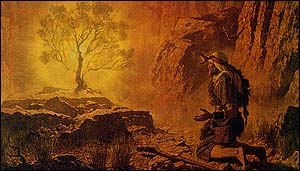
Arnold Friberg (1913- ), "Moses and the Burning Bush" (1957). Larger image. Painted for Cecil B. DeMille's "10 Commandments." - Domenico Feti (Italian painter (ca. 1589-1623), Moses before the Burning Bush (1613-14), Oil on canvas, 168 x 112 cm, Kunsthistorisches Museum, Vienna. Also beautiful "Parable of the Lost Drachma" (1618-22)
- Eugene Pluchart (French painter, 1809-1880), "God Appears to Moses in Burning Bush" (1848), St. Isaac of Dalmatia Cathedral, St. Petersburg. Fascinating stylized painting.
- Ernst Fuchs, Moses Before the Burning Bush
- James Tissot, Moses and the Burning Bush (1896-1900), watercolor.
- William Blake (1757-1827), Moses & The Burning Bush. Victoria and Albert Museum, London, Great Britain
- Marc Chagall, Moses before the burning bush, oil on canvas, Musée National Message Biblique Marc Chagall (L'Académie de Nice)
- Moses and the Burning Bush, stylized Japanese contemporary
- Hippolyte Flandrin (French, 1809-1864), Moses and the Burning Bush
- Tiffany Studios, Moses and the Burning Bush, Union Congregational Church, Montclair, NJ.
- Raphael, The Burning Bush, fresco, Palazzi Pontifici, Vatican
- Raphael, Moses Before the Burning Bush, Stanza d'Eliodoro Ceiling


Creator
- William Blake (1757-1827),
The Ancient of Days (1794)
Creation of the World - Michaelangelo,
ceiling of the Sistene Chapel, Vatican
Creation of Adam,
Creation of Eve
Creation of Moon and Stars - Wieslaw Sadurski, Creation (1976-78), oil on canvas, 250 x 200 cm
- Pietro Perugino (1450-1523), God the Creator and Angels (1507-08), ceiling medalion, fresco, diameter 240 cm., Stanza dell'Incendio di Borgo, Palazzi Vaticani, Vatican
- Collection: God the Creator, Biblical Art on the WWW


Mighty Warrior
-
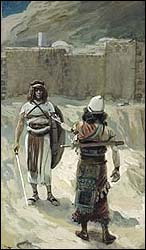
James Tissot, Joshua and the Angel Before Jericho
-
Marc Chagall, Josué devant l'ange à l'épée (1956), etching
Call of Isaiah
- Tiffany Studios, The Call of Isaiah, Union Congregational Church, Montclair, NJ.
- Call of Isaiah, Christ Church, Pompton, NJ, stained glass window #9.
- Links to images of Isaiah, The Text This Week
- Title Page of Luther's Bible, Isaiah's Call
- Raphael, The Prophet Isaiah (1511-12), fresco 250x155 cm, Sant'Agostino, Rome
- Unknown contemporary artist (perhaps LDS). Isaiah writing prophecy of Jesus birth.
- June Vecchio, Isaiah (1996) , mixed media on canvas.
- Greek Orthodox icon of Isaiah.
- Jean-Louis-Ernest Meissonier, Isaiah (1838), oak panel, 35.3x23.8. The Wallace Collection, Hertford House, London.
- Gustave Doré, Isaiah Praying, b&w
- Isaiah's vision of God from Martin Luther's German Bible (1525), woodcut. Full-size PDF of page from Pitts Theology Library Digital Image Archive, Chandler School of Theology, Emory University.

The Holy and Righteous God, Judge
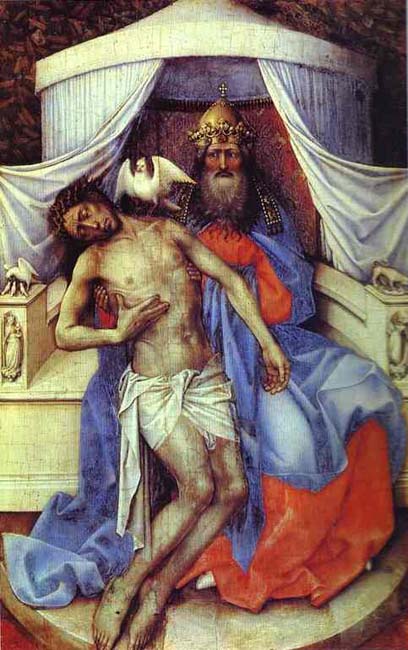
- "Mourning Trinity (Throne of God)," by Robert Campin (Flemish painter, "Master of Flemalle," 1375/80-1444). Oil on panel, 34.3cm x 24.5cm, The Hermitage, St. Petersburg, Russia. Museum.
- Albrecht Dürer (1471-1528), St.John in Clouds, Surrounded by 24 Elders around the Throne of God (St.John before God and the Elders), woodcut, Revelation 4. 15x11in.
- Images of the Last Judgment
- The Burning Coal, Isaiah 6:7, picart. B&W engraving
-
The Last
Judgement, French Romanesque, relief sculpture in tympanum,
1130 A.D., Conques, France. The website says the judge is
Christ, but I see no nail prints.


God Enthroned
- Jacobello Alberegno (Italian painter, Venetian school, d. 1397), Vision of Saint John the Evangelist on Patmos (n.d.), tempra on panel, 95 x 61 cm, Galleria dell' Accademia, Venice.
- God Enthroned, Nuremberg Chronicle
- figure of God enthroned, 14th century, Northern Spain, wood, remains of polychromy, height: 58.5 cm.
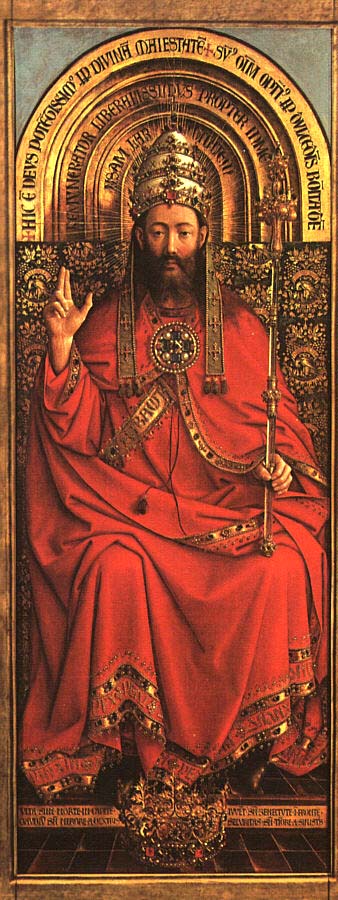
- Hubert (c. 1366-1426). and Jan van Eyck (c. 1390-1441; Flemish painters) , Ghent Altarpiece (1432), central panel, God Almighty enthroned.Cathedral of St. Bavo, Ghent. See my short discussion of: "Who Is the Central Image in the Ghent Altarpiece?"
God our Protector
Shields
- 16th century AD Persian shield, Punjab, India. Bronze, round. Engraved.
- Indo-Persian shield, bronze. between 12th-15th C buckler and a 18th-19th C separ or dhal, engraved with men, lions and floral motifs. Diameter: 25 cm. Height: 4,8 cm.
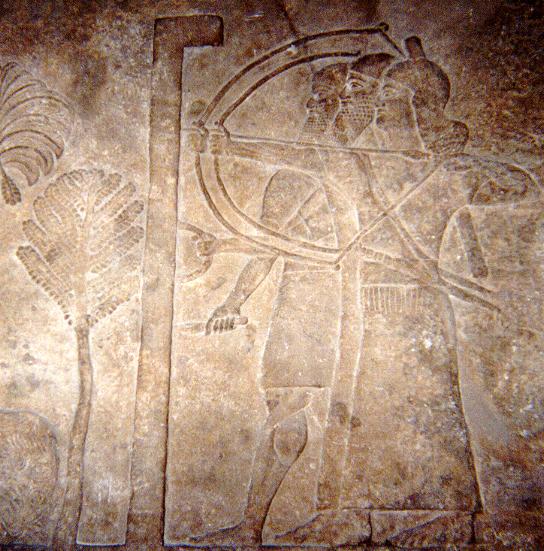
- Assyrian shields of various types made of wicker, bronze, and hide.
- Assyrian tall shield
- Siege of Lachish
Fortress
- Masada, the name for Herod the Great's fortress-palace plateau near the Dead Sea, comes from metsûdâ,"fastness, fortress, stronghold." Another.
- Citadel example from Bitlis, Turkey
- High tower from Lachish
- Nimrod Fortress (Kalat Namrud) National Park, Israel
Rock
- Marat Rutman, Lion Rock. Israel
Shepherd
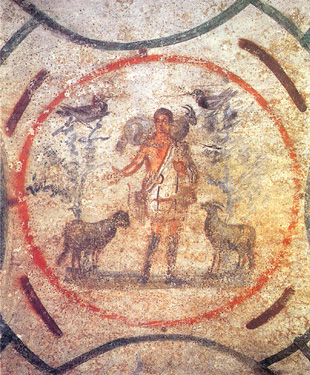
I doubt that there are images of the Shepherd of Psalm 23, since Christ the Good Shepherd was very early a strong Christian art theme, especially in death.
- Marble shepherd, gave its name to the Villa del Pastore at Stabiae (Stabiano, Italy, near Pompeii), where it was found in the garden, an aged shepherd carrying a young goat on his shoulders and a rabbit, that appears dead, in his right hand. This typical Roman bucolic subject of Hermes the ram-carrier was adapted by early Christian artists to portray Christ the Good Shepherd. ~ 75 AD.
- Good shepherd wall painting, Priscilla catacombs
- The Good Shepherd, Catacombs of Rome, 284 AD
- The Good Shepherd, Catacomb of Domitilla (200 CE)
- The Good Shepherd, catacombs of St. Callixtus
- Good Shepherd, Catacombs of St. Peter
- Christ as Good Shepherd, c. 225 AD, statue
- Christ as the Good Shepherd, mosaic at the Mausoleum of Galla Placidia, Ravenna, 5th century
- Christ the Good Shepherd, marble sarcophagus, Praetexta Catacomb, c. 390 AD. Sarcophagus of the Good Shepherd, Rome, 4th century, about 390 AD.
- Sarcophagus of Junius Bassus
- Links to images of the Good Shepherd, Textweek.com



Father
- God the Father, by Billy Ledet, contemporary artist
- Francesco di Giorgio Martini, God the Father (c. 1470), panel 36 x 51 cm, National Gallery of Art, Washington DC
- St. Ignatius praying to Father and Son (1622) Los Angeles County Museum of Art
- Giovanni Battista Pittoni (1687-1767) The Nativity with God the Father and the Holy Ghost (c. 1740), National Gallery, London, Oil on canvas, 222.7 x 153.5 cm. Again.
- Icon of God the Father, theworkofgod.org
- God
the Father (1442) ceiling Fresco
San Zaccaria, Venice, Francesco da Faenza (probably Francesco Torelli) - Stanislaw Wyspianski (Polish painter and playrwright, 1869-1907), stained glass window, God the Father, St Francis Bascilica, Cracow, 1897-1902. Again.
- Russian Icon, Barakat Gallery, Beverly Hills, God the Father.
- Durer, The Trinity.
- Antoniazzo Romano, God the Father, detail (c. 1489)
- 24 inch God the Father Relief in Lindenwood. Made in Italy.
- Stamp, Ajman, Michaelangelo, Head of God the Father.
- God the Father stained glass window, Holy Trinity Episcopal Church, Midland TX. Hand of God extended downward in front of red cross.


The Trinity
One theme is the Father as an old man wearing a papal crown, holding in his arms the lifeless body of the crucified Son, attended by the Holy Spirit, represented by a dove.
- Lucas Cranach the Elder (German painter, 1472-1553), The Trinity (undated), oil on wood; Museum der Bildenden Künste at Leipzig, Germany
-
Robert Campin (Master of Flemalle), The Holy Trinity, oil on panel; 34.3cm x 24.5cm, Hermitage Museum, St. Petersburg, Russia
-
Trinity, Schonenfahrer (Scania traveller) altar is the two tables that today are exhibited in St. Annenmuseum in Lübeck.
-
Albrecht Dürer, Woodcut of the Trinity

Other themes:
- The Trinity by Andrei Rublev, with abraham's three divine guests seen as the Trinity. Common icon of the Trinity in the Orothodox church
- Theophanes the Greek. The Trinity. Fresco. 1378. The Church of Our Savior on Ilyin Street, Novgorod, Russia
- Franz Anton Maulbertsch (Austrian painter, 1724-1795)
- Triumph of the Trinity (1771-72), Fresco, Cathedral, Vác
- The Trinity (c. 1785), oil on canvas 62.5x33 cm, Museum of Fine Arts, Budapest.
-
The Doctrine of the Trinity (1903), Frieze of Angels, with the Crucifixion, (South End, lunette), John Singer Sargent (American painter), Boston Public Library Murals
-
The Trinity with the Virgin and Four Kneeling Angels, Niccolò di Pietro Gerini (Florence, active 1368-1415). The Trinity with the virigin, who is sometimes being crowned, is another Catholic theme.
-
Textweek.com, Links to images of the Trinity
-
Hendrick van Balen, Holy Trinity (1620s), Saint Jacobskerk Antwerp. Son and Father co-reigning with dove above.
Loving and Faithful God, God of All Grace
Probably best pictured from Jesus' parable of the Prodigal Son, where the father represents God.
- Rembrandt, The Return of the Prodigal Son (c. 1669), oil on canvas, 262 x 206 cm, The Hermitage, St. Petersburg
Savior, Deliverer, and Redeemer
Yevgeny or Eugene Pluchart (1809-1880), a lesser known contributor to the artistic decoration of St. Isaac's Cathedral, received his education, according to some sources, at the Munich Academy of Arts in 1831-32 and according to some others, in his homeland, France. E. Pluchart came to St. Petersburg in 1836 and soon won fame as a fashionable portraitist. In 1839 he was made Academician for his portrait of Karol Lipinsky. In the 1840s and 1850s the artist continued to work on commissioned portraits. Worthy of special note among them are series of portraits featuring the daughters of grand Duke Mikhail Pavlovich, 10 portraits of Anatoly Demidov, portraits of Kiselevskaya, Auguste de Montferrand, and others. Montferrand's patronage enabled him to receive a commission for painting seven subjects for St. Isaac's Cathedral: The Miracle of the Loaves, The Sacrifice of Abraham, God Appearing to Moses in the Burning Bush, Moses in the Nile, and others. (Information from Natalia Negodova - the Head of the International Dept., State Memorial Museum, "St. Isaac's Cathedral.")
Copyright © 2026, Ralph F. Wilson. <pastor joyfulheart.com> All rights reserved. A single copy of this article is free. Do not put this on a website. See legal, copyright, and reprint information.