


|
Old Testament
New Testament
Gospels
Acts
Paul's Letters
General Letters
Revelation
Topical Studies
Beginning the Journey (for new Christians). en Español

|
Old Testament
New Testament
Gospels
Acts
Paul's Letters
General Letters
Revelation
Topical Studies

|
Home
Bible Studies
Articles
Books
Podcasts
Search
Menu
Donate
About Us
Contact Us
FAQ
Sitemap


 Faith of Abraham (Genesis 11-25)
|
|
In this lesson we'll be covering a great deal of ground, skipping over the details of Esau (chapter 36), Judah and Tamar (chapter 38), and much of Joseph's life (chapters 39-45). But we'll be stopping to observe Jacob at various points, to seek to understand what is going on in him, and to see what God does about it.
The Loss of Joseph (chapter 37)
Joseph is the apple of Jacob's eye. The young man is granted a kind of special status far above his older brothers, causing tremendous resentment among them. As a teenager, he is out tending the flocks with his half-brothers. When something doesn't go his way, or when they do something behind their father's back, Joseph is the tattletale -- and their father believes Joseph (37:2).
The High Cost of Favoritism (37:3-4)
"3 Now Israel loved Joseph more than any of his other sons, because he had been born to him in his old age; and he made a richly ornamented robe for him." (37:3)
In his grief, Jacob makes the serious error of displaying openly his preference for one son over another. Now that Rachel is gone, his love and attention shifts to her son.
On some special occasion, Jacob presents Joseph a special coat. The exact translation is difficult. The word "robe" is clear, but passîm, from pas, "flat (palm) of hand,"1 is difficult to understand. Here are some of the attempts:
- "Richly ornamented robe" (NIV).
- "Coat of many colors" (KJV), based on the Septuagint and Vulgate translations.
- "Long robe with sleeves" (NRSV), taking pas, "palm," to indicate the robe's sleeves reached to the palm and to the soles (flat) of the feet, as Aquila's translation.
Hamilton's rendering "a long, colorful tunic"2 is probably a good compromise. We're just not sure exactly what it looked like. In 2 Samuel 13:18, a garment so named was royal apparel. Whatever it was, it was special, far beyond what Jacob had given any of Joseph's brothers. Jacob may have sewn it himself, which made it doubly special.
"When his brothers saw that their father loved him more than any of them, they hated him and could not speak a kind word to him." (37:4)
Jacob should have known better. His own father Isaac had made Esau his obvious favorite. He knew how it felt to be less loved. He had seen how this selective love had caused hatred and threats of violence in his own case. But Jacob continued in his selective love and sowed the seeds of murder in his own family also.
Joseph's Dreams (37:5-11)
Joseph was not only a tattletale. He was also a dreamer. He told his brothers of seeing their sheaves of grain in the field bowing down to his sheaf. Their hatred grew. Next he dreamed of the sun and moon and eleven stars bowing down to him. Jacob himself rebukes Joseph:
"What is this dream you had? Will your mother and I and your brothers actually come and bow down to the ground before you?" (37:10)
Though he rebukes his son, yet he keeps wondering: What does this mean?
Selling Joseph into Slavery (37:12-36)
The older sons had gone north to graze the flocks near Shechem, so Jacob sends Joseph to make sure all is well with them. When they see him coming, their hatred boils over:
"When they saw him in the distance, and before he reached them, they plotted to kill him. 'Here comes that dreamer....'" (37:18-19)
Finally, they decide to dispose of him by selling him to a caravan of Ishmaelites, Midianites headed for Egypt.
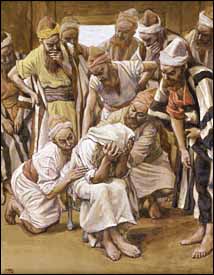
They dip the beautiful coat in goat's blood and bring it to their father. "We found this," they say. "Look to see whether it's your son's robe" (37:32) They don't tell Jacob any lies. They don't have to. Jacob creates his own horrible story of his beloved son's death:
"It is my son's robe! Some ferocious animal has devoured him. Joseph has surely been torn to pieces." (37:33)
Jacob's heart and mind seem to stop. The old patriarch is overcome with grief and loss.
"34 Then Jacob tore his clothes, put on sackcloth and mourned for his son many days. 35 All his sons and daughters came to comfort him, but he refused to be comforted. 'No,' he said, 'in mourning will I go down to the grave to my son.' So his father wept for him." (37:34-35)
His grief is inconsolable. Jacob is broken in spirit. His sons' deed of bitterness has not only destroyed their hated brother, but also their father. In the unbearable weight of his sadness, only in his young son Benjamin does he find some comfort (42:38; 44:20, 30-31). Benjamin is the little bit of Rachel's memory that still endures.
|
Q1. (Genesis 37:31-35) What does bringing
the blood-stained robe to Jacob say about these sons' attitude
toward their father? How does this loss affect Jacob? How do you
think it affects his future behavior?
|
Joseph's Fortunes in Egypt (chapters 39-41)
|
|
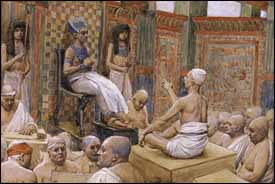
The boy who was "too big for his britches," who was "king of the mountain" in his father's household is now a slave. But he rises quickly under God's blessing. He is sold as a slave to Pharaoh's captain of the guard and is promoted to manage Potiphar's entire estate. When the nobleman's wife tries to seduce him, his sense of honor and responsibility cause him to flee from her. When she accuses him of attempted rape, he is thrown into prison under her husband's jurisdiction, the prison in which Pharaoh's prisoners are confined.
Joseph's faithfulness and abilities cause him to gain the trust of the warden, who sets him over the whole prison, though he is still confined. When Pharaoh's cupbearer is thrown in prison for offending the king, Joseph interprets dreams that come to pass exactly as Joseph had predicted. Two years later, when Pharaoh is troubled by dreams, the cupbearer remembers Joseph and sends for him to help. Joseph tells Pharaoh:
"The seven fat cows in your dream are seven years of abundance, while the seven gaunt cows are seven years of famine. Let Pharaoh appoint a man to take a fifth of the seven abundant harvests and store them away in granaries so that the country may not starve during the seven years of famine." (41:29-34, paraphrase)
Pharaoh sees God's hand in the interpretation and appoints Joseph himself to the task. In a single day, Joseph moves from being prison trustee to second in command over all Egypt.
A Famine Sends Jacob's Sons to Egypt (41:1-34)
The years of plenty are a time of abundance, but when a drought grips the entire region, famine comes. In Canaan, the harvests are meager and Jacob can buy no food despite his wealth. Jacob's clan faces starvation and death.
"When Jacob learned that there was grain in Egypt, he said to his sons, 'Why do you just keep looking at each other?' He continued, 'I have heard that there is grain in Egypt. Go down there and buy some for us, so that we may live and not die.'" (42:1-2)
Jacob may have been passive when Dinah had been raped, but he takes the lead now.
So ten of the brothers go to Egypt to buy grain, leaving young Benjamin at home with their father, "because he was afraid that harm might come to him" (42:4).
When the brothers arrive in Egypt, Joseph recognizes them. He questions them closely about his father and younger brother Benjamin. "You are spies!" he says. Then to test them, he demands that one remain as hostage until the youngest brother Benjamin is brought with them to prove their story. He detains Simeon in prison, and sends the others back home with sacks full of grain. But curiously, he returns each man's silver and has his servants bury it in each man's sack of grain.
When they reach home and begin to empty their sacks, the pouches of silver coin fall out. None returns home without his silver. The grain is theirs for free.
Fear, Blame, and Stubbornness (42:35-38)
"When they and their father saw the money pouches, they were frightened. Their father Jacob said to them, 'You have deprived me of my children. Joseph is no more and Simeon is no more, and now you want to take Benjamin. Everything is against me!'" (42:35-36)
This is paranoia fed by depression. Jacob has experienced more loss than he can endure. His mother, his mother's nurse, his Rachel, his father, his beloved son Joseph have all been taken from him. Benjamin is all he feels he has left -- and now he will be taken from him, too! Jacob turns to blaming his sons for all his woes.
"Everything is against me!" Have you ever been overtaken by depression? Has your heart ever been broken by loss, your world shattered by death? Your world suddenly shrinks to only you and what has meaning to you. At such times it seems like you against the world.
It is amazing that this story of the patriarch Jacob was not whitewashed as it was retold again and again until it was finally written down in the book of Genesis. You'd think that all the negatives about this legendary ancestor would be stricken from the record as the Israelites sought to glorify their past. But no, the character seems very real. Too real -- if you've ever felt what Jacob is feeling, if you've ever been depressed.
Now this ruler in Egypt requires that Benjamin be brought before him.
"Then Reuben said to his father, 'You may put
both of my sons to death if I do not bring him back to you. Entrust him to
my care, and I will bring him back.'
But Jacob said, 'My son will not go down there with you; his brother is dead
and he is the only one left. If harm comes to him on the journey you are
taking, you will bring my gray head down to the grave in sorrow.'"
(42:37-38)
The "only loved brother," Jacob could have said. His obvious favoritism must hurt the other brothers. Jacob is thinking only of himself and how this might affect him. He is consumed by self-pity.
Preparing for the Second Trip to Egypt (43:1-13)
But events have a way of forcing us to do what we've sworn we would never do. The famine continues unabated and the grain from their sacks is finally depleted.
"Go back and buy us a little more food," Jacob says to his sons.
"Don't you remember, Dad, what the man said. He won't give us food unless we bring our brother."
"Why did you tell him you even had another brother?" says Jacob in reproof. You can tell that this is just the flare-up of an argument that has continued periodically over the past year.
"The man questioned us closely about our family," replies Judah. "How did we know he would say, 'Bring your brother down here'?"
Their children are slowly starving and their father is quibbling about Benjamin. It is almost more than the sons can bear.
Now Judah offers to take personal responsibility for Benjamin. "I myself will guarantee his safety; you can hold me personally responsible for him."
Jacob finally relents. "If it must be, then do this...." He explains to them how to appease their enemy, much as he had once appeased his brother Esau. They prepare a pitiful gift, "a little balm and a little honey, some spices and myrrh, some pistachio nuts and almonds."
"Take double the amount of silver with you, for you must return the silver that was put back into your sacks," adds Jacob. It has been nearly a full year, we assume, since the first trip to Egypt for food. How would a busy administrator dealing with thousands of starving people remember that a few foreigners were sent off with their money still in its pouches? But Jacob the deceiver is changed. He may be depressed and overcome with loss, but he is now honest.
"Take your brother also and go back to the man at once." Now that his mind is made up, he is ready to execute the plan immediately. There is no time for dithering. If it must be done, it must be done at once.
Jacob's Prayer (43:14)
"And may God Almighty grant you mercy before the man so that he will let your other brother and Benjamin come back with you." (43:14)
Here it is finally, a prayer to God Almighty, El Shaddai. Jacob has grieved and blamed, but now he turns to God for blessing. It is just a glimmer of hope through the gloom of bereavement, but it is a glimmer nevertheless.
"As for me, if I am bereaved, I am bereaved." Finally, Jacob is willing to let the world go on, even if he must suffer. His selfishness gives way to resignation and he sends the brothers on their way.
|
Q2. (Genesis 42:35-43:14) What is Jacob's
state of mind after the first trip to Egypt? If you were a
psychologist, how would you diagnose him? What factors have
paralyzed Jacob mentally and spiritually? Why do you think Jacob
changed his mind about going again to secure grain?
|
Joseph Confronts His Brothers (43:15-44:34)
The brothers return to Egypt, and Joseph is moved to see his brother Benjamin. But he cannot show his feelings now. He must test his brothers once more. What will they do this time when their youngest brother, their father's new beloved son, is threatened? Have they changed? Have they finally repented of what they had done to him?
The brothers return the silver sent back with them on the first journey. They do the honest, right thing.
"It is all right," says Joseph. "Don't be afraid. Your God, the God of your father, has given you treasure in your sacks. I received your silver."
Simeon is released from prison, and the brothers are banqueted in Joseph's private quarters, and are then sent home with bags of grain. But Joseph's own silver cup is secretly placed in the mouth of Benjamin's bag and their pouches of silver returned again.
No sooner than they have left the city, they are stopped and searched. Have they taken the missing cup? The cup is found in Benjamin's sack and the boy is taken into custody to become a slave.
The brothers "tore their clothes." They themselves had sold Joseph into slavery, but now when Benjamin is taken into slavery, they are visibly moved.
Judah now goes up to Joseph to plead with him for Benjamin's life.
"If the boy is not with us when I go back to your servant my father, and if my father, whose life is closely bound up with the boy's life, sees the boy isn't there, he will die. Your servants will bring the gray head of our father down to the grave in sorrow." (44:30-31)
Judah offers his own life in exchange for the life of the boy.
"How can I go back to my father if the boy is not with me? No! Do not let me see the misery that would come upon my father." (44:34)
Joseph Makes Himself Known (45:1-24)
|
|
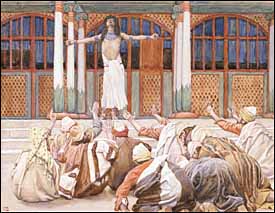
Joseph can bear it no longer. His brothers have changed. They care about their father. They care about their brother. He orders all his servants out of the room and begins to weep. "I am Joseph!" he tells his brothers. "Is my father really still alive?"
His brothers are terrified. Their brother, whom they had sold into slavery, now has them fully in his power and none can deliver them. They don't know what to do. They are speechless.
"Come here," says Joseph, and proceeds to reveal to them an astonishing insight into God's plan.
"Do not be angry with yourselves for selling me here, because it was to save lives that God sent me ahead of you.... God sent me ahead of you to preserve for you a remnant on earth and to save your lives by a great deliverance. So then, it was not you who sent me here, but God." (45:5-8)
Seldom does a person see the big picture in his lifetime, but Joseph could see it. Ever since his brothers had appeared the year before seeking food to keep their families from starving, Joseph had begun to understand what God's real purpose was.
Here is the Blessing of Abraham again. This isn't for Egypt, though God cares for the Egyptians. This isn't for Joseph's sake; he has power enough. This is God's purpose: to raise up a people whom no one could number. Joseph's part is to keep them from starving and to provide a place for them to grow in number and flourish. This isn't about Joseph at all, but about God fulfilling his purposes.
What an amazing insight!
Joseph weeps in his brothers' arms and sends them home to fetch their father to come and live in the best part of Egypt, with the knowing words, "Don't quarrel on the way!" (45:24).
|
Q3. (Genesis 45:4-8) Contrast Jacob and
Joseph. Jacob has suffered great loss. Joseph has suffered great
injustice. Why is Jacob's vision so bleak, but Joseph's so broad?
What have been their differing responses to fear? What insight has
kept Joseph from being bitter towards his brothers?
|
Jacob's Reassurance (45:25-46:27)
The jubilant brothers' caravan finally arrives at Jacob's camp. They shout:
"Joseph is still alive! In fact, he is ruler of all Egypt." (45:26)
Jacob is stunned. Joseph alive? Could he allow himself to even consider the possibility? It would hurt too much to open old wounds, if it were not true. Sometimes we get into a place of looking at the dark side of everything. We can't see God's blessings even when they stare us in the face.
"But it is true," his sons insist, and they tell him Joseph's words and show him the carts Joseph has sent to carry him back. A smile breaks out over his long-sad countenance and he laughs. The scripture says:
"The spirit of their father Jacob revived. And Israel said, 'I'm convinced! My son Joseph is still alive. I will go and see him before I die.'" (45:27-28)
The next days are busy with preparations for the journey. Belongings of a lifetime are packed. Numerous families are gathered and told they will be leaving behind all they have known. Herds are gathered, and the caravan of Jacob and sixty-six sons and grandsons, plus wives and daughters and servants, leaves and heads south.
Jacob Journeys to Egypt (chapter 46)
|
|
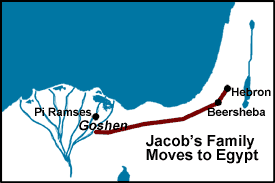
Jacob stops in Beersheba. Here his grandfather Abraham had sojourned and had called upon the name of the Lord, the Eternal God (21:33). Here the Lord had appeared to Jacob's father Isaac and confirmed to him the promises of Abraham. Here Isaac had built an altar and called on the name of the Lord and dug a well (26:23-25).
And now Jacob, on his way to see his son, stops in Beersheba and calls on the God of his father Isaac (46:1). He offers sacrifices, perhaps on the very altar Isaac had built many years before and is refreshed from the very well Isaac had dug.
That night God speaks to Jacob in a vision:
"'Jacob!
Jacob!'
'Here I am,' he replied.
'I am God, the God of your father,' he said. 'Do not be afraid to go down to
Egypt, for I will make you into a great nation there. I will go down to
Egypt with you, and I will surely bring you back again. And Joseph's own
hand will close your eyes.'" (46:2-4)
When God speaks to us, all we can do is weep.
"Do not be afraid," God says. Jacob's life has been consumed by fear. Fear of Esau, fear of Laban, fear of Esau again, fear of the Canaanites after the destruction of Shechem. Fear of loss. Fear of loneliness. Fear. Fear has gripped him, and now God graciously releases him from its grasp. "Do not be afraid to go down to Egypt," he says.
Jacob has suffered loss after loss. His world has narrowed down until he clings to his youngest son Benjamin, only to have to give him up, too. He has nearly forgotten the promise of God to be with him.
"I will go down to Egypt with you," God promises him, "and will surely bring you back again."
So often we forget the companionship God offers, and turn to our own dwindling resources. There's an old hymn that expresses it well:
"O what
peace we often forfeit, O what needless pain we bear,
All because we do not carry everything to God in prayer....
Are we weak and heavy laden, Cumbered with a load of care?
Precious Savior, still our refuge, take it to the Lord in prayer."3
|
Q4. (Genesis 46:2-4) Faith is what quiets
our fears. What in God's word to Jacob at Beersheba quiets his
fears? God had brought the same assurance to Jacob before (28:15;
31:3). Why do you think he had stopped believing it? What is the
relationship between faith and God's words?
|
And Joseph's Hand Will Close Your Eyes
Jacob has a future again. Like so many elderly people, his life had narrowed down to himself alone. Now his God will go with him. He will see Joseph and Joseph himself will be with him when he dies.
|
|
Jacob had left home the first time with nothing but a staff in his hand. This time when he leaves home, he counts a company of people as his descendants and household, including sixty-six sons and grandsons -- a total of seventy when they are reunited with Joseph's family in Egypt -- plus the wives and daughters and granddaughters and servants. Here is a man whom God has tried, but has also blessed -- abundantly.
"Do not be afraid to go down to Egypt," or wherever your path is leading you, says your God, "for I will go down to Egypt with you and will surely bring you back again." Don't be afraid of your future. You have a Friend alongside.
Prayer
Father, so often, I've been afflicted with fear. At times in my life, it has gripped me in its evil fingers and motivated my decisions. Forgive me for not trusting in you. Forgive me for forgetting your promise to be with me. Father, I trust my future into your hands afresh. Thank you for your blessings of love and life and salvation in Jesus Christ. In His name, I pray. Amen.
References
1. BDB 1108.
2. Hamilton, Genesis 18-50, p. 407.
3. From the song "What a Friend We Have in Jesus," by Joseph M. Scriven (1855).
Copyright © 2025, Ralph F. Wilson. <pastor joyfulheart.com> All rights reserved. A single copy of this article is free. Do not put this on a website. See legal, copyright, and reprint information.
 To be notified about future articles, stories, and Bible studies, why don't you subscribe to our free newsletter, The Joyful Heart, by placing your e-mail address in the box below. We respect your