


|
Old Testament
New Testament
Gospels
Acts
Paul's Letters
General Letters
Revelation
Topical Studies
Beginning the Journey (for new Christians). en Español

|
Old Testament
New Testament
Gospels
Acts
Paul's Letters
General Letters
Revelation
Topical Studies

|
Home
Bible Studies
Articles
Books
Podcasts
Search
Menu
Donate
About Us
Contact Us
FAQ
Sitemap


Free
E-mail Bible Study
 The Discipleship Process
Home |
Bible Studies |
Articles |
Books |
Podcasts |
Search |
Menu |
Donate |
About Us |
FAQ |
Contact Us
The Discipleship Process
Home |
Bible Studies |
Articles |
Books |
Podcasts |
Search |
Menu |
Donate |
About Us |
FAQ |
Contact Us
|
|
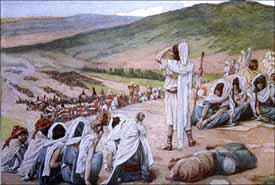
"We went to your brother Esau, and now he is coming to meet you, and four hundred men with him." (32:6)
Laban had only suffered loss of property; Esau has been nurturing a murder wish against Jacob for twenty years! No wonder Jacob is in "great fear and distress" (32:7).
Sign of the Angelic Army (32:1-2)
But knowing this was coming, God sends a wonderful sign to Jacob.
"Jacob also went on his way, and the angels of God met him. When Jacob saw them, he said, 'This is the camp of God! So he named that place Mahanaim.'" (32:1-2)
In Bethel, Jacob had seen angels in his dream, ascending and descending a staircase to heaven and called the place Beth-el, "house of God" (28:17-19). Here he sees angels and exclaims, "This is the camp of God!" (32:2). God, who had promised him in Bethel to watch over him wherever he went (28:15), has not forgotten.
Jacob's small encampment of wives and children, servants and livestock, is matched by God's nearby encampment of an army of angels. When Jacob moves, the angelic army moves as well, shadowing him, protecting him from any harm. When Laban had gotten his band of men within range to threaten Jacob, God had spoken a stern warning (31:24, 29, 42), and Laban had complied. Jacob realizes that his camp is protected by God's camp, so he names the place Mahanaim, in Hebrew "two camps."1
Q1. (Genesis 32:1-2) Why does God reveal
the angel army to Jacob? What is the significance of the presence of
this army? Why do you think he calls the place Mahanaim ("two
camps")?
|
Preparing to Meet Esau (32:3-21)
|
|
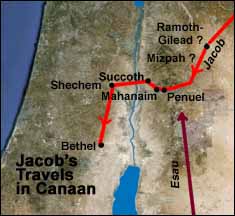
Jacob knows he must reconcile with Esau if he is to live in the land to which God has sent him, and so he makes careful preparations.
1. Jacob sends messengers ahead
First, Jacob sends messengers ahead so that he will not surprise Esau suddenly by word of his presence.
"This is what you are to say to my master Esau: 'Your servant Jacob says, I have been staying with Laban and have remained there till now. I have cattle and donkeys, sheep and goats, menservants and maidservants. Now I am sending this message to my lord, that I may find favor in your eyes.'" (32:4-5)
The messengers are to bring several things to Esau's attention:
- Peaceful. Jacob has been with their uncle Laban for 20 years and is only now returning home. Jacob shows that his past actions constitute no threat to Esau, and that he has not secretly returned home without Esau's knowledge to somehow gain further advantage over Esau.
- Wealthy. Jacob is wealthy and returns home with a considerable fortune. Thus he does not need what Esau has and poses no threat to Esau's goods. He does not need to exercise the birthright inheritance of double the inheritance Esau would receive. Jacob is independently wealthy. And he is not sneaking home, his tail between his legs. He comes on his own and is a person to be reckoned with.
- Humble. Jacob comes humbly. He instructs his servants to refer to Esau as his lord, his superior. All his life Jacob had been struggling to be Esau's lord. He had tricked Esau into handing over his birthright and had deceived in order to receive the blessing of the firstborn from his father. But now he comes acknowledging Esau as his lord. This may be the formal deference of courtesy, but it is deference nevertheless.
- Healing. Jacob comes to seek Esau's favor and heal the rift between them.
2. Jacob prays (32:9-12)
|
|
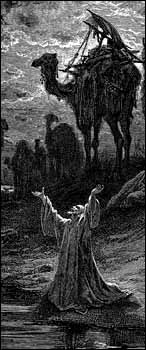
Next, Jacob prays.
" 9O God of my father Abraham, God of my father Isaac, O LORD, who said to me, 'Go back to your country and your relatives, and I will make you prosper,' 10 I am unworthy of all the kindness and faithfulness you have shown your servant. I had only my staff when I crossed this Jordan, but now I have become two groups. 11 Save me, I pray, from the hand of my brother Esau, for I am afraid he will come and attack me, and also the mothers with their children. 12 But you have said, 'I will surely make you prosper and will make your descendants like the sand of the sea, which cannot be counted.'" (32:9-12)
Jacob reminds God that he is returning in obedience to God's own instructions. He acknowledges his own unworthiness of God's great blessings to him. We see both humility and thankfulness have grown in Jacob these twenty years since he first met God at Bethel.
Now he asks for God's salvation (rescue) and protection from Esau. He admits his fear for himself and for his wives and young children, all under 13 years of age. This kind of transparency in prayer is another indication that Jacob has gotten to know God. He concludes with a reminder of God's promise to him and his ancestors that God would prosper him and make him fruitful.
Does Jacob remind God of his promises as some kind of persuasive leverage? Perhaps. But we must understand that these promises are the bedrock of Jacob's own faith. He believes and has acted on God's instructions to return home. God has confirmed the blessings of Abraham to him, and he believes them, too. I think Jacob reminds God of his promises as a faith-statement. It is this faith that props Jacob up when he is afraid. He shares with his God both his fears and his faith, and so his prayer is an authentic, faith-filled prayer. How Jacob has grown!
Q2. (Genesis 32.9-12) What does Jacob's
prayer tell us about his fears? About his faith? About his pride?
What are the signs of spiritual growth you see in Jacob since he
left Canaan to go to Haran years before?
|
3. Jacob prepares a succession of gifts to appease Esau (32:13-21)
Look at the quantity of animals he gives to Esau:
| 1. | 200 female, and 20 male goats | 220 |
| 2. | 200 ewes and 20 rams | 220 |
| 3. | 30 female camels and their young | 30 |
| 4. | 40 cows and 10 bulls | 50 |
| 5. | 20 female donkeys and 10 male donkeys | 30 |
|
Total |
_______ 550 |
Five hundred fifty animals, 490 of which are female and will cause Esau's herds to increase rapidly.
Jacob gives instructions that the animals are to be sent as individual groups, each with space between it and the next, so that the cumulative effect will be of one gift after another. Perhaps if Esau is angry when he encounters the first herd, his anger will have abated somewhat by the time the fifth herd reaches him. Each herder is to bring the same humble message when he meets Esau's army:
"They belong to your servant Jacob. They are a gift sent to my lord Esau, and he is coming behind us." (32:18)
Jacob's purpose is clearly stated:
"I will pacify him with these gifts I am sending on ahead; later, when I see him, perhaps he will receive me." (32:20)
Jacob seeks to pacify with generous gifts a tribal chieftain whom he has offended, much as centuries later, Abigail, the wife of churlish Nabal (who insulted David), seeks to pacify David with gifts and gracious words to David who is coming with his own 400 men (1 Samuel 25:18-31).
Jacob is traveling down the east side of the Jordan, southward in the direction of Seir, Esau's lands, in Edom. He has just come to the Jabbok ravine, a small river flowing into the Jordan from the east. Jacob has sent the herds of animals ahead of him the previous afternoon, but he stays the night on the banks of the Jabbok.
4. Jacob divides his party into two groups (32:7-8; 33:1-2)
Jacob's final preparation is to divide his party into two groups to avoid a wholesale massacre.
Wrestling with God (32:22-32)
At nightfall, Jacob sends his wives and children across the ford in the Jabbok River with all their possessions, ready for an early start in the morning. But he stays behind, as the Scripture records,
"So Jacob was left alone, and a man wrestled with him till daybreak." (32:24)
|
|
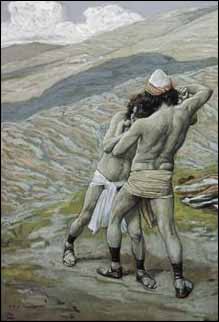
Who is this strange antagonist? What is the significance of this struggle? While the event is shrouded by darkness and mystery, several things emerge as we meditate on it.
God the Wrestler
First, we find that the "man" is a manifestation of God himself. Hosea calls him both an "angel" and God:
"In the
womb he grasped his brother's heel;
as a man he struggled with God.
He struggled with the angel and overcame him;
he wept and begged for his favor." (Hosea 12:3-4)
Would God reveal himself as a wrestler? Isn't God gentle and peaceful? Yes, and he is also just and holy and a God of vengeance. Both the Old and New Testaments give many indications of God's violent judgment upon the unrighteous. In his letters, Paul refers to spiritual conflict as "wrestling," both struggling with the dark powers, as well as struggling in prayer before God (Ephesians 6:12; Colossians 1:29; 2:1; 4:12).
Who is Jacob struggling with in the night? Is it with a ghost? A phantom? A river god guarding the ford of the Jabbok? A spirit who can only manifest itself in the darkness and must flee at dawn? All these pagan theories of Jacob's struggle ignore the text itself which clearly identifies the Wrestler as none other than God (32:28, 30).
Symbolism and Reality
Was this a symbolic wrestling? In the daytime, we are often too busy to dwell on the past, but at night our worries often increase. Haven't you ever struggled with your conscience at night? Agonized over problems? Been buffeted with fears of the day to come? Jacob had elements of deceit and trickery in his past. In the morning he would face the consequences of them. He had little sleep the night before.
|
|
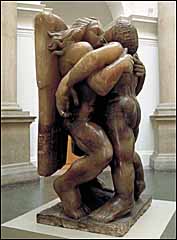
So it is symbolic, you cry. Yes, I would respond, it is very symbolic, but it was physical, too. One can't spiritualize away the injury to Jacob's hip socket, and the limp that characterized his walk in later years. These were not just symbols of his encounter and humbling before God, they were physical remnants of the struggle, too.
Sometimes we have trouble believing in events that we can't understand on the basis of our own experience. We have experienced the mental and spiritual anguish and struggle of the night, but not the physical, and so we doubt. This event is both physical and symbolic!
God's Testing
But having said that, I can't say I fully understand what was going on. Why couldn't the "man" (God) overpower Jacob? Certainly, God's strength is infinite. What is the significance of laming Jacob at the close of the conflict?
As a father, I've wrestled with my sons and daughter on the lawn or the living room floor. I've seen their intent expressions of maximum effort to best me, and I have resisted their strength to encourage persistence and greater effort, rather than always pinning them with my obviously superior strength. Cats play with their kits in mock battles to teach them and challenge them. This must have been some kind of testing of Jacob's persistence.
Unless You Bless Me (32:26)
Somehow, Jacob recognizes that this is no human assailant. This is a divine messenger who has the power to bless him. Jacob and the "man" are locked in combat, but are at an impasse. Neither can overcome the other, but neither wants to release his grip for fear that the other will take advantage of the moment. The "man" injures Jacob's hip, but still he holds on. The "man" finally says:
"Let me go, for it is daybreak."
Jacob is tenacious and persistent:
"I will not let you go unless you bless me."
Unless the "man" will speak words of peace and blessing to him, Jacob will not release him.
"What is your name?"
"Jacob,"
"Your name will no longer be Jacob [meaning 'supplanter'], but Israel [meaning 'he struggles with God'], because you have struggled with God and with men and have overcome" (32:27-28).
A New Name: Israel (32:28)
This new name from God is significant. We see several times throughout the Bible that a new name is a sign of a new place with God, a new phase of faith.
- Abram is renamed Abraham ("father of nations," 17:5)
- Sarai is renamed Sarah ("princess," 17:15)
- Simon is renamed Peter ("rock," Matthew 16:16-18)
One of the promises to people of overcoming faith in Revelation is "a new name … known only to him who receives it" (Revelation 2:17).
God, who has struggled with Jacob, now bestows on him a new name to remind all that he has "struggled with God and with men and have overcome" (32:28). Jacob's new name now contains the name of God (-el) within it. What a heritage: to be known as one who has met both God and man and succeeded! What a goal for us to strive for in our own spiritual pilgrimage!
Peniel -- the Face of God (32:30)
Jacob now asks the "man's" name, but receives instead a question ("Why do you ask my name?") and a blessing in return. Centuries later Manoah, Sampson's father, asks an angel his name with a similar answer. "Why do you ask my name? for it is beyond your understanding" (KJV, Hebrew "wonderful"; Judges 13:17-18). Jacob receives the blessing and calls the name of the place Peniel (Hebrew, "face of God"), saying,
"It is because I saw God face to face, and yet my life was spared." (32:30)
Jacob's Limp (32:31-32)
So at dawn's light, Jacob receives yet another blessing, and walks -- no, limps -- into what the day will hold between him and his brother Esau. I like this verse:
"The sun rose above him as he passed Peniel, and he was limping because of his hip." (32:31)
Twenty years before, when Jacob met God, he had left Bethel a new man. Today, as well, Jacob departs from his encounter a changed man, a marked man.
Jacob's limp isn't so much a mark of discipline, but a remembrance of encounter -- a mark which reminded him ever after of the seriousness with which he served his God, a mark of faith which he carried to his grave.
|
Q3. (Genesis 32:24-30) Who was the "man"
Jacob wrestled with? What does the wrestling represent? Was it
spiritual or physical? Why does the "man" wound Jacob permanently?
What do you think the limp means to him?
|
Jacob Meets Esau (33:1-16)
Jacob is struggling as he limps forward, pushing himself to walk in spite of the throbbing pain in his hip. Now out in front of his two parties of wives and children, he looks up and sees Esau "coming with his four hundred men." He goes forward bowing himself all the way to the ground seven times as he approaches his brother as a sign of obeisance to his brother. Esau runs to meet him, but instead of anger is an embrace, instead of thrusting a knife, he offers a kiss of peace. After a lifetime of enmity the two brothers are reconciled.
We will pass over the formalities quickly. The children and their mothers come bowing and are presented. "These are the children God has graciously given your servant," Jacob explains.
|
|
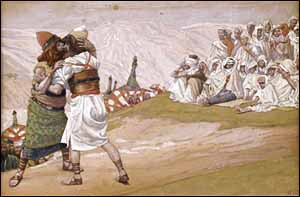
"8 Esau asked, 'What do you mean by all these droves I met?'
'To find favor in your eyes, my lord,' he said.
9 But Esau said, 'I already have
plenty, my brother. Keep what you have for yourself.'
10 'No, please!' said Jacob. 'If I have found favor in your eyes,
accept this gift from me. For to see your face is like seeing the face of
God, now that you have received me favorably. 11 Please accept
the present that was brought to you, for God has been gracious to me and I
have all I need.'
And because Jacob insisted, Esau accepted it." (33:8-11)
It is vital that Esau accept Jacob's peace gifts to him. To accept them puts Esau under obligation to Jacob. Once he has received these gifts from his brother's hand he cannot righteously take up arms against him. That would be seen in his culture as a sinister act of betrayal.
Jacob insists. Esau refuses politely. Jacob persists, for, he explains, "God has been gracious2 to me and I have all I need." Notice how God's grace figures centrally in Jacob's conversation with his brother. He is not attributing his family and children to his own shrewdness, but to God's graciousness. This is no longer the Supplanter, but the one who looks to God for his very life and safety.
Now Esau offers to accompany Jacob, or to leave some men with him to protect him. Whether this is an act of brotherly care for Jacob's safety or a way of exercising power over Jacob we can't be sure. But Jacob politely declines to have any of Esau's men with them. He needs his freedom. And he doesn't want to move his family to Seir under his brother's headship. So he suggests that he will "come to my lord in Seir," but doesn't specify a time.
"So that day Esau started on his way back to Seir." (33:16)
Esau departs, and so far as is recorded, they only meet again briefly at their father's burial (35:29).
|
Q4. (Genesis 33:1-16) How has Esau changed
since Jacob had gone to Haran? How has Jacob changed? How does the
encounter demonstrate Jacob's "craftiness"? How does it demonstrate
his faith? Can Jacob be humble and "crafty" at the same time?
|
Reflections on Jacob's Wrestling
The story of Jacob's wrestling with God on the banks of the Jabbok moves me. Our walk with God includes some quiet and uneventful times where we seldom see his active intervention (though we are often blind to his care over us). At these times it seems that we experience little spiritual growth. But at the crisis times we are pushed up against God with no place else to turn. We are called to steps of faith, and as we take those difficult steps, we can move to a new place in God.
Jacob is told directly, "Go back to the land of your fathers" and is feeling the pressure of Laban's resentment of him. Does he obey God and face the threat of his brother's blood vengeance, which has been hanging over him for two decades, or stay where he continues to be dominated by his unfair and increasingly hostile father-in-law? Too often we take the path which requires of us the least change, even though it may mean taking backward steps from what God would have for us. Taking steps of faith requires the willingness to endure change and the unknown, relying upon God's resources rather than our own comfortable place of security. Jacob, to his credit, doesn't argue, but obeys God in spite of his fears.
At the Jabbok this profound change comes to a climax. Jacob has been leaning heavily upon God throughout this journey. He has seen God turn aside Laban's hostile forces, and now he has called upon God to keep him safe from his brother Esau, according to God's promises. The time of prayer leads to a time of intense struggle in the dark hours of night.
Jesus Wrestled with His Father in the Garden
I think of Jesus' struggle with his Father in the Garden of Gethsemane (Luke 22:39-46).
"Father, if you are willing, take this cup from me; yet not my will, but yours be done." (Luke 22:42)
This is Jesus' step of faith, if you will. He knows how to minister for the Father on earth. He speaks words of power and energy to convert men's souls. His voice and touch heal men's bodies, as well, and drive away demons who have been tormenting their souls. Jesus knows this ministry.
But he is praying in Gethsemane because he senses that it is time to fulfill God's ultimate call upon his life, to die on the cross, carrying upon him all the sins of the world. While that which is human in him shuns death, this is not about physical death. That which is holy in him is repulsed by sin, but within a few hours he will feel the crushing load, the ugly, filthiness of compounded human sin bearing down upon him, suffocating him and creating between him and his Holy Father a gulf, a separation for the first time in all eternity. The Father cannot embrace sin, but must punish it. And the Son must cry out in agony of soul,
"My God, my God, why hast thou forsaken me?" (Matthew 27:45-50),
and then, in faith, commit his spirit into the Father's hands. Like Jacob, Jesus wrestled with his Father in the Garden. And like Jacob he came from that struggle intent upon doing the Father's will.
You, too, may be locked in a great struggle with God. You will not let go and neither will he. You are marked by the struggle, never to be the same -- exhausted, and yet you continue: "I will not let you go, Father, until you bless me," you say in your earnestness, in your persistence. And he does bless you.
|
|
The crisis of faith passes and you are changed by it, marked by it, and perhaps limping because of it. But you can step forth from your encounter into a new place of intimacy and knowledge of your Father, a place where your faith becomes unbounded and unfettered, a place where you are now ready to walk, or limp, wherever he would lead you, because you know that He will walk with you. May you and I arise from our struggle of faith to a new Day in the Lord!
"The sun rose above him as he passed Peniel, and he was limping because of his hip." (32:31)
Prayer
Father, I think I've felt what Jacob has felt. Thank you for your crucible of change that has changed me. Let me walk forth to the new day that you bring for me. In Jesus' name, I pray. Amen.
References
1. Kidner, Genesis p. 167.
2. Hānan, "show favor" (BDB 109).
Copyright © 2026, Ralph F. Wilson. <pastor joyfulheart.com> All rights reserved. A single copy of this article is free. Do not put this on a website. See legal, copyright, and reprint information.
 To be notified about future articles, stories, and Bible studies, why don't you subscribe to our free newsletter, The Joyful Heart, by placing your e-mail address in the box below. We respect your