|
Old Testament
New Testament
Gospels
Acts
Paul's Letters
General Letters
Revelation
Topical Studies
Beginning the Journey (for new Christians). en Español

|
Old Testament
New Testament
Gospels
Acts
Paul's Letters
General Letters
Revelation
Topical Studies

|
Home
Bible Studies
Articles
Books
Podcasts
Search
Menu
Donate
About Us
Contact Us
FAQ
Sitemap


Free
E-mail Bible Study
 The Discipleship Process
Home |
Bible Studies |
Articles |
Books |
Podcasts |
Search |
Menu |
Donate |
About Us |
FAQ |
Contact Us
The Discipleship Process
Home |
Bible Studies |
Articles |
Books |
Podcasts |
Search |
Menu |
Donate |
About Us |
FAQ |
Contact Us
|
|
The Supplanter, whose cheating forced him to leave his home, now arrives in Paddan Aram (Haran), hundreds of miles away. He is lonely, and eager to see his mother's family, hoping that they will receive him into their home.
Lesson 3 covers three chapters. It's a wonderfully written story, so be sure to read it in your Bible. We'll be looking at the highlights.
Haran
Haran lies along the Jullab River just inside present day Turkey near its border with Iraq, 24 miles southeast of the Turkish city Urfa, and 60 miles north of the Euphrates River. It is located on the main road that ran from Nineveh to Carchemish and was considered a strategic city in ancient times. Its chief cult was that of the Mesopotamian moon-god Sin. It was probably founded as a merchant outpost by the Sumerian city of Ur in the late third millennium BC. The name Haran means "highway, road, caravan" in Akkadian.
Today a village on this site consists of beehive shaped houses. There is only a small amount of archaeological evidence available, but it includes inscriptional evidence of the Sin temple (from the beginning of the second millennium), a stella of the moon-god, and violent destruction about 610 BC by the Scythians, Medes, and Chaldeans.1
Jacob's Family in Haran
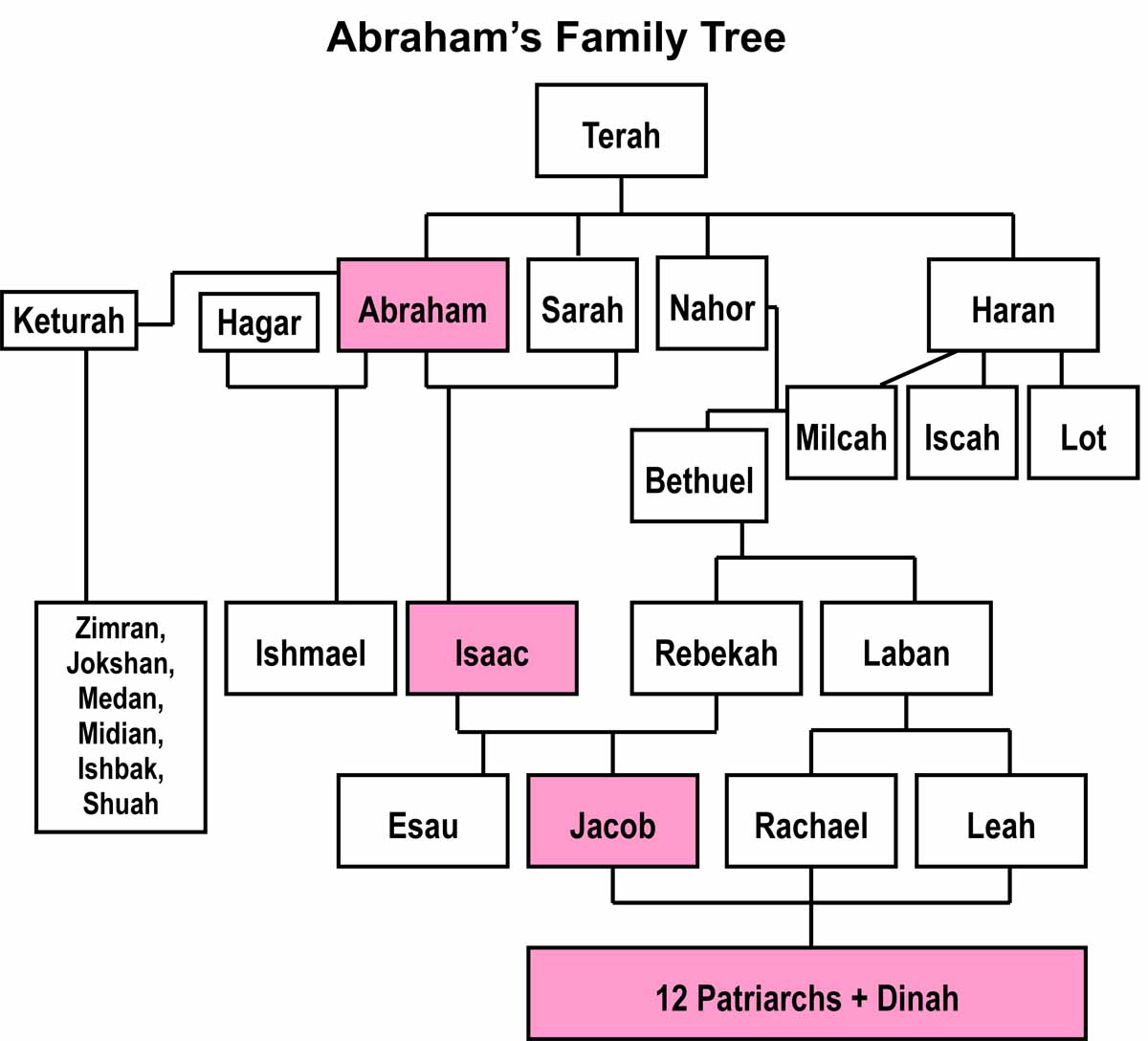
I've included a family tree of Abraham's ancestors and descendents so you can see Jacob's place in it and get an idea of the various family relationships between Rachel's family and Isaac's.
|
|
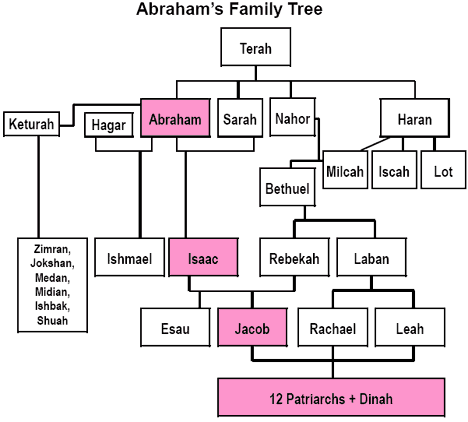
Abraham's Family Tree. Larger chart.
Jacob the Servant (29:1-14)
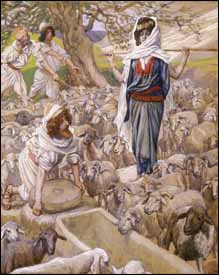
Jacob arrives at a well in the desert to find three flocks of sheep lying near it and their shepherds taking their ease.
"Have you heard of Laban?" he asks.
"Yes, we know him."
"How is he?"
"He's fine ... and here comes his daughter Rachel."
Jacob sees a young woman leading a flock of sheep towards the well, looks at the heavy stone over the well, and suddenly he feels a chivalrous impulse towards his cousin.
"Get up," he says to the reclining shepherds, hoping to get them to move the stone. "It's not quitting time. Water the sheep and then take them back in the field. There's still time for grazing before dark."
None makes a move. "We always wait until all the flocks are gathered before we move the stone and water the sheep," they tell him. They don't move a muscle. They wait for all the shepherds to arrive before they move the stone together. No need to hurry today.
So Jacob goes to the well alone. The God who has promised to be with him gives him power. Single-handedly, by a great feat of strength, he rolls the great stone away from the top of the well. Then he puts down the bucket again and again to fill the nearby trough, until all of Rachel's sheep have been watered. Only when he's finished does the mysterious stranger identify himself. He kisses her in the Eastern custom of greeting and begins to weep.
"I am Jacob," he says, overcome by emotion. "Your father's nephew and Rebekah's son."
She runs home to tell her father of the wonderful man who has helped her water her sheep, a long lost relative. Soon Laban hurries to the well, embraces Jacob, kisses him, and invites him home, inquiring about the welfare of his sister and the rest of the Western branch of the family. "You are my own flesh and blood," he says.
Love Is Blind (29:15-30)
|
|
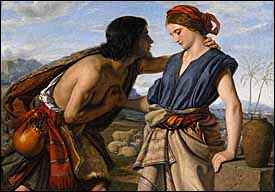
And so Jacob enjoys the comfort of his mother's family and helps out with the chores. But by his moving of the well stone, Jacob has shown them that he is a doer, a decisive person, a strong man. He could be useful, thinks Laban. A month goes by, and one evening Laban brings up the matter of staying.
Laban isn't blind. He has observed how Jacob looks at his daughter and she at him. He sees a man utterly entranced. So he brings up the matter of wages.
"Just because you are kin doesn't mean I shouldn't be paying you for your work," he begins. "Let's determine some basis to pay you wages for watching my flocks."
Jacob has no doubt been thinking about this very thing. He has no money for a bride price, but he must have this enchanting girl, "lovely in form, and beautiful" (29:17).
"I'll work seven years for you in return for your younger daughter Rachel," he ventures.
Laban couldn't have hoped for more. Seven years of labor just for a bride price? That was far too generous. He must love her! But Laban doesn't let on.
"It'd be better for me to give her to you than some other man," he says with feigned resignation. "Stay with me." And so Jacob stays and works seven years for the love of his life, "but they seemed like only a few days to him because of his love for her" (29:20).
At the end of seven years -- and I'm sure Jacob has been counting -- he says to Laban, "Give me my wife. My time is completed, and I want to lie with her" (29:21). That's a pretty direct way to talk to the father-of-the-bride!
Laban calls all his friends for a sumptuous feast to celebrate the event. The party goes long into the night. But Laban sends Leah, not Rachel, to Jacob's tent to enjoy a night of intimacy. The scripture is terse: "When morning came, there was Leah!" (29:25). What a shock!
How could it have happened? Apparently customs of the time required no formal wedding ceremony to precede the consummation. Laban had called a feast (Hebrew mishteh, from the root shātâ, "to drink"), a drinking banquet.2 Jacob was "both in drink and in the dark," concluded Jewish historian Josephus.3 This isn't the first time in Scripture that this sort of thing occurred; Lot's daughters had become pregnant by their father after getting him drunk (19:32-35).
You can't miss the irony. Jacob deceives his blind father into believing he is Esau and giving him the blessing, and so Laban deceives the deceiver into marrying the older sister instead the girl of his dreams.
Jacob comes to Laban in the morning in anger. "What is this you have done to me? I served you for Rachel, didn't I? Why have you tricked me?"
Laban replies evenly, "Didn't you know? Here in Haran it is our custom to marry off the older daughter before the younger." You can almost see him smile wickedly, his yellowing teeth showing as he grins. "But I have such a deal for you. Spend the customary bridal week with Leah, and at the end of the week you can have Rachel. Only seven years more labor for her. What's a little misunderstanding among kin?"
Jacob is burning inwardly, but he sees his prize in sight. Only a week. He agrees to Laban's offer, and soon Rachel is his. Jacob's story gives new meaning to the saying "Love is blind."
Jacob's Children (29:31-30:24)
|
|
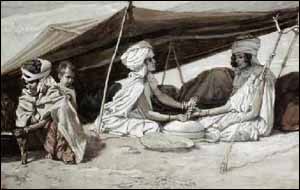
Why, I wonder, does God allow Jacob to be tricked? I'm sure that the Supplanter needs to taste some of his own medicine. God is building a character of integrity in Jacob and God needs to deal with this serious flaw of deceit.
But this is more than character building. This is also a time of family building. God is raising up for Jacob the beginnings of the great people that he had promised, as many as the sand of the seashore and the stars in the sky. God begins the Israelite people with the gene pool of five individuals, three of them closely related (Jacob, Leah, and Rachel), and two of them completely different, the servant girls (Bilhah and Zilpah).
Q1. (Genesis 29) Why do you think God
allows Jacob to be tricked into 14 years of labor for two wives?
What purposes do you think God is working out through these
circumstances?
|
As a wedding present Laban gives each of his daughters a maidservant as their property. Leah is given Zilpah (29:24), and Rachel is given Bilhah (29:29). The Scripture doesn't teach slavery any more than polygamy, but God works within people and cultures in spite of their institutional sins and gradually changes them and their values. The Scripture simply reports here.
The passage that recounts each of Jacob's children unfolds a tale of jealousy and competition within the family, though we'll be skipping over most of the details.
Rachel is the favorite wife, but is barren (29:30). She gives up Jacob to her sister's bed in exchange for mandrakes, reputed to make a woman fertile, but to no avail (30:14-16). She is reduced to giving her servant Bilhah to Jacob to bear children for her (30:1-6), and when Leah's fecundity falters, Leah reciprocates by giving her servant girl Zilpah to Jacob to bear still more children (30:9).
Bilhah and Zilpah don't have full status as wives, since they are clearly acting as surrogates for their mistresses. Notice, for example, who names the babies. They would be considered concubines. However, the children all seem to have equal status as Jacob's offspring.
We see in this passage an interesting custom of naming of children based on the hopes and dreams and happenstances of the wives. In many cases, the derivation of the name is based more on what it "sounds like" than on true etymological derivation, but in a non-literate culture, who knew or cared? Here are the sons, their name meanings, and mothers, given in order of birth.
| Name | Meaning | Mother | |
| 1. | Reuben | "see, a son" | Leah |
| 2. | Simeon | "one who hears" | Leah |
| 3. | Levi | "attached" | Leah |
| 4. | Judah | "praise" | Leah |
| 5. | Dan | "he has vindicated" | Bilhah |
| 6. | Naphtali | "my struggle" | Bilhah |
| 7. | Gad | "good fortune" or "a troop" | Zilpah |
| 8. | Asher | "happy" | Zilpah |
| 9. | Issachar | "reward" | Leah |
|
10. |
Zebulun | "honor" | Leah |
| 11. | Joseph | "may he add" | Rachel |
| 12. | Benjamin | "son of my right hand" (35:18) | Rachel |
I include Benjamin in this list for the sake of completeness, though he is born much later (35:16).
Leah also had a daughter named Dinah, whose name seems to mean "justice" (30:21). Weren't there any other daughters among all these children? Probably. "Daughters" (plural) are mentioned (34:9, 16; 37:35), but they probably weren't considered important to this story of the origins of the Twelve Tribes of Israel. Dinah is mentioned because she figures in family events in chapter 34. Neither were many daughters counted among the members of Jacob's family that went to Egypt (46:8-27). Women figure much more prominently in the New Testament, as Jesus elevates them to equality and importance.
It is clear that Jacob loves only Rachel, but by the time chapter 30 concludes, Jacob is the father of eleven sons and at least one daughter. God has blessed the man!
Jacob Negotiates with Laban (30:25-36)
The birth of these children apparently took a total of fourteen years or more (30:25-26). With a dozen children, two wives, and two concubines to support, Jacob has nothing but his own labor. His family is living off his father-in-law's household income. He is a son-in-law and, as such, has no prospect of inheriting after Laban dies. The property will go to Laban's sons. Jacob owns no flocks. He confronts Laban, asking to be released to return to his homeland, saying, "When may I do something for my own household?" (30:30).
Laban, who likes this sweet deal he has had for years, doesn't want to let him go.
"'Please stay, for I have learned by divination that the LORD has blessed me because of you.' And he added, 'Name your wages and I will pay them.'" (30:27-28)
The word "divination" (NIV, NRSV), "experience" (KJV) is nāḥash, "seek and give an omen, practice divination."4 Divination is the heathen act of gaining understanding about the present or future by means of signs or omens.5
Indeed, Laban had been blessed through Jacob's presence in answer to God's promise, "All peoples on earth will be blessed through you and your offspring" (28:14). Jacob argues this to Laban:
"The little you had before I came has increased greatly, and the LORD has blessed you wherever I have been." (30:30)
Jacob asks that after the current striped or spotted sheep and goats are removed from the flock, he get all striped or spotted animals that are subsequently born. Thus, when Jacob is saying, "Don't give me anything" (30:31) he means, "Don't give me anything of the current huge flock; only those variegated animals that may be born in the future." In the Near East sheep are normally white and the goats are black. At most, the variegated animals might constitute 20%.6
Jacob seems to be settling for so little, thinks Laban. He agrees, smiles, and the same day removes all the abnormally colored sheep and goats, putting them in the care of his sons whom he sends three-day's journey away (30:36). Laban will fix him! But Laban hasn't reckoned with God.
Breeding Variegated Sheep and Goats (30:37-43)
Jacob, ever the entrepreneur, seeks to maximize the number of spotted and streaked goats and sheep by state-of-the-art breeding techniques: having the animals mate in front of brown and white striped sticks, on the theory that what they saw at conception would affect the embryo. It sounds like an old wives' tale. It certainly doesn't have any scientific basis. Did this superstition make Jacob rich? No. Not any more than mandrakes make a woman fertile (30:14-16). Yet God increases his flocks.
Laban, seeing how successful Jacob is becoming in developing larger and larger variegated flocks, begins changing the terms of the deal. Each time he does, God changes the coloration patterns of the kids and lambs being born.
As Jacob explains to Rachel and Leah,
"... The God of my father has been with me.... Your father has cheated me by changing my wages ten times. However, God has not allowed him to harm me. If he said, 'The speckled ones will be your wages' then all the flocks gave birth to speckled young; and if he said, 'The streaked ones will be your wages,' then all the flocks bore streaked young. So God has taken away your father's livestock and has given them to me" (31:5-9).
Jacob is under no illusions. He has been diligent and has done all he knows to do, but he attributes the results to God. He knows that his peeled poplar sticks don't fine-tune the coloration patterns that Laban keeps changing. It has to be God himself!
Hundreds of years later, Moses exhorts the people of God never to forget God's role in wealth creation:
"You may say to yourself, 'My power and the strength of my hands have produced this wealth for me.' But remember the LORD your God, for it is he who gives you the ability to produce wealth...." (Deuteronomy 8:17-18)
Q2. (Genesis 30:25-43) At what point do you
think Jacob realizes that his breeding techniques are not the cause
of his growing wealth? According to Deuteronomy 8:17-18, what danger
are we in when our income and assets begin to increase?
|
God Commands Jacob to Return to Canaan (31:1-13)
The more God blesses him, the more Jacob begins to feel uneasy. Laban's sons are complaining that Jacob is taking their father's wealth away from him and there is increasing tension with Laban (31:1-2). But more important than that by far, the Lord speaks directly to Jacob to return:
"Go back to the land of your fathers and to your relatives, and I will be with you." (31:3)
Jacob calls his wives Rachel and Leah away from the encampment into the fields so he can talk to them privately and make his case for leaving. If Jacob is to escape with his family and new-found wealth, he needs the active, willing cooperation of his wives. They are on Laban's turf. If Laban decides to prevent them from leaving, he and the men he commands can keep them there by force or intimidation -- and, if they escape at all, it will be only with what they can carry on their backs (31:42).
So Jacob shares with his wives about God's material blessings in spite of Laban's constantly changing terms (31:4-9). He recounts his vision of an angel of God and repeats Yahweh's specific words:
"I am the God of Bethel, where you anointed a pillar and where you made a vow to me. Now leave this land at once and go back to your native land." (31:13)
Rachel and Leah Back Jacob (31:14-16)
Rachel and Leah are united in what they should do. They feel used by their father: he has "sold" them and then used up the money.
Legally, a father is supposed to hold and use the bride price only for a time. Then the money, in whole or in part, is to revert to the daughter at such time her father dies or if she is impoverished by her husband's death.7 But no money had changed hands -- Jacob had traded seven years of labor for the bride in lieu of cash. Thus Rachel and Leah have no future whatsoever if they stay with their father.
They, too, feel Laban is resentful towards Jacob: "Does he not regard us as foreigners?" (31:15). They're ready to leave with Jacob.
Jacob's Family Escapes from Haran (31:17-21)
 |
Once the decision is made, they await an opportune time. When Laban goes to shear the sheep, the time has come.
"17 Then Jacob put his children and his wives on camels, 18 and he drove all his livestock ahead of him, along with all the goods he had accumulated in Paddan Aram, to go to his father Isaac in the land of Canaan.
19 When Laban had gone to shear his sheep, Rachel stole her father's household gods. 20 Moreover, Jacob deceived Laban the Aramean by not telling him he was running away. 21 So he fled with all he had, and crossing the River, he headed for8 the hill country of Gilead." (31:17-21)
Laban Pursues Jacob (31:22-30)
When Laban is told "on the third day" (31:22), he gathers a large band of his relatives and takes off in hot pursuit. How dare they! It is one thing to grow large herds at his expense. It is even worse to leave before he had a chance to get them back! From Laban's reaction, it is pretty easy to see why Jacob, Rachel, and Leah -- who knew him well -- decided to leave unannounced. With his controlling attitude toward Jacob and his family, Laban would not have allowed them to leave if he could stop them.
But Laban "the Aramean" is accosted by God the night before he catches up with Jacob, in the hill country of Gilead, northeast of the Sea of Galilee.
"Then God came to Laban the Aramean in a dream at night and said to him, 'Be careful not to say anything to Jacob, either good or bad.'" (31:24, cf. 29, 42)
In other words, Laban is forbidden "from threatening Jacob with any harm."9
|
|
Laban is still angry and complains how Jacob has deceived him and "carried off my daughters like captives in war." He claims he would have sent them away "with joy and singing to the music of tambourines and harps." I can see Jacob, Rachel, and Leah looking at one another trying to suppress a smile. They knew what Laban would have done.
Theft of Household Gods (31:30-35)
"Rachel stole her father's household gods" (terāpîm, 31:19b)
"[Laban asked] 'Why did you steal my gods (ʾelōhîm)?' .... Now Jacob did not know that Rachel had stolen them." (31:30, 32)
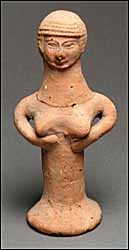
Laban levels a serious charge: stealing his household gods. These were teraphim, portable idols, small enough to conceal inside a camel's saddle. Of course, Rachel's monotheist descendants, who would later read this story, would laugh. How can you steal a god -- a real god? Rachel is guilty of "god-napping."
But why would she do this? One ancient tablet found at Nuzi seems to indicate that possession of the family gods constituted title to the chief inheritance portion and headship of the family.10
A simpler explanation, however, is that she steals them for protection on her journey to Canaan. She had been raised believing in their power. She isn't quite ready to replace her old way with Jacob's new faith -- especially when threatened with the greatest change and challenge of her life. She is like many Christians, who have made some profession of faith, but haven't fully repented of some of their pagan ways -- and in times of crisis fall back into what they know and trust.
Jacob knows nothing about Rachel's theft. He vows that anyone found with the gods will be killed. Rachel deliberately deceives her father and succeeds in keeping him from discovering the gods in his search of the tents.
But Jacob finds out. Years later, Jacob commands his household, "Get rid of the foreign gods you have with you and purify yourselves...." (35:2), when Jacob consecrates himself and family before God at Bethel.
Q3. (Genesis 31:17-36) Why did Jacob and
his family leave without saying good-bye to Laban? In what sense did
they "deceive" Laban? (31:20, 27). Was anything they did unjust or
unrighteous? If so, how?
|
The Covenant at Mizpah (31:36-55)
Jacob angrily confronts his father-in-law when Laban doesn't find any proof of the theft. He justifies himself. He took nothing that wasn't his. He had worked 14 years for Laban's daughters and another six years for the flocks that are now his.
"If the God of my father ... had not been with me, you would surely have sent me away empty-handed. But God has seen my hardship and the toil of my hands, and last night he rebuked you." (31:42)
God has "rendered judgment"11 against Laban and thus rebukes him.
Jacob has been discerning in his assessment of Laban's possessiveness, for immediately his father-in-law says,
"The women are my daughters, the children are my children, and the flocks are my flocks. All you see is mine." (31:43)
Laban did not recognize Jacob's right to anything, but God has warned Laban sternly and Laban is afraid to take anything by force. So Laban calls for a covenant between them. Here are some of the elements of the covenant described in this passage:
- A stone pillar (31:45), such as Jacob had set up in Bethel.
- A heap of stones (31:46-49a) which they named Mizpah (watchtower) and Galeed or Gilead (witness heap).
- Calling on Yahweh as witness and guarantor of the covenant: "May the LORD keep watch between you and me...." (31:49b).
- A promise from Jacob not to mistreat his wives, nor to take rival wives to displace them from their status (31:50).
- A non-aggression pact: "I will not go past this heap to your side to harm you...." (31:51-52).
- An oath in the name of God (31:53).
- A sacrifice and fellowship/covenant meal together (31:54).
Notice, to whom Laban swears compared to Jacob:
|
Laban |
Jacob |
|
"the God of Abraham and the God of Nahor, the God of their father" (31:53a). |
"the Fear of his father Isaac" (31:53b), literally, "the One of Isaac who inspires dread."12 |
Does Jacob wonder whether the God of Nahor and Abraham's father Terah (11:26-32) was the true God? Is that why he swears by "the Fear of his father Isaac" instead? We don't know.
Many centuries later Joshua recounts,
"Long ago your forefathers, including Terah the father of Abraham and Nahor, lived beyond the River and worshipped other gods." (Joshua 24:2)
It is possible that Jacob saw a distinction that Laban did not. Or it may have been just a way of reminding Laban that "the Dread of Isaac," who had appeared to Laban with a warning not to harm Jacob, would be watching to make sure he obeyed.
Mizpah Is Not a Sentimental Word at Parting
When I was a boy, I heard the Mizpah covenant said as a parting word between friends:
"The LORD watch between me and thee, when we are absent one from another." (31:49, KJV)
But this was no sentimental saying. It was a threat with divine sanction that meant: If you break this covenant when I can't see you, may God watch you and punish you. The word "watch," ṣāpâ, "conveys the idea of being fully aware of a situation in order to gain some advantage or keep from being surprised by an enemy." Miṣpeh (from the verb ṣāpâ, "watch") means, "watchtower, lookout point."13
|
Q4. (Genesis 31:44-55) What are the terms
of the Mizpah Covenant? Of what is the Mizpah monument supposed to
remind Jacob and Laban?
|
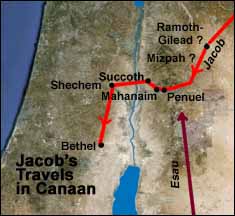
The location of Mizpah is somewhere in the "hill country of Gilead" (NIV, NRSV), "mount Gilead" (KJV, 31:21, 24), north of the Jabbok River, perhaps near Rammoth-Gilead, on the main road, the "King's Highway" that ran from Damascus down to Elath at the tip of the Gulf of Aqaba.14
Blessing and Conflict
When you look at Jacob's sojourn in Haran, he has a lot to complain about.
- Deceit. He is tricked into an extra seven years of labor.
- Idolatry. He has at least one wife -- his true love -- who worships idols.
- Family conflict. There's an ongoing conflict between Jacob's wives and children.
- In-law injustice. Later he endures constant struggle with Laban who changes his wages ten times, always trying to better himself at Jacob's expense.
- Escape. He has to flee when Laban is away to be able to go home.
Do you call that blessing?
But look at it from a larger perspective. Jacob came empty-handed and left with many children and great wealth. Indeed, God has been with him and watched over him (28:14-15) -- and even blessed Laban on his account (30:27).
Too often when we are experiencing trials we complain. "Nothing seems to be going right." How hard our life is. Too often we can't see the forest for the trees.
|
|
Blessing always comes amidst conflict. Name one person in the Bible whom God blessed and blessed others through, and I'll show you struggle and suffering. Sometimes we act as if God has "promised us a rose garden." He has promised to bless us and to be with us, but he doesn't promise all sunny skies. Jesus told his disciples:
"I have told you these things, so that in me you may have peace. In this world you will have trouble. But take heart! I have overcome the world." (John 16:33)
And this is God's word to you today, you who feel defeated, beat up, and sorry for yourself. Jesus says to you: Take heart, don't be discouraged, my child. I have overcome the world.
Q5. Why do we often fail to see God's
blessings during the everyday conflicts of our lives? Why do
blessings and conflicts so often come at the same time? What hope do
we have in the midst of our struggles?
|
Prayer
Father, thank you for your promise that you will never leave us or forsake us. Help us to see your blessings and give you praise, even through our tears. In this crucible of life in which we are being purified, help us to bring glory to you. In Jesus' name, we pray. Amen.
References
1. Mark W. Chavalas, "Haran," DOTP 379-381; Robert J. Hughes, III, "Haran," ISBE 2:614.
2. Hermann J. Austel, shātâ, TWOT #2477c.
3. Josephus, Antiquities of the Jews, 1.19.7.
4. Holladay, Lexicon, p. 235.
5. Another possible translation is, "I have become rich and the Lord has blessed me...." (NIV margin), taking the verb as cognate with the Akkadian verb nahāšu, "to flourish, prosper." Hamilton (Genesis 18-50, p. 282) prefers this, since he says divination purports to gives information about the future, not about the past.
6. Hamilton, Genesis 18-50, p. 283.
7. Hamilton, Genesis 18-50, p. 289; Roland de Vaux, Ancient Israel, 1:26-29.
8. "Headed for" (NIV) is literally, "set his face toward" (NRSV, KJV), denoting movement towards a specific location (Hamilton, Genesis 18-50, p. 291, fn. 8).
9. Hamilton, Genesis 18-50, p. 299.
10. See the discussion in Hamilton, Genesis 18-50, p. 294.
11. "Rebuked" (NIV, NRSV, KJV), "rendered judgment" (NASB) is yākaḥ. In the Niphal stem it can mean "argue out together (in legal dispute). Here in the Hiphil stem it means either "set someone right, reprove," or "give judgment" (Holladay, Lexicon, p. 134).
12. Hamilton, Genesis 18-50, p. 310.
13. John E. Hartley, ṣāpâ, TWOT #1950, 1950b.
14. The Hebrew word is har, "mountain, hill, hill country"(Har, BDB p. 249). Mizpah is probably located either near Mt. Gilead, or on the mountain opposite Gilead (A.F. Rainey, "Mizpah," ISBE 3:387-388). Ramoth-Gilead is identified with Tell Rāmîh, near the present border between Syria and Jordan. The location is almost certainly on the main road south from Damascus (the King's Highway; William S. LaSor, "Ramoth-Gilead," ISBE 4:40-41).
Copyright © 2026, Ralph F. Wilson. <pastor joyfulheart.com> All rights reserved. A single copy of this article is free. Do not put this on a website. See legal, copyright, and reprint information.
 To be notified about future articles, stories, and Bible studies, why don't you subscribe to our free newsletter, The Joyful Heart, by placing your e-mail address in the box below. We respect your