


|
Old Testament
New Testament
Gospels
Acts
Paul's Letters
General Letters
Revelation
Topical Studies
Beginning the Journey (for new Christians). en Español

|
Old Testament
New Testament
Gospels
Acts
Paul's Letters
General Letters
Revelation
Topical Studies

|
Home
Bible Studies
Articles
Books
Podcasts
Search
Menu
Donate
About Us
Contact Us
Sitemap


 Faith of Abraham (Genesis 11-25)
|
|
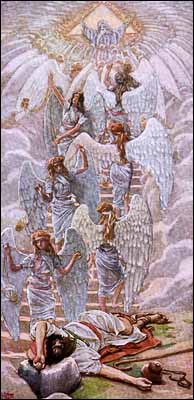
Esau's Grudge (27:41)
"Esau held a grudge against Jacob because of the blessing his father had given him. He said to himself, 'The days of mourning for my father are near; then I will kill my brother Jacob.'" (27:41)
Fortunately for Jacob, Isaac lives another 44 years or so. But Esau's sin of murder in his heart is yet another occasion to move Jacob into the center of God's will for him, to find him wives in Haran who will bear the 12 sons, whose descendants will constitute the 12 tribes of Israel. Strange, how God can work out his will through sin, in spite of sin! This is a mystery to us.
Yet, here it is. Esau bears a grudge and because of this grudge begins to speak about his intentions to others. Note: first he says it to himself (27:41), but soon he is saying it to others (27:42). Out of the abundance of the heart, the mouth speaks.
Rebekah's Plan (27:42-45)
"42 When Rebekah was told what her older son Esau had said, she sent for her younger son Jacob and said to him, 'Your brother Esau is consoling himself with the thought of killing you. 43 Now then, my son, do what I say: Flee at once to my brother Laban in Haran. 44 Stay with him for a while until your brother's fury subsides. 45 When your brother is no longer angry with you and forgets what you did to him, I'll send word for you to come back from there. Why should I lose both of you in one day?'" (27:42-45)
Rebekah overhears what Esau is plotting against her favorite son, and summons Jacob. "Flee at once," is her command. Is running from our enemies ever an answer? Sometimes. On a number of occasions when Jesus' enemies sought to arrest him or stone him, he just slipped away in the crowd (Luke 4:30; John 8:59; 10:39). Jesus had a mission to complete, and showdowns with his enemies did not suit this mission. Too often, our ego is so involved that we refuse to avoid conflicts which would distract us from our primary task. Jacob's primary task -- from God's perspective -- is to become a man of God and to raise a big family. He can do that better in Haran than he could with the Canaanite women in Palestine at the time. So Esau's threat becomes the impetus for change.
Godly Marriage
Esau had married two wives from among the local heathen tribes populating Palestine at that time, the Hittites.
"When Esau was forty years old, he married Judith daughter of Beeri the Hittite, and also Basemath daughter of Elon the Hittite. They were a source of grief to Isaac and Rebekah." (26:34-35).
We aren't told the source of the conflict, but it is, no doubt, partly cultural. Rebekah has been raised in a nomadic tribe hundreds of miles away in Haran (Paddan Aram), north of the Euphrates River. The Hittites lived in houses and cities, and had different values. Probably Esau had brought his wives to live in the family encampment near Beersheba (26:23, 33). "We hate living in tents," they may have complained. "Things used to be better in our home cities." Complain, complain, complain. Major in-law conflicts result from this cross-cultural marriage.
Religion of the Canaanites
Not that Rebekah's family have been faithful followers of Yahweh, the God of Abraham. They possess household idols and are probably moon worshippers (31:19; Joshua 24:2, 15; see the Introduction). Apparently God preferred converting people from this distortion of true worship, than from the distortions practiced by the Canaanites. If the Israelites' religion were too close to that of the tribes of Canaan, the Israelites would be more tempted than ever to assimilate heathen practices into their worship.
Polygamy in the Ancient Near East
Esau has two wives. Eventually, Jacob acquires two wives and two concubines. Today Muslims allow up to four wives, if the husband is wealthy enough to support them. In the ancient Near East, having a number of wives was considered a mark of wealth and power. David had six wives, plus a number of concubines. Solomon had more than 1,000 wives and concubines (and he was considered wise!). But these multiple-wife households were full of problems of jealousy and favoritism, as we will see as our story unfolds. The Bible doesn't seek to justify polygamy, only report it.
What are we as Christians to think about polygamy? "In the beginning it was not so," said Jesus (Matthew 19:8b). He taught:
"At the beginning the Creator 'made them male and female,' and said, 'For this reason a man will leave his father and mother and be united to his wife, and the two will become one flesh.' So they are no longer two, but one." (Matthew 19:4-6, quoting Genesis 2:24)
Monogamy is God's ideal, the righteous standard. But perhaps due to the hardness of men's hearts (Matthew 19:8), God allowed polygamy for a time. Certainly by the mid-first century AD, the Christian standard was "the husband of but one wife" (1 Timothy 3:2; Titus 1:6). This is still an issue in Africa, where, in many cultures, polygamy has been practiced for many generations. Typically, by the second generation of Christians in a believing family, polygamy is no longer practiced.
Jacob Is Sent Away to Find a Wife (27:46-28:2)
Rebekah is the master manipulator. She knows how to get her way -- with Isaac, with Esau, and with Jacob. She says to Isaac:
"I'm disgusted with living because of these Hittite women. If Jacob takes a wife from among the women of this land, from Hittite women like these, my life will not be worth living." (27:46)
Isaac, too, has suffered from having Esau's wives around (26:35). He takes action:
"So Isaac called for Jacob and blessed him and commanded him: 'Do not marry a Canaanite woman. Go at once to Paddan Aram, to the house of your mother's father Bethuel. Take a wife for yourself there, from among the daughters of Laban, your mother's brother." (28:1-2)
Now, Jacob can flee Esau with an excuse and with his father's blessing. Esau, too, hears of his father's wishes regarding a non-Hittite wife for Jacob, so Esau finds a descendent of Abraham -- Mahalath, Ishmael's daughter -- and marries her as a third wife, in order to try to please his father (28:6-9).
The Blessing of Abraham (28:3-4)
In spite of Jacob openly deceiving his father, Isaac still loves him and blesses him generously as he departs. Perhaps Isaac is finally beginning to see that Jacob is indeed the son through whom God's promise to Abraham will be fulfilled. And so he speaks over Jacob the ancient blessing of Abraham:
"3 May God Almighty bless you and make you fruitful and increase your numbers until you become a community of peoples. 4 May he give you and your descendants the blessing given to Abraham, so that you may take possession of the land where you now live as an alien, the land God gave to Abraham." (28:3-4)
Look carefully at the blessing, for it is a central theme of both the Old Testament and the New. This is the same blessing that God gave Abraham more than a century before Jacob's departure for Haran. In the chart below you can see the various forms of this blessing. There are at least three elements woven again and again through these blessings:
- Fruitfulness -- numerous descendants,
- Land -- the land of Canaan, and
- World -- the nations of the world will be blessed.
|
|
Descendants |
Land |
Blessing |
|
God to Abraham in Haran (12:2-3) |
x |
|
x |
|
God to Abraham at Hebron (15:1-21) |
x |
x |
|
|
God to Abraham at Hebron (17:1-21) |
x |
x |
|
|
God to Abraham at Hebron (18:17) |
x |
|
x |
|
God to Abraham at Mt. Moriah (22:15-18) |
x |
|
x |
|
God to Isaac at Gerar (26:2-5) |
x |
x |
x |
|
God to Isaac at Beersheba (26:24) |
x |
|
x |
|
Isaac to Jacob at Beersheba (27:27-29) |
|
|
x |
|
Isaac to Jacob at Beersheba (28:3-4) |
x |
x |
|
|
God to Jacob at Bethel (28:13-15) |
x |
x |
x |
|
God to Jacob at Bethel (35:11-12) |
x |
x |
|
This series of blessings introduces concepts that anchor themselves in Genesis and carry on throughout the Bible: covenant -- blessings and cursings, oaths and promises. We'll examine these more fully in Lesson 7.
The blessing of Abraham is mentioned in the New Testament also:
"[Christ] redeemed us in order that the blessing given to Abraham might come to the Gentiles through Christ Jesus, so that by faith we might receive the promise of the Spirit." (Galatians 3:14)
"If you belong to Christ, then you are Abraham's seed, and heirs according to the promise." (Galatians 3:29)
Paul's argument is that Jesus is the Seed of Abraham, and if we belong to Jesus, then we, too, are descendants and heirs of Abraham. So what of Abraham's promise is left for us to inherit?
- Land. Christ will reign on earth from Jerusalem, we are told.
- Descendants. For us, probably spiritual descendents are most prominent.
- World. Abraham's spiritual descendents are the salt of the
earth who bring the message of Abraham's Seed -- the Messiah
-- to the world. We are to be a blessing to the world. Through us,
Christ's blessings are to flow out to others.
|
Q1. (Genesis 28:3-4) Why does Isaac bless
Jacob, especially after Jacob's deception? How does this blessing
compare to other blessings of Abraham, Isaac, and Jacob? What are
the main elements of Isaac's blessing?
|
Jacob Begins His Journey (28:10-11)
|
|
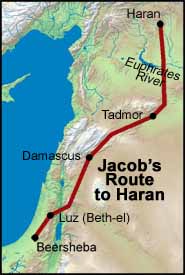
"Then Isaac sent Jacob on his way, and he went to Paddan Aram, to Laban son of Bethuel the Aramean, the brother of Rebekah, who was the mother of Jacob and Esau." (28:5)
"Jacob left Beersheba and set out for Haran. When he reached a certain place, he stopped for the night because the sun had set.... He called that place Bethel, though the city used to be called Luz." (28:10-11, 19)
Jacob leaves Isaac's tent in Beersheba, a desert town in the extreme south of Palestine, and heads north to his uncle's home, hundreds of miles away around the Fertile Crescent. He stops, perhaps the second or third night, at a town called Luz (28:19).
Jacob's Dream (28:11-12)
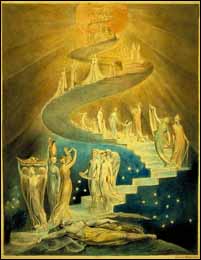
"11 When he reached a certain place, he stopped for the night because the sun had set. Taking one of the stones there, he put it under his head and lay down to sleep. 12 He had a dream in which he saw a stairway resting on the earth, with its top reaching to heaven, and the angels of God were ascending and descending on it." (28:11-12)
As he sleeps, he sees a vision of "Jacob's Ladder," angels ascending and descending a ladder or stairway1 to heaven itself, with the base of it resting near him -- the "gateway" of heaven.
God's Blessing in the Dream (28:13-15)
Then, in the dream, God himself appears to Jacob and speaks.
|
|
"13b
I am the LORD, the God of your father Abraham and the God of Isaac.
I will give you and your descendants the land on which you are lying.
14 Your descendants will be like the dust of the earth,
and you will spread out to the west and to the east, to the north and to the
south.
All peoples on earth will be blessed through you and your offspring.
15 I am with you and will watch over you wherever you go, and I
will bring you back to this land. I will not leave you until I have done
what I have promised you." (28:13-15)
First, God identifies himself: "I am the LORD, the God of your father Abraham and the God of Isaac" (28:13b).
Second, he renews the promise of inheritance of the land of Canaan:
"I will give you and your descendants the land on which you are lying." (28:13c)
Third, he promises a multitude of descendants:
"Your descendants will be like the dust of the earth, and you will spread out2 to the west and to the east, to the north and to the south." (28:14a)
Fourth, he promises that Jacob and his offspring will be a source of blessing to the entire world:
"All peoples on earth will be blessed through you and your offspring." (28:14b)
As we've seen, these promises form the core of the promises made to Abraham, renewed to Isaac, and then passed on to Jacob.
But he goes on to make personal promises to Jacob:
"I am with you and will watch over3 you wherever you go, and I will bring you back to this land. I will not leave you until I have done what I have promised you." (28:15)
This doesn't mean that God will eventually leave him; it means that God will be with him to fulfill the promise.
Jacob has received blessings from Isaac by deceit (27:27-29) and then by Isaac's own will (28:1-4). But now he receives a blessing directly from God which confirms to him, the third generation, God's promises to Abraham. Jacob will never be the same.
Surely, the Lord Is in this Place (28:16-17)
Up until this time, we see little spiritual life in Jacob, but when he awakes from his dream, he is profoundly moved. Something in his life has fundamentally changed. His father's and grandfather's God has just now become his own. Whereas, once he took what he wanted for himself, now God becomes the One he lives for. This is Jacob's conversion.
"16 When Jacob awoke from his sleep, he thought, 'Surely the LORD is in this place,4 and I was not aware of it.'" (28:16)
How many times in our lives we could say the same thing. We are intent upon our own plans and we are surprised by God. He makes himself known. We had no idea he was there.
Jacob probably doesn't understand God's omnipresence, that God is everywhere. He lives in a society of local, tribal gods. He probably believes that God is in sacred places, such as where his father or grandfather have set up altars. And he has just begun to grasp the greatness and awesomeness of the Creator God who made the heavens and earth. But for now, his faith has just taken a big leap to see the Lord of Glory in this humble place.
"He was afraid and said, 'How awesome is this place! This is none other than the house of God; this is the gate of heaven.'" (28:17)
He is frightened (yārēʾ).5 The word "awesome" (NIV, NRSV), "dreadful" (KJV) is also the verb yārēʾ, "to fear," but this time, in the Niphal stem. In this form the word is "frequently used to describe things as 'terrible,' 'awesome,' or 'terrifying.'"6
The phrase "house of God" in Hebrew is "Beth-el," the name which he gives the city in verse 19. Beth-el is from bayit, "house" + ʾel, "God" ("El" is a shortened form of "Elohim.")
But Jacob sees more than just a "house" or dwelling in his sudden new vision of God. This place, with angels ascending and descending, is the "gate of heaven," the entrance7 to the majestic City of God. Jacob has had a mind-expanding glimpse of God's infinite greatness.
|
Q2. (Genesis 28:12-15) What did Jacob's
dream of the angels ascending and descending from heaven signify to
Jacob? What did God's blessing mean to him? In what way was this a
conversion experience for him?
|
Jacob Sets Up a Stone to Yahweh (28:18a)
The dream suddenly awakens Jacob. I doubt that he sleeps much more that night. At first light, he takes action.
"18 Early the next morning Jacob took the stone he had placed under his head and set it up as a pillar and poured oil on top of it. 19 He called that place Bethel, though the city used to be called Luz." (28:18-19)
He takes the stone at his head and sets it up as a pillar (maṣṣēbâ), a stone standing upright, a commemorative stele, from nāṣab, "to stand upright."
|
|
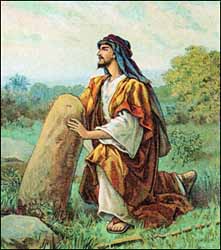
Hundreds of years later, after the tabernacle had been built and the people settled in Canaan, such pillars were not allowed (Deuteronomy 16:21). They were too easily confused with the heathen Baal worship which occurred on the high places, in contrast to the true worship of Yahweh.
But in Jacob's time, the setting up of such a commemorative stele or pillar seemed an entirely appropriate way to honor and remember God's revelation of himself in this place.8 Prior to this time, his father Isaac had led the family in worship of Yahweh. But for the first time Jacob sets upright a stone of faith and remembrance before the Lord. It is his way of placing himself, his life, before the Lord. His father's God has become his own God now.
Anointing the Stone (28:18b)
After Jacob sets up the stone, he pours on top of it some of the precious oil he had taken with him for his journey. The practice of anointing seemed to be involved with cleansing and consecrating to God. Centuries later, kings, priests, and prophets were anointed for their offices. Objects in the tabernacle were anointed with specially-formulated anointing oil: altars, the tent of meeting, the ark, the laver and its stand, and all objects relating to the altar.9 When Samuel anoints David as king over Israel, the scripture records, "from that day on the Spirit of the LORD came upon David in power" (1 Samuel 16:13). The words "Messiah" (Hebrew māshîaḥ) and Christ (Greek christos) both mean "Anointed One." Peter describes "how God anointed Jesus of Nazareth with the Holy Spirit and power...." (Acts 10:38).
So Jacob sets up the stone as an act of dedication of himself in worship, a way of remembering God's presence in this place. He anoints it as an act of cleansing and consecration, setting it -- and himself -- apart for God.
Jacob's Holy Vow to Yahweh (28:20-22)
But Jacob's act of commitment to Yahweh is not over yet. It includes a vow.
"20 Then Jacob made a vow, saying, 'If God will be with me and will watch over me on this journey I am taking and will give me food to eat and clothes to wear 21 so that I return safely to my father's house, then the LORD will be my God 22 and this stone that I have set up as a pillar will be God's house, and of all that you give me I will give you a tenth.'" (28:20-22)
Here are the provisions of the vow. Notice the giant "if" clauses:
- If God will be with me...
- If God will watch over (protect) me...
- If God will give me food and clothing...
- If God brings me safely again to my father's house ...
If God will do what he has promised, then Jacob solemnly vows:
- Then Yahweh will be my God...
- Then this pillar will be God's house...
- Then I will give God a tenth of all God gives me
This may look like bargaining with God, but such was the format of a formal vow in Jacob's time. Each party would state his rights and obligations and formally make a vow to uphold the covenant. God has made promises to him in the dream; now Jacob formally responds. Yahweh has been his father's God, but now he vows that Yahweh (and Yahweh alone) will be his own God. What was family tradition now becomes personal.
"Vow" is nēder, "the act of verbally consecrating to (devoting to the service of) God, that is, vowing to perform.... To bind one's self with what proceeds from one's mouth.10
The Promise to Return to Canaan (28:15b, 21a)
Notice one consistent element of both God's promise and Jacob's vow: return.11
"I will bring you back to this land." (28:15b)
"... so that I return safely to my father's house...." (28:21a)
God's purpose for Jacob is focused in Canaan, the land that God had promised to Abraham and his descendents forever. However, the present journey is not just a sidebar to Jacob's life. Sometimes we feel like God may put us on a shelf, or that we're off on a siding, rather than on the main track. We must be patient as God works out his purposes in our lives. We can't always see God's purposes from our vantage point. We must trust him. He will "bring us back" safely to that place he has for us.
Q3. (Genesis 28:18-21) What did it mean to
Jacob to set up the stone? What did anointing the stone mean to him?
Why does he do these things? What does he promise God in his vow?
|
Jacob Promises to Tithe (28:22)
"... Of all that you give me I will give you a tenth." (28:22)
Why does Jacob promise to tithe, that is, give one tenth of all that God gives him? His grandfather Abraham had tithed to Melchizedek, king of (Jeru)salem and priest of the Most High God (14:18-20), so there is some family tradition. But what does tithing mean in this context?
Tithing was known outside of Israel in the Near East. For example, we hear of tithing among the Egyptians, Syrians, Lydians, Babylonians, Assyrians, and in Ugarit and Carthage. But these tithes were not all religious; some were taxation by the king.12
Tithing as Allegiance to a King
We see an interesting passage in 1 Samuel 8, where the
Israelites demand that the aging prophet Samuel give them "a king to lead
us, such as all the other nations have"
(1 Samuel 8:5). The Lord tells Samuel, "It is not you they have rejected,
but they have rejected me as their king" (1 Samuel 8:7). So Samuel warns
them about what a king will require of them:
"... He will take a tenth of your grain and of your vintage and give it to his officials and attendants...." (1 Samuel 8:15)
I believe that Jacob offering to tithe is his way of accepting the Lord's kingship over him, an act of submission and fealty.
This would accord well with Israel's tithe after the tabernacle was built, as well. If you study it, you'll see that the tabernacle in the wilderness was built as a richly appointed portable palace for Israel's invisible king. The Holy of Holies was the throne room, where the Mercy Seat was over the Ark of the Covenant, the throne. The next room was the Holy Place where the Levitical Priests attended the King, burning incense on the golden Altar of Incense, keeping the Seven-Branched Lampstand lit, and bringing fresh loaves for the Table of Showbread. The courtyard which surrounded the Tabernacle formed a boundary of sacred ground in the very midst of Israel's camp.
Tithes were collected from the people in order to support the Levites who served the God in the tabernacle or temple.
"I give to the Levites all the tithes in Israel as their inheritance in return for the work they do while serving at the Tent of Meeting." (Numbers 18:21)
Through the Prophet Malachi, God says that to withhold the tithe is to rob God (Malachi 3:8). The tithe was not just an offering to God, but his due.
"Bring the whole tithe into the storehouse, that there may be food in my house." (Malachi 3:10a)
Tithing as a Recognition of God's Supply
So Jacob says:
"... Of all that you give me I will give you a tenth." (28:22)
Jacob's faith is both that God will supply -- and that the resources are ultimately God's. His tithe is a recognition of that.
My point is that Jacob's vow to tithe all that God gives him is both a statement of faith that God will meet his needs, and a vow of loyalty and submission to the Lord as his King and God. (When you ask who Jacob ended up tithing to, however, I run out of answers.)
I believe that tithing for the Christian represents something similar. We see ourselves as stewards of what actually belongs to God. And the tithe of our income is a way of demonstrating our allegiance, our love, and that we serve God rather than Money (Matthew 6:24).
Ultimately, tithing isn't about money but about discipleship. Tithing is a powerful indicator to us that we trust God and have committed our lives to him. And so it was for Jacob.
Q4. (Genesis 28:22) What does Jacob's
promise to tithe indicate about his commitment? Presumably, Jacob
has been a believer in Yahweh all his life. In what sense is this
incident at Bethel a conversion experience for him? What is the
relationship of tithing to conversion?
|
|
|
At the beginning of our passage we see Jacob the manipulator fleeing from his brother. But before he gets very far, he meets God and his life is radically changed. He has heard about his father's God; now he meets him. He had heard of the blessings of Abraham; now he has them renewed to him by God himself. He has had a nebulous faith in his father's God; now he commits himself in allegiance and submission to God as his King and Lord. Jacob the Supplanter is converted.
Prayer
Lord God, thank you for your patient love that finds us and calls us to yourself. I pray that my conversion to serve you might be deep and lasting. I place myself before you as Jacob set up a stone in your sight. I offer my tithe to you as a way of saying that I place myself under you and give you my full allegiance and trust. I love you. In Jesus' name, I pray. Amen.
References
1. Sullām, "ladder." Patterson remarks, "Some would suggest the translation "stairway" and liken the structure to a ziggurat, which is possible. However, there are other words for stairway, and ladders were used at a very early time" (R.D. Patterson, Sullām, TWOT #1506c). However, Hamilton sees a connection (through metathesis) with the Akkadian simmiltu, "stairway" (Hamilton, Genesis, p. 239).
2. Pāraṣ, "break through," perhaps here, "spread," that is, "become known." (BDB 829, 10).
3. Shāmar, "keep, preserve, protect" (BDB 1036, 4).
4. Māqôm is a "mem preformative" noun from qûm, "stand," represents "the physical location where something is or ought to be, that is, its station. So, it is translated 'place, home, room'" (Leonard J. Coppes, qûm, TWOT #1999h).
5. Yārēʾ, Qal stem,
6. Andrew Bowling, yārēʾ, TWOT #3372.
7. "Gate" is shaʿar, "gate." Two other words are sometimes translated "gate," petaḥ and delet. The former actually means 'entrance,' from the verb meaning 'to open.' The latter refers to the 'door leaves' making up part of the gate. Shaʿar refers to the whole gate complex and to the open area on either side of it. The shaʿar "gate" was, of course, the means of controlled access to a walled city. Depending on its size, a city had varying numbers of gates, but always one main gate which often consisted of an outer and an inner gate (Herman J. Austel, shʿr, TWOT #2437a).
8. Roland K. Harrison, "pillar," ISBE 3:869-871; Roland de Vaux, Ancient Israel 2:285-286; Uzi Avner, "Scared Stones in the Desert," Biblical Archaeology Review, May-June 2001..Such a stone is known by different names: pillar, standing stone, massebah, and stele. See also passages in Genesis 31:13, 45, 51f; 35:14,20; Exodus 23:24; 24:4; 34:13; Deuteronomy 7:5; 12:3; 16:22, etc.
9. Franz Hesse, chrio TDNT 9:496-509.
10. "A nēder is something promised to God verbally" (Leonard J. Coppes, nādar, TWOT #1308a).
11. The very common verb shûb is used in both verses. The basic meaning of shûb in the Qal stem (as in verse 21a) is "to (re)turn," implying physical motion or movement. The Hiphil stem (as in verse 15b) is causative, "bring back, carry back" (Victor P. Hamilton, shûb, TWOT #2340).
12. Eugene E. Carpenter, "Tithe," ISBE 4:861-864.
Copyright © 2025, Ralph F. Wilson. <pastor joyfulheart.com> All rights reserved. A single copy of this article is free. Do not put this on a website. See legal, copyright, and reprint information.
 To be notified about future articles, stories, and Bible studies, why don't you subscribe to our free newsletter, The Joyful Heart, by placing your e-mail address in the box below. We respect your