


|
Old Testament
New Testament
Gospels
Acts
Paul's Letters
General Letters
Revelation
Topical Studies
Beginning the Journey (for new Christians). en Español

|
Old Testament
New Testament
Gospels
Acts
Paul's Letters
General Letters
Revelation
Topical Studies

|
Home
Bible Studies
Articles
Books
Podcasts
Search
Menu
Donate
About Us
Contact Us
FAQ
Sitemap


Free
E-mail Bible Study
 Experiencing the Psalms
Home | Bible Studies | Articles | Books | Podcasts | Search | Menu | Donate | About Us | FAQ | Contact Us
|
|
Rebekah, Woman of the Lord (25:19-34)
"19 This is the account of Abraham's son Isaac. Abraham became the father of Isaac, 20 and Isaac was forty years old when he married Rebekah daughter of Bethuel the Aramean from Paddan Aram and sister of Laban the Aramean." (25:19-20)
Abraham -- patriarch of what will become Israel -- has one legitimate son, Isaac. This son has married his cousin, Rebekah, who moves from far-away Haran (near the border between Turkey and Iraq), to Canaan.
Rebekah feels isolated in this new land -- and is shamefully barren. It is shameful because for a women to be childless in that culture is to be incapable of performing her primary function -- bearing children. Failure to produce an heir is a major calamity for the family in the ancient Near East.
She has a husband who loves her -- that is something! (24:66). And her husband prays for her.
"Isaac prayed to the LORD on behalf of his wife, because she was barren. The LORD answered his prayer, and his wife Rebekah became pregnant." (25:21)
The Lord answers his prayer -- twice over. Rebekah is pregnant with twins!
"22 The babies jostled each other within her, and she said, 'Why is this happening to me?' So she went to inquire of the LORD. 23 The LORD said to her,
'Two nations are in your womb,
and two peoples from within you will be separated;
one people will be stronger than the other,
and the older will serve the younger.'" (25:21b-23)
Rebecca has heard from the Lord. She is a spiritual woman.
Papa's Boy and Mama's Boy
"24 When the time came for her to give birth, there were twin boys in her womb. 25 The first to come out was red, and his whole body was like a hairy garment; so they named him Esau. 26 After this, his brother came out, with his hand grasping Esau's heel; so he was named Jacob. Isaac was sixty years old when Rebekah gave birth to them." (25:24-26)
The birth itself is an acted prophecy of the future. Esau comes out first, red and hairy.1 Jacob follows his brother straightaway. His tiny hand grips2 his brother's heel ('āqēb) as they pull Esau out, and they have to pry his little fingers off to free Esau. Jacob is born second, but he is grasping to be first from the earliest moments of his life. They name him Jacob (yaʿaqōb), which means, "he grasps the heel," or figuratively, "he deceives."3
Isaac is sixty when the boys are born. Rebekah is in her early to mid-thirties by this time. The boys bring great joy into Isaac's life, especially his firstborn. Esau loves the out-of-doors4 like his dad and they would go hunting together. The boy becomes a skilled5, renowned hunter, who tracks deer in the wilderness and brings them down with his bow and arrow. Esau is happiest when he is out hunting in the wild (25:27a).
Jacob is just the opposite. He is quieter6 and stays around the tents (25:27b). He and his mother Rebekah grow close, and she helps him understand something of his destiny. No doubt, she tells him of the prophecy that he will rule over his brother. She implants the idea, reinforces it, and -- as we'll see -- pushes him to fulfill it.
Obtaining the Birthright (25:29-34)
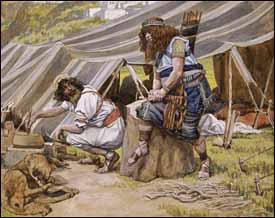
One day while Esau is out hunting, Jacob is at home cooking lentil7 stew8 in a pot over the fire. (The KJV calls it "pottage."9). Esau is exhausted and famished. He craves the red-colored stew. "Quick, let me have some of that red stew!" He can't wait. This is Jacob's opportunity.
"First, sell10 me your birthright," he says. The "birthright" or "primogeniture" (bekōrâ) involved the legal rights of the firstborn to a double portion of the inheritance (Deuteronomy 21:17), plus leadership of the family or clan when the father died. Esau, the firstborn, is destined to rule over Jacob all his life -- unless he is foolish enough to part with his legal rights.
"Hey, I'm about to die," replies Esau. "What good is the birthright to me?"
This exchange tells us a great deal about the character of both brothers.
The Desire for Instant Gratification
Esau betrays his own tendency towards instant gratification. "I want it now. I can't wait for the future." In so doing, he bargains away his future options. Jacob, on the other hand, is willing to deny himself in the present to obtain in the future what he values most. Each of us faces temptations -- strong temptations -- to get our gratification now. We want instant pleasure, instant wealth, instant popularity. And for this we trade away our futures. Jacob is an example of a person who can live with delayed gratification.
Taking Shrewd Advantage (25:33)
Jacob's motives aren't pure, of course. Esau accuses him of deceiving (27:36), though Jacob isn't guilty of deception -- this time. Instead, Jacob takes advantage of Esau's weakness. In a weak moment he extracts from his brother a binding promise.
"'Swear11 to me first.' So he swore an oath to him, selling his birthright to Jacob." (25:33)
Could such an inherent right as a birthright be sold or transferred in this manner? There's no clear precedent, either in ancient literature or Biblical literature. There is a 15th Century BC text from Nuzi as a parallel where a man named Tupkitilla transfers his inheritance rights to a grove over to his brother Kurpazah in exchange for three sheep. While not parallel in every aspect, it does indicate that one brother could sell inherited property to another.12 In Ruth 4 we see a legal transaction between Boaz and his relative which gives Boaz the right to marry Ruth -- and purchase her mother-in-law Naomi's property. The relative relinquishes his right and formalizes it by taking off his sandal and giving it to Boaz in the presence of witnesses.
Though Esau sells his birthright on the spur of the moment in a casual setting, it seems to have been considered binding. Neither Esau nor Isaac seem to question that Jacob has indeed obtained the birthright (25:34; 27:35-36).
Ethical Implications
Is Jacob being honest? Is he being a good businessman? Do we really get ahead by taking advantage of others' weaknesses and shortsightedness? Are we obligated to disclose to others their potential mistakes? How can we love our neighbor as ourselves in business?
Jay Conrad Levinson wrote a whole series of books beginning with Guerrilla Marketing (1984), based on the hypothesis that business is war and conflict, and that the little guy can gain advantage by being smarter, quick on his feet -- and ruthless.
I think Jesus calls us to a higher standard in our business practices. He would be much more pleased by the "win-win" deal, than the one that took advantage of the weakness of a brother. His "Golden Rule" is: "Do to others as you would have them do to you" (Luke 6:31). Jacob doesn't love his brother as himself.
Despising Spiritual Things (25:34)
"Then Jacob gave Esau some bread and some lentil stew. He ate and drank, and then got up and left. So Esau despised his birthright." (25:34)
This incident also says a lot about one's value of spiritual things, if we can consider the birthright in a spiritual as well as legal light. Esau values stew more than the birthright, while Jacob values the birthright more than his own integrity. The narrator notes, "So Esau despised his birthright" (25:34). "Despised" is bāzâ, "to despise, distain, hold in contempt," with the root meaning, "to accord little worth to something."13
The author of Hebrews discusses this incident:
"See that no one ... is godless like Esau, who for a single meal sold his inheritance rights as the oldest son. Afterward, as you know, when he wanted to inherit this blessing, he was rejected. He could bring about no change of mind, though he sought the blessing with tears." (Hebrews 12:15-17)
Indeed, Esau did seek his father's blessing with tears:
"When Esau heard his father's words, he burst out with a loud and bitter cry and said to his father, 'Bless me -- me too, my father!'" (27:34)
"'Do you have only one blessing, my father? Bless me too, my father!' Then Esau wept aloud." (27:38)
God is merciful and can forgive us of sin, but there are some doors we forever close for ourselves by our actions, actions that cannot be undone. This is for us a sobering warning, which speaks directly to our character and what we value most.
Q1. Why does the New Testament condemn Esau
for selling his birthright? (Hebrews 12:16-17) What did
selling the birthright represent? What does this transaction say
about Esau's character and values? What does it reveal about Jacob's
character and values?
|
Q2. Was Rebekah a spiritual woman, that is,
interested in spiritual things? Was Isaac a spiritual man? Which do
you think was the more spiritually sensitive? What evidence of
spirituality do you see in Jacob? In Esau?
|
Tricking Isaac into a Blessing (27:1-40)
While Jacob's acquisition of the birthright might have been strictly legal, his acquisition of his father's blessing is grossly deceptive and unrighteous on its very face.
Genesis 27:1-40 contains the fascinating but dark story of conspiracy and fraud. Pause now and read it from your Bible.
Isaac is now about 135 years old, bedridden and nearly blind. Tent walls are thin. Jacob's mother Rebekah overhears Isaac telling Esau to hunt some venison and cook it for him, and then receive the formal father-to-son blessing of the firstborn before Isaac dies.
Rebekah remembers -- though Isaac doesn't seem to -- that this is all wrong. The Lord had told her "the older will serve the younger" (25:23).
Now Rebekah takes it upon herself to make the prophecy happen. She decides that Isaac must not bless Esau. You could argue that Rebekah is more spiritual than her husband Isaac, in that she remembers God's word and makes sure that nothing -- not even righteousness and her husband's will -- will stand in the way of God's will for her favorite son, Jacob. Call it what you will, what she proposes is pure deceit.
|
|
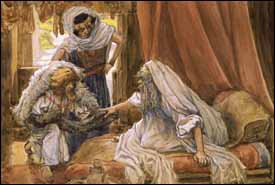
Quickly, Rebekah calls her favorite son Jacob. Do what I say, she says. Trick your father into giving you his blessing rather than Esau. She comes up with a scheme to trick the old man:
- Prepare a well-cooked meal of domestic livestock -- he'll never know it wasn't venison.
- Wear Esau's gamy-smelling clothing to make blind Isaac think he is speaking to Esau. (Isaac has apparently lost his eyesight, but not his sense of smell.)
- Put goatskin pieces on your arms and neck to simulate Esau's hairiness. (Can you really fool Isaac with fur? Or was Esau that hairy?)
Jacob is afraid that if his father discovers the ruse, he will curse him. "Let the curse fall on me," says his mother. "Just do what I say."
Jacob follows his mother's instructions and thus begins the deception. Isaac seems to suspect something and asks Jacob directly: "Are you really my son Esau?"
"I am," Jacob says without hesitation.
Later, when Isaac realizes what has happened, he calls this deceit. Note the Hebrew play on words in verse 36.
"35 But he said, 'Your brother came
deceitfully and took your blessing.'
36 Esau said, 'Isn't he rightly named Jacob (yaʿaqōb)?
He has deceived (ʿāqab)
me these two times: He took my birthright, and now he's taken my blessing!'"
(27:35-36)
"Deceitfully" (NIV, NRSV), "subtilty" (KJV) in verse 35 is mirmâ, "deceit, treachery," from the verb rāmâ, "beguile, deceive, mislead."14 Esau remarks that Jacob (whose name means "supplanter, deceiver") has acted in accordance with his name.
|
Q3. (Genesis 27:6-29) God had told Rebekah
that Jacob is supposed to rule over Esau (Genesis 25:23). To what
extent does this excuse her plan to deceive her husband Isaac? How
much responsibility does Jacob bear in the deception?
|
Isaac Blesses Jacob (27:27-29)
And so Isaac blesses Jacob with a blessing Isaac had intended for the minutes-older twin Esau. It includes:
- Heaven's dew and earth's richness -- an abundance of grain and new wine
- The subjection of whole nations.
- Priority and superiority over his brothers,
- Protection from the curses of others, and
- To be a source of blessing to others.
The key words that Rebekah had sought for were spoken:
"Be lord
over your brothers,
and may the sons of your mother bow down to you." (27:29b)
Now Jacob has obtained both the birthright and the coveted blessing from his father. Jacob has won; Esau has lost.
When Esau returns too late, his father gives him not a blessing, but a kind of anti-blessing, which is the promise that he will overthrow his brother's domination at some point (27:39-40).
What Kind of Blessing Is This?
What kind of blessing is this? It is clear from Isaac's reaction when he discovers the deception ("violent trembling," 27:33), that he didn't realize he was pronouncing the blessing on the wrong person.
It becomes clear that this is more than the simple blessing of a father to a son. It is a kind of spoken prophecy that comes from the Lord himself, given through Isaac as a spokesman to the person God intends to bless. We see two additional examples later in Genesis, which we'll study in detail in Lesson 7.
- Jacob's blessing of Joseph's sons, Ephraim and Manasseh (Genesis 48)
- Jacob's blessing of his twelve sons (Genesis 49)
In each case Jacob prophesies a specific blessing, speaking of future things that he has no way of knowing except for God's word in his mouth.
In one sense, Isaac's blessing of Jacob and Esau is God's, not Isaac's. In that case, I wonder if Rebekah's and Jacob's deceitful intervention was "necessary," if God would have blessed Jacob in spite of Isaac's intentions to the contrary? Some of Isaac's blessing of Jacob might be attributed to a father's good wishes for his firstborn, but there's more. Isaac's later blessing of Esau includes at least one phrase that sounds much like prophecy:
"You
will live by the sword
and you will serve your brother.
But when you grow restless,
you will throw his yoke from off your neck." (27:40)
Indeed, Esau later does prevent Jacob from ruling over him. But Esau does not attempt to subjugate Jacob, even when he had a chance. We'll explore that further in Lesson 4.
|
Q4. (Genesis 27:33) Why couldn't Isaac
reverse his blessing once he discovers Jacob's trickery? What is
Isaac's role in this blessing? What is God's role in it?
|
Can God bless through Unrighteousness
Of course, there's an ethical problem with Rebekah's and Jacob's deception. If God is a God of truth, then this is the opposite of truth. It is a sin. It is unrighteous. And though it is quite in keeping with Jacob's opportunistic and deceptive character so far, it is hardly worthy of approval -- except perhaps by shrewd people who value expediency over integrity.
Can God -- does God -- allow sin to be a part of the working out of his purposes? The surprising answer of Genesis is, "Yes." Later in Genesis we come to the sordid tale of Joseph's brothers selling him into slavery out of jealously. After Jacob's death his brother's are terrified. Listen to Joseph's answer:
"You intended to harm me, but God intended it for good to accomplish what is now being done, the saving of many lives." (50:20)
Though Joseph's brothers had sold him into slavery with the basest of motives, and a clear sin against him and against their father, "God intended it for good...." Does this mean that somehow Joseph's brothers are innocent, that God made them do it and they had no choice? No. They were responsible for their sin, just as Judas was responsible for his sin, even though in his sin he was fulfilling prophecy.
God's sovereignty and man's free will
We see human sin and responsibility on the one side and God working out his plan on the other. Of course, we're getting deep into things we scarcely understand. We throw around such words as predestination, foreknowledge, foreordination, and the like, as if we understood them. They are merely theological constructs to label what we've never experienced firsthand. Whole churches have been divided over views of God's sovereignty and man's will. There's no need to re-visit these sorry controversies.
But to be biblical and balanced we must affirm two seemingly contrary truths:
- God is sovereign
- Man has a free will
Both are somehow true.
"And we know that in all things God works for the good of those who love him, who have been called according to his purpose." (Romans 8:28)
In spite of man's evil, God will still work good out of it and further his plan in spite of it. True, man's evil causes great pain and suffering, which God does not always shield us from -- nor did he shield his own Son -- but he will work out his plan.
I struggle against saying about every tragedy, "It must be God's will." Many times tragedies are the result of man's sin. But I can affirm that God can work good out of every tragedy. Indeed, he delights in doing so!
Preferring One Child over Another (25:28)
Rebekah loved Jacob, while Isaac loved Esau (25:28). What trouble this caused! Jacob himself made the same mistake by loving the sons of his beloved wife Rachel -- Joseph and Benjamin -- to the obvious pain and jealously of their brothers. Later, David makes a similar mistake to the ruin of his family.
As parents, we need to learn from this. While we cannot love our children the same, we must love them equally if we desire a peaceful household and children whose lives are blessed. Of course, each child is different and we show our love in different ways to them. Love is the key.
|
Q5. (Genesis 25:28) What happens when your
children sense that you love one child more than another? Did such
discrimination happen to you when you were growing up? If so, how
are you finding healing? How can we as parents love our children
equally but differently?
|
"Jacob Have I loved"
We can't leave this passage without looking for a moment at God's preference of Jacob over Esau. Esau was a descendent of Abraham, but didn't have the spiritual acuity to appreciate it. Though God blessed Esau's descendents with nation-status, the country of Edom, they were subjugated again and again by the sons of Jacob (Israel).
Here we really get into the thick of predestination. In explaining God's sovereignty in Romans 9:10-13, Paul uses Jacob and Esau as examples, quoting Malachi:
"'Was
not Esau Jacob's brother?' the LORD
says.
'Yet I have loved Jacob,
but Esau I have hated,
and I have turned his mountains into a wasteland
and left his inheritance to the desert jackals.'" (Malachi 1:2-3)
This indicates, says the Apostle Paul, "... that God's purpose in election might stand: not by works, but by him who calls" (Romans 9:11b-12a). "It does not, therefore, depend on man's desire or effort," Paul concludes, "but on God's mercy" (Roman 9:16).
God is in ultimate control and we can't do anything about it. This is hard for us humans. We don't like anyone taking away our control over our destiny -- not even God!
Did God really love Jacob and hate Esau? No. God loved them both, but for his plan of redemption, he preferred Jacob over Esau, and decided to bring the blessings of Abraham to the entire world through the offspring of Jacob rather than Esau. "Love" and "hate" are used hyperbolically in place of "prefer" or "show favor" in order to make a point.
It's pretty obvious that neither Jacob nor Esau had a sterling character. God didn't chose Jacob over Esau because Jacob was more righteous. God had a plan in spite of Jacob's character. God works on Jacob's character and changes it, as we'll see, but God's plan and purpose for Jacob is not dependent upon Jacob's goodness and worthiness, but on God's grace and plan.
|
Q6. Extra Credit. Whose character flaws
most remind you of your own? Isaac's, Rebekah's, Esau's, or Jacob's?
Why? How is God working to improve your character?
|
Conclusion
|
|

While we haven't got all our questions answered, this passage gives us lots to think about, to grasp insights about character and personal growth. What have we learned?
- There is hope for flawed people such as us.
- God's choice to bless us is based on his own purposes, not on ours.
This should give us hope. God has made clear in the New Testament that he intends to bless us in spite of ourselves, in spite of our flawed character. He is faithful to us, not for our sakes alone, but for the sake of Jesus who died for us to redeem us.
Prayer
Father, as the story of Jacob and Esau unfolds, I find that both of them have deep flaws. When I'm honest, I see deep flaws in myself. I ask you to heal what is broken in me. And work in me and through me, not based on my righteousness, but by the mercies of Jesus. In His name, I pray. Amen.
References
1. Esau (ʿēśāw) faintly resembles the word "hairy" (śēʿār), but Esau's future homeland is called Seir (śēʿîr) as well as Edom ("red"), perhaps after the red sandstone characteristic of the area. (Robin J. DeWitt Knauth, "Esau, Edomites," DOTP 219-224).
2. ʾĀḥaz, "grasp, take hold, take possession" (BDB 28).
3. The verb ʿāqab means "take by the heel, supplant," related to the noun 'āqēb, "heel" (J. Barton Payne, ʿāqab, TWOT #1676f).
4. Śādeh, "field, country, ground, land." This masculine noun broadly designates the open field, country, or a definite portion of ground, a field (TWOT #2236).
5. "Skillful" (NIV, NRSV), "cunning" (KJV) is yādaʿ, "to know." The participle occurs in phrases describing skill in hunting (Genesis 25:27), learning (Isaiah 29:11-13), lamentation (Amos 5:16), sailing the sea (2 Chronicles 8:18), and playing an instrument (1 Samuel 16:16) (TWOT #848).
6. "Quiet" (NIV, NRSV), "plain" (KJV) is tām, "Perfect," so translated in nine of thirteen occurrences, many of which refer to the patriarch Job. It also means "undefiled, upright," from tāmam, "be complete" (TWOT #2522c). Kidner (p. 152) sees a suggestion of "sound" or "solid," "the level-headed quality that made Jacob, at his best, toughly dependable, and at his worst a formidably cool opponent." Hamilton (pp. 181-182) surveys the possibilities and settles on the translation of "wholesome man."
7. In Genesis 25:34 this is called "lentil stew" (ʿadāshîm). The lentil (also known as daal or dal, Lens culinaris), a type of pulse, is a bushy annual plant of the legume family, grown for its lens-shaped seeds. It is about 15 inches tall and the seeds grow in pods, usually with two seeds in each.
8. "Cooking" (NIV), "sod" (KJV, obsolete past tense of "seethe," that is, "boil") is the verb zîd, "boil" (TWOT #547). The related word, "stew" (NIV, NRSV), "pottage" (KJV) nāzîd, "boiled food, pottage," from zîd, "boil" (TWOT #547d).
9. In English, "pottage" is "a thick soup of vegetables and often meat," from "pot." The phrase "mess of pottage" isn't in the Bible, but comes from a section heading in the Geneva Bible (1560). "Mess" is an archaic usage meaning "food set on a table at one time," preserved in our word "mess hall."
10. "Sell" is mākar, used for all kinds of sales, including selling into slavery. The Nuzi tablets (c. 1500 BC) witness two other cases of men yielding inheritance rights to a younger brother for some immediate temporal consideration (TWOT #1194).
11. "Swear" is shābaʿ, "swear, adjure, bind oneself by an oath" (TWOT #2319).
12. Discussed by Hamilton, Genesis, pp. 183-184.
13. Bruce K. Waltke, bāzâ, TWOT #224.
14. William White, rāmâ, TWOT #2169d.
Copyright © 2026, Ralph F. Wilson. <pastor joyfulheart.com> All rights reserved. A single copy of this article is free. Do not put this on a website. See legal, copyright, and reprint information.
 To be notified about future articles, stories, and Bible studies, why don't you subscribe to our free newsletter, The Joyful Heart, by placing your e-mail address in the box below. We respect your