


|
Old Testament
New Testament
Gospels
Acts
Paul's Letters
General Letters
Revelation
Topical Studies
Beginning the Journey (for new Christians). en Español

|
Old Testament
New Testament
Gospels
Acts
Paul's Letters
General Letters
Revelation
Topical Studies

|
Home
Bible Studies
Articles
Books
Podcasts
Search
Menu
Donate
About Us
Contact Us
FAQ
Sitemap


 The Discipleship Process
Throughout this letter, Paul has been arguing for the way of the Spirit, rather than the way of the law. Yes, the law restrained sin and showed us our need for salvation, but now that the Spirit has come, the law is obsolete. The reign of the flesh is over, the Spirit is working his fruit in you. You are Spirit-people!
In the first few verses of chapter 6, Paul begins to unfold some of the implications of being Spirit-people rather than slaves to the law.
Restoring a Fallen Brother (6:1-2)
Christians are not lawless (5:13-14), but led by the Spirit who fulfills the law in us (5:18). What happens when we slip, however? When we don't walk in the Spirit? When a fleshly mindset begins to take hold?
"1 Brothers, if someone is caught in a sin, you who are spiritual should restore him gently. But watch yourself, or you also may be tempted. 2 Carry each other's burdens, and in this way you will fulfill the law of Christ." (6:1-2)
Notice how he talks about sin: "If someone is caught in a sin...." The verb "caught" (NIV), "detected" (NRSV), "overtaken" (KJV) is prolambanō, originally, "take before (hand)." Here it means "to ascertain something by surprise, detect, overtake, surprise someone."[278] The word indicates a non-normal event.
Sin[279] isn't to be considered a "normal" part of the Christian's life! There's a bumper-sticker that gets me angry: "I'm not perfect, just forgiven." While these words are true, they function as a way to excuse our sins. To non-Christians these words seem as the "cop-out" that they are. Excuses!
The normal Christian life is walking in the Spirit. However, the reality is that we goof up, we slip, we sin. Because it happens doesn't make it normal. Just because potty-trained children sometimes have accidents, that doesn't mean that this should be considered their normal way of life!
But when we ourselves sin, there is help. Praise God! The Apostle John reminds us:
"My dear children, I write this to you so that you will not sin. But if anybody does sin, we have one who speaks to the Father in our defense -- Jesus Christ, the Righteous One. He is the atoning sacrifice for our sins, and not only for ours but also for the sins of the whole world." (1 John 2:1-2)
But what if someone in the congregation sins? Do we jump on them with legalism and judgment? No! The law isn't necessary to keep Christians in line. Paul says,
"Brothers, if someone is caught in a sin, you who are spiritual should restore him gently." (6:1a)
In these verses, Paul tells us how to bring a person back into step with the Spirit.
Who. Who is to do the restoration? The word translated "You who are spiritual" (NIV, KJV), "you who have received the Spirit" (NRSV) is pneumatikos, here, "possessing the Spirit, the one who possesses the Spirit," "spirit-filled people."[280] Paul isn't talking about people who are just spiritually inclined. Our culture now uses the word "spiritual" to refer to people who practice any spiritual exercise, whether Christian or Buddhist. But when Paul uses the word "spiritual," he means those who are living and walking in the Spirit (5:16), led by the Spirit (5:18), conforming their lives to the Spirit's influence (5:25), as we saw in Galatians 5. Restoration must be by the Spirit, not by the law.
What. "Restore" is katartizō, "to cause to be in a condition to function well, put in order, restore," here, "restore to a former condition."[281] Restoration requires careful discernment and the willingness to be patient. It is a process. If you have a car that has the "engine light" come on, the restoration and repair process takes diagnosing the problem, then patiently correcting it. If a classic car has been allowed to fall into general disrepair, the restoration process is very expensive and may take years. Nevertheless, classic car enthusiasts are only satisfied by restoring the car to its prime condition.
How. Paul now explains that restoration must be done "gently" (NIV), with "a spirit of gentleness" (NRSV), "a spirit of meekness" (KJV). This phrase has two words, pneuma, "spirit" and prautēs, "the quality of not being overly impressed by a sense of one's self-importance; gentleness, humility, courtesy, considerateness, meekness."[282] This expression, "spirit of meekness" is found in 1 Corinthians 4:21. Is Paul talking about the Holy Spirit here? Yes, kind of. He has just discussed gentleness as a fruit of the Spirit that grows in and transforms our human spirit. So the "spirit of gentleness" is a combination of both the Holy Spirit and our spirit.
Why is gentleness so vital to restoration? People often sin because they've been wounded or victimized by Satan along the way. Often they've compensated for their inner pain by behaviors that don't make sense in a healthy person, but make all kinds of sense to the hurting person who is trying to cope. Unspiritual people apply the law with condemnation. The law can't heal; it can only make us feel worse about ourselves and spiral down further in our sense of being loved by God. But spiritual people are humble, not self-righteous. They apply love and grace to sin. Love heals!
Paul warns the restoration team,
"But watch yourself, or you also may be tempted." (6:1b)
This relates directly to the "spirit of meekness/gentleness" that is to accompany restoration. If we come with arrogance to restore a brother or sister -- we're better than they are -- then we will not only be ineffective in ministering with love, but we are being extremely foolish. We're all subject to being surprised by sin. So Paul warns, "Watch yourself" (NIV), "take care" (NRSV), "considering thyself" (KJV). The verb is skopeō (from which we get our English word "scope"), "to pay careful attention to, look (out) for, notice."[283] We can all be tempted -- and are tempted.[284]
Carry Each Other's Burdens (6:2)
Rather than a condescending attitude, we are to come with humble love:
"1 Brothers, if someone is caught in a sin, you who are spiritual should restore him gently. But watch yourself, or you also may be tempted. 2 Carry each other's burdens, and in this way you will fulfill the law of Christ." (6:1-2)
What is the law of Christ? To love our neighbor, of course (Galatians 5:13-14). It is Jesus'command:
"A new command I give you: Love one another. As I have loved you, so you must love one another." (John 13:34)
James calls it "the royal law" (James 2:8).
Love requires that we carry[285] the burdens[286] of those who fall down under them. Lifting up their burdens is our way of fulfilling[287] the true purpose of the law. Paul had talked about the law as a burden, a heavy yoke of slavery (5:1). Jesus had said,
"You experts in the law, woe to you, because you load people down with burdens they can hardly carry, and you yourselves will not lift one finger to help them." (Luke 11:46)
But in our passage, Paul hints at an expression of love reminiscent of the law:
"If you see the donkey of someone who hates you fallen down under its load, do not leave it there; be sure you help him with it." (Exodus 23:5)
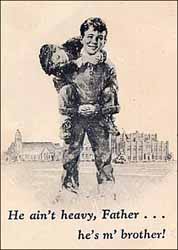 Paul urges us to go out of our way to help those who
are falling under their burden -- this is love!
Paul urges us to go out of our way to help those who
are falling under their burden -- this is love!
"Carry each other's burdens, and in this way you will fulfill the law of Christ." (Galatians 6:2)
"We who are strong ought to bear with the failings of the weak and not to please ourselves." (Romans 15:1)
"And we urge you, brothers, warn those who are idle, encourage the timid, help the weak, be patient with everyone." (1 Thessalonians 5:14)
We're tempted to say, "I don't want to get involved. It's not my business." But that's not love -- nor does it recognize the sinner as part of our family. During the Christmas season of 1941, Father Edward J. Flanagan, founder of Boys Town orphanage in Omaha, Nebraska, came across a line drawing by Van B. Hooper of a young boy carrying his brother with the caption, "He ain't heavy Mister—he's m'brother!" It became the motto of Boys Town.[288]
"Carry each other's burdens, and in this way you will fulfill the law of Christ." (Galatians 6:2)
Beware of Being Condescending (6:3-5)
Now Paul says another word about the pride that characterizes the self-righteousness of law-keepers and makes them ineffective as restorers.
"3 If anyone thinks he is something when he is nothing, he deceives himself. 4 Each one should test his own actions. Then he can take pride in himself, without comparing himself to somebody else, 5 for each one should carry his own load." (6:3-5)
"Deceives" is phrenapataō, a Greek word used in Christian writings primarily, "mislead concerning the truth, deceive," from phrēn, "thinking" + apataō, "cheat, deceive, beguile."[289]
It's easy to deceive ourselves about our own righteousness. Preachers and long-time church leaders are particularly vulnerable, since we're around church, we've taught the Scripture, we believe in the truth. We think of ourselves as "good" people. But we can be the worst hypocrites! James is especially instructive here:
"22 Be doers of the word, and not merely hearers who deceive themselves. 23 For if any are hearers of the word and not doers, they are like those who look at themselves in a mirror; 24 for they look at themselves and, on going away, immediately forget what they were like. 25 But those who look into the perfect law, the law of liberty, and persevere, being not hearers who forget but doers who act—they will be blessed in their doing." (James 1:22-25)
"1 Not many of you should presume to be teachers, my brothers, because you know that we who teach will be judged more strictly. 2 We all stumble in many ways. If anyone is never at fault in what he says, he is a perfect man, able to keep his whole body in check." (James 3:1-2)
Sin and the flesh are deceptive!
Now Paul shows us the path to protect ourselves from self-deception.
"4 Each one should test his own actions. Then he can take pride in himself, without comparing himself to somebody else, 5 for each one should carry his own load." (6:4-5)
"Test" (NIV, NRSV), "prove" (KJV) is dokimazō, "to make a critical examination of something to determine genuineness, put to the test, examine."[290] In classical Greek, the word is used of assaying metals to determine their quality. In the Septuagint, dokimazō translates Hebrew bāḥan, "to examine, try, prove," test for genuineness by fire[291] or in a crucible, a symbol for God's testing that carries into the New Testament.
"The crucible for silver and the furnace for gold,
but the LORD tests the heart."
(Proverbs 17:3)
"... The Day will bring it to light. It will be revealed with fire, and the fire will test the quality of each man's work." (1 Corinthians 3:13)
Here Paul says, "Each one should test his own actions." We're not to be easy on ourselves. What do our actions show about our character? Only through continual self-examination and bare honesty can we protect ourselves from self-deceit. "Watch yourself," says Paul (6:2).
The danger is that we who are restoring others may lose our humility and become condescending -- and lose our own edge!
"3 If anyone thinks he is something when he is nothing, he deceives himself. 4 Each one should test his own actions. Then he can take pride in himself, without comparing himself to somebody else, 5 for each one should carry his own load." (6:3-5)
Paul isn't really recommending boasting in 6:4b. "Take pride" (NIV), "cause for pride" (NRSV), "rejoicing" (KJV) is kauchēma, the "act of taking pride in something or that which constitutes a source of pride, boast."[292] But he is warning us about getting self-righteous by comparing[293] ourselves to those Christians who are in a sorry state, whom we're gently restoring. "I must be pretty good," we tend to think, "because I'm better than they are!"
"Watch yourself," says Paul.
Finally, Paul reminds us,
"... For each one should carry his own load." (6:5)
What does this mean? I'm told I'm supposed to carry my brother's burdens in verse 2. What does it mean in verse 5 that I'm supposed to carry my own load?
True, the burden in verse 2 uses a different word, baros. In verse 5, "load" (NIV, NRSV), "burden" (KJV) is phortion, literally, "that which constitutes a load for transport." Here it's used figuratively, "that which is carried and constitutes a burden."[294] But no sharp distinction can be drawn between the two words. In fact, the use of similar words is purposeful, says Burton:
"Every man has his own burden, that is, of weakness and sin. The paradoxical antithesis to verse 2a is doubtless conscious and intentional. It is the man who knows he has a burden of his own that is willing to bear his fellow's burden."[295]
Paul's point here is similar to one he makes elsewhere:
"You, then, why do you judge your brother? Or why do you look down on your brother? For we will all stand before God's judgment seat." (Romans 14:10)
Q1. (Galatians 6:1-5) What does Paul mean, "caught in a
sin"? What would restoration of a such brother or sister look like in his or her
life? Who should restore this person? In what spirit should it be done? What is
the result of trying to restore a person without humility?
https://www.joyfulheart.com/forums/index.php?showtopic=1152
Sharing with Your Teachers (6:6)
Now Paul comes to a saying that seems out of context -- unless perhaps he gives it as an example of carrying another's burdens.[296]
"Anyone who receives instruction[297] in the word must share all good things with his instructor." (6:6)
"Share" (NIV, NRSV), "communicate" (KJV) is koinōneō, "give/contribute a share."[298] Paul uses this word also in his letter to the Philippians.
"Not one church shared with me in the matter of giving and receiving, except you only." (Philippians 4:15b)
Paul isn't trying to get money from the Galatians.
Elsewhere he insists that he himself glories in preaching the gospel free of
charge to the recipients (1 Corinthians 9:18;
2 Corinthians 2:7) -- and he can do so because the Philippian church helped
support him! But it is important that he teaches his churches how to provide
some support for their own leaders and preachers both financially and
materially. Otherwise these teachers won't be able to spend their time
preaching. So he asserts this important principle
(1 Corinthians 9:4-14; 1 Timothy 5:17) that came down from Jesus himself (1
Corinthians 4:14; Matthew 10:10).
A Warning against Self-Deception (6:7)
Now Paul returns to a main theme. He has argued that faith has always been the way God's people were justified, not by law. The law has now become obsolete since God has sent his Holy Spirit. But we are not then lawless, but the Spirit empowers us to fulfill the spirit of law -- the law of love -- because it can deal effectively with the flesh, the corrupt sinful nature that the law couldn't tame.
But the Spirit can tame the flesh -- if we will yield ourselves to Him, here using the figure of "sowing." Paul begins his recap of the superiority of the Spirit over the flesh with some strong language about deception and mocking God. Remember that the Galatian church was deeply troubled by backbiting and dissension (5:15, 26).
"Do not be deceived: God cannot be mocked. A man reaps what he sows." (6:7)
"Deceived" is planaō, "to proceed without a sense of proper direction, go astray, be misled, wander about aimlessly," here, "be mistaken in one's judgment, deceive oneself."[299] You've been deceived by the Judaizers who made you think that by observing the law you could be justified and please God, says Paul. This is a lie! This is "a different gospel" (1:6-7), and those who propagate it deserve to be accursed (1:9).
"Mocked" is myktērizō, "turn up the nose at, treat with contempt" (from myktēr, "nostril, nose").[300] Paul is referring to mocking God's justice, expecting to get away with sowing to the flesh (verse 8). When you listen to how people use God's name, you understand how widespread is the mocking of God in our world. When you hear the stupid jokes and asides, God is treated with contempt by many, many people. God have mercy on us!
Now Paul comes to the point of his warning:
"A man reaps what he sows." (6:7b)
As mentioned above, Paul has given essentially the same warning in three epistles. Why? Because of the widespread belief that God's justice won't catch up with them. That they won't reap what they sow!
"I warn you, as I did before, that those who live like this will not inherit the kingdom of God." (Galatians 5:21)
"Do you not know that the wicked will not inherit the kingdom of God? Do not be deceived...." (1 Corinthians 6:9)
"No immoral, impure or greedy person -- such a man is an idolater -- has any inheritance in the kingdom of Christ and of God. Let no one deceive you with empty words...." (Ephesians 5:5-6a)
Paul warns us not to be deceived, that God will not be mocked. There's a lot of self-deception going on, both in the church and outside of it.
Sowing and Reaping (6:7b-9)
Paul is using a familiar agricultural analogy.
"7b A man reaps[301] what he sows.[302] 8 The one who sows to please his sinful nature, from that nature will reap destruction; the one who sows to please the Spirit, from the Spirit will reap eternal life. 9 Let us not become weary in doing good, for at the proper time we will reap a harvest if we do not give up." (6:7-9)
What makes this analogy powerful is that the images of sowing and reaping in the Bible are used of judgment on the Last Day.
- Parable of the Tares and the Wheat (Matthew 13:24-30, 36-43). "The harvest is the end of the age, and the harvesters are angels" (Matthew 13:39b).
- Harvest of the Earth (Revelation 14:14-16; Joel 3:13). "Take your sickle and reap, because the time to reap has come, for the harvest of the earth is ripe" (Revelation 14:15; cf. Joel 3:13).
People don't like preaching of judgment because it dislodges their preferred belief. They would rather embrace their self-deception that there will be no consequences for sin.
But Paul brings a stern warning to the Galatians that there are serious consequences for following your corrupt sinful nature -- corruption. This is a kind of play on words, since "flesh" (sarx) can also mean physical flesh that decays rapidly when you die. "Destruction" (NIV), "corruption" (NRSV, KJV) is phthora, literally, "breakdown of organic matter, dissolution, deterioration, corruption," here figuratively, "total destruction of an entity."[303]
Paul conveys a similar idea in Romans 8, with the same contrast between the flesh and the Spirit:
"5 Those who live according to the sinful nature (sarx) have their minds set on what that nature (sarx) desires; but those who live in accordance with the Spirit have their minds set on what the Spirit desires.
6 The mind of sinful (sarx) man is death, but the mind controlled by the Spirit is life and peace; 7 the sinful (sarx) mind is hostile to God. It does not submit to God's law, nor can it do so. 8 Those controlled by the sinful nature (sarx) cannot please God. 9 You, however, are controlled not by the sinful nature (sarx) but by the Spirit, if the Spirit of God lives in you. And if anyone does not have the Spirit of Christ, he does not belong to Christ." (Romans 8:5-9)
So what does it mean to "sow to the Spirit" or "set your mind on the things of the Spirit"? This is the same action as "walking in the Spirit," "being led by the Spirit," "living in the Spirit," and "keeping in step with the Spirit."
We can choose either to yield to God's Spirit in us or to go our own way. Each direction has eternal consequences. One end is eternal life; the other is "corruption," that is, destruction.
Q2. (Galatians 6:7-8) What does it mean to "sow to the
flesh"? What does this look like? What synonyms does Paul use for "sow to the
Spirit" in Galatians? (Hint: see 5:16, 18, 25). What does sowing to the Spirit
look like in a congregation? What are the results in a congregation of sowing to
the flesh?
https://www.joyfulheart.com/forums/index.php?showtopic=1153
Don't Become Weary (6:9)
"Let us not become weary in doing good, for at the proper time we will reap a harvest if we do not give up." (6:9)
We will be rewarded. We will reap, if we don't give up. But sometimes we just lose all energy for the task.
"Weary" is egkakeō, "to lose one's motivation in continuing a desirable pattern of conduct or activity, lose enthusiasm, be discouraged."[304]
"Give up" (NIV, NRSV), "faint" (KJV) is eklyō. In Greek literature the word frequently has the sense "loose from something, set free," also "relax." Here it means, "be exhausted in strength, become weary, give out."[305]
Why do we get weary? Why do we want to give up? Because we don't believe what Paul says, that "A man reaps what he sows" (6:7b). And so Paul reminds us that there is a reward! At the proper time, the time God has chosen, Christ will come and reward us. We'll see the fruition of all the promises of God.
Paul says something similar to the Corinthian church after describing the resurrection of the dead on the Last Day:
"Therefore, my dear brothers, stand firm. Let nothing move you. Always give yourselves fully to the work of the Lord, because you know that your labor in the Lord is not in vain." (1 Corinthians 15:58)
Dear friend, are you tired? Are you weary? Does your labor in the Lord seem like a waste of time to you? Does it seem like you're getting nowhere? Remember that God will reward you for your faithfulness. Notice how Paul encouraged Christians in Ephesus who labored day after day as slaves in the households of their masters:
"Serve wholeheartedly, as if you were serving the Lord, not men, because you know that the Lord will reward everyone for whatever good he does, whether he is slave or free." (Ephesians 6:7-8)
Doing Good (6:9-10)
"Let us not become weary in doing good, for at the proper time[306] we will reap a harvest if we do not give up. Therefore, as we have opportunity, let us do good to all people, especially to those who belong to the family of believers." (6:9-10)
We are called to "do good" to all people, especially to Christians. Of course, "goodness" (agathōsynē) is a fruit of the Spirit (5:22). Two words are used for "good" in these two verses, kalos[307] (6:9) and agathos[308] (6:10) but they seem to be used synonymously here.
We are to continually find ways to do good to others, since it is the natural outflowing of God's love that has been poured into our hearts by the Holy Spirit (Romans 5:5). It was this doing good which was to characterize Christians to the pagan culture that surrounded them. We're not to be known as religious weirdos, but as people who act in loving and kind ways, patiently doing good wherever we can. Consider these verses:
"To those who by persistence in doing good seek glory, honor and immortality, he will give eternal life." (Romans 2:7)
"For it is God's will that by doing good you should silence the ignorant talk of foolish men." (1 Peter 2:15)
"It is better, if it is God's will, to suffer for doing good than for doing evil." (1 Peter 3:17)
"So then, those who suffer according to God's will should commit themselves to their faithful Creator and continue to do good." (1 Peter 4:19)
"See that none of you repays evil for evil, but always seek to do good to one another and to all." (1 Thessalonians 5:15)
"For we are God's workmanship, created in Christ Jesus to do good works, which God prepared in advance for us to do." (Ephesians 2:10)
Of course, we don't do good in order to be saved (Ephesians 2:8-9), but because we are saved, because the Holy Spirit lives within us.
We're to do good to all around us, but especially to our Christian family.[309] This isn't selfishness, but our first responsibility. Family members have a responsibility first to one another, to meet each other's needs. Then if there is something left, they can help those outside the family. In this case, the Galatian churches were hurting, filled with dissension and bickering. Paul is saying: Do good to one another, and so bring healing to your Christian community by your love.
Q3. (Galatians 6:9-10) Why do we tend to become weary
living out our faith? What promise does Paul give us in 6:9 to forestall this
weariness? Why should our "doing good" begin with our spiritual family, not with
the non-Christians?
https://www.joyfulheart.com/forums/index.php?showtopic=1154
Paul's Handwriting (6:11)
Now Paul points his readers to his handwriting.
"See what large letters I use as I write to you with my own hand!" (6:11)
While this could be a way to authenticate this letter as from him (2 Thessalonians 2:2; 3:17), it is more likely that at the end of the letter he wrote his final greetings in his own (large) handwriting as usual (1 Corinthians 16:21, Colossians 4:18), rather than impersonally dictate them to his secretary or amanuensis.
The Judaizers'True Motivation (6:12-13)
Now Paul reveals something about the Judaizers that helps us understand their true motivation for trying to impose circumcision and adherence to the law upon the Gentile Christians at Galatia.
"12 Those who want to make a good impression[310] outwardly[311] are trying to compel[312] you to be circumcised. The only reason they do this is to avoid being persecuted[313] for the cross of Christ. 13 Not even those who are circumcised obey the law, yet they want you to be circumcised that they may boast about your flesh." (6:12-13)
"Your flesh" in verse 13 refers to the foreskins of the Galatian Gentiles they wanted to circumcise.[314] In other words, the Jewish Christians who were pushing circumcision upon the Galatian believers were doing this so they would be accepted by their fellow Jews in the area, rather than be persecuted by them as Christians (see Galatians 5:11). They weren't interested in the Galatians'salvation so much as their own social acceptance by people who meant something to them, their own countrymen.
The Offense of the Cross of Christ (6:12, 14)
Notice carefully the two references to the cross of Christ in verses 12 and 14:
"The only reason they do this is to avoid being persecuted for the cross of Christ." (6:12b)
"May I never boast except in the cross of our Lord Jesus Christ, through which the world has been crucified to me, and I to the world." (6:14)
You must realize that to the world in Paul's time, the cross didn't represent the Christian faith as it does in our day. Rather, the cross represented a convicted criminal's shameful death by torture. To be crucified was to be branded a criminal, the scum of society.
Why would the cross of Christ bring persecution? Why was it so offensive to the Jews? Two reasons, as mentioned in Lesson 6 on 5:11, where this is explored in detail. The cross represents both (1) a crucified Messiah and (2) an atoning sacrifice for our sins. Let's understand this.
1. A crucified Messiah. First, it was offensive to the Jews that these Christians believed that Jesus was the Messiah, the Christ. They couldn't make sense of the claim that the Messiah, whom they expected to deliver them from their Roman oppressors, had been killed on the cross. If they saw Jesus as the Messiah, then they had to admit that their own Jewish leaders had been responsible for Christ's death. The cross of the Messiah was offensive to the Jews.
2. Faith rather than law. But just as important, the "cross of Christ" represents our faith that we are justified, made right with God, by grace, by Jesus'sacrifice for our sins on the cross, not by keeping the law. The Jews, especially the strict Pharisees, maintained that they were justified, made right before God, by their own observance of the law (including circumcision). If they acknowledged that Jesus'death on the cross had been an atoning sacrifice for their sin (1 John 2:1-2), a ransom for their sins (Mark 10:45), that meant that the law did not indeed save them, but it was faith in Jesus. Yes, the cross of the Messiah was offensive to the Jews.
The Jewish Christians in Galatia were ashamed of the cross of the Messiah. They had stumbled over the "stumbling stone" (Romans 9:32-33; Isaiah 8:14; 1 Peter 2:8) just like the Jews they were trying to impress. But Paul is not like them:
"I am not ashamed of the gospel, because it is the power of God for the salvation of everyone who believes: first for the Jew, then for the Gentile. For in the gospel a righteousness from God is revealed, a righteousness that is by faith from first to last, just as it is written: 'The righteous will live by faith.'" (Romans 1:16-17)
Boasting in the Cross (6:14)
"May I never boast except in the cross of our Lord Jesus Christ, through which the world has been crucified to me, and I to the world." (6:14)
Paul wasn't ashamed of the cross. On the contrary he boasted in it! "Boast" (NIV, NRSV), "glory in" (KJV) in verse 13 and 14 is kauchaomai, "to take pride in something, boast, glory, pride oneself, brag."[315]
Paul so identifies with Christ, that he sees himself as being crucified with Christ on the cross, as we discussed in 2:20. This represented the point in his life that his flesh, his corrupt human nature, lost its power.
"Those who belong to Christ Jesus have crucified the sinful nature with its passions and desires." (5:24)
This was the time the Holy Spirit, the Spirit of Christ, began to live in him.
"I have been crucified with Christ and I no longer live, but Christ lives in me. The life I live in the body, I live by faith in the Son of God, who loved me and gave himself for me." (2:20)
When the crucified, risen Christ appeared to Paul, everything changed. He saw righteousness by the law for what it was -- a naïve, self-serving, self-deceiving sham. He wrote to the Philippians:
"8 I consider everything a loss compared to the surpassing greatness of knowing Christ Jesus my Lord, for whose sake I have lost all things. I consider them rubbish, that I may gain Christ 9 and be found in him, not having a righteousness of my own that comes from the law, but that which is through faith in Christ -- the righteousness that comes from God and is by faith. 10 I want to know Christ and the power of his resurrection and the fellowship of sharing in his sufferings, becoming like him in his death, 11 and so, somehow, to attain to the resurrection from the dead." (Philippians 3:8-11)
The cross that was a stumbling block to the Jews, was Paul's glory! Isaac Watts said it well in his hymn, "When I Survey the Wondrous Cross" (1707):
When I survey the wondrous cross
On which the Prince of glory died,
My richest gain I count but loss,
And pour contempt on all my pride.
Forbid it, Lord, that I should boast,
Save in the death of Christ my God!
All the vain things that charm me most,
I sacrifice them to His blood.
See from His head, His hands, His feet,
Sorrow and love flow mingled down!
Did e'er such love and sorrow meet,
Or thorns compose so rich a crown?
His dying crimson, like a robe,
Spreads o'er His body on the tree;
Then I am dead to all the globe,
And all the globe is dead to me.
Were the whole realm of nature mine,
That were a present far too small;
Love so amazing, so divine,
Demands my soul, my life, my all.
Law vs. the New Creation (6:15)
Paul is summarizing now.
"Neither circumcision nor uncircumcision means anything; what counts is a new creation." (6:15)
Circumcision no longer was the chief identifying mark of God's people. It was now the Spirit that was given when a person became a Christ-follower, a "new creation." "Creation" (NIV, NRSV), "creature" (KJV) is ktisis, "the result of a creative act, that which is created."[316] To the Corinthians he had written:
"Therefore, if anyone is in Christ, he is a new creation; the old has gone, the new has come!" (2 Corinthians 5:17)
The old distinctions between Jew and Greek have vanished. We are one in Christ! Hallelujah!
"But now in Christ Jesus you who once were far away have been brought near through the blood of Christ. For he himself is our peace, who has made the two one and has destroyed the barrier, the dividing wall of hostility, by abolishing in his flesh the law with its commandments and regulations. His purpose was to create in himself one new man out of the two, thus making peace, and in this one body to reconcile both of them to God through the cross, by which he put to death their hostility." (Ephesians 2:13-16)
Q4. (Galatians 6:15) What characterizes this "new
creation" that Paul talks about? What does the "old creation" look like in
contrast? What does the old creation lack that the new creation possesses? How
does Jesus'saying, "You must be born again" (John 3:3-8) relate to this concept
of the new creation?
https://www.joyfulheart.com/forums/index.php?showtopic=1155
The Church and the Israel of God (6:16)
Paul is almost at the end of the letter, and so gives a greeting of "peace and mercy" -- but with a twist:
"Peace and mercy to all who follow this rule, even to the Israel of God." (6:16)
Paul's blessing follows the great blessing of the Psalms: "Peace be upon Israel" (Psalm 125:5). But he directs his greeting to "all who follow[317] this rule[318]" or have this understanding of the new creation in Christ. Then he refers to this group as "the Israel of God."
Does this mean that the church is now the true Israel. Yes, with a couple of important qualifications.
Jesus had hinted at this in his Parable of the Tenants (Matthew 21:33-44). The landowner builds a vineyard (which represents Israel), and then rents it out to tenants. When he sends for his annual rent, his servants are abused, and finally his son is killed by the tenants, bringing the king's wrath upon the tenants. As to the meaning of the parable, Jesus said:
"Therefore I tell you that the kingdom of God will be taken away from you and given to a people who will produce its fruit." (Matthew 21:43)
Indeed, Paul writes to the Philippians:
"For it is we who are the circumcision, we who worship by the Spirit of God, who glory in Christ Jesus, and who put no confidence in the flesh." (Philippians 3:3)
But it is not quite that simple. Paul uses the analogy of grafting a tree.
"If some of the branches have been broken off, and you, though a wild olive shoot, have been grafted in among the others and now share in the nourishing sap from the olive root, do not boast over those branches. If you do, consider this: You do not support the root, but the root supports you." (Romans 11:17-18)
In other words, the Gentiles have become part of the people of God that began with Abraham. We are Abraham's children by faith (Galatians 3:7, 7-12; Romans 4:12, 16; 9:6-8). Formerly, we were not God's people, but now we are God's people (1 Peter 2:9-10; Hosea 1:10). It is no longer Jew or Gentile, but we are part of the "one new man out of the two, thus making peace" (Ephesians 2:15). The believing Jew and the believing Gentile alike form "the Israel of God."
And so, Paul closes his letter with this blessing:
"Peace and mercy to all who follow this rule, even to the Israel of God." (6:16)
Q5. (Galatians 6:16) Who comprises "the Israel of God"
today? Who is excluded from this group? How is Romans 11:17-25 designed to
temper Gentile pride?
https://www.joyfulheart.com/forums/index.php?showtopic=1156
The Marks of Jesus (6:17)
Unlike most of Paul's other epistles, this one bears no personal greetings, perhaps because it was a general letter to be circulated to several churches -- but also because it is primarily a polemic epistle, not a personal "feel good" letter. He leaves them a veiled warning.
"Finally, let no one cause me trouble, for I bear on my body the marks of Jesus." (6:17)
"Trouble" is kopos, "a state of discomfort or distress, trouble, difficulty," a transferred sense of kopos = "beating."[319] "Marks" (Greek plural, stigmata) is the noun stigma (from which derive our English word), "mark, brand," from stizō, "tattoo."[320] Such brands were given to slaves -- especially runaway slaves who had been returned to their master. The brand was the master's mark, permanently identifying the slave as his property. But Paul's marks of being Christ's servant came from the beatings, the floggings, the stonings he had endured (2 Corinthians 11:21-29). One of those stonings had taken place at Lystra (Acts 14:19), which may have been one of the Galatian churches to which he was writing.[321]
Paul is warning the Galatians, especially his opponents, the Judaizers: Don't hassle me, I'm not your slave, but the slave of Jesus! If you trouble me, you'll have to answer to my Master.
"Who are you to judge someone else's servant? To his own master he stands or falls. And he will stand, for the Lord is able to make him stand." (Romans 14:4)
Final Benediction (6:18)
Paul concludes with a final blessing:
"The grace of our Lord Jesus Christ be with your spirit, brothers. Amen." (6:18)
It is similar to the blessing that concludes several
other letters: Romans 16:20;
2 Corinthians 13:14; Philippians 4:23; 2 Timothy 4:22; and Philemon 25; as well
as the Book of Revelation 22:21.
 Available in paperback and e-book formats |
The Galatian churches had known God's grace, but then had been flirting with law, obtaining righteousness before God, not by faith in God's grace in Christ, but through their own works. So Paul gives them the last word: grace. May God's grace so fill your spirits that you'll no longer be clamoring for something more. It is all found in the grace of the Lord Jesus Christ!
Prayer
Father, teach us to walk in your Spirit, to be led by your Spirit, to sow to your Spirit. We want to please you, be like you. And thank you for the cross of Christ. His death has given us life! Thank you! In Jesus'name, we pray. Amen.
Key Verses
"Brothers, if someone is caught in a sin, you who are spiritual should restore him gently. But watch yourself, or you also may be tempted. Carry each other's burdens, and in this way you will fulfill the law of Christ." (Galatians 6:1-2)
"Anyone who receives instruction in the word must share all good things with his instructor." (Galatians 6:6)
"Do not be deceived: God cannot be mocked. A man reaps what he sows." (Galatians 6:7)
"Let us not become weary in doing good, for at the proper time we will reap a harvest if we do not give up." (Galatians 6:9)
"Therefore, as we have opportunity, let us do good to all people, especially to those who belong to the family of believers." (Galatians 6:10)
"May I never boast except in the cross of our Lord Jesus Christ, through which the world has been crucified to me, and I to the world." (Galatians 6:14)
"Neither circumcision nor uncircumcision means anything; what counts is a new creation." (Galatians 6:15)
"Peace and mercy to all who follow this rule, even to the Israel of God." (Galatians 6:16)
End Notes
[278] Prolambanō, BDAG 872, 2.
[279] "Sin" (NIV), "transgression" (NRSV), "fault" (KJV) is paraptōma, in imagery of one making a false step so as to lose footing, "a violation of moral standards, offense, wrongdoing, sin," ordinarily of offenses against God" (BDAG 770, bα).
[280] Pneumatikos, BDAG 837, 2bβ.
[281] Katartizō, BDAG 526, 1a. This is a compound word, from kata, "in succession, in course" + artizō, "get ready, prepare," that is, "to render fit, sound, complete" (Thayer 336).
[282] Prautēs, BDAG 863.
[283] Skopeō, BDAG 932.
[284] "Tempted" is peirazō, "to entice to improper behavior, tempt" (BDAG 793, 4).
[285] "Carry" (NIV), "bear" (NRSV, KJV) is bastazō, "to sustain a burden, carry, bear," here and in verse 5, of bearing anything burdensome (BDAG 172, 2bα).
[286] "Burdens" is baros, "experience of something that is particularly oppressive, burden" (BDAG 167, 1).
[287] "Fulfill" is anaplēroō, "to carry out an agreement or obligation, fulfill" (BDAG 70, 2).
[288] The artist, Van B. Hooper, later became the editor of Ideals magazine and the drawing was reprinted in the first issue of Ideals in December 1944. The song, "He Ain't Heavy, He's My Brother" was written by Bobby Scott and Bob Russell (1969) became a hit for The Hollies in 1969, and for Neil Diamond in 1970.
[289] Phrenapataō, BDAG 1065.
[290] Dokimazō, BDAG 255, 1.
[291] John N. Oswalt, bāḥan, TWOT #230. Hermann Haarbeck, dokimos, NIDNTT 3:808-811.
[292] Kauchēma, BDAG 536, 1.
[293] The word "comparing" (NIV) isn't really in the text. The KJV is pretty literal: "not in another."
[294] Phortion, BDAG 1065, 2).
[295] Burton, Galatians, p. 334.
[296] So Lightfoot, Galatians, p. 217.
[297] "Receives instruction" (NIV), "is taught" (NRSV, KJV) is katēcheō (from which we get our English word "catechism"), "teach, instruct." (BDAG 534, 2a). "Instructor" (NIV), "teacher" (NRSV), "him that teacheth" (KJV) is a participle of the same verb.
[298] Koinōneō, BDAG 552, 2.
[299] Planaō, BDAG 822, 2cγ. We get our word "planet" from this word, from the old idea that the planets were wandering stars.
[300] Myktērizō, BDAG 660.
[301] "Reap" is therizō, "to harvest a grain crop by reaping, reap, harvest," here figuratively, "to gain results or benefits, reap" (BDAG 453, 2a).
[302] "Sows" is speirō, "sow seed" (BDAG 936, 1bα).
[303] Phthora, BDAG 1054, 5.
[304] Egkakeō, BDAG 272, 1. There is a textual variant here. Most early manuscripts have egkakeō (Aleph A B D* 33, 81, 326), while some have ekkakeō (C D2 F G Ψ). There is little difference in meaning.
[305] Eklyō, BDAG 306. Robertson (Word Studies) comments on ekluō, an old verb "to loosen out." Here, it means literally, "not loosened out," that is, "relaxed, exhausted as a result of giving in to evil."
[306] Both the word "time" in verse 9 and "opportunity" in verse 10 is kairos. Here it has the sense of a "point of time or period of time, time, period," frequently with implication of being especially fit for something, "a moment or period as especially appropriate, the right, proper, favorable time" (BDAG 497, 1b).
[307] Kalos (6:9) pertains to being "in accordance at a high level with the purpose of something or someone, good, useful." Here it refers to moral quality, "good, noble, praiseworthy, contributing to salvation" (BDAG 504, 2b).
[308] Agathos (6:10) means "that which is beneficial or helpful, good." In classical Greek, when used of persons, it frequently is in reference to good citizenship or acceptance of communal responsibility (BDAG 3, 2b).
[309] "Family" (NIV, NRSV), "household" (KJV) is oikeios, literally, "belonging to the house." Here it refers to "persons who are related by kinship or circumstances and form a closely knit group, members of a household." (BDAG 694, b).
[310] "Good impression" (NIV), "good showing" (NRSV), "fair shew" (KJV) is euprosōpeō, "make a good showing" before people (BDAG 417).
[311] "Outwardly" (NIV), "in the flesh" (NRSV, KJV), sarx, has the sense of "before people."
[312] "Compel" (NIV, NRSV), "constrain" (KJV) is anankazō, "to compel someone to act in a particular manner, compel, force," of inner and outer compulsion, but perhaps with the weakened sense, "weakened strongly urge/invite, urge upon, press" (BDAG 60, 1 and 2). The word is used elsewhere in Galatians: "Not even Titus ... was compelled to be circumcised" (Galatians 2:3) and to Peter, "How is it ... that you force Gentiles to follow Jewish customs?" (Galatians 2:14).
[313] "Be persecuted" (NIV, NRSV), "suffer persecution" (KJV) is the passive of diōkō, "to harass someone," especially because of beliefs, "persecute" (BDAG 254, 2).
[314] Sarx, BDAG 914, 1.
[315] Kauchaomai, BDAG 536, 1.
[316] Ktisis, BDAG 573, 2a.
[317] "Follow" (NIV, NRSV), "walk according to" (KJV) is stoicheō (which we saw in 5:25), "to be in line with a person or thing considered as standard for one's conduct, hold to, agree with, follow, conform" (BDAG 946).
[318] "Rule" is kanōn (from which we get our English word "canon"), originally, "a straight rod," here, "a means to determine the quality of something, rule, standard" (BDAG 508, 1).
[319] Kopos, BDAG 559, 1.
[320] Stigma, BDAG 945.
[321] According to the South Galatian Theory.
Copyright © 2026, Ralph F. Wilson. <pastor joyfulheart.com> All rights reserved. A single copy of this article is free. Do not put this on a website. See legal, copyright, and reprint information.
 To be notified about future articles, stories, and Bible studies, why don't you subscribe to our free newsletter, The Joyful Heart, by placing your e-mail address in the box below. We respect your