


|
Old Testament
New Testament
Gospels
Acts
Paul's Letters
General Letters
Revelation
Topical Studies
Beginning the Journey (for new Christians). en Español

|
Old Testament
New Testament
Gospels
Acts
Paul's Letters
General Letters
Revelation
Topical Studies

|
Home
Bible Studies
Articles
Books
Podcasts
Search
Menu
Donate
About Us
Contact Us
FAQ
Sitemap


Free
E-mail Bible Study
 Names and Titles of God
Home | Bible Studies | Articles | Books | Podcasts | Search | Menu | Donate | About Us | FAQ | Contact Us
Historically, Paul's Letter to the Galatians has been foundational for Christian doctrine, preaching, and practice. It strongly influenced Luther's understanding of justification by faith, which helped launch the Reformation.
Acceptance in the Early Church
From the earliest days, Galatians has been accepted as an important letter from the pen of the Apostle Paul. Among the earliest references to it are found in Clement, Ignatius, and Polycarp. It is contained in the Syriac and Old Latin versions, as well as the Canon of the Muratorian Fragment.
It is considered one of Paul's most important epistles. No serious challenge to its authenticity has ever been entertained, even in the last century, when the authenticity of so many others was called into question.
Location of the Galatian Churches
But that doesn't mean it has escaped controversy. One of the issues yet to be resolved to universal satisfaction is the very location of the Galatian churches to which Paul was writing.
The Greek word Galatai is a variant of Keltai or Keltoi, that is the "Celts" (Latin Galli). The Celts in the Danube basin of central Europe migrated not only west to Gaul and Britain, but also southeast into north central Asia Minor.
The original kingdom of the Galatians was confined after a defeat at the hands of Attalus I, king of Pergamum about 230 BC into an area which had formerly belonged to Phrygia. Bruce says that the three tribes of Galatians occupied "a broad strip of land stretching over 200 miles from south-west to north-east, between the longitudes of 31° to 35° E and the latitudes of 39° and 40°, 30' N,"[1] which we'll call the Kingdom of Galatia or ethnic Galatia (see map below). Their capital became Ancyra (the modern capital of the Turkish Republic).
In 190 BC, the Galatians lost a key battle to the Romans, who began to exert their influence in Asia Minor, eventually dividing it into a number of provinces. They expanded the Province of Galatia substantially beyond the borders of the original ethnic Galatia.
So when Paul writes this letter to "the churches of Galatia," which did he mean? Ethnic Galatia? Or the Roman Province of Galatia? (See map).
Because of the ambiguity of the term Galatia, two theories have developed about the location of the churches Paul was addressing:
- North Galatian Theory. Understands the churches in the ethnic Kingdom of Galatia to be the recipients of the letters.
- South Galatian Theory. Understands the churches visited by Paul and Barnabas on the First Missionary Journey (mentioned in Acts 13:13-14:23, which are in the Roman Province of Galatia) as the recipients, such as Pisidian Antioch, Iconium, Lystra, and Derbe.
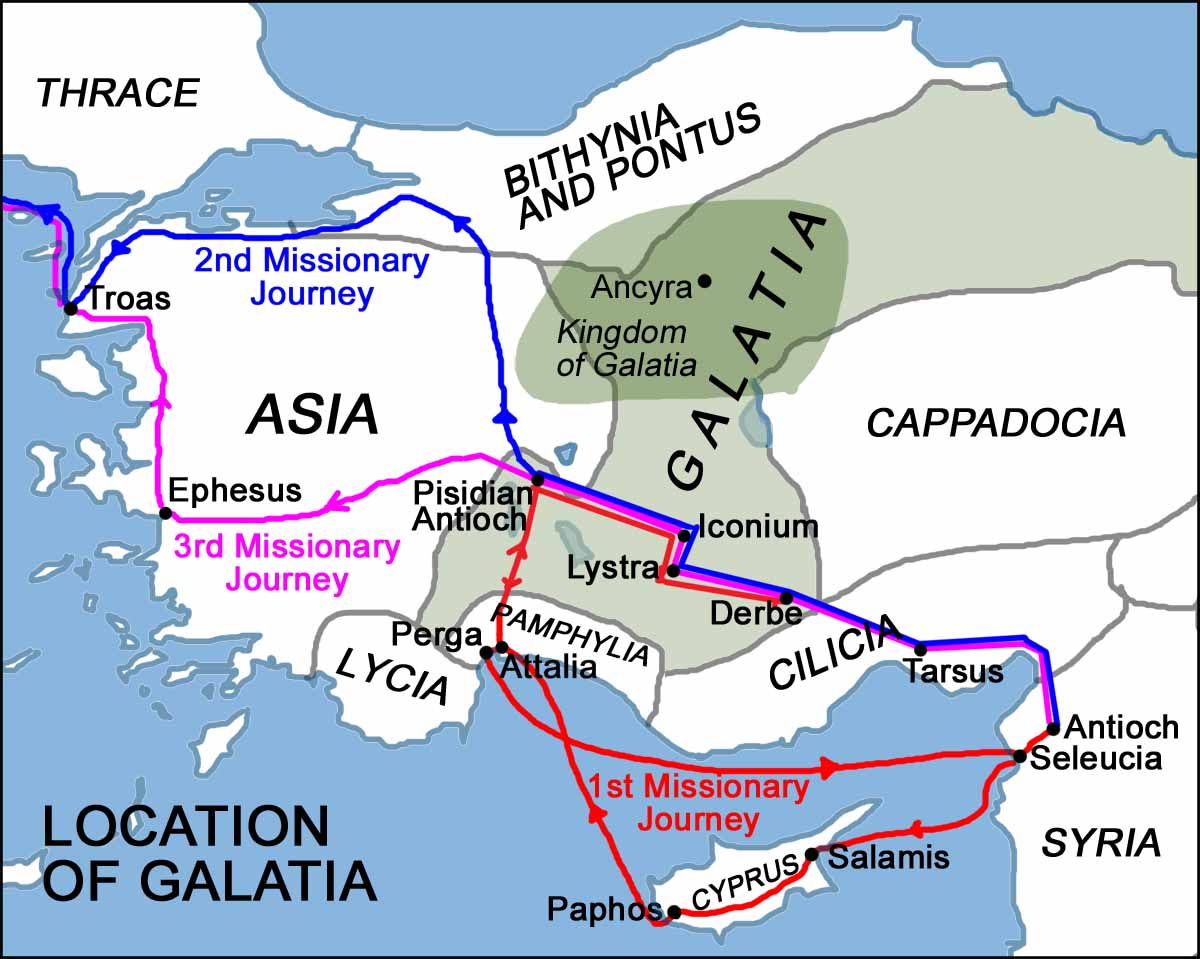
Adherents of each theory have put forth strong arguments. I'll outline them here, but to study them, read a detailed commentary.
North Galatian Theory Arguments
- This was the universal view of the Early Church -- a period after the Province of Galatia had been reduced back to comprise North Galatia only.
- Paul addresses his letter to the "Galatians," that is, what these northerners were by race and language.
- Characteristics of the Galatians described in the letter correspond to those traditionally associated with the Gauls in the time of Julius Caesar.
- Circumstances of the Galatians' evangelization don't correspond with the account in Acts. Thus it must refer to another area, namely ethnic Galatia.
- Acts allows for evangelization of this area, perhaps from a base in Ephesus, on one or two occasions.
- Paul assumes that the majority of his readers would be Gentiles, but there are Jewish synagogues in the south, not in the north that we know of.
- Problems concerning circumcision would more likely arise in areas without a large Jewish population.
Not all of these arguments are convincing, but some are strong. J.B. Lightfoot was one of the strongest proponents of the North Galatian Theory in his commentary published in 1865.
South Galatian Theory Arguments
On the other hand, proponents of the South Galatian Theory put forward these arguments. Some, you'll notice, take the same facts as the North Galatian adherents, but see them pointing a different direction. Some of these arguments are strong, others are weak.
- We know of no churches in the region of the Kingdom of Galatia during this period, either from the New Testament or from other sources.
- Galatians is the only logical name Paul could have used to refer to Pisidians, Lycaonians, etc., since it was the name of the Roman province. What's more, elsewhere he refers to the churches of Asia, another Roman provincial name (1 Corinthians 16:19; 2 Corinthians 1:8; Romans 16:5; 2 Timothy 1:15; Acts 2:9; 19:10; 1 Peter 1:1; Revelation 1:4).
- It's more likely that the Judaizers would have pursued Paul in the southern regions where there were Jewish communities, rather than in the remote northern plateau.
- Many details of the evangelism in Galatians fit details mentioned in the Acts account. Barnabas is mentioned in the epistle implying that the Galatian saints knew him (Galatians 2:1, 9, 13). But he couldn't have been evangelizing in the Kingdom of Galatia with Paul, since they worked together only on Paul's First Missionary Journey in the Province of Galatia.[2]
- In the list of delegates accompanying the offering for Jerusalem (Acts 20:4), Paul names one or two delegates from the southern part of the Province of Galatia, but none from the Kingdom of Galatia, though we know he had instructed the Galatian churches concerning the offering (1 Corinthians 16:1).[3]
- A hypothetical evangelization of the Kingdom of Galatia is unlikely, though everyone acknowledges that Paul probably passed through the southwestern corner of ethnic Galatia on his 2nd Missionary Journey (Acts 16:6, see map above) -- and perhaps his 3rd Missionary Journey (18:23):
"Paul and his companions traveled throughout the region of Phrygia and Galatia, having been kept by the Holy Spirit from preaching the word in the province of Asia." (Acts 16:6)
W.M. Ramsay conducted a systematic survey of central Asia Minor, laying the archaeological foundation for the South Galatian Theory published in 1893 and 1899. He concluded that the Southern Theory better fits the dominant trade routes and key cities of Paul's day, and was thus more likely.
As I weigh the various arguments, I see that, on the one hand, the Early Church believed that Paul wrote the epistle to the ethnic Galatians. This is strong argument from tradition, though by the time they wrote, the Province of Galatia was now reduced to include mainly the Kingdom of Galatia (ethnic Galatia).[4] On the other hand, it seems inherently more likely to me that, instead of having to hypothesize a separate ethnic Galatian evangelization mission (an argument from silence), Paul is writing this epistle to churches that he visited on his First, Second, and Third Missionary Journeys, chronicled in the Book of Acts. I find the South Galatian Theory more convincing.
Dating of Galatians
A second issue that hasn't been resolved is the dating of Galatians. It could be one of the earliest documents in the New Testament. According to the Early Dating Theory, Galatians was written by Paul following his First Missionary Journey (perhaps 48 AD), even before the Council of Jerusalem in 49 AD.
According to the Later Dating Theory, Galatians was written by Paul from Corinth about 56 AD, prior to writing his Epistle to the Romans.
One's theory of the dating of Galatians will have a lot to do with how you chart Paul's visits to Jerusalem -- and a lot of that demands careful exegesis of the first two chapters of this letter. "Historiographically speaking," says Longenecker, "Paul's statements in Galatians 1-2 are the most important in the entire New Testament."[5] We'll be examining this in Lesson 2 in greater detail. Also see Appendix 2. Chronology of St. Paul's Ministry.
A lot depends on how you match Paul's two visits mentioned in Galatians to the five post-conversion visits of Paul to Jerusalem mentioned in Acts:
- Conversion visit (Acts 9:26-30)
- Famine visit (Acts 11:27-30)
- Jerusalem Council (Acts 15:1-30)
- Hasty visit (Acts 18:22)
- Collection visit (Acts 21:15-17), during which Paul was arrested.
A second factor affecting dating is whether you adopt a South Galatian Theory of the recipients or a North Galatian Theory, though this is not entirely definitive.
In brief, here are the arguments for the two main positions. For a detailed discussion, see the commentaries.
Later Dating Arguments (about 56 AD)
Traditionally, Galatians has been dated about 56 AD from Corinth. Arguments include:
- Galatians bears a strong affinity to Romans (and perhaps also 2 Corinthians), appearing to be a first attempt at formulating a rationale for justification by faith that is fleshed out in Romans. Since other Pauline epistles miss this striking affinity, it is likely that Galatians was written just prior to writing Romans. We can date Romans with some certainty during the winter preceding Paul's last visit to Rome, about 56 AD (Romans 15:25ff; Acts 20:2ff).
- Galatians records a second visit to Jerusalem with Titus (2:1) fourteen years after the first, which later dating proponents equate with the Council of Jerusalem visit in 49 AD, thus making Galatians later than 49 AD.
- Paul wouldn't have had time to evangelize ethnic Galatia (North Galatian Theory) until at least after his Second Missionary Journey (49-50 AD).
- The phrase "I first preached the gospel to you" (4:13) suggests two evangelistic journeys into Galatia, the second being his Second Missionary Journey or later.
Early Dating Arguments (about 48 AD)
- While there is certainly an affinity between the arguments in Galatians and those in Romans, there is no necessity of them being written close to each other in time. Paul's understanding of justification by faith was likely formed before he went to Antioch, many years before Romans was written.
- If the Council of Jerusalem (49 AD) had taken place before writing Galatians,
Paul would surely have mentioned the Apostolic Decrees in this letter as a
strong argument against the Judaizers' demanding that the Galatian Gentiles be
circumcised, but he did not. This is the strongest argument, in my opinion, for
early
dating. - Paul's second visit to Jerusalem is more likely to be the Famine Visit (Acts 11:27-30; 12:25; Galatians 2:1-10) in perhaps 46 AD, allowing for Galatians to be written prior to the Jerusalem Council which took place about 49 AD.
- The phrase "I first preached the gospel to you" (4:13) doesn't require two separate missionary journeys. We do know that Paul and Barnabas doubled back and visited Pisidian Antioch, Iconium, and Lystra a second time "strengthening the disciples" (Acts 14:21-24).
- The sentence, "I am astonished that you are so quickly deserting ... and turning to a different gospel" (1:6) suggests that the time after the founding of the Galatian churches and this epistle was relatively short. But this argument is weak, no matter which theory it is used to support.
- Paul writes of Barnabas (2:1, 9, 13) in a way that suggests that the Galatians believers knew him personally, which would be true only if we accept both the South Galatian theory and the Early Dating Theory.
While the Late Date Theory proponents are numerous, their strongest argument is the affinity between Galatians and Romans. If you accept the South Galatian Theory (as I do), then there is no reason to prevent an early dating of Galatians -- and it would explain why Paul didn't mention the Apostolic Decrees following the Jerusalem Council in his letter. I tentatively adopt the early dating of Galatians, but think that it's wise not to be dogmatic about it.
Fortunately, neither the exact location of the Galatian churches nor the date have anything to do with our modern application of the teachings of the epistle. But what was going on in these churches that brought Paul to write the letter becomes pretty clear as you read the text.
Occasion and Purpose of the Letter
Clearly, some Christian Jews -- led by perhaps a single individual -- had gained a dominant influence in these churches. These Judaizers contended that the Gentile Christians needed to be circumcised in order to be saved, similar to the false teaching that came to Antioch and precipitated the Jerusalem Council:
"Some men came down from Judea to Antioch and were teaching the brothers: 'Unless you are circumcised, according to the custom taught by Moses, you cannot be saved.'" (Acts 15:1)
When he hears of this, Paul's reaction is strong. He is disappointed with the Gentile Christians for giving into this teaching after the careful instruction he had given them (1:6; 4:19-20). But he is outraged at the Judaizers who are bringing a false gospel. He calls down a curse on them (1:9) and wishes they would castrate themselves instead of circumcising the Gentiles (5:12).
Paul seeks to reestablish his apostolic authority, which has been attacked and undermined by his opponents. To do this he reviews his personal revelation by Jesus Christ that was independent of -- but in line with -- the teaching of the Jerusalem church that the Judaizers claimed as their authority.
Paul's primary purpose in this letter is to show from Scripture that God's promise to Abraham was righteousness by faith, not by the law, which wasn't given for another 450 years. His blessing was promised to his descendent, the Messiah and to the Gentiles.
In his argument he reminds the Galatians that they received the Holy Spirit without circumcision and law observance. Moreover, he shows that the essence of the law is fulfilled by the Holy Spirit working in the believer, not by obedience to an obsolete written code. He contrasts the inadequacy of the corrupt sinful nature to fulfill the law, vs. the power of the Spirit to overcome the weakness of the flesh.
 Available in paperback and e-book formats |
Finally, it's important to observe that the Galatian churches are in turmoil. They have been thrown into confusion (1:7) and are now characterized by backbiting, pride, and selfish ambition (5:15, 26). Paul seeks to re-teach them the gentle and humble ministry of Christ (6:1-5) to replace the current disorder they are experiencing.
My prayer is that you'll be strengthened and inspired as you study this impassioned and classic statement of the Christian faith.
End Notes
[1] Bruce, Galatians, p. 3.
[2] But see 1 Corinthian 9:6, where we have no evidence that the Corinthians knew Barnabas.
[3] However, this is an argument from silence; no Corinthian representative is named in Acts 20:4.
[4] Bruce (Galatians, p. 5-6) notes that about 137 AD, Laconia Galatia was detached from the province, and by 297 AD, the remainder of South Galatia had been attached to another province.
[5] Longenecker, Galatians, p. lxxii.
[6] The exact date of Jesus' crucifixion is disputed, but Friday, April 7, 30 AD is a probable date (William P. Armstrong and Jack Finegan, "Chronology of the New Testament," ISBE 1:689).
Copyright © 2026, Ralph F. Wilson. <pastor joyfulheart.com> All rights reserved. A single copy of this article is free. Do not put this on a website. See legal, copyright, and reprint information.
 To be notified about future articles, stories, and Bible studies, why don't you subscribe to our free newsletter, The Joyful Heart, by placing your e-mail address in the box below. We respect your