


|
Old Testament
New Testament
Gospels
Acts
Paul's Letters
General Letters
Revelation
Topical Studies
Beginning the Journey (for new Christians). en Español

|
Old Testament
New Testament
Gospels
Acts
Paul's Letters
General Letters
Revelation
Topical Studies

|
Home
Bible Studies
Articles
Books
Podcasts
Search
Menu
Donate
About Us
Contact Us
FAQ
Sitemap


Free
E-mail Bible Study
 Names and Titles of God
Home | Bible Studies | Articles | Books | Podcasts | Search | Menu | Donate | About Us | FAQ | Contact Us
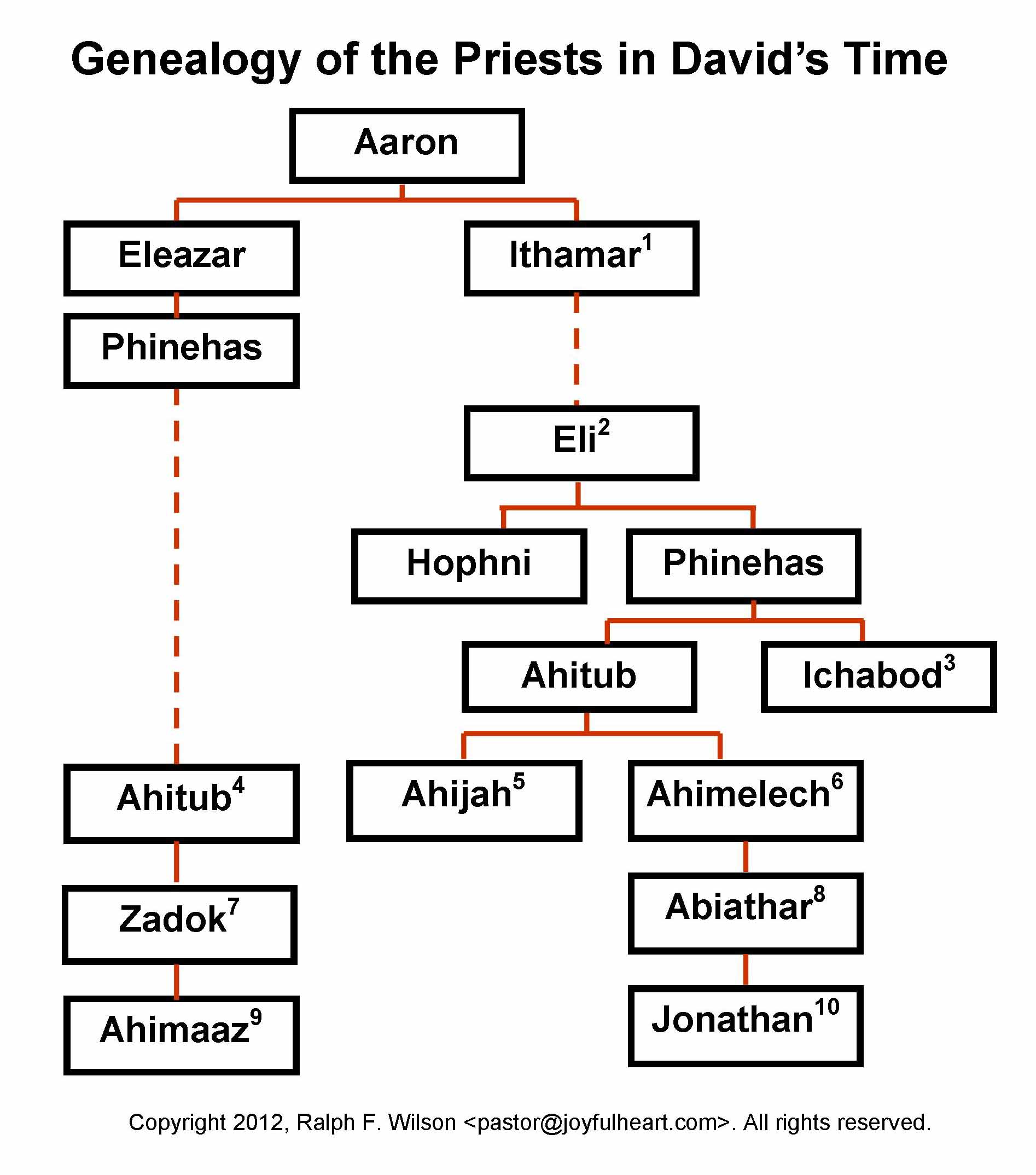
Larger image of genealogy of the priests in David's time
 Available as a book in paperback, Kindle, and PDF formats. |
[1] Ithamar. 1 Chronicles 24:1-6
[2] Eli was high priest when Samuel was born and helped raise him (1 Samuel 1-4).
[3] Ichabod, which means, “The glory has departed from Israel” (1 Samuel 1:21).
[4] Ahitub. 1 Chronicles 6:7-8; 18:16; 2 Samuel 8:17; Ezra 7:2.
[5] Ahijah is the son of Ahitub, son of Phinehas, son of Eli (1 Samuel 14:3, 18). Perhaps he is the same person as Ahimelech.
[6] Ahimelech. 1 Samuel 21; 22:11. Ahijah (1 Samuel 14:3, 18) may be the same person or Ahimelech’s brother, we’re not sure. In 1 Chronicles 24:6ff, the name Ahimelech is mistakenly transposed with Abiathar. In 24:6 it should read, “... Abiathar the son of Ahimelech,” instead of the other way around. W.J. Beecher and J.A. Balchin, “Ahimelech,” ISBE 1:80.
[7] Zadok. 2 Samuel 8:17; 15:24-36; 17:15; 18:19; 1 Kings 1:8, 26-39; 2:35. According to Josephus (Antiquities 8.1.3), Eli (of the house of Ithamar) was given the high priesthood when it was removed from Abishua (of the house of Eleazer). When Abiathar was deposed by Solomon, the preisthood returned to the house of Eleazer, to Zadok, who, for a time, had been co-high priest with Abiathar (Antiquities 7.5.4). Zadok’s son Shallam was the father of Hilkiah was the chief leader during the revival in 621 BC under Mosiah, who was the ancestor Ezra (Ezra 7:1-2) as well as Jehozadak (Jozadak), high priest under Zerubabel when the Israelites returned from the exile.
[8] Abiathar. When Abiathar’s family was executed by Saul, Abiathar fled to David, bringing the ephod, by which David inquired of the Lord (1 Samuel 22:20-23; 23:6). Abiathar was deposed when he supported Solomon’s brother Adonijah for the kingship, when David was on his deathbed. Zadok and Nathan the prophet supported Solomon (1 Kings 2:26-27).
[9] Ahimaaz. 1 Chronicles 6:8, 53; 2 Samuel 15:27, 36; 17:17, 20; 18:19ff.
[10] Jonathan was loyal to David while Absalom reigned in Jerusalem. He carried news from his father Abiathar to David (2 Samuel 15:27, 36; 17:17, 20; 1 Kings 1:42f).
Copyright © 2026, Ralph F. Wilson. <pastor joyfulheart.com> All rights reserved. A single copy of this article is free. Do not put this on a website. See legal, copyright, and reprint information.