


|
Old Testament
New Testament
Gospels
Acts
Paul's Letters
General Letters
Revelation
Topical Studies
Beginning the Journey (for new Christians). en Español

|
Old Testament
New Testament
Gospels
Acts
Paul's Letters
General Letters
Revelation
Topical Studies

|
Home
Bible Studies
Articles
Books
Podcasts
Search
Menu
Donate
About Us
Contact Us
FAQ
Sitemap


Free
E-mail Bible Study
 Names and Titles of God
Home | Bible Studies | Articles | Books | Podcasts | Search | Menu | Donate | About Us | FAQ | Contact Us
|
|
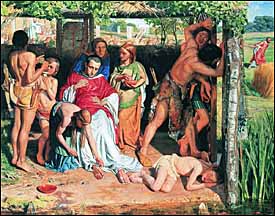
We see this type of brief counsel to people in various roles several times in Scripture. In commentaries, this table of household roles and duties is sometimes referred to as an Haustafel, literally "house table," a term first used by Martin Luther. The New Testament contains three of these:
|
|
Ephesians |
Colossians |
1 Peter |
|
Wives |
5:22-24 |
3:18 |
3:1-6 |
|
Husbands |
5:25-33 |
3:19 |
3:7 |
|
Children |
6:1-4 |
3:20 |
- |
|
Fathers |
6:4 |
3:21 |
- |
|
Slaves |
6:5-8 |
3:22-25 |
2:18-25 |
|
Masters |
6:9 |
4:1 |
- |
Colossians is the most abbreviated of these lists, with the most instruction given to the common situation in the New Testament world of how Christian slaves should behave.
Wives, Submit to Your Husbands (3:18)
Let's look at Paul's first brief instruction:
"Wives, submit to your husbands, as is fitting in the Lord." (3:18)
One of the areas that both Paul and Peter need to remind Christian wives about is to submit to their husbands. This is a complex topic in a Western twenty-first century context. We'll look at the principles here.
"Submit yourselves" (NIV, KJV), "be subject" (NRSV) is hypotassō, "to cause to be in a submissive relationship, to subject, to subordinate," here in the middle voice, "subject oneself, be subjected or subordinated, obey." 1 It is a compound word derived from hypo, "under"+ tassō, "put, place." Hypotassō, "subordinate yourselves," has a subtle difference from "obey" (hypakouō) that we see with regard to children in verse 20. Here, wives are instructed to voluntarily subordinate themselves rather than to be subject to a parent's command. Voluntary submission is an honorable position that shows respect. It does not required a servile attitude, nor does it invite male domination. It does not lessen one's personhood to submit oneself -- we do it in all sorts of relationships in our world. For a much fuller development of this topic see my exposition of Ephesians 5:21-33, where Paul considers the theological underpinnings of the husband-wife relationship.2
Notice in verse 8 three important modifiers:
- "Husbands." The Greek word is the plural of anēr, "adult male, man, husband." 3 "Wives" is the plural of gynē, "adult female, woman, wife." 4 Here, however, the context and the presence of definite articles in verses 19 and 20 require husband and wife (your man / your woman). Paul does not teach that all women must submit to any man or all men, but that a wife should submit to her own husband. Women are not second-class Christians.
- "Fitting/fit" is anēkō, "it is proper, fitting." 5 Appropriate submission to one's husband is proper. However, there are types of submission which are not proper, godly, or healthy. Wives are not required to submit in such ways.
- "In the Lord." The submission is part of a woman's service to God and is to be carried out in that context. This is not male domination of a wife, but a voluntary submission "as is fitting in the Lord."
Husbands, Love Your Wives (3:19)
Now Paul turns to men as husbands -- he speaks to them as fathers in verse 21. Sometimes men only want to read verse 18 about their wife's responsibility, but neglect their own.
"Husbands, love your wives and do not be harsh with them." (3:19)
"Love" is agapaō, "to have a warm regard for and interest in another, cherish, have affection for, love." 6 The problem we often face in families is a husband who demands submission from his wife, but doesn't really love her or have her interests at heart. This doesn't work well. The husband must have an unselfish love for his wife for a Christian marriage to thrive. Grow up, men!
"Be harsh" (NIV), "treat harshly" (NRSV), "be bitter" (KJV) is pikrainō, from which we get our word "picric acid," that is, bitter acid. It means, "to cause bitter feelings, embitter, make bitter," in an affective sense. Passive "become bitter" or "embittered." 7 Sometimes when a wife doesn't behave the way her husband wants, he gets sharp and bitter in the way he treats her. Don't do it, says Paul.
Husbands, we are commanded in both a positive and a negative way. Positive: Do love your wife unselfishly. Negative: Do not speak or act with bitterness toward her.
|
Q1. (Colossians 3:18-19) Why do you
think Paul chose these directions to give to wives and husbands -- considering all the things he could have said? Why is true
submission difficult for wives? Why is unselfish love difficult
for husbands? What prompts harshness in a husband? Is the cause
inner or outer?
|
Children, Obey Your Parents (3:20)
Now Paul speaks to children:
"Children, obey your parents in everything, for this pleases the Lord." (3:20)
The children8 spoken to here are minor children, not adult children. We are to honor our parents always (Exodus 20:12), but we are to obey them "in all things" when we are in their household. At marriage, "a man will leave his father and mother and be united to his wife, and the two will become one flesh" (Matthew 19:5, quoting Genesis 2:24).
"Obey" here (and with regard to slaves in verse 22) is hypakouō, "to follow instructions, obey, follow, be subject to," 9 from hypo-, "under"+ akouō, "hear." Children are literally under their parents' commands. They are to hear and obey.
This is not just a natural duty, says Paul. Children are to obey their parents because it "pleases10 the Lord."
Fathers, Don't Provoke Your Children (3:21)
Paul looks at both sides of each of these relationships -- wife/husband, child/parent/father, slave/master. Here his instruction to fathers is:
"Fathers, do not embitter your children, or they will become discouraged." (3:21)
"Embitter" (NIV), "provoke" (NRSV, KJV), is erethizō, "to cause someone to react in a way that suggests acceptance of a challenge, arouse, provoke," mostly in bad sense, "irritate, embitter." 11 I'm sure that mothers can arouse anger in their children, too -- and to the degree that this is true, Paul's injunction applies to them, as well. However, it seems like it is more often fathers (at least in our culture) that tend to be more distant from their children and sometimes impose harsh, impractical laws upon them.
Be careful, says Paul. The effect can be that they "become/be discouraged" (NIV, KJV) or "lose heart" (NRSV). The verb is athymeō, "to become disheartened to the extent of losing motivation, be discouraged, lose heart, become dispirited." 12 It is one thing to punish misbehavior. But we must not seek to break the spirits of our children, for then hopelessness can set in, causing far more long-lasting effects than simple misbehavior. Be careful, Paul warns.
|
Q2. (Colossians
3:20-21) In what way does obedience prepare a child for everyday
life in the future? For spiritual life in the future? What can
fathers do to keep from discouraging their children?
|
Slaves and Employees
Now Paul speaks to slaves13 and masters. We just don't have slavery in our cultures of the type seen in the Mediterranean world. Sadly, there is illegally slavery where immigrants are exploited for their labor or young girls sold into the sex trade. But that's not the same as slavery in Paul's day, where up to one third of the population might be slaves. Nor can we find a helpful analogy from plantation slavery in the American South from the 1600s to the 1860s. That was cruel, repressive, and racial in nature.
Slavery in Paul's day derived primarily from three sources: prisoners of war captured in the wars of Roman conquest (largely over by the time Colossians was written), children of slaves, and those who became slaves from debt. Slavery was widespread, especially outside of Palestine. Slaves weren't free, but were considered part of the household. They were usually of the same race as their owners, but were often from other ethnic origin.
Since the message of the gospel appealed especially to the poor and oppressed, there were many slaves within Christian congregations.
Though slavery in Paul's day has no modern-day equivalence, I've found that many of Paul's instructions to both slaves and masters are quite applicable to relations between employers or managers and employees. Yes, employees are free to quit, while slaves weren't. And no, employers don't have absolute power over their employees -- except in the workplace, perhaps. But Paul's instructions tend to apply quite well, so I'll pursue those applications as we look at this passage.
Slaves, Obey Your Masters (3:22)
Paul instructed slaves:
"Slaves, obey your earthly masters in everything; and do it, not only when their eye is on you and to win their favor, but with sincerity of heart and reverence for the Lord." (3:22)
"Obey" (hypakouō) means to follow the master's instructions precisely. The obedience is to be total "in everything," specifically, in everything under the master or employer's sphere of authority. But notice that Paul qualifies this sentence. "Earthly masters," they may be, but neither slave owners or employers have ultimate authority. That is reserved exclusively to God on high. He is to be obeyed always when there is a conflict between his commands and a human master's commands.
Paul isn't just speaking of outward obedience of the letter of the command, however. He is touching on attitude.
"... Do it, not only when their eye is on you and to win their favor, but with sincerity of heart and reverence for the Lord." (3:22b)
- "When their eye is on you" (NIV), "while being watched" (NRSV), "eyeservice" (KJV) is ophthalmodoulia, "service that is performed only to make an impression in the owner's presence, eye-service." 14
- "To win their favor" (NIV), "to please them" (NRSV), "menpleasers" (KJV) is anthrōpareskos, "one who tries to make an impression on others, fawner, timeserver," 15 from anthrōpos, "man, human"+ areskō, "to act in a fawning manner, win favor, please, flatter." 16
Don't just "kiss up" to your bosses when they are present, but then slack off when they are away, says Paul. That is hypocrisy. Rather we are to obey our employers with honesty and sincerity.
- "Sincerity" (NIV), "wholeheartedly" (NRSV), "singleness" is haplotēs, literally, "singleness." In the New Testament, it is used especially of personal integrity expressed in word or action, "simplicity, sincerity, uprightness, frankness." 17 Here it is used along with "heart" (kardia), "a sincere heart."
- "With reverence" (NIV), "fearing" (NRSV, KJV) is phobeō, "to fear," here with the sense, "to have a profound measure of respect for, (have) reverence, respect," with special reference to fear of offending.18 The idea here is to show respect for the master's or employer's role.
As Working for the Lord, Not Men (3:23-25)
Now Paul goes deeper into the work ethic that we should have as Christians:
"23 Whatever you do, work at it with all your heart, as working for the Lord, not for men, 24 since you know that you will receive an inheritance from the Lord as a reward. It is the Lord Christ you are serving. 25 Anyone who does wrong will be repaid for his wrong, and there is no favoritism." (3:23-25)
There's a phrase common in some circles: "Good enough for government work." In other words, the job isn't performed with excellence, but good enough for the low standards that the government often has. For some of us, "good enough" represents our whole attitude toward life and work. But Paul suggests that our standard shouldn't be just "acceptable," but "excellence." He says:
"Whatever you do, work at it with all your heart, as working for the Lord, not for men." (3:23)
Look at the phrases:
- "Whatever you do." Our goal should be excellence in any project, whether the boss is watching or not.
- "With all your heart" (NIV), "put yourselves into it" (NRSV), "heartily" (KJV) is made up of two words: the preposition ek, "out of" and psuchē, "soul" as the seat and center of the inner human life in its many and varied aspects. The phrase means, "from the heart, gladly." 19
- "As working20 for the Lord, not for men" (NIV). Wow! This is a radical statement. We are to consider our work as performed for God himself. This has a number of implications.
God Is Our Employer or Master
Look at the passage again:
"23 Whatever you do, work at it with all your heart, as working for the Lord, not for men, 24 since you know that you will receive an inheritance from the Lord as a reward. It is the Lord Christ you are serving. 25 Anyone who does wrong will be repaid for his wrong, and there is no favoritism." (3:23-25)
In what sense should we consider God our employer? Paul brings out three points:
1. Jesus is our Lord of lords. Paul calls him "the Lord Christ," that is, the Messiah who is superior to all. He is Lord (kyrios) over our earthly lords or masters (same word, kyrios) or employers. We serve21 him, answer to him, and put his interests first. In a real sense the work we do for an under-lord, we do as unto Him. He is the one whom we serve with our actions. Our place of employment may be as a household slave or the CEO of a great company, but our Lord is the same.
2. Jesus pays great wages. I know this will upset us evangelicals who have been raised on the concept of grace rather than works (Ephesians 2:8-9), but bear with me. Elsewhere Paul deliberately contrasts wages and grace (Romans 4:4; 6:23). But here Paul is using an analogy that slaves and employees can understand. The word "reward" is antapodosis, "that which is given to someone in exchange for what has been done, repaying, reward." 22
We must realize, however, that in Paul's day, slaves didn't normally earn a wage. They were wholly owned by a master, who provided them room and board, usually within his own household. But he didn't owe them any wages nor did they inherit his property as would his sons.
So when Paul says to slaves that "you will receive an inheritance from the Lord as a reward," he is telling them that Jesus is a better master or Lord. He pays! The wages or recompense he offers will come in the form of our inheritance (klēronomia) of all of God's riches, to be received when Christ comes again. Yes, our inheritance includes salvation, but also the additional rewards and blessings that Christ chooses to bestow upon us.
If you're a slave, the idea of an inheritance is huge. If you're an employee earning a paycheck, this is huge, too. Yes, if you live in the West, you may earn a few million dollars over the course of your lifetime. But that is nothing compared to the inheritance you will receive in glory. Does it pay to serve Christ? You bet it does! And since he pays better than your earthly employer, you owe him your first allegiance. Remember, this is an analogy; don't try to push it too far.
3. Jesus is a just employer. On earth people do things behind the boss's back and get away with it. Bosses often show favoritism to their favorites. Sometimes bosses (and slave-owners) are unfair and cruel to those under them. Not so with Jesus. He is just.
"Anyone who does wrong23 will be repaid for his wrong, and there is no favoritism." (3:25)
How are we to take this warning about justice and favoritism? Is it directed at slaves or at masters? Probably at both, since the sentence occurs at the junction between Paul's directions for slaves and his direction for masters. "Favoritism" (NIV), "partiality" (NRSV), "respect of persons" (KJV) translates a Greek compound word that renders a Hebrew concept, prosōpolēmpsia, from prosōpon, "face"+ lambanō, "to receive, accept," that is, "to take note of the face," to judge by the face or appearance, that is, to pay regard to one's looks or circumstances rather than to his intrinsic character." 24 God doesn't care whether a person is a slave or a master; he will hold each accountable, without treating him or her according to an earthly station in life.
What are the implications of this for employees today? I can think of just a few, though these don't exhaust the subject:
- The quality of our work must be excellent. We aren't to do what we can get away with, but give it our best. Even if our employer demands us to keep up a fast pace, we still give our best within those time constraints. We don't excuse our self for sloppy work. We shouldn't feel "entitled," because we receive a low wage for our labors. With Christ as our employer, we will be abundantly compensated!
- Our work is holy. I've heard people say, "I'm just a layperson"--as if this was less worthy than a full-time Christian vocation. Or, "I'm just the pastor of a small church." Baloney! God will show no favoritism to ordained clergy -- except to expect more from them since they've been given more. Your life, lived out before Christ your King, is holy in and of itself. Christ is your employer, your master -- no matter what kind of work you do (or did) to earn a living. This is no small thing! You are not judged in comparison to others -- that's our human way of judging.
- Our attitude towards God shows in our attitude towards our employer. If you are bitter towards your employer, whom God has put over you for now, how can you give your job your best? Christ requires your attitude at work to be pleasing to him.
I'm sure that as you talk to the Lord about this, he will show you more implications of Jesus being your employer.
|
Q3. (Colossians
3:22-24) If you apply Paul's instructions to slaves to the role
of being an employee, what is the role of sincerity as an
employee? How do we live this out when working under a poor
boss? In what sense are we actually "working for the Lord"? What
would happen in the workplace, if we actually began to live by
these attitudes of heart?
|
Masters, Be Fair to Your Slaves (3:25-4:1)
"3:25 Anyone who does wrong will be repaid for his wrong, and there is no favoritism. 4:1 Masters, provide your slaves with what is right and fair, because you know that you also have a Master in heaven." (3:25-4:1)
As we observed above, verse 25 applies as much to masters and employers as it does to slaves and employees. You may be able to "get away with" some action or attitude here on earth, but not before Christ. Paul reminds human masters25 that "you also have a Master in heaven" (4:1b). As a result of this, masters are held responsible for three things:
1. Providing for them. "Provide" (NIV), "treat" (NRSV), "give" (KJV) is parechō, which, in classical Greek, carries the idea, "hand over, furnish, supply, provide" for someone.26 Masters didn't pay slaves, but they were to give them enough to eat and a place to live. Employers, too, are to provide for their employees. Often, employers think of themselves in terms of buying a person's time, as if it were a commodity, with no strings attached. Don't give them enough hours, so that you have to pay benefits, is a way of life. But hours are not a commodity; they represent people -- people whom God loves and people who pray to him. When we employ people we also take on a responsibility to help provide for their needs. Making a living is not just our employees' problem; as employers it is our responsibility as well. This casts a whole new light on the subject.
2. Providing for them what is just and right. "Right" (NIV), "just/justly" (NRSV, KJV) is dikaios, "obligatory in view of certain requirements of justice, right, fair, equitable." 27 Employers aren't just to pay as little as the market will bear. We will be judged by our Master in terms of what is just and right, not just by market conditions. Is it just, is it right to employ laborers in sweatshop conditions and pay them a pittance? God will hold us employers responsible for what we do.
3. Providing for them what is fair. "Fair/fairly" (NIV, NRSV), "equal" (KJV) is isotēs. The root idea of the word is "equality," as in 2 Corinthians 8:13-14. Here it carries the extended idea of "state of being fair, fairness." 28 Paul wasn't a social reformer pressing for absolute equality of earthly station and condition. But the implications of his teaching is clearly that masters and slaves are equal before God, and masters must not forget it. In Ephesians, Paul reminds us:
"The Lord will reward everyone for whatever good he does, whether he is slave or free." (Ephesians 6:8)
We are equal before God. It is from this foundation in Christianity that the U.S. Declaration of Independence would later declare the radical contention (for its time):
"We hold these truths to be self-evident, that all men are created equal, that they are endowed by their Creator with certain unalienable Rights...."
The Gospel sets people free as its truth and the implications of its truth are worked throughout a culture. When the Declaration of Independence was written in 1776, slaves were not free in the fledgling country. But because of the truth of the Biblical principle of the equality of all before God, Abraham Lincoln issued the Emancipation Proclamation freeing slaves (1863), which would become part of the U.S. Constitution in the Thirteenth Amendment outlawing slavery and involuntary servitude.
Churches, Be Fair to Your Church Employees
You may not be an employer, but in a sense, if you are a member of a church -- and especially if you are a church leader -- then you are responsible for how your pastor and church employees are paid. Do you pay the least you can? Do you take pride in keeping your pastor or church employees poor? Are you fair in your dealings?
God will hold us all responsible for carrying out our roles where he has put us. There is no partiality. He holds us all responsible.
|
Q4. (Colossians 3:25-4:1) What
instructions does Paul give masters -- or employers, in our
culture? What would happen in the workplace if employers sought
to live by this rule?
|
 A book of the compiled lessons is available in both e-book and paperback formats. |
Paul's desire in Colossians 3 is to help Christian believers to begin to shine with the light of Christ -- in their personal characters and in their homes and workplaces. Christ, through Paul, is seeking for us to experience "the peace of Christ" ruling in our hearts and homes.
Prayer
Father, sometimes we try to look good for church people, but at home and at work we hardly act like disciples of Jesus. Forgive us. Work in our hearts and attitudes so that we might reflect your glory in our homes and offices and shops. Grant it, O God. In Jesus' name, we pray. Amen.
Key Verse
Whatever you do, work at it with all your heart, as working for the Lord, not for men, since you know that you will receive an inheritance from the Lord as a reward. It is the Lord Christ you are serving. (Colossians 3:23-24, NIV)
References
1. Hypotassō, BDAG 1042, 1bβ.
2. Ralph F. Wilson, Disciple Lessons from Ephesians (JesusWalk, 2007), chapter 13.
3. Anēr, BDAG 79, 1a.
4. Gynē, BDAG 209, 2.
5. Anēkō, BDAG 79, 2.
6. Agapaō, BDAG 5, 1aα.
7. Pikrainō BDAG 812, 2.
8. Teknon, "an offspring of human parents, child" (BDAG 994, 1a).
9. Hypakouō, BDAG 1028, 1.
10. "Pleases" (NIV), "acceptable duty" (NRSV), "well pleasing" (KJV) is euarestos, "pleasing, acceptable" (BDAG 403).
11. Erethizō, BDAG 391.
12. Athymeō, BDAG 25.
13. "Slaves" (NIV, NRSV), "servants" (KJV) is doulos, pertaining to being under someone's total control, slavish, servile, subject," here "male slave as an entity in a socioeconomic context, slave" (BDAG 260, 1a).
14. Ophthalmodoulia, BDAG 743.
15. Anthrōpareskos, BDAG 80.
16. Areskō, BDAG 129, 1.
17. Haplotēs, BDAG 104, 1.
18. Phobeō, BDAG 1061, 2a.
19. Psuchē, BDAG 1098, 2c.
20. "Work at it" (NIV) is ergazomai, "to engage in activity that involves effort, work, be active" (BDAG 389, 1).
21. "Serve" is douleuō, "to act or conduct oneself as one in total service to another, perform the duties of a slave, serve, obey" (BDAG 259, 2aβ).
22. Antapodosis, BDAG 87.
23. Adikeō, "to act in an unjust manner, do wrong" (BDAG 20, 1).
24. Robertson, Word Pictures, on Romans 2:11 and Acts 10:34.
25. "Masters" is kyrios, "one who is in charge by virtue of possession, owner" (BDAG 572, II1b).
26. Parechō, Liddell-Scott, A; cf. "grant something to someone" (BDAG 776, 3b).
27. Dikaios, BDAG 247, 2.
28. Isotēs, BDAG 483, 2; also Liddell-Scott, III. "fair dealing, impartiality."
Copyright © 2026, Ralph F. Wilson. <pastor joyfulheart.com> All rights reserved. A single copy of this article is free. Do not put this on a website. See legal, copyright, and reprint information.
 To be notified about future articles, stories, and Bible studies, why don't you subscribe to our free newsletter, The Joyful Heart, by placing your e-mail address in the box below. We respect your