


|
Old Testament
New Testament
Gospels
Acts
Paul's Letters
General Letters
Revelation
Topical Studies
Beginning the Journey (for new Christians). en Español

|
Old Testament
New Testament
Gospels
Acts
Paul's Letters
General Letters
Revelation
Topical Studies

|
Home
Bible Studies
Articles
Books
Podcasts
Search
Menu
Donate
About Us
Contact Us
FAQ
Sitemap


Free
E-mail Bible Study
 Experiencing the Psalms
Home | Bible Studies | Articles | Books | Podcasts | Search | Menu | Donate | About Us | FAQ | Contact Us
|
|
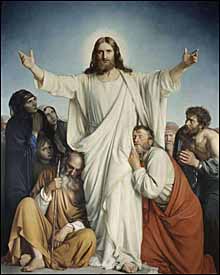
Reconcile All Things to God (1:20a)
"For God was pleased1 ... through him to reconcile to himself all things, whether things on earth or things in heaven" (1:20b)
"Reconcile" is apokatallassō. This compound Greek word in verses 20 and 21 is found only in Christian writings. It is formed from apo-, "finishing and completion"+ katallassō, "the exchange of hostility for a friendly relationship, reconcile"--"to reconcile completely." 2
Whom does God reconcile? "All things, whether things on earth or things in heaven," Paul tells us. It means estranged human beings, certainly. But does it refer also to evil spiritual forces -- the principalities and powers, for example? Perhaps some of them, though Revelation tells us that the ultimate destiny of Satan, the Antichrist, and the false prophet is the lake of fire (Revelation 20:10). In Ephesians, Paul states God's purpose as:
"... To bring all things in heaven and
on earth together under one head, even
Christ." (Ephesians 1:10)
In Philippians we see Christ's final exaltation over all:
"
Therefore God exalted him to the highest place
and gave him the name that is above every name,
that at the name of Jesus every knee should bow,
in heaven and on earth and under the earth,
and every tongue confess that Jesus Christ is Lord,
to the glory of God the Father." (Philippians 2:9-11)
Making Peace through His Blood (1:20b)
"Reconcile ... by making peace through his blood, shed on the cross." (1:20b)
The Greek text lacks the word "shed" added by the NIV to clarify the idea, though I don't think the NIV distorts the meaning. The text reads, "by making peace through the blood of his cross" (Colossians 1:20, NRSV).
How does shed blood bring peace? Paul states it as a fact, as a kind of shorthand for the gospel, but doesn't spell out the rationale for his statement here. However, in a nutshell, here it is:
- Enemies. Because of our sins and self-centeredness we have made ourselves enemies of God (Romans 5:10). We both resist God's will in our hearts (Romans 8:7) and our sins and unholiness separate us from the Holy God (Isaiah 59:2).
- Sacrifice. When Jesus died on the cross and shed his blood, he did so as a sacrifice for our sins (Romans 3:25; 1 Corinthians 5:7).
- Love. This unilateral act of love astounds us and draws us to Jesus (Romans 5:8; 1 John 4:19).
- Faith. When we put our trust in Jesus, repent, and ask forgiveness, we are reconciled to God (Ephesians 2:8-9).
Now we are at a state of peace with God. We are no longer enemy combatants who resist him, but enemies whom he has won over and transformed into his friends by his own mercy and grace.
Alienation Contrasted with Reconciliation (1:21-22)
Now Paul spells out the contrast:
"21 Once you were alienated from God and were enemies in your minds because of your evil behavior. 22 But now he has reconciled you by Christ's physical body through death to present you holy in his sight, without blemish and free from accusation." (1:21-22)
Look at the descriptive words which describe our previous condition:
- "Alienated" (NIV, KJV), "estranged" (NRSV) is apallotrioō, "estrange, alienate", from apo-, "from" (as in "separation, liberation, cessation, departure") + allotrios, "belonging to another, foreign, strange." 3
- "Enemies" (NIV, KJV), "hostile" (NRSV) is the adjective echthros, "pertaining to being hostile, hating," or as a substantive, "enemy." 4
Then contrast these with the amazing words that describe our new condition granted through God's grace alone:
- "Reconciled" which we examined above in verse 20.
- "Holy" is hagios. Here it means, "consecrated to God, holy, pure, reverent." 5
- "Without blemish" (NIV), "blameless" (NRSV), "unblameable" (KJV) is amōmos, initially, "pertaining to being without defect or blemish, unblemished," from a-, "not"+ mōmos, "blemish, blot, disgrace." It is used in the Old and New Testaments of the absence of defects in sacrificial animals. Then, by extension, "pertaining to being without fault and therefore morally blameless." 6 It is difficult to think of ourselves in this way, but this is how God has made us to be in Christ.
- "Free from accusation" (NIV), "irreproachable" (NRSV), "unreproveable" (KJV) is anenklētos, "blameless, irreproachable," 7 from a-, "not"+ enkaleō, "to call in, to call to account, bring a charge against, accuse." The word is also used in 1 Corinthians 1:8 and as qualifications for elders (1 Timothy 3:10) and overseers (Titus 1:6-7).
The key phrase here is "... in his sight." (1:22). In our own sight we are sinners, seemingly unable to live consistently free of sin. But God sees us as united with Christ. Thus we are seen "in him," not on our own.
|
Q1. (Colossians 1:20-22). What does
"reconcile" mean? What was our state before reconciliation?
(verse 21)
|
|
Q2. (Colossians
1:20-22) By what means did Jesus accomplish this
reconciliation? What does "the blood of his cross" have to
do with it? What is the purpose of this reconciliation?
(verse 22) To whom are we "presented?" (verse 22)
|
|
Q3. (Colossians
1:22) How can we be presented "holy," "without blemish," and
"free from accusation" since we are not perfect? How is this
possible?
|
If You Continue (1:23)
Our salvation is not independent of Christ, but is very much "in him." Thus Paul warns us of the necessary condition of our salvation:
"... If you continue in your faith, established and firm, not moved from the hope held out in the gospel." (1:23a)
In the face of the way the doctrine of Eternal Security is sometimes taught, this verse is troubling. Let's examine the words, then look at the implications.
- "Continue" is epimenō, "to continue in an activity or state, continue, persist (in), persevere," 8 from epi-, "continuance, rest, influence upon or over"9 + menō, "remain, stay, persist."
- "Established" (NIV), "securely established" (NRSV), "grounded" (KJV) is themelioō, "to provide a base for some material object or structure, lay a foundation," here used figuratively, "to provide a secure basis for the inner life and its resources, establish, strengthen."10
- "Firm" (NIV), "steadfast" (NRSV), "settled" (KJV) is hedraios, "pertaining to being firmly or solidly in place, firm, steadfast,"11 from hedra, "seat, chair."
- "Not moved" (NIV, KJV), "not shifting" (NRSV) is the negative particle and the word metakineō, "shift, remove,"12 from meta-, "exchange, transfer, transmutation"+ kineō, "to cause to go, set in motion" (from which we get our English word "kinetics").
I'm not trying to exalt Calvinism as the peak of all theological understanding, but to clarify an important point that is sometimes forgotten. John Calvin taught the Perseverance of the Saints, that is, that the true believers do indeed continue in Christ and do not ultimately fall away. In the face of the persecutions of the end time, Jesus himself said, "the one who endures to the end will be saved" (Mark 13:13).
Contrast authentic Calvinism with a modern-day, cheap imitation, crudely known as "once saved, always saved." Some teach that if you've once prayed the sinner's prayer and been baptized, then you're saved, even if you later fall away and don't show any signs of your Christian faith. Dear friends, this isn't biblical teaching, but a distortion of the holy truth. The Apostle Paul teaches clearly in our passage, "But now he has reconciled you ... if you continue in your faith..." (1:22-23a).
The true Christian faith is lived in union with Jesus, by faith in him, walking with him, receiving his encouragement and forgiveness throughout our lives.
"God has given us eternal life, and this life is in his Son. He who has the Son has life; he who does not have the Son of God does not have life." (1 John 5:11-12)
Yes, we sin sometimes, but our heart is set on serving Christ, and his grace and his promises are our security.
Let's put this in context. The "hope" (elpis) has been offered the Colossian believers in the gospel that they originally heard through Epaphras. But now they are being enticed with another hope offered by the false teachers. Paul's aim is to enhance their confidence in Christ so they are no longer tempted by the hope of mystical Judaism. The rather stern warnings against drifting away that we see in the book of Hebrews are in the same context -- to warn Christians that turning back to Judaism was to turn away from Christ (Hebrews 3:12-14; 6:4-8; 10:26-31). Our only hope, dear friends, is found in union with Christ -- and this is the great and firm hope held out to us in the gospel.
The Hope of the Gospel (1:23)
Now Paul segues from salvation through Christ to a word about the gospel:
"... Not moved from the hope held out in the gospel. This is the gospel that you heard and that has been proclaimed to every creature under heaven, and of which I, Paul, have become a servant." (1:23)
"Gospel," of course, is euangelion, "good news." The Greeks used the word for bringing news, especially of a victory or some other joyous event, in person or by letter. A runner, who would bring back news of a remarkable defeat of the enemy, was a bringer of good news. The word is used this way in the Old Testament:
"How beautiful on the mountains
are
the feet of those who bring good news,
who proclaim peace,
who bring good tidings,
who proclaim salvation,
who say to Zion, 'Your God reigns!'" (Isaiah 52:7)
Jesus' message was called, "the gospel of the kingdom" (Matthew 4:23), that is, the good news that the Kingdom of God was at hand, that the Messiah is present to bring salvation. This is indeed good news! God has sent his Son to help us and rescue us!
Now Paul specifies this gospel in three ways:
"This is the gospel that you heard and that has been proclaimed to every creature under heaven, and of which I, Paul, have become a servant." (1:23)
- You heard. You Colossians received this very message of good news when you first became believers. It hasn't changed.
- Proclaimed. The word "proclaimed" (NIV, NRSV), "preached" (KJV) is kēryssō, "to make public declarations, proclaim aloud." 13 Paul and other apostles and preachers have been proclaiming this gospel. It has been preached "to every creature under heaven," Paul says. Does he really mean that every person has heard the gospel? Probably not. Rather that the gospel has been proclaimed widely and openly. As Luke described Paul's ministry in Ephesus: "This went on for two years, so that all the Jews and Greeks who lived in the province of Asia heard the word of the Lord" (Acts 19:10).
- Served. Third, Paul calls himself a
"servant"
(NIV,
NRSV) or "minister" (KJV) of the gospel. The word is diakonos
(from which we get our word "deacon"), "one who serves as an
intermediary in a transaction, agent, intermediary, courier."
14 We are not free to teach any message that seems popular in our day.
We are servants of the gospel, that is, our assigned job is to
proclaim the good news.
|
Q4. (Colossians
1:23) If our salvation depends upon the grace of God, not
us, why is it necessary for us to "continue in your faith,
established and firm, not moved"? What happens if we don't?
What is the nature of the security we have in Jesus
according to this text (and this text only*)?
|
 A book of the compiled lessons is available in both e-book and paperback formats. |
We have examined the wonder of Christ's reconciliation of us, his former enemies. And we have seen the importance of commitment to our union with Christ, who is our hope. We are saved by Christ, and Christ alone. And it is to him that we trust our lives and our futures.
Prayer
Father, thank you for such a wonderful salvation. Thank you for the power of the One who has taken hold of us and rescued us. We don't deserve this, but we glory in it and in our Savior. In Jesus' name, we pray. Amen.
Key Verse
"But now he has reconciled you by Christ's physical body through death to present you holy in his sight, without blemish and free from accusation." (Colossians 1:22, NIV)
References
1. "Pleased" is eudokeō, "to consider something as good and therefore worthy of choice, consent, determine, resolve" (BDAG 404, 1).
2. Apokatallassō, Thayer.
3. Apallotrioō, BDAG 96.
4. Echthros, BDAG 419, 2a or b.
5. Hagios, BDAG 10, 1aβ Aleph.
6. Amōmos, BDAG 56, 2a. See similar statements in Ephesians 1:4; 5:27; 2 Peter 3:14; Philippians 2:15; Jude 24.
7. Anenklētos, BDAG 76.
8. Epimenō, BDAG 375, 2.
9. Epi in composition, Thayer, E1.
10. Themelioō, BDAG 449, 2a.
11. Hedraios, BDAG 276.
12. Metakineō, BDAG 639.
13. Kēryssō, BDAG 543, 2bβ.
14. Diakonos BDAG 230, 1.
Copyright © 2026, Ralph F. Wilson. <pastor joyfulheart.com> All rights reserved. A single copy of this article is free. Do not put this on a website. See legal, copyright, and reprint information.
 To be notified about future articles, stories, and Bible studies, why don't you subscribe to our free newsletter, The Joyful Heart, by placing your e-mail address in the box below. We respect your