


|
Old Testament
New Testament
Gospels
Acts
Paul's Letters
General Letters
Revelation
Topical Studies
Beginning the Journey (for new Christians). en Español

|
Old Testament
New Testament
Gospels
Acts
Paul's Letters
General Letters
Revelation
Topical Studies

|
Home
Bible Studies
Articles
Books
Podcasts
Search
Menu
Donate
About Us
Contact Us
FAQ
Sitemap


Understanding the Flesh, the Sinful Nature, in Romans 7-8
by Dr. Ralph F. Wilson
Free
E-mail Bible Study
 Names and Titles of God
Home | Bible Studies | Articles | Books | Podcasts | Search | Menu | Donate | About Us | FAQ | Contact Us
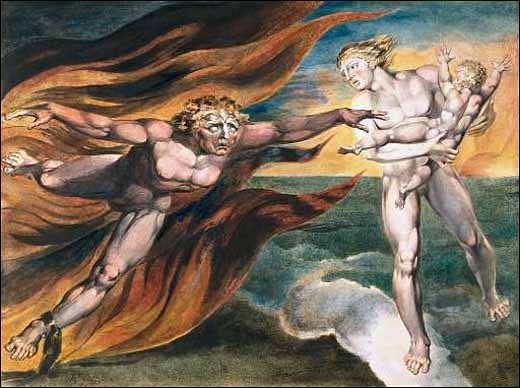
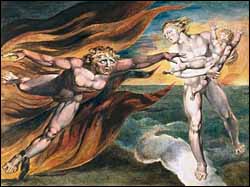 William Blake (1757-1827) often illustrated spiritual struggle. Here is his "Good and Evil Angels Struggling for Possession of a Child" (1795/? circa 1805). The blond figure is the Good Angel; the dark figure clasping at the child is Evil. (Color print finished in ink and watercolor on paper, 445 x 594 mm, Tate Gallery.) Larger image. |
- Physical matter that makes up human bodies.
- The human body itself.
- A human being, the human race.
But perhaps Paul's most characteristic use of sarx is with reference to
- The rebellious human nature, human value systems that stand in opposition to God's value system.125 Here flesh is "the body which is dominated by sin" ... "the unregenerate and sinful state."126 The NIV nearly consistently translates this meaning of flesh as "sinful nature."
The word appears with this fourth definition in Romans 6:19; 7:5, 18, 25, and 13 times in the first 13 verses of Romans 8. It is central to our study.
Paul teaches that the fallen human nature is inherently rebellious against God. We inherited this nature from Adam and, unfortunately, it was not eradicated when we became Christians. It is still within us, but we are no longer forced to follow its dictates. As we will see in Romans 8, we now have the Spirit within us who is strong enough to keep the flesh from getting the upper hand. What kinds of things does the flesh cause us to do?
"The acts of the sinful nature are obvious: sexual immorality, impurity and debauchery; idolatry and witchcraft; hatred, discord, jealousy, fits of rage, selfish ambition, dissensions, factions and envy; drunkenness, orgies, and the like." (Galatians 5:19-21)
The flesh motivates the selfishness we sometimes feel, the whining about our circumstances, the petty jealousies, the jockeying for power in the office and in our marriages, the lure of pornography, the desire for money and possessions, and all the rest. In 7:14-25 we'll explore our struggle with the flesh. In 8:1-17 we'll see how the Spirit can enable us to live free of the flesh.
Waging War against Our Souls (7:23)
As we seek to understand the flesh, it's important to see that this is no benign competition. It is war against our spirits. Consider verse 23:
"I see another law at work in the members of my body, waging war against the law of my mind and making me a prisoner of the law of sin at work within my members." (7:23)
This term "waging war" (NIV, NASB), "warring" (KJV), "at war" (NRSV) is antistrateuomai, "to be at war with,"127 from anti, "over against, hostile opposition" + "strateuō, "to engage in a conflict, wage battle, fight."128 In chapter 8 we read, "The mind that is set on the flesh is hostile to God" (8:7, NRSV). This concurs with several other New Testament references that characterize the Christian life as conflict:
"[The flesh and the Spirit] are in conflict129with each other." (Galatians 5:17)
"What causes fights and quarrels among you? Don't they come from your desires130 that battle (strateuō) within you?" (James 4:1)
"Dear friends, I urge you, as aliens and strangers in the world, to abstain from sinful desires,131 which war (strateuō) against your soul." (1 Peter 2:11)
Note: The scope of spiritual warfare is the world, the flesh, and the devil. These verses refer primarily to the war with the flesh, though these realms do interact with each other.
If we pamper the flesh and give into its desires, we are merely feeding a monster that will grow that much stronger. The flesh is the enemy of our soul and wages war against it. The answer to the flesh, of course, is the power of the Spirit, which we'll explore fully in Romans 8.
Note: The scope of spiritual warfare is the world, the flesh, and the devil. These verses refer primarily to the war with the flesh, though these realms do interact with each other.
The Corrupt Heart of Man -- Total Depravity
Jeremiah put it this way:
"The heart is deceitful above all things and beyond cure. Who can understand it?" (Jeremiah 17:9)
Man in his present fallen state is not basically good, the Scripture teaches. He is deceitful and conniving. Yes, there is good in him -- the remnant of God's image in which he was formed. But the good is corrupted. No part of man is any longer perfectly good. All is a mixture of good and evil. And certainly man's "flesh" is corrupt: "I know that nothing good lives in me, that is, in my sinful nature (flesh, sarx)" (7:18).
All is somewhat corrupt and therefore, even the "good" in us cannot be trusted. Jesus recognized this when he taught on the heart or core of man:
"The things that come out of the mouth come from the heart, and these make a man 'unclean.' For out of the heart come evil thoughts, murder, adultery, sexual immorality, theft, false testimony, slander. These are what make a man 'unclean.'" (Matthew 15:18-20a)
 The study is available as an e-book or printed book |
Of course, this is just what Paul is teaching about the flesh. Theologians
have framed this as the Doctrine of Total Depravity. Not that man has absolutely
no good in him. But that in every aspect man is flawed. Even the good that a
person may intend may come from mixed motives, etc.
If we pamper the flesh and give into its desires, we are merely feeding a monster that will grow that much stronger. The flesh is the enemy of our soul and wages war against it. The answer to the flesh, of course, is the power of the Spirit, which we explore fully in Romans 8:1-17.
References
Copyright © 2026, Ralph F. Wilson. <pastor joyfulheart.com> All rights reserved. A single copy of this article is free. Do not put this on a website. See legal, copyright, and reprint information.