


|
Old Testament
New Testament
Gospels
Acts
Paul's Letters
General Letters
Revelation
Topical Studies
Beginning the Journey (for new Christians). en Español

|
Old Testament
New Testament
Gospels
Acts
Paul's Letters
General Letters
Revelation
Topical Studies

|
Home
Bible Studies
Articles
Books
Podcasts
Search
Menu
Donate
About Us
Contact Us
FAQ
Sitemap


5. I Thirst (John 19:28)
by Dr. Ralph F. Wilson
Audio (12:08)
Free
E-mail Bible Study
 Experiencing the Psalms
Home | Bible Studies | Articles | Books | Podcasts | Search | Menu | Donate | About Us | FAQ | Contact Us
|
|
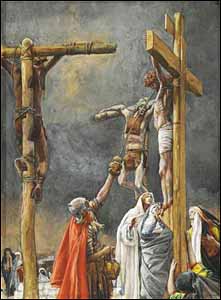
It is near the end of Jesus' human life. He senses it. He has hung on the cross for six hours now.
It has become hard for Jesus to even get a breath. Hung from his arms, he must pull himself up each time he wants to breathe. His shoulders ache, his mouth is parched. He is exhausted.
And yet he does not want to die without a final word. He asks for something to drink to wet his lips for this final effort.
"28 Later, knowing that all was now completed, and so that the Scripture would be fulfilled, Jesus said, "I am thirsty." 29 A jar of wine vinegar was there, so they soaked a sponge in it, put the sponge on a stalk of the hyssop plant, and lifted it to Jesus' lips." (John 19:28-29)
The Fulfillment of Scripture
"Knowing that all was now completed, and so that the Scripture would be fulfilled...." (John 19:28a)
What Scripture was fulfilled here? A Psalm of lamentation, written by David, seems to have been fulfilled literally in Jesus:
"They put gall45
in my food
and gave me vinegar46
for my thirst." (Psalm 69:21)
Apparently Jesus asked for something to quench his thirst in order to fulfill Psalm 69:21.
The First Offering of Wine
This was not the first time Jesus had been offered wine. Both Mark and Matthew observe that he was offered bitter wine just prior to being crucified (Matthew 27:34; Mark 15:23). Perhaps this was intended as an intoxicant for those about to suffer pain. A group of Jerusalem women, as an act of piety, provided for a condemned man a vessel of wine containing a grain of frankincense to numb him.47 Jesus refuses to drink this. He has committed himself to the Father to offer himself as a sacrifice. To attempt to lessen the pain of this sacrifice would have somehow been going back on this commitment.
The Second Offering of Wine Vinegar (Posca)
The offering of something to quench his thirst after hanging on the cross for some time is a separate incident.
"A jar of wine vinegar was there, so they soaked a sponge in it, put the sponge on a stalk of the hyssop plant, and lifted it to Jesus' lips." (John 19:29)
Wine vinegar (oxos) didn't have any alcohol left, but was sour wine that had turned to vinegar. Wine is made from grape juice. Yeast fermentation causes sugar to be transformed into alcohol, which continues until the alcohol content reaches about 11% to 12%. Wine vinegar, on the other hand, is made by the action of acetic acid bacteria on alcohol to produce acetic acid. Since the bacteria that cause this reaction are aerobic, they require that the wine be exposed to oxygen in order to form vinegar.
What is a container of wine vinegar doing on Golgotha that day? It is posca, a drink popular with soldiers of the Roman army, made by diluting sour wine vinegar with water. It was inexpensive, considered more thirst quenching than water alone, prevented scurvy, killed harmful bacteria in the water, and the vinegary taste made bad smelling water more palatable. All over the empire, posca was the soldier's drink of choice. The soldiers had brought posca to sustain them during their crucifixion duty. They weren't getting drunk on it, just using it to quench their own thirst.
The Sponge
While a condemned criminal might be able to drink wine prior to being crucified, drinking from a cup while hanging on the cross wasn't practical. So when Jesus indicated his thirst, the soldiers used a sponge to give him posca to slake his thirst.
What was a sponge (Greek sponges) doing on Golgotha that day? It seems scarcely the thing you'd expect to find. Again, sponges were part of a Roman soldier's kit. Sponges were found along the Mediterranean coast, were widely used in ancient times to line and pad a soldier's helmet. Soldiers also used sponges as drinking vessels.48
No doubt one of the soldiers offered Jesus a drink of posca from his own supply, using his own sponge. A soldier wasn't required to share his drink with the criminals under his care. But he had seen that Jesus was dying unlike any other criminal he had ever seen. No cursing, no blaming, no anger.
A Man Like No Other
What was it like to watch Jesus' slow death? Perhaps it had impressed the soldier with something like St. Peter's words:
"'He committed no sin, and no deceit was found in
his mouth.'
When they hurled their insults at him, he did not retaliate;
when he suffered, he made no threats.
Instead, he entrusted himself to him who judges justly." (1 Peter 2:22-23)
St. Peter concludes this passage with something, however, that the soldier did not yet know, echoing the words of the Suffering Servant passage of Isaiah 53:
"He himself bore our sins in his body on the tree, so that we might die to sins and live for righteousness; by his wounds you have been healed." (1 Peter 2:24)
The posca offered by a soldier on his sponge that day was an act of mercy to the One who was bringing God's mercy to all humankind.
The Hyssop
"They ... put the sponge on a stalk of the hyssop plant, and lifted it to Jesus' lips." (John 19:29)
John makes a point of specifying the hyssop plant, a small bush with blue flowers and highly aromatic leaves,49 whereas the Synoptic Gospels refer to it as "stick" (NIV, NRSV) or "reed" (KJV, RSV).50 What is the significance of hyssop? Hyssop was used to sprinkle blood on the doorposts and lintels on the first Passover (Exodus 12:22). It was associated with purification and sacrifices in the tabernacle (Leviticus 14:4, 6; Numbers 19:6, 18). No doubt John had this in mind when he wrote his Gospel.
Receiving the Posca
John tells us that Jesus actually drank some of the vinegary posca from the sponge.51
"When he had received the drink, Jesus said, 'It is finished.' With that, he bowed his head and gave up his spirit." (John 19:30)
For a few seconds, at least, Jesus sucked the posca from the sponge. He didn't drink long enough to slake what must have been moderate to severe dehydration from loss of blood, exposure to the elements, and the necessity of gasping for breath through his mouth.
The end was near. So he drank only enough to moisten his parched throat so that his last words of triumph might be heard across the hilltop of Golgotha.
What Does This Word Tell Us?
What does the Fifth Word say to us? I see three things that this Word reminds us of:
1. Jesus' Physical Humanity
First and probably of greatest importance, Jesus' word "I thirst," reminds us of Jesus' physical nature, his humanity.
This was no play-acting on the cross -- a divine being pretending to undergo a physical act of torture that could not touch him. This was tangible physical suffering, of which extreme thirst is the one element most of us can readily identify with from our own personal experience.
There was a heresy afoot in the Hellenistic world that Jesus didn't really come in flesh and blood, much less die a gruesome physical death on the cross. Flesh was of the evil realm, they believed, and could never be holy. Only spirit was capable of the divine. So Jesus didn't really die, he only appeared to. He was only pretending. Thus said Docetism and Gnosticism.
The Apostle John was combating an early form of this heresy in his letters:
"... Every spirit that confesses that Jesus Christ has come in the flesh is from God, and every spirit that does not confess Jesus is not from God. And this is the spirit of the antichrist...." (1 John 4:2-3)
"Many deceivers, who do not acknowledge Jesus Christ as coming in the flesh, have gone out into the world. Any such person is the deceiver and the antichrist." (2 John 7)
Jesus Fifth Word, "I thirst," reminds us that Jesus died in the flesh for us and for our sins.
2. Jesus' Awareness of Scripture
Second, "I thirst" reminds us of Jesus' extensive knowledge of the prophetic scriptures concerning his suffering and death -- and his willingness to fulfill each of them to the letter. The best known passage, of course, is the Servant Song from Isaiah 53:
"He poured out his life unto death,
and was numbered with the transgressors.
For he bore the sin of many,
and made intercession for the transgressors." (Isaiah 53:12)
He knew it well and referred to it again and again.52 Jesus' action to ask for a drink is deliberately prompted by his knowledge of Scripture and determination to fulfill it:
"... So that the Scripture would be fulfilled, Jesus said, 'I am thirsty.'" (John 19:28)

3. Jesus' Determination to Complete His Task
Third, Jesus said, "I thirst" to strengthen himself and ease his throat so that he might cry out his final words from the cross "with a loud voice." He was summoning himself to bring it all to completion.
Prayer
Father, extreme thirst, being parched, is something I can relate to. But adding to the physical torment and exhaustion was the crushing spiritual aloneness. That is beyond my experience. Thank you for your love that conquered all to save us. In Jesus' name, I pray. Amen.
Question for Personal Meditation
Q5. (John 19:28) What do you learn from
Jesus' Fifth Word: "I thirst"? What does this tell us about Jesus? What does
this tell us about his experience on the cross?
|
Questions for Group Discussion
- What are the reasons that Jesus would have been thirsty? Physiologically what would have been going on in a person suffering as Jesus did?
- What Scriptures are fulfilled by John 19:28-30 or may refer to this aspect of the crucifixion? Why was fulfilling Scripture important to Jesus?
- What is the significance of the sponge being offered to Jesus on a branch of hyssop? (John 19:29)
- Why do you think the New Testament makes such a strong point about Jesus' physical suffering? What difference would it make if Jesus were a divine person who didn't actually suffer on the cross? What difference would it make if Jesus were only a human being martyred on the cross?
References
45. "Gall" (Hebrew rōʾsh, Greek Septuagint cholē) probably refers to a Babylonian plant name which originally meant "head" of some kind of plant. It comes to mean "poison" and "poisonous" and occurs twelve times in the OT. In Psalm 69:21 it is used figuratively as "bitter herbs" (TWOT #2098).
46. Vinegar (Hebrew ḥōmeṣ) comes from ḥāmēṣ, "be sour, be leavened" (TWOT #679b).
47. "Again, what of Rabbi Hiyya ben Ashi's dictum in Rabbi Hisda's name: When one is led out to execution, he is given a goblet of wine containing a grain of frankincense, in order to benumb his senses, for it is written, Give strong drink unto him that is ready to perish, and wine unto the bitter in soul. And it has also been taught; The noble women in Jerusalem used to donate and bring it. If these did not donate it, who provided it? As for that, it is certainly logical that it should be provided out of the public [funds]: Since it is written. 'Give', [the implication is] of what is theirs" (Babylonian Talmud, Sanhedrin 43a). Mark mentions "wine mingled with myrrh" (Mark 15:23). First century army physician Dioscorides Pedanius observed the narcotic properties of myrrh (Materia Medica 1.64.3).
48. Thomas F. Johnson, "Sponge," ISBE 4:605. Sponges were also carried by Roman soldiers to use the way we use toilet paper.
49. Hyssōpos, BDAG 104.
50. Kalamos, "1. reed, 2. stalk, staff" (BDAG 502; Matthew 27:48; Mark 15:36). This sometimes causes confusion, our dramatic depictions of the cross usually picture Jesus elevated far above the onlookers. However, most likely his cross was much shorter. All that was necessary was to have the feet elevated high enough so they didn't touch the ground. We have some reports of the feet of crucified criminals being ravaged by dogs. A common guess is that Jesus' cross stood some 7 feet high (Brown, Death, pp. 948-949).
51. "Received" (lambanō) carries the idea "to take into one's possession, take, acquire" (BDAG 583, 3).
52. See my "Quotations, References and Allusions in the New Testament to Isaiah 53 and other Servant Songs," as part of the Behold, the Lamb of God Bible Study. https://www.jesuswalk.com/lamb/isaiah53_nt_allusions.htm
Copyright © 2026, Ralph F. Wilson. <pastor joyfulheart.com> All rights reserved. A single copy of this article is free. Do not put this on a website. See legal, copyright, and reprint information.