|
Old Testament
New Testament
Gospels
Acts
Paul's Letters
General Letters
Revelation
Topical Studies
Beginning the Journey (for new Christians). en Español

|
Old Testament
New Testament
Gospels
Acts
Paul's Letters
General Letters
Revelation
Topical Studies

|
Home
Bible Studies
Articles
Books
Podcasts
Search
Menu
Donate
About Us
Contact Us
FAQ
Sitemap


Free
E-mail Bible Study
 Names and Titles of God
Home | Bible Studies | Articles | Books | Podcasts | Search | Menu | Donate | About Us | FAQ | Contact Us
 St. Peter, from a mosaic icon in naves of the Patriarchal Basilica of St. Paul: Outside the Wall, The Vatican. |
The beginning of 1 Peter is a gourmet table featuring the greatness of Jesus' salvation. Peter seems to savor every aspect of salvation as he spells it out in the first 12 verses.
We see....
- A Trinitarian salvation accomplished by the Father, Son, and Holy Spirit,
- A future salvation that we will experience when Christ returns,
- An inexpressible and glorious joy we can have in salvation, even though we go through struggles, and
- A promise of salvation into which prophets and angels long to look.
Study the first twelve verses of Peter's letter with me. Taste with me and see that the Lord is very good!
Salutation (1:1)
"Peter, an apostle of Jesus Christ, to God's elect, strangers in the world, scattered throughout Pontus, Galatia, Cappadocia, Asia and Bithynia." (1:1)
The letter begins with a salutation -- but one that must have thrilled the recipients. A salutation usually has three parts:
- Identifies the sender -- here, "Peter, an apostle of Jesus Christ."
- Identifies the recipients.
- Offers a blessing or greeting to them -- in this case: "Grace and peace be yours in abundance."
But what's really intriguing and powerful is how the recipients are described. Let's see what we can learn from a couple of these descriptive words:
Elect. Our word "elect" is a transliteration of the Greek noun eklektos, "pertaining to being selected, chosen."[4] Peter is emphasizing the fact that God chose and selected us. Present-day evangelists call us to "make a decision" to follow Christ -- and this is important. But sometimes this clouds for us the realization that the only way we can come to Christ is if he chooses us, calls us, softens our hearts, brings his Holy Spirit to bear on us so we are able to repent.[5]
Exiles. "Strangers" (NIV, KJV) or "exiles" (NRSV) is the Greek adjective parepidēmos, "pertaining to staying for a while in a strange or foreign place, sojourning, residing temporarily." In the New Testament, it is used of Christians as a noun, "stranger, sojourner, resident alien" (also 1 Peter 2:11; Hebrews 13:13). Some closely related Greek words are used to describe "civil servants who distinguish themselves for exemplary conduct while on international duty"[6] "Scattered" (NIV, KJV) or "the Dispersion" (NRSV; Greek diaspora) is used figuratively of Christians who live in dispersion in the world, far from their heavenly home (also at James 1:1).[7]
Peter is warning us not to get too settled here. We are first citizens of the Kingdom of God, not of the corrupt world system. This reminds me of an old Gospel song:
"This world is not my home,
I'm just a-passing through...."[8]
We are to be engaged in this world -- Jesus certainly was -- but we must remember that our allegiance is elsewhere. We're resident aliens for now.
Instructions: Now answer the question below. Click on the URL given after the question to post your answers on the Joyful Heart Bible Study Forum. You can also read others' answers there. If you haven't registered at the Forum already, you'll need to do that before you can post your answer. Subscribing to this Bible study is separate from registering at the Forum. Here are instructions for using the Forum.
Q1. (1:1) How would you describe the behavior of a
Christian who identifies more with his present homeland than his heavenly one?
Have you ever caught yourself doing this? What has to happen to get our
spiritual priorities straight?
https://www.joyfulheart.com/forums/topic/146-q1-citizens-of-another-homeland/
 Asia Minor in the First Century. Larger map. |
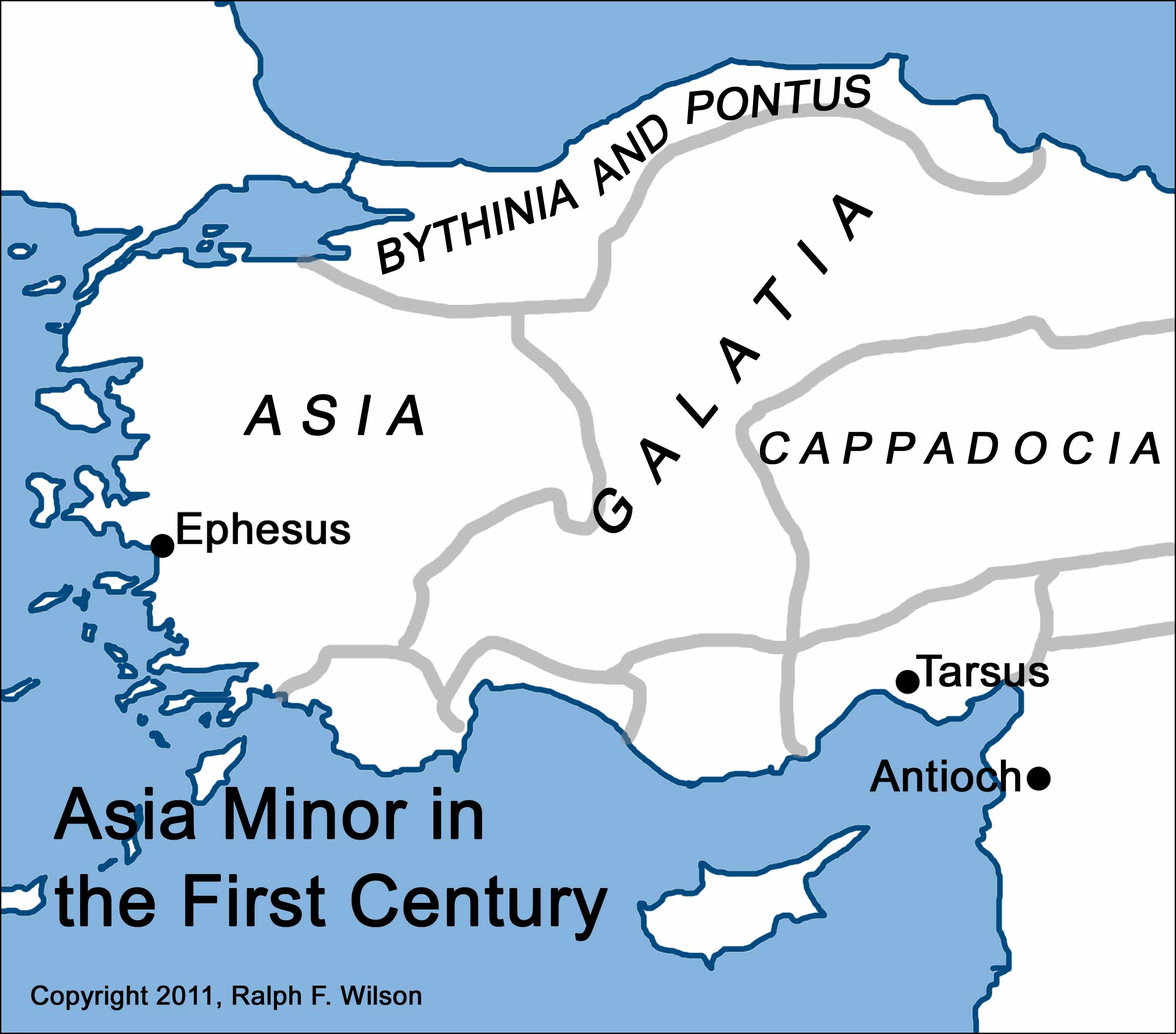
"Pontus, Galatia, Cappadocia, Asia and Bithynia" refer to various regions in Asia Minor, modern-day Turkey, perhaps the north two-thirds are referred to. This is an area that Paul had evangelized in several of his missionary journeys.
Trinitarian Salvation (1:2)
Peter's salutation continues:
"... Who have been chosen according to the
foreknowledge of God the Father, through the sanctifying work of the Spirit, for
obedience to Jesus Christ and sprinkling by his blood:
Grace and peace be yours in abundance." (1:2)
Nowhere does the New Testament use the word "Trinity," but the concept of the triune God is certainly present. In fact, I don't think you can really understand the New Testament without some concept of the three-fold nature of God. Other verses that clearly assume the Trinity include Matthew 28:19 and 2 Corinthians 2:13.[9]
I don't want to debate the Trinity here, however. Let's examine this passage by looking at a few of the words used here.
"Foreknowledge" (NIV, KJV) or "destined" (NRSV) is the Greek noun prognōsis, "foreknowledge, predetermination."[10] This Greek word is transliterated in English. In some places it refers to a forecast of the probable course of a disease. We already discussed the word "chosen" or "elect" above. Put together (as the NIV does), the phrase "chosen according to the foreknowledge of God" is pregnant with possibilities and fuels an endless debate about the nature of predestination. I've concluded that we humans don't know enough to really understand predestination, much less to argue about it with any real meaning. For me it's enough to affirm that God does the choosing -- that's his part -- and I must do the responding -- that's my part. And ultimately my salvation is all because of his grace, no credit to me (Ephesians 2:8-10).
"Sanctifying" is the Greek noun hagiasmos, "personal dedication to the interests of the deity, holiness, consecration, sanctification." The lexicographer says, "The use in a moral sense for a process or, more often, its result (the state of being made holy) is peculiar to (the New Testament)."[11] We'll talk more about holiness and sanctification in later lessons, since holiness is one of the major themes of 1 Peter.
Notice that the Father's and the Spirit's ministries have a two-fold purpose:
- Obedience. Our destiny is to obey Jesus, pure and simple.
- Sprinkling by his blood, that is, forgiveness and cleansing.
"Obedience" is the Greek noun, hupakoē, "a state of being in compliance, obedience (one listens and follows instructions)."[12] Listening and following instructions is our purpose and destiny in Jesus Christ. Sadly, many people sign on to Christianity to get forgiveness, but not for obedience. They come only as a package. One who says that he believes in Jesus, but refuses to listen and follow him, is kidding himself. He thinks he has acquired fire insurance, but he doesn't have true faith. As Jesus -- and his brother, the disciple James -- tell us, "By their fruits you shall know them" (Matthew 7:20) and "Faith by itself, if it is not accompanied by action is dead" (James 2:17).
"Sprinkling by his blood" refers to Jewish temple worship that involved animal sacrifice and sprinkling the blood upon people or objects that were to be set apart for the service of God. This concept appears in the Pentateuch especially, dozens of times[13] and in the Book of Hebrews.[14] In the Old Testament, the priest imparted holiness. In the New Testament, Jesus acts as our High Priest, who, by his own sacrifice and blood, atones for our sin and offers pardon and forgiveness for our sins.
For each member of the Trinity in his verse, take your own notes on each member's function regarding salvation:
- Father. Choosing and destining.
- Holy Spirit. Sanctifying.
- Son. Sprinkling.
Now try to answer the second question:
Q2. (1:2) Why do forgiveness (sprinkling) and obedience
come together as a package? Why is it deceptive to think you can have one
without the other? Extra credit: If true faith requires obedience, how can we
say that we are saved by grace rather than works? (Ephesians 2:8-10)
https://www.joyfulheart.com/forums/topic/147-q2-forgiveness-and-obedience-together/
Cause for Rejoicing (1:3-5)
"Praise be to the God and Father of our Lord Jesus Christ! In his great mercy he has given us new birth into a living hope through the resurrection of Jesus Christ from the dead, and into an inheritance that can never perish, spoil or fade -- kept in heaven for you, who through faith are shielded by God's power until the coming of the salvation that is ready to be revealed in the last time." (1:3-5)
In verses 3-5, Peter enumerates a number of things which should give us joy as Christians. Notice that as Peter lists them, they run together -- they can't be analyzed in complete isolation from each other. I'll identify each with a word, but you fill in why this should give you joy.
- Great mercy
- New birth
- Living hope
- Resurrection from the dead
- Imperishable inheritance
- Protection by God's power
- Salvation revealed when Christ returns
Great mercy is a theme all of us can identify with. Someone once said, "Grace is getting what we don't deserve. Mercy is not getting what we do deserve." When I think of how much we fall short -- even the best of Christians -- I realize how much mercy God has towards us. We have impure thoughts and motives -- God shows mercy. We say and do unkind things -- God shows mercy. We sometimes commit terrible sins -- God shows mercy. He withholds the righteous judgment that we deserve. That, my friends, is great mercy.
The new birth is a theme in 1 Peter. It occurs here, in 1:23, and in 2:2. The Greek verb used in 1:3 and 1:23 is anagennaō, "beget again, cause to be born again, figuratively of the spiritual rebirth of Christians."[15] When used of a female parent it would be translated "bear again." When used of male, means, "begotten again." Notice that 1:23 associates this begetting with "seed" (spora).
A living hope reminds us that we have an expectation for the future, based not on the great deeds of a fallen martyr, but in a living and risen Savior.[16]
Resurrection from the dead is not just an historical event, but an astounding, paradigm-shattering miracle that both (1) identifies Jesus as Victor over death, whose words can be believed and relied upon, and (2) inspires in us a hope for life beyond mortal life. We look forward to our resurrection, too.
An imperishable inheritance is in sharp contrast with "things." As a teenager I remember visiting the Cliff House in San Francisco, a museum of the era before the great San Francisco earthquake of 1906. All the glitter looked dusty and tarnished. The clothing was faded and moth-eaten. The brass was dull with tinges of green. Our possessions here on earth are like that. They look new and bright in the store, but after a few years they are a bit worn, the kind of things you might find at a thrift store. Even precious metals, land, and investments can drop precipitously in value. It may seem secure, but it is not -- not really. The only secure investment is the one Christ has made on our behalf in heaven -- "an inheritance that can never perish, spoil or fade."
Shielded through Faith (1:5)
Not only our heavenly investment is secure, so are we.
"... Who through faith are shielded by God's power until the coming of the salvation that is ready to be revealed in the last time." (1:5)
There's controversy in some circles about the security of the believer. I don't want to get into the controversy, except to have you consider the teaching of this tiny verse.
God does the shielding of the believer. The word "shielded" (NIV), "kept" (KJV), or "protected" (NRSV) is the Greek verb phroureō, a military term: "to maintain a watch, guard," here "to provide security, guard, protect, keep."[17] This guarding will continue until Christ returns -- and personally consummates our salvation (Hebrews 9:28; Romans 8:23; 1 Corinthians 15:54).[18]
But the phrase "through faith" indicates that our faith has a part in activating this protection and salvation. Certainly God's strong guard around us is not dependent upon our sometimes weak and vacillating faith, but our faith still has a role. Jesus told his disciples that even if they had faith the size of a mustard seed, it could move mountains (Matthew 17:20). Perhaps you underestimate the power of your faith![19]
I am aware that some doctrinal systems can't hold these truths simultaneously of God's part and our part in salvation -- they must accentuate the one and downgrade the other -- but the scripture doesn't seem to see them as mutually exclusive.
Q3. (1:5) According to 1 Peter 1:5, what is God's part in
securing your salvation? What is your part?
https://www.joyfulheart.com/forums/topic/148-q3-secure-by-faith-through-gods-protection/
Tenses of Salvation (1:5)
"... Who through faith are shielded by God's power until the coming of the salvation that is ready to be revealed in the last time." (1:5)
It may be confusing to talk about salvation in the future. We normally think about it in the past, when we have been rescued from our sins by God. Actually our salvation can be looked at in several tenses:
Past -- both Jesus' death on the cross for our sins, but also how he rescued us from our old way of life at our spiritual birth, spiritual awakening, or whatever you want to call it. In our church we sometimes sing Geoff Bullock's song, "I Will Never Be":
"I will never be the same again.
I can never return, I've closed the door.
I will walk the path, I'll run the race,
And I will never be the same again."[20]
No way do we want to go back to the life we had before.
Present -- a present activity of God on our behalf to help us in our present circumstances and rescue us from problems and persistent sins. Paul expressed it this way:
"Continue to work out your salvation with fear and trembling, for it is God who works in you to will and to act according to his good purpose." (Philippians 2:12-13)
Future -- when we receive all the benefits of our salvation. There will be a time when Christ returns that we will be completely rescued from our worldly existence and be fully immersed in his presence. In Revelation it is expressed,
"He will wipe every tear from their eyes.
There will be no more death or mourning or crying or pain,
for the old order of things has passed away" (Revelation 21:4)
This is the final salvation that Isaiah foresaw when he wrote:
"The ransomed of the Lord will return.
They will enter Zion with singing;
everlasting joy will crown their heads.
Gladness and joy will overtake them,
and sorrow and sighing will flee away" (Isaiah 51:11)
Rejoicing in Spite of Suffering (1:6-7)
Verse 6 contains two seemingly contradictory concepts -- rejoicing and suffering grief:
"In this you greatly rejoice, though now for a little while you may have had to suffer grief in all kinds of trials. These have come so that your faith -- of greater worth than gold, which perishes even though refined by fire -- may be proved genuine and may result in praise, glory and honor when Jesus Christ is revealed." (1:6-7)
We rejoice in God's blessings, but at the same time we "suffer grief in all kinds of trials." The joy of our life in Christ is tempered by "grief" (NIV) or "heaviness" (KJV) by the various troubles of this life -- both the normal problems of life that all people face, as well as the persecutions we may face as Christians. The Greek verb is lypeō, which in the passive voice means "be sad, be distressed, grieve."[21] It refers to the emotion of grief, not to the suffering that produces grief.[22]
"Trials" (NIV, NRSV) or "temptations" (KJV) is the Greek noun peirasmos, and can refer to either (1) a test or trial, or (2) a temptation or enticement to sin.[23] Here it is probably used in the general sense of test or trial. Of course, God doesn't tempt us with evil (James 1:12-14). But he does allow circumstances that stretch our faith and force us to grow.
If we had our choice, we'd be on cruise control. But there's no growth in cruise control. Our faith grows when we encounter circumstances that push us out of our comfort zone and force us to rely on God. As we are pushed up against Jesus, he makes an "impression" on us, and his image in us is reinforced (Romans 8:29). These trials or tests of our faith are God's way of forming Christ in us. Without them we would remain spiritual babies; with them we grow into the full stature of Christ (Ephesians 4:13). So we can endure these trials and the griefs they bring, because we look beyond them in hope to God's purpose for us.
Peter compares this spiritual growth to the smelting process by which metals are purified. In ancient days, silver or gold ore was melted in a crucible. The weight of gold and silver atoms causes them to settle to the bottom, while other molten elements (the dross) separate from the heavy metal and rise to the surface where they are skimmed off. This heating and skimming process is repeated many times until the gold or silver is pure. Only then is it be allowed to cool fully and is then formed into ingots or jewelry of great value. Unrefined ore has value only in its potential; but refined precious metals are ready to use.
"These [trials] have come so that your faith -- of greater worth than gold, which perishes even though refined by fire -- may be proved genuine and may result in praise, glory and honor when Jesus Christ is revealed" (1:7).
Ultimately, not even gold will endure (2 Peter 3:12) -- only genuine, tested, purified faith. The Greek word used here is dokimazō, "to make a critical examination of something to determine genuineness, put to the test, examine."[24] And that tested and approved faith will bring great glory and honor to Jesus when he returns.
Q4. (1:6-7) Can you remember any instances in which God
used difficult circumstances to refine and purify your faith? What did God
accomplish in your life? How, exactly, does genuine, tested faith bring glory to
Jesus?
https://www.joyfulheart.com/forums/topic/149-q4-circumstances-which-refine-our-faith/
Unspeakable Joy Inspired by Faith (1:8-9)
Peter the Fisherman and the believers he preached to had found a joy beyond themselves, a joy that they experienced even when everything wasn't going well, even when persecution was intense (see Matthew 5:10-12):
"Though you have not seen him, you love him; and even though you do not see him now, you believe in him and are filled with an inexpressible and glorious joy, for you are receiving the goal of your faith, the salvation of your souls" (1:8-9).
Peter is marveling at the joy inspired in the hearts of believers. He had seen Jesus in the flesh, most of the Christians he encounters at this point in his life had not -- yet they love him. And they do not see him now -- in the flesh. But with eyes of faith they -- and we -- see him, and we are filled with "joy unspeakable and full of glory," as the KJV powerfully renders this phrase.
Let's examine how this joy is characterized by Peter. "Inexpressible" (NIV), "unspeakable" (KJV), or "indescribable" (NRSV) is the Greek adjective aneklalētos, a word which occurs only here in the New Testament, and "describes a joy so profound as to be beyond the power of words to express."[25] Peter also refers to this joy as "full of glory" (KJV) or "glorious" (NIV, NRSV). This Greek word is doxazō, the verbal form of the noun doxa, used throughout the Bible to describe the weightiness of God, the bright shining radiance of God's very presence. The joy we Christians have can reflect that Shekinah glory of God.
Have you ever experienced this kind of amazing joy? This isn't emotionalism -- something artificially worked up by oneself or by a skillful manipulator of people -- but an emotion, a joy prompted by a faith-vision of God himself.
Last Sunday, the Spirit was powerfully at work in our church during the singing. Our worship leader had sought God for what songs to sing, and now the congregation seemed caught up in worship. The words focused our minds and hearts on Jesus and what he has done for us. And the Spirit of God began to rise within us, filling us with faith and a fresh vision of God. I gradually found myself smiling with joy and lifting my hands in worship.
Not that I had a physical vision of Jesus, but by faith and by the Spirit, my spirit was connected afresh with power. I experienced that "inexpressible and glorious joy" on Sunday. Not that I always do. Sometimes my vision of Christ is pretty mundane. But as I hear the word and sing the truth, my faith responds with joy. Why? Because, Peter says: "you are receiving the goal of your faith, the salvation of your souls" (1:9). Part of that salvation and freeing work of Christ in my soul is to be experienced and enjoyed now, even though it is a brief glimpse or earnest or taste of what it will be like in heaven (2 Corinthians 1:22; 5:5; Ephesians 1:14).
Q5. (1:8-9) According to 1 Peter 1:8-9, what is the basis
of Christian joy that is "inexpressible and glorious"? How does this joy
interplay with human emotions? Is it essentially emotional? How does it differ
from what is generally regarded as the pursuit of "happiness"? Extra Credit: How
can you tell the genuine article of joy from the counterfeit?
https://www.joyfulheart.com/forums/topic/150-q5-inexpressible-and-glorious-joy/
The Witness of Prophets and Angels (1:10-12)
Peter underscores the specialness and uniqueness of Christian salvation by speaking of the curiosity and expectation of both prophets and angels.
"Concerning this salvation, the prophets, who spoke of the grace that was to come to you, searched intently and with the greatest care, trying to find out the time and circumstances to which the Spirit of Christ in them was pointing when he predicted the sufferings of Christ and the glories that would follow. It was revealed to them that they were not serving themselves but you, when they spoke of the things that have now been told you by those who have preached the gospel to you by the Holy Spirit sent from heaven. Even angels long to look into these things." (1:10-12)
 In book form as PDF, Kindle, and paperback |
Do you take your salvation for granted? You shouldn't. The Old Testament prophets found themselves speaking about this salvation by the Spirit. The kind of salvation you and I experience is much more complete, much greater than that experienced by even the greatest of the Old Testament prophets -- John the Baptist (Luke 7:28). The prophets tried to search out what this salvation was all about. How about you? Will you search out its meaning as diligently as the prophets who foretold it? Our salvation is great! It is glorious! It is even the subject of angelic speculation! And it is ours, a wonderful gift granted to us in whom God has sparked faith.
Prayer
Lord, it's been years since I first began to know you. So often I take your salvation for granted. I've failed to search and probe the depths and wonder of my own salvation. Forgive me. I pray that I may live my life experiencing the "joy unspeakable and full of glory" that Peter describes. Let me live out your salvation for me with genuine, not presumptive, faith. In Jesus' name, I pray. Amen.
Key Verses
"Though you have not seen him, you love him; and even though you do not see him now, you believe in him and are filled with an inexpressible and glorious joy, for you are receiving the goal of your faith, the salvation of your souls." (1 Peter 1:8-9)
End Notes
[4] Eklektos, BDAG 306.
[5] John 15:16; 17:6; Ephesians 1:4; 2:10; 2 Thessalonians 2:13; and 2 Timothy 2:25.
[6] Parepidēmos, BDAG 775.
[7] Diaspora, "the state or condition of being scattered, dispersion" (BDAG 236).
[8] "This World is Not My Home" first appeared in a songbook in Joyful Meeting in Glory No. 1, edited by Bertha Davis (published 1919, C. Miller of Mt. Sterling, KY). It has since appeared in books by both Albert E. Brumley (1939) and J.R. Baxter (1946), but they are not the authors.
[9] For a fuller study, see my article entitled, "Four Reasons Why I Believe in the Trinity" (www.joyfulheart.com/scholar/trinity.htm).
[10] Prognōsis, BDAG 866-867.
[11] Hagiasmos, BDAG 10.
[12] Hupakoē, BDAG 1028.
[13] For example, Exodus 24:8, 29:20-21; Leviticus 1:11; 4:6 etc.
[14] Hebrews 9:13, 19, 21; 10:22; 11:28; 12:24.
[15] Anagennaō, BDAG 59.
[16] Zaō, "live."
[17] Phroureō, BDAG 1066-1067.
[18] On this, see also John 10:27-29; John 17:11-12; Romans 8:31; 14:4; 2 Timothy 1:12; 4:18; Hebrews 7:25; and Jude 24.
[19] On this, see also Matthew 20:13; Luke 8:13-15; 22:32; John 8:30-32; Galatians 6:9; Colossians 1:23; Hebrews 3:6, 14; 4:14; 1 Peter 1:9; 1 John 5:4; and Revelation 2:10.
[20] Geoff Bullock, "I Will Never Be," © 1996. Word Music (a division of Word, Inc.)/ASCAP.
[21] Lypeō, BDAG 604.
[22] Grudem, p. 62.
[23] Peirasmos, BDAG 793.
[24] Dokimazō, BDAG 255-256.
[25] Grudem, 66.
Copyright © 2026, Ralph F. Wilson. <pastor joyfulheart.com> All rights reserved. A single copy of this article is free. Do not put this on a website. See legal, copyright, and reprint information.
 To be notified about future articles, stories, and Bible studies, why don't you subscribe to our free newsletter, The Joyful Heart, by placing your e-mail address in the box below. We respect your