|
Old Testament
New Testament
Gospels
Acts
Paul's Letters
General Letters
Revelation
Topical Studies
Beginning the Journey (for new Christians). en Español

|
Old Testament
New Testament
Gospels
Acts
Paul's Letters
General Letters
Revelation
Topical Studies

|
Home
Bible Studies
Articles
Books
Podcasts
Search
Menu
Donate
About Us
Contact Us
FAQ
Sitemap


Free
E-mail Bible Study
 Experiencing the Psalms
Home | Bible Studies | Articles | Books | Podcasts | Search | Menu | Donate | About Us | FAQ | Contact Us
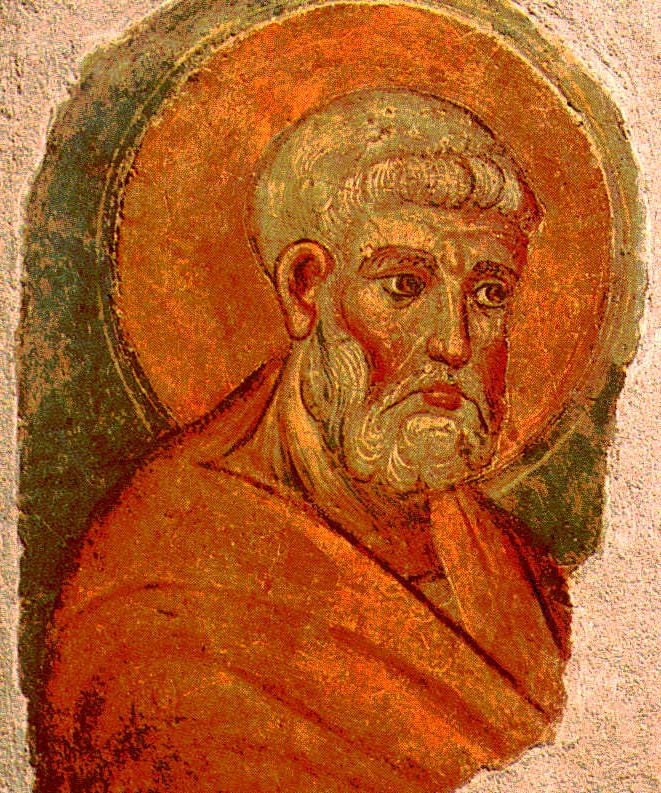
 St. Peter, fresco fragments, Rome, second half of the 13th century, 39 x 27.6 cm. Larger image. |
We are attacked by fear. We are attacked by the adversary. And God is greater and stronger than our attacks, says St. Peter in this concluding portion of his letter. It ends on an upbeat but practical note. He tells us how to face life, how to face our spiritual enemy, how to face suffering, and how to face God.
Rejecting Fear (5:7)
Peter instructs us to face life by trusting God.
"Cast all your anxiety on him because he cares for you." (5:7)
Grammatically, verse 7, "casting all your anxiety on him..." goes with verse 6 about humbling ourselves before one another, trusting God. But I've decided to look at it in this lesson, along with other instructions about living the Christian life.
We all face difficulties, testings -- and sometimes persecution and suffering. All these cause stress. We worry, we fret, we forget to trust God. One of the most important lessons of the Christian life is found in Peter's brief instruction: "Cast all your anxiety on him because he cares for you" (5:7). No doubt Peter recalled a similar verse in Psalms as the basis of his instruction:
"Cast your cares on the Lord
and he will sustain you;
he will never let the righteous fall." (Psalm 55:22)[275]
Let's look carefully at the words Peter uses. Peter's one-verse command has three elements.
First, fear or anxiety. "Anxiety" (NIV, NRSV), "care" is the Greek noun merimna, "anxiety, worry, care" from the verb merimnaō, "be apprehensive, have anxiety, be (unduly) concerned."[276] Jesus had taught his disciples something similar in the Sermon on the Mount. His listeners were worried about food and clothing. Jesus pointed them to the birds and the flowers, and then said:
"Seek first his kingdom and his righteousness, and all these things will be given to you as well. Therefore do not worry (merimnaō) about tomorrow, for tomorrow will worry about itself. Each day has enough trouble of its own." (Matthew 6:33-34)
Don't worry, trust God.
I am fascinated by the verb in Peter's instruction. "Cast" is the Greek verb epiriptō, which means originally, "to propel something from one place to another, throw." Then it means "to transfer one's concerns, cast upon."[277] This is a very active word. I think of it in terms of "throw," "propel," "eject," "remove violently," "send worry as a projectile far from you." So often we nurse our fears. We welcome them, we nurture and dwell upon them several times each day. At night we allow them to haunt our sleep. Peter tells us to "propel" them to God. We do that through prayer. Paul teaches us:
"Do not be anxious (merimnaō) about anything, but in everything, by prayer and petition, with thanksgiving, present your requests to God." (Philippians 4:6)
We must come to the point where we do not allow anxiety and fear to grip us. Instead we covenant to throw our fears on God in prayer. We refuse to pamper and nurse them any longer. Instead, as might a quarterback making a lateral pass -- we throw them to God in prayer!
Trusting in God's Care (5:7)
"Cast all your anxiety on him because he cares for you." (5:7)
Third, Peter tells us about God's concern for us. "Cares" is the Greek verb melomai, "be an object of care, be a cause of concern."[278] What Peter is saying is that you -- insert your name -- are an object of concern to God. You aren't by yourself. You don't have to keep your worries. God himself is concerned for your welfare. God himself wants you to be whole and healthy. God himself feels your pain and sadness. God himself paid the penalty for your sins and has set you free from condemnation. God himself cares for you! Wow!
Why should we cast our anxieties his way? Because he has real concern for us. Let him bear your worries, for he has deep concern and interest in everything you face.
Q1.
(5:7) According to this verse what should you do with your fears? What
reason is given why you should do this? In what manner should you do it? How
will you apply this verse's instruction in your own life?
https://www.joyfulheart.com/forums/topic/189-q1-dealing-with-your-fears/
The Existence of the Devil
But this is not just a lonely psychological and spiritual struggle with fear. There is an active enemy as well.
I think it is interesting that while most people believe that there is a God, a much smaller percentage actually believe there is a devil. Flip Wilson's "the devil made me do it" line has helped to trivialize and caricature the devil so that thinking people are embarrassed to believe in the devil.
But Jesus believed in the devil. He met Satan in direct spiritual conflict. Satan is much more than a convenient myth to explain evil. He is a person who is opposed to God and all God stands for. From hints given to us in Scripture, Satan seems to be an archangel who rebelled against God, has fallen from a place in heaven, and has control over many lesser fallen angels, known as demons. Jesus said in the parable of the sheep and the goats, "Depart from me, you cursed, into the eternal fire prepared for the devil and his angels" (Matthew 25:41).
Satan is named in many Old and New Testament references.[279] The devil appears in the New Testament many times.[280] The term "the evil one" also appears.[281]
A very strong case can be made that both Jesus and the Apostles believed in Satan. The only case against the existence of a personal devil is an arrogant, paternalistic, "we know better than that" unbelief that appeals to our intellectual insecurities.
The Enemy of Our Souls (5:8)
Peter describes the devil in this passage as a dangerous animal.
"Your enemy the devil prowls around like a roaring lion looking for someone to devour." (5:8)
I've heard preachers minimize Satan's power. They say that he can only roar, not bite. He can only gum you to death. That's foolishness. The devil depicted in the New Testament is powerful, though not omnipotent. He was dealt a death-blow at the cross, but still dangerous. The devil described in the Book of Revelation, the Beast and the Antichrist, are certainly dangerous, formidable foes. Don't underestimate them.
What does Peter's brief description tell us? He calls Satan an enemy. "Adversary" (KJV, NRSV), "enemy" (NIV) is the Greek noun antidikos, originally a legal technical term, "one who brings a charge in a lawsuit, accuser, plaintiff," but here could mean more generally "one who is continuously antagonistic to another, enemy, opponent."[282]
"Devil" is the Greek noun diabolos (from which we get our English word "diabolic"). It means originally, "one who engages in slander." In the New Testament it is "the title of the principal transcendent evil being, the adversary/devil."[283] "Roaring" translates an onomatopoeic Greek verb, that is, a word that imitates the sound it suggests -- oruomai.
In verse 8, Peter depicts Satan as a lion. In America we are fairly free of lions, but a few years ago jogger was killed by a mountain lion in my community. I once saw a mountain lion chasing deer outside my study window. Two weeks ago I saw a small mountain lion prowling, trying to hide from view, looking for prey to devour. In Israel, lions were a constant threat, since there was no way to exterminate them as we have done with the grizzly bear and wolf in this country. Lions are mentioned 77 times in the Bible, mostly in the Old Testament. Jesus is called "the lion of Judah" (Revelation 5:5; Genesis 49:9).
God's judgment is sometimes compared to the threat of lions and wild animals:
"So I will come upon them like a lion,
like a leopard I will lurk by the path.
Like a bear robbed of her cubs,
I will attack them and rip them open.
Like a lion I will devour them;
a wild animal will tear them apart." (Hosea 13:7-8)
My point is that we shouldn't minimize or underestimate our enemy. To be called a lion seeking prey is to say he is dangerous. "Devour" is the Greek verb katapinō, to drink or swallow completely," then figuratively, "to destroy completely, devour."[284]
Q2. (5:8) Why is it important to be aware of Satan's
existence? What does this verse teach us about the devil? Why is this teaching
important?
https://www.joyfulheart.com/forums/topic/190-q2-your-enemy-the-devil/
Resisting the Devil (5:8-9)
On the other hand, though we are aware of the threat, we are certainly not to cower in fear!
"Be self-controlled and alert. Your enemy the devil prowls around like a roaring lion looking for someone to devour. Resist him, standing firm in the faith, because you know that your brothers throughout the world are undergoing the same kind of sufferings." (5:8-9)
What is required to be victorious over our arch enemy? In verses 8 and 9 Peter gives us five instructions:
1. Be self-controlled. "Self-controlled" (NIV), "sober" (NIV), "discipline yourselves" (NRSV) is the Greek verb nēphō, which primarily means "sober, not drunk." But in the New Testament it is used figuratively, "be free from every form of mental and spiritual 'drunkenness,' from excess, passion, rashness, confusion, etc. Be well-balanced, self-controlled."[285] If we expect to have a victorious Christian life we must become disciplined people. Sloppy living makes us sitting ducks for prowling lions.
2. Be alert. "Be alert" (NIV, NRSV), "be vigilant" (KJV) is the Greek verb grēgoreō, which literally means, "to stay awake, be watchful." Here it is used of spiritual watchfulness, "to be in constant readiness, be on the alert," similar to our expression, "Keep your eyes open."[286] If we expect to have a victorious Christian life we must be alert to what is happening around us and not assume that we have no enemies. We can't assume that we are safe. We can't remain oblivious to the dangers. We have a cunning spiritual foe who seeks to destroy us. Watch out for him.
3. Resist him. "Resist" is the Greek verb anthistēmi, which means, "to be in opposition to, set oneself against, oppose."[287] We can't be neutral about serving God. If we want to have a victorious Christian life we must take a firm stand in our lives against sin and consistently resist temptation. If we are "double minded" (James 1:8; 4:8), however, we resist part of the time and then give in to our true desires the rest of the time. That is a losing strategy. We can't be neutral or excuse our weaknesses. We must resist. Paul talks about preparing oneself with spiritual armor:
"Therefore put on the full armor of God, so that when the day of evil comes, you may be able to stand your ground, and after you have done everything, to stand." (Ephesians 6:13)
Standing in the face of the foe is what it means to resist. It is not surrendering nor is it retreating.
4. Keep your faith. To stand in the face of an enemy takes courage and faith. "Firm" (NIV), "steadfast" (KJV, NRSV) is the Greek adjective stereos, which refers originally to physical properties, "pertaining to being firm or solid in contrast to being soft or viscous; firm, hard, solid, strong." In our verse it is used figuratively of human character, "steadfast, firm."[288]
5. Be willing to suffer. To experience spiritual victory we need to be prepared to suffer persecution or hardship, if necessary, for our faith. "Sufferings" (NIV, NRSV), "afflictions" (KJV) is the Greek noun pathēma that Peter has used throughout this letter. Jesus warned in the Parable of the Sower of believers who give up at the first sign of persecution:
"The one who received the seed that fell on rocky places is the man who hears the word and at once receives it with joy. But since he has no root, he lasts only a short time. When trouble or persecution comes because of the word, he quickly falls away." (Matthew 13:20-21)
Paul warned timid Timothy:
"Everyone who wants to live a godly life in Christ Jesus will be persecuted." (2 Timothy 3:12).
We must decide ahead of time that we will stand our ground, even when it means taking lots of heat.
But with these instructions, we Christians can experience spiritual victory over our enemy Satan. He is not invincible. Through faith and prayer we can defeat him in the everyday struggles of life. We can!
Q3. (5:8-9) What instructions does Peter give us to guide
us in spiritual warfare? Extra credit: How are these instructions similar to or
different from Paul's instructions in Ephesians 6:10-17?
https://www.joyfulheart.com/forums/topic/191-q3-instructions-for-spiritual-warfare/
Our Eternal Hope (5:10)
Now Peter is winding down his letter. But he can't finish without a paean of praise to his God.
"And the God of all grace, who called you to his eternal glory in Christ, after you have suffered a little while, will himself restore you and make you strong, firm and steadfast. To him be the power for ever and ever. Amen." (5:10-11)
This short doxology is rich in hope. Look at it with me:
"The God of all grace" is a God who has shown us favor and forgiveness when we least deserved it, taking the punishment upon himself in Christ Jesus. If you've been terrified of God and distrustful of his power, realize that he is a God of favor and grace toward you.
"Who has called you to his eternal glory" describes God's invitation to you. His hope and plan for you is eternal glory, eternal life. "Eternal" is the Greek adverb aiōnios, "pertaining to a period of unending duration, without end."[289] Glory refers to the great aura of holiness and brightness that surrounds God. When God revealed himself to Moses, Moses' face glowed for days (2 Corinthians 3:13). Paul described God as:
"The blessed and only Ruler, the King of kings and Lord of lords, who alone is immortal and who lives in unapproachable light, whom no one has seen or can see." (1 Timothy 6:15-16)
But God calls us to share life with him in the midst of that "unapproachable light" for eternity. That he has "called" you to eternal glory means that eternal glory is your destiny!
"In Christ" reminds us that we can come to the Father only through Jesus Christ his Son (John 14:6). It is our relationship to Christ that saves us, nothing on our own account.
"After you have suffered a little while," acknowledges that we experience suffering now, but declares a limit to its duration. "A little while" (NIV, NRSV), "a while" (KJV) is the Greek adjective oligos, "pertaining to being relatively small in number, few." Here it refers to duration, "a short time."[290] Peter's promise is that suffering will not last forever. I don't believe that Peter means that we must wait until Christ comes for God to relieve us. He means that we will typically experience periods of attack, struggle, and persecution, but they will not last forever and will be followed by periods of renewal and help.
"God ... will himself" reminds us that God personally will assist us and strengthen us. Peter uses four words to describe God's personal relief of your suffering that you can look forward to:
"Restore you" (NIV, NRSV), "make you perfect" (KJV) is the Greek verb kataritizō, "to cause to be in a condition to function well, put in order, restore."[291]
"And make you strong." "Make ... strong" (NIV), "stablish" (KJV), "support" (NRSV) is the Greek verb stērizō, which has a basic meaning of, "to fix firmly in place, set up, establish, support," mainly of physical objects. Here it is used figuratively, "to cause to be inwardly firm or committed, confirm, establish, strengthen."[292]
"Firm." Make ... firm" (NIV), "strengthen" (NIV, NRSV) is the Greek verb sthenoō, "strengthen, make strong."[293]
"And steadfast." "Make ... steadfast" (NIV), "settle" (KJV), "establish" (NRSV) is the Greek verb themelioō, means literally, "to provide a base for some material object or structure, lay a foundation, found." Here it is used figuratively, "to provide a secure basis for the inner life and its resources, establish, strengthen."[294]
We will have periods of struggle in our Christian lives. We should expect this. But we can also expect God to heal and restore us, to give us strength, stability, and support. We can count on it!
Q4. (5:10-11) Which promises in verses 10 and 11 are most
meaningful to you at this point in your life? Why?
https://www.joyfulheart.com/forums/topic/192-q4-promises-for-the-future/
Doxology (5:11)
"And the God of all grace, who called you to his eternal glory in Christ, after you have suffered a little while, will himself restore you and make you strong, firm and steadfast. To him be the power for ever and ever. Amen." (5:10-11)
"To him be the power for ever and ever" is a doxology (literally "word of praise"), common in apostolic letters, especially at the conclusion.[295] Yesterday I found myself singing that Noel Richards' praise song, which is in itself a modern rendition of an ancient doxology (1 Timothy 1:17):
"You deserve the glory and the honor,
Lord, we lift Your name in worship,
As we lift Your Holy name..."[296]
In Peter's doxology, to God is attributed power and rule forever. "Power" is the Greek noun kratos, "ability to exhibit or express resident strength, might," and in our passage, "exercise ruling ability, power, rule, sovereignty."[297]
Stand Fast (5:12)
Now Peter concludes his letter with some personal words.
"With the help of Silas, whom I regard as a faithful brother, I have written to you briefly, encouraging you and testifying that this is the true grace of God. Stand fast in it." (5:12)
We don't know Silas's exact role in writing the letter. He may have served as a secretary or amanuensis to whom Peter dictated the letter. But given Peter's personal commendation "whom I regard as a faithful brother," it is more likely that he had been designated to deliver the letter in person to the churches in Asia Minor to which Peter wrote. The actual name is "Silvanus," which was often shortened to "Silas." We aren't told whether this was Paul's missionary companion; it was a common name in Peter's time.
Peter describes his purpose in the letter as two-fold:
- To encourage and exhort them (parakaleō), and
- To offer testimony (epimartyreō[298]) to the true grace of God, that is, to carefully define what the grace of God actually consists of in order to differentiate it from various distortions of the gospel that were prevalent in Peter's time.
Having set forth accurate Christian teaching, he now commands his readers to "stand fast in it." "Stand fast" (NIV, RSV), "stand" (KJV) is the common Greek verb histēmi, "stand, set." Here it means "stand firm so as to remain stable, stand firm, hold one's ground."[299] Too often, bizarre teachings steer people away from the truth because of the charisma of the teacher or the momentum of a movement. But Peter tells readers to reject anything that isn't the "true grace of God."
Final Greetings (5:13-14)
"She who is in Babylon, chosen together with
you, sends you her greetings, and so does my son Mark.
Greet one another with a kiss of love.
Peace to all of you who are in Christ." (5:13-14)
"Babylon" is a symbol for Rome, as it is in Revelation 16:19; 17:5; and 18:2. Peter writes to the "Dispora" (1:1), the Christians scattered abroad. Babylon is a suitable image from Old Testament history of the people of God in exile in the land of their captor, Babylon. Thus "she who is in Babylon" is the Church in Rome and Peter relays the greetings[300] of the Roman Christians. Mark was a close associate of Peter's and is thought to be the author of The Gospel of Mark, which presumably reflects Peter's perspective on Jesus' life and teaching.
He invites the Christians in the various churches where the letter comes to greet each other with genuine affection. "Kiss" is the Greek noun philēma, "a kiss." Christians often greeted one another with a "holy kiss."[301] In our passage the phrase is called a "kiss of love" (agapē), that is, "an affectionate kiss."[302]
 In book form as PDF, Kindle, and paperback |
Finally, he offers a benediction or blessing to his readers:
"Peace to all of you who are in Christ." (5:14)
True peace is only experienced by Christians who have experienced peace with God.
Thus concludes a short but powerful apostolic letter from Peter, the Fisherman and Apostle. May God bless it to your life! Amen.
Prayer
Father, thank you for the assurances in your Word.... The assurance that you personally care for me. The assurance that I can resist the devil. The assurance of your establishing strength. The assurance of glory with you forever. Thank you for your astounding love! In Jesus' name, I pray. Amen.
Key Verses
"Cast all your anxiety on him because he cares for you." (1 Peter 5:7)
"And the God of all grace, who called you to his eternal glory in Christ, after you have suffered a little while, will himself restore you and make you strong, firm and steadfast. To him be the power for ever and ever. Amen." (1 Peter 5:10-11)
End Notes
[275] In the Greek Septuagint translation of the Old Testament both "cast" and "anxiety/cares" are the same Greek words that we find in 1 Peter, through it isn't an exact quote.
[276] Merimna, BDAG 632.
[277] Epiriptō, BDAG 378.
[278] Melomai, BDAG 628. Here the verb is found in a common form melei, third person singular: "it is a care/concern, is of interest to someone" (BDAG 626-627).
[279] 1 Chronicles 21:1; Job 1:6-12, 2:1-7; Zechariah 3:1-2; Matthew 12:26 (=Mark 3:26=Luke 11:18); 16:23 (=Mark 8:33); Mark 4:13 (=Matthew 13:19=Luke 8:12); Luke 10:18; 13:16; 22:3, 31; John 13:27; Acts 5:3; 26:18; Romans 16:20; 1 Corinthians 5:5; 7:5; 2 Corinthians 2:11; 11:14; 12:7; 2 Thessalonians 2:18; 2 Thessalonians 2:9; 1 Timothy 1:20; 5:15; Revelation 2:9, 13, 24; 3:9; 12:9; 20:2, 7.
[280] Matthew 4:1-11 (=Mark 1:12-13=Luke 4:1-13), 13:39; 25:41; John 8:44; 13:2; Acts 10:38; 13:10; Ephesians 4:27; 6:11; 1 Timothy 3:6-7; 2 Timothy 2:26; Hebrews 2:14; James 3:15; 4:7; 1 Peter 5:8; 1 John 3:8, 10; Jude 9; Revelation 2:10; 12:9, 12; 20:2, 10.
[281] Matthew 5:37; 6:13; 13:19, 38; John 17:15; Ephesians 6:16; 2 Thessalonians 3:3; 1 John 2:13-14; 3:12; 5:18-19. Another reference is in Colossians 2:15.
[282] Antidikos, BDAG 88.
[283] Diabolos, BDAG 226-227. The Spanish word for "devil" is diablo.
[284] Katapinō, BDAG 524.
[285] Nēphō, BDAG 672.
[286] Grēgoreō, BDAG 207-208.
[287] Anthistēmi, BDAG 80.
[288] Stereos, BDAG 943.
[289] Aiōnios, BDAG 33.
[290] Oligos, BDAG 702-703. Used both in 1:6 and in 5:10.
[291] Kataritizō, BDAG 526.
[292] Stērizō, BDAG 945.
[293] Sthenoō, BDAG 922, from the noun sthenos, "strength."
[294] Themelioō, BDAG 449.
[295] Romans 11:36; 16:27; 1 Corinthians 15:57; Ephesians 1:3; 3:20-21; Philippians 4:20; 1 Timothy 1:17; 1 Peter 1:3; 4:11; 5:11; 2 Peter 3:18; Jude 25; Revelation 1:6.
[296] Noel Richards, "You Deserve the Glory" (1991, Kingsway's Thankyou Music).
[297] Kratos, BDAG 565. This is a favorite word for doxologies, used also in 1 Timothy 6:16; 1 Peter 4:11; Jude 25; and Revelation 1:6; 5:13.
[298] "Testifying" is the Greek verb epimartuyreō, "to affirm that something is true, bear witness, attest" (BDAG 375), used only here in the New Testament.
[299] Histēmi, BDAG 482-483.
[300] "Sends greetings" (NIV, NRSV) and "salutes" (KJV) in verses 13 and 14 is the Greek verb aspazomai, "to engage in hospitable recognition of another, greet, welcome" (BDAG 144).
[301] Romans 16:16; 1 Corinthians 16:20; 2 Corinthians 13:12; 1 Thessalonians 5:26.
[302] Philēma, BDAG 1057.
Copyright © 2026, Ralph F. Wilson. <pastor joyfulheart.com> All rights reserved. A single copy of this article is free. Do not put this on a website. See legal, copyright, and reprint information.
 To be notified about future articles, stories, and Bible studies, why don't you subscribe to our free newsletter, The Joyful Heart, by placing your e-mail address in the box below. We respect your