


|
Old Testament
New Testament
Gospels
Acts
Paul's Letters
General Letters
Revelation
Topical Studies
Beginning the Journey (for new Christians). en Español

|
Old Testament
New Testament
Gospels
Acts
Paul's Letters
General Letters
Revelation
Topical Studies

|
Home
Bible Studies
Articles
Books
Podcasts
Search
Menu
Donate
About Us
Contact Us
FAQ
Sitemap


Free
E-mail Bible Study
 The Discipleship Process
Home |
Bible Studies |
Articles |
Books |
Podcasts |
Search |
Menu |
Donate |
About Us |
FAQ |
Contact Us
The Discipleship Process
Home |
Bible Studies |
Articles |
Books |
Podcasts |
Search |
Menu |
Donate |
About Us |
FAQ |
Contact Us
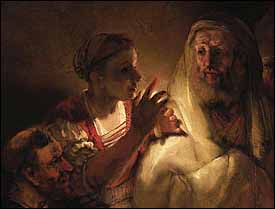 Detail from Rembrandt, 'The Denial of St. Peter' (1660), oil on canvas, 61" x 67", Rijksmuseum, Amsterdam. |
I've been around churches all my life. In that time, I have seen lots of church leaders. Some have been wonderful men and women. Others have been small people trying to take advantage of a church's leadership needs in order to project themselves larger than life.
In this passage the church's most celebrated apostle, Peter, talks straight to church leaders.
Appealing as a Fellow Elder (5:1)
Peter begins with an act of humility. Though he is an apostle and writes with apostolic authority, he humbles himself to the level of the church leaders themselves. He writes:
"To the elders among you, I appeal as a fellow elder, a witness of Christ's sufferings and one who also will share in the glory to be revealed." (5:1)
He is not prefacing mere suggestions. He is exhorting. He is appealing to church leaders. "Appeal" (NIV), "exhort" (KJV, NRSV) is the Greek verb parakaleō. The basic meaning is "to call to one's side." Here it means "to urge strongly, appeal to, urge, exhort, encourage." In other contexts it can mean "request, implore, entreat" and "comfort, encourage, cheer up."[248] Peter is in earnest.
He identifies himself as a "fellow elder" and appeals to "elders." "Elder" is the Greek noun presbyteros, from which we get the word "Presbyterian." The basic meaning is "pertaining to being relatively advanced in age, older, old." Then it used as the title of an official, "elder, presbyter."[249] Among the Jews the term "elder" was used as the title for members of local councils in individual cities, as well as members of a group in the Sanhedrin in Jerusalem. The earliest Christian churches took over the synagogue form of government, with a group or council of elders, usually led by a presiding elder.[250]
Peter also presents himself as an eyewitness (Greek martys) to Christ's sufferings and one who will share in glory when Christ returns. "Share" (NIV, NRSV), "partaker" (KJV) is an interesting word. The Greek noun koinōnos means "one who takes part in something with someone, companion, partner, sharer."[251] The root word koinos means "pertaining to being of mutual interest or shared collectively, communal, common." A related word that you may have heard of is koinōnia, "fellowship, communion, close association."
Peter is affirming one of his most valued hopes -- as a shareholder in the greatest gold mine of glory ever imagined -- Christ returns in glory. He says, "I have a part in that!" And so do you and I!
Shepherds and Pastors (5:2a)
After his prefacing remarks, Peter begins his appeal to the elders:
"Be shepherds of God's flock that is under your care, serving as overseers." (5:2)
Notice three words that seem to be used synonymously in verses 1 and 2 (and also in Acts 20:17, 28):
- Elders
- Shepherds (or pastors)
- Overseers (sometimes translated "bishops")
At this point in the history of the primitive church, all three words referred to the same group of church leaders: elders = pastors/shepherds = overseers/bishops.
Though the words are used synonymously here, each has its own special flavor. "Be shepherds" (NIV), "feed" (KJV), "tend" (NRSV) is the Greek verb poimainō, "to serve as a tender of sheep, herd, tend, (lead to) pasture," then extended figuratively to mean, "to watch out for other people, to shepherd, of activity that protects, rules, governs, fosters."[252] Since the word "pastor" (Greek poimēn) refers to one who shepherds, and "one who serves as guardian or leader," we have in our passage a verb that could just as well be translated "to pastor." "Flock" is the related Greek noun poimnion, "flock," then figuratively, "a defined group of persons under a leader, flock."[253]
To be a shepherd means to assume the responsibility of caring for the sheep and all their needs -- food, healing, help with giving birth, protection. A pastor (and in many cases a small group leader) assumes spiritual responsibility for God's people that have been placed in his or her charge.
Are you an elder in your church? Your position is no hollow title. You have spiritual responsibilities, under the senior pastor, for the well-being of the flock. You are an under-shepherd.
Overseers (5:2)
In addition to "elders" and "pastors" or "shepherds," Peter refers to his fellow elders as overseers.
"Be shepherds of God's flock that is under your care, serving as overseers." (5:2)
"Serving as overseers" (NIV), "taking/exercising the oversight" (KJV, NRSV) is the Greek verb episkopeō, from which we get our word "Episcopal." The basic meaning is "to give attention to, look at, take care of, see to it." Here it has a figurative meaning, "to accept responsibility for the care of someone, oversee, care for."[254] The noun episkopos is used in 1 Peter 2:25 of Jesus ("guardian of the souls"). Sometimes this word is translated "bishop," but bishops, in a hierarchical sense over presbyters or priests, weren't present in the Church until the early second century.
If you are a pastor or a small group leader, then in some sense you, too, are an overseer and guardian. You watch over to care for the members and to make sure they are protected from threats within and without.
Q1. (5:1-2) What do you learn about the responsibilities
of an elder from the definitions of "elder," "pastor," and "overseer"? What
stood out to you as you considered these words?
https://www.joyfulheart.com/forums/topic/185-q1-responsibilities-of-an-elder/
Attitudes for Elders (5:2b-3)
Now Peter moves from the functions of an elder to the attitudes required.
"Serving ... not because you must, but because you are willing, as God wants you to be; not greedy for money, but eager to serve; not lording it over those entrusted to you, but being examples to the flock." (5:2b-3)
Willingness (5:2)
The first characteristic is willingness. Peter uses contrasting words here to emphasize the point: "not because you must, but because you are willing."
"Because you must (NIV), "by constraint" (KJV), "under compulsion" is the Greek adverb anankastōs, "by compulsion," from the noun anankē, "necessity, pressure, constraint."[255] In many churches, I've heard this kind of plea from an elder or a nominating committee member. "Won't you serve on the elder board. I've put in my time. You don't have to do much -- just attend four meetings a year." Or "We can't get anyone else to serve. You said you'd do it if no one else would. So you've got to!"
What a travesty in the Church of the Living God! That men and women must be manipulated by guilt or duty, rather than from love of Christ, to serve God's people. My dear friends, our churches would be much better off if we refused to take anyone in a leadership position unless they were willing and eager to serve Christ. Any other motive disqualifies a person from this high office! (Excuse me for preaching, but I am a preacher.) "Willing" (NIV), "willingly" (KJV, NRSV) is the Greek adverb ekousiōs, "willingly, without compulsion," that is, "deliberately, intentionally."[256]
Q2. (5:2) What's wrong with the common practice in
churches of "twisting a person's arm" to get him or her to serve as a church
leader? What damage does this do to the church? What kind of leader does it
produce?
https://www.joyfulheart.com/forums/topic/186-2-the-dangers-of-recruitment-by-arm-twisting/
Not Motivated by Money (5:2)
Watch out for ministers (or any Christians) who are out to get wealthy.[257] Since elders often had responsibility for stewardship over church funds, it was important that they weren't people motivated by money. "Greedy for money" (NIV), "for filthy lucre" (KJV), "for sordid gain" (NRSV) is the Greek adverb aischrokerdōs, "in fondness for dishonest gain, greedily," from the noun meaning "shamelessly greedy for money, avaricious, fond of dishonest gain" (warned against in elders in 1 Timothy 3:8 and Titus 1:7).[258]
It is wrong for churches to be stingy in paying their pastors, just as wrong as it would be for an employer to pay an employee less than what he or she was worth.[259] True pastors need enough to live on if they are to serve a congregation well. But pastors who are always about money are likely to have a problem.
Rather than serving for the sake of money, elders should be "eager to serve" (NIV), "eagerly" (NRSV), "of a ready mind" (KJV). These translate the Greek adverb prothymōs, "pertaining to being eager to be of service, ready, willing, eager."[260] In other words, elders should be eager for service, rather than eager for money.
Not Domineering (5:3)
Power corrupts, the saying goes, and absolute power corrupts absolutely. If you've studied church history you can find many, many examples of a domineering kind of leadership.
"... Not lording it over those entrusted to you, but being examples to the flock." (5:3)
"Lording it over" is the Greek verb katakyrieuō, "to bring into subjection, become master, gain dominion over, subdue," then "to have mastery, be master, lord it (over), rule."[261] Jesus specifically warns against this kind of leadership. When James and John were jockeying for places of power, Jesus used their power politics as an occasion to teach on leadership style:
"You know that those who are regarded as rulers of the Gentiles lord it over them, and their high officials exercise authority over them. Not so with you. Instead, whoever wants to become great among you must be your servant, and whoever wants to be first must be slave of all." (Mark 10:42-44)
Contrary to the common type of self-centered rulers, Jesus insisted that the disciples adopt a servant leadership approach. Rather than ruling by fiat, they were to lead by example. "Examples" (NIV, NRSV), "ensamples" (KJV) is the Greek noun typos, here used of the moral life, "example, pattern."[262]
Sometimes church leaders act as if they "own" the church and that people are there to serve them. But it is the opposite. The leader, following Jesus' example, is to serve the people. Imagine Jesus washing Peter's feet as an act of humility and you have the idea (John 13:4-17). Peter is echoing Jesus' own words on that occasion when he said,
"You also should wash one another's feet. I have set you an example that you should do as I have done for you." (John 13:14-15)
It takes a humble leader to do this. Rather than owning the people, the people are "given as a portion or share" for the leader to care for. "Those entrusted to you" (NIV), "those in your charge" (NRSV), "[God's] heritage" (KJV) is the Greek noun klēros, "lot," which was thrown to make decisions. From this, the word means "that which is assigned by lot," and then "that given as a portion or share." In our verse, the word is in the plural, "portions," referring to the flock as a whole, suggesting that the various parts of the people of God have been assigned as "portions" to individual elders or shepherds.[263]
Q3. (5:3) How can we best keep elders and pastors from
being power-mongers? From limiting a pastor's authority? What's the danger here?
From testing a person before bestowing authority? How can this be difficult? How
can we deal with this serious problem properly?
https://www.joyfulheart.com/forums/topic/187-q3-preventing-power-mongering-by-leaders/
The Reward for Elders (5:4)
Humility and service are the watchwords now, but "glory" is the promise when Christ appears.
"And when the Chief Shepherd appears, you will receive the crown of glory that will never fade away." (5:4)
"Chief Shepherd" is the Greek noun archipoimēn, from archē, "beginning, first" + poimēn, "shepherd." Peter uses this term to remind fellow elders that none of them is the "chief pastor," even though they might be a "senior pastor." Christ is the ultimate pastor, the ultimate shepherd to whom all pastors and leaders must answer and give account. The author of Hebrews says:
"Obey your leaders and submit to their authority. They keep watch over you as ones who must give an account." (Hebrews 13:17a)
But with the responsibility also comes the reward. "Crown" is the Greek noun stephanos, "a wreath made of foliage or designed to resemble foliage and worn by one of high status or held in high regard, wreath, crown."[264] No doubt Peter has this in mind, because he refers to a crown that never fades in contrast to an earthly wreath that does fade.[265]
Submission to Elders (5:5a)
Peter has admonished the elders themselves. Now he speaks to those under their charge.
"Young men, in the same way be submissive to those who are older." (5:5a)
We in America are an independent lot. We don't like anyone to tell us what to do. But, like the writer of Hebrews above, Peter commands Christians in the church to "be submissive" (NIV), "submit yourselves" (KJV), "accept the authority of" (NRSV) the elders. This is the Greek verb hypotassō that we saw previously (2:18; 3:1), "subject oneself, be subjected or subordinated, obey."[266] Peter contrasts "younger men"[267] with "those who are older." But this is a play on words, since "older" (NIV), "elder" (KJV), "elders" (NRSV) is the Greek noun presbyteros, "elder," that we saw in 5:1, and refers, I believe, to a church leader, not just an older Christian.
Humility for Elders (5:5b-6)
Even though elders have spiritual authority which must be recognized and submitted to, elders aren't to become proud because they have power. Peter calls all his readers to mutual humility, quoting Proverbs 3:34:
"All of you, clothe yourselves with humility
toward one another, because,
'God opposes the proud
but gives grace to the humble.'
Humble yourselves, therefore, under God's mighty hand, that he may lift you up
in due time." (5:5b-6)
"Clothe yourselves" is the Greek verb enkomboomai, "to put or tie something on oneself, put on," from en + kombos, "band."[268] Humility is to be worn like a garment. When we begin the day and dress, we must also be careful to include an attitude of humility.
"Humility" is the Greek noun tapeinophrosynē, "humility, modesty" related to the adjective tapeinos, "to be of low social status," then "unpretentious, humble," later in this verse, and the verb tapeinoō in verse 6, "to cause to be or become humble in attitude, humble, make humble."[269] Jesus described himself as humble or meek in heart (Greek praus, Matthew 11:28). Would that all God's leaders remember who God is and who they really are. Might they realize that all they have is a gift from God and the people are a trust from God. This is nothing to get big-headed about. It is a cause to lean heavily on the Lord for strength to lead well.
Peter himself had been a blowhard and a braggart. He had learned humility through what he had suffered and through God's gracious forgiveness. The quotation from Proverbs 3:34 is heavy stuff:
"God opposes the proud
but gives grace to the humble." (5:5b)
"Opposes" (NIV, NRSV), "resists" (KJV) is the Greek verb antitassō, "oppose, resist," from anti, "opposite, against" + tasso, "put, place."[270] Do you struggle with pride?[271] If you don't humble yourself, this passage says that God himself will resist and oppose you. God will stand against you in order to break your pride.
On the other hand, he promises his special favor for those who are humble. "Grace" is the Greek noun charis, "a beneficent disposition toward someone, favor, grace, gracious care/help, goodwill."[272]
Q4. (5:5-6) What acts of humility are appropriate for
church leaders? How can we discern a person's humility before putting him or her
in a place of leadership in the church? What happens when we fail to do this?
https://www.joyfulheart.com/forums/topic/188-q4-humility-in-leadership/
Exaltation Is Coming (5:6)
"Humble yourselves, therefore, under God's mighty hand, that he may lift you up in due time." (5:6)
We want to be exalted now rather than be humbled. But we must wait. And if we are willing to submit to God's discipline of humility, one day he will lift us up. "Exalt" (KJV, NRSV), "lift up" (NIV) is the Greek verb hypsoō, "to lift up spatially, lift up, raise high," then "to cause enhancement in honor, fame, position, power, or fortune, exalt."[273]
You are a "King's kid" now, but it doesn't appear like it sometimes. Jesus was the Eternal Son of God, but sometimes it seemed untrue. Jesus patiently waited for the right time.[274] Two New Testament passages come to mind:
"[Jesus] who for the joy set before him endured the cross, scorning its shame, and sat down at the right hand of the throne of God." (Hebrews 12:2)
With his eyes firmly fixed on the prize, he endured the humbling shame of the cross, because he had faith that one day he would sit again at the right hand of his Father. We, too, follow Jesus. We humble ourselves because he humbled himself and set us an example that we might follow in his steps (2:21):
"Your attitude should be the same as that of
Christ Jesus:
Who, being in very nature God,
did not consider equality with God something to be grasped,
but made himself nothing,
taking the very nature of a servant,
being made in human likeness.
And being found in appearance as a man,
he humbled himself
and became
obedient to death--
even death on a cross!
Therefore God exalted him to the highest
place
and gave him the name that is above every name,
that at the name of Jesus
every knee should bow,
in heaven and on earth and under the earth,
and every tongue confess that Jesus Christ is Lord,
to the glory of God the Father." (Philippians 2:5-11)
My dear friend, your pride now is an inverse barometer of your faith. The prouder you are now, the less your real belief that God will exalt you when Christ comes. You feel you must exalt yourself or no one will exalt you. Not so. We must humble ourselves and Christ will exalt us in due time.
 In book form as PDF, Kindle, and paperback |
Leadership in the Church of Jesus Christ is a serious matter. Perhaps you became a church pastor, elder, officer, or board member for the wrong motive. But Peter calls you to your best, to the victory of ...
- Willingness over compulsion,
- Eagerness over greed,
- Servant leadership by example over exercising power over people,
- Submission to the Chief Shepherd rather than building one's own little kingdom, and
- Humility over self-exaltation.
Prayer
Father, I pray for the leaders of your congregations around the world that are studying this passage. I ask you to humble each of us and teach us to lead with the humility you desire. Where we have character flaws, Lord, convict us and heal us that we might continue to serve rather than be disqualified. Thank you for your mercy in Bible days to our fellow-elder Peter. You not only forgave but healed his sin and used him. Do the same for us, we pray. In Jesus' name. Amen.
Key Verse
"Humble yourselves, therefore, under God's mighty hand, that he may lift you up in due time." (1 Peter 5:6)
End Notes
[248] Parakaleō, BDAG 764-765. A related word paraklētos is used to describe the Holy Spirit, the Paraclete, as One who comes along side to help, encourage, and comfort.
[249] Presbyteros, BDAG 862.
[250] K.N. Giles, "Church Order, Government," DLNT 219-226. See also Günther Bornkamm, presbys, ktl., TDNT 6:651-683. There is much more I could say about early church leaders. For more, see my brief essay: "Elders, Pastors, and Overseers: A Word Study" (www.joyfulheart.com/scholar/elders.htm).
[251] Koinōnos, BDAG 553-554.
[252] Poimainō, BDAG 842.
[253] Poimnion, BDAG 843.
[254] Episkopeō, BDAG 379. Hermann W. Beyer, episkeptomai, ktl., TDNT 2:599-622. This word is missing in some important manuscripts (א* B 33 al) but present in most others (p72 א2 A etc.). The United Bible Societies Greek New Testament (third edition) gives it a {C} rating, but include it in the text in brackets. They find it hard to decide whether or not the word was missing due to deliberate excision, from either stylistic considerations or the conviction that Peter could have never admonished presbyters to exercise the function of bishops. (Bruce M. Metzger, A Textual Commentary on the Greek New Testament (United Bible Societies, 1971), pp. 695-696.
[255] Anankastōs, BDAG 61.
[256] Ekousiōs, BDAG 307.
[257] See 1 Timothy 6:9; Mark 4:19; 1 John 2:15-16.
[258] Aischrokerdōs, BDAG 29. Robertson notes, "Clearly the elders received stipends, else there could be no such temptation." (A.T. Robertson, Robertson's Word Pictures of the New Testament (Broadman Press, 1932-33), in loc.).
[259] See my article, "Does Your Church Run a Spiritual Sweatshop?" (www.joyfulheart.com/church/sweatshop.htm).
[260] Prothymōs, BDAG 870.
[261] Katakyrieuō, BDAG 519.
[262] Typos, BDAG 1019-1020.
[263] Klēros, BDAG 548.
[264] Stephanos, BDAG 943-944.
[265] "Never fade" is the Greek adjective amarantinos, "unfading," similar to amarantos, "pertaining to not losing pristine quality or character, unfading" (BDAG 49).
[266] Hypotassō, BDAG 1042.
[267] "Young men" (NIV) and "younger" (KJV, NRSV) is the comparative of the Greek noun neos, "pertaining to being in the early stages of life, young" (BDAG 669).
[268] Enkomboomai, BDAG 274.
[269] Tapeinophrosynē, tapeinos, tapeinoō, BDAG 989-990.
[270] Antitassō, BDAG 90.
[271] "Proud" is the Greek adjective hyperēphanos, "arrogant, haughty, proud" (BDAG 1033).
[272] Charis, BDAG 1079.
[273] Hypsoō, BDAG 1045-1046.
[274] "Due time" is the Greek noun kairos, one of the chief terms relating to the end time, "the time of crisis, the last times" (BDAG 498).
Copyright © 2026, Ralph F. Wilson. <pastor joyfulheart.com> All rights reserved. A single copy of this article is free. Do not put this on a website. See legal, copyright, and reprint information.
 To be notified about future articles, stories, and Bible studies, why don't you subscribe to our free newsletter, The Joyful Heart, by placing your e-mail address in the box below. We respect your