Free E-Mail
Bible Studies
 King
Solomon
King
SolomonBeginning the Journey (for new Christians). en Español
Old Testament
Abraham
Jacob
Moses
Joshua
Gideon
David, Life of
Elijah
Psalms
Solomon
Songs of Ascent
(Ps 120-135)
Isaiah
Advent/Messianic Scriptures
Daniel
Rebuild & Renew: Post-Exilic Books
Gospels
Christmas Incarnation
(Mt, Lk)
Sermon on the Mount
(Mt 5-7)
Mark
Luke's
Gospel
John's Gospel
7 Last Words of Christ
Parables
Jesus and the Kingdom
Resurrection
Acts
The Early Church
(Acts 1-12)
Apostle Paul
(Acts 12-28)
Paul's Epistles
Christ Powered Life (Rom 5-8)
1 Corinthians
2 Corinthians
Galatians
Ephesians
Vision for Church
(Eph)
Philippians
Colossians,
Philemon
1
& 2 Thessalonians
1 & 2 Timothy,
Titus
General Epistles
Hebrews
James
1 Peter
2 Peter, Jude
1, 2, and 3 John
Revelation
Revelation
Conquering Lamb of Revelation
Topical
Glorious Kingdom, The
Grace
Great Prayers
Holy Spirit, Disciple's Guide
Lamb of God
Listening for God's Voice
Lord's Supper
Names of God
Names of Jesus
Christian Art
About Us
Speaking
Contact Us
Dr. Wilson's Books
Donations
Watercolors
Sitemap

Godliness - A Forgotten Christian Virtue
by Dr. Ralph F. Wilson
 King Solomon: Wisdom, Wealth, Weakness
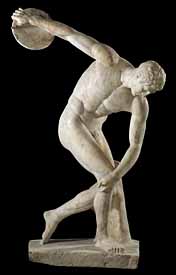 Physical training is of some value, but training in godliness much more so. Myron (ca. 460-450 BC), "The Discus Thrower" (Discobolus), found at Hadrian's Villa, Tivoli, now in the British Museum. Larger image. |
So just what is godliness? First of all, "godliness" is not a synonym for "boring." Our culture caricatures godliness as boring. But Jesus certainly wasn't boring. His wit is evident, his sense of humor well developed. Paul's life didn't seem boring. Rather godliness should be seen as good, clean-living enjoyment of life and of God -- healthy, balanced, God-oriented living.
The word "godliness" comes from a Greek stem seb-, which meant originally "to step back from someone or something, to maintain a distance," then "to have awe at something, especially something lofty and sublime."211 This stem is combined with eu- ("abundance, fullness of") to form eusebeia, which means in classical Greek, "awe, respect for the divine, for the social order."
In the New Testament, the word is used in the sense of, "awesome respect accorded to God, devoutness, piety, godliness."212 The word group appears in the Pastoral Epistles as a verb, an adjective, and an adverb.213 Paul also contrasts for us the opposite of godliness (asebeia): "godless, ungodliness, impiety."214
Godliness and Ungodliness in the Pastoral Epistles
Let's look at the occurrences of this word group in the Pastoral Epistles215 to get a feel for it, for it occurs here much more often than anywhere else in the New Testament.
| 1 Timothy 1:9 |
We also know that law is made ... for lawbreakers and rebels, the ungodly and sinful, the unholy and irreligious.... |
| 2:2 | [Pray] ... for kings and all those in authority, that we may live peaceful and quiet lives in all godliness and holiness. |
| 2:10 | ... But with good deeds, appropriate for women who profess to worship God (godliness, KJV, theosebeia).216 |
| 3:16 | Beyond all question, the mystery of godliness is great. |
| 4:7-8 | Have nothing to do with godless myths and old wives' tales; rather, train yourself to be godly. For physical training is of some value, but godliness has value for all things.... |
| 6:3, 5-6 | If anyone teaches false doctrines and does not agree to the sound instruction of our Lord Jesus Christ and to godly teaching ... who think that godliness is a means to financial gain. But godliness with contentment is great gain. |
| 6:11 | But you, man of God, flee from all this, and pursue righteousness, godliness, faith, love, endurance and gentleness. |
| 6:20 | Turn away from godless chatter.... |
| 2 Timothy 2:16 |
Avoid godless chatter, because those who indulge in it will become more and more ungodly. |
| 3:5 | ... Having a form of godliness but denying its power. |
| 3:12 | In fact, everyone who wants to live a godly life in Christ Jesus will be persecuted. |
| Titus 1:1 | ... And the knowledge of the truth that is in accordance with godliness. |
| 2:12 | It teaches us to say "No" to ungodliness and worldly passions, and to live self-controlled, upright and godly lives in this present age. |
Godliness and Lifestyle
The spread of false doctrine at Ephesus is producing ungodliness, ungodly behavior, unrighteousness.217 So Paul is very concerned that the Christians in the church at Ephesus are practicing godliness in their everyday living. He isn't dealing in some kind of theoretical theology. Rather, he is adamant that healthy doctrine produces healthy behavior. Unhealthy teaching produces a kind of lifestyle that is only a "form of godliness," a kind of outward religion and religious belief, but one which lacks its real essence and power (2 Timothy 3:5).
Fearing the Lord and Godliness
The idea that best expresses the idea of godliness in the Pastoral Epistles is the Old Testament expression, "to fear the Lord," which was almost a synonym of "believer" under the Old Covenant. Someone who fears the Lord does not live in terror of God, but has a healthy respect for God and seeks in both heart and in action to "love God" and not be offensive to God.
I have friends who have grown up in the church, who have even graduated from seminary, but who joke about God and holy things in a way that demonstrates a profound disrespect. I did that myself for a while when I was young, until God brought me up short.
Our respect for God shows not only in the way we joke, but by how we live. Godly people live in such a way as to please God. Ungodly people don't really consider or care what God thinks about their way of life. Hypocrites lead double lives -- one for others to see, alongside a secret life that is unseen -- except by God.
Godliness as an Attitude of Seeking to Please the Lord
Paul exhorts us:
"Therefore, I urge you, brothers, in view of God's mercy, to offer your bodies as living sacrifices, holy and pleasing218 to God -- this is your spiritual act of worship. 2 Do not conform any longer to the pattern of this world, but be transformed by the renewing of your mind. Then you will be able to test and approve what God's will is -- his good, pleasing and perfect will." (Romans 12:1-2)
Godliness has this attitude:
"So we make it our goal to please him, whether we are at home in the body or away from it." (2 Corinthians 5:9)
"Live as children of light ... and find out what pleases the Lord." (Ephesians 5:8, 10)
Godliness and Love for God
Godliness is not just avoiding sin in order to escape punishment. It is avoiding things which we know don't please God, because we love him more than we love sin, more than we love our own way. Godliness fulfills the first great commandment:
"Love the Lord your God with all your heart and with all your soul and with all your mind and with all your strength." (Mark 12:29-30, quoting Deuteronomy 6:4).
This is why godliness can only be the fruit of love for God -- not an outward obedience or legalism, but an inward seeking of God in love.
Examples of Godly Living
What does godliness look like in action? Consider in 1 Timothy 3 the qualities one is to look for in an overseer or deacon.
"Now the overseer must be above reproach, the husband of but one wife, temperate, self-controlled, respectable, hospitable, able to teach, not given to drunkenness, not violent but gentle, not quarrelsome, not a lover of money...." (1 Timothy 3:2-3)
"Deacons, likewise, are to be men worthy of respect, sincere, not indulging in much wine, and not pursuing dishonest gain...." (1 Timothy 3:8)
What are the qualities of a godly life? The spiritual fruit that comes from a pattern of yielding again and again to the Holy Spirit within us.
"The fruit of the Spirit is love, joy, peace, patience, kindness, goodness, faithfulness, gentleness and self-control. Against such things there is no law." (Galatians 5:22-23)
Godliness comes from seeking to please God, from submitting as a way of life to the gentle leading of the Holy Spirit, as well as to his occasional rebuke.
Godliness, Training, and Discipleship
Do we sometimes fall short of these qualities? Oh, yes! But when we do, we repent, ask forgiveness, and get up to follow our Lord once again, washed in the forgiveness of God (1 John 1:7, 9).
 Available in paperback, PDF, and Kindle formats. |
And so we come back to Paul's teaching to Timothy about walking in the Spirit, using the example of disciplined athletes who see themselves in training:
"Train209 yourself to be godly. For physical training is of some value, but godliness has value for all things, holding promise for both the present life and the life to come." (1 Timothy 4:7-8)
Are you a top spiritual athlete? Not yet, perhaps, but you are a disciple in training, learning how to love and please God.
Endnotes
[209] "Train" (NIV, NRSV) or "exercise" (KJV) is gymnazō, "to train, undergo discipline" (from which we get our word "gym" or "gymnasium"). The root is gumnos, "naked." Greek men used to exercise in the nude. The noun form of the word, gymnasia, "training" appears in verse 8.Gymnazō, BDAG 208.
[211] Werner Forester, sebomai, ktl., TDNT 7:168-196, especially p. 169. Walther Günther, "Godliness, Piety," NIDNTT 2:90-95.
[212] Eusebeia, BDAG 413.
[213] The verb is eusebeō, "be reverent, respectful, devout," in the New Testament "to show uncommon reverence or respect, show profound respect for someone" (BDAG 413). The adjective is eusebēs, "pertaining to being profoundly reverent or respectful, devout, godly, pious, reverent" (BDAG 413). The adverb is eusebōs, "in a godly manner" (BDAG 413).
[214] The noun asebeia is used "vertically as a lack of reverence for deity and hallowed institutions as displayed in sacrilegious words and deeds: impiety." The verb asebeō means "to violate the norms of a proper or professed relation to deity, act impiously." The adjective asebēs means, "pertaining to violating norms for a proper relation to deity, irreverent, impious, ungodly" (BDAG 141).
[215] Eusebia and related words are used elsewhere in the New Testament at Acts 3:12; 10:2, 7; 2 Peter 1:3, 6-7, 9.
[216] "Worship" (NIV), "reverence" (NRSV), "godliness" (KJV) is theosebeia, "reverence for God or set of beliefs and practices relating to interest in God, piety, godliness" (BDAG 452). Eusebeia suggests an abundance of awe, while theosebeia suggests awe towards God in particular.
[217] Forester observes that eusebeia is "right conduct towards the gods," to be distinguished from dikaiosunē, "righteousness" (which is coupled with "godliness" in 1 Timothy 6:11) as "right conduct towards one's neighbor." Sophrosunē or egkrateia are seen as right conduct towards oneself (Werner Forester, sebomai, ktl., TDNT 7:176).
[218] "Pleasing/please" in these passages is euarestos, "pleasing, acceptable," in the Greco-Roman world commonly said of things and especially of persons noted for their civic-minded generosity and who endeavor to do things that are pleasing (BDAG 403).
Copyright © 2024, Ralph F. Wilson. <pastor joyfulheart.com> All rights reserved. A single copy of this article is free. Do not put this on a website. See legal, copyright, and reprint information.
 |

|

In-depth Bible study books
You can purchase one of Dr. Wilson's complete Bible studies in PDF, Kindle, or paperback format -- currently 48 books in the JesusWalk Bible Study Series.
Old Testament
- Abraham, Faith of
- Jacob, Life of
- Moses the Reluctant Leader
- Joshua
- Gideon
- David, Life of
- Elijah
- Psalms
- Solomon
- Songs of Ascent (Psalms 120-134)
- Isaiah
- 28 Advent Scriptures (Messianic)
- Daniel
- Rebuild & Renew: Post-Exilic Books
Gospels
- Christmas Incarnation (Mt, Lk)
- Sermon on the Mount (Mt 5-7)
- Luke's Gospel
- John's Gospel
- Seven Last Words of Christ
- Parables
- Jesus and the Kingdom of God
- Resurrection and Easter Faith
Acts
Pauline Epistles
- Romans 5-8 (Christ-Powered Life)
- 1 Corinthians
- 2 Corinthians
- Galatians
- Ephesians
- Philippians
- Colossians, Philemon
- 1 & 2 Thessalonians
- 1 &2 Timothy, Titus
General Epistles
Revelation
Topical

 To be notified about future articles, stories, and Bible studies, why don't you subscribe to our free newsletter, The Joyful Heart, by placing your e-mail address in the box below. We respect your