Free E-Mail
Bible Studies
 King
Solomon
King
SolomonBeginning the Journey (for new Christians). en Español
Old Testament
Abraham
Jacob
Moses
Joshua
Gideon
David, Life of
Elijah
Psalms
Solomon
Songs of Ascent
(Ps 120-135)
Isaiah
Advent/Messianic Scriptures
Daniel
Rebuild & Renew: Post-Exilic Books
Gospels
Christmas Incarnation
(Mt, Lk)
Sermon on the Mount
(Mt 5-7)
Mark
Luke's
Gospel
John's Gospel
7 Last Words of Christ
Parables
Jesus and the Kingdom
Resurrection
Acts
The Early Church
(Acts 1-12)
Apostle Paul
(Acts 12-28)
Paul's Epistles
Christ Powered Life (Rom 5-8)
1 Corinthians
2 Corinthians
Galatians
Ephesians
Vision for Church
(Eph)
Philippians
Colossians,
Philemon
1
& 2 Thessalonians
1 & 2 Timothy,
Titus
General Epistles
Hebrews
James
1 Peter
2 Peter, Jude
1, 2, and 3 John
Revelation
Revelation
Conquering Lamb of Revelation
Topical
Glorious Kingdom, The
Grace
Great Prayers
Holy Spirit, Disciple's Guide
Lamb of God
Listening for God's Voice
Lord's Supper
Names of God
Names of Jesus
Christian Art
About Us
Speaking
Contact Us
Dr. Wilson's Books
Donations
Watercolors
Sitemap

 King Solomon: Wisdom, Wealth, Weakness
|
|
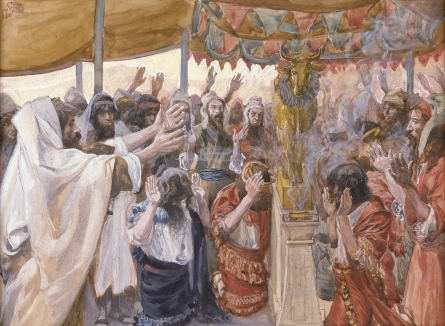
A. Idolatry (Exodus 32)
The Israelites Worship the Golden Calf (Exodus 32:1-6)
When Moses doesn't return soon from up on the mountain, the people become restless.
"1 When the people saw that Moses was so long in coming down from the mountain, they gathered around Aaron and said, 'Come, make us gods who will go before us. As for this fellow Moses who brought us up out of Egypt, we don't know what has happened to him.'
2 Aaron answered them, 'Take off the gold earrings that your wives, your sons and your daughters are wearing, and bring them to me.'3 So all the people took off their earrings and brought them to Aaron." (Exodus 32:1-3)
I'm amazed at Aaron's complicity in this idolatry! He is the delegated leader along with Hur (Exodus 24:14). But instead of rebuking the idolaters, he helps them.
Aaron reminds me of the leadership philosophy that says: Find out where people want to get, then get ahead of them and lead them there. This is a prime example where rule by majority fails to be rule by God. We sometimes see visioning exercises in churches that ask people what they'd like the church to do. Then those various visions are prioritized by votes of the people and the top ones are selected. While voting can help a group find God's will (if that is their heartfelt, prayerful desire), it often falls to the lowest common denominator of people's desires and understandings.
Dear leader, if you are just a facilitator of the desires of your people, are you a real leader under God? Or do you seek God's will on behalf of your people and represent God's interests when they are threatened in your church?
Next, Aaron directs the molding and shaping of the idol:
"He took what they handed him and made it into an idol cast in the shape of a calf, fashioning it with a tool. Then they said, 'These are your gods, O Israel, who brought you up out of Egypt.'" (Exodus 32:4)
Aaron now confuses worship of the calf with Yahweh worship by combining them into a single festival.
"5 When Aaron saw this, he built an altar in front of the calf and announced, 'Tomorrow there will be a festival to the LORD.'6 So the next day the people rose early and sacrificed burnt offerings and presented fellowship offerings. Afterward they sat down to eat and drink and got up to indulge in revelry."1 (Exodus 32:5-6)
This practice of combining elements of various religions is called syncretism, a sin that Israel suffered from for many centuries after they entered Canaan. Perhaps Aaron justifies his action in trying to keep Yahweh in the picture, so the heathen worship isn't directed entirely towards other gods, but the damage is severe!
The Israelites had spent 400 years in Egypt, which was rife with many gods that appeared as animals. The Apis Bull and the bull-headed Khnum were comparable objects of worship in Egypt. You can take the Israelites out of Egypt, but it's not so easy to get Egypt out of the Israelites!
|
Q1. (Exodus 32:1-6) Why do you think the
people of Israel were so quick to make idols, even after hearing the
monotheism of the Ten Commandments that forbade graven images? Why
do you think Aaron facilitated their sin? How do you think the
golden calf made God feel? What idols do Christian churches allow
that lead them away from pure worship of God in our day?
|
A Stiff-Necked People (Exodus 32:7, 9)
Up on the mountain, God tells Moses what is going on with the people.
"Go down, because your people, whom you brought up out of Egypt, have become corrupt.... They are a stiff-necked people." (Exodus 32:7, 9)
Stiff-necked" is a reference to a mule or ox which would resist the lead rope and refuse to let its master lead it. Instead it would stiffen its neck against the reins. The Israelites have attributed to an idol what the invisible God has done! It is a terrible sin!
God's Righteous Anger (Exodus 32:10)
Now God says to Moses:
"Leave me alone so that my anger may burn against them and that I may destroy them. Then I will make you into a great nation." (Exodus 32:10)
The people have utterly rebelled against God by substituting idols and attributing God's salvation to them. This is treason against the Monarch, the Suzerain. This is rebellion.
God is angry -- "wroth," you might say. Cole calls this
"... a deliberate 'anthropopathism,' [anthropos, "mankind"+ pathos, "feelings, passion"] describing God's feelings in human terms, as being more comprehensible to us."2
Now, now, some people might chide God. You shouldn't be angry. But God's anger at sin can't be understood apart from his own holiness, his separateness from sin, his nature utterly opposed to injustice, sin, and human degradation. Our sins offend God's very character. The Bible contains hundreds of statements about God's anger at sin. We, too, are told, "Let those who love the LORD hate evil" (Psalm 97:10a).
If you can't accept an angry God, then you won't be able to understand him. If God's anger at sin offends you, then you have placed yourself above God as his judge, with no understanding of God's holiness or his mercy. Is God's anger merely an anthropomorphism, a solely human attribute projected upon God? I don't think so. That's too easy a dismissal of a characteristic of God which is enmeshed in our entire revelation of him and his character.
Moses Intercedes for the People (Exodus 32:11-13)
God tells Moses that he will destroy the nation of Israel, and reconstruct the nation from Moses' own offspring: "Then I will make you into a great nation" (Exodus 32:10b). Since Moses himself is a direct descendent of Abraham, Isaac, and Jacob, God's promises to the patriarchs would be fulfilled. God had destroyed mankind once and restarted it with Noah and his descendents (Genesis 6-8); Moses has every reason to believe that God is quite serious.
"11 But Moses sought the favor of the LORD his God. 'O LORD,' he said, 'why should your anger burn against your people, whom you brought out of Egypt with great power and a mighty hand? 12 Why should the Egyptians say, "It was with evil intent that he brought them out, to kill them in the mountains and to wipe them off the face of the earth"? Turn from your fierce anger; relent and do not bring disaster on your people. 13 Remember your servants Abraham, Isaac and Israel, to whom you swore by your own self: "I will make your descendants as numerous as the stars in the sky and I will give your descendants all this land I promised them, and it will be their inheritance forever."'" (Exodus 32:11-13)
Moses' intercession is a clear example of someone who has taken God's interests into his heart as his own. Even though, in a way, Moses' own family would benefit from God's proposal as the New Patriarchs, Moses appeals to God, boldly interceding for the people of Israel, pleading for mercy rather than condemnation upon them. In the end God relents and responds positively to Moses' prayer.
When I read Moses' intercession, it makes me think of a Prime Minister appealing to the King to alter his decree so that it is in keeping with the concerns of foreign relations, previous treaties, the King's character, and previous decrees. Notice the basis of Moses' appeals:
- Because the Israelites are God's own people
- Because of God's reputation among the heathen
- Because of God's promises
God answers Moses' prayer of intercession.
"Then the LORD relented3 and did not bring on his people the disaster he had threatened." (Exodus 32:14)
|
|
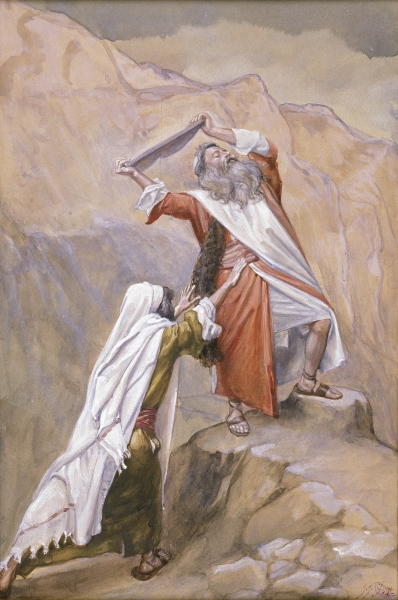
The leadership lesson here and later in Moses' ministry4 is that we are to intercede for our people, in spite of their great sins. God is merciful and will keep his promises. The leader stands between God and the people in intercessory prayer.
Moses Breaks the Tablets (Exodus 32:15-16, 19)
God had invited Moses up the mountain and promised him tablets of stone.
"The LORD said to Moses, "Come up to me on the mountain, and wait there; and I will give you the tablets of stone, with the law and the commandment, which I have written for their instruction." (Exodus 24:12)
"When the LORD finished speaking to Moses on Mount Sinai, he gave him the two tablets of the Testimony, the tablets of stone inscribed by the finger of God." (Exodus 31:18)
Moses has been given two stone tables (KJV) or tablets (NIV, NRSV), lûaḥ, "tablet, plank, board," 5 fashioned by God and written on or engraved by God himself, by the "finger of God."6
After God promises mercy on the people, Moses descends from the mountain, carrying the Ten Commandments.
"15 Moses turned and went down the mountain with the two tablets of the Testimony in his hands. They were inscribed on both sides, front and back. 16 The tablets were the work of God; the writing was the writing of God, engraved on the tablets...." (Exodus 32:15-16)
They are called here and later in the Pentateuch the "tablets of the Testimony" (NIV, KJV) or "covenant" (NRSV). The word is ʿēdût, "testimony, reminder, warning sign," related to the verb ʿûd, "bear witness, admonish, warn."7 But now Moses is overcome by anger at what he sees:
"19 When Moses approached the camp and saw the calf and the dancing, his anger burned and he threw the tablets out of his hands, breaking them to pieces at the foot of the mountain." (Exodus 32:19)
The tablets didn't slip out of Moses' hands; he threw them in anger!8 They shattered. The tablets represented God's covenant with Israel. Israel had broken the covenant almost immediately after it was made and were now attributing God's mighty salvation to mere idols.
Moses Destroys the Golden Calf (Exodus 32:20)
Moses is still angry.
"And he took the calf they had made and burned it in the fire; then he ground it to powder, scattered it on the water and made the Israelites drink it." (Exodus 32:20)
Moses destroys and desecrates this idol. The text says that he "burned it in the fire." But how do you burn a molten image? We don't have a good answer. Some have suggested that it was a gold plating over a wood structure. Perhaps. The point is that Moses took what was left -- and ground it up. We also read that centuries later, during Josiah's revival, the king burned idols and then crushed them to powder, "and scatter[ed] the dust over the graves of the common people" (2 Kings 23:6, 15). Perhaps crushing an idol to powder is how one is to "utterly demolish" an idol (Exodus 23:24).
Then Moses made the people drink the water over which he had scattered this gold powder. He "threw the dust into a stream that flowed down the mountain" (Deuteronomy 9:21). In other words, he polluted the people's drinking water with the remnants of the idol. Why, we just don't understand, but it may have had some kind of symbolic significance.
Moses Reprimands Aaron (Exodus 32:21-24)
Now, Moses confronts his brother Aaron, who is deeply implicated in this.
"21 He said to Aaron, 'What did
these people do to you, that you led them into such great sin?'
22 'Do not be angry, my lord,' Aaron answered. 'You know how
prone these people are to evil. 23 They said to me, "Make us gods
who will go before us. As for this fellow Moses who brought us up out of
Egypt, we don't know what has happened to him."24 So I told
them, "Whoever has any gold jewelry, take it off." Then they gave me the
gold, and I threw it into the fire, and out came this calf!'
25 Moses saw that the people were running wild and that Aaron had let them get out of control and so become a laughingstock to their enemies." (Exodus 32:21-24)
First, let's examine Aaron's sin.
- Bringing idolatry and syncretism (32:21), in the sense that he not only passively allowed it to occur, but actually led by supervising the fashioning of the golden calf.9
- Letting people get out of order and control (32:25) uses a single Hebrew word twice: pāraʿ, "let go, let loose, ignore." Here it has the sense of "to let go, let loose people, that is, remove restraint from them."10 Instead of stopping this wild worship of idols, he did not restrain the people. It is the job of a godly leader to keep order, even among unruly, disorderly people. To let them run wild with a mere shrug of the shoulders is not an option.
But what is worse is Aaron's false repentance. Instead of being shocked and humbled by the trouble he caused, rather he offers a lame explanation:
"Then they gave me the gold, and I threw it into the fire, and out came this calf!" (Exodus 32:24)
Recently I had occasion to see this kind of excuse in action, where an officer of the church caused schism by an action completely out of church order, and then claimed no responsibility for the resulting departure of people from the church.
I am still amazed that Aaron isn't severely punished for his leadership in idolatry and his refusal to take responsibility for his actions! Moses' sister Miriam receives a clear rebuke from the Lord for her rebellion against Moses' leadership (Numbers 12:1-15), but we don't read of Aaron being punished for leading a rebellion against the Lord!
Nevertheless, God had already told Moses on the mountain that Aaron and his sons will serve as priests in the Tabernacle. God, in his mercy, can see ahead in a way we cannot.
|
Q2. (Exodus 32:21-24) What was the nature
of Aaron's sin with the golden calf? Why do you think he won't take
responsibility for his actions? Why do you think he
gets off so easily? Why must leaders be accountable for their
actions? What is necessary for leaders to be able to learn from
their mistakes?
|
Levites Slaughter the Idolaters (Exodus 32:26-29)
Perhaps because of the urgency of the situation, Moses can't deal with Aaron at this time. And perhaps Aaron redeems himself by joining the other Levites in putting the idolaters to death. We're not told. But the people are running wild, so Moses takes action:
"26 So he stood at the entrance to the camp and said, 'Whoever is for the LORD, come to me.' And all the Levites rallied to him." (Exodus 32:26)
Moses says, "If you're for Yahweh, gather around me!" In my mind I hear the echoes of Joshua's challenge a generation later:
"Choose for yourselves this day whom you will serve.... But as for me and my household, we will serve Yahweh!" (Joshua 24:15)
The Levites, of course, are Moses' and Aaron's kinsmen, the tribe of Levi. Of anyone among the Israelites, they were most likely to be loyal to Moses. So they follow Moses' direction.
"27 Then he said to them, 'This is what the LORD, the God of Israel, says: "Each man strap a sword to his side. Go back and forth through the camp from one end to the other, each killing his brother and friend and neighbor."'
28 The Levites did as Moses commanded, and that day about three thousand of the people died." (Exodus 32:27-28)
People object to this slaughter of the idolaters as unloving or unjust. But it is likely that because of the Levites' action -- taken at the direct command of the Lord -- Israel was spared greater judgment. As it is the Lord blotted the idolaters out of his book (Exodus 32:34), and we read:
"And the LORD struck the people with a plague because of what they did with the calf Aaron had made." (Exodus 32:35)
Verse 29 is difficult for us to understand.
"Then Moses said, 'You have been set apart to the LORD today, for you were against your own sons and brothers, and he has blessed you this day.'" (Exodus 32:29)
Some translators have treated this as a statement, some as a command. The ancient Septuagint and Vulgate translations see this as a statement, followed by several modern translations:
"You have been set apart to the LORD today..." (NIV)
"Today you have ordained yourselves for the service of
the LORD..." (NRSV)
"Today you have consecrated yourselves to Yahweh..." (NJB)
Others translate it as a command, following the Hebrew text itself:
"Today ordain yourselves" (NRSV margin)
"Consecrate yourselves" (KJV)
"Dedicate yourselves today" (NASB)
The verb translated set apart / ordain / consecrate / dedicate is a two-word phrase, an idiom, literally, "fill your hand...."Keil comments, "'To fill the hand for Jehovah' does not mean to offer a sacrifice to the Lord, but to provide something to offer God."11 So "to fill one's hand (with sacrifices)," means, "to consecrate" one's service.12
Cole sees this in the context of hērem, or "sacred war," that develops in the Conquest under Joshua. As gruesome as it may seem to us, "The dead were regarded as an 'installation-sacrifice' by which Levi was consecrated to the service of the Lord."13 The phrase "and he has blessed you this day," refers not to the slaughter, but to the privilege of serving the Lord in close proximity to his holy things. Later, Phinheas, Aaron's grandson, performs a similar act of zeal for Yahweh and receives the blessing of a perpetual priesthood (Numbers 25:10-13). Cole comments, "It is important to realize that it was not the nature of the vengeance that secured the blessing. It was the wholehearted following of God."14
B. Interceding (Exodus 32:30-33:23)
Moses Intercedes for the People -- Again (Exodus 32:30-35)
The rebellion against God has been put down and that danger eliminated. But now the danger to the Israelites is from God, for they have flagrantly broken his covenant with them. Moses acts here as a mediator of God to the people, and of the people to God. When you consider it, he takes on an amazing role.
"30 The next day Moses said to the people, 'You have committed a great sin. But now I will go up to the LORD; perhaps I can make atonement for your sin.'
31 So Moses went back to the LORD and said, 'Oh, what a great sin these people have committed! They have made themselves gods of gold. 32 But now, please forgive their sin -- but if not, then blot me out of the book you have written.'
33 The LORD replied to Moses, 'Whoever has sinned against me I will blot out of my book. 34 Now go, lead the people to the place I spoke of, and my angel will go before you. However, when the time comes for me to punish, I will punish them for their sin.'
35 And the LORD struck the people with a plague because of what they did with the calf Aaron had made." (Exodus 32:7-35)
Here, the "book you have written" doesn't seem to refer to eternal life, as it does in the New Testament (Philippians 4:3; Revelation 3:5), but of physical life. God will put to death each of the sinners.
The Lord listens to Moses, but does not answer his request. Each person will be responsible for his sin and bear his punishment, says the Lord. A plague or blow from the Lord strikes the people -- but doesn't wipe them all out. However, Moses' intercession is not over.
Repentance and Mourning (Exodus 33:1-6)
"1 Then the LORD said to Moses, 'Leave this place, you and the people you brought up out of Egypt, and go up to the land I promised on oath to Abraham, Isaac and Jacob, saying, "I will give it to your descendants." 2 I will send an angel before you and drive out the Canaanites... But I will not go with you, because you are a stiff-necked people and I might destroy you on the way.'4 When the people heard these distressing words, they began to mourn and no one put on any ornaments" (Exodus 33:1-4)
The Lord had said to them,
"'Now take off your ornaments15 and I will decide what to do with you.' So the Israelites stripped off their ornaments at Mount Horeb." (Exodus 33:5b-6)
God calls them to a time of mourning rather than lightness, to repentance rather than celebration -- and they respond. They finally are beginning to understand the seriousness of turning away from Yahweh to the gods of Egypt. God is threatening to remove his Presence from their camp.
When we repent, we can avoid discipline, but if we remain adamant in our opposition to God's will, we expose ourselves to God's terrible judgment. Two verses come to mind:
"It is a dreadful thing to fall into the hands of the living God." (Hebrews 10:31)
"But if we judged ourselves, we would not come under judgment. When we are judged by the Lord, we are being disciplined so that we will not be condemned with the world." (1 Corinthians 11:31-32)
Having a healthy fear of God is a good thing -- even though it is only a step on the way to maturity (1 John 4:16-18).
Moses Intercedes One More Time (Exodus 33:12-17)
The people had experienced the Presence of the Lord in the pillar of cloud and fire (Exodus 13:21). Now God threatens to substitute a powerful intermediary, an angel, for his own Presence. While the people are humbling themselves before the Lord, Moses intercedes for them. Observe this remarkable dialog between Moses and the Lord.
"12 Moses said to the LORD, 'You have been telling me, "Lead these people," but you have not let me know whom you will send with me. You have said, "I know you by name and you have found favor with me."13 If you are pleased with me, teach me your ways so I may know you and continue to find favor with you. Remember that this nation is your people.'
14 The LORD replied, 'My Presence16 will go with you, and I will give you rest.'"17 (Exodus 33:12-14)
On what bases does Moses appeal to God?
- God's promise to be with Moses personally (Exodus 3:12), not through an intermediary.
- God's statement that he has found favor with God.18
- Moses' continued to desire to learn from God and please Him -- "teach me your ways."
- God's declaration that the Israelites are "my treasured possession" (Exodus 19:5). Moses reminds God, "Remember that this nation is your people."
In other words, Moses intercedes on a combination of (1) God's Word and promises and (2) Moses' own personal favor with God.
In the course of my business and ministry, I have developed a large network of contacts, people I know and have worked with. Often, when I need a favor, I call them up, give them my name, which they recognize immediately because of our former relationship, and then ask for what I need. If they didn't know me, they might be guarded in their response, but because we have a relationship, they answer positively if they can..
Moses can ask God for favors based on his personal relationship with him. Moses "hangs out" with God in the "tent of meeting" until his face glows (Exodus 33:7-11; 34:33-35; 2 Corinthians 3:7, 13). The Bible says,
"The LORD would speak to Moses face to face, as a man speaks with his friend" (Exodus 33:11).
And the LORD said to Moses, 'I will do the very thing you have asked, because I am pleased with you and I know you by name.'" (Exodus 33:17)
Lessons for Leader-Intercessors
In the text we've studied lie several important leadership lessons:
- Leaders are to intercede for their people, even when their people have not acted in a worthy manner.
- We intercede on the basis of God's promises. Therefore, we must know the Word. We must know intimately the promises of God.
- We intercede on the basis of our personal relationship with God, forged in prayer. Yes, in the New Testament, we come in Jesus' name, not our own (John 16:23-26). But there is no substitute for getting to know God in prayer, so that he is a personal friend. Jesus reminds us to develop our own prayer relationship with the Father: "The Father himself loves you because you have loved me" (John 16:27).
So many people approach God only liturgically or at arm's length. But we are to develop a "face-to-face" relationship with God in prayer, an intimacy, like Jesus himself had. Jesus spent hours a day in prayer with the Father, and wouldn't do anything he didn't see the Father doing (John 5:19). He patterns that same intimacy for us, his disciples! Only as we become intimately acquainted with God and his ways can we do our job as leaders when there is a crisis.
|
Q3. (Exodus 32:11-13, 30-35; 33:12-17) Why
is interceding for the people so important in Moses' ministry? Why
is this such an important role for pastors and lay leaders today? To
intercede effectively before God, why must we know both his
character and his promises??
|
Teach Me Your Ways (Exodus 33:13)
Notice one other element of Moses' character: a longing to learn from God. He says,
"If you are pleased with me, teach me your ways so I may know you and continue to find favor with you." (Exodus 33:13)
Notice the contrast when this is expressed by the Psalmist:
"He made known his ways to Moses,
his deeds to the people of Israel." (Psalm 103:7)
Yes, this could be only an example of synoptic parallelism common in Hebrew poetry. But I think it reflects more than that. Moses is seeking God himself. "Ways" is derek, from dārak "to tread, trample." Thus, "it refers first to a path worn by constant walking." While it can be used in a literal sense, here it seems to be used in terms of God's customary way of doing things.19
Here is a disciple lesson: seek to learn to know God intimately. The people were afraid of God and didn't want God to talk to them (Exodus 20:19). They only saw God's mighty acts of power. But Moses sought to understand God himself. We followers of Christ can pray with the Psalmists, "Teach me your way, O Lord" (Psalm 25:4; 27:11; 86:11).
God with Us (Exodus 33:15-16)
Observe how important God's Presence is to Moses.
"15 Then Moses said to him, 'If your Presence does not go with us, do not send us up from here. 16 How will anyone know that you are pleased with me and with your people unless you go with us? What else will distinguish me and your people from all the other people on the face of the earth?'" (Exodus 33:15-16)
Dear friends, our only power and claim to anything is that God's Presence goes with us. That is the only thing that distinguishes us and our churches from the world. Therefore, the prime thing we must do as Christian leaders and congregations is to seek the Presence of the Lord, by praise, by honor, and by repentance when our people have sinned before him. We cannot afford to "grieve the Holy Spirit" by our rebelliousness (Ephesians 4:30). I can't help but think of the wife of one of Eli's corrupt sons:
"She named the [newborn] boy Ichabod, saying, 'The glory has departed from Israel'-- because of the capture of the ark of God." (1 Samuel 4:21)
God forbid that "Ichabod" be written over the door of our church because we have not sought the Presence of the Lord and his glory has departed from our assembly!
Moses' "Tent of Meeting" Outside the Camp (Exodus 33:7-11)
Now let's back up just a bit. In Exodus 33:7-11, we're introduced to a special tent where Moses' would meet with God, a tent that preceded the construction of the Tabernacle..
"7 Now Moses used to take a tent and pitch it outside the camp some distance away, calling it the 'tent of meeting.' Anyone inquiring of the LORD would go to the tent of meeting outside the camp. 8 And whenever Moses went out to the tent, all the people rose and stood at the entrances to their tents, watching Moses until he entered the tent.
9 As Moses went into the tent, the pillar of cloud would come down and stay at the entrance, while the LORD spoke with Moses. 10 Whenever the people saw the pillar of cloud standing at the entrance to the tent, they all stood and worshiped, each at the entrance to his tent.
11 The LORD would speak to Moses face to face, as a man speaks with his friend. Then Moses would return to the camp, but his young aide Joshua son of Nun did not leave the tent." (Exodus 33:7-11)
What makes this confusing is that this "tent of meeting" uses the same term that in most places refers to the Tabernacle. Apparently after the construction of the Tabernacle (Exodus 39:32), the term "Tent of Meeting" was transferred to the formal location of God's presence in the center of the camp. However, the differences between the early tent and the later tabernacle are clear:
|
|
Moses' "tent of meeting"" |
The Tabernacle |
|
Location |
Outside the camp |
Center of camp (Num 2:2) |
|
Purpose |
Inquiring of the Lord and speaking with the Lord face-to-face |
Formal worship and sacrifice, and location of the ark of the covenant |
|
Attendants |
Joshua |
Priests and Levites |
This "tent of meeting" is referred to when Moses speaks with the Lord "face to face," that is, intimately.20
"33 When Moses finished speaking to them, he put a veil over his face. 34 But whenever he entered the LORD's presence to speak with him, he removed the veil until he came out. And when he came out and told the Israelites what he had been commanded, 35 they saw that his face was radiant. Then Moses would put the veil back over his face until he went in to speak with the LORD." (Exodus 34:33-35)
After the tabernacle was built, however, Moses would enter there and seek the Lord:
"When Moses entered the Tent of Meeting to speak with the LORD, he heard the voice speaking to him from between the two cherubim above the atonement cover on the ark of the Testimony. And he spoke with him." (Numbers 7:89)
Here he would receive additional revelations from the Lord.21
One of the secrets of Moses' ministry was his prayer and communion time spent before the Lord in this tent of meeting. Here he came to seek the Lord, and people would come here to inquire of the Lord.
Friend, do you have a place which is your "tent of meeting" with the Lord? If not, why don't you find a place and time where you can meet with the Lord regularly. As you are faithful to do this and to listen -- not to fill the time only with your own prayers -- you'll find an intimacy develop with the Lord that you've never experienced before.
|
Q4. (Exodus 33:7-11) Why is Moses' pre-tabernacle "tent of meeting" so important in
Moses' ministry?
Why is it called the "tent of meeting"? What would it take for you
to spend longer periods of intimate time seeking God? How do you
think this would affect your ministry?
|
Moses Sees God's Glory (Exodus 33:18-23)
Moses has talked to God face-to-face in his "tent of meeting" (Exodus 33:7-11) but he longs for a greater knowledge of and intimacy with God.
"18 Then Moses said, 'Now show me your glory.' 19 And the LORD said, 'I will cause all my goodness to pass in front of you, and I will proclaim my name, the LORD, in your presence.... 20 But,' he said, 'you cannot see my face, for no one may see me and live.'21 Then the LORD said, 'There is a place near me where you may stand on a rock. 22 When my glory passes by, I will put you in a cleft in the rock and cover you with my hand until I have passed by. 23 Then I will remove my hand and you will see my back; but my face must not be seen.'" (Exodus 33:18-23)
You understand, of course, that all the talk of God's face and his back are symbolic. God is Spirit, not flesh and bones (John 4:24). But the symbolic language speaks of a very great reality, the power of intimacy with the Father! Do you desire it like Moses did when he asked, "Show me your glory"? Or are you content with the relationship you already have?
The discipleship lesson I learn here from Moses is that we must keep pressing into God, not content with a status quo relationship, but always desiring more. Paul shared Moses' heart towards God:
"I regard everything as loss because of the surpassing value of knowing Christ Jesus my Lord.... I press on to make it my own.... This one thing I do: forgetting what lies behind and straining forward to what lies ahead, I press on toward the goal for the prize of the heavenly call of God in Christ Jesus." (Philippians 3:8a, 12b, 13b-14)
Dear friend, Moses was an Old Covenant prophet, whose potential intimacy with God was far less than yours (Matthew 11:11). But did Moses love God more than you do?
The Second Giving of the 10 Commandments (Exodus 34:1-4))
"1 The LORD said to Moses, 'Chisel out two stone tablets like the first ones, and I will write on them the words that were on the first tablets, which you broke. 2 Be ready in the morning, and then come up on Mount Sinai....'
4 So Moses chiseled out two stone tablets like the first ones and went up Mount Sinai early in the morning, as the LORD had commanded him; and he carried the two stone tablets in his hands." (Exodus 34:1-2, 4)
The first time, Yahweh had presented Moses with the stone tablets; he didn't have to bring anything to write on. But because Moses had broken what God had written on, this time Moses had to bring his own writing material.
The terms of the covenant are renewed and given again -- and Moses faithfully records them, though we won't rehearse them here (Exodus 34:10-27). Moses is in God's presence for a long time, basking in his glory.
"28 Moses was there with the LORD forty days and forty nights without eating bread or drinking water. And he wrote on the tablets the words of the covenant -- the Ten Commandments.
29 When Moses came down from Mount Sinai with the two tablets of the Testimony in his hands, he was not aware that his face was radiant because he had spoken with the LORD." (Exodus 34:28-29)
This is an important discipleship lesson. When we spend time in the presence of the Lord, we are changed by it. Others can see it, and though they may not understand it, they are affected by it. Paul wrote:
"And all of us, with unveiled faces, seeing the glory of the Lord as though reflected in a mirror, are being transformed into the same image from one degree of glory to another; for this comes from the Lord, the Spirit." (2 Corinthians 3:18, NRSV)
Proclamation of the Name of Yahweh (Exodus 34:5-7)
We'll close this lesson with the declaration of Yahweh's name as he reveals his glory to Moses. This is important:
"5 Then the LORD came down in the cloud and stood there with him and proclaimed his name, the LORD. 6 And he passed in front of Moses, proclaiming, 'The LORD, the LORD, the compassionate and gracious God, slow to anger, abounding in love and faithfulness, 7 maintaining love to thousands, and forgiving wickedness, rebellion and sin. Yet he does not leave the guilty unpunished....'" (Exodus 34:5-7a)
 Available as an e-book and paperback |
Notice that when God revealed his glory, he declared his goodness and graciousness. So here on the mountain God reveals his character. This quintessential statement of God's gracious character is reiterated at least twelve times in Scripture.22
God is good, God is loving, God is faithful, And God is just -- and most of all, God is gracious!
"May the grace of the Lord Jesus Christ, and the love of God, and the fellowship of the Holy Spirit be with you all." (2 Corinthians 13:14)
Prayer
Father, help us to seek you with all of our hearts, that we may know you with the same intimacy as Moses did. Forgive our prayerlessness. Forgive us for trying to do your work with merely human tools. Help us to lead your people in your ways by your mighty power! In Jesus' name, we pray. Amen.
References
1. "Indulge in revelry" (NIV, cf. NRSV), "to play" (KJV) is ṣāḥaq, which means "laugh" in the Qal stem and "play, mock" in the Piel stem, as in verse 6. The Piel of śāḥaq does, however, progress, where Samson was summoned by the cruel Philistines to "make sport," i.e., entertainment, before them (Judges 16:25); Jeremiah disdained the company of "them that make merry" (Jeremiah 15:17; 1 Kings 4:20). At Sinai their revelry included dancing (J. Barton Payne, ṣāḥaq, TWOT #1905). Acts 7:41 refers to it as "a celebration." 1 Corinthians 10:7 refers to it as "pagan revelry," paizō, to engage in some activity for the sake of amusement, play, amuse oneself" (BDAG 750). The religious celebration before Baal of Peor (Numbers 25:1-3) near the end of the Exodus involved sexual immorality. Here it included dancing (Exodus 32:19) as well as "running wild ... out of control" (Exodus 32:25).
2. Cole, Exodus, p. 215.
3. The word translated "relented" (NIV), "repented" (KJV), and "changed his mind" (NRSV) is the verb nācham, "be sorry, repent, regret, be comforted, comfort." In the majority of cases, this verb refers to God's repentance, not man's. When man's repentance is in view, the Hebrew verb shub is mainly used (Marvin R. Wilson, nācham, TWOT #1344).
4. Exodus 33:12-17; Numbers 14:13-20; 21:6-7.
5. Lûaḥ can refer to writing surfaces of stone, the wooden planks of the tabernacle, or of a ship, and the metal plates on the bases of the lavers in Solomon's temple (Walter C. Kaiser, TWOT #1091a).
6. " The finger of God" is figurative, of course, since God is Spirit (John 4:24) and has no fingers. But the term is used elsewhere (Exodus 8:19; Luke 11:20) to indicate the immediate and direct action of God himself.
7. Carl Schultz, ʿēdût, TWOT #1576f.
8. "Threw" (NIV, NRSV), "cast" (KJV) is shālak, "throw, cast, hurl" (Herman J. Austel, shālak, TWOT #2398).
9. "Led into such great sin (NIV), "brought such great sin upon them" (NRSV, KJV) is "bring." Hiphil stem of bôʾ (Elmer A. Martens, bôʾ, TWOT #212).
10. BDB 829. The word is also used in the sense of cutting or unbraiding one's hair and in the sense of "to let slip through the fingers," that is, "to ignore, reject" advice, disciple, and instruction (Victor P. Hamilton, pāraʿ, TWOT #1824).
11. Keil and Delitzsch, Exodus, p. 299.
12. "Consecration was depicted by the idiom 'fill the hands.'Some suggest that the sense of filling means the hands were full and had no time for other business, though others think that 'filling'was with a sacrificial portion since this phrase was predominately used in the commissioning of priests" (Ralph H. Alexander, yād, TWOT #844).
13. Cole, Exodus, p. 220.
14. Cole, Exodus, p. 220. Joshua 14:8; Numbers 25:11; Psalm 139:21-22.
15. "Ornaments" (ʿadî) is translated by Durham as "festive dress" ... "any ornamental or fancy dress, any attire that might suggest not just joyful life, but even life as normal" (Durham, Exodus, p. 435, citing BDB 725-726). ʿAdî is from the verb ʿādâ, "to adorn, bedeck oneself."
16. "Presence" is literally "face" (pânîym). To "see one's face" means to have a personal interview with him, rather than just through a messenger or representative.
17. Durham translates this phrase, "Thus I will dispel your anxiety" (Exodus, p. 444).
18. We don't find this statement of favor prior to this in Exodus. God had said it to Moses, but it was unrecorded.
19. Herbert Wolf, dārak, TWOT #453a.
20. Other possible references to this tent of meeting outside the camp can be found in Numbers 11:14-17, 24-30 and Numbers 12:4-5. Richard E. Averbeck ("Tabernacle," DOTP pp. 807-827) believes that the oracular tent of meeting existed even after the tabernacle was dedicated.
21. Exodus 40:34-35; Leviticus 1:1; 9:23; Numbers 1:1.
22. Numbers 14:17-19; Deuteronomy 5:10; Joel 2:13; Jonah 4:2; Nahum 1:7; 2 Chronicles 30:9; and Psalms 86:15; 103:8-13; 111:4; 112:4; 116:5; and 145:8. You can find an exposition of this passage in my book Names and Titles of God (JesusWalk, 2010), chapter 10, "The God of All Grace."
Copyright © 2024, Ralph F. Wilson. <pastor joyfulheart.com> All rights reserved. A single copy of this article is free. Do not put this on a website. See legal, copyright, and reprint information.
 |

|
In-depth Bible study books
You can purchase one of Dr. Wilson's complete Bible studies in PDF, Kindle, or paperback format -- currently 48 books in the JesusWalk Bible Study Series.
Old Testament
- Abraham, Faith of
- Jacob, Life of
- Moses the Reluctant Leader
- Joshua
- Gideon
- David, Life of
- Elijah
- Psalms
- Solomon
- Songs of Ascent (Psalms 120-134)
- Isaiah
- 28 Advent Scriptures (Messianic)
- Daniel
- Rebuild & Renew: Post-Exilic Books
Gospels
- Christmas Incarnation (Mt, Lk)
- Sermon on the Mount (Mt 5-7)
- Luke's Gospel
- John's Gospel
- Seven Last Words of Christ
- Parables
- Jesus and the Kingdom of God
- Resurrection and Easter Faith
Acts
Pauline Epistles
- Romans 5-8 (Christ-Powered Life)
- 1 Corinthians
- 2 Corinthians
- Galatians
- Ephesians
- Philippians
- Colossians, Philemon
- 1 & 2 Thessalonians
- 1 &2 Timothy, Titus
General Epistles
Revelation
Topical

 To be notified about future articles, stories, and Bible studies, why don't you subscribe to our free newsletter, The Joyful Heart, by placing your e-mail address in the box below. We respect your