Free E-Mail
Bible Studies
 Jesus' Parables for Disciples
Beginning the Journey (for new Christians). en Español
Old Testament
Abraham
Jacob
Moses
Joshua
Gideon
David, Life of
Elijah
Psalms
Songs of Ascent
(Ps 120-135)
Isaiah
Advent/Messianic Scriptures
Daniel
Rebuild & Renew: Post-Exilic Books
Gospels
Christmas Incarnation
(Mt, Lk)
Sermon on the Mount
(Mt 5-7)
Mark
Luke's
Gospel
John's Gospel
7 Last Words of Christ
Parables
Jesus and the Kingdom
Resurrection
Acts
The Early Church
(Acts 1-12)
Apostle Paul
(Acts 12-28)
Paul's Epistles
Christ Powered Life (Rom 5-8)
1 Corinthians
2 Corinthians
Galatians
Ephesians
Vision for Church
(Eph)
Philippians
Colossians,
Philemon
1
& 2 Thessalonians
1 & 2 Timothy,
Titus
General Epistles
Hebrews
James
1 Peter
2 Peter, Jude
1, 2, and 3 John
Revelation
Revelation
Conquering Lamb of Revelation
Topical
Glorious Kingdom, The
Grace
Great Prayers
Holy Spirit, Disciple's Guide
Lamb of God
Listening for God's Voice
Lord's Supper
Names of God
Names of Jesus
Christian Art
About Us
Speaking
Contact Us
Dr. Wilson's Books
Donations
Watercolors
Sitemap

 King Solomon: Wisdom, Wealth, Weakness
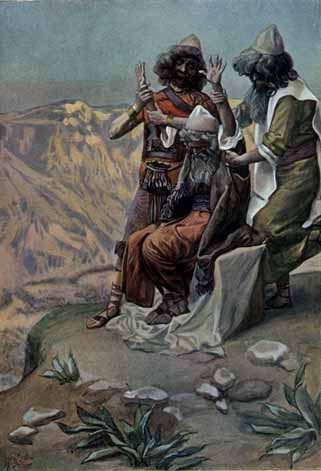
 James J. Tissot, "Moses on the Mountain during the Battle" (1896-1900), watercolor, Jewish Museum, New York. Larger image. |
Dating of the Exodus
When did the Exodus take place? If we can determine that, we'll know something about the historical setting of the people of Israel at this time. There are two popular theories of the date of the Exodus:
- Early date, about 1470 BC, end of the Middle Bronze Age
- Late date, about 1250 BC, Late Bronze Age IIB
A number of factors go into dating. This is not a matter of liberals vs. conservatives, but a matter of weighing the evidence carefully. Evidence comes from several sources: references in the Bible that can be tied to specific dates, archaeological excavations of ancient cities, and inscriptions found on ancient monuments and buildings. Weighing this evidence is quite difficult, since some of it seems ambiguous. But here's the major evidence that has come to light so far.
Store Cities of Rameses and Pithom
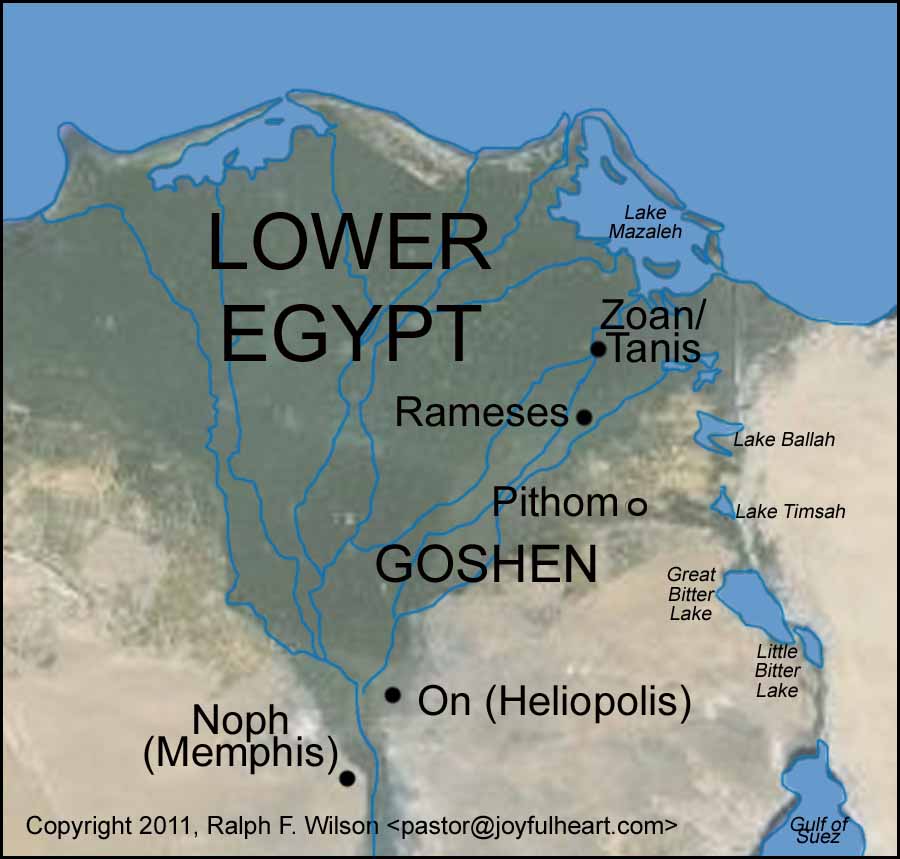 Location of Rameses and Pithom store cities. Larger image. |
There are two Egyptian store-cities mentioned in the Exodus account -- Pithom and Rameses (Exodus 1:11). The Exodus began when "the Israelites journeyed from Rameses to Succoth" (Exodus 12:37).
Scholars identify Rameses ("house of Rameses") as Qantir or Tell el-Dab`a, the ancient Avaris/Pi-Ramesse, dating to the beginning of the Eighteenth Dynasty of Egypt. The first city on that site was founded by Seti I (1294-1279 BC). Major development, however, took place under his son Rameses II, a great builder, whose 67-year reign extended from 1279-1213 BC.1 Rameses II established Pi-Ramesse as his capital city. It consisted of a mud-brick citadel associated with storage facilities to support military efforts in Canaan. It declined from 1130 BC onward. Its temple stonework was reused to build new temples at Tanis (Zoan) and elsewhere. The disused mud-brick structures crumbled back into the Nile mud from which they had been drawn.2
Some argue that, since the city (under another name) existed prior to Rameses II, it could have been referred to as Rameses as an anachronism, but I don't find that very likely. To me, the mention of the city of Rameses is evidence for the Late Date of the Exodus.
Merneptah Stela
One piece of hard evidence dated between 1220 and 1207 BC3 is the Merneptah Stela, sometimes called the Israel Stela, a black granite stela or commemorative pillar found in the ruins of a pharaoh's mortuary temple at Thebes. Merneptah was a pharaoh of the Nineteenth Dynasty (c. 1213-1203 BC), successor of Rameses II, who inscribed on this stela a series of victory hymns that appear to mention Ysr'r (Egyptian for Ysr'l) among his conquests in Syria-Palestine This seems to indicate that the Israelites were in Palestine at this time, so it marks the latest possible date for the conclusion of the Exodus period.4
Amarna Letters
In 1887, more than 300 clay tablets were discovered in Upper Egypt at Amarna. They are written in Akkadian cuneiform, and consist of correspondence that spans 15 to 30 years during the reign of Pharaoh Amenhotep III (1390-1352 BC). They consist of letters between Egypt and various vassal city-states or administrative centers, including several in Palestine. There is no mention of Israel or the Israelites. However, the `apiru referred to are probably "warlords, brigands, and disenfranchised peoples on the outskirts of society." The word cannot be etymologically related to the word "Hebrew" and the word cannot be equated with the Israelites.5 For those who contend for an Early Date for the Exodus, the Amarna Letters present several problems since they contain no clear reference to the Israelites who (according the Early Date theory) should be in Canaan by this time.6
Conquest of Canaanite Cites
The results of archaeological digs in ancient Canaanite cities don't provide consistent support for either a late or early date. The data is controversial and often incomplete. In Jericho, the only discovery of city walls that would seem to match the Conquest account in Joshua is found in Stratum IV, usually dated about 1550 BC. After that, there seems to have been no significant occupation until well into the Iron Age. This might argue for an earlier date for the Exodus and Conquest.
Reference in 1 Kings
An Early Date of about 1446 BC (fifteenth century, Late Bronze I) can be derived by adding up numbers in the Bible. The key text says:
"In the four hundred and eightieth year after the Israelites had come out of Egypt, in the fourth year of Solomon's reign over Israel, in the month of Ziv, the second month, he began to build the temple of the LORD." (1 Kings 6:1)
Since the dedication of Solomon's temple occurred in 966 BC, this gives a date of 1446 BC for the Exodus. But to complicate matters, the Masoretic Hebrew text reads 480 years, while the Greek Septuagint text reads 440 years, which would make the date of the Exodus about 1406 BC.
But how does this fit with the historical data that we can glean from other documents and from the evidence of archaeological digs? An event of the magnitude of the Exodus should synch with at least some events in the surrounding cultures. Unfortunately, the resulting data at this point just isn't that clear-cut.
Is there another way of understanding 1 Kings 6:1? To pioneering Bible archaeologist William F. Albright, the number looks less like an exact figure, but rather a round figure of 12 generations of 40 years each, the usual conventional length. But if men were 20 to 30 at the birth of their eldest son as often seemed the case, the period of 12 generations would actually bring the date of the Exodus to the 13th century BC.7
Old Testament scholar K. A. Kitchen observes,
"In principle, this problem is not quite so contradictory as it may appear, if we remember that the Old Testament is also part of the Ancient Near East, and therefore that Ancient Oriental principles must be applied. Thus, in ordinary king lists and historical narratives, ancient scribes and writers did not usually include synchronistic tables8 and cross-references as we do today."9
Summing Up
So which date has the most support? This is difficult. My own tentative conclusion is the Late Date. Evangelical Old Testament scholar R.K. Harrison agrees.
"The beginning of the Conquest can be dated about 1235 BC, or slightly later, on the assumption that the Exodus occurred in the thirteenth rather than the fifteenth century BC." 10
This would make
- Seti I (1294-1279 BC) the pharaoh of the oppression, and
- Rameses II (1279-1213 BC) the pharaoh of the Exodus
But, as Durham puts it,
"The chronology of the events described in Exodus is of little importance to the theological message of the book in its present form. "11
Who Wrote the Books of Moses
The second question I'd like to explore briefly is: Who wrote the Books of Moses? Of course, the traditional answer is Moses himself. But note that nowhere in the Pentateuch does the author speak in the first person, but always in the third person voice of a narrator.
Moses didn't have any difficulty writing. After all, he was well educated. Moreover, the Scripture specifically says that he wrote down God's revelation (Exodus 17:14; 24:4, 12; 34:27; etc.). Surely, Moses was the original author of a considerable part of the Pentateuch!
But when you read the Pentateuch carefully, you begin to see "seams" between some of the various stories narrated, as if they were put together by a final editor or redactor from various documents in existence when the final version was complete.
The most celebrated and complex theory of authorship was advanced by German Old Testament scholar Julius Wellhausen (1844-1918), which is referred to as "the Documentary Hypothesis." He posited four strands of sources, which are abbreviated JEDP:
|
J |
Yahwistic |
|
E |
Eloistic |
|
D |
Deuteronomic |
|
P |
Priestly |
The Yahwistic strand could be identified, so goes the theory, by the editor's use of Yahweh (Jehovah) or LORD for God; the Eloistic strand by the use of El for God. Wellhausen was widely influential and the theory grew more and more complex -- and speculative. These days, however, Wellhausen's JEDP theory is in disarray. R.N. Whybray commented in 1995 on the state of Pentateuchal studies:
"There is at the present moment no consensus whatever about when, why, how, and through whom the Pentateuch reached its present form, and opinions about the dates of composition of its various parts differ by more than five hundred years."12
 Available as an e-book and paperback |
Certainly, Jesus, the Jews, and the early church all believed that the Pentateuch (which the Jews referred to as "the law") was inspired by God and attributed it as a whole to Moses. It's likely that the materials Moses or other early editors worked with represent oral and written traditions dated much earlier than Moses himself. Whether Moses was the first to write down the stories of Abraham and his descendents or served as an editor himself, we just don't know.13 Our focus will not be on speculative theories of sources, but on the text that comes down to us in the Bible and the meaning of that revelation.
We'll look at the route of the Exodus in Appendix 2 and New Testament references to Moses in Appendix 3. Other questions will be covered in the appropriate lesson.
References
1. K. A. Kitchen, Ancient Orient and Old Testament (InterVarsity Press, 1966), pp. 57-58, fn. 6, sees his accession taking place in either 1304 or 1290, based on a combination of lunar and historical data. William S. LaSor ("Ramses," ISBE 3:41-42) pegs the date at 1304 BC. Other sources state his accession as 1279 BC.
2. K. A. Kitchen, "Egypt, Egyptians," DOTP, p. 210.
3. The stela was placed in the fifth year of Merneptah's reign. Using Kuhrt's "middle chronology this would be c. 1220. Using Kitchen's "low chronology," adopted here, the date would be about 1208.
4. Gary Pratico, "Merneptah," ISBE 3:324-325.
5. Ibid., p. 263.
6. Ibid., pp. 263-264.
7. Cole, Exodus, p. 42.
8. For example, it is likely that reigns of the judges overlapped. We also see princes co-reigning with their fathers for a period, before the reigning king died.
9. Kitchen, Ancient Orient, p. 72.
10. Harrison, Introduction to the Old Testament, p. 177. Cecil B. DeMille's epic movie "The Ten Commandments" (1956) and the animated film "Prince of Egypt" (1998) assume a late date for the Exodus
11. Durham, Exodus, p. xxvi.
12. R.N. Whybray, Introduction to the Pentateuch (Eerdmans, 1995), pp. 12-13, cited in T. Desmond Alexander, "Authorship of the Pentateuch," DOTP 61-72.
13. Alexander, DOTP 61-72; Hamilton, Genesis 1:11-38.
Copyright © 2024, Ralph F. Wilson. <pastor joyfulheart.com> All rights reserved. A single copy of this article is free. Do not put this on a website. See legal, copyright, and reprint information.
 |

|

In-depth Bible study books
You can purchase one of Dr. Wilson's complete Bible studies in PDF, Kindle, or paperback format -- currently 48 books in the JesusWalk Bible Study Series.
Old Testament
- Abraham, Faith of
- Jacob, Life of
- Moses the Reluctant Leader
- Joshua
- Gideon
- David, Life of
- Elijah
- Psalms
- Solomon
- Songs of Ascent (Psalms 120-134)
- Isaiah
- 28 Advent Scriptures (Messianic)
- Daniel
- Rebuild & Renew: Post-Exilic Books
Gospels
- Christmas Incarnation (Mt, Lk)
- Sermon on the Mount (Mt 5-7)
- Luke's Gospel
- John's Gospel
- Seven Last Words of Christ
- Parables
- Jesus and the Kingdom of God
- Resurrection and Easter Faith
Acts
Pauline Epistles
- Romans 5-8 (Christ-Powered Life)
- 1 Corinthians
- 2 Corinthians
- Galatians
- Ephesians
- Philippians
- Colossians, Philemon
- 1 & 2 Thessalonians
- 1 &2 Timothy, Titus
General Epistles
Revelation
Topical

 To be notified about future articles, stories, and Bible studies, why don't you subscribe to our free newsletter, The Joyful Heart, by placing your e-mail address in the box below. We respect your