Free E-Mail
Bible Studies
 Jesus' Parables for Disciples
Beginning the Journey (for new Christians). en Español
Old Testament
Abraham
Jacob
Moses
Joshua
Gideon
David, Life of
Elijah
Psalms
Songs of Ascent
(Ps 120-135)
Isaiah
Advent/Messianic Scriptures
Daniel
Rebuild & Renew: Post-Exilic Books
Gospels
Christmas Incarnation
(Mt, Lk)
Sermon on the Mount
(Mt 5-7)
Mark
Luke's
Gospel
John's Gospel
7 Last Words of Christ
Parables
Jesus and the Kingdom
Resurrection
Acts
The Early Church
(Acts 1-12)
Apostle Paul
(Acts 12-28)
Paul's Epistles
Christ Powered Life (Rom 5-8)
1 Corinthians
2 Corinthians
Galatians
Ephesians
Vision for Church
(Eph)
Philippians
Colossians,
Philemon
1
& 2 Thessalonians
1 & 2 Timothy,
Titus
General Epistles
Hebrews
James
1 Peter
2 Peter, Jude
1, 2, and 3 John
Revelation
Revelation
Conquering Lamb of Revelation
Topical
Glorious Kingdom, The
Grace
Great Prayers
Holy Spirit, Disciple's Guide
Lamb of God
Listening for God's Voice
Lord's Supper
Names of God
Names of Jesus
Christian Art
About Us
Speaking
Contact Us
Dr. Wilson's Books
Donations
Watercolors
Sitemap
10. Preparing Ourselves for the Lord's Supper (1 Corinthians 11: 27-34)
Audio (23:50) |
 King Solomon: Wisdom, Wealth, Weakness
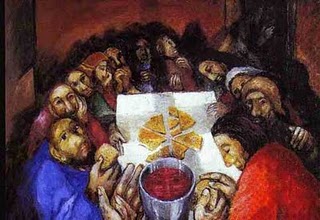 Sieger Köder (German priest-artist, 1925- ), "The Last Supper." The painting is from the perspective of Christ facing his disciples. You see Jesus' face reflected in the cup of red wine, the Chi Rho symbol in the broken bread, the cross, etc. |
"27Therefore, whoever eats the bread or drinks the cup of the Lord in an unworthy manner will be guilty of sinning against the body and blood of the Lord. 28A man ought to examine himself before he eats of the bread and drinks of the cup. 29For anyone who eats and drinks without recognizing the body of the Lord eats and drinks judgment on himself. 30That is why many among you are weak and sick, and a number of you have fallen asleep. 31But if we judged ourselves, we would not come under judgment. 32When we are judged by the Lord, we are being disciplined so that we will not be condemned with the world. 33So then, my brothers, when you come together to eat, wait for each other. 34If anyone is hungry, he should eat at home, so that when you meet together it may not result in judgment. And when I come I will give further directions." (1 Corinthians 11:27-34)
Before we consider eating and drinking unworthily, let's survey the context of Paul's teaching.
Divisions between the Rich and Poor in Corinth (11:17-22)
The church at Corinth had various problems with unity, with divides between pastoral allegiance (1 Corinthians 1:12; 3:1-10), spiritual gifts (1 Corinthians 12-14), and in our passage, economic status. Apparently people in the early church often brought their own food to meetings of the congregation, which would likely have met in the larger homes of the wealthy members. They would eat an Agape Meal together, mixing a communal meal with a celebration of the Lord's Supper. Verses 17-22 give us the situation:
"17In the following directives I have no praise for you, for your meetings do more harm than good. 18In the first place, I hear that when you come together as a church, there are divisions among you, and to some extent I believe it. 19No doubt there have to be differences among you to show which of you have God's approval. 20When you come together, it is not the Lord's Supper you eat, 21for as you eat, each of you goes ahead without waiting for anybody else. One remains hungry, another gets drunk. 22Don't you have homes to eat and drink in? Or do you despise the church of God and humiliate those who have nothing? What shall I say to you? Shall I praise you for this? Certainly not!" (1 Corinthians 11:17-22)
The problem in Corinth was that the rich would go ahead and eat without waiting for others -- and not even making sure that the poor in the congregation had eaten or even brought food with them. The poor probably made up a large portion of the congregation, many of them slaves (1 Corinthians 7:21-23).
The class divisions in the society at large remained in the church. By eating without the poor, the rich showed utter disdain for their brothers and sisters. It was more than rudeness. It was an offence against Christian unity.
Paul had confronted church divisions before. Once he had rebuked the Apostle St. Peter who had eaten with Gentiles in Antioch, but separated himself from them when Jewish Christians came from Jerusalem -- trying to show them that he was a good Jew who didn't eat with Gentiles (Galatians 2:11-14). At the conclusion of his first letter to the Corinthian church Paul tells them:
"The body is a unit, though it is made up of many parts; and though all its parts are many, they form one body. So it is with Christ. For we were all baptized by one Spirit into one body -- whether Jews or Greeks, slave or free -- and we were all given the one Spirit to drink." (1 Corinthians 12:12-13)
Paul is disgusted at the behavior of the wealthy Corinthian church members. You can catch his tone in the words: "What shall I say to you? Shall I praise you for this? Certainly not!" (1 Corinthians 11:22).
Not Discerning the Body (11:29)
Following this rebuke, Paul gives instructions on the Words of Institution of the Lord's Supper (11:23-26), which we have considered in detail before. Then he returns to implications of the wealthy members' disregard for the poor. Rather than going through this passage verse by verse, let's begin our exploration with verse 29, since it holds the key to Paul's meaning:
"For anyone who eats and drinks without recognizing the body [of the Lord] eats and drinks judgment on himself." (1 Corinthians 11:29, NIV)
"Discerning" (KJV, NRSV) or "recognizing" (NIV, NJB) is dokimazō, "to make a critical examination of something to determine genuineness, put to the test, examine," often used of assaying the genuineness of metal.1 Fee sees the meaning here as "to discern, distinguish as distinct and different."2 But to understand this verse we must determine what Paul means by "the body." There is a textual variant here. The NIV and KJV render the phrase "the Lord's body." But the earliest Greek manuscripts (followed by the NRSV, NASB, NJB, etc.) omit "the Lord's," which was probably included by an early copyist to help explain the word "body."3
I see two possible interpretations of the word "body":
- "Body" refers to the Eucharistic elements , that is, the bread and wine which represent Christ's body and blood. The meaning is thus that the communicants -- that is, those taking communion -- are judged for not recognizing that they are partaking of a sacred meal, and must act accordingly towards one another, caring for the needs of the poor and those who come in late.
- "Body" refers to the church, the "Body of Christ. " The meaning is thus that communicants are judged for not discerning needs of other members the Body of Christ, that is, the congregation.
The main argument for "body" as the Eucharistic elements is that the most immediate uses of the word "body" are clearly referring to the Eucharistic bread representing Christ's flesh. "Body" here serves a kind of "shorthand" for "body and blood."4
The main argument for "body" as the church is that references to "body" in the immediate passage are to "body and blood" together, not to "body" by itself. There is a clear reference to "body" as the church in 1 Corinthians 10:17 -- "Because there is one loaf, we, who are many, are one body, for we all partake of the one loaf." Since verse 16 clearly uses "body" in a Eucharistic sense, we know that Paul can freely mix these metaphors within the same topic.5 Of these two interpretations, I see the second as more likely.
Paul contends that partaking of the Lord's Supper without making sure that other members of the congregation are taken care of is "unworthy." The Greek anaxiōs means "in an unworthy/careless manner."6 To partake in such a fashion is to live lower than their calling to "walk worthy of the gospel" (Philippians 1:27; 1 Thessalonians 2:12; Colossians 1:10; Ephesians 4:1; 3 John 6).
Sinning against the Body and Blood of the Lord (1 Corinthians 11:27)
What does it mean to sin "against the body and blood of the Lord" (verse 27). It means to commit an act that is disrespectful of this holy meal, in this case, by eating of it in a careless fashion, without a thought of slighting others in the congregation. The Lord's Table, as it is called in 1 Corinthians 10:21, is holy and demands our reverence. If we sin carelessly and then expect to partake of the elements depicting Christ's suffering and death for our sins, we are hypocrites. In the Old Testament, the priests had become casual towards holy things and were rebuked for it:
"You place defiled food on my altar.
But you ask, 'How have we defiled you?'
By saying that the LORD's table is contemptible." (Malachi 1:7)
As terrible as it is to sin "against the body and blood of the Lord," however, realize that it is no more or less sinful than other sins against fellow Christians. For example, Paul admonishes those who flaunt their so called "freedom" in Christ in a way that offends or scandalizes weaker Christians, "When you sin against your brothers in this way and wound their weak conscience, you sin against Christ" (1 Corinthians 8:12). Jesus spoke in a similar way in the Parable of the Sheep and the Goats (Matthew 25:31-46) where neglecting "one of the least of these brothers of mine" was like a sin against Jesus himself.
| Q1. (11:29) Why does "not discerning the body" at the Lord's Supper
constitute such a grave sin? Aren't there worse things a church could have
done? https://www.joyfulheart.com/forums/index.php?showtopic=493
|
Incurring Judgment and Discipline (1 Corinthians 11:29-32)
Paul warns the Corinthians that to continue sinning is to invite punishment. Two words are used to describe this punishment:
- "Judgment " (NIV, NRSV, NKJV) or "damnation" (KJV) in verse 29 is krima, "legal decision rendered by a judge, judicial verdict."7
- "Disciplined" (NIV, NRSV) or "chastened" (KJV) in verse 32 is paideuō, "to assist in the development of a person's ability to make appropriate choices, practice discipline," here, to discipline with punishment,8 especially the kind of punishment a parent might give to a child to help mold his or her character.
Paul is not talking here about eternal damnation for the sinning Corinthians (as suggested by the KJV translation), but corrective punishment, "that we should not be condemned9 with the world." The writer of Hebrews reminds us (quoting from Proverbs 3:11-12):
"'My son, do not make light of the Lord's discipline,
and do not lose heart when he rebukes you,
because the Lord disciplines those he loves,
and he punishes everyone he accepts as a son.'
Endure hardship as discipline; God is treating you as sons. For what son is not disciplined by his father?" (Hebrews 12:5-7)
Nevertheless, this discipline can be severe if we resist it, resulting in sickness or even premature death.
"That is why many among you are weak and sick, and a number of you have fallen asleep." (1 Corinthians 11:30)
We may think this is too harsh of God. He should be more forgiving! we cry. Our problem is that we minimize the seriousness of sin. We excuse ourselves and then wonder why God won't. God our Father is seeking to form us in his own image. We also maximize death as the ultimate penalty, whereas for his children, God sees it as a homecoming, not eternal death. He will deal with our sins if we won't, but he prefers that we recognize ourselves what needs to be done and repent without him applying pressure.
| Q2. (1 Corinthians 11:29-32) Why has God brought judgment to the
offending parties at Corinth? Isn't sickness and death rather harsh? How
does God's discipline actually work for our good in the light of Hebrews
12:5-7? https://www.joyfulheart.com/forums/index.php?showtopic=494
|
Self-Examination (1 Corinthians 11:28, 31)
Paul recommends that take heed to this ourselves. He uses two words to describe this:
- "Examine" yourself (verse 28), dokimazō (which we saw as "discerning" or "recognizing" in verse 29) "to make a critical examination of something to determine genuineness, put to the test, examine."10
- "Judge" yourself (vs. 31), diakrinō, used twice in this passage to mean, "to evaluate by paying careful attention to, evaluate, judge." In verse 31 it is used as "evaluate oneself." In verse 29 it means "recognize" the body.11
"A man ("person," anthropos) ought to examine himself before he eats of the bread and drinks of the cup" (verse 28)
"But if we judged ourselves, we would not come under judgment." (verse 31)
In two other passages Paul urges self-examination:
"Examine yourselves (peirazō12) to see whether you are in the faith; test (dokimazō) yourselves." (2 Corinthians 13:5)
"Each one should test (dokimazō) his own actions. Then he can take pride in himself, without comparing himself to somebody else, for each one should carry his own load." (Galatians 6:4-5)
| Q3. (1 Corinthians 11:28, 31) Introspection by a neurotic person can
foster guilt and self-loathing. Where is the balance? How can we conduct
self-examination and self-judgment so that it has a healthy rather than an
unhealthy result in us? https://www.joyfulheart.com/forums/index.php?showtopic=495
|
Confession and Repentance
Jesus, too, encouraged reflection when we come to worship God. Here are a pair of verses -- one from Matthew, one from Mark -- that serve as the flip side of each other:
"Therefore, if you are offering your gift at the altar and there remember that your brother has something against you, leave your gift there in front of the altar. First go and be reconciled to your brother; then come and offer your gift." (Matthew 5:23-24)
"And when you stand praying, if you hold anything against anyone, forgive him, so that your Father in heaven may forgive you your sins." (Mark 11:25)
The Didache, a late first-century Christian document, says in the context of the Lord's Supper:
" But every Lord's day gather yourselves together, and break bread, and give thanksgiving after having confessed your transgressions, that your sacrifice may be pure. But let no one who is at odds with his fellow come together with you, until they be reconciled, that your sacrifice may not be profaned..."13 (Didache 14.2)
It is significant that the 12 Steps of Alcoholics Anonymous includes these:
- "Made a searching and fearless moral inventory of ourselves.
- Admitted to God, to ourselves and to another human being the exact nature of our wrongs.
- Were entirely ready to have God remove all these defects of character.
- Humbly asked Him to remove our shortcomings.
- Made a list of all persons we had harmed, and became willing to make amends to them all.
- Made direct amends to such people wherever possible, except when to do so would injure them or others."
(Were you aware that the 12 Steps were developed by evangelical Christians?) It is one thing to acknowledge a sin. It is another to repent of it as wrong and seek to make it right, if possible.
For many centuries the Roman Catholic Church has required regular confession to a priest as a prerequisite to taking communion. Done sincerely, confession can aid in spiritual growth and victory over sin. Protestants have often taken sin much too lightly. In the context of sickness resulting from unacknowledged sin, St. James exhorts confession and repentance, so there might be healing (James 5:16).
Confession to another human, such as an accountability partner, is a powerful way of helping us deal squarely with our sins. But we can also confess our sins to God alone and receive forgiveness (absolution) of our sins (1 John 1:9; Psalm 32:5; 51:2-5; ). No matter how confession is made, confession and repentance are absolutely necessary to growth in the Christian life. When we bury our sins, we stagnate, falter, and are subject to our Father's loving but firm discipline.
If we know we are living with unrepented sin, is it more respectful of Jesus not to partake of the Lord's Supper? Yes, it is more respectful, but it is stupid. We are subject to God's discipline for hanging onto sin whether or not we take communion. There is a time to repent and come clean, and let the chips fall where they will. The Lord's Supper is a reminder to us that now is the time to examine ourselves, this is the day to get back on the path. Paul writes:
"As God's fellow workers we urge you not to receive God's grace in vain... I tell you, now is the time of God's favor, now is the day of salvation." (2 Corinthians 6:1)
| Q4. How do confession and repentance fit with self-examination? What
is the result of self-examination without confession and repentance? How do
confession and repentance serve to bring spiritual health and character
change? https://www.joyfulheart.com/forums/index.php?showtopic=496
|
How to Prepare for Communion
Of course, we should begin each day in reflection, confession, and repentance. But especially when we come to the Lord's Table it is a time to "do business with God." How do we prepare ourselves for communion?
- If possible, take some time before the communion service, at home or arriving at church early. Don't expect the pastor or the liturgy to do this preparation for you. Fellowshipping with others at church is good, but not if it distracts you from that heart-preparation necessary so that you can worship God aright.
- Examine yourself to see if you are in sin , either a known sin or perhaps something you are unaware of. This means to pause to consider your life. How are you treating the people close to you? How are you treating those in the congregation? With indifference? With selfishness? With disrespect?
- Confess any sins , known sin or sins that God brings to mind as you are examining yourself.
- Repent of these sins and resolve to take immediate steps to correct your actions or make amends, if you are able.
- Accept God's forgiveness . This time of self-reflection and repentance is not to give Satan permission to continually beat you up over sins of the past. Accept and believe in God's promises of forgiveness. We don't look backward -- our sins have been forgiven. We look forward to living with God the day ahead of us.
Occasionally we can undo a wrong, but many times we cannot, and to try to do so might be harmful to others and seem self-serving. Sometimes we must resolve not to sin like that again, accept God's forgiveness, and go on, trusting his promise that he will "forgive our sins and purify us from all unrighteousness" (1 John 1:9).
We have examined in some detail the Words of Institution,
"This is my body, which is for you; do this in remembrance of me.... This cup is the new covenant in my blood; do this, whenever you drink it, in remembrance of me." (1 Corinthians 11:24-25)
But just to understand it isn't enough. Now we are called to live our lives before God with thanksgiving for his sacrifice and humble appreciation for his forgiveness. The Lord's Supper is designed by our Lord both to nourish us and cause us to grow in him.
My prayer for both you and me is that Jesus' intention for his Supper might be fulfilled in us, in our congregations, and in our world -- now and until Jesus' return in glory. "For whenever you eat this bread and drink this cup, you proclaim the Lord's death until he comes" (1 Corinthians 11:26).
 Available as e-book and paperback. |
Prayer
Father, forgive me for the times that I've come to the Table without preparing my heart to commune with you. Help me and my brothers and sisters to come to you ready to give worship and receive your blessings of the Word and the refreshing Holy Spirit. We love you, but we are weak; help us. In Jesus' name, we pray. Amen.
Evaluation
This completes the Lord's Supper Bible study.
Would you please evaluate this
Bible study by filling out a brief survey? Thank you.
https://www.jesuswalk.com/evaluation/
References
- Dokimazō
Copyright © 2024, Ralph F. Wilson. <pastor joyfulheart.com> All rights reserved. A single copy of this article is free. Do not put this on a website. See legal, copyright, and reprint information.
 |

|
In-depth Bible study books
You can purchase one of Dr. Wilson's complete Bible studies in PDF, Kindle, or paperback format -- currently 48 books in the JesusWalk Bible Study Series.
Old Testament
- Abraham, Faith of
- Jacob, Life of
- Moses the Reluctant Leader
- Joshua
- Gideon
- David, Life of
- Elijah
- Psalms
- Solomon
- Songs of Ascent (Psalms 120-134)
- Isaiah
- 28 Advent Scriptures (Messianic)
- Daniel
- Rebuild & Renew: Post-Exilic Books
Gospels
- Christmas Incarnation (Mt, Lk)
- Sermon on the Mount (Mt 5-7)
- Luke's Gospel
- John's Gospel
- Seven Last Words of Christ
- Parables
- Jesus and the Kingdom of God
- Resurrection and Easter Faith
Acts
Pauline Epistles
- Romans 5-8 (Christ-Powered Life)
- 1 Corinthians
- 2 Corinthians
- Galatians
- Ephesians
- Philippians
- Colossians, Philemon
- 1 & 2 Thessalonians
- 1 &2 Timothy, Titus
General Epistles
Revelation
Topical

 To be notified about future articles, stories, and Bible studies, why don't you subscribe to our free newsletter, The Joyful Heart, by placing your e-mail address in the box below. We respect your