Free E-Mail
Bible Studies
 Jesus' Parables for Disciples
Beginning the Journey (for new Christians). en Español
Old Testament
Abraham
Jacob
Moses
Joshua
Gideon
David, Life of
Elijah
Psalms
Songs of Ascent
(Ps 120-135)
Isaiah
Advent/Messianic Scriptures
Daniel
Rebuild & Renew: Post-Exilic Books
Gospels
Christmas Incarnation
(Mt, Lk)
Sermon on the Mount
(Mt 5-7)
Mark
Luke's
Gospel
John's Gospel
7 Last Words of Christ
Parables
Jesus and the Kingdom
Resurrection
Acts
The Early Church
(Acts 1-12)
Apostle Paul
(Acts 12-28)
Paul's Epistles
Christ Powered Life (Rom 5-8)
1 Corinthians
2 Corinthians
Galatians
Ephesians
Vision for Church
(Eph)
Philippians
Colossians,
Philemon
1
& 2 Thessalonians
1 & 2 Timothy,
Titus
General Epistles
Hebrews
James
1 Peter
2 Peter, Jude
1, 2, and 3 John
Revelation
Revelation
Conquering Lamb of Revelation
Topical
Glorious Kingdom, The
Grace
Great Prayers
Holy Spirit, Disciple's Guide
Lamb of God
Listening for God's Voice
Lord's Supper
Names of God
Names of Jesus
Christian Art
About Us
Speaking
Contact Us
Dr. Wilson's Books
Donations
Watercolors
Sitemap
7. Father, Into Your Hands I Commit My Spirit (Luke 23:46)
by Dr. Ralph F. Wilson
Audio (7:15)
 King Solomon: Wisdom, Wealth, Weakness
|
|
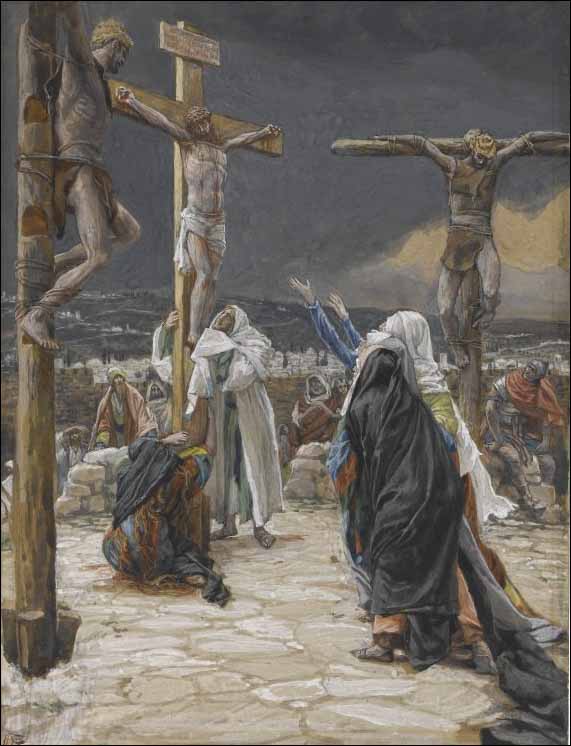
"44 It was now about the sixth hour, and darkness came over the whole land until the ninth hour, 45 for the sun stopped shining. And the curtain of the temple was torn in two. 46 Jesus called out with a loud voice, 'Father, into your hands I commit my spirit.' When he had said this, he breathed his last." (Luke 23:44-46)
Under the Romans, crucifixion was often a long, drawn-out process. That was the idea -- a prolonged, tortuous death for criminals would not only inspire horror in the hearts of the populace, but also provide a public reminder of the danger of any attempt to resist Roman power.
Criminals would often last for days before they finally succumbed, though on this day, the day before a Sabbath, any surviving criminals would be killed by breaking their legs (John 19:31-33) and their bodies removed from the cross through some kind of agreement brokered with the chief priests so as not to overly offend Jewish sensibilities.
Temple Curtain Torn
It was a time of ominous signs in the heavens and on the earth beneath.
"44 It was now about the sixth hour, and darkness came over the whole land until the ninth hour, 45 for the sun stopped shining. And the curtain of the temple was torn56 in two." (Luke 23:44-45)
We discussed the eerie darkness under the Fourth Word above. But in addition to the sun not shining, the curtain of the temple was rent.
The curtain mentioned is the inner curtain that separates the Holy of Holies from the Holy Place.57 Edersheim tells us that it consisted of two curtains that were 60 feet long and 30 feet wide, as thick as the palm of a man's hand, woven in 72 separate squares, and joined together.58 Think of the force that would have been required to tear this massive curtain! Perhaps the earthquake caused the fall of a lintel to begin the vertical rip that went from top to bottom (Mark 15:38).59
But what does the rent curtain mean? The Gospel writers don't tell us. But it probably signifies: (1) an opening of the way between people and the very presence of God, brought about by Christ's redemption on the cross, or (2) a forewarning of the obsolescence and final destruction of the temple. Perhaps it means both of these.
Jesus Final Word (Luke 23:46)
"Jesus called out with a loud voice, 'Father, into your hands I commit my spirit.' When he had said this, he breathed his last." (Luke 23:46)
These words are from a Psalm written by David:
"Into your hands I commit my spirit;
redeem me, O LORD, the God of truth." (Psalm 31:5)
They are part of an evening prayer used daily by devout Jews.60
Notice the loud voice -- scarcely what one would expect from a man about to die. But Jesus seems determined that his final words be heard. His words are firm and confident. Let's examine three aspects of this Seventh Word.
1. A Word of Intimacy
First, Jesus speaks to God with intimacy. His time of desolation expressed by the Fourth Word is past. He prays to the Father as he has done throughout his ministry. For Jesus, death is no out-of-control enemy. No matter how bleak the moment, he knows his Father is present with him -- now present to receive his spirit.
2. A Word of Trust
Second, Jesus entrusts himself to his Father. In Psalm 31:5 the word "commit" is the Hebrew verb pāqad. In our verse it occurs in the Hiphil stem, with the meaning "commit, entrust."61 The corresponding Greek verb is paratithēmi, meaning, "to entrust to someone for safekeeping, give over, entrust, commend," particularly, "to entrust someone to the care and protection of someone."62 As he lets go of this life, Jesus trusts his eternal destiny to the Father's everlasting arms.
3. A Word of Surrender
Finally, Jesus speaks a word of surrender. He gives up his human life to his Father who gave it to him 33 years before. The word "spirit" is the common word pneuma, "breathing, breath of life." It can refer to the Holy Spirit, but here refers to the personal spirit of Jesus, part of the human personality (Hebrews 4:12; 1 Thessalonians 5:23).63
Jesus prays his final prayer with this kind of equanimity and peace because he knows the Father, and knows that there is life with the Father beyond death. As a devout Jew he has prayed these words as part of an evening prayer all his life. Now at the end of his life he prays them one last time -- and lets go of human life64 in order to embrace the Life that the Father has to offer in his own presence.
We pray, with Jesus, "Father, into your hands I commit my spirit"
Prayer
Father, when it comes time for us to let go of this life, help us do it with the same kind of faith and confidence that we see in Jesus. We love you, Lord. Thank you for our salvation and eternal life. In Jesus' name, we pray. Amen.
Question for Personal Mediation
Q7. (Luke 23:46) What does Jesus mean when
he says, "Father, into your hands I commit my spirit"? Why does this saying
comfort us so much?
|
Questions for Group Discussion
- What is the meaning of the curtain of the temple being torn in two? (Luke 23:45b)b)
- What does Jesus mean when he says, "Father, into your hands I commit my spirit" (Luke 23:46)? Why does this saying comfort us so much?
- What would you have felt like had you witnessed Jesus' crucifixion -- if you didn't know the next chapter in the story?
- Why is faith so important during the dark chapters of our lives? What does it take to shake off the numbness and depression and take hold of that faith once more?
References
56. The word "torn" (NIV, NRSV), "rent" (KJV) is schizō (from which we get our English words "schism" and "schizophrenia"). Here it means "to divide by use of force, split, divide, separate, tear apart" (BDAG 981, 1b).
57. Katapetasma, BDAG 524. See also Hebrews 6:19 and 10:20.
58. Edersheim writes, "That some great catastrophe, betokening the impending destruction of the Temple, had occurred in the Sanctuary about this very time, is confirmed by not less than four mutually independent testimonies: those of Tacitus, of Josephus, of the Talmud, and of earliest Christian tradition" (Life and Times, 2:611). He cites Yoma 54a, Kethub 106a; Sheqal. viii. 5.
59. Edersheim, Life and Times, 2:610. He cites Tacitus, Hist. v. 13; Josephus, Wars 6, 5, 3; Jer. Yoma 43c; Yoma 39b. Marshall, Luke, p. 874 notes Jewish references to such portents 40 years before the fall of Jerusalem, and cites Strack and Billerback I, 1045f., but notes that Josephus dates these in 66 AD. Edersheim (2:610) observes, "So in the Gospel according to the Hebrews, from which St. Jerome quotes (in Matthew 27:51, and in a letter of Hedibia) to the effect that the huge lintel of the Temple was broken and splintered, and fell. St. Jerome connects the rending of the Veil with this, and it would seem an obvious inference to connect again this breaking of the lintel with an earthquake."
60. Marshall, Luke, p. 876.
61. Pāqad, BDG 823, h2a. The basic meaning of the word is "attend to, visit, muster, appoint." A similar idea is found in 1 Kings 14:27, where the king entrusts bronze shields to the commanders of the palace guard (1 Kings 14:27).
62. Paratithēmi, BDAG 772, 3b. We see similar expressions in Acts 7:59 and 1 Peter 4:19.
63. Pneuma, BDAG 832-836.
64. The phrase "breathed his last" (NIV, NRSV), "gave up the ghost" (KJV) translates a verb from the same root as pneuma: ekpneō, "breathe out one's life/soul, expire," a euphemism for "die" (BDAG 308). See also Eduard Schweitzer, "ekpneō," TDNT 6:452-453.
Copyright © 2024, Ralph F. Wilson. <pastor joyfulheart.com> All rights reserved. A single copy of this article is free. Do not put this on a website. See legal, copyright, and reprint information.
 |
|
In-depth Bible study books
You can purchase one of Dr. Wilson's complete Bible studies in PDF, Kindle, or paperback format -- currently 48 books in the JesusWalk Bible Study Series.
Old Testament
- Abraham, Faith of
- Jacob, Life of
- Moses the Reluctant Leader
- Joshua
- Gideon
- David, Life of
- Elijah
- Psalms
- Solomon
- Songs of Ascent (Psalms 120-134)
- Isaiah
- 28 Advent Scriptures (Messianic)
- Daniel
- Rebuild & Renew: Post-Exilic Books
Gospels
- Christmas Incarnation (Mt, Lk)
- Sermon on the Mount (Mt 5-7)
- Luke's Gospel
- John's Gospel
- Seven Last Words of Christ
- Parables
- Jesus and the Kingdom of God
- Resurrection and Easter Faith
Acts
Pauline Epistles
- Romans 5-8 (Christ-Powered Life)
- 1 Corinthians
- 2 Corinthians
- Galatians
- Ephesians
- Philippians
- Colossians, Philemon
- 1 & 2 Thessalonians
- 1 &2 Timothy, Titus
General Epistles
Revelation
Topical