Free E-Mail
Bible Studies
 King
Solomon
King
SolomonBeginning the Journey (for new Christians). en Español
Old Testament
Abraham
Jacob
Moses
Joshua
Gideon
David, Life of
Elijah
Psalms
Solomon
Songs of Ascent
(Ps 120-135)
Isaiah
Advent/Messianic Scriptures
Daniel
Rebuild & Renew: Post-Exilic Books
Gospels
Christmas Incarnation
(Mt, Lk)
Sermon on the Mount
(Mt 5-7)
Mark
Luke's
Gospel
John's Gospel
7 Last Words of Christ
Parables
Jesus and the Kingdom
Resurrection
Acts
The Early Church
(Acts 1-12)
Apostle Paul
(Acts 12-28)
Paul's Epistles
Christ Powered Life (Rom 5-8)
1 Corinthians
2 Corinthians
Galatians
Ephesians
Vision for Church
(Eph)
Philippians
Colossians,
Philemon
1
& 2 Thessalonians
1 & 2 Timothy,
Titus
General Epistles
Hebrews
James
1 Peter
2 Peter, Jude
1, 2, and 3 John
Revelation
Revelation
Conquering Lamb of Revelation
Topical
Glorious Kingdom, The
Grace
Great Prayers
Holy Spirit, Disciple's Guide
Lamb of God
Listening for God's Voice
Lord's Supper
Names of God
Names of Jesus
Christian Art
About Us
Speaking
Contact Us
Dr. Wilson's Books
Donations
Watercolors
Sitemap

3. The Fragrance of Christ's Ministering People (2 Corinthians 2:12-3:6)
by Dr. Ralph F. WilsonAudio (27:00)
 King Solomon: Wisdom, Wealth, Weakness
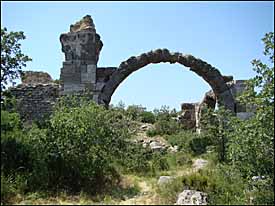 The remains of several ancient vaulted chambers at the Baths of Herodes Atticus, near Troas. |
An Open Door and Peace in One's Spirit (2:12-13)
Paul's ministry center was Ephesus during this time, but from there he made various trips to strengthen the churches.
"Now when I went to Troas to preach the gospel of Christ and found that the Lord had opened a door for me...." (2:12)
He travelled north in the province of Asia by road to Troas, an important seaport and commercial center, and gateway from Asia to Macedonia and Thrace.
Paul had passed through Troas on his second missionary journey (Acts 16:7-12), but did not stay to preach there. He received his "Macedonian call" in a dream and sailed to Macedonia to begin the church in Philippi. But now Paul finds "an open door," an expression that Paul uses to indicate receptiveness to the gospel, an opportunity for "effective work" (1 Corinthians 16:9), "something made possible or feasible."[73] And so he begins to preach in Troas, establishing a church.[74] But he doesn't stay very long.
"13 I still had no peace of mind,[75] because I did not find my brother Titus there. So I said good-by to them and went on to Macedonia." (2:12-13)
He has hoped to find Titus at this possible meeting place. However, still concerned about the report that Titus will bring regarding the situation in Corinth, he sails from Troas to Macedonia where he finds Titus at last (7:5-7).
Marching in the Triumphal Procession (2:14)
Now he pauses to reflect on the amazing experience of seeing God open people to the gospel as he had at Troas. So many are closed to God, but some have been prepared to receive the Word.
"But thanks be to God, who always leads us in triumphal procession in Christ and through us spreads everywhere the fragrance of the knowledge of him." (2:14)
Paul's image of a triumphal expression is a graphic "“ and controversial "“ one. "Triumphal procession" (NIV, NRSV), "triumph" (KJV) is thriambeuō, used here and in Colossians 2:15. It has four possible meanings:
- To cause someone to triumph (KJV), but this has been abandoned by modern interpreters.
- To put someone on show or display.
- To lead captives in a triumphal procession. Though this use has the best lexical support, being led as a captive suggests shame, which isn't Paul's point here.
- To lead someone as a soldier in a triumphal procession. This fits the context best and has been adopted by the NIV, NRSV, NASB, New Jerusalem Bible. This makes the most sense to me.[76]
The image is striking: a victorious general leading his army in a triumphant procession through a conquered city "“ or even into the capital city of the empire. During such a parade, incense would be burned to the gods and its fragrance would be carried to the crowds lining the streets. The aroma would be unforgettable.
Up until now, Paul has talked about the trials and struggles that have accompanied his ministry. This reference to a triumphal procession doesn't reflect triumphalism, but a balanced view of ministry effectiveness that God brings in spite of difficulties.
The Fragrance of Knowing God (2:14-16)
It is this idea of fragrance that Paul carries forward to describe his ministry of salvation.
"14 But thanks be to God, who always leads us in triumphal procession in Christ and through us spreads everywhere the fragrance of the knowledge of him. 15 For we are to God the aroma of Christ among those who are being saved and those who are perishing. 16 To the one we are the smell of death; to the other, the fragrance of life. And who is equal to such a task?" (2:14-16)
Two Greek nouns are used to describe this scent:
- "Fragrance" (NIV, NRSV), "savor" (KJV) in verses 14 and 16 is osmē, generally, "odor, smell," of a pleasant odor or a bad odor, then figuratively, the quality of something that affects the mind as with an odor."[77] The word in verse 14 is in a positive sense. Then the word occurs twice in verse 16, first of the smell of death and then of the fragrance of life.
- "Aroma" (NIV, NRSV), "sweet savor" (KJV) in verse 15 is euōdia, "aroma, fragrance," used elsewhere of the fragrance from a sacrifice, pleasing to God.[78]
The fragrance of the gospel "“ and of the carriers of this gospel "“ is "the knowledge of God." Wherever Paul went, he told people about Jesus, spread the knowledge that there is a Savior "“ and he reflected in his life the intimate knowledge of a personal relationship with Jesus, the fragrance of a pleasant, winsome character.
Paul contrasts two types of smells in verse 16:
- Smell of death is the odor of the putrefying flesh of a corpse. Even when masked by funeral spices, the smell is still present. No one is fooled. It is the smell of people who are "perishing," ap-ollymi, "to cause or experience destruction," here in the middle voice, "perish, be ruined."[79] Many Christians don't really believe that people are lost, dying, and being destroyed forever to end up in a hell eternally separated from God. But that is the pungent odor of eternal death that Paul is trying to contrast with the fragrant smell of life and victory.
- Fragrance of life is the pleasant smell of perfumed incense that fills the nostrils with the stimulating scent of safety and joy, signified by a victory parade. It is the fragrance of people being saved and rescued from their lives of sin.
Dear friend, do you have any strong spiritual "scent" when you are around people, or have you given up on it so as not to offend those who are allergic to Christian perfume? Jesus said that it's possible for disciples to lose their "saltiness" (to employ a different analogy, Matthew 5:12). We must be authentic "“ be who we really are in Christ "“ realizing that to some (those whom the Holy Spirit has prepared) we will be welcome messengers of eternal life, and to others (who resist the Holy Spirit), we will be seen as bearers of a restrictive message that would hobble a person's licentious lifestyle. The gospel has a way of clarifying the issue, leading some to eternal life and confirming others in their destination of eternal death.
Q1. (2 Corinthians 2:14-16a) In what sense is knowing God
fragrant to people who are open to God? In what way is this fragrance repugnant
to people who are closed to God? Have you suppressed your "fragrance" because
some people are allergic to Christian perfume? If so, how can you regain the
fragrance of Christ's gospel?
https://www.joyfulheart.com/forums/index.php?showtopic=1078
Who Is Sufficient for This Ministry (2:16b)
Paul closes this brief section with a question:
"And who is equal to such a task?" (NIV)
"Who is sufficient for these things?" (NRSV, KJV)
Who is really able to spread the fragrance of Christ around him or her to draw people to the gospel of love? The answer to this question is found later in this lesson in 3:4-6, where the questions of sufficiency and competency[80] is explored. But with his next sentence, Paul implies that though he and his associates are equipped for the task of the gospel ministry, his opponents are not "“ those who are mere peddlers of the word.
Peddlers or Sincere Advocates (2:17)
Now Paul turns to motives for ministry, since his motives have been called into question by his opponents in Corinth.
"Unlike so many, we do not peddle the word of God for profit. On the contrary, in Christ we speak before God with sincerity, like men sent from God." (2:17)
He contrasts two motives:
- Selfish. "Peddle for profit / peddlers" (NIV, NRSV), "corrupt" (KJV) is the verb kapēleuō, "trade in, peddle, huckster," in the context of retail trade, often used of tavern-keepers in secular Greek. Because of the tricks of small tradesmen of using false weights, or thinning the wine with water, the word almost comes to mean, "adulterate."[81] The motive of self-appointed false apostles is always self-seeking, self-aggrandizing, sometimes with a financial incentive. Too often we've seen preachers abuse money! But this verse also applies to those who will water down the requirements of the gospel in order to get followers. We've seen a lot of people promoting "easy believe-ism" in our day, since to get people to embrace the concept of discipleship might result in them walking sadly away from Jesus "“ and from us.
- Unselfish. "Sincerity" (NIV) is eilikrineia, "the quality or state of being free of dissimulation, sincerity, purity of motive."[82] The motive of "men sent from God" is to bear the truth without any selfish motive or trickery, but with sincerity. We have been sent to people to please God our Sender, not to please ourselves. It is not about us! We are bearers of God's word, not reinterpreters of it in order to suit the hearers' fancies.
Letters Written on the Heart (3:1-3)
Paul's opponents question and undermine his apostolic authority. Does he have credentials that prove he is an apostle? Or is he just promoting himself? Paul answers these innuendoes head on.
"Are we beginning to commend ourselves again? Or do we need, like some people, letters of recommendation to you or from you?" (3:1)
The verb "commend" is synistēmi, from syn-, "together" + istēmi, "place, set," that is, "to bring together." Here it has the specialized meaning, "to bring together as friends or in a trusting relationship by commending or recommending, present, introduce/recommend someone to someone else."[83] This theme of commending or recommending is mentioned a number of places in 2 Corinthians.[84]
Letters of introduction or recommendation were widespread in the ancient world. Often the bearer of the letter would be the one commended and would receive appropriate hospitality and welcome upon arrival.[85] Paul himself sent such letters, for example, to the Roman church, he says:
" I commend to you our sister Phoebe, a servant of the church in Cenchrea. 2 I ask you to receive her in the Lord in a way worthy of the saints and to give her any help she may need from you, for she has been a great help to many people, including me." (Romans 16:1-2)
Some of the Corinthians seem to be agitating for Paul to produce a letter stating his apostolic credentials. His answer is to the point:
"2 You yourselves are our letter,[86]
written on our hearts, known and read by everybody.
3 You show that you are a letter from Christ, the result of our
ministry, written not with ink but with the Spirit of the living God, not on
tablets of stone but on tablets of human hearts." (3:2-3)
Do you want proof that I am an apostle? You're it! You are the fruit of my apostolic ministry. I founded your church. I brought many of you to faith in Christ. Rather than someone else's recommendation of us, you yourselves are the evidence.
Living Letters
Paul's insight is quite remarkable. People can read you like a book. They can sense if you're genuine or not. That's why outward piety is so disgusting. What convinces people of Christian authenticity is the unmistakable inner spirit. Peter told women who were tempted to dress to impress:
"Instead, it should be that of your inner self, the unfading beauty of a gentle and quiet spirit, which is of great worth in God's sight." (1 Peter 3:4)
You, dear friend, are a letter from Christ to your neighbor, to your son or daughter, to your co-worker. Let the Spirit of God have his full way with you so that the letter doesn't get distorted or become unreadable because of your smudges!
Q2. (2 Corinthians 3:2-3) In what sense are we "living
letters"? In what way can people "read us"? Why is it so important to be
authentic, not phony, in our lives? What happens when people "read" something in
you that they admire and mention it to you? How might you respond appropriately?
https://www.joyfulheart.com/forums/index.php?showtopic=1079
Competent Servants of a New Covenant (3:4-6)
Because he knows the fruit of his ministry, Paul is confident "“ but he doesn't take personal credit for this fruit. Back in 2:16, Paul asked the rhetorical question: "Who is sufficient (hikanos) for these things?" (NRSV, KJV). Now he answers the question.
"4 Such confidence[87] as this is ours through Christ before God. 5 Not that we are competent (hikanos) in ourselves to claim anything for ourselves, but our competence (hikanotēs) comes from God. 6 He has made us competent (hikanoō) as ministers of a new covenant "“ not of the letter but of the Spirit; for the letter kills, but the Spirit gives life." (3:4-6)
"Competent" (NIV, NRSV), "sufficient" (KJV) is the adjective hikanos, which has the basic sense of "sufficient, enough, large enough."[88] We saw it first in 2:16 above. Here it means "pertaining to meeting a standard, fit, appropriate, competent, qualified, able," with the connotation, "worthy, good enough."[89] The word group also appears in this verse as a verb hikanoō[90] and a noun hikanotēs.[91]
How Seminaries and Ordination Relate to Competency
The question Paul is addressing is: What makes a minister competent? Is it a letter of recommendation "“ which is the ancient equivalent of a certificate of ordination, which is an organizational recommendation? Or is it a diploma of graduation from a Bible course or a theological seminary? What makes a minister competent?
Paul's answer is that God makes us competent by his Spirit "“ pure and simple. With the gifts and calling of God, a minister is competent to nurture and give birth to spiritual life in people who don't know the Lord. This is from God!
So if our competence for ministry is from the Spirit, then does theological training and ordination have any meaning? Yes! Let me explain.
First, let's discuss the value of theological training. I grant that many seminaries offer inadequate training. They deal with the intellectual questions of the faith and equip pastors to lead existing churches. Too often, however, they don't offer enough in the areas of character development and practical topics such as leadership, church planting, and evangelism that are necessary to grow the church. But in my experience, seminaries, and to some extent Bible colleges, provide excellent help in (1) training pastors to interpret scripture and (2) background to be able to think critically, to ask the important questions.
Next, let's talk about the role of the local church. Frankly, an indispensible place for ministers to be prepared is through experience in the local church under the mentoring of a wise pastor. Here is where character formation happens along with leadership development and experience with evangelism and growth.
Finally, let's examine the place of licensing (for pastors-in-training working in the local church) and ordination (for those who have been trained and are ready to go out on their own). Licensing says: We believe this person is called by God and is qualified to work in ministry under supervision. Ordination is essentially a letter of recommendation to people who come across the path of the minister that he or she has gone through an adequate training program, possesses gifts of the Holy Spirit, is of strong Christian character, and has placed himself or herself in an ongoing relationship of accountability to other leaders in the Church.
I've met some "self-made" pastors who seem to be functioning well in ministry "“ and many who aren't. I've heard seminaries called "cemeteries" by groups that have an anti-intellectual bias. (And some seminaries probably are!) I've heard people say dismissively, "I don't need man's ordination; it is God who ordains people." But often these kinds of statements are made out of a combination of ignorance, pride, arrogance, and rebelliousness.
To have a healthy ministry, the Church (usually a denomination or association of like-minded churches) needs to make sure that those in ministry leadership roles:
- Know the Scriptures and can interpret them soundly and wisely,
- Have spiritual gifts for ministry and exercise them with care and wisdom,
- Are of tested moral character and live a holy life,
- Have a healthy and growing devotional life,
- Act properly in terms of money, sex, and power (areas that have derailed many promising ministries), and
- Continue in accountability to their elders and peers in the larger Church, so that they don't get off track doctrinally, morally, or spiritually.
There are always mavericks in ministry "“ some of whom bring a real corrective to the Church. But it is valuable to local churches when seeking a pastor to have a letter of recommendation from other trusted Christian leaders that this candidate meets important criteria as a spiritual leader. I believe that training and ordination have an important place.
The Vital Role of the Holy Spirit (3:6)
Having said that, Paul is absolutely correct in stating that our competency "“ that is, our ability to do effective ministry "“ comes from God working through the Spirit.
"He has made us competent as ministers of a new covenant "“ not of the letter but of the Spirit; for the letter kills, but the Spirit gives life." (3:6)
We can have the best training that seminaries can provide, we can have powerful spiritual gifts, we can have great personal charisma, we can have a dynamic work ethic. But none of this by itself will produce spiritual fruit that remains. Only coupled with submission to the dynamic Spirit of God will we see fruit that remains "“ and that is the purpose of ministry, whether ordained or lay ministry.
Q3. (2 Corinthians 3:4-6) What is the balance between the
need for training in ministry (either in the local church or in schools) and
personal submission to the Spirit of God? Are you able to "listen to the
Spirit's voice" in your own life? Why would this ability be so important in
being a competent minister?
https://www.joyfulheart.com/forums/index.php?showtopic=1080
Ministers of a New Covenant (3:6a)
"He has made us competent as ministers of a new covenant" (3:6a)
I've spent quite a bit of time discussing theological training and ordination, as if it were necessary for ministry within the local church. It's not! For church members who aspire to lead other congregations, however, these elements are very important.
Each Christian, each member, has been given spiritual gifts and has a ministry "“ no matter how seemingly insignificant "“ within the local church. After all, the word "minister" in 3:6 is the word diakonos (from which we get our word "deacon"), which means simply, "one who serves," "generally, one who is busy with something in a manner that is of assistance to someone."[92] People who serve according to their gifts make any local church effective. Without them, the church doesn't work. In this sense, think of yourself as a "minister" who is serving Christ and Christ's body, the church.
One of the serious consequences of not attending church regularly is that you probably aren't exercising your spiritual gifts in ministry, and you may not be giving of your finances to support Christ's mission in your community. Every church has flaws, since it is made up of flawed people, but you must be part of a church because it an integral part of Jesus' strategy to minister to his people and to the world. If you're out of regular fellowship with a church "“ unless you're physically unable to attend "“ it's time to reconsider!
Q4. (2 Corinthians 3:6a) Why is a Christian's spiritual
health so closely related to his or her involvement in ministry? What are the
consequences of dropping out of church "“ for the believer? For Christ's Kingdom?
https://www.joyfulheart.com/forums/index.php?showtopic=1081
The other important phrase in this verse is "new covenant." The Old Covenant brought through Moses and spelled out in the Mosaic Law, has now been fulfilled and is therefore obsolete. We are under the New Covenant, promised by the Prophet Jeremiah (Jeremiah 31:31) and ushered in by Jesus through his own blood "“ a Kingdom that operates not on the basis of a written law or code, but on the basis of the Holy Spirit now living in each believer. The old has passed, behold the new has come!
"In the same way, after the supper he took the cup, saying, "This cup is the new covenant in my blood, which is poured out for you." (Luke 22:20; cf. 1 Corinthians 11:25)
"... To Jesus the mediator of a new covenant...." (Hebrews 12:24; also see Hebrews 8:8; 9:15)
 Also available in e-book and paperback |
Because of the New Covenant in Jesus' blood and the life of the Holy Spirit within you, you have eternal life "“ now and an unfading hope of life with Christ "“ forever! You have a fragrance around you that attracts people to salvation in Jesus. You have the ability to serve by the Spirit. And you are a competent minister of the Messiah. Hallelujah!
Prayer
Thank you, Father, for all the blessings you bestow upon me through the Spirit. Keep me humble before you and before my brothers and sisters, so that your Spirit may flow unimpeded and uncontaminated through me to touch others. In Jesus' name, I pray. Amen.
Key Verses
"But thanks be to God, who always leads us in triumphal procession in Christ and through us spreads everywhere the fragrance of the knowledge of him. 15 For we are to God the aroma of Christ among those who are being saved and those who are perishing." (2 Corinthians 2:14-15)
"You yourselves are our letter, written on our hearts, known and read by everybody. You show that you are a letter from Christ, the result of our ministry, written not with ink but with the Spirit of the living God, not on tablets of stone but on tablets of human hearts." (2 Corinthians 3:2-3)
"He has made us competent as ministers of a new covenant "“ not of the letter but of the Spirit; for the letter kills, but the Spirit gives life." (2 Corinthians 3:6)
End Notes
Chapter 3
[73] Thyra, BDAG 462, 1bγ. The expression is also found in 1 Corinthians 16:9; Colossians 4:3; Acts 14:27.
[74] Paul returned to preach in the Troas church (and put Eutychus to sleep during a late-night meeting) at the conclusion of his Third Missionary Journey (Acts 20:5-12).
[75] "Peace" (NIV), "rest" (NRSV, KJV) is anesis, literally, "relaxing, loosening," here, "relief from something onerous or troublesome, rest, relaxation, relief" (BDAG 77, 2). It is used twice more in this letter (7:5; 8:13). Here, it is used along with pneuma, "spirit," as "as the source and seat of insight, feeling, and will, generally as the representative part of human inner life" (BDAG 833, 3b).
[76] Kruse, pp. 88-89; thriambeuō, BDAG 459.
[77] Osmē, BDAG 728, 2.
[78] Euōdia, BDAG 417. Also Philippians 4:18 and Ephesians 5:2. This is different from the name Euodia (Philippians 4:2), since her name is spelled differently in Greek and means "fine travelling."
[79] Apollymi, BDAG 115, 1bα, present participle.
[80] "Equal" (NIV), "sufficient" (NRSV, KJV) is hikanos, which we see several times in 3:5-6.
[81] Kapēleuō, BDAG 508.
[82] Eilikrineia, BDAG 282. Also used at 1:12.
[83] Synistēmi, BDAG 972, 2. "Recommendation" (NIV, NRSV), "commendation" (KJV) is the adjective systatikos, "introducing, commendatory" (BDAG 978).
[84] 2 Corinthians 3:1-3; 4:2; 5:12; 6:4; 10:12-18; and 12:11.
[85] Barnett, p. 161, fn. 12.
[86] "Letter" is epistolē, (from which we get our word, "epistle"), "letter, epistle" (BDAG 383).
[87] "Confidence" (NIV, NRSV), "trust" (KJV) is pepoithēsis, "a state of certainty about something to the extent of placing reliance on, trust, confidence," found four times in 2 Corinthians (here and in 1:15; 8:22; 10:2) (BDAG 796, 1b).
[88] Karl H. Rengstorf, hikanΓ³s, ktl., TDNT 3:293-296.
[89] Hikanos, BDAG 472, 2.
[90] "Made competent" (NIV, NRSV), "made able" (KJV) is hikanoō, "to cause to be adequate, make sufficient, qualify," perhaps shading into the sense "empower, authorize" someone for something (BDAG 473).
[91] Hikanotēs, "state of being qualified or adequate for something, fitness, capability, qualification" (BDAG 473).
[92] Diacanos, BDAG 232.
Copyright © 2024, Ralph F. Wilson. <pastor joyfulheart.com> All rights reserved. A single copy of this article is free. Do not put this on a website. See legal, copyright, and reprint information.
 |

|

In-depth Bible study books
You can purchase one of Dr. Wilson's complete Bible studies in PDF, Kindle, or paperback format -- currently 48 books in the JesusWalk Bible Study Series.
Old Testament
- Abraham, Faith of
- Jacob, Life of
- Moses the Reluctant Leader
- Joshua
- Gideon
- David, Life of
- Elijah
- Psalms
- Solomon
- Songs of Ascent (Psalms 120-134)
- Isaiah
- 28 Advent Scriptures (Messianic)
- Daniel
- Rebuild & Renew: Post-Exilic Books
Gospels
- Christmas Incarnation (Mt, Lk)
- Sermon on the Mount (Mt 5-7)
- Luke's Gospel
- John's Gospel
- Seven Last Words of Christ
- Parables
- Jesus and the Kingdom of God
- Resurrection and Easter Faith
Acts
Pauline Epistles
- Romans 5-8 (Christ-Powered Life)
- 1 Corinthians
- 2 Corinthians
- Galatians
- Ephesians
- Philippians
- Colossians, Philemon
- 1 & 2 Thessalonians
- 1 &2 Timothy, Titus
General Epistles
Revelation
Topical

 To be notified about future articles, stories, and Bible studies, why don't you subscribe to our free newsletter, The Joyful Heart, by placing your e-mail address in the box below. We respect your