Free E-Mail
Bible Studies
 Jesus' Parables for Disciples
Beginning the Journey (for new Christians). en Español
Old Testament
Abraham
Jacob
Moses
Joshua
Gideon
David, Life of
Elijah
Psalms
Songs of Ascent
(Ps 120-135)
Isaiah
Advent/Messianic Scriptures
Daniel
Rebuild & Renew: Post-Exilic Books
Gospels
Christmas Incarnation
(Mt, Lk)
Sermon on the Mount
(Mt 5-7)
Mark
Luke's
Gospel
John's Gospel
7 Last Words of Christ
Parables
Jesus and the Kingdom
Resurrection
Acts
The Early Church
(Acts 1-12)
Apostle Paul
(Acts 12-28)
Paul's Epistles
Christ Powered Life (Rom 5-8)
1 Corinthians
2 Corinthians
Galatians
Ephesians
Vision for Church
(Eph)
Philippians
Colossians,
Philemon
1
& 2 Thessalonians
1 & 2 Timothy,
Titus
General Epistles
Hebrews
James
1 Peter
2 Peter, Jude
1, 2, and 3 John
Revelation
Revelation
Conquering Lamb of Revelation
Topical
Glorious Kingdom, The
Grace
Great Prayers
Holy Spirit, Disciple's Guide
Lamb of God
Listening for God's Voice
Lord's Supper
Names of God
Names of Jesus
Christian Art
About Us
Speaking
Contact Us
Dr. Wilson's Books
Donations
Watercolors
Sitemap

 King Solomon: Wisdom, Wealth, Weakness
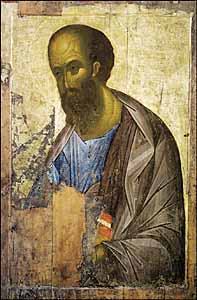 Andrei Rublev, "Apostle Paul" (1420s), tempera on wood, 160 x 109 cm, The Tretyakov Gallery, Moscow. |
Paul has struggled with how to help the Corinthian church in its difficulty. He has written letters, he has made a short painful visit (see Introduction), but still the problems persist. In this lesson, he explains his change of plans to them and the reasons for the change. While we're not too interested now, two millennia later, in changes of plans, we do learn much from Paul's incidental teaching as he makes his explanation.
A Legacy of Godliness and Sincerity (1:12-14)
First, Paul affirms his sincerity in his relations with the Corinthians. Their current leaders manipulated and exploited them (11:20), but Paul reminds them that he didn't do this.
"Now this is our boast: Our conscience testifies that we have conducted ourselves[37] in the world, and especially in our relations with you, in the holiness and sincerity that are from God. We have done so not according to worldly wisdom but according to God's grace." (1:12)
Paul's demeanor towards the Corinthians has been characterized by openness and selflessness. He employs two words to indicate this. The first conveys the idea of singleness of motive, the second of being unmixed with other motives.
- Simple love. James warns against double-mindedness (James 1:8; 4:8). Paul emphasizes his singleness of motive with the word haplotēs, from a root meaning "single" as opposed to "two-fold."�[38]
- Sincerity. "Sincerity" is eilikrineia, which has the basic meaning of "unmixed, without alloy." Here it is used in a moral sense, "pertaining to being sincere, without hidden motives or pretense, pure."�[39]
Even his letters are clear and understandable.
"13 For we do not write you anything you
cannot read or understand. And I hope that,
14 as you have understood us in part, you will come to understand
fully that you can boast[40]
of us just as we will boast of you in the day of the Lord Jesus." (1:13-14)
Paul is seeking restoration of a relationship to the point where both he and the Corinthians admire each other so much that they are proud of each other.
Paul's Planned Visit to Corinth (1:15-18)
Now Paul tells them of his previous plans to visit them, not because of some selfish motive, but to benefit them.
"15 Because I was confident of this, I planned to visit you first so that you might benefit[41] twice. 16 I planned to visit you on my way to Macedonia and to come back to you from Macedonia, and then to have you send me on my way to Judea." (1:15-16)
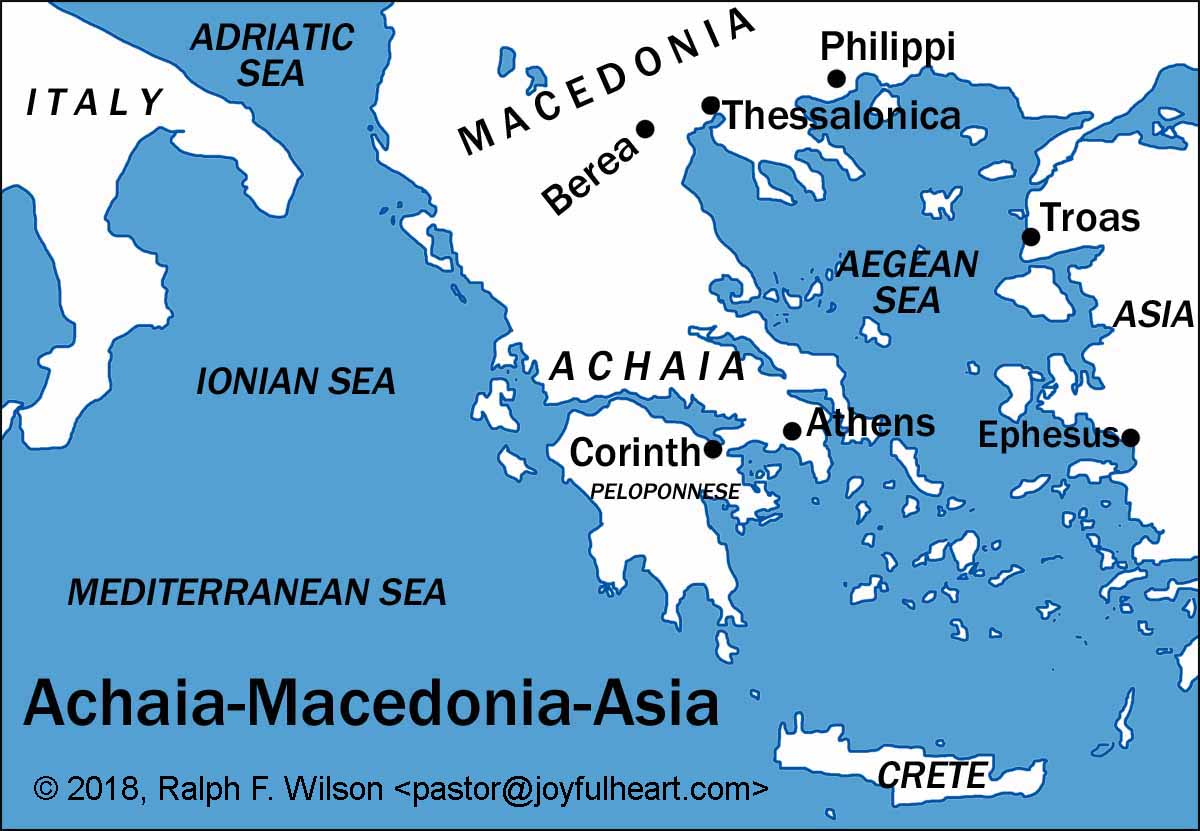
Paul planned to sail from Ephesus across the Aegean Sea to Corinth and stay with them for a while. Then travel by land north to Macedonia (Philippi, Thessalonica, Berea). Then after his time in Macedonia, return to Corinth for another visit. Then sail from Corinth (actually, from the nearby port of Cenchreae just east of Corinth) to Jerusalem, bearing a monetary gift to aid the poverty-stricken believers there.
His motive was pure, but now he feels he has to defend even his change of plans to his opponents in Corinth, who might take this as a pretext to criticize him for being indecisive and vacillating. So he explains:
"When I planned this, did I do it lightly?[42] Or do I make my plans in a worldly manner so that in the same breath I say, ‘Yes, yes' and ‘No, no'?"�(1:17)
The Firm Promises of God (1:18-20)
Then Paul reinforces his sincerity and clarity of purpose by pointing to the clear, unequivocal message of Christ that he had brought to them.
"18 But as surely as God is faithful, our message to you is not ‘Yes' and ‘No.' 19 For the Son of God, Jesus Christ, who was preached among you by me and Silas and Timothy, was not ‘Yes' and ‘No,' but in him it has always been ‘Yes.' 20 For no matter how many promises God has made, they are ‘Yes' in Christ. And so through him the ‘Amen' is spoken by us to the glory of God. 21 Now it is God who makes both us and you stand firm in Christ." (1:18-21)
Christ is the fulfillment of all of God's promises for Israel in the Old Testament. To which we respond: "Amen," a word transliterated from the Hebrew as a strong affirmation of something that has been stated, an expression of faith: "let it be so, truly, amen."�[43]
Anointing, Seal, and Spirit (1:21b-22)
Not only is Christ the fulfillment of God's promises. Through Christ, God also acts on our behalf by the Holy Spirit.
"21b Now it is God who makes both us and
you stand firm in Christ. He anointed us,
22 set his seal of ownership on us, and put his Spirit in our hearts
as a deposit, guaranteeing what is to come." (1:21b-22)
Look at some of the blessings to us from the Holy Spirit:
- Established. Through the Spirit we are firmly founded in Christ.[44]
- Anointed. The idea of anointing by the Spirit is at least as old as Samuel anointing Saul and David with oil to be king, after which the Holy Spirit came upon them. In the New Testament, the term "anointing," putting oil on a person, is sometimes nearly synonymous with the Holy Spirit's presence in a Christian's life (1 John 2:20, 27). Here, the anointing of the Holy Spirit sets us apart for his service.[45]
- Marked as God's property. In ancient times a seal marked a document, or item, or shipment as authentic and the property of the owner of the seal.[46] The Holy Spirit is the identifier that we belong to God. Indeed, Paul writes: "If anyone does not have the Spirit of Christ, he does not belong to Christ" (Romans 8:9).
- Guaranteed eternal life. "A deposit, guaranteeing what is to come" (NIV), "a first installment" (NRSV), "earnest" (KJV) is arrabōn, "payment of part of a purchase price in advance, first installment, deposit, down payment, pledge."� This either secures a legal claim to the article in question, or makes a contract valid; in any case, arrabōn is a payment that obligates the contracting party to make further payments.[47]
Dear friends, so often we take the Spirit for granted. We believe in the Father and the Son, but seem to know little about the Spirit. He is the member of the Trinity who enjoys our own personal interface with the Godhead. Meditate on verses 21b-22 again. What does it mean to you to be established, anointed, belong to God, and have a built-in guarantee of eternity? It's awesome!
Q1. (2 Corinthians 1:21b-22) According to this verse,
what does the presence of the Holy Spirit in our lives signify? How does the
Spirit unite us with God? What is the promise of future blessing inherent in the
Spirit's presence?
https://www.joyfulheart.com/forums/index.php?showtopic=1074
Sparing Them Another Painful Visit (1:23-2:2)
After this wonderful passage, Paul continues his explanation of why he didn't visit the Corinthians as planned.
"23 I call God as my witness that it was in order to spare you that I did not return to Corinth. 24 Not that we lord it over your faith, but we work with you for your joy, because it is by faith you stand firm.
1 So I made up my mind that I would not make another painful visit to you. 2 For if I grieve you, who is left to make me glad but you whom I have grieved?" (1:23-2:2)
Sometimes in a family, there are issues that aren't wise to raise "“ yet. You wait for the opportune moment. To force the issue may be your right, but may be extremely unwise for the health of the family.
So Paul seeks to spare[48] the Corinthians from one more battle that will hurt more than it will help; it will cause grief.[49] So instead of another "painful visit,"�[50] he sends Titus to learn how things are and finds that conditions have improved in response to a previous letter from Paul. (See "Tentative Chronology of Paul and the Corinthians" in the Introduction.)
He deflects the criticism that he is too authoritative, that he "lords it over" them[51] "“ though later in this letter he warns that when he comes he will set thing in order without sparing the guilty (13:1-2). Paul's goal isn't accruing personal power, however. He leads with humility in accord with Jesus' teaching to his disciples (Mark 10:42-44). Rather, Paul works to develop their faith, which results in joy and stability.[52]
Q2. (2 Corinthians 1:24) What does it mean to "lord it
over" someone? What is the balance between (1) good, strong leadership, (2)
micromanaging, and (3) a complete laissez-faire approach to leadership?
What are the dangers of an authoritative leadership style? What are the dangers
of a weak leadership style?
https://www.joyfulheart.com/forums/index.php?showtopic=1075
Paul Wrote the ‘Severe' Letter Rather than Visiting (2:3-4)
Now Paul explains a bit about why he had written them a "severe" letter sometime in the previous couple of years. Unfortunately, we have no copy of this letter.
"I wrote as I did so that when I came I should not be distressed by those who ought to make me rejoice. I had confidence in all of you, that you would all share my joy." (2:3)
During Paul's brief "painful visit" to Corinth, his apostolic authority had been openly resisted by a member of the church "“ and the other members did nothing to defend Paul. In the "severe" letter, Paul had insisted that this offending brother be disciplined (which we'll consider in 2:5-11 below).
So in verse 3, he explains that he wrote a letter instead of visiting so that this offending brother would be dealt with by the congregation and he wouldn't have to endure more distress. "I have confidence in all of you," he says, and his confidence was well-placed, because the church did discipline the brother.
Now Paul opens up a bit about his own emotions that lay behind that letter.
"For I wrote you out of great distress[53] and anguish[54] of heart and with many tears, not to grieve you but to let you know the depth of my love for you." (2:4)
Restoring the Disciplined Brother (2:5-9)
The offending brother had indeed been disciplined. The Corinthians have been rigorous in following through on Paul's letter "“ perhaps too rigorous. So Paul seeks to end the period of discipline. First, he points out that the man's offence was primarily against Paul, but has affected all of them.
"If anyone has caused grief,[55] he has not so much grieved me as he has grieved all of you, to some extent "“ not to put it too severely."�[56] (2:5)
Now it's time to bring him back into your fellowship, says Paul.
" 6 The punishment[57] inflicted on him by the majority is sufficient[58] for him. 7 Now instead, you ought to forgive[59] and comfort[60] him, so that he will not be overwhelmed[61] by excessive sorrow. 8 I urge you, therefore, to reaffirm[62] your love for him." (2:6-8)
In our day, few churches seem to exercise the kind of discipline described in the New Testament (Matthew 18:15-18; 1 Corinthians 5:1-5; 2 Corinthians 13:1-10; 1 Timothy 5:20). As a result, too often we have members who are allowed to hurt and bully others, to gossip, to backbite, to quench the Holy Spirit, to block the church from moving forward, and to destroy the peace and unity of the body. Our lack of discipline keeps our churches sick. Rightly, lovingly, and sensitively exercised, church discipline makes the congregation stronger and puts would-be offenders on notice that they will be held accountable for their words and actions. Church discipline is designed to help congregations become healthy social and spiritual organisms.
Obedience to Apostolic Authority (2:9)
Now we come upon a curious verse about obedience.
"The reason I wrote you was to see if you would stand the test[63] and be obedient in everything." (2:9)
Most Americans have an independent streak and don't like the idea of obedience to a spiritual superior (with the exception of Catholic clergy and those in religious orders). But clearly, Paul uses the word to remind the Corinthians of his apostolic authority.
The word hypēkoos refers to "one who is in subjection, obedient."�[64] This idea of obedience occurs five times in 2 Corinthians, in addition to this verse:
"And [Titus'] affection for you is all the greater when he remembers that you were all obedient, receiving him with fear and trembling." (7:15)
"Men will praise God for the obedience that accompanies your confession of the gospel of Christ, and for your generosity in sharing." (9:13)
"We take captive every thought to make it obedient to Christ. And we will be ready to punish every act of disobedience, once your obedience is complete." (10:5-6)
I think that we've been so aware of the dangers of the tyranny of leaders who seek to control their followers, that we have backed off from the idea of obedience entirely. However, the Scriptures clearly call us to obedience, not just to apostles, but to our spiritual leaders.
"But we appeal to you, brothers and sisters, to respect[65] those who labor among you, and have charge[66] of you in the Lord and admonish[67] you; esteem them very highly in love because of their work." (1 Thessalonians 5:12-13, NRSV)
"Obey[68] your leaders and submit to [their authority]. They keep watch over you as men who must give an account. [Obey them] so that their work will be a joy, not a burden, for that would be of no advantage to you." (Hebrews 13:17, NIV)
Of course, the only basis that a spiritual leader has to expect obedience is that he or she is, in turn, listening to and passing on the word and direction of God. If we exercise authority with humility we can follow Christ's teachings concerning servant leadership (Mark 10:35-45; 1 Peter 5:1-6).
Q3. (2 Corinthians 2:9) How does obedience to servant
leaders help the church of Jesus Christ? How does obedience to self-serving
leaders hurt the church? Are you obedient to those whom God has placed over you
in the Lord? Why or why not? What is the relationship between obedience and
church unity?
https://www.joyfulheart.com/forums/index.php?showtopic=1076
Forgive So that Satan Doesn't Take Advantage of You (2:10-11)
Now Paul mentions the central importance of forgiveness in the Christian faith.
"10 If you forgive[69] anyone, I also forgive him. And what I have forgiven "“ if there was anything to forgive "“ I have forgiven in the sight of Christ for your sake, 11 in order that Satan might not outwit us. For we are not unaware of his schemes." (2:10-11)
To forgive is to refuse to hold something against a person any longer, but to let it go. Paul says that since he was the main person sinned against, that he forgives. Note clearly, the reason:
"... in order that Satan might not outwit us. For we are not unaware of his schemes." (2:11)
If we don't forgive, we provide a foothold that Satan can use to defeat us. In a similar way, Paul wrote to the Ephesian church:
"‘In your anger do not sin': Do not let the sun go down while you are still angry, and do not give the devil a foothold." (Ephesians 4:26-27)
Nursing an offence from one day to the next allows it to turn into bitterness, which gives the devil a "foothold" (literally, a "place"�) in our spirits from which to attack and undermine us further. Jesus told his disciples:
"I will not speak with you much longer, for the prince of this world is coming. He has no hold on me" (NIV) "“ literally "nothing in me." (KJV, John 14:30)
If we want to be free of Satan's power over us, we must give him no opportunity to work, such as holding onto bitterness and unforgiveness. Notice that unforgiveness can give Satan an opportunity to deceive us.
"... in order that Satan might not outwit us. For we are not unaware of his schemes." (2:11)
The deception is that we think we are being righteous to hold a person responsible for their sin, while Satan outwits (NIV, NRSV) or "takes advantage" (KJV) of us in doing so. The word is pleonekteō, "to take advantage of, exploit, outwit, defraud, cheat,"�[70] from the adjective pleonektēs, "greedy, eager for gain."
Paul has learned that unforgiveness is one of Satan's most common traps that catches Christians everywhere.[71] We cannot afford to be "unaware" (NIV) or "ignorant" (NRSV, KJV)[72] of how he works.
Dear friend, do you hold unforgiveness for some past wrong? Has Satan used this to make you an angry, bitter person without God's peace. It's time to let it go, to give it to God. Your anger and "righteous" unforgiveness aren't succeeding in hurting the person who has sinned against you "“ but it is destroying you!
Q4. (2 Corinthians 2:10-11) How does Satan take advantage
of our unforgiveness? What are the symptoms in our own heart of unforgiveness?
According to Matthew 6:14-15, how does holding unforgiveness hurt our spiritual
lives? What would you have to do to really let go of your resentment and give it
to God?
https://www.joyfulheart.com/forums/index.php?showtopic=1077
 Also available in e-book and paperback |
Paul's letter to the Corinthians began with the theme of comfort "“ being comforted by the God of all comfort and then learning to comfort others. Dear friend, in the place of the open, festering wound of anger and unforgiveness, receive God's comfort by obeying Christ's command to forgive.
Prayer
Father, thank you for Paul's example of offering love and forgiveness in the face of false accusations and tension. Help us "“ help me "“ to do the same. Relax the knotted muscles of our tension and unforgiveness with your grace. In Jesus' name, we pray. Amen.
Key Verses
"Now it is God who makes both us and you stand firm in Christ. He anointed us, set his seal of ownership on us, and put his Spirit in our hearts as a deposit, guaranteeing what is to come." (2 Corinthians 1:21-22)
"I have forgiven in the sight of Christ for your sake, in order that Satan might not outwit us. For we are not unaware of his schemes." (2 Corinthians 2:10b-11)
End Notes
[37] "Conducted ourselves" (NIV), "behaved" (NRSV), "had our conversation" (KJV) is anastrephō, "�to conduct oneself in terms of certain principles, act, behave, conduct oneself, live" (BDAG 72, 3).
[38] "Holiness" (NIV), "frankness" (NRSV), "simplicity" (KJV) is haplotēs, of personal integrity expressed in word or action (like our colloquial expression, "what you see is what you get"�) "simplicity, sincerity, uprightness, frankness" (BDAG 104).
[39] Eilikrineia, BDAG 282.
[40] "Boast" (NIV, NRSV), "rejoicing" (KJV) is kauchēma, "act of taking pride in something or that which constitutes a source of pride, boast." (BDAG 536).
[41] "Benefit" (NIV, KJV), "favor" (NRSV) is charis, "grace," here, "practical application of goodwill, (a sign of) favor, gracious deed/gift, benefaction." (BDAG 1079, 3).
[42] "Lightly" (NIV), "vacillating" (NRSV), "lightness" (KJV) is elaphria, "condition of treating a matter frivolously, as by irresponsible change of mind, vacillation, levity" (BDAG 314).
[43] Amēn, BDAG 53, 1a. A liturgical formula at the end of the liturgy, spoken by the congregation.
[44] "Makes "¦ stand firm" (NIV), "establishes" (NRSV), "stablisheth" (KJV) is bebaioō, which is used in two ways, (1) "to put something beyond doubt, confirm, establish," and (2) as here, "to make a person firm in commitment, establish, strengthen" (BDAG 173).
[45] "Anointed" is chriō, "anoint," in our literature only in a figurative sense of an anointing by God setting a person apart for special service under divine direction (BDAG 1091, d).
[46] "Set his seal of ownership" (NIV), "put his seal" (NRSV), "sealed" (KJV) is sphragizō, "to mark with a seal as a means of identification, mark, seal," so that the mark denoting ownership also carries with it the protection of the owner (BDAG 980, 3). Also in Revelation 7:3; Ezekiel 9:4; Ephesians 1:13; 4:30; John 6:27.
[47] Arrabōn, BDAG 134.
[48] "Spare" is pheidomai, "to save from loss or discomfort, spare" (BDAG 105, 1).
[49] The verb lypeō is found in verses 2 and 4, active, "to cause severe mental or emotional distress, vex, irritate, offend, insult," passive, "become sad, sorrowful, distressed" (BDAG 604, 1 and 2b).
[50] "Painful visit" (NIV, NRSV), literally "come in heaviness" (KJV) in verse 1 and "be distressed" (NIV), "suffer pain" (NRSV), "have sorrow" (KJV) both use the noun lypē, "pain of mind or spirit, grief, sorrow, affliction" (BDAG 605).
[51] "Lord it over" (NIV, NRSV), "have dominion" (KJV) is kyrieuō, "to exercise authority or have control, rule" (BDAG 576, 1).
[52] "Stand firm" (NIV, NRSV), "stand" (KJV) is histēmi, "stand," here in the sense of, "stand firm so as to remain stable, stand firm, hold one's ground" (BDAG 483, B4).
[53] "Distress" (NIV, NRSV), "affliction" (KJV) is thlipsis, literally, "pressing, pressure," here, "inward experience of distress, affliction, trouble" (BDAG 457, 2).
[54] "Anguish" is synochē, literally, "a holding together, narrowing," here metaphorically, "a state of distress that involves a high degree of anxiety, distress, dismay, anguish" (BDAG 974, 2 ; Thayer 606).
[55] "Caused grief/grieve" (NIV, KJV) is lypeō, first in active causative sense, "to cause severe mental or emotional distress, vex, irritate, offend, insult someone," then in the emotional sense, "to experience sadness or distress" (BDAG 604, 1, 2a,b).
[56] "Put too severely" (NIV), "to exaggerate" (NRSV), "overcharge" (KJV) is epibareō, "to be a burden to, weigh down, burden."�"2 Corinthians 2:5 seems to have the meaning ‘in order not to heap up too great a burden of words' = in order not to say too much" (BDAG 368).
[57] "Punishment" is epitimia, here as a technical term in congregational discipline for the church's "punishment" or "censure" (E. Stauffer, epitimáō, epitimÃa, TDNT 2:623-27).
[58] "Sufficient" (NIV, KJV), "enough" (NRSV) is hikanos, which can mean "sufficient in degree, sufficient, adequate, large enough," but more likely here, "pertaining to meeting a standard, fit, appropriate, competent, qualified, able," with the connotation "worthy, good enough for something" (BDAG 472, 2).
[59] "Forgive" is charizomai, "give graciously," here, "to show oneself gracious by forgiving wrongdoing, forgive, pardon" (BDAG 1078, 3). Charizomai is used three times in verse 10.
[60] "Comfort" "console" is parakaleō, literally, "call to one's side," here with the connotation, "to instill someone with courage or cheer, comfort, encourage, cheer up" (BDAG 764, 4).
[61] "Overwhelmed" (NIV, NRSV), "swallowed up" (KJV) is katapinō, literally "swallow up," here with the idea of being destroyed (BDAG 524, 2b).
[62] "Reaffirm" (NIV, NRSV), "confirm" (KJV) is kyroō, originally, "ratify, make legally binding," here, perhaps "to come to a decision in a cognitive process, conclude, decide in favor of" or "reaffirm" (BDAG 579).
[63] "Test" (NIV, NRSV), "proof" (KJV) is dokimē, "�a testing process, test, ordeal" (BDAG 256, 1). "A proving" (Thayer 154, 1). Also at 8:2 and 9:13.
[64] Hypēkoos, BDAG 103. Hypēkoos the substantive of hypakouo, "to listen attentively," that is, "heed," thus, it differs a bit from a related word, hypotassomai, "to voluntarily submit to or place oneself under another" (though hypotassomai can also indicate obedience as well). For greater depth on these and similar words, see Lesson 13 of my book Ephesians: Discipleship Lessons (JesusWalk, 2011).
[65] "Respect" (NIV, NRSV), "know" (KJV) is eidō, "to know," here, "to recognize merit, respect, honor" (BDAG 694, 6).
[66] "Over you" (NIV, KJV), "have charge over" (NRSV) is proistēmi, "to exercise a position of leadership, rule, direct, be at the head (of)" (BDAG 870, 1).
[67] "Admonish" is noutheteō, "to counsel about avoidance or cessation of an improper course of conduct, admonish, warn, instruct" (BDAG 679).
[68] Peithō, in the passive voice means "be persuaded," which sometimes moves over to "listen to, obey, follow" (BDAG 792, 3b; Liddell-Scott, B2).
[69] "Forgive" here is charizomai, "to show oneself gracious by forgiving wrongdoing, forgive, pardon," from charis, "grace, gift" (BDAG 1079, 3).
[70] Pleonekteō, BDAG 824, 1b. Pleonekteō, is used five times in the New Testament (here as well as 2 Corinthians 12:17-18; 2 Thessalonians 4:6).
[71] "Scheme" (NIV), "design" (NRSV), "device" (KJV) is noēma, "that which one has in mind as product of intellectual process," here "design, purpose, intention," from noeō, "to perceive with the mind, think upon, ponder" (BDAG 675, 1b; Thayer 426).
[72] The verb is agnoeō, "to be uninformed about, not to know, be ignorant (of)" (BDAG 13, 1a).
Copyright © 2024, Ralph F. Wilson. <pastor joyfulheart.com> All rights reserved. A single copy of this article is free. Do not put this on a website. See legal, copyright, and reprint information.
 |

|

In-depth Bible study books
You can purchase one of Dr. Wilson's complete Bible studies in PDF, Kindle, or paperback format -- currently 48 books in the JesusWalk Bible Study Series.
Old Testament
- Abraham, Faith of
- Jacob, Life of
- Moses the Reluctant Leader
- Joshua
- Gideon
- David, Life of
- Elijah
- Psalms
- Solomon
- Songs of Ascent (Psalms 120-134)
- Isaiah
- 28 Advent Scriptures (Messianic)
- Daniel
- Rebuild & Renew: Post-Exilic Books
Gospels
- Christmas Incarnation (Mt, Lk)
- Sermon on the Mount (Mt 5-7)
- Luke's Gospel
- John's Gospel
- Seven Last Words of Christ
- Parables
- Jesus and the Kingdom of God
- Resurrection and Easter Faith
Acts
Pauline Epistles
- Romans 5-8 (Christ-Powered Life)
- 1 Corinthians
- 2 Corinthians
- Galatians
- Ephesians
- Philippians
- Colossians, Philemon
- 1 & 2 Thessalonians
- 1 &2 Timothy, Titus
General Epistles
Revelation
Topical

 To be notified about future articles, stories, and Bible studies, why don't you subscribe to our free newsletter, The Joyful Heart, by placing your e-mail address in the box below. We respect your